1865: John Yates Beall, well-connected Confederate

On this date in 1865, Confederate John Yates Beall was hanged at Governors Island, New York, as a spy and saboteur.

This Virginian was knocked out of regular service through injuries early in the Civil War, but proceeded to a privateering career harassing Union shipping.

The pinpricks inflicted by Beall’s couple of ships was hardly calamitous for the North, but what he lacked in resources he made up in persistence.

Captured and exchanged midway through the war, he returned to his swashbuckling ways. But sneaking into New York from Canada in a bid to free rebel prisoners, Beall was caught again trying to derail trains — and secretly condemned by a military tribunal.

When the news of his impending execution got out, six Senators and 85 other members of Congress* appealed for leniency.

Despite Lincoln’s reputation for clemency, he did not grant it in this case.

“For days before the execution,” it was said, “the President closed the doors of the executive palace against all suppliants, male or female, and his ears against all appeals, whether with the tongue of men or angels in behalf of the unfortunate prisoner. From the first Mr. Lincoln had responded to all applications for his interposition — ‘Gen. Dix may dispose of the case as he pleases — I will not interfere.’ Gen. Dix on his part replied, ‘All now rests with the President — as far as my action rests there is not a gleam of hope.’ Thus they stood as the pillars of the gallows, on which Beall’s fate was suspended and between them he died.” (Source)

Here’s the capture-trial-and-execution portions of a homemade documentary on Beall (also check the preceding parts 1, 2, and 3)

There’s a strange tradition that the hanged man was a personal friend of John Wilkes Booth, and that the actor’s assassination of Honest Abe seven weeks after Beall’s hanging was partly motivated by personal revenge.

* One of Beall’s clemency supporters was future assassinated U.S. President James Garfield.

On this day..

1942: Boris Vilde, linguist

On this date in 1942, Estonian linguist and ethnographer Boris Vilde was shot with his French Resistance circle at Fort Mont-Valerien.

St. Petersburg-born, Estonian-raised, the young scientist came to Paris at age 25 (French link) with his life in a backpack.

In the eight short years remaining to him before he gave his life for his adopted land’s anti-Nazi resistance, Vilde cofounded the Paris Musee de l’Homme. (When visiting, be sure to look for the skull of Suleiman al-Halabi, a Syrian executed for assassinating one of Napoleon’s Egyptian officers in 1800.)

It says here that Vilde even imported the French word “resistance” into Estonian.

Boris knew whereof he spoke.

His Musee de l’Homme group recruited scientists and intellectuals and published anti-fascist propaganda.

When the Vichy government infiltrated it and had its principals condemned, one of Vilde’s compatriots is said to have bellowed at the firing squad at the last moment,

Imbeciles, it’s for you, too that I die.

On this day..

1945: Denise Bloch, Lilian Rolfe and Violette Szabo

On or about this date in 1945, three women who had been caught behind German lines working for the British Special Operations Executive were shot at Ravensbruck.

Left to right: Denise Bloch, Lilian Rolfe, Violette Szabo.

Denise Bloch, Lilian Rolfe, and Violette Szabo were all fluent young Francophones who volunteered their services for Britain’s dangerous spying-and-sabotage operations in support of the French Resistance.

Bloch and Rolfe were wireless operators; Szabo, the most famous of the three, got her hands dirtier with explosives and sabotage.

One evening towards 1900 hours they were called out [of the punishment block] and taken to the courtyard by the crematorium. Camp Commandant Suhren [German Wikipedia link] made these arrangements. He read out the order for their shooting in the presence of the chief camp doctor, Dr. Trommer, SS Sergeant Zappe, SS Lance Corporal Schult, SS Corporal Schenk, and the dentist Dr. Hellinger

All three were very brave, and I was deeply moved. Suhren was also impressed by the bearing of these women. He was annoyed that the Gestapo did not themselves carry out these shootings.

Extensive and illustrated biographies on all three, as well as other SOE agents, can be found at 64 Baker Street: Bloch; Rolfe; Szabo.

Violette Szabo in particular was much written-of after the war (long out of print, the classic Carve Her Name With Pride was recently republished), and was posthumously awarded a variety of decorations by both England and France.

Szabo has what looks to be a charming museum in Herefordshire (phone ahead to Miss Rigby before visiting!); for a younger generation, she’s the inspiration behind “Violette Summers”, the protagonist of the video game Velvet Assassin.

On this day..

1461: Owen Tudor, sire of sires

A Welsh courtier with the boldness to bed the queen lost his head this date in 1461 … but his career in usurpation was just getting started.

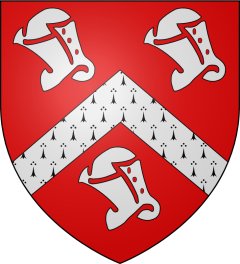
Owen Tudor’s coat of arms.

The House of Tudor that would come to rule England counted Owen its sire; the four-year-old grandson he left at his death grew up to become the first Tudor monarch, Henry VII.

Owen produced the root of this august line with Dowager Queen Catherine of Valois, the French princess Henry V had extracted as part of the price of peace after Agincourt.

That union was supposed to join the two great realms, but Henry V unexpectedly kicked the bucket in 1422, leaving an infant son who was not only unable to hold the French throne … he was too unstable to hold the English throne, either.

Unless he was a seer, suave Owen must not have been thinking dynasties when he took the Queen as his lover (and eventually his wife via a secret marriage in the early 1430s).

They produced six children, but it wasn’t the bedroom politics that did our prolific father in, at least not directly. Only decades later, when ownership of the crown was up for grabs in the War of the Roses and Owen loyally led Lancastrian forces at a battle he was unwise enough to lose, did he give up his head for the pedestrian crime of backing the wrong horse.

Owen reportedly thought he had stature enough to expect a reprieve until the very last moment, when the executioner’s ripping his collar caused him to sigh,

The head which used to lie in Queen Catherine’s lap, would now lie in the executioner’s basket.

In time, Owen’s descendants would get to pull the same trick, because the doomed cause in whose service Owen Tudor lost his life swept clear England’s political chessboard and made possible his own line’s accession.

Elizabethan poet Michael Drayton later versified Owen’s prodigious conquest in “Owen Tudor to Queen Catherine”.

When first mine eyes beheld your princely name,
And found from whence this friendly letter came;
Is in excess of joy, I bad forgot.
Whether I saw it, or I saw it not:

My panting heart doth bid mine eyes proceed,
My dazzled eyes invite my tongue to read,
Which wanting their direction, dully mist it:
My lips, which should have spoke, were dumb, and kist it,

And left the paper in my trembling hand,
When all my senses did amazed stand :
Even as a mother coming to her child,
Which from her presence hath been long exil’d,

With gentle arms his tender neck doth strain,
Now kissing it, now clipping it again;
And yet excessive joy deludes her so,
As still she doubts, if this be hers, or no.

At length, awaken’d from this pleasing dream,
When passion somewhat left to be extreme,
My longing eyes with their fair object meet,
Where ev’ry letter’s pleasing, each word sweet.

It was not Henry’s conquests, nor his court,
That had the power to win me by report;
Nor was his dreadful terrour-striking name,
The cause that I from Wales to England came:

For Christian Rhodes, and our religion’s truth,
To great achievement first had won my youth:
Th’ brave adventure did my valour prove,
Before I e’er knew what it was to love.

Nor came I hither by some poor event,
But by th’ eternal destinies’ consent;
Whose uncomprised wisdom did foresee,
That you in marriage should be link’d to me.

By our great Merlin was it not foretold,
(Amongst his holy prophesies enroll’d)
When first he did of Tndor’s name divine,
That kings and queens should follow in our line?

And that the helm (the Tudors ancient crest)
Should with the golden flow’r-de-luce be drest ?
As that the leek (our country’s! chief renown!)
Should grow with roses in the English crown –

As Charles his daughter, you the lilly wear;
As Henry’s queen, the blushing rose you bear;
By France’s conquest, and by England’s oath,
You are the true-made dowager of both :

Both in your crown, both in your cheek together,
Join Tether’s love to yours, and yours to Tether.
Then cast no future doubts, nor fear no hate,
When it so long hath been fore-told by fate ;

And by the all-disposing doom of Heav’n,
Before our births, we to one bed were giv’n.
No Pallas here, nor Juno is at all,
When I to Venus yield the golden ball:

Nor when the Grecians wonder I enjoy,
None in revenge to kindle fire in Troy.
And have not strange events divin’d to us,
That in our love we should be prosperous ?

When in your presence I was call’d to dance,
In lofty tricks whilst I myself advance,
And in a turn my footing fail’d by hap,
Was’t not my chance to light into your lap ?

Who would not judge it fortune’s greatest grace,
Sith he must fall, to fall in such a place ?
His birth from Heav’n, your Tudor not derives,
Nor stands on tip-toes in superlatives,

Although the envious English do devise
A thousand jests of our hyperbolies;
Nor do I claim that plot by ancient deeds,
Where Phoebus pasture his fire-breathing steeds:

Nor do I boast my god-made grandsire’s scars,
Nor giants trophies in the Titans wars:
Nor feign my birth (your princely ears to please)
By three nights getting, as was Hercules:

Nor do I forge my long descent to rim
From aged Neptune, or the glorious Sun:
And yet in Wales, with them that famous be,
Our learned bards do sing my pedigree

And boast my birth from great Cadwallader,
From old Caer-Septon, in mount Palador:
And from Eneon’s line, the South-Wales king,
By Theodor, the Tudors’ name do bring.

My royal mother’s princely stock began
From her great grandame, fair Gwenellian,
By true descent from Leolin the great,
As well from North-Wales, as fair Powsland’s seal.

Though for our princely genealogy
I do not stand to make apology:
Yet who with judgment’s true impartial eyes,
Shall look from whence our name at did first rise,

Shall find, that fortune is to us in debt
And why not Tudor, as Plantagenet?

Nor that term Croggen, nick name of disgrace
Us’d as a by-word now in ev’ry place,
Shall blot our blood, or wrong a Welshman’s name,
Which was at first begot with England’s shame.

Our valiant swords our right did still maintain,
Against that cruel, proud, usurping Dane,
Buckling besides in many dang’rous fights,
With Norway, Swethens, and with Muscovites;

And kept our native language now thus long,
And to this day yet never chang’d our tungue:
When they which now our nation fain would tame,
Subdu’d, have lost their country and their name.

Nor ever could the Saxons’ swords provoke
Our British necks to hear their servile yoke:
Where Cambria’s pleasant countries bounded be
With swelling Severn, and the holy Dee:

And since great Brutus first arrived, have stood
The only remnant of the Trojan blood.
To every man is not allotted chance,
To boast with Henry, to have conquer’d France:

Yet if my fortune be thus rais’d by thee,
This may presage a further good to me;
And our Saint David, in the Britons’ right,
May join with George, the sainted English knight:

And old Caer-merdin, Merlin’s famous town,
Not scorn’d by London, though of such renown.

Ah, would to God that hour my hopes attend,
Were with my wish brought to desired end !
Blame me not, madam, though I thus desire,
Many there be, that after you inquire;

Till now your beauty in night’s bosom slept,
What eye durst stir, where awful Henry kept ?
Who durst attempt to sail but near the bay,
Where that all-conqu’ring great, Alcides lay ?

Your beauty now is set a royal prize,
And kings repair to cheapen merchandise.
If you but walk to take the breathing air,
Orithia makes me that I Boreas fear:

If to the fire, Jove once in light’ning came.
And fair Egina makes me fear the flame:
If in the Sun, then sad suspicion dreams
Phoebus should spread Lucothoe in his beams:

If in a fountain you do cool your blood,
Neptune, I fear, which once came in a flood:
If with your maids, I dread Apollo’s rape,
Who cous’ned Chion in an old wife’s shape :

If you do banquet, Bacchus makes me dread,
Who in a grape Erigone did feed :
And if myself your chamber-door should keep,
Yet fear I Hermes coming in a sleep.

Pardon (sweet queen) if I offend in this,
In these delays love most impatient is:
And youth wants pow’r his hot spleen to suppress,
When hope already banquets in excess.

Though Henry’d fame in me you shall not find,
Yet that which better shall content your mind;
But only in the title of a king
Was his advantage, in no other thing:

If in his love more pleasure you did take,
Never let queen trust Briton for my sake.
Yet judge me not from modesty exempt,
That I another Phaeton’s charge attempt;

My mind, that thus your favours dare aspire,
Shows, that ’tis touch’d with a celestial fire:
If I do fault, the more is beauty’s blame,
When she herself is author of the same;

“All men to some one quality incline,”
Only to love is naturally mine.

Thou art by beauty famous, as by birth,
Ordain’d by Heav’n to cheer the drooping Earth :
Add faithful love unto your greater state,
And be alike in all things fortunate.

A king might promise more, I not deny,
But yet (by Heav’n) he lov’d not more than I.
And thus I leave, till time my faith approve,
I cease to write, but never cease to love.

Aficionados of old tyme history novelizations can also kick back with Owen Tudor: An Historical Romance.

On this day..

1938: Han Fuqu, Koumintang general

On this date in 1938, Chinese warlord Han Fuqu (or Fuju, or Fu-chu) was executed by the Koumintang for cravenly surrendering Shandong Province to the Japanese without a fight.

Han cut his teeth during China’s Warlord Era, and though he made a timely adherence to Chiang Kai-shek‘s central government that gave him rule over Shandong, he was never exactly in love with the KMT. He ran his fief like a dictator and got rich.

When Japan and China went to war in 1937, it wasn’t a gung-ho nationalist heart throbbing beneath his decorated breast.

Commanded by this still-alien central government to defend Shandong and its capital Jinan at all costs, the former warlord instead bargained secretly with the Japanese for a way to keep his prerogatives.

Why, after all, should he throw away his own position against an overwhelming foe merely for the better advantage of the distant Chiang Kai-shek?

When Han couldn’t pull off a deal and the Japanese set about simply taking his province by force, Han withdrew without firing a shot — forcing other KMT units in Shandong to likewise fall back. To top it off, Han himself then ditched the army he’d taken a-retreatin’.

Chiang, no dummy, could see an example waiting to be made. A couple weeks after arresting Han, Chiang’s trusted aide Hu Zongnan shot him in the back of the head in what is now Wuhan for flouting superior orders.

On this day..

1676: Joshua Tefft, drawn and quartered in Rhode Island

On this date in 1676, Puritan colonist Joshua Tefft (or Tifft, or Tift) became perhaps the only person ever to suffer the traitor’s death of hanging and quartering in what is now the United States.

The 30-ish Rhode Island farmer got sucked into King Philip’s War and was captured by colonists apparently fighting for the Narragansett Indians during a the Great Swamp Fight.

Lacking a first-person account from Mr. Tefft, we are left to descry (or project) his purpose. Tefft himself claimed that he had been enslaved by the Indians, but he made this claim in the context of trying to avoid a grisly execution; opposing witnesses said he’d been much more enthusiastic in the fight, raising an evident horror of civilized man gone native.

Without English clothes and with a weather-beaten face, he looked like an Indian to the English. Tefft was a troubling example of what happened to a man when the Puritan’s god and culture were stripped away and Native savagery was allowed to take over. (Source)

He was one man caught up in a war, so of course he could have been many things. But Tefft invites speculation on racial self-identification on this still-tenuous New World frontier.

Living immediately adjacent to the Narragansett, Tefft was probably on good terms with the natives, something that at least some Anglos had keenly worked after for fifty-plus years. Some sources report (or charge) that he had taken an Indian wife,* and the Narragansett redoubt attacked in the Great Swamp Fight was a fortified encampment full of non-combatant types, hundreds of whom were eventually slaughtered.

And Rhode Island had a long-running border dispute with its Puritan fellow-colonists that intersected their historical differences on religious toleration. (Tefft is also decried as irreligious, though whether that’s literally true or just an extra heaping of opprobrium is anyone’s guess.) Why, after all, should a man not cohabit among the friendly peoples of his wife, and assist them when attacked — for the Narragansett were not at war until they were attacked — by a bunch of Connecticut and Plymouth colony prigs who’d want to shanghai him into their army?

One colonist able to sympathize with the Indians’ situation wrote of them that “perhaps if Englishmen, and good Christians too, had been in their case and under like temptations, possibly they might have done as they did.” Who knows but that some were, and they did.

Our Scouts brought in Prisoner one Tift, a Renegadoe English man, who having received a deserved punishment from our General, deserted our Army, and fled to the Enemy, where had good entertainment, and was again sent out by them with some of their forces; he was shot in the knee by our scouts, and then taken before he could discharge his musket, which was taken from him and found deep charged, and laden with Slugs: He was brought to our army, and tryed by a counsel of war, where he pretended that he was taken prisoner by the Indians, and by them compelled to bear Arms in their Service; but this being proved to be false, he was condemned to be hanged and Quartered, which was accordingly done. (Source)

But while some Indian tribes allied with some whites, European identification ultimately proved much too strong to admit any possibility of not banding together against the “savages.” When vengeful Narragansett warriors raided Providence the following spring and torched the house of Rhode Island founder Roger Williams, Massachusetts in sympathy lifted its 39-year-old exile on the man they’d have hung as a heretic in days gone by.

By then, it had long been over for Joshua Tefft, whose trial preceded execution by only two days. Joshua’s son Peter and other descendants of the Tefft family, however, would be fruitful and multiply.

By the time these New World settlements became the United States a century later, drawing and quartering was still on the books in England. But the New York legislature expressed (pdf) the sense of that realm’s North American offspring that this sentence even for treason was “marked by circumstances of Savage Cruelty, unnecessary for the Purpose of public Justice, and manifestly repugnant to that Spirit of Humanity, which should ever distinguish a free, a civilized, and Christian People.”

* Joshua Tefft’s previous wife, Sara, had died from childbirth a few years before. For Sara, also notable as the owner of what was once thought to be the oldest marked headstone in New England, it was her second husband … the first, Thomas Flounders, was hanged for murder.

Part of the Themed Set: Resistance and Rebellion in the Restoration.

On this day..

2009: A day in the death penalty around the world

Capiital punishment may be an ancient historical phenomenon, but it’s hardly ancient history.

The executions that several of the 21st century world’s more aggressive death penalty users coincidentally carried out a year ago today testify together to the enduring place (and variegated guises) of the headsman in modernity.

China

Three prisoners were reported killed in Jinan in China on Jan. 15, 2009.

Two were men who had been serving prison terms for separate crimes when they incurred a death sentence for a violent (though seemingly non-lethal) escape attempt.

Liu Junjie, 35, and Wang Bing, 31, broke out of the prison in Zibo City on December 8, 2007 as a truck was moving out of the prison gate, according to a statement from the Shandong Provincial High People’s Court.

They hit a prison worker and two policemen with iron bars and choppers as they forced their way out. They were later caught as they fled along a road.

Former cabbie Bo Lijun shared that fate for a series of thefts, rapes, and murders.

According to the court, Bo raped and suffocated a female barber on Oct. 23, 2002 in Dongying.

Bo attempted to rape a female passenger in a wooded area near Dongying on July 29, 2006. Although he abandoned the rape attempt, he clubbed her to death for fear she would inform the police, and he buried the body at the site.


Saudi Arabia

One Mushabeb Al-Ahmari was beheaded in the province of Asir for “killing a compatriot with a machine gun” (who he killed and why was not reported).

Al-Ahmari was a minor when he was sentenced. The statement said his execution was delayed until he came of age.


United States

62-year-old James Callahan suffered lethal injection in Alabama Jan. 15, 2009, after 26 years on death row for raping and murdering a Jacksonville State University student in 1982. Callahan

requested a last meal of two corn dogs, french fries and a Coke … spent the day visiting with family and spiritual supporters … receive[d] communion at 4:30 p.m.

Callahan’s will bequeaths to his son $36.42 from his prison account, a black and white Radio Shack TV, two watches, a Walkman, some headphones, a leather belt, two pairs of boots, one pair of Nike tennis shoes, food items and legal papers.


Updated: Somalia

(This incident was not brought to our attention until after the post was already up, but in the peripatetic spirit of the entry, we thought it suitable to append.)

Somali politician Abdirahman Ahmed (also known as Waldiire) was shot by an Islamist militia in the port of Kismayo on Jan. 15, 2009.

Perhaps the first pol executed by Islamists, Ahmed was once the spokesman for a faction in the Somali civil war. He was put to death for collaborating with the Ethiopians who invaded Somalia at U.S. behest. As the Ethiopians were Christian, this behavior qualified as “apostasy” to the militants’ sharia court.

In January 2009, Ethiopia was in the process of withdrawing its military presence in its war-torn neighbor.

On this day..

1897: The Thirteen Martyrs of Bagumbayan

On this date in 1897, days after Philippine independence hero Jose Rizal was shot by the Spanish, 13 martyrs to the same cause suffered the same fate at the same execution grounds.

The 13 Martyrs of Bagumbayan (not to be confused with the 13 Martyrs of Cavite; it was a bakers’ dozen special on Filipino martyrs during the Philippine Revolution) consisted of:

They were casualties of Spanish pressure against the revolutionary Katipunan and/or its Rizal-rounded parent organization La Liga Filipina.

Not all this grab-bag of sacrificial patriots were really firebreathing revolutionaries. But the (serious) divisions among Filipino activists and revolutionaries were of small import to the Spanish, who (as the 13-strong martyr batches suggest) went in for the wholesale school of repression.

Perhaps most notable in this day’s batch was Francisco Roxas, one of the Philippines’ wealthiest men. Despite his liberal sympathies, he’d refused the more radical Katipunan’s shakedown for financing, only to have that organization vengefully place his name on a membership list the Spanish were sure to find. (Roxas maintained his innocence, but accepted his unsought martyr’s crown and never betrayed his fellows.)


Two photos of the 13 martyrs’ execution, from this page, with plenty of other undated executions.

On this day..

2009: Haidar Ghanem, human rights activist

On this date last year, in the midst of Israel’s bloody incursion, Gaza’s Hamas government executed Palestinian journalist and human rights activist Haidar Ghanem as an Israeli spy.

Ghanem was the best-publicized of a number of Israeli collaborators to suffer that fate during the one-sided, three-week war.

“He was taken to an abandoned building in southern Gaza and shot to death,” a Palestinian source said. “Others were executed the same way.”

The Rafah resident had actually been a minor cause celebre back in 2002, when the Palestinian Authority condemned him to death for pinpointing Fatah activists for assassination by Israeli security, for which assignment he was supposedly recruited in the 1990’s while working as a field researcher for the Israeli human rights organization B’Tselem. International pressure got him released.

The Jerusalem Post reported that Ghanem confessed (as he had in the 2002 case) to the charges.

On this day..

1794: Maurice Joseph Louis Gigost d’Elbee, Vendean general

On this date in 1794, one of the great royalist generals of the Vendee revolt was shot by the French Revolution’s Republican forces at Nourmoutier.

The 1793 counterrevolutionary uprising in the Vendee had roused retired cavalryman Maurice Joseph Louis Gigost d’Elbee (English Wikipedia link | French), and he became the second commander of the Royal and Catholic Army upon the death of Jacques Cathelineau.

Unfortunately for d’Elbee, even with English support, the balance of force rather tipped in favor of Paris, and the Revolutionary government was obviously not shy about sealing its victories in blood.

D’Elbee suffered a grievous wound at the Battle of Cholet in October 1793, and for a couple of months was spirited one step ahead of the advancing Republicans.

As Charles MacFarlane writes in The French Revolution, Vol. 3, he ran out of room to run at the island of Noirmoutier.

D’Elbee was lying in bed between life and death; his wife might have escaped, but would not leave him: they were both taken. As Turreau’s soldiers entered their chamber the wounded royalist exclaimed, “Yes, here I am! Here is d’Elbee, your greatest enemy! If I had been strong enough to fight or stand upon my feet, you would not have taken me in my bed!” They kept him for five days, treating him with execrable barbarity, and then carried him in an arm-chair to the place appointed for fusilading the prisoners, and there shot him. His wife was fusiladed the next day, and her brother and brother-in-law perished in the same manner.


Mort du General d’Elbee, by Julien Le Blant, depicts the general shot with three other royalist officers. Not pictured: Hundreds of other Vendean prisoners massacred in the aftermath of the Battle of Savenay.

On this day..