1578: Kort Kamphues, outlaw judge

Most judges are content to inflict their atrocities with a gavel, but on this date in 1578, a magistrate turned freebooter named Kort Kamphues was beheaded at Bevergern.

Just a few months before his July 1553 death, Prince-Bishop Franz von Waldeck set Kamphues up for his interesting career arc by appointing him Stadtrichter of Coesfeld.

Kamphues’s overbearing presumptions on the perquisites of that sinecure, coming on more than one occasion to physical violence, led other city leaders to petition unsuccessfully for his removal in 1569.

But his attempt in 1572 to assemble a mercenary army on the pretext of getting involved in Spain’s war in the Netherlands led to a definitive break with Coesfeld — which tried to arrest him, and then outlawed him when he escaped with his armed posse into the Westphalian countryside.

For several years, Kamphues and gang marauded merrily until a clumsy bid to frighten a new Coesfeld magistrate led to an arson attack on the city. Kort Kamphues was captured on June 19, 1578, and tortured into confessing to arson, banditry, and breaching the peace — gaining a permanent place in folklore at the small expense of his head.

The Kamphues Dagger, a beautiful 14th century artifact later documented in the Coesfeld treasury, is supposed on sketchy evidence to have been captured from this brigand.


A replica of the Kamphues Dagger, at the city museum in Walkenbrückentor. (cc) image from Günter Seggebäing.

On this day..

1556: Beatrice, a servant

An everyday execution in 16th century Montpellier, from the diary of Swiss medical student Felix Platter — whom we have already had cause to notice in these pages:

Beatrice, Catalan’s former servant girl, who had drawn off my boots when I had first arrived in Montpellier, was executed on the 3rd of December. She was hanged in the square, on a little gibbet that had only one arm. She had left us a year before to go into service in the house of a priest. She became pregnant, and when her child was born, she threw it into the latrine, where it was found dead. Beatrice’s body was taken to the anatomy theatre, and it remained several days in the College. The womb was still swollen, for the birth of the child had occurred no more than eight days before. Afterwards the hangman came to collect the pieces, wrapped them in a sheet, and hung them on a gibbet outside the town.

Part of the Themed Set: Filicide.

On this day..

1591: Barnabe Brisson, at the hands of the Sixteen

On this date in 1591, the summary execution of Barnabe Brisson and two other French doctors of law signaled the beginning of the end of France’s Wars of Religion.

After the untimely death of Henri II in a freak jousting accident, his widow Catherine de’ Medici employed three frustrating decades shuttling the late monarch’s uninspiring offspring onto the throne only to see each in his turn die young and without issue. We are by these late years on to the last of Henri II’s sons — Henri III of France.

Actually, Henri wasn’t the last: just the last left alive. He had a younger brother, Francis, Duke of Anjou, who dropped dead in 1584 of malaria and left Henri III as the only Valois male. The heir presumptive after Henri III was his Calvinist brother-in-law Henri of Navarre. Spoiler alert: by the end of this post, Henri of Navarre is going to get there as King Henri IV.

The Catholic-vs.-Huguenot Wars of Religion had raged in France for many years but the last major installment of the bloody serial was the War of the Three Henrys: the two Henris aforesaid, plus the Duke of Guise, also named Henri — the standard-bearer of Catholic zealots.

Our present-day presumption of live-and-let-live spirituality was bequeathed from the Enlightenment only after it had been hard-won by centuries previous. In France of the 1500s, the most extreme (but by no means marginal) Catholic party saw the very existence of a Huguenot faction — and the fact that more moderate Catholic politiques were prepared to tolerate and treat with them — as an existential threat to the kingdom. Catholicism in the literal universal sense was intrinsic to France itself: if she should cease to be so, what would become of her? A 1589 pamphlet extolled what

an admirable thing [it is] to view the ardor and the devotion of everyone in France, the air resounding with prayer and processions of our youth who are purified by our prayers and by the common voice which is spread throughout this kingdom; we demonstrate that the benedictions and maledictions of a people have great effects.

With such great effects at stake, the pious ought not abide any fooling around with Providence. “If your brother, your friend, and your wife all of whom you hold dear wish to strip you of your faith,” wrote Louis D’Orleans in 1588, “kill them, cut their throats and sacrifice them to God.”*

This was a faction for whom Henri of Navarre’s prospective succession was absolutely intolerable, which makes it somewhat ironic that they themselves soon turned prospect into reality.

King Henri III was a Catholic himself, of course, and this irreconcilable Catholic League was part of what you might call his base. But though initially allied, the League’s attempts to dominate the young king led Henri III to execute a daring breakout: on December 23, 1588, he summoned the Duke of Guise to confer with him at the Chateau de Blois and there had his bodyguards murder Guise on the spot.


Just two Henries now …** (Executed Today’s court painter Paul Delaroche interprets that same scene here.)

The resulting fury of the Catholic League was so great that the king soon fled Paris and made common cause with Henri of Navarre. Now the civil war was the two Henris together — and the Catholic League opposing them. We come here to our date’s principal character, Barnabe Brisson (English Wikipedia entry | French), a distinguished jurist† in the Parlement of France. While most of this chamber followed the king out of Paris, Brisson chose to remain. “The Sixteen,”‡ the council of Catholic militants who now ruled Paris with the support of a populist militia, elevated Brisson to President of the Parlement.

In 1589 the Henris besieged staunchly Catholic Paris in an attempt to bring the civil war to a close. In a classic Pyrrhic victory, the League defeated this attempt by having a priest assassinate King Henri.


… and now we’re down to the last Henri.

While this action did break the siege, and avenge the murder of Guise, it made Henri of Navarre into King Henri IV. (Told you we’d get there.) The Catholic League’s attempt to recognize the new king’s uncle, a Cardinal, as the successor went nowhere at all, and at any rate this man himself died in 1590.

This succession greatly deepened the internal tension among Paris Catholics between the uncompromising men of the Sixteen and the moderate politiques, and the latter party’s interest in finding with the legitimate king a settlement that looked increasingly inevitable. After all, were these armed commoners really going to rule Paris indefinitely?


An armed march of the Holy League in Paris in 1590. (Anonymous painting)

The situation provoked the ultras among Paris’s ruling Sixteen to more desperate measures in a vain effort to maintain control. Their faction’s own post-Guise leader among the high nobility, the Duke of Mayenne, had refused inducements to seize the crown himself or to seat a sovereign provided by the League’s Hapsburg allies. He too was visibly sliding towards an accommodation with the heretic king. (He would reach one in 1596.) In much the same camp was an establishment figure like Brisson whose staying behind in Paris during the confused situation of 1588-1589 was scarcely intended to declare that his allegiance to creed surpassed all care for order. The man was a lawyer, after all.

During Mayenne’s absence from the capital in the autumn of 1591, the Sixteen mounted a radical internal coup and attempted to purge the city’s moderates. Brisson was arrested walking to work on the morning of the 15th and subjected along with two other jurists to a sham snap trial. All three were hung by lunchtime, and per a proposal floated among the council that afternoon were the next morning fitted with denunciatory placards and displayed on gibbets at the Place de Greve.

Barnabé Brisson, a chief traitor and heretic

Claude Larcher, an instigator of treacherous politiques

Jean Tardiff, an enemy of God and of Catholic princes

Their shocking exhibition was intended to incite a “St. Barthelemy des politiques” — a St. Bartholomew’s Day-esque pogrom against the politique moderates.

But the Sixteen had badly misjudged the mood of the city. The crowd beheld the mangled corpses silently, full of horror or pity — emblematic of the turning-point France was nearing in its interminable confessional strife. Despite the Catholic League’s strength in Paris, most Parisians were losing their appetite for bloodshed. The Duke of Mayenne was back in the capital by the end of the month and underscored the coming arrangements by seizing four of the Sixteen for summary execution themselves.

Two years later, Henri IV at last took Paris in hand by making a nominal conversion to Catholicism with the legendary (alleged) remark, “Paris is worth a Mass.”§

French speakers may enjoy this 19th century pdf biography of Brisson by Alfred Giraud.

* “Du Contemnement de la mort. Discours accomode a la miserable condition de ce temps” (blockquoted section) and Replique pour le Catholique Anglois, contre le Catolique associe des Huguenots (D’Orleans quote). Both via Dalia Leonardo in “Cut off This Rotten Member”: The Rhetoric of Heresy, Sin, and Disease in the Ideology of the French Catholic League,” The Catholic Historical Review, April 2002.

** Also of interest: this 1908 silent film of the assassination of the Duc de Guise, scored by Saint-Saens.

† Brisson’s dictionary of Justinian legal terminology remained in print until 1805. He also in 1587 produced a compilation of the laws of France as Le Code du Roy Henri III.

‡ The Sixteen were delegates of Paris’s quarters, assembled by the Duke of Mayenne. For detail on the composition and internal history of The Sixteen, see J.H.M. Salmon, “The Paris Sixteen, 1584-94: The Social Analysis of a Revolutionary Movement,” The Journal of Modern History, December 1972.

§ In the end, of course, an entirely unreconciled Catholic extremist assassinated Henri IV in 1610.

On this day..

1584: Anders Bengtsson, unchristian man and tyrant

(Thanks to Meaghan Good of the Charley Project for the guest post. -ed.)

Sometime in October 1584 in the city of Stockholm, Sweden, one Anders Bengtsson was sentenced to death for his crimes “against the law and justice and the subjects of His Royal Majesty.”

Anders, according to trial records, had a reputation as a violent criminal and “an unchristian man and a tyrant.” The crime that lead to his death sentence? He had “murderously beaten his son to death.”

The book Five Centuries of Violence in Finland and the Baltic Area provides some details of the crime,

A witness in the case testified to having seen him carry out this savage assault and stated that he had called on Anders a score of times to stop beating his child. After the father’s mishandling, the boy was said to be “so weak and battered that both his head and his body sagged limply.”

As the book explains, the Swedish justice system at the time did not rely heavily on the death penalty, even in cases of killing. However, because of its cruelty, Bengttson’s was considered no ordinary crime, and it was not dealt with in the ordinary way:

The town court stated in its grounds that the normal penalty prescribed by the law of Sweden under the Accidental Manslaughter Code for parents who chastised their children too harshly was a fine. However, in this case, it was not a question of an accident. Anders’s action is described as “tyrannical and inhuman.” He had not chastised his son for his betterment; rather, he had acted “like an executioner, in an unchristian way that was contrary to natural love.” The town court found that the deed could not be atoned for with a fine, and so it sentenced Anders Bengtsson to execution by the wheel.

He was put to death on some unknown date shortly thereafter.

On this day..

1593: Gabriel Wolff, Nuremberg adventurer

On this date in 1593, Nuremberg executioner Franz Schmidt beheaded one of that city’s finest con artists.

Gabriel Wolff, a burgher’s son, had gone on a picaresque swindling bender through central Europe and all the way to Constantinople, posing as a V.I.P. in various courts for fun and profit.

As Schmidt recounted it, Wolff first “called himself George Windholz, Secretary to the Elector at Berlin, also took the name of Ernst Haller and Joachim Furnberger, borrowed 1,500 ducats from a councillor here in Nuremberg by means of a forged letter in the Elector’s name and under the seal of the Margrave John George in Berlin; was arrested at Regensburg and delivered over to Nuremberg.”

And this was far from all.

The inveterate trickster had made off with 1,400 crowns from the Duke of Parma in the Netherlands and fled to Ottoman Turkey. He had had a misadventure with an Italian abbess, netting a silver clock for his trouble; conned a Knight of St. John out of his mount; and ensconced himself as the Habsburg emperor’s personal attendant in Prague, where he perpetrated “many other frauds, causing false seals of gentlemen to be cut, wrote many forged documents and was conversant with seven languages; carrying on this for twenty-four years.” In his time he got the best of “a councilor at Danzig, the count of Ottingen, his lord at Constance, two merchants at Danzig, a Dutch master,” and similar worthies crisscrossing Europe from Lisbon to Crete to Krakow to London and seemingly every point worth mentioning in between.

As Schmidt’s biographer observes, it’s more than likely that the crowd under the scaffold beheld Wolff with admiration as much as opprobrium, for this native son’s silver tongue and brass balls had enabled him to spend a lifetime in material luxury, hobnobbing with the masters of Europe — and certainly ensured him an afterlife in pleasurable folklore he could scarcely have conjured had he spent his days respectably haggling for a better price on the ell. Frankly, we in drab modernity could ourselves do with a Gabriel Wolff book.

On this day..

1529: Adolf Clarenbach, Lower Rhine evangelist

On this date in 1529, the city of Cologne burnt Protestant evangelist Adolf Clarenbach at the stake.

Clarenbach (English Wikipedia entry | German) was a humanist-trained teacher who caught the Reformation spirit when he read Martin Luther’s On the Freedom of a Christian in about 1523.

The ears of our generation have been made so delicate by the senseless multitude of flatterers, that, so soon as we perceive that anything of ours is not approved of, we cry out that we are being bitterly assailed …

-Luther in the dedicatory preface* to On the Freedom of a Christian (Source)

Adolf Clarenbach in statuary on present-day Cologne’s city hall. (cc) image from Raimond Spekking

Luther’s words would kindle many a fagot in the years to come. Clarenbach got an early start assailing orthodox delicacies; he was dismissed from teaching posts and harried from city to city (German link, a handy little biography). Munster ran him out for agitating against idolatrous images of saints in 1523; Duke Johann III** personally ordered his expulsion from Jülich-Cleves-Berg; Osnabrück, Büderich and Elberfeld all gave him the boot before Cologne finally arrested him in April 1528.

Clarenbach’s condemnation would only be secured by an arduous process stretching well over a year and contested by the heretic and his friends not only in theology but in law (Clarenbach, a layperson, disputed the ecclesiastical court’s right to try him and appealed successfully to an Imperial court against Cologne, dragging out the process) and in public opinion (Clarenbach’s supporters in Cologne published defenses of him). Even the actual death sentence took half a year to enact after it was issued in March 1529 while authorities loath to conduct it negotiated with their prisoner to moderate his heresy.

He was finally put to death together with another Lutheran, Peter Fliesteden; they are among the first Protestants to die for their confession in the Lower Rhine.

Given the Lutheran movement’s strong run in Germany, it’s no surprise to find this seminal martyr honored in many places in present-day Germany — and his name ornamenting a street in his hometown, a seminary, and a primary school.

* On the Freedom of a Christian was dedicated to the sitting pope. While Luther’s dedication inveighed furiously against the Roman curia, it took the politic and preposterous rhetorical angle that the Medici Leo X was a helpless ingenue undone by his scheming court, “like Daniel in the midst of lions”: “I have always grieved that you, most excellent Leo, who were worthy of a better age, have been made Pontiff in this. For the Roman Court is not worthy of you and those like you, but of Satan himself, who in truth is more the ruler in that Babylon than you are.”

Luther signed that dedication on September 6, 1520. He had not been excommunicated at that point.

Just a few weeks later, he received the papacy’s official (and none too polite) rebuttal to Luther’s 95 theses. Luther answered this missive much less temperately, and his breach with Rome was complete by January 1521.

† Cologne at this time was under the bishopric of Hermann of Wied, a humanist with the germ of reform curiosity. Many years later, he would actually convert to Lutheranism which naturally led to his excommunication and deposition. (But not execution.)

** That’s Duke Johann of Cleves, the father of the Anne of Cleves whose unsatisfactory betrothal to Henry VIII precipitated the downfall of Thomas Cromwell.

On this day..

1573: Hans von Erschausen, Seeräuber

On this date in 1573, the Hanseatic city of Hamburg beheaded the Seeräuber Hans von Erschausen with his crew, leaving naught but a vast row of pike-mounted heads and some excellent woodcuts.

On this day..

1526: 2,000 Hungarian prisoners after the Battle of Mohacs

The Sultan, seated on a golden throne, receives the homage of the viziers and the beys, massacre of 2,000 prisoners, the rain falls in torrents.

-Sultain Suleiman the Magnificent (writing of himself in the third person), diary, 31 August 1526

On this date in 1526, two days after the pivotal Battle of Mohács, the Ottomans executed all their Hungarian captives from that battle.

After the 1490 death of Hungary’s greatest king Matthias Corvinus, the Hungarian kingdom began to crumble. Ottoman incursions ate away at that realm’s Balkan possessions.

Squeezed between two stronger empires, Hungary’s King Lajos II put a ring on the non-Turkish one by marrying a Habsburg princess. Fair enough.

Less successful statecraft was his decision not to cut a deal for peace with the Turks and instead force a decisive confrontation … especially since that battle was a tactical debacle. Eschewing a coy retreat towards nearby friendly forces, the belligerent Hungarian nobles hurled their heavy cavalry straight at the numerically superior Turks, basically duplicating the gameplan that the West’s last Crusaders had used when they got their lances handed to them by the Ottomans a century before at Nicopolis.

And those who did not learn from history were here doomed to repeat it. “The Hungarian nation will have twenty thousand martyrs on the day of the battle, and it would be well to have them canonized by the Pope,” a priest is reported to have said when he heard about the decision. By sundown, the Hungarians were routing in disarray, the wounded Lajos himself falling into the Danube in the disorder and drowning in his heavy armor.


Well, we’re boned. The Battle of Mohacs, by Hungarian painter Mor Than (1856).

“May Allah be merciful to him, and punish those who misled his inexperience,” said Suleiman of his 20-year-old opposite number. “It was not my wish that he should thus be cut off, while he had scarcely tasted the sweets of life and royalty.”

Not so tender were Suleiman’s pities for those 2,000 anonymous prisoners of war … and, for that matter, for anyone in the surrounding countryside unfortunate enough to find him- or herself in the path of the now-unchecked Ottoman force.

The cavalry, knowing no mercy, dispersed into the provinces of the wicked one like a stream overflowing its banks and, with the fiery meteors of its sparkling sabers, burned every home to the ground, sparing not a single one…. The contemptible ones were slain, their goods and families destroyed…. Not a stone of the churches and monasteries remained.

Within the fortnight the Turks were sacking defenseless Buda(pest); they would take it for good in 1541 and hold it for 145 years, pressing the Ottoman frontier deep into Europe. It wouldn’t be a Hungarian polity that recaptured it, but the Habsburg empire into which the Magyar wreckage was subsumed — retaking Buda in 1686 in the counterattack after the failed Ottoman Siege of Vienna.

On this day..

1570: John Felton, papal bull promulgator

On this date in 1570, the English Catholic martyr John Felton suffered hanging, disemboweling, and quartering at St. Paul’s Churchyard in London for the Old Faith.

Not to be confused with the 17th century assassin of the same name, our John Felton was reported by the biography from his daughter’s hand to be a wealthy Southwark gentleman whose wife had gamboled in her own childhood with the future Queen Elizabeth.

John’s crime was to hang up publicly in the dark of night before Corpus Christi the papal bull excommunicating Queen Elizabeth — an act not merely of religious dissidence but of overt political rebellion, inasmuch as the bull released English subjects from their obedience to “the pretended Queen of England” and exhorted them on pain of damnation to ignore her edicts. This directive from Rome was to prove so taxing for Catholics that it was soon modified to permit outward obedience in civil matters, pending the overthrow of the heresiarchess.

Following a decade of uneasy religious tolerance — in which, not coincidentally, Elizabeth entertained the suits of assorted continental royalty, some of them Catholic — Regnans in Excelsis marked the onset of open hostilities. The Catholic “Ridolfi plot” would be hatched this very year, for instance, and lead the Duke of Norfolk to the scaffold by 1572.

And then he said, O Lord, into thy hands I commend my spirit, in English; and as he was saying it in Latin, In munus tuas Domine, he was turned off the ladder; and hanging there six turns, he was cut down, and carried to the block, and there his head was smitten off, and held up, that the people might see it: whereat the people gave a shout, wishing that all Traitors were so served. Then he was quartered, and carried to Newgate to be parboiled, and so set up as the other rebels were. — God save the Queen.

John Felton’s son Thomas Felton was also martyred, in 1588. Both have since been beatified.

On this day..

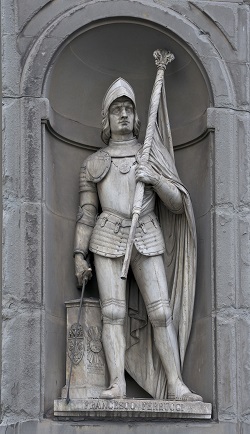
1530: Francesco Ferruccio, victim of Maramaldo

On this date in 1530, Francesco Ferruccio (or just Ferrucci) and his executioner Fabrizio Maramaldo clinched their immortality at the Battle of Gavinana.

The battle was the tragic final scene of the War of the League of Cognac, in which an alliance of Italian city-states tried to expel the Habsburg Holy Roman Emperor Charles V from the peninsula. Charles had already in effect decided matters by forcing the French out of the fight, which also brought about the capitulation of the Vatican.

Left alone in the fray, doughty Florence — ever so briefly at this moment restored as a Republic, having given the Medici the boot — continued to hold out against impossible odds. A vast imperial army swollen by landsknechts whose mercenary arms were now unnecessary elsewhere in Italy besieged Florence on October 24, 1529.


The Siege of Florence, by Tuscan Renaissance Man Giorgio Vasari.

The intrepid Florentine commander Francesco Ferruccio (English Wikipedia entry | Italian) strove to take his hopeless fight to the enemy. After a plan to coerce papal support by striking Rome was vetoed, Ferruccio mounted a march through the Apennines to threaten the Imperials’ rear.

He was intercepted at Gavinana, a battle decided by the arrival of landsknecht reinforcements under the command of the notoriously cruel condottiere Fabrizio Maramaldo.

Maramaldo would elevate himself for posterity out of the ranks of his merely brutal brethren by finding Ferruccio, badly wounded, his prisoner, and putting him to immediate death by his own hand — an execution that resulted in Florentine capitulation one week later, and the installation of Alessandro de’ Medici as Duke of the now ex-Republic.*

While admittedly borderline as an “execution” suitable for this here site, Ferruccio’s defiance in the face of his killer and his last denunciation of Maramaldo — “Coward, you kill a dead man!” — became the stuff of legend in a later Italy. (It also helped Ferruccio’s case for the nationalist pantheon that he died fighting against the Germans, not against the next city-state over.)

The romantic novelist Francesco Domenico Guerrazzi** made Ferruccio the subject of his magnum opus L’Assedio di Firenze, and before you knew it the name was on the lips of every risorgimento Tom, Dick and Francesco. Garibaldi invoked him in speech; Goffredo Mameli wrote him into the national anthem.


Every man has the heart
and hand of Ferruccio …

Under the Italian state those men helped to make, Ferruccio was appropriated as the name of a battleship; fascist Italy especially found Ferruccio congenial to the national-pride project and valorized the martyr relentlessly.


1930 Fascist Italy stamp depicting — for the 400th anniversary of the occasion — Fabrizio Maramaldo murdering his prisoner Francesco Ferruccio. Other Februccio stamps from the same period can be found on the man’s Italian Wikipedia page.

For Maramaldo, a less flattering but possibly more durable legacy: Italian gained the noun maramaldo, the adjective maramaldesco, and the verb maramaldeggiare to signify bullying or cruel domineering.

* Alessandro had a reputation for despotism, and was assassinated a few years later by his cousin Lorenzino de’ Medici in a tyrannicide that was Brutus-like in both its motivation and effect. That later affair is the subject of the 19th century play Lorenzaccio.

** Guerrazzi also did his bit for the legend of Beatrice Cenci.

On this day..