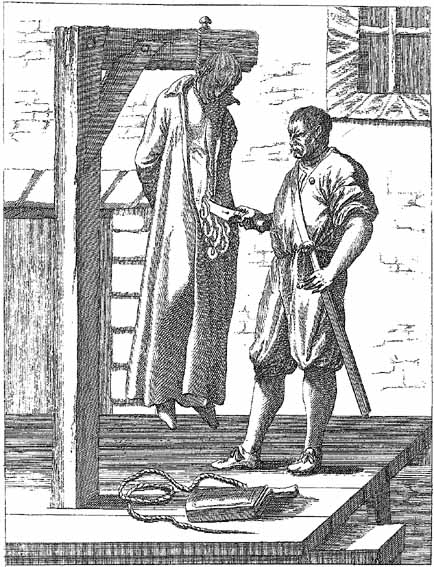
1691: Jack Withrington, highwayman

On this date in 1691, highwayman Jack Withrington hanged at Tyburn.

THIS fellow was the youngest of five brothers, who were all born at Blandford, in Dorsetshire. The other four were all hanged in the country, but Jack had the good fortune to be reserved for Tyburn, and by that means to have his name transmitted to posterity. He was bound to a tanner in Shaftesbury, a town in his native county, with whom he served about three years. Then he entered into the Earl of Oxford’s Regiment of Horse, in which, when Monmouth‘s rebellion was suppressed in the West of England, he came up to London, where he soon met with opportunities of discovering his valour to the world. These occasions were two quarrels in which he was engaged: the first with a man famous for fighting, against whom he behaved with so much bravery and skill that it won him a vast reputation; the second with a person of great estate, but a noted coward, when he showed himself a gentleman by his adherence to the point of honour and good breeding. By these duels he won abundance of applause, so as thereby to contract a familiarity with all the greatest fighting men of the time, especially those in his own regiment. Withrington however carried his manhood so far as to get himself turned out of the regiment within a year after, for challenging his captain. He then became a perfect bully and gamester; and, being fortunate, in a little time by these means saw himself master of a considerable sum of money. Notwithstanding all this good luck at first, he found himself afterwards subject to the fate of gamesters —- viz. to be frequently without money in spite of his large winnings. This brought him at last to consider the uncertainty of Fortune and endeavour to make himself master of her, by supplying with fraud what he might want in plain open skill. But this also did not continue long; for everyone began to be aware of him as a common sharper, and none who knew him would venture to play with him.

In the common scale of knavery the next step above a sharper is a downright thief. Withrington made bold to ascend this degree, and was resolved to take the most honourable station thereon, that of a highwayman. He had money enough to buy him a good horse and accoutrements, so that the resolution and the real attempt were not long asunder. His first adventure was with a farmer, from whom he took forty pounds, giving him in return only an impudent harangue, occasioned by the countryman’s reproaching him with the robbery.

The next that fell in Withrington’s way was Mr Edward Clark, gentleman usher to the Duchess of Mazarin. They met in Devonshire, on the road between Chudleigh and Ashburton. Mr Clark made some resistance, so that in the scuffle Withrington’s mask fell off and discovered his face, which Mr Clark knowing, he called him by his name, and said he hoped he would not rob an old acquaintance. “Indeed I shall, sir,” quoth Withrington, “for you get your money much easier than I do, who am forced to venture my life for a maintenance; you have so much a year for eating, drinking and entertaining your lady with scandal and nonsense. What I shall take from you will do you little harm; it is only putting a higher price upon half-a-score reputations, which you know how to do as well as any coxcomb in England. Ladies never let such faithful servants go unrewarded, nor will yours suffer your loss to fall on yourself.” He got about eight guineas out of this gentleman’s pocket, and for old acquaintance sake bade him “Good-b’w’ye” very heartily.

Withrington’s robberies in less than a year and a half were talked of almost all over the kingdom. But alas! he met with a diversion, common to mankind, that draws even the most stupid into the rank of polite persons. The poor man was in love; and with whom but a rich widow inn-keeper in Bristol! Farewell to the highway: Withrington has another scent to pursue. No more robberies to be thought of from a man who was himself robbed of his heart! He employed an old bawd in the affair, who was intimately acquainted with our hostess, and by this flesh-broker’s mediation things had like to have come to an issue, and Jack to have been master of the Swan Inn. In short, there was nothing prevented it but the accidental coming of a certain gentleman, who knew our highwayman, and informed his mistress what he was. The effects of this discovery were Jack’s being kicked out of doors by the ostler and chamberlain, and the commitment of madam the negotiatress to Bridewell, in order to mill Dolly.

After his return to the highway he and one of his companions met with Mr Thompson, a noted tailor, in a part of Hertfordshire that was convenient for robbing. They took from him about thirty pounds in silver, and then, dismounting him, they ordered him to stay where he was till they brought him more company. As soon as they were gone from him he remounted his horse and attempted to ride off as fast as he could; but our highwaymen perceiving what he was at, and having the best horses, they fetched him back, and mistrusting he had more money, by his being in so much haste, they searched him afresh, he protesting all the while that he had not so much as a farthing left if it were to save his soul. In a literal sense he might be right; but they made a shift to find forty guineas, which they thought better than farthings. Withrington upon this exclaimed that it was a sad thing that one Christian could not believe another! They then shot his horse, to put a stop to his speed, and so rode away and left him.

These, we pause to digress, are not the only stock and store among the (surely half-legendary) c.v. of this colorful bandit. The verbosely entitled Complete History of the Lives and Robberies of the Most Notorious Highwaymen, Footpads, Shoplifts and Cheats of Both Sexes reports that Withrington delivered himself of an even wordier critique of the nascent economic order of the day.

[T]ravelling the road, he met a rich farmer, from whom he took £40. Quoth he, Is not this a downright robbery? Roberry? replied Withrington; So let it be; who is there now-a-days does not rob? The tailor steals before his customer’s face; the weaver steals by eking out the length of a piece of cloth with the remainder of broken ends; the surgeon steals by prolonging a cure; the apothecary steals with a quid pro quo, using one drug for another for cheapness, without any regard to the age and constitution of the patient; the merchant steals by putting his money into the Bank of England; the scrivener steals by selling the soul of a poor man for the money that he can take of a forfeit; the grocer steals by using false weights; the vintner steals by adulterating his wine; the butcher steals by blowing up his meat; the victualler steals by drawing in short measures; the cook steals by roasting his meat twice over; the baker steals by raising his bread when there’s no occasion; and the shoe-maker steals by stretching his leather as much as he does his conscience. Thus, as there is cheating and cozening in all trades but mine, you cannot blame me for borrowing this small trifle; which I shall honestly pay you when we meet again; so till then, farewell.

And a bit of, er, gallantry.

Another time Jack Withrington meeting a gentleman and his wife on the road betwixt St. Albans and Dunstable, he very submissively craved their benevolence; but they not instantly granting his request, he shot the horse on which they both rode, and swore that as he denied him his money, he would take his wife. So forcing her into an adjacent copse, and acting a man’s part by her, he restored her to her husband again, from whom taking eleven or twelve guineas he said, This is no more than my due for I am not obliged to do your drudgery for nothing.

Rape and repartee! Dreamy.

But we know where this is heading.

The last robbery Withrington committed was alone. He stopped a nobleman on Hounslow Heath attended by two footmen. There was a short dispute, but Withrington having the best of it, he took a portmanteau in which were two hundred and eighty guineas, sixty pounds in silver, and a parcel of fine linen. A hue and cry was soon issued out after him, and he was apprehended by means of it at Malmesbury, in Wiltshire, from whence he was removed to London, where he was condemned for this fact.

The sentence of death seemed to have no effect on his temper, for he was as gay and humorous under that circumstance as ever he had been before. When he was riding up Holborn Hill he ordered the cart to stop, and calling up the Sheriff’s deputy, “Sir,” said he, “I owe a small matter at the Three Cups, a little farther on, for which I am afraid of being arrested as I go by the door; therefore I shall be much obliged to you if you will be pleased to carry me down Shoe Lane and bring me up Drury Lane again into the road by which I am to travel this devilish long journey.” The deputy informed him that if such a mischance should happen he should come to no damage. “For,” says he, “I’ll be bail for you myself, rather than you shall go back to prison again.” “Thank you heartily, sir,” quoth Jack; “I protest I could not have thought that I had a friend in the world who would have stood by me so in such a time of need.” After this he rode very contentedly to the place of execution, where he was tucked up with as little ceremony as usual. This fatal day was Wednesday, the 1st of April, in the year 1691.

Part of the Themed Set: Selections from the Newgate Calendar.

On this day..

1697: Godfrey McCulloch, on the maiden

On this date in 1697, Godfrey McCulloch was beheaded for murder.

A lesser Scotch noble, McCulloch was heir to a family that had seen better times. His forebears had built and laid their [attached] heads at cozy Cardoness Castle, but hard times had seen the Gordon clan foreclose a bum McCulloch mortgage, and that put the families at pistols drawn.*

A minor confrontation between Godfrey McCulloch and Sir William Gordon saw McCulloch plant in Gordon’s leg a bullet wound that festered into a fatal infection.
McCulloch fled to the continent, but eventually — there’s no place like home — returned, and was recognized in Edinburgh.

One boring scaffold speech later, and that was that … unless you credit the legend that his headless body sprang up and ran 100 yards.

McCulloch was beheaded on the Maiden, a guillotine precursor that automated the chopping process.

He seems to have the distinction of being the last person so executed. (Update: Perhaps not.)

* McCulloch, who was also a member of the Scottish Parliament, held a sheriff’s commission in Wigton. Although anti-Covenanter, he washed his hands of the Wigtown martyrs case.

On this day..

1699: William Chaloner, Isaac Newton’s prey

(Thanks to Thomas Levenson of the Inverse Square Blog. Prof. Levenson is head of the Graduate Program in Science Writing at MIT, and author of the forthcoming Newton and the Counterfeiter.)

Early in the morning of March 22, 1699, William Chaloner raged.

Chaloner, a convicted coiner, refused the Newgate Jail Chaplain’s plea to show proper penitence, shouting with “more Passion than Piety,” of his wronged state and unmerited destination (according to his anonymous biographer in the one surviving account of his life). In time, he calmed sufficiently to accept the sacrament, and so proceeded to the execution convoy to be borne from Newgate to the hanging tree at Tyburn (now Marble Arch, just to the west of the old City of London).

There Chaloner’s fury mounted again, and he shouted to the crowd, drawn as always to the spectacle of public hanging days, that “he was murder’d … under pretence of Law.” He mounted the ladder to the top of Tyburn’s gibbet. He prayed, and then pulled the hood over his eyes without aid. When the moment came, the executioner’s men pulled the ladder out of the way and Chaloner dangled, twitching and jumping (the “hangman’s dance”) as long as it took –- minutes, at least — for life to choke out of him. Richer men often paid the hangman to pull on their legs to speed death. Not the destitute Chaloner. He had to choke till he drooped, to the greater amusement of the crowd.

The investigator who had sent Chaloner to the noose was not present; or at least nowhere in his copious notes and letters did he admit to curiosity about the fate of a man whose pursuit occupied him for almost three years. The Warden of His Majesty’s Mint had more pressing duties to perform, and so Isaac Newton allowed the date of Chaloner’s death to pass unmarked.

Isaac Newton? That Newton?


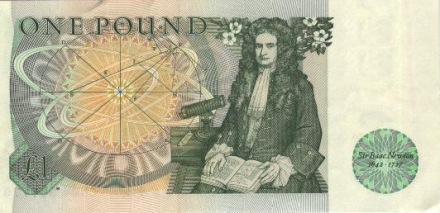
Appropriately, Newton himself wound up on the currency.

The accidents of place and time that brought the man who was recognized in his own day as the greatest mind of the age into conflict with Chaloner, an uncommonly gifted common criminal have fascinated me since I first learned of them through reading Chaloner’s last, piteous letter to the implacable Newton, written days before the hanging. In it Chaloner begged, writing “O dear S[i]r nobody can save me but you O God my God I shall be murderd unless you save me.”

What I wanted to answer was the obvious question: how and why did Isaac Newton come to pass judgment on the life of any other man? I had always thought of him as the nearly cloistered scholar of Trinity College, Cambridge, his home for more than thirty years. It was there he performed the experiments and the calculations that led him, in 1687, to write his masterwork, Philosophiae naturalis principia mathematica the Mathematical Principles of Natural Philosophy — better known simply as the Principia -– as well as pursuing his decades-long program of alchemical research.

So how, I wondered, did he end up in London, wallowing in the muck with the capital’s criminal underground?

Not to put too fine a point on it, finding out has turned into a book Newton and the Counterfeiter, published by Houghton Mifflin Harcourt and scheduled for release on June 4. But, to anticipate that longer story, here is the gist: Newton, after Principia found himself an international celebrity, and, as one of Cambridge University’s representatives to the Convention Parliament of 1689 that legitimized William of Orange‘s seizure of the English throne from the deposed Stuart King James II, he had nearly a year to enjoy the acclaim of London and Europe’s thinking and political elites before returning to the quiet of Cambridge, then a small town of about 5,000 inhabitants. It was an intellectual backwater too, especially compared to the big city in which he encountered figures like Robert Boyle, John Locke, Robert Hooke (whom he despised), Samuel Pepys (whom he did not) and so on. So he started, with Locke’s help, to seek a patronage appointment that would allow him to live comfortably in London. It took six years to find the right one, but ultimately he was offered the Warden’s post at the Mint. That job was supposed to be a sinecure, a nearly no-show position that would pay him a very comfortable wage.

And so it would have turned out were it not for the terribly debased state of England’s silver coinage, which had deteriorated to about half its legal weight for a whole host of reasons. So Newton arrived at a time when (a) the Mint was attempting to recall and recoin the entire stock of silver money for the entire country –- all the smaller units of money essential to everyday transactions –- and (b) coining, counterfeiting, was flourishing as enterprising men and women set out to get rich by filling in the gaps in the money supply with coins that never felt the stamp of an official Mint die. As Warden, it became Newton’s duty to see that legal money was produced fast and fairly, and to pursue all those who set up on their own.

Of those who did none were more technically skilled or ambitious than William Chaloner. His is a fascinating story, told at much greater length in my book, in which you see the currents of rapid economic change, class and ambition all converge within this one, barely remembered life. He was born desperate poor, a weaver’s son in Lincolnshire. He ran from his first apprenticeship to London, where he started out at the very bottom of the criminal ladder, hawking porn on street corners. He rose rapidly, first with his clearly impressive gift of gab, and then, after falling in with someone who knew how to gild surfaces, as the central figure in a series of ever grander schemes to counterfeit gold and silver money. He had sidelines as an informer, betraying conspiracies that he would himself set up, but his central gift and fascination was in the creation of fakes. Ultimately, he was one of the first to recognize the power of paper, and he started to counterfeit a variety of the early experiments with paper money and bank instruments.

In this sense Chaloner’s career –- and Newton’s urgent pursuit of him –- offer a window into the birth of the modern idea of money, of finance. And one of the things that fascinated me about this case is the degree to which this old story tracks some of our immediate problems. England’s and Europe’s economies were in rapid revolution in the late seventeenth century. The old idea of money as a chunk of metal with a pretty picture on it could no longer come close to accommodating the kind of enterprises governments and individuals wanted to undertake, from war to the funding of global webs of trade. And so people came up with all kinds of different ways of trying to represent value and exchange and even the idea of the changing worth of an investment over time. And the people making these experiments did not fully understand the implications of each expedient they tried. The last piece of paper Chaloner counterfeited was called a Malt Lottery Ticket, and it was at once simply paper money, a bond, and a gamble. Traders attempted to value these kinds of things in embryonic financial markets -– which would in a couple of decades blow up in a financial collapse that possess some striking similarities to our current predicament. Newton himself would lose a considerable fortune in that collapse, a sum worth a couple of million pounds, maybe more, in 21st century money.

It was that sense of precariousness that made the pursuit of counterfeiters so urgent in the midst of the late 17th century; England’s money supply was genuinely at risk, and no one had a good grasp of what it would take to make both the daily experience of small transactions and the high finance of war and trade go smoothly. So anyone threatening either or both levels of money was public enemy number one.

Of those who tried their hand at currency crime, Chaloner was the most accomplished, and notorious. By his own admission he counterfeited on the order of 30,000 pounds worth of currency over a seven- or eight-year career, an enormous fortune for the day. His big mistake, though, was to challenge Newton directly, accusing him in public of incompetence or fraud in his management of the recoinage of silver money between 1696 and 1698. He laid that charge both in testimony to Parliament and in a pamphlet he had printed for public distribution, and the scandal could genuinely have wounded Newton, were it not for the influence of his friends in power in Parliament at the moment.

It was enough, certainly, to propel Newton into an extraordinary investigation, an exercise of what may be seen as true non-fiction scientific detection. He set up a net of agents and informers throughout the worst neighborhoods and pubs in London, tracking any instance of coining he could find, interrogating suspects at the Tower or in jail, trying to build a web of connections around Chaloner. That story is contained within a collection of several hundred depositions and summaries of interrogations, all signed by Newton, that have survived, largely unexamined until now. Those records show that it took Newton almost two years in all, but aided in the end by listeners whose lives he held at his disposal inside Chaloner’s cell at Newgate, he managed to collect a sufficient weight of testimony to ensure that he could convict a prisoner clever enough to have escaped several previous attempts at prosecution.

The trial itself was something of a sham. Chaloner had feared being charged on the Malt Lottery Ticket forgery, (as we know from the accounts in Newton’s files of informers in the cells) but Newton actually presented evidence of a coining spree that almost certainly did not take place as described. Among other confounding facts, Chaloner was supposed to have made six different denominations of both silver and gold coins in a single day, which would have involved an enormous confusion of tools and materials that ran counter to basic counterfeiting practice.

No matter: the sheer volume of precise detail that Newton’s witnesses were able (or convinced) to provide produced a conviction within a very short time –- the whole trial took no more than an hour or so on March 3, 1699. There was a truncated appeal process -– really just a request for clemency from the crown, which was denied, and Chaloner’s sentence came down.

Formally, he had been found guilty of high treason, an assault upon the crown in the form of the king’s likeness and authority represented on the face of England’s coins. The punishment for high treason was essentially that suffered by William Wallace of Braveheart fame: to be strangled to the point of death, to be disemboweled whilst still living, to be beheaded and then quartered. By the date of Chaloner’s execution, the punishment had eased this far: convicted coiners were drawn to the place of execution on a rough sledge, subject to all the filth and abuse London’s open-sewered streets possessed; then hung until dead, and then, on rare occasions, to suffer post-mortem dismemberment. Chaloner himself was not, so far as any records revealed, actually cut into pieces. (As a gesture to public decency, women convicted of coining or other capital crimes were not supposed to be hung, lest their twitching at rope’s-end seem lewd. So they were burnt instead – though by the eighteenth century it was common to strangle them to death before lighting the pyre. Mercy, after the fashion of the times.)

Levenson lectures on his book at the MIT Writer’s Series.

One last note in a post gone much too long: Newton was involved in a number of counterfeiting investigations, and by some reckonings at least two dozen people went to their deaths as a result. Some historians, notably Frank Manuel, have speculated that Newton pursued this work with implausible eagerness, out of a kind of frustrated blood lust born of his abandoned and unhappy childhood.

This seems to me to be nonsense. The specific historical context matters here: Newton did not author the bloody code, nor did he send everyone he could to the gallows. Rather, the record of his depositions shows him to be simply a relentless practical man doing his job. He used little fish to catch big fish, and at least some of those low on the ladder received their escape from the gibbet. What you can see here, surprisingly, is the birth of a modern idea of a civil service. The Warden -– even Isaac Newton — was simply a man in a job doing the functions of that job, which included organizing the investigation and prosecution of counterfeiters.

What’s striking, of course, is that this civil servant, this bureaucrat, happened to possess the greatest scientific mind in history. And that’s the real sting in this tale. There is a connection between Newton’s pursuit of counterfeiters and his attempts to understand nature. He did employ the same resources of concentration and logical organization in his criminal investigations that he did when he tackled any problem. But more than the commonality of work habits, there is, I think this link: Newton can be seen as many people: the mathematician, the theoretical physicist, the empirical experimentalist, the alchemical mystic, the heretically devout religious thinker –- and the government functionary too.

And yet he was, of course, a single man, one with many interests, but ultimately with a consistent ambition, to reduce to order the complexity of any problem which was posed to him. Newton did not expect as Warden to have to chase crooks; when he found out that was part of the job he wrote a rather whiny letter to the Treasury to see if he could wriggle out of the duty. When he found he could not, he responded as he always had to the job at hand.

As one consequence, on this day three hundred and ten years ago, William Chaloner died.

On this day..

1615: St. John Ogilvie

On this date in 1615, Scotland’s only post-Reformation Catholic martyr was hanged at Glasgow Cross.

The Protestant-born Ogilvie had been educated in Europe and there fallen under the sway of the Catholic faith forbidden in his homeland. He converted, trained as a Jesuit, and at his own request returned to minister to the secret Catholic population in Glasgow.

Within a year he was in irons, awaiting a death sentence he refused to spurn with a timely submission to King James‘ spiritual supremacy. Ogilvie greeted his conviction for treason — and like most Catholic martyrs in the British Isles, he protested his loyalty in vain — with the words,

God have mercie upon mee! … if there bee heere anie hidden catholikes, let them pray for me, but the Prayers of Heretickes I will not have.


John Ogilvie? (See Update below)

There’s a multilingual Jesuit text celebrating Ogilvie available free from Google books.

Glaswegians can watch for more demonstrative tribute at St. Andrew’s Cathedral, which is poised to produce a monumental mural by Peter Howson.

Part of the Themed Set: The Church confronts its competition.


Update: Friend of the blog Louise Yeoman, whose guest post on a witchcraft execution remains one of the best pieces in this humble space, has an interesting correction to offer on Saint J.O. According to Yeoman, disemboweling “was not part of Scots law until 1708, when the British government wanted to hang draw and quarter some of those involved in the abortive Jacobite uprising of that year and were shocked to find that Scotland had no such penalty.” She’s backed by this contemporaneous account of Ogilvie’s death, which observes that even the “quartering” part of the sentence was not carried out.

So, what gives with the image, if Ogilvie’s corpse wasn’t carved up?

It’s from this (U.S.) Library of Congress page which marks it as a representation of Ogilvie in a late 17th-century text of Bohemian Jesuit propagandist Matthias Tanner. That provenance, of course, would be consistent with a bit of sanguinary exaggeration. It’s also possible that it’s mislabeled on the Library of Congress page, whose identification of it seems a bit oblique.

Working as I am from secondary sources, I tread cautiously here and welcome further clarification or correction.

On this day..

1613: Ivan Susanin, a life for the tsar

On an uncertain date in February (perhaps) 1613 — so says a cherished Russian national legend — a villager met a Polish army intent on deposing the Russian tsar, offered to guide it on a “shortcut,” and proceeded to lead it into a forest or fen where it succumbed to the elements.

A monument to Ivan Susanin in Kostroma. Image courtesy of Barbara Partee (Barbara adds: to help prevent future executions of the wrongly convicted, check out the Innocence Project.)

That peasant, Ivan Susanin, is supposed to have been put to death as the army realized its folly and imminent doom — the fate one would expect, although also not the sort that would leave a lot of corroborating witnesses.

Though the particulars are of doubtful veracity, Susanin’s son-in-law was awarded estates for the man’s tortures by enemy armies seeking the tsar — so the story is not completely baseless.

It was tsarist public relations, however, that gave us Susanin in his dramatic, familiar* form with the trackless wilderness.

This Susanin embodies the Russian people’s sacrificial love for their autocrat … and more specifically, since this was the Time of Troubles when the Russian crown’s succession was contested, for the Romanov dynasty whose first scion chosen in February 1613 would have been the Poles’ target.**

Thus, Glinka’s 19th century opera A Life for the Tsar.

But Glinka and Ivan proved up to the shifting needs of authority as the tsar gave way to the Politburo, and that to the post-Soviet state.

In a fascinating 2006 academic disquisition,† Marina Frolova-Walker dissects A Life for the Tsar‘s transmutation into Ivan Susanin, a Stalin-era opera with the same score but a libretto altered to expunge the tsar — and the success this adaptation of a national classic enjoyed vis-a-vis Soviet artists’ original creations under the impossible aesthetic and political restrictions of official censorship.

Not only did this now-nationalist composition thrive in the USSR, it has been successfully re-staged in its Soviet form, or as a fresh amalgamation of Stalin and Glinka, in the Putin era.‡

From the days of serfdom via the days of the gulag past the fall of the Iron Curtain, here’s Ivan Susanin‘s stirring finale performed by the Russian army at the Vatican, and broadcast on Russian television.

* Familiar to Russians, certainly, and you can call one who gets you lost “susanin”.

** And we all know how they left the throne.

† Marina Frolova-Walker, ‘The Soviet opera project: Ivan Dzerzhinsky vs. Ivan Susanin’, Cambridge Opera Journal (2006), 18:2:181-216

‡ In the Yeltsin era, the opera was staged in its pre-Soviet form. Frolova-Walker argues that the version incorporating Stalinist edits actually speaks to contemporary Russia more aptly than the original, an operatic mirror of the state’s re-adopting the Stalinist national anthem after having used a tsarist piece (written by Glinka!) during the 1990’s.

The reappearance of these cultural tokens is occurring because high Stalinism provides the most easily assimilable model for Russian nationalism today: it is less remote than its nineteenth-century counterpart … The eclectic and confident nationalist of the new Susanin contains the appropriate message for those Russian citizens wealthy enough to attend the Bolshoi today.

On this day..

1661: Oliver Cromwell, posthumously

On this anniversary date of King Charles I’s beheading, the two-years-dead corpse of the late Lord Protector Oliver Cromwell was hung in chains at Tyburn and then beheaded, along with the bodies of John Bradshaw and Henry Ireton.

The great-great-grandnephew of ruthless Tudor pol Thomas Cromwell rose higher than any English commoner, high enough to be offered the very crown he had struck off at Whitehall. Oliver Cromwell declined it in sweeping Puritan rhetoric just as if he hadn’t spent weeks agonizing over whether to take it.

“I would not seek to set up that which Providence hath destroyed and laid in the dust, and I would not build Jericho again.”

The House of Stuart never could rebuild its Jericho while the Lord Protector ran the realm* — thirteen years, writes Macaulay, “during which England was, under various names and forms, really governed by the sword. Never, before that time, or since that time, was the civil power in our country subjected to military dictation.”

“Cromwell lifting the Coffin-lid and looking at the body of Charles I”, by Hippolyte (Paul) Delaroche — a French painter with an affinity for English execution scenes. The painting is based on an apocryphal but irresistible legend, also used by Nathaniel Hawthorne in a tedious short story.

And not only England. Cromwell’s prodigious depredations in Ireland — justifiably or not — remain a source of bad blood.

The English Commonwealth foundered after Cromwell’s death, however, and restoration of the monarchy — a rock, as it turned out, on which the Puritans’ bourgeois revolution could erect its colossus — came with the price of a few examples being made.

Of course, “executing” dead guys displays about as much strength as it does sanitation, and for all Charles II‘s demonstrative vengeance, the politically circumscribed throne he resumed was very far from his father’s dream of absolutism. Between the late dictator and the new king, the future belonged to the corpse clanking around on the gibbet.

When the able Charles II followed Cromwell into the great hereafter, his brother James II promptly fumbled away the crown with his anachronistic insistence on royal authority and his impolitic adherence to Catholicism.**

In the emerging England of the century to come, the divine right would depart the Stuarts for another dynasty more amenable to the rising authority of the parliament whose sword Oliver Cromwell once wielded.

* Resources on the particulars of Cromwell’s career, the English Civil War, et al, are in plentiful supply online. This BBC documentary is a very watchable overview: part I; part II; part III; part IV.

** James II remains England’s last Catholic monarch.

On this day..

1634: Anna Tait, “trublit in conscience”

(Thanks to historian and witchcraft expert Louise Yeoman for this guest post on an obscure and once-forgotten “witch” whose human tragedy all but leaps off the page. This post was originally an article prepared for the National Library’s now-defunct journal Quatro. Her work has appeared in many more high-falutin’ places than this here blog, and she is a co-creator of the Survey of Scottish Witchcraft.)

On the trail of Anna

If you look in Christina Larner’s Sourcebook of Scottish Witchcraft, you won’t find Anna Tait. That’s because she was one of many accused witches whose names were unknown to the compilers of the sourcebook. The details of Anna and almost a hundred others were recorded in a National Library of Scotland Advocates manuscript, which was overlooked many years ago when the huge edition of Scotland’s Privy Council records was in preparation. In the closing years of the last century, the editors of the Privy Council volumes carefully combed the holdings of the National Archives of Scotland for their material. What they didn’t realise was that a single volume of the Register of Commissions for the years 1630-42 had escaped them. In it were hundreds of records of Privy Council commissions to try criminal trials.

In it was Anna Tait.

I first came across Anna and Adv. Ms. 31.3.10 when my friend and fellow researcher Dr Michael Wasser of McGill University, Montreal showed it to me in the Library’s North Reading Room. Michael was (and still is) a historian of crimes of violence in 16th-17th century Scotland, and he was instantly aware of the significance of the manuscript. Almost the first thing he pointed out to me in it was a remarkable story of family tragedy. Out of hundreds of records, this one tale of domestic misery, horror and a woman’s life stood out. It stood out to the clerk who wrote the volume too. A commission is normally a bare record of who is accused of what crime and who is to try them. But the commission to try Anna contained harrowing detail. Almost straight away I agreed to transcribe her commission and to edit it for Scottish History Society. Why was it so remarkable?

Anna Tait ‘alias ‘Hononni’, was in the Scots of the original ‘thrie several times deprehendit putting violent hands to herself at her awne hous,’ in Haddington in 1634. In other words, she was caught trying to kill herself.

In 17th century terms suicide was one of the most heinous acts one could commit. It was like witchcraft, considered to be a particularly odious crime against God’s law and it was punishable by forfeiture of the entire goods of the victim and by a dishonourable burial in unconsecrated ground. What drove Anna to such terrible lengths?

The rest of the commission made the reasons clear. When Anna was apprehended for attempted suicide, she told a terrible tale of adultery, poisoning, domestic murder, unwanted pregnancy, botched home-abortion and death. Here is this part of the commission slightly adapted and with the spelling modernised.

She was for that cause, upon the 18th of December, taken and committed to ward within the tolbooth of the said burgh where being demanded and examined why she put hands to herself, she answered that the intolerable trouble of her mind, which she conceived for the murder of her first husband called John Coltart, nolt driver [cattle drover], and for the murder of her daughter, moved her thereto.

Confessing plainly that about 28 years ago, she being married to the said John, ane aged man, before the marriage she had sundry times committed fornication with William Johnston, her present husband, and that within the time of the marriage she had likewise committed adultery with him. To be quit of her first husband, she consulted with the Devil for his destruction, and that the Devil having directed her to make a drink of foxtrie leaves [foxglove leaves], she did the same, and gave it to her husband to drink who within three hours departed this life.

Concerning her daughter, she confessed that the daughter being with child, and she [Anna] having a purpose to murder the infant in the mother’s belly, at last she consulted with the Devil. He gave her direction to buy wine and to mix it with salt and give it to her daughter to drink, which she having drunken, she shortly thereafter departed this life.

So far, so sadly comprehensible, except for the inclusion of a character whose presence might seem unnecessary to modern readers — The Devil. The Commission finally proceeds ‘upon the 8th of December instant; she had carnal copulation with the Devil in her own bed, and that upon the 11th of December the Devil came to her bedside, gripped her by the hair of her head and did nip her cheek’. Suddenly a classic case of domestic murder and family tragedy is turned to that strangest of all 17th century phenomena to the modern mind: a witchcraft accusation. This was not just a case of three in a marriage, but three plus the Prince of Darkness. However, this wasn’t a strange notion to 17th century people. Where two, three or even just one person were engaged in works of wickedness, it went almost without saying that Satan was somehow present too. Anna was tried not as an adulteress or a murderer but as a witch – the commission was the licence to the magistrates of Haddington to try her, but where was her trial?

Records of such witchcraft trials held in local, rather than central, courts rarely survive. Whilst I was working on the commissions, I happened by chance to be helping someone with a totally different enquiry. Dr John McGavin was researching records of early modern Scottish drama. We discussed his research on poet and minister James Melville and Melville’s account of a dramatic performance in St Andrews. Hearing that John was soon going to be searching through the Haddington Burgh records in the National Register of Archives, I asked him if he would keep an eye out for Anna and any other witches he might happen to spot. To my delight, I soon had an e-mail from John telling me that her trial records were in the Haddington burgh court book.

Researching witchcraft cases can be an intense mixture of horror and delight for a historian. On the one hand to find unexpected light on a unique case is a matter for rejoicing. On the other hand, the details I found in the court book were even grimmer than those of her commission.

Anna had tried several times to hang herself using her own head-dress (her curch). When she was taken into custody, her suicidal behaviours became even more extreme. She attempted suicide again, both by trying to cut her own throat and then ‘when your hands were bound and your feet maid fast in the stocks, no other meanes being left to accomplish your devilishe designes, ye knocked your heid to the wall and stocks, wherby thinking to dispatch your self.’ The court book went into more detail, it claimed that Anna had sex with the Devil in the form of a black man and in the form of the wind and had made a covenant with him. Shape-shifting was a not uncommon piece of Scottish popular belief about Auld Nick, but on top of it were overlaid the sinister assumptions of European theories about demonic pact. One didn’t just meet the Devil according to the demonologists, one had sex with him, took his mark and swore one’s soul away to him. Anna was explicitly accused of all three actions.

The trial also gave more personal information about Anna to add to that from the commission. Taking both sources together we can say a little about her. She had married her first husband John Colthard, the cattle drover, 28 years ago at a place called ‘Furd Kirk’ in England in 1606. Cattle drovers went far afield in the course of their work and Anna had obviously travelled too. Interestingly enough she was accused of having made an appointment to meet the Devil at ‘Ellerslie’. The only places of this name are to be found over in the West of Scotland and not near her home in Lothian. Given 17th century spelling this may also have been the little Lanarkshire village of Elderslie, famed as the birthplace of William Wallace. Whichever it was, Anna’s world clearly stretched well beyond the confines of Haddington.

Age of marriage could be quite late in 17th century Scotland, so Anna was probably about or just under 50 years of age. Her second husband William Johnston was a miller who had lived at Winram, nearby Anna and her first husband. The proximity had assisted their illicit affair. Millers and cattle drovers could be prosperous members of an early modern community, so it is likely that Anna too had some standing in her community to keep up. She was probably very far from the stereotypical portrait of an accused witch as a poor begging woman going door to door looking for alms.

At sometime in her life Anna had acquired the alias ‘Hononni’, a Scottish variant of the English ‘Hey nonny no!’ a popular nonsense refrain in songs. It was an ironically jolly nickname for someone whose life was characterised by murder, tragedy and despair. We find the name of her beloved daughter too –- Elizabeth Johnston who died from the botched abortion. The records of this are chilling

The said Elizabeth, being as ye confessed with child (to whom, few but yourself knows and neither will ye reveal the truth of it), and apparently being loath to let it be known to whom the child belonged, she and ye sought all means to kill, to murther the child in her belly, that it might not come to light who was the father thereof, or how it was gotten, whether in adultery or incest, or what other unlawful way.

To that effect ye consulted with diverse of your confederates fra whom, ye got sundry feall [evil] counsel and by their advice, administered feall drinks to your daughter. But these not doing your turn and all other means failing you, ye went to your old maister the devil … who gave you advise to buy ane mutchkin of white wine, and mix a pint thereof with salt and minister the same unto your daughter, and it would do your turn. The which cruel and devilish counsel ye willingly obeyed and fetched the wine, mixt with the same with salt and gave it to your daughter to drink. By which she presently swelled and shortly thereafter both she and the child died.

In token wherof, you have confessed that the devil gave you as much money in true and real turners [small copper coins] as would buy the said mutchkin of wine and salt. And this deed only of all the devilish and abominable actions has most troubled you, and been the greatest cause of your desire to murder yourself.

In trying to cover up her daughter’s unwanted pregnancy, Anna ended up killing her child. Blaming herself for Elizabeth’s death, Anna no longer wanted to live. She tried repeatedly to kill herself. When it was put to her that the Devil had advised her do all this and that she had become a witch, it seems she barely bothered to defend herself. After all, even though she might have wanted to avoid the shameful death of being strangled and burned at the stake, at least it would have the virtue of ending her life. When the court asked whether she wanted anyone to speak in her defence, she answered ‘none but God in heaven’.

To modern eyes, Anna’s situation seems clear-cut. She had done some terrible things and for very understandable human reasons she wanted to die. Even in 21st century Scotland we would insist that, at the very least, Anna should go to jail for murdering her first husband and that she should be prevented from killing herself. Yet in 21st century Scotland, Anna would have been able to obtain a divorce from her first husband and her daughter would have been able to obtain an abortion (whatever you think of that). So the whole catalogue of tragedy might not have happened at all, or then again, perhaps it might. Was Anna a victim of a society which stacked the cards against women through its interpretation of the Bible or was she the sort of callous person who might have murdered a spouse despite all the advantages of a modern legal system? After all, the murders of spouses still occur. These are questions the historian can only raise and cannot answer.

Even in today’s society, however, a female criminal who had committed crimes of violence comparable to Anna’s would be unusual. To a 17th century society she was such a paragon of horror that the Devil had to be invoked to explain her conduct. In a society which stressed a woman’s subordination to her husband and saw her only rightful adult roles being those of a wife or a mother, Anna was a monster. To her community, she was not only an attempted self-murderer but also an adulteress and the unnatural murderer of her husband, daughter and unborn grandchild. By confessing to witchcraft, she had just about collected the set of the most appalling crimes a 17th century woman could commit. To be regarded with such horror in contemporary society, a woman would probably need to be accused of a string of serious offences against children or young people.

However Anna’s case also raises the question of her mental state and how issues of mental disturbance and suicidal urges were dealt with in her society. Such a suicidal defendant in a modern case might be found unfit to plead, but how did Anna’s contemporaries see her mental distress? Anna was ‘trublit in conscience’ and this points to the beliefs which probably helped to seal her fate. Despair as to whether one was part of the Calvinist ‘Elect’ or whether one was going to hell was a perfectly respectable state in Early Modern Scotland –- even to the extent of repeated suicidal impulses. This can be seen from the diaries, books, letters and sermons of radical Presbyterians and Covenanters. It was a very common phase of the Calvinist conversion experience of the 17th century. Demonic or even suicidal temptations were an almost a normal complication of the road to heaven. To despair over committing terrible sins worthy of hell-fire was not seen as being mentally unstable but as being eminently sane. Any reasonable Bible-believing person might think that way.

So Anna’s despair may have made her seem more culpable, rather than less culpable, to her interrogators whose beliefs would be that in her agony she had done utterly the wrong thing and turned in absolutely the wrong direction. She had, in their minds, turned to the Devil and not to God. Instead of despair proving to be a half-way stage for Anna on the road to conversion and eternal glory, Anna, it seemed by her confession, had failed to choose eternal life and had instead perversely chosen the ultimate dead-end: Hell. This was an offence made all the more horrible, as heaven in its Calvinist form, was no doubt being held out to her every Sabbath in their local church. Perhaps the reason it was necessary to punish the despairing so emphatically was pour encourager les autres; to make sure that when people experienced despair, they would in the Church’s eyes make the right choice: that they would resist the temptation and intensify their piety until the threat was overcome.

Faced with the reality of burning large numbers of accused witches amongst whom they found the suicidal and the mentally disturbed, later generations of Scottish Privy Councillors increasingly doubted the wisdom of this approach. In 1662 in the midst of a nation-wide witch-panic the council issued commissions under strict orders that to proceed with executing a convicted witch, it must be found that ‘At the tyme of their confessions they were of right judgement, nowayes distracted or under any earnest desyre to die’. Almost 30 years after Anna’s death, Scotland’s elite were becoming sensitive to the issue of attempted suicide by witch-confession and the mental state of the accused. It came much too late to affect Anna and because of her murder confession wouldn’t have saved her anyway, but it shows a little how things moved on even in that relatively short time frame. For Anna there could only be one ending — execution. Because she had confessed she was not burnt alive [burning alive tended to be reserved for those who died ‘impenitent’ ie. they refused to confess]. Her sentence was as follows:

It was given for doom [sentence] by the mouth of William Sinclair dempster [pronouncer of sentence] that the said Anna Tait should be taken, her hands bound behind her back and conveyed by William Allot, lockman [executioner] of Haddington to the ordinary place of execution, and there wirried [strangled] to the death at ane post and thereafter her body to be burnt in ashes, desuper act.

Note on sources

The commission for Anna’s trial is edited from Adv.Ms.31.3.10, f.102v. Her trial records may be found in National Archives of Scotland, Haddington Burgh Court Register B30/10/13, fos.24r-26v. A calendar of the witchcraft commissions in Adv. Ms 31.3.10 (including transcriptions of Anna Tait’s commission and her trial records) has been prepared by the author for Julian Goodare (ed.), Miscellany XIII, Scottish History Society, forthcoming.

On this day..

1638: The melancholy Dorothy Talby

On this date in 1638, Dorothy Talby was hanged in Boston for breaking the neck of her baby daughter (aptly named “Difficulty”) “in order to save the child from future misery.”

Though not the first execution of a woman in the territory of the future United States, it is the first that is reasonably well-documented … and for a disturbed, possibly insane, woman striking out against her troubled family life, a case that resonated for later Americans like Nathaniel Hawthorne and Oliver Wendell Holmes.

For those of us, post-Andrea Yates, for whom “post-partum depression” has become a sadly familiar term of criminology, it is likely to resonate as well.

Mrs. Talby was esteemed for godliness, etc., but after the birth of the child she became melancholy and possessed of delusions. She sometimes tried to kill herself and her husband by refusing to eat “meat” and not permitting them to eat it, saying it had been so revealed to her. (Source)

Take a break from the Headsman’s noodlings and instead enjoy the thoughtful treatment given Talby’s case by crime blogger extraordinaire Laura James.

On this day..

1615: Kate McNiven, the Witch of Monzie

(It’s Samhain — the ancient, pagan wellspring of Halloween. Thanks to Royelen for this timely remembrance of a completely undated witch-burning from Scottish folklore.)

A gurgling fountain at the property border announces a gentle place. The fountain has a small pond filled with friendly goldfish which swim your way. They are hoping for morsel of food but it feels like an appropriate welcome to a local herb shop.

The mission is to find a remedy for leg pain. For a few moments the pain can wait while the lemon thyme gets rubbed by fingers gathering up the smell for a delightful inhalation. And then there is the basil, the chocolate mint, the rosemary — and so it goes with rows and rows of little pots of tiny green plants, each fragrant in a unique way. Each creating its own sensation.

When sated with nasal stimulation, it’s time to enter the house. It causes no surprise when cheery sounding chimes ring as the door opens. Inside the walls are lined with shelves. Each shelf is filled with glass jars. Each jar has a different dried leaf. There are many jars. An herb shop employee is happy to help.

“Pain, long-standing muscle pain? In your leg. Uh-huh. It’s possibly a nutritional deficiency, you want to take calcium, two pills twice-a-day. You’ll know in two weeks if this is the cause.”

This knowledge, long forgotten and now denied by Western medicine, may have been the kind of knowledge that got Kate McNiven killed.

Scottish lore has it that Kate McNiven’s community of Monzie in Scotland first sought her out for her wisdom, maybe for her herb cures and curse-ending charms. Then, in the era of witch burnings, her community pulled her from her service and burned her to death. After killing her, Kate McNiven’s community made her a local legend.

Today we might assess Kate McNiven as a real witch based on the power of the curse she left behind — a curse which the generations passed down and which now comes to us across the Internet; a curse which leaves us the tale of a talisman known as the Inchbrakie Moonstone.

Though there are no official records, the curse is said to begin in 1615* when Kate was accused of witchcraft. Having been found guilty, word spread of her immediate execution by fire. A landowner of a nearby estate, having come upon the fire preparations, asked the gathered crowd to stop their execution plan. While he had no success, he did win favor from the named witch.

As the fires around her grew, Kate McNiven began her curse. The landowner of execution site was cursed, then the area known as Monzie was cursed, and finally she honored the unsuccessful estate owner who attempted to stop her execution. She threw from the fires a charm — a blue stone that had been around her neck — and told him that if he kept it close, he would always be blessed with sons and they would always be blessed with lands.

The legend goes that the cursing was successful. The landlord on whose land she died was not able to pass the property on. Monzie withered.

Of course, the land owner who pleaded her case kept the stone near as directed. As the legend goes it always was put on the fingers of the daughter-in-laws and heirs were always produced. Centuries of fecundity were enjoyed until one descendant made the mistake of allowing the stone to be moved outside of the estate. That was the end of the good run and proof of Kate’s powers as a witch.

Is the legend of the Witch of Monzie a romantic retelling of a woman’s death or is it a community reassuring itself that the executed woman was guilty of her crimes? Maybe both. Maybe more.

Swiss psychotherapy pioneer Carl Jung’s theory of the shadow tells us that Kate McNiven’s peers attributed to her what they could not accept in themselves. They found her untrustworthy and capable of doing strange things. For some reason, she of all people was chosen as the one to be the scapegoat. It may have been for no other reason than she didn’t point the finger at someone else. The people of Monzie did not fight for her release, and they likely felt relieved that the pressure was off of them. Their untrustworthiness and strange behaviors were not under scrutiny. For the moment, they were safe.

It’s easy to imagine Kate McNiven as Tessie in Shirley Jackson’s short story, “The Lottery”:,

The children had stones already. And someone gave little Davy Hutchinson a few pebbles.

Tessie Hutchinson was in the center of a cleared space by now, and she held her hands out desperately as the villagers moved in on her. “It isn’t fair,” she said. A stone hit her on the side of the head. Old Man Warner was saying, “Come on, come on, everyone.” Steve Adams was in the front of the crowd of villagers, with Mrs. Graves beside him.

“It isn’t fair, it isn’t right,” Mrs. Hutchinson screamed, and then they were upon her.

* Not only the year but the century of Kate McNiven’s — or M’Niven, McNieven or Nicniven — execution is disputed. Sources report both 1615 (in the midst of King James’ witch-sniffing reign), and 1715 (which would make her one of the last witchcraft executions in Scotland).

But there is no original documentation — a University of Dundee archivist has confirmed this for Executed Today — and McNiven is not listed in Scotland’s witch executions database. She was promulgated in a 19th-century text, The Holocaust, or, the Witch of Monzie and could be entirely fictional. (Update: The myth dissected in comments.)

On this day..

1618: Walter Raleigh, age of exploration adventurer

On this date in 1618, schemer, explorer, and lover Walter Raleigh fell permanently out of favor.

One of the biggest wheels of Elizabethan England, Raleigh (who also rendered his name Rawleigh, Rawley, and most commonly, Ralegh) charmed his way into the Queen’s inner circle, and possibly her pants, and was even thought to be a contender for her hand.

In between gorging on royal monopolies, scribbling poetry, popularizing tobacco, and introducing the potato to Ireland [allegedly], Raleigh got his New World on by attempting to colonize Virginia,* helping fund it with privateering operations against England’s rivals in the land-grab game. The city of Raleigh, North Carolina — present-day North Carolina was part of the Virginia Colony back in the day — is named for him.

Proud, powerful, and the queenie’s pet. Just the sort of courtier other noble suckups loved to hate.

When the palace fave secretly dallied with one of the Queen’s ladies-in-waiting, he went on the royal outs and got real familiar with the Tower of London. Though he managed to patch up with Elizabeth, things were never quite the same for Sir Walter. Elizabeth’s successor James I put him back in prison (suspending a death sentence) for supposedly participating in the Main Plot.

Raleigh passed the time under lock and key burnishing his Renaissance man rep by writing various poetry and treatises, including an account of his voyage to Guyana. Convinced the legendary city of El Dorado was in the vicinity, Raleigh eventually prevailed upon James to release him to make another run at it.

But a dust-up with a Spanish outpost in South America left his son dead, and the Spanish ambassador hopping mad. Raleigh was arrested upon his return, and the death sentence reinstated.

At 66 years of age or so, Walter Raleigh had had a pretty good run.

He took his punishment with equanimity, writing tenderly to his wife, and examining the blade that would take off his head on the scaffold with the observation,

“This is a sharp Medicine, but it is a Physician for all Diseases.”

His wife creepily kept the severed head for the remaining 29 years of her life.

There’s a more detailed tour of Raleigh’s life here, and a site linking many works by and about Raleigh here.

* As Governor of Virginia, Raleigh forbade injuring Indians on pain of death, according to Giles Milton’s Big Chief Elizabeth. Raleigh’s “imperialism with a human face” policy had exchange programs of Indians visiting England, most notably Pocahontas.

On this day..