1622: Anne de Chantraine, young witch

On this date in 1622, Anne de Chantraine was burned at the stake for witchcraft in Waret-la-Chaussee, Belgium.

Our day’s heroine answers most prominently to fictional modern interpretations — about which more in a moment — but Anne de Chantraine was a flesh-and-blood person, at least for 17 years.*

In outline form, Anne is said to have faced the usual litany of sorcerous allegations and the usual ordeals to demonstrate guilt, with the usual result: confession, execution. Here in the opening years of the Thirty Years’ War coeval with the the conflicts of the Protestant Reformation, one cannot but suspect the fearful hand of endangered authority in witch-hunts. Historian Hugh Trevor-Roper argued that

this recrudescence of the witch-craze in the 1560s was directly connected with the return of religious war … It can be shown from geography: every major outbreak is in the frontier-area where religious strife is not intellectual, a dissent of opinion, but social, the dissidence of a society. … Thereafter, almost every local outbreak can be related to the aggression of one religion upon the other.

Anne de Chantraine’s environs fit the theorem.

The Walloon region of Liege at this point was governed by a Catholic Prince-Bishop of Habsburg stock, just as the Holy Roman Empire was putting down the Protestant stirrings in Bohemia that would initiate Europe’s epochal war and send armies to and fro through the Low Countries. Said Prince-Bishop, name of Ferdinand of Bavaria, would win renown as a zealous persecutor of the diabolical in his realms.

Alas for Anne.

She’s a bit better documented among Francophones (see this biography in French, for instance, full of sensual details like the gorgeous red hair, a spurned lover accusing her, and the rough play of medieval torture; there’s also a brief roundup in German here), but worldwide, she’s a literary character of some consequence — most notably, perhaps, through the work of Belgian author Francoise Mallet-Joris: her 1968 Trois âges de la nuit (translated to English as simply The Witches) presents Anne de Chantraine as the focal point of one of three vignettes reimagining real historical “witches” as persons struggling for spiritual growth.

Anne, in this version, does participate in (staged, not-really-supernatural) witches’ sabbaths, plus a lesbian affair with a fellow participant. Her seekings both godly and infernal (paralleled by lifestyles both monastic and hedonistic) fall short of satisfactory; in the end, exercising magic unto her own death is a form of self-actualization among fellow people who, unable to recognize her humanity, brutalize or ignore her.

Players of the long-running video board game Atmosfear (or Nightmare) will also recognize Anne de Chantraine as a recurring witch character. The series uses recordings (VCR tapes originally; DVDs now) played during gameplay; “the witch” is featured as the central character in Atmosfear III/Nightmare III:

(In the comment thread for this video on YouTube, the French actress Frederique Fouche drops in to confirm her part as the witch. According to this French interview, the role caused her to become an emigre in Australia.)

* Some reports say she was burned at age 17, others that she was arrested at 17, which would have made her 18 or 19 at her death.

Part of the Themed Set: Belles Epoque.

On this day..

1660: Major-General Thomas Harrison, the first of the regicides

On this date in 1660, the restored House of Stuart began a week of bloody justice against Charles I‘s regicides by hanging, drawing and quartering Thomas Harrison at Charing Cross.

Stuart Little

Charles’ son and heir Charles II had been stuck on the continent during the 1650’s, until the Commonwealth came apart from its own internal contradictions after the death of Oliver Cromwell.

With anarchy looming, suddenly monarchy didn’t look so bad — and Charles II had a way back into the saddle.

Beheads I Win …

The first thing on everyone’s mind was what to do about the little matter of having lopped off his dad’s head.

Political reality drove the settlement: nearly everyone in the English gentry had in some manner acquiesced to the Commonwealth during its decade-plus turn steering the ship of state; an expansive line on treason would be a nonstarter. At the same time, His Soon-To-Be-Royal-Again Majesty expected a few examples made to do right by the old man and keep king-killing well off his future subjects’ agenda.

Result: the Indemnity and Oblivion Act, granting a free pardon to all supporters of the Commonwealth save a handful of those most directly implicated in Charles I’s execution.

Weeks of frantic negotiating between the parties and private settlements of borderline cases with the royalist camp preceded the action. But Thomas Harrison wasn’t part of any of it.

… Entrails you Lose.

The rigid Puritan, one of 59 who signed the last king’s death warrant and at one time the commander of England’s armies, had been on the outs with everyone since Cromwell set up the Protectorate in 1653. Godly Tom was a “Fifth Monarchist,” anticipating the imminent return of Christ perhaps in conjunction with the imminent year 1666 … and no government felt safe about these millenarians. He’d been imprisoned several times by the Protectorate, too.

Though many attainted regicides fled for Europe or America, Harrison (possibly motivated by age and infirmity) hung out, waited for arrest, and took his punishment stolidly.

God hath covered my head many times in the day of Battle. By God I have leaped over a wall, by God I have runned through a Troop, and by my God I will go through this death.

Specifically meaning, drawn on a hurdle from Newgate to Charing Cross (with a fine vantage for the doomed on Whitehall, where Charles I had met his end), hanged but revived, his genitalia cut off and bowels carved out and burned while still conscious, and finally beheaded and his body divided into quarters for gruesome public display around town.

You have selected regicide.

Harrison died on a Saturday, and his was the opening act of a busy week in the bowel-burning business; nine other fellow regicides condemned with him would share that fate during the week ahead:

  • John Carew, on Monday the 15th;
  • John Cook and Hugh Peters, on Tuesday the 16th;
  • Thomas Scot, Gregory Clemen, Adrian Scroop and John Jones, on Wednesday the 17th;
  • Francis Hacker and Daniel Axtel, on Friday the 19th.

Harrison was chosen as the first partly, perhaps, because the Fifth Monarchists were (justifiably) considered a still-extant menace, and partly because, as one account had it,

[h]e was a fierce and bloody enthusiast. And it was believed, that, while the army was in doubt, whether it was fitter to kill the king privately, or to bring him to an open trial, that he offered, if a private way was settled on, to be the man that should do it. So he was begun with. But, however reasonable this might be in itself, it had a very ill effect: for he was a man of great heat and resolution, fixed in his principles, and so persuaded of them, that he never looked after any interests of his own, but had opposed Cromwell when he set up for himself. He went through all the indignities and severities of his execution, in which the letter of the law in cases of treason was punctually observed, with a calmness or rather a cheerfulness that astonished the spectators.

“As cheerful as any man could do in that condition”

And this coda is attested by the age’s famous diarist, Samuel Pepys, whose neat and oft-quoted summation of Harrison’s fate runs thus:

I went out to Charing Cross, to see Major-General Harrison hanged, drawn, and quartered; which was done there, he looking as cheerful as any man could do in that condition … Thus it was my chance to see the King beheaded at White Hall, and to see the first blood shed in revenge for the blood of the King at Charing Cross.

Who overcomes by force hath overcome but half his foe

As might be expected, vindicated royalists sought more blood than the handful of exemplars could furnish. What compromise could expiate the sin of regicide?

Poet and polemicist John Milton, having been propagandist-in-chief for the now-abortive revolution, endured the jeers of his enemies for the conspicuously apolitical stuff (a grammar book!) by which he would set his table in the years ahead.

Upon John Milton’s not suffering for his traiterous Book when the Tryers were executed, 1660.

That thou escaped’st that vengeance, which o’ertook,
Milton, thy regicides, and thy own book,
Was clemency in Charles beyond compare:
And yet thy doom doth prove more grievous far.
Old, sickly, poor, stark blind, thou writest for bread:
So for to live thoud’st call Salmasius from the dead.

(Claudius Salmasius was a French intellectual whose defense of the Stuart royal rights had been savaged by Milton during the Protectorate.)

It’s thanks to the Indemnity and Oblivion Act’s not sending Milton the way of General Harrison that we have Paradise Lost.

On this day..

1621: Not Katharina Kepler, thanks to her son Johannes

On October 4, 1621, the Duke of Württemberg declared Katharina Kepler free of a witchcraft charge for which she had barely avoided execution … with the help of her son, the astronomer Johannes Kepler.

The famous scientist was very well along his career, and his mother (German Wikipedia link) a too-old-for-this-crap 69, when authorities in her native town of Leonberg initiated proceedings in 1615.

It says here she was an eccentric, cantankerous old dame, just the sort liable to face a gossip campaign that would promote her into partnership with the Evil One. She was only one of a number of people targeted in the town’s witch-spasm, noticeably occurring as the Catholic-Protestant conflict was stoking that crucible of modernity, the Thirty Years’ War — a fine time and place for infernal superstition.

Several of the suspected were put to death.*

Kepler, whose heterodoxy and heliocentrism made him a touchy figure in a fraught time for scientists, might have done her no favors with his trippy Dream, whose overt musings on “daemons” and the like might have drawn suspicion onto the family. Johannes made six years of atonement struggling — ultimately successfully — to keep his mother alive and untortured.

Commuting back and forth from his work in Linz (showing an admirable capacity for keeping his head while others about him were in danger of losing theirs, Kepler discovered his third law of planetary motion in 1618; apparently he also read Galileo’s father on one of the trips between Linz and Leonberg), he organized his mother’s defense and wrote her briefs in his own hand.

It finally paid off.

The judicial college at the University of Tübingen — Kepler had matriculated there as a younger man — opened the door to Katharina’s release by declaring the evidence insufficient either way, and issuing a split-the-baby conviction directing that she be shown but not subjected to the instruments of torture.

On September 28, 1620, the Feast of St. Wenceslas, the executioner showed Katharina Kepler the instruments of torture, the pricking needles, the rack, the branding irons. Her son Johannes Kepler was nearby, fuming, praying for it to be over. He was forty-nine and, with Galileo Galilei, one of the greatest astronomers of the age — the emperor’s mathematician, the genius who had calculated the true orbits of the planets and revealed the laws of optics to the world. Dukes listened to him. Barons asked his advice. And yet when the town gossips of Leonberg set their will against him, determined to take the life of his mother on trumped-up charges of witchcraft, he could not stop them.

There were tidal forces at work in this little town. The events around the duchy of Württemberg would gather into themselves all the violent changes of the day, for by their conviction of Katharina, the consistory (the duke’s council), the magistrates, and the Lutheran church authorities had bundled together their fear of Copernicus and their anger against Johannes, a man they had already convicted of heresy. The Reformation, like an earthquake, had cracked Western Christianity, stable since the fifth century, into Catholics and Protestants, and the Protestants into Lutherans, Zwinglians, Calvinists, Anglicans, and Anabaptists, with the many camps drifting apart like tectonic plates. Even the heavens had begun changing, and Kepler had been a part of that change. … Fear ruled Europe — fear of difference, fear of change.

And there, in one corner of Swabia in southern Germany, the mother of a famous man, a mathematician and scientist, a respected, pious Lutheran, nearly paid with her life.

Early that morning, she was led to the torturer by Aulber, the bailiff of Güglingen, who was accompanied by a scribe for recording her confession, and three court representatives. The torturer, with the bailiff standing to one side, then shouted at her for a long time, commanding her to repent and tell the truth and threatening her if she didn’t. He showed her each instrument and described in detail all that it would do to her body — the prickers, the long needles for picking at the flesh; the hot irons for branding; the pincers for pulling and tearing at the body; the rack; the garrote; and the gallows for hanging, drawing, and quartering. He adjured her to repent, to confess her crimes, so that even if she would not survive in this world, she could at least go to God with a clear conscience.

Stubborn Katharina was having none of it.

Do with me what you want. Even if you were to pull one vein after another out of my body, I would have nothing to admit. (Source)

Having survived the “torture,” she was in the clear; at her son’s relentless insistence, the Duke ordered her released six days later.

Katharina Kepler died naturally the following April. There’s a school named for her (German link) in nearby Güglingen, Germany, where ma Kepler spent 14 months in prison. (German again)

* This German timeline of Leonberg says the witchsmeller got nine out of 10 targets. Other versions have slightly different head counts for the persecution; at any rate, Katharina wasn’t alone.

On this day..

1652: Captain James Hind, royalist highwayman

On this date in 1652, James Hind, a highwayman who preyed on Roundheads, was drawn and quartered for treason.

Famed throughout the realm for his dashing heists on the roads, Hind was the subject of no less than 16 printed pamphlets of the nascent popular press in the early 1650’s, which magnified brigand’s feats, oratory and persona into a sort of populist Cavalier superhero: Marvel Comics for the woodcut age.

The highlights of Hind’s adventures receive rapturous attention from the Newgate Chronicles:

  • Setting upon Oliver Cromwell shortly after the execution of Charles I, his partner Thomas Allen being taken in the affray;
  • An amusing duel of Biblical citations while robbing regicide Hugh Peters, resolved in the characteristic manner of such impasses by reference to which disputant holds the gun.

    “Pray, sir, make no reflections on my profession; for Solomon plainly says, ‘Do not despise a thief’; but it is to little purpose for us to dispute. The substance of what I have to say is this: deliver thy money presently, or else I shall send thee out of the world to thy master in an instant.”

  • Any number of pleasing episodes with lesser personages suitable for the gallant highwayman — ladies charmed but un-pillaged, paupers subsidized, and always, wicked Parliamentarians chastened. Several excellent Hind anecdotes are gathered by Gillian Spraggs here.

As to the veracity of this stuff, the Captain himself suggests a pinch of caution.

A Gentleman or two, desired so much favour of [the gaoler], as to aske Mr. Hind a civil question; which was granted. So pulling two books out of his pocket, the one entituled, Hind’s Ramble, The other Hind’s Exploits, asked him whether he had ever seen them or not: He answered, yes; And said upon the word of a Christian, they were fictions: But some merry Pranks and Revels I have plaid, that I deny not.

But Hind’s adherence to the Stuart cause was real enough, or at any rate something he had the 17th century media savvy to play up. At his execution, he professed pleasure in having targeted Roundheads for most of his crimes, and it was not theft that saw him to the scaffold, but treason. He made free royalist talk upon his arrest, proposing a toast to the exiled king that otherwise sympathetic guests were too cautious to take up.

Hind fits symbolically into the tradition of the romantic outlaw of Robin Hood stock, and anticipates the 18th century rogues’ gallery of noble brigands fighting a doomed rearguard against capitalism. Hind’s acts, criminal by any standard, are justified by the illegitimacy of the society he preys upon; he embodies at once a social and political rejection of the nascent mercantile England, and a biographical realization of its actuating mythos — personal aptitude and acquisition,* with a cover story for why his victims had it coming.

Neither did I ever wrong any poor man of the worth of a penny: but I must confess, I have (when I have been necessitated thereto) made bold with a rich Bompkin, or a lying Lawyer, whose full-fed fees from the rich Farmer, doth too too much impoverish the poor cottage-keeper: And truly I could wish, that thing were as little used in England amongst Lawyers, as the eating of Swines-flesh was amongst the Jews.

A dead-end position — just like James Hind himself.

* In a supposed rhapsody over gold forced from the hand of John Bradshaw — yet another regicide; Hind seemingly met them at every turn — our robber rather has his cake and eats it too in extolling and condemning lucre.

Ay, marry, sir, this is the metal that wins my heart for ever. Oh! precious gold, I admire thee as much as Bradshaw, Prynne or other such villains, who would for the sake of it sell our Redeemer again, were He now upon earth.

On this day..

1642: Thomas Granger and the beasts he lay with

On this date in 1642, a teenager was hanged in the Plymouth colony for bestiality — in accordance with the law of the Pentateuch.

William Bradford — we just met him, trying to keep things cool with the Indians — relates the “very sadde accidente of the like foule nature in this govermente”:

Ther was a youth whose name was Thomas Granger; he was servant to an honest man of Duxbery, being aboute 16 or 17 years of age. (His father and mother lived at the same time at Sityate.) He was this year detected of buggery (and indicted for the same) with a mare, a cowe, tow goats, five sheep, 2 calves, and a turkey. Horrible it is to mention, but the truth of the historie requires it. He was first discovered by one that accidentally saw his lewd practise towards the mare. (I forbear perticulers.) Being upon it examined and committed, in the end he not only confest the fact with that beast at that time, but sundrie times before, and at severall times with all the rest of the forenamed in his indictmente; and this his free-confession was not only in private to the magistrates, (though at first he strived to deney it,) but to sundrie, both ministers and others, and afterwards, upon his indictemente, to the whole court and jury; and confirmed it at his execution. And whereas some of the sheep could not so well be knowne by his description of them, others with them were brought before him, and he declared which were they, and which were not. And accordingly he was cast by the jury, and condemned, and after executed about the 8 of Sept 1642. A very sade spectakle it was; for first the mare, and then the cowe, and the rest of the lesser catle, were kild before his face, according to the law, Levit: 20.15 and then he him selfe was executed.* The catle were all cast into a great and large pitte that was digged of purposs for them, and no use made of any part of them.

So, pilgrims: weird about sex, a bit rough with the punishment. No wonder they got a rep.

Granger is the first juvenile known to be executed in the territory of the modern United States — if you like, you could read it as the start of a pattern, even though almost a century would pass before the next such execution. “Juvenile” is a relative term, of course, since we see our day’s victim across a historical redefinition (arguably, outright creation) of “childhood” in the centuries to come: Granger left a wife and daughter.

“Sodomy, rapes, buggery,” were one of the five classes of crimes punishable by death according to the Plymouth Colony’s 1636 statutes. Still, Granger’s is the only one of ten recorded Plymouth Colony executions not imposed for murder (Source, via.) — not that other hot-blooded Puritans, including later zoophiles, didn’t get themselves into hot water.

American poet Charles Olson reimagined Thomas Granger in the 1940’s by remixing William Bradford’s narrative into a startlingly poignant piece, “There was a Youth whose Name was Thomas Granger”:

From the beginning, SIN
and the reason, note, known from the start

says Mr. Bradford: As it is with waters when
their streames are stopped or damed up, wickednes

(Morton, Morton, Morton)
here by strict laws as in no more,
or so much, that I have known or heard of,
and ye same nerly looked unto
(Tom Granger)
so, as it cannot rune in a comone road of liberty
as it would, and is inclined,

it searches every wher (everywhere)
and breaks out wher it getts vente, says he

Rest, Tom, in your pit where they put you
a great & large pitte digged of purposs for them
of Duxbery, servant, being aboute 16. or 17. years of age
his father & mother living at the time at Sityate

espetially drunkennes & unclainnes
incontinencie betweene persons unmaried
but some maried persons allso
And that which is worse
(things fearfull to name)

HAVE BROAK FORTH OFTENER THAN ONCE
IN THIS LAND

2
indicated for ye same) with
a mare, a cowe, tow goats, five sheep, 2. calves
and a turkey (Plymouth Plantation)

Now follows ye ministers answers

3
Mr Charles Channcys a reverend, godly, very larned man
who shortly thereafter, due to a difference aboute baptising
he holding it ought only to be by diping
that sprinkling was unlawful, removed him selfe
to the same Sityate, a minister to ye church ther

in this case proved, by reference to ye judicials of Moyses
& see: Luther, Calvin, Hen: Bulin:. Theo: Beza. Zanch:
what greevous sin in ye sight of God,
by ye instigation of burning lusts, set on fire of hell,

to procede to contactum & fricationem ad emissionem seminis,
&c.,
& yt contra naturam, or to attempt ye grosse acts of

4

Mr Bradford: I forbear perticulers.
And accordingly he was cast by ye jury,
and condemned.

It being demanded of him
the youth confessed he had it of another
who had long used it in old England,
and they kept cattle together.

And after executed about ye 8. Of Septr, 1642.
A very sade spectakle it was; for first the mare,
and then ye cowe, and ye rest of ye lesser catle,

were kild before his face, according to ye law
Levit: 20.15.

and then he him selfe

and no use made of any part of them

* The hangman, John Holmes — no, not that one — claimed a fee “for x weeks dyett for Granger £1., and for executing Granger and viij beasts, £2.10.0.” His count of executed beasts falls short of the total (12) enumerated by Bradford, presumably accounted by the difficulty in identifying the sheep.

On this day..

1638: Three (of four) English colonists for murdering a Native American

Four hundred years removed from the events surrounding the colonization of Massachusetts by English settlers through the 1620’s, it’s difficult to properly evaluate the mindsets of either colonist or colonizer in this time of violent encounters and expansive cultural shifts.

The 1638 case of Arthur Peach, Thomas Jackson, Richard Stinnings, and Daniel Cross serves as a potent reminder that the relationship between the interlopers and natives in the early years of these meetings was driven as much by tribal politics as by interpersonal attitudes.

Peach, by all accounts, was not on track to be elected Plymouth Man of the Year. A servant of Edward Winslow, one of the Mayflower originals responsible for political gaming with the native leaders, Peach was dispatched to serve in the Pequot War in 1637. The war pitted English colonists and some of their tribal neighbors against the Pequots and resulted in the slaughter of hundreds of Pequot in several attacks.

Peach went work-idle in the post-war years, enjoying his remaining youth: he frequently drank and spent evenings in merriment with his friends, accumulating a sizable debt in the process; said merriment also extended to impregnating Dorothy Temple, a servant of Stephen Hopkins (who was, in one of the less surprising twists, later charged with allowing drunken merriment of his servants in his house).

Plymouth Colony leader William Bradford: Can’t we all get along?

William Bradford speculates that it was to escape punishment for this latter social offense that Peach convinced three other indentured servants to break their bonds and follow him to the nearby Dutch plantations. No matter the motive, they were ill-advised to join him.

Along the way, the quartet came across a man of the Nipmuc tribe (allied with the English and Narragansett during the recent war) named Penowanyanquis. They convinced him to stay, smoked a pipe and talked trade, then stabbed and robbed him, leaving him for what they thought was dead; Penowanyanquis was found on the road and lived for several more days, plenty of time to describe his attackers to first his tribesmen, then the Englishman Roger Williams.

The Plymouth authorities accepted the case (in Plymouth, though the event occurred far from its apparent jurisdiction) in the interests of maintaining the tenuous peace with the New England natives — in Bradford’s words, “The Gov[ernment] in the Bay were aquented with it, but refferrd it hither, because it was done in this jurissdiction; but pressed by all means that justice might be done in it; or els the countrie must rise and see justice done, otherwise it would raise a warr.”

Peach, Jackson, and Stinnings were caught at Aquidneck Island, while Cross fled to Piscataqua (New Hampshire), where it was traditional for locals to refuse to help Plymouth colonials. The three detainees were tried, with much of the trial devoted to proving that Penowanyanquis was, in fact, dead. It took two Narragansett to affirm upon pain of their own heads that Penowanyanquis had succumbed to his injuries, but their testimony sent three whites to the gallows for killing an Indian; for the second time since the Plymouth colony was established 18 years prior, a murderer was hanged.*

The oddity of the affair is not that such a conviction occurred — it was a long-standing colonial tradition to uphold treaties with natives through civil law and break them in a variety of other ways — but the reaction of persons involved before and during the trial. To wit:

Ousamequin coming from Plymouth told me that the four men were all guilty. I answered but one; he replied true, one wounded him, but all lay in wait two days and assisted. Also that the principal must not die, for he was Mr. Winslow’s man; and also that the Indian was by birth a Nipmuck man, so not worthy that any other man should die for him.

Ousamequin, here making the case that Peach should be spared, was another name for Massasoit, the old chief of the Pokanoket whose special kinship with Peach’s indenturerer Winslow was cemented after the settler brought a severely ill Massasoit European remedies when the chief was struck with an unnamed ailment in 1623.

Nor, indeed, were the colonists uniformly positive about the event: Bradford reports that “[s]ome of the rude and ignorant sorte murmured that any English should be put to death for the Indean.”

Massasoit himself seems to have been the only thing holding the colonial relationship together: Metacomet (“King Philip”) took the title of Great Sachem shortly after Massasoit’s death, and his alliances with other tribes exacerbated the harsh feeling towards English attempts to Christianize their neighboring “heathens”. With the white population expanding swiftly beyond its early boundaries, a small event was bound to spell trouble, and when the Christian convert John Sassamon (an Indian) was found murdered and three Wampanoag were executed for the deed, Indian sovereignty was impugned.

King Philip’s War was on, and it did not end well for the native Americans.

No.

To his credit, Peach still produced a son, and Temple’s pregnancy ended the public life of Hopkins. Hopkins was charged with mistreating Temple, who was his indentured servant, and ordered to pay for both her and her child through the two years remaining on her contract.

Hopkins dissented and was jailed, bailed out four days later by John Holmes, who purchased Temple’s servitude for a whopping three pounds (somewhere between 1/4 and 1/2 the price of a cow). Her son remains unnamed in the record, but after giving birth, Temple was charged with producing a bastard child and whipped. Her fate thereafter is lost to the mists of history, as are the future exploits of Daniel Cross.

* The first was Mayflower original John Billington, who was executed in 1630 for shooting John Newcomen to resolve what was apparently a long-standing dispute.

On this day..

1676: Malin Matsdotter and Anna Simonsdotter, ending a witch hunt

On this date in 1676, two starkly contrasting women were executed for sorcery in Stockholm.

Anna Simonsdotter Hack — also known as “Tysk-Annika” — is the forgotten one of the pair, who played the expected role of a condemned witch and meekly gave herself over to the judgment. There were rewards for good behavior: Tysk-Annika had her head cleanly lopped off.

Malin Matsdotter, however, did not plan any reciprocal back-scratching with the men who came to kill her.

Accused by her own daughters of carrying their children — Malin’s grandchildren — to Satanic masses, “Rumpare-Malin” obstinately refused to cop to the charge. (Naturally, not confessing was a further indicator to the court that Satan was fortifying her defiance.) Without a confession, the authorities couldn’t assuage themselves by giving her the easy-ish death of decapitation; the law required burning at the stake.* A sack of gunpowder around the neck to speed things up was the best they could offer her.

Matsdotter maintained her innocence to the stake, frustrating the confessors, and when one of her daughters called on her to admit the crime, “she gave her daughter into the hands of the devil and cursed her for eternity.”

And maybe it worked. Judges may well have been wearying of the eight-year-old witch craze, but Matsdotter’s discomfiting end was the turning point; the cases dried up, existing sentences were overturned, and the clergy was summoned to draw a line under the proceedings by announcing from the pulpits that witches had been driven out of Sweden for good. Only one more witchcraft execution ever took place in Sweden — and that in 1704.

By the end of 1676, several of the most notorious accusers in the witch trials were being hunted for perjury by those very same courtrooms. Reportedly, Matsdotter’s daughter was herself executed for her fatal accusation.

* Previously, the law had not allowed a witchcraft execution without a confession, and in a notable case a few years before Matsdotter’s burning, two other women had escaped death by refusing to confess. Evidently, they closed that loophole.

On this day..

1685: James Scott, Duke of Monmouth

On this date in 1685, the haughty Duke of Monmouth mounted the scaffold at London’s Tower Hill to suffer beheading for treason, and tipped the headsman with the words, “Here are six guineas for you and do not hack me as you did my Lord Russell. I have heard you struck him four or five times; If you strike me twice, I cannot promise you not to stir.”*

Upon this tart public reminder of his recent and infamous failure of craft, the eponymous executioner Jack Ketch quite came apart.

Monmouth, certainly, would have appreciated the advance that would bring the guillotine. Beheading by a free-swinging axe was a ghoulishly inexact procedure: bad aim, insufficient force, an untimely flinch, or the tough neck muscles of a grizzled campaigner regularly complicated the process, often to the fury of spectators. Jack Ketch is sometimes reported a sadist, and sometimes a professional hangman so rarely summoned to give a nobleman the chop that he simply lacked proficiency. Either way, he’d been on the job for a generation by this time: his reputation for infelicity with the blade preceded him.

Historical fiction from the perspective of the Duke of Monmouth.

Monmouth, an illegitimate son of King Charles II, had cause to dread Ketch’s offices for the rebellious culmination of a long power struggle with his uncle, the future King James II.

The personal contest between these men for the throne of England was the echo of the decades-old struggles straining the English polity — the Reformation and the reach of royal authority.

As it became known that the king’s brother James had gone from Catholic sympathizer to Catholic convert, Protestants began maneuvering to keep him from inheriting the crown. For three years, Parliament pushed the Exclusion Bill, which would have excluded James from succession.**

Favor among the bill’s supporters settled on the Protestant playboy Monmouth — politically convenient rumors that he was actually a legitimate child began circulating. “Weak, bad, and beautiful,” this unfriendly-to-Monmouth free book has him; whatever he was, his allies in the House of Commons were handily outmaneuvered. The Exclusion measures failed, and in 1685, James II began his reign as England’s last Roman Catholic monarch.

Monmouth’s hopes had been raised, however, and he proceeded to invade England at Dorset with a somewhat ragtag army that was routed by the Protestant royal troops who remained loyal to James at the Battle of Sedgemoor — not quite the last battle fought on English soil, but the last consequential one (the last fought with pitchforks makes a livelier distinction). Monmouth was caught trying to get away in a shepherd’s disguise. Other fugitives of his cause were hunted mercilessly.

The defeated duke was reputedly not above begging the sovereign for his life; obviously, that didn’t work out. But his cause was a popular one, nearing reverence among some commoners. Jack Ketch may have had a case of the butterflies even before the duke undressed him … and as it turns out, Ketch almost left the scaffold worse than his victim.

Here is the scene in Macaulay’s words:

The hangman addressed himself to his office. But he had been disconcerted by what the Duke had said. The first blow inflicted only a slight wound. The Duke struggled, rose from the block, and looked reproachfully at the executioner. The head sank down once more. The stroke was repeated again and again; but still the neck was not severed, and the body continued to move. Yells of rage and horror rose from the crowd. Ketch flung down the axe with a curse. ‘I cannot do it,’ he said; ‘my heart fails me.’ ‘Take up the axe, man,’ cried the sheriff. ‘Fling him over the rails,’ roared the mob. At length the axe was taken up. Two more blows extinguished the last remains of life; but a knife was used to separate the head from the shoulders. The crowd was wrought up to such an ecstasy of rage that the executioner was in danger of being torn in pieces, and was conveyed away under a strong guard.

In the meantime many handkerchiefs were dipped in the Duke’s blood; for, by a large part of the multitude he was regarded as a martyr who had died for the Protestant religion.

Just the sort of soil for posthumous tall tales — that his execution was bogus and he was in hiding to return again, or had been packed off to France to become the Man in the Iron Mask. One possibly better-founded legend is that his head was set back upon its stump to sit him for what must have been a pungent portrait.

Protestant opponents of James were much thicker on the ground than the Duke’s own person, of course. They soon succeeded where Monmouth had failed.

* Slightly different versions of this address from the Duke to the executioner are recorded. Macaulay omits the “if you strike me twice” clause but adds “My servant will give you some more gold if you do the work well”; a more polite (barely) construction suggests “Do not serve me as you did my Lord Russell.”

** The factions in this dispute — the “Petitioners” (supporting the bill) and the “Abhorrers” (supporting the king) — evolved into the Whig and Tory political parties.

Part of the Themed Set: Embarrassed Executioners.

On this day..

1621: Bohemia’s “Day of Blood”

On this date in 1621, the Habsburg crown took 27 nobles’ heads in Prague’s Old Town Square for attempting to lead Bohemia to independence.

A century into the Protestant Reformation, the many conflicts between the prerogatives of princes and prelates were about to spawn the Thirty Years’ War — a settling of accounts eventually to lay the cornerstone of modern national sovereignty.

And it all got started in the mother of cities.

Predominantly Protestant Bohemia was at loggerheads with the doctrinaire Catholic slated to become the next Holy Roman Emperor, and as rising tensions in Prague between the faiths took on a patriotic tone, a mob chucked a couple of imperial representatives out the window of Prague Castle.

The Defenestration of Prague. It’s a great word for a great political tradition — there are multiple Defenestrations of Prague in Czech history.

The royal retainers survived the plunge, thanks to miraculous angelic intervention [Catholic version], or to fortuitously landing on a dunghill [Protestant version]. (Maybe the truth lies somewhere in between.)

Either way, it was game on. The Protestant nobility refused to recognize the Habsburg heir and offered the crown to a Calvinist toff instead.

This Frederick V, Elector Palatine answers to the nickname “the winter king” — because by the next winter, the Catholics had overrun Bohemia and driven Frederick off to the dissolute life of exiled nobility, where he anonymously knocked around the Low Countries and accidentally sired the modern line of British royalty.

Good choice: the Czech lands soon felt the monarch’s wrath.

J.E. Hutton’s History of the Moravian Church — which treats especially a distinctive strain of local Christianity with roots in the pre-Lutheran Hussite movement, and which although shattered by the failed revolt still persists today — narrates the result for the 27 unluckiest nobles:

There fell the flower of the Bohemian nobility … Among these were various shades of faith — Lutherans, Calvinists, Utraquists, Brethren; but now all differences were laid aside, for all was nearly over …


Detail view (click for the full image) of the Bohemian nobles’ execution. Note the block on the scaffold foreground for chopping off hands.

Swiftly, in order, and without much cruelty the gory work was done. The morning’s programme had all been carefully arranged. At each corner of the square was a squad of soldiers to hold the people in awe, and to prevent an attempt at rescue. One man, named Mydlar, was the executioner; and, being a Protestant, he performed his duties with as much decency and humanity as possible. He used four different swords … The first of these swords is still to be seen at Prague, and has the names of its eleven victims engraven upon it. … In every instance Mydlar seems to have done his duty at one blow. At his side stood an assistant, and six masked men in black. As soon as Mydlar had severed the neck, the assistant placed the dead man’s right hand on the block; the sword fell again; the hand dropped at the wrist; and the men in black, as silent as night, gathered up the bleeding members …

Much more general reprisals were in store, too. One of Europe’s most liberal writs of religious toleration was swiftly revoked. Catholicism was imposed from above, with Marian columns thrown up in every town. German became the official language. Books were burned by the thousand. Protestants fled or were expelled over the years to come in such numbers that (combined with the general devastation of a war that wrought famine on Europe), modern Czechia’s population had dropped by a third by the Peace of Westphalia.

And while the war the Bohemians helped touch off would win recognition for several small polities breaking away from dynastic imperial formations and cement the principle for other such states to follow, Bohemia itself would remain yoked to the Habsburgs until World War I.

Nobody’s nursing any grudges against the headless nobles for all this, however. Now that the Czech Republic has finally got a place to hang its hat in the community of nations, it keeps 27 white crosses in the Old Town Square bricks as homage to the Day of Blood.

On this day..

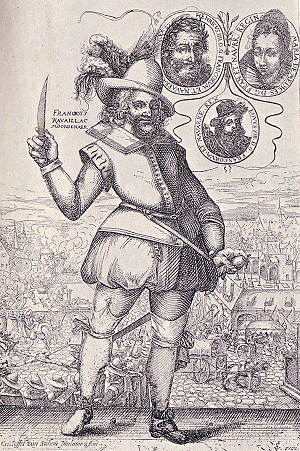
1610: Francois Ravaillac, because Paris was worth more than a mass

On this date in 1610, the fanatical Catholic who assassinated Henri IV of France was ripped apart on the Place de Greve.

The road to this man’s calvary begins long before his infamous crime, even long before the birth of his illustrious victim.

The Protestant Reformation — so richly represented in the executioner’s annals — had fractured France in the 16th century.

After decades of voluptuously indecisive Catholic-versus-Hugeunot slaughter, matters had finally been settled by the man upon whom French absolutism would erect its (ill-fated) edifice.

Henri IV, the first Bourbon monarch and a Huguenot, had unified the country by the sword, capped by his memorably politic conversion to Catholicism in 1593 to win over the holdout capital of Paris — the occasion of his understated declaration that “Paris is worth a mass”.

Let us tarry here to appreciate “the good king Henri” in a kaleidoscope of flattering artwork to the tune of Vive Henri IV, the monarchy’s unofficial anthem after its subject’s passing:

Did you catch that last image?

Henri’s fine gesture of sectarian triangulation and the reign of relative calm it inaugurated were naturally resented by godly partisans of both camps who either considered his conversion a betrayal or considered the king a closet Protestant.

At the crazed end of this latter spectrum, we meet our day’s principal, Francois Ravaillac.

Readers unconstrained by time may enjoy this Tolstoyan trek into the regicide’s mind and milieu, but it will suffice us to say that the modern shotgun-wielding postal clerk who just seemed like a quiet, harmless type to all his coworkers might like the cut of Ravaillac’s jib. A bit of a loner, a bit of a professional washout, with a penchant for religious visions and a passel of ill-arranged grievances … by this point in the movie, that’s about what you expect the police profiler to be reciting.*

It is only right that such a contemporary-sounding lone nut story ought to have a vigorous conspiratorial counternarrative.

There has always been a strong suspicion that behind Ravaillac’s hand was the work of the scheming Catholic Duc d’Epernon, perhaps even with the complicity of Henri’s wife Marie de’ Medici, who had conveniently been crowned as queen the day before the murder** and promptly teamed up with Epernon to cement an alliance with a traditional French rival, the ultra-Catholic Habsburgs.

Balzac, for one, had no doubt about it:

all of [her] actions were prejudicial to France … Marie de’ Medici wasted the wealth amassed by Henri IV.; she never purged herself of the charge of having known of the king’s assassination; her ‘intimate’ was d’Epernon, who did not ward off Ravaillac’s blow, and who was proved to have known the murderer personally for a long time. … [T]he victory Richelieu at last won over her (on the Day of the Dupes) was due solely to the discovery the cardinal made, and imparted to Louis XIII, of secret documents relating to the death of Henri IV.

The historical jury is out on that question, presumably for good.

If Ravaillac was a conspirator, he proved to be a damned good one, denying under repeated torture that he had any accomplices. On this date, the tortures reached their crescendo and conclusion — to the horrible delight of the Parisian mob, as reported by Alistair Horne (via The Corner):

On 27 May, still protesting that he had acted as a free agent on a divinely inspired mission, Ravaillac was put to death. Before being drawn and quartered, the lot of the regicide, on the Place de Grève scaffold he was scalded with burning sulphur, molten lead and boiling oil and resin, his flesh then torn by pincers. Then his arms and legs were attached to horses which pulled in opposite directions. One of the horses “foundered,” so a zealous chevalier offered his mount; “the animal was full of vigour and pulled away a thigh.” After an hour and a half of this horrendous cruelty, Ravaillac died, as the mob tried to prevent him receiving last rites. When he finally expired,

“…the entire populace, no matter what their rank, hurled themselves on the body with their swords, knives, sticks or anything else to hand and began beating, hacking and tearing at it. They snatched the limbs from the executioner, savagely chopping them up and dragging the pieces through the streets.”

Children made a bonfire and flung remains of Ravaillac’s body on it. According to one witness, Nicholas Pasquier, one woman actually ate some of the flesh. The executioner, supposed to have the body of the regicide reduced to ashes to complete the ritual demanded by the law, could find nothing but his shirt.

Ravaillac was the last Frenchman drawn and quartered for a century and a half — but his punishment as a regicide formed the precedent for that handed down in 1757 to Damiens.

* No need, though, as Francois wasn’t hard to catch: he stepped up to Henri’s carriage when it was caught in a traffic jam on May 14, 1610, and stabbed the king to death plain as can be. He was lucky (sort of) to avoid a lynching.

** Rubens later painted a gaudy celebration of this event.

On this day..