1877: Leon Vitalis, inamorato

(Thanks to Harry Brodribb Irving for the guest post, originally published in his Book of Remarkable Criminals. Some formatting has been adjusted for readability. -ed.)

In the May of 1874, in the town of Montpellier, M. Boyer, a retired merchant, some forty-six years of age, lay dying. For some months previous to his death he had been confined to his bed, crippled by rheumatic gout. As the hour of his death drew near, M. Boyer was filled with a great longing to see his daughter, Marie, a girl of fifteen, and embrace her for the last time. The girl was being educated in a convent at Marseilles. One of M. Boyer’s friends offered to go there to fetch her. On arriving at the convent, he was told that Marie had become greatly attracted by the prospect of a religious life. “You are happy,” the Mother Superior had written to her mother, “very happy never to have allowed the impure breath of the world to have soiled this little flower. She loves you and her father more than one can say.”

Her father’s friend found the girl dressed in the costume of a novice, and was told that she had expressed her desire to take, one day, her final vows. He informed Marie of her father’s dying state, of his earnest wish to see her for the last time, and told her that he had come to take her to his bedside. “Take me away from here?” she exclaimed. The Mother Superior, surprised at her apparent reluctance to go, impressed on her the duty of acceding to her father’s wish. To the astonishment of both, Marie refused to leave the convent. If she could save her father’s life, she said, she would go, but, as that was impossible and she dreaded going out into the world again, she would stay and pray for her father in the chapel of the convent, where her prayers would be quite as effective as by his bedside. In vain the friend and the Mother Superior tried to bend her resolution.

Happily M. Boyer died before he could learn of his daughter’s singular refusal. But it had made an unfavourable impression on the friend’s mind. He looked on Marie as a girl without real feeling, an egoist, her religion purely superficial, hiding a cold and selfish disposition; he felt some doubt as to the future development of her character.

M. Boyer left a widow, a dark handsome woman, forty years of age.

Some twenty years before his death, Marie Salat had come to live with M. Boyer as a domestic servant. He fell in love with her, she became his mistress, and a few months before the birth of Marie, M. Boyer made her his wife. Madame Boyer was at heart a woman of ardent and voluptuous passions that only wanted opportunity to become careless in their gratification. Her husband’s long illness gave her such an opportunity. At the time of his death she was carrying on an intrigue with a bookseller’s assistant, Leon Vitalis, a young man of twenty-one. Her bed-ridden husband, ignorant of her infidelity, accepted gratefully the help of Vitalis, whom his wife described as a relative, in the regulation of his affairs. At length the unsuspecting Boyer died. The night of his death Madame Boyer spent with her lover.

The mother had never felt any great affection for her only child.

During her husband’s lifetime she was glad to have Marie out of the way at the convent. But the death of M. Boyer changed the situation. He had left almost the whole of his fortune, about 100,000 francs, to his daughter, appointing her mother her legal guardian with a right to the enjoyment of the income on the capital until Marie should come of age. Madame Boyer had not hitherto taken her daughter’s religious devotion very seriously. But now that the greater part of her husband’s fortune was left to Marie, she realised that, should her daughter persist in her intention of taking the veil, that fortune would in a very few years pass into the hands of the sisterhood. Without delay Madame Boyer exercised her authority, and withdrew Marie from the convent. The girl quitted it with every demonstration of genuine regret.

Marie Boyer when she left the convent was growing into a tall and attractive woman, her figure slight and elegant, her hair and eyes dark, dainty and charming in her manner. Removed from the influences of convent life, her religious devotion became a thing of the past. In her new surroundings she gave herself up to the enjoyments of music and the theatre. She realised that she was a pretty girl, whose beauty well repaid the hours she now spent in the adornment of her person.

The charms of Marie were not lost on Leon Vitalis.

Mean and significant in appearance, Vitalis would seem to have been one of those men who, without any great physical recommendation, have the knack of making themselves attractive to women. After her husband’s death Madame Boyer had yielded herself completely to his influence and her own undoubted passion for him. She had given him the money with which to purchase a business of his own as a second-hand bookseller. This trade the enterprising and greedy young man combined with money-lending and he clandestine sale of improper books and photographs.

To such a man the coming of Marie Boyer was a significant event. She was younger, more attractive than her mother; in a very few years the whole of her father’s fortune would be hers. Slowly Vitalis set himself to win the girl’s affections. The mother’s suspicions were aroused; her jealousy was excited. She sent Marie to complete her education at a convent school in Lyons. This was in the April of 1875. By this time Marie and Vitalis had become friendly enough to arrange to correspond clandestinely during the girl’s absence from home. Marie was so far ignorant of the relations of Vitalis with her mother.

Her daughter sent away, Madame Boyer surrendered herself with complete abandonment to her passion for her lover. At Castelnau, close to Montpellier, she bought a small country house. There she could give full rein to her desire.

To the scandal of the occasional passer-by she and her lover would bathe in a stream that passed through the property, and sport together on the grass. Indoors there were always books from Vitalis’ collection to stimulate their lascivious appetites. This life of pastoral impropriety lasted until the middle of August, when Marie Boyer came home from Lyons.

Vitalis would have concealed from the young girl as long as he could the nature of his relations with Madame Boyer, but his mistress by her own deliberate conduct made all concealment impossible. Whether from the utter recklessness of her passion for Vitalis, or a desire to kill in her daughter’s heart any attachment which she may have felt towards her lover, the mother paraded openly before her daughter the intimacy of her relations with Vitalis, and with the help of the literature with which the young bookseller supplied her, set about corrupting her child’s mind to her own depraved level.

The effect of her extraordinary conduct was, however, the opposite to what she had intended. The mind of the young girl was corrupted; she was familiarised with vice. But in her heart she did not blame Vitalis for what she saw and suffered; she pitied, she excused him. It was her mother whom she grew to hate, with a hate all the more determined for the cold passionless exterior beneath which it was concealed.

Madame Boyer’s deliberate display of her passion for Vitalis served only to aggravate and intensify in Marie Boyer an unnatural jealousy that was fast growing up between mother and daughter.

Marie did not return to the school at Lyons. In the winter of 1875, Madame Boyer gave up the country house and, with her daughter, settled in one of the suburbs of Montpellier. In the January of 1876 a theft occurred in her household which obliged Madame Boyer to communicate with the police. Spendthrift and incompetent in the management of her affairs, she was hoarding and suspicious about money itself. Cash and bonds she would hide away in unexpected places, such as books, dresses, even a soup tureen.

One of her most ingenious hiding places was a portrait of her late husband, behind which she concealed some bearer bonds in landed security, amounting to about 11,000 francs. One day in January these bonds disappeared. She suspected a theft, and informed the police. Three days later she withdrew her complaint, and no more was heard of the matter. As Marie and Vitalis were the only persons who could have known her secret, the inference is obvious.

When, later in the year, Vitalis announced his intention of going to Paris on business, his mistress expressed to him the hope that he would “have a good time” with her bonds. Vitalis left for Paris. But there was now a distinct understanding between Marie and himself. Vitalis had declared himself her lover and asked her to marry him. The following letter, written to him by Marie Boyer in the October of 1876, shows her attitude toward his proposal:

I thank you very sincerely for your letter, which has given me very great-pleasure, because it tells me that you are well. It sets my mind at rest, for my feelings towards you are the same as ever. I don’t say they are those of love, for I don’t know myself; I don’t know what such feelings are. But I feel a real affection for you which may well turn to love. How should I not hold in affectionate remembrance one who has done everything for me? But love does not come to order. So I can’t and don’t wish to give any positive answer about our marriage — all depends on circumstances. I don’t want any promise from you, I want you to be as free as I am. I am not fickle, you know me well enough for that. So don’t ask me to give you any promise. You may find my letter a little cold. But I know too much of life to pledge myself lightly. I assure you I think on it often. Sometimes I blush when I think what marriage means.

Madame Boyer, displeased at the theft, had let her lover go without any great reluctance. No sooner had he gone than she began to miss him. Life seemed dull without him. Mother and daughter were united at least in their common regret at the absence of the young bookseller.

To vary the monotony of existence, to find if possible a husband for her daughter, Madame Boyer decided to leave Montpellier for Marseilles, and there start some kind of business. The daughter, who foresaw greater amusement and pleasure in the life of a large city, assented willingly. On October 6, 1876, they arrived at Marseilles, and soon after Madame bought at a price considerably higher than their value, two shops adjoining one another in the Rue de la Republique. One was a cheese shop, the other a milliner’s.

The mother arranged that she should look after the cheese shop, while her daughter presided over the milliner’s. The two shops were next door to one another. Behind the milliner’s was a drawing-room, behind the cheese shop a kitchen; these two rooms communicated with each other by a large dark room at the back of the building. In the kitchen was a trap-door leading to a cellar. The two women shared a bedroom in an adjoining house.

Vitalis had opposed the scheme of his mistress to start shop-keeping in Marseilles. He knew how unfitted she was to undertake a business of any kind. But neither mother nor daughter would relinquish the plan. It remained therefore to make the best of it.

Vitalis saw that he must get the business into his own hands; and to do that, to obtain full control of Madame Boyer’s affairs, he must continue to play the lover to her. To the satisfaction of the two women, he announced his intention of coming to Marseilles in the New Year of 1877. It was arranged that he should pass as a nephew of Madame Boyer, the cousin of Marie. He arrived at Marseilles on January 1, and received a cordial welcome.

Of the domestic arrangements that ensued, it is sufficient to say that they were calculated to whet the jealousy and inflame the hatred that Marie felt towards her mother, who now persisted as before in parading before her daughter the intimacy of her relations with Vitalis.

In these circumstances Vitalis succeeded in extracting from his mistress a power of attorney, giving him authority to deal with her affairs and sell the two businesses, which were turning out unprofitable. This done, he told Marie, whose growing attachment to him, strange as it may seem, had turned to love, that now at last they could be free. He would sell the two shops, and with the money released by the sale they could go away together.

Suddenly Madame Boyer fell ill, and was confined to her bed. Left to themselves, the growing passion of Marie Boyer for Vitalis culminated in her surrender. But for the sick mother the happiness of the lovers was complete. If only her illness were more serious, more likely to be fatal in its result! “If only God would take her!” said Vitalis. “Yes,” replied her daughter, “she has caused us so much suffering!”

To Madame Boyer her illness had brought hours of torment, and at last remorse.

She realised the duplicity of her lover, she knew that he meant to desert her for her daughter, she saw what wrong she had done that daughter, she suspected even that Marie and Vitalis were poisoning her. Irreligious till now, her thoughts turned to religion. As soon as she could leave her bed she would go to Mass and make atonement for her sin; she would recover her power of attorney, get rid of Vitalis for good and all, and send her daughter back to a convent.

But it was too late. Nemesis was swift to overtake the hapless woman. Try as he might, Vitalis had found it impossible to sell the shops at anything but a worthless figure. He had no money of his own, with which to take Marie away. He knew that her mother had resolved on his instant dismissal.

As soon as Madame Boyer was recovered sufficiently to leave her bed, she turned on her former lover, denounced his treachery, accused him of robbing and swindling her, and bade him go without delay.

To Vitalis dismissal meant ruin, to Marie it meant the loss of her lover. During her illness the two young people had wished Madame Boyer dead, but she had recovered. Providence or Nature having refused to assist Vitalis, he resolved to fall back on art. He gave up a whole night’s rest to the consideration of the question.

As a result of his deliberations he suggested to the girl of seventeen the murder of her mother. “This must end,” said Vitalis. “Yes, it must,” replied Marie. Vitalis asked her if she had any objection to such a crime. Marie hesitated, the victim was her mother. Vitalis reminded her what sort of a mother she had been to her. The girl said that she was terrified at the sight of blood; Vitalis promised that her mother should be strangled. At length Marie consented. That night on some slight pretext Madame Boyer broke out into violent reproaches against her daughter. She little knew that every reproach she uttered served only to harden in her daughter’s heart her unnatural resolve.

On the morning of March 19 Madame Boyer rose early to go to Mass.

Before she went out, she reminded Vitalis that this was his last day in her service, that when she returned she would expect to find him gone.

It was after seven when she left the house. The lovers had no time to lose; the deed must be done immediately on the mother’s return. They arranged that Vitalis should get rid of the shop-boy, and that, as soon as he had gone, Marie should shut and lock the front doors of the two shops.

At one o’clock Madame Boyer came back. She expressed her astonishment and disgust that Vitalis still lingered, and threatened to send for the police to turn him out. Vitalis told the shop-boy that he could go away for a few hours; they had some family affairs to settle. The boy departed. Madame Boyer, tired after her long morning in the town, was resting on a sofa in the sitting-room, at the back of the milliner’s shop. Vitalis entered the room, and after a few heated words, struck her a violent blow in the chest. She fell back on the sofa, calling to her daughter to come to her assistance. The daughter sought to drown her mother’s cries by banging the doors, and opening and shutting drawers. Vitalis, who was now trying to throttle his victim, called to Marie to shut the front doors of the two shops.

To do so Marie had to pass through the sitting-room, and was a witness to the unsuccessful efforts of Vitalis to strangle her mother. Having closed the doors, she retired into the milliner’s shop to await the issue. After a few moments her lover called to her for the large cheese knife; he had caught up a kitchen knife, but in his struggles it had slipped from his grasp. Quickly Marie fetched the knife and returned to the sitting-room.

There a desperate struggle was taking place between the man and woman. At one moment it seemed as if Madame Boyer would get the better of Vitalis, whom nature had not endowed greatly for work of this kind. Marie came to his aid. She kicked and beat her mother, until at last the wretched creature released her hold and sank back exhausted. With the cheese knife, which her daughter had fetched, Vitalis killed Madame Boyer.

They were murderers now, the young lovers. What to do with the body? The boy would be coming back soon. The cellar under the kitchen seemed the obvious place of concealment. With the help of a cord the body was lowered into the cellar, and Marie washed the floor of the sitting-room. The boy came back. He asked where Madame Boyer was. Vitalis told him that she was getting ready to return to Montpellier the same evening, and that he had arranged to go with her, but that he had no intention of doing so; he would accompany her to the station, he said, and then at the last moment, just as the train was starting, slip away and let her go on her journey alone. To the boy, who knew enough of the inner history of the household to enjoy the piquancy of the situation, such a trick seemed quite amusing. He went away picturing in his mind the scene at the railway station and its humorous possibilities.

At seven o’clock Vitalis and Marie Boyer were alone once more with the murdered woman. They had the whole night before them.

Vitalis had already considered the matter of the disposal of the body. He had bought a pick and spade. He intended to bury his former mistress in the soil under the cellar. After that had been done, he and Marie would sell the business for what it would fetch, and go to Brussels — an admirable plan, which two unforeseen circumstances defeated. The Rue de la Republique was built on a rock, blasted out for the purpose. The shop-boy had gone to the station that evening to enjoy the joke which, he believed, was to be played on his mistress.

When Vitalis tried to dig a grave into the ground beneath the cellar he realised the full horror of the disappointment. What was to be done? They must throw the body into the sea. But how to get it there?

The crime of Billoir, an old soldier, who the year before in Paris had killed his mistress in a fit of anger and cut up her body, was fresh in the recollection of Vitalis. The guilty couple decided to dismember the body of Madame Boyer and so disfigure her face as to render it unrecognisable. In the presence of Marie, Vitalis did this, and the two lovers set out at midnight to discover some place convenient for the reception of the remains. They found the harbour too busy for their purpose, and decided to wait until the morrow, when they would go farther afield. They returned home and retired for the night, occupying the bed in which Madame Boyer had slept the night before.

On the morning of the 20th the lovers rose early, and a curious neighbour, looking through the keyhole, saw them counting joyously money and valuables, as they took them from Madame Boyer’s cash-box. When the shop-boy arrived, he asked Vitalis for news of Madame Boyer. Vitalis told him that he had gone with her to the station, that she had taken the train to Montpellier, and that, in accordance with his plan, he had given her the slip just as the train was starting. This the boy knew to be false: he had been to the station himself to enjoy the fun, and had seen neither Vitalis nor Madame Boyer. He began to suspect some mystery.

In the evening, when the shops had been closed, and he had been sent about his business, he waited and watched. In a short time he saw Vitalis and Marie Boyer leave the house, the former dragging a hand-cart containing two large parcels, while Marie walked by his side. They travelled some distance with their burden, leaving the city behind them, hoping to find some deserted spot along the coast where they could conceal the evidence of their crime. Their nerves were shaken by meeting with a custom-house officer, who asked them what it was they had in the cart. Vitalis answered that it was a traveller’s luggage, and the officer let them pass on. But soon after, afraid to risk another such experience, the guilty couple turned out the parcels into a ditch, covered them with stones and sand, and hurried home.

The next day, the shop-boy and the inquisitive neighbour having consulted together, went to the Commissary of Police and told him of the mysterious disappearance of Madame Boyer. The Commissary promised to investigate the matter, and had just dismissed his informants when word was brought to him of the discovery, in a ditch outside Marseilles, of two parcels containing human remains. He called back the boy and took him to view the body at the Morgue. The boy was able, by the clothes, to identify the body as that of his late mistress.

The Commissary went straight to the shops in the Rue de la Republique, where he found the young lovers preparing for flight. At first they denied all knowledge of the crime, and said that Madame Boyer had gone to Montpellier. They were arrested, and it was not long before they both confessed their guilt to the examining magistrate.

Vitalis and Marie Boyer were tried before the Assize Court at Aix on July 2, 1877. Vitalis is described as mean and insignificant in appearance, thin, round-backed, of a bilious complexion; Marie Boyer as a pretty, dark girl, her features cold in expression, dainty and elegant. At her trial she seemed to be still so greatly under the influence of Vitalis that during her interrogatory the President sent him out of court. To the examining magistrate Marie Boyer, in describing her mother’s murder, had written, “I cannot think how I came to take part in it. I, who wouldn’t have stayed in the presence of a corpse for all the money in the world.”

Vitalis was condemned to death, and was executed on August 17. He died fearful and penitent, acknowledging his miserable career to be a warning to misguided youth. Extenuating circumstances were accorded to Marie Boyer, and she was sentenced to penal servitude for life. Her conduct in prison was so repentant and exemplary that she was released in 1892.

M. [Louis] Proal, a distinguished French judge, and the author of some important works on crime, acted as the examining magistrate in the case of Vitalis and Marie Boyer. He thus sums up his impression of the two criminals:

Here is an instance of how greed and baseness on the one side, lust and jealousy on the other, bring about by degrees a change in the characters of criminals, and, after some hesitation, the suggestion and accomplishment of parricide, Is it necessary to seek an explanation of the crime in any psychic abnormality which is negatived to all appearances by the antecedents of the guilty pair? Is it necessary to ask it of anatomy or physiology? Is not the crime the result of moral degradation gradually asserting itself in two individuals, whose moral and intellectual faculties are the same as those of other men, but who fall, step by step, into vice and crime? It is by a succession of wrongful acts that a man first reaches the frontier of crime and then at length crosses it.

On this day..

1548: Seraphin d’Argences

On this date in 1548, the Calvinist evangelist Robert de Lievre — better known by his nom de prosélytisme Seraphin d’Argences, or as Antoine Deschamps — was burned at Paris’s Place Maubert.

According to their hagiographies, the martyrs’ steadiness caused their assigned Catholic hector Francois Le Picart to lay off the browbeating and comfort them in their last pains.

This neat trick was achieved by the dread Chambre Ardente, really earning its name in this instance, which wanted the example made of this itinerant preacher to match the scope of his roving heresy. Seraphin d’Argences had even had the temerity to administer reformed Lord’s Suppers, leading the judgment against them to cite not only the obvious heresy stuff but “acts repugnant to the holy Catholic faith and the sight of the Holy Church, outraging the Blessed Sacrament of the altar.”

The show began with the minister’s collaborators, Jean Thuillier, Michel Mareschal and Jean Camus, piled into a cart for the ride to the stakes. Seraphin d’Argences trailed right behind them, drug on a sledge pulled by the tumbril.

At the Place Maubert, they all burned the same, but the heresiarch’s stake was consciously elevated above the other three — a sure nod to the developing age of spectacular capital punishment.

Following his bodily execution, Seraphin d’Argences was re-executed in effigy in various towns where he had been active: Langres, Sens, Blois, Bourges, Angers, and others all hosted ceremonial “executions” of lifelike likenesses of the lifeless schismatic.

On this day..

1817: Two-fifths of the condemned in Valenciennes

From the York Herald and General Advertiser (York, England) of Saturday, Aug. 16, 1817.

Five English soldiers being on guard, the 18th of June last, at one of the gates of Valenciennes, committed a robbery on the house of an individual, and were condemned to be hanged. They were conducted, by the orders of Lord Wellington, on the 3d of July, outside the walls of the town, to undergo their punishment.

The people followed the culprits, invoking, in accents of sorrow, the pity of their officers, and crying “Mercy! Mercy!”

Two of them were executed, and the other three received their pardon at the very moment they were about to part with life. At this news the joy of the numerous spectators was extreme, and the thanks they addressed to the English General were no doubt less eloquent than the joy from which they emanated.

On this day..

1413: Pierre des Essarts

On this date in 1413, France’s treasurer Pierre des Essarts was beheaded and gibbeted on Montfaucon.

The backdrop for this disorderly drumhead execution is a popular rebellion of Parisian artisans and laborers. Known as the Cabochien Revolt after one of its leaders, the butcher Simon Caboche (“Simon the Skinner”), it dovetailed with an intra-French civil war pitting Armagnacs against Burgundians.


Armagnac vs. Burgundy. (Rimshot.)

With the mentally incapacitated Charles VI on the French throne, de facto executive power on the regency council that called the shots in his stead was violently contested by these rival factions.

The Burgundian Duke John the Fearless mounted a systematic push to nail down ultimate say-so in the French government. Were there electoral maps in Hundred Years’ War France — for this civil conflict took place even while English armies were ravaging the countryside — Paris would have been colored wine-red: mercantile Burgundy, whose territories ran up to the trade-happy Low Countries, espoused the more urban economic outlook and favored constraining the king’s own prerogatives — both going interests for Parisian burghers. John the Fearless won popularity proposing those old political chestnuts for the City of Light: tax abatement paid for by reeling in waste and corruption. By contrast, “Armagnac” branded the feudal and royalist party, led by Charles, Duke of Orleans.*

This volatile solution went bang when the Cabochiens rose in Paris a few days after Easter, trapping the king in the city. Though they had some sympatico with the Burgundians, John the Fearless’s attitude towards the Cabochiens is difficult to state with certainty — somewhere between outright conniving with them, and using his popular esteem to rein in the mob. Either way, backlash against the Cabochiens would redound to the favor of the Armagnacs — Backlash against things like hanging the provost on Montfaucon.

Pierre des Essarts had actually been elevated to his post by John the Fearless himself, after the latter took Paris in hand 1409 and executed a previous royal chamberlain, Jean de Montaigu. The Cabochiens, however, besieged him in the Bastille and finally drug him out to prison.

“Many Parisians, who in the previous year had shown great attachment to [Pierre des Essarts] … then changed their minds, which I do not understand,” one chronicler complained (Source). “One cannot explain this love of change, which always torments the capricious rabble. They became deeply resentful of him, harboured a mortal hatred of him, and demanded that another provost replace him.” (According to Karen Green’s introductory essay on the remarkable author Christine Pizan, an observer to these events, it was des Essarts’s willingness to cooperate with Armagnac factors charging peculation on the part of Burgundians that made him a target for his former allies.)

Though they amount to just a blip historically, the Cabochiens for a few months in 1413 stalked elites’ nightmares like the Jacobins would later do. That May, a mob barged into the royal palace of St. Paul and arrested the queen’s brother, adding him to several dozen crammed into prison on their say-so, and eventually having des Essarts’s head on a pike.

And just in time. By August, the wealthier part of the Cabochien movement had been bought off with some reforms, leaving the remnants ripe for smashing — and John the Fearless, popularity waning, ready to abandon Paris to the Armagnacs.

* The Armagnac name arrived via the Duke of Orleans’s marriage to the daughter of the Count of Armagnac. As Orleans was a mere strapling at this point (having inherited young because Burgundy assassinated his father), Armagnac guided the policy.

A few years on from the narrative in this post, Orleans would be captured at the Battle of Agincourt and spend a quarter-century as an English prisoner. Since he had plenty of time to kill, he made his name during his relaxed captivity as a poet. Whatever ravages he might have committed in service of civil strife in his youth, probably none lies heavier on his soul than launching the industry of Valentine’s Day schlock.

On this day..

1794: Rosalie Lubomirska, mother of Balzac’s antagonist

On this date in 1794, the Polish princess Rosalie Lubomirska was guillotined during the Paris Terror.

The hottest thing to come out of Chernobyl before 1986, the glamorous young Lubomirska had it all going for her before Europe turned revolutionary.

Her support for the reformist Patriotic Party in her homeland required her flight on to France when a Russian invasion defeated that movement in 1792. Indeed, short as her own thread was cut, Rosalie Lubomirska was only barely outlived by the Polish-Lithuanian Commonwealth itself.

But escaping to her friend Marie Antoinette in France might not have been the savviest choice.

The irrepressible Melanie “Madame Guillotine” Clegane, author of such topical historical fiction as The Secret Diary of a Princess: A Novel of Marie Antoinette, has everything you need to know about Rosalie Lubomirska’s activities from that point in this post: going royalist after the execution of Louis XVI, taking Vendee rebels into her salon and/or bed, and seeing her lovers precede her to the guillotine while she desperately bought time by feigning pregnancy.

She left behind a young daughter. In much later years, this little girl grown up and married to noted Orientalist scholar Waclaw Seweryn Rzeuwski would manifest as a side character in a very different story: she is “Aunt Rozalia”, whose niece was Ewelina Hanska, the admirer turned wife of the novelist Honore de Balzac. Aunt Rozalia was a bitter foe of Ewelina’s declasse romance with the bourgeois scribbler and to judge by the correspondence of the lovers was continually trafficking in rumors that Balzac — who was in actuality a legendary workaholic — was a gambler, boozer, or suchlike dissipated wastrel.

Balzac gave his antagonist the gift of literary immortality by using her as an inspiration (one inspiration: his own mother was another) for the titular killjoy spinster in his novel Cousin Bette.

On this day..

1340: Nicholas Behuchet, Battle of Sluys naval commander

On this date in 1340, the English and French fought an early naval engagement of the Hundred Years’ War: the Battle of Sluys.

The English won the battle … and the French admiral wound up hanging from a mast.

At the outset of the Hundred Years’ War in 1337, the French bossed the Channel and inflicted devastating sea raids on the English coast. In the long war’s first major battle at sea, a French fleet in September 1338 overwhelmed an English flotilla carrying valuable English wool to the Low Countries.

Nicholas Behuchet, one of the French commanders at this earlier battle, did not hesitate to massacre his prisoners.

Thus conquering did these said mariners of the king of France in this winter take great pillage, and especially they conquered the handsome great nef called the Christophe, all charged with the goods and wool that the English were sending to Flanders, which nef had cost the English king much to build: but its crew were lost to these Normans, and were put to death.

England’s allies were in the Low Countries, so too many battles like this stood to strangle the English cause in the crib. For near two years, French privateers had leave to ravage the English coast, while French troops overran Flanders and made the English Queen Philippa* hostage.

Seeking a breakout, King Edward III requisitioned English merchant cogs — there was no standing navy at the time — into a fleet of perhaps 160 or 200 vessels, heavy with soldiers to invade Flanders.

On June 24, two days after setting out from the Orwell estuary at Ipswich, Edward’s armada boldly fell upon a larger French fleet anchored at the Flanders port of Sluys.

The medieval chronicler Froissart’s account makes for riveting reading.** This was no stately ballet of seamanship but a gory close-quarters melee: as was characteristic for the time, the “sea” battle was mostly just about coming together for the respective fleets’ marines to board one another’s ships and murder anyone on board who wasn’t worth a ransom. The French admiral Behuchet lashed his ships together across the mouth of the harbor, a sort of floating breastwork that would enable the French soldiery to shimmy up and down the entire line no matter where the English focused their attack.

To the sound of “scores of trumpets, horns and other instruments,”

Fierce fighting broke out on every side, archers and crossbowmen shooting arrows and bolts at each other pell-mell, and men-at-arms struggling and striking in hand-to-hand combat. In order to come to closer quarters, they had great iron grappling-hooks fixed to chains, and these they hurled into each others’ ships to draw them together and hold them fast while the men engaged. Many deadly blows were struck and gallant deeds performed, ships and men were battered, captured and recaptured. The great ship Christopher [a large English cog previously captured by the French and situated in the French front row -ed.] was recovered by the English at the beginning of the battle and all those on board were killed or taken prisoner …


An illustration of the Battle of Sluys from Froissart’s chronicle. Note the mast of the ship at far left: it displays the English arms quartered with the French, Edward III’s heraldic assertion of sovereignty over both realms.

It was indeed a bloody and murderous battle. Sea-fights are always fiercer than fights on land, because retreat and flight are impossible. Every man is obliged to hazard his life and hope for success, relying on his own personal bravery and skill … [it] rage[d] furiously from early morning until afternoon, during which time there were many notable feats of arms and the English were hard put to it to hold their own, since they were opposed by hardened soldiers and seamen, who outnumbered them by four to one.

Edward III took an arrow or crossbow bolt to the leg — great-man historical legend has it that it was fired by Nicholas Behuchet himself — but captained his flotilla to an overwhelming victory, capturing most of the French ships and destroying the French, their Genoese allies, “and all who were with them … [they were] killed or drowned, not a single one escaping in the general slaughter.” Poetic license aside, it was a spectacular triumph for the English — and a crushing defeat for the French.†

In the 1596 play Edward III, which might have been co-written by Shakespeare, imagined the scene in the report of an escaped mariner:

Purple the sea, whose channel filled as fast
With streaming gore that from the maimed fell
As did the gushing moisture break into
The crannied cleftures of the through-shot planks.
Here flew a head dissevered from the trunk,
There mangled arms and legs were tossed aloft
As when a whirlwind takes the summer dust
And scatters it in middle of the air.
Then might ye see the reeling vessels split
And tottering sink into the ruthless flood,
Until their lofty tops were seen no more.

Let it not be said that in this instance the commander escaped the consequences of his folly. Behuchet, who insisted against advice on lashing the boats together and thereby sacrificed all maneuverability, didn’t have much room for maneuver himself when the victorious English hanged him at battle’s end from the mast of his own ship.

* Seen elsewhere in these pages successfully begging her husband’s pardon of the famed Six Burghers of Calais later in the war. Philippa was a homegrown native of the Low Countries, and her marriage to Edward III reflects the alliance between their respective regions.

** For a snappy modern gloss on the battle, check this excerpt of Dan Jones’s The Plantagenets: The Warrior Kings and Queens Who Made England.

It is said that no courtier dared give King Philip VI of France the horrifying news until a jester availing his station’s license for cheek informed him that “Our knights are much braver than the English.” Asked why, the fool replied, “The English do not dare jump into the sea in full armour.”

On this day..

1977: Jerome Carrein, the second-last in France

At dawn this date in 1977, child murderer Jerome Carrein was guillotined in the courtyard of Douai prison. He was the second-last person executed in France’s history.*

He was a vagabond ex-convict who slept most nights in the slough of rural Arleux, cadging food enough off relatives and a pitying local barkeep.


The Marsh at Arleux by Jean-Baptiste-Camille Corot (1871)

It was a more bestial appetite that saw him into the guillotine’s annals: on October 27, he pursuaded an eight-year-old schoolgirl, the daughter of his benefactor publican, to come along with him. Once he had her in the swamps, Carrein attempted to ravish little Cathy Petit. As Cathy struggled, Carrein later explained — he confessed almost immediately — “I saw red. I felt lost in the idea that she would denounce me, so I threw her in the pond.”
Her drowned corpse was discovered the next day.

The growing reluctance of the French state to slice off heads in the 1970s did not express itself in interminable wait times on death row. Carrein was condemned to death on July 12, 1976, during the run-up to Christian Ranucci‘s execution for a similar abduction/child murder.

That conviction was vacated a few months later for a trial irregularity, but the retrial took place in the wake of another high-profile trial: anti-death penalty crusader Robert Badinter had successfully defended a man named Patrick Henry from the guillotine in yet another nationally known child murder case, winning a life sentence instead. There was no small public outcry over this outcome, and Carrein’s prosecutor explicitly called on the jury in his second case to avenge with severity to Carrein the “rape of public conscience” perpetrated by leniency to Henry. (London Times, June 24, 1977)

Pierre Lefrance, speaking for Carrein’s defense, ventured his own appeal to the jurors’ wider sensibilities — in this case, of the growing likelihood that capital punishment was nearing the end of the line in France: “Were the death penalty to be abolished at last in the next year or two, would you wish that Carrein was the last man guillotined in France?”

The invaluable French-language guillotine.cultureforum.net has a forum thread on this case; be sure to note the appearance on page 3 of a poster claiming to be the daughter of Jerome Carrein’s first wife.

* It was also the first execution of France’s last official chief executioner, Marcel Chevalier.

On this day..

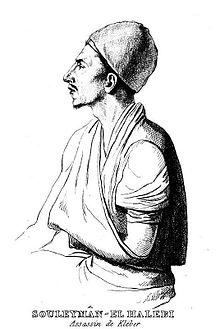
1800: Suleiman al-Halabi, assassin of General Kleber

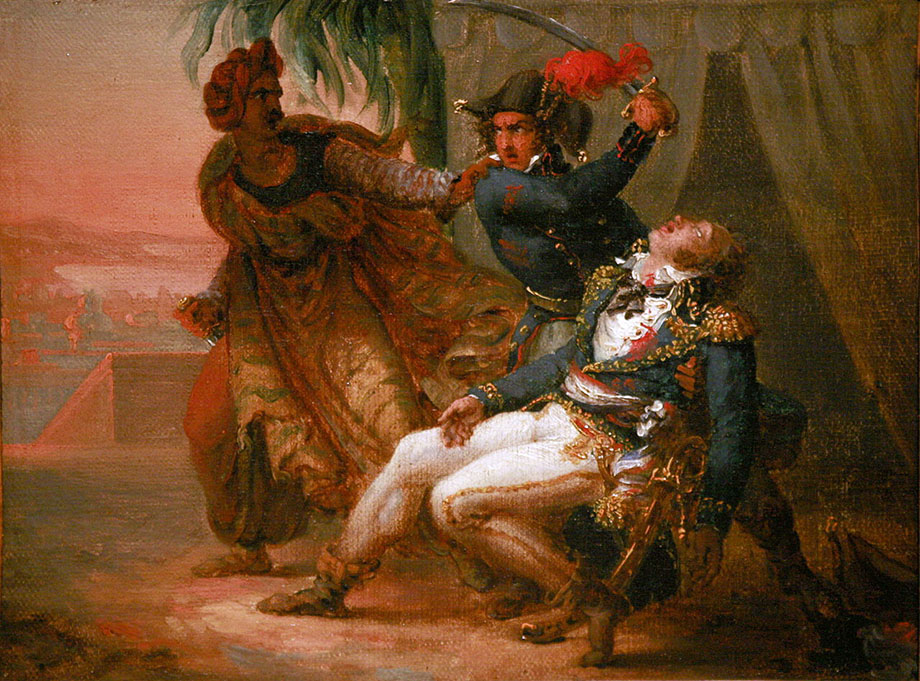
On this date in 1800 — which was the same date they buried his victim — the 23-year-old student Suleiman al-Halabi was put to death in Cairo for assassinating French General Jean Baptiste Kleber.

Casualty of the brief Napoleonic adventure in Egypt, Kleber had received supreme command of the expedition when Napoleon himself returned to France the previous year — a mission which involved running the English naval blockade that trapped the Armee d’Orient.

Kleber, a product of the French Revolution’s military meritocracy who had attained his rank capably suppressing the Vendee royalists, was certainly up to the martial tasks at hand. He routed a larger Ottoman-English-Mamluk force in March of 1800, and then smashed a revolt in Cairo.

But the Napoleonic invasion often figures as a periodization marker for this region: the germ of liberalism and nationalism that would tear apart the Ottoman Empire and set the scene for a recognizably modern Middle East. So it’s somewhat fitting that Kleber would be undone by a figure who could be lifted from the evening news,* the anti-occupation insurgent.

Suleiman al-Halabi (English Wikipedia entry | French) was a Syrian Kurd hailing from Aleppo. (“al-Halabi” means “of Aleppo”)

He had been in Cairo to study, but after a return visit home was induced by the Turks to attend himself to punishing the invader instead. He then made his way back to to Egypt where, disguising himself as a beggar, where he was able to approach the general innocuously and dagger him to death.

The French, of course, had just a few years before this point introduced its most distinctive execution device in place of the ghastly old methods, and employed it with egalite for commoner and king alike. Nor was France, as an imperial power, reluctant about exporting its invention to the every corner of earth.

But in this particular instance, the French decided to prioritize, er, cultural sensitivity.

The committee, after carrying through the trial with all due solemnity and process, thought it necessary to follow Egyptian customs in its application of punishment; it condemned the assassin to be impaled after having his right hand burned; and three of the guilty sheikhs to be beheaded and their bodies burned.

The “guilty sheikhs” in question were men to whom the killer had confided — not his plan, exactly, but the fact that he was on a jihad mission. Hey, close enough.

As for Suleiman al-Halabi himself,

The executioner Barthèlemy sat down on Suleiman’s belly, drew a knife from his pocket, and made a large incision to widen the rectum, then hammered the point of the stake into it with his mallet. Then he bound the patient’s arms and legs, raised the stake the air and mounted it in a prepared hole. Suleiman lived for four hours, and he had lived longer save that, during the absence of Barthèlemy, a soldier gave him a drink which caused his immediate death.

(Impaling victims could live for agonizing days, but the water caused Suleiman, mercifully, to quickly bleed out.)

Not content with going all Vlad the Impaler, the French then paid homage to the invasion’s scientific sub-theme** by shipping Suleiman’s remains back to France for use as an anthropological exhibit.† His skull still remains at the Musee de l’Homme to this day. What’s left in his homeland(s) is a martyr’s memory.

According to the scholar al-Jabarti, whose chronicle is one of the principal sources on this episode, the investigation indicated that Suleiman undertook his mission for no ideology save his family’s desperate need of the purse the Porte was willing to offer. But in the ensuing decades’ growth of nationalism and, eventually, anti-colonialism, the brave young Muslim dying on a spike to slay the French commander could not help but be viewed in an exalted light. (Notably, at the acme of Arab nationalism, the Egyptian writer Alfred Farag celebrated Suleiman as an avatar of resistance in a 1965 play. “I do not kill for revenge,” Farag’s Suleiman avers — and when pressed for the reason, he has a one-word reply: “Justice.”)

* Indeed, the name has been in the news: there’s a Suleiman al-Halabi neighborhood in Aleppo that has seen fighting during the ongoing Syrian civil war. Since it’s even a Kurdish neighborhood one can’t but suspect that it’s named for the man featured in this post; however, I haven’t been able to establish that with certainty. If any reader knows, a comment would be most welcome.

** Napoleon brought a corps of scientists and intellectuals along on his invasion, kicking off the modern Egyptology craze. His mission also uncovered the Rosetta Stone — although that artifact now resides in the British Museum because of the aforementioned naval blockade.

† According to Dark Trophies: Hunting and the Enemy Body in Modern War, phrenologists hailed Suleiman’s skull as an outstanding exemplar of criminality and fanaticism.

On this day..

1820: Louis Pierre Louvel, anti-Bourbon assassin

On this date in 1820, Louis Pierre Louvel was guillotined at Paris’s Place de Greve for murdering the heir to the French throne.

Louvel (French link) was a Bonapartist saddler, so embittered by the return of the ancien regime that he vowed on the day of the Restoration to exterminate all the Bourbons.

While his attempt to greet the returning Louis XVIII in April 1814 with a dagger came to naught, Louvel’s patience paid off six years later.

On February 13, 1820, he surprised the Duke of Berry outside the opera and plunged a knife into his chest.

The Duke, who expired the next morning, was not the heir to the throne: he was the younger of two sons of the Comte d’Artois, who was the brother of the still-reigning Louis XVIII. These Bourbons, however, seemed congenitally unable to reproduce: Louis XVIII would die childless, leaving the aforesaid Comte d’Artois to inherit as Charles X; the oldest of Artois’s children also had a childless marriage.

So the potential future of the dynasty looked a murky thing in 1820. The Duke of Berry had an infant daughter, and the guy looked like maybe the only male in the royal family’s younger generation who might be capable of fathering a son. Louvel’s blow potentially set the stage for an eventual succession crisis.*

The killer was promptly arrested and made no bones about his action, avowing that he acted without aid or accomplice. He had, he said, no particular personal beef with the Duke: it’s just that he considered the guy’s entire family traitors whose presence dishonored the nation. (Here’s a complete French account of his trial.)

Because Louvel had his head cut off by the guillotine, he was not around to experience the miraculous September delivery by Louvel’s widow of a posthumous son and heir. In time, this son would become the Legitimist pretender to the French throne.

As a matter of fact, the prideful Count of Chambord could have become king after the Franco-Prussian War and the Paris Commune wiped away the Second Empire. But to the grief of practical-minded monarchists, he publicly refused to accept the offered throne that he’d been waiting all his life for unless the nation also gave up the beloved tricolore flag associated with the regicidal Revolution. France said no thanks, and hasn’t had a monarch since.

* One more immediate consequence of Louvel’s strike: the liberal monarchist prime minister Elie Decazes came under opportunistic attack by ultra-royalists for giving aid and comfort to the terrorists with his moderate policies. Decazes was forced to resign and briefly went into exile in England due to the Ultras’ fulminations.

On this day..

1871: Archbishop Georges Darboy, Paris Commune hostage

On this date in 1871, the doomed Paris Commune martyred Archbishop Georges Darboy.

When Darboy (English Wikipedia entry | French) was tapped for the job in 1863, there had already been two recent occupants of the seat of Notre Dame killed violently over the generation preceding.*

A “learned, conscientious, and respected prelate,” Darboy’s own cross to shoulder was the collapse of the Second Empire with France’s defeat in the Franco-Prussian War.

That conflict in turn triggered the 1871 working-class revolution in Paris which briefly drove the established government to the old Bourbon haunts at Versailles while maintaining the capital as the Paris Commune.

Darboy declined to follow the many Parisian bourgeoisie who escaped the city in those brief months, but his importance as a visible envoy of the rival order was not so easily refused. The Communards seized Darboy as perhaps the crown jewel among dozens of hostages against the anticipated Versailles counterattack.

Versailles declined to bargain for Darboy or any of the other human shields.** Instead, the city’s cobblestones drank the blood of 20,000 or more in a seven-day urban invasion in late May that has become known as the “bloody week” (semaine sangiante) — and the Commune’s hostages would mingle their blood with the those on the barricades, suffering in their few individual persons the vengeance the Parisian workers longed to visit upon an entire class.

When the Versaillese fixed his eye upon you, you must die; when he searched a house, nothing escaped him. “These are no longer soldiers accomplishing a duty,” said a conservative journal, La France. And indeed these were hyenas, thirsting for blood and pillage. In some places it sufficed to have a watch to be shot. The corpses were searched, and the correspondents of foreign newspapers called those thefts the last perquisition. And the same day M. Thiers had the effrontery to tell the Assembly: “Our valiant soldiers conduct themselves in such a manner as to inspire foreign countries with the highest esteem and admiration.”

At half-past seven a great noise was heard before the prison of La Roquette, where the day before the three hundred hostages, detained until then at Mazas, had been transported. Amidst a crowd of guards, exasperated at the massacres, stood a delegate of the Public Safety Commission, who said, ‘Since they shoot our men, six hostages shall be executed. Who will form the platoon?’ ‘I! I!’ was cried from all sides. One advanced and said, ‘I avenge my father,’ another, ‘I avenge my brother.’ ‘As for me,’ said a guard, ‘they have shot my wife.’ Each one brought forward his right to vengeance. Thirty men were chosen and entered the prison.

The delegate looked over the jail register, pointed out the Archbishop Darboy, the President Bonjean, the banker Jecker, the Jesuits Allard, Clerc, and Ducoudray; at the last moment Jecker was replaced by the Curé Deguerry.

They were taken to the exercise-ground. Darboy stammered out, ‘I am not the enemy of the Commune. I have done all I could. I have written twice to Versailles.’ He recovered a little when he saw death was inevitable. Bonjean could not keep on his legs. ‘Who condemns us?’ said he. ‘The justice of the people.’ ‘0h, this is not the right one,’ replied the president. One of the priests threw himself against the sentry-box and uncovered his breast. They were led further on, and, turning a corner, — met the firing-party. Some men harangued them; the delegate at once ordered silence. The hostages placed themselves against the wall, and the officer of the platoon said to them, ‘It is not we whom you must accuse of your death, but the Versaillese, who are shooting the prisoners.’ He then gave the signal and the guns were fired. The hostages fell back in one line, at an equal distance from each other. Darboy alone remained standing, wounded in the head, one hand raised. A second volley laid him by the side of the others.

The blind justice of revolutions punishes in the first-comers the accumulated crimes of their caste.

Lissagaray

The six who fell on this occasion would be followed in the Commune’s few remaining days by many more of their fellow hostages — and by countless communards. Theophile Ferre, who authorized the May 24 reprisal execution (and specifically called for Archbishop Darboy’s selection) was himself executed by the victorious bourgeois government that November.

* One of those violent deaths sent an assassin to the guillotine in 1857.

** Specifically, the Commune attempted to exchange Darboy and other hostages for Louis Auguste Blanqui, the great socialist leader whom Versailles had taken prisoner.

On this day..