1868: Three Italian bandits

On this date in 1868, a trio of notorious Italian brigands went under the French guillotine in Marseilles.

Joseph Coda-Zabetta, the leader, had escaped a hard labor sentence in Italy and fled to France where he founded a large band of robbers who terrorized France’s Mediterranean countryside from Nice to Marseilles for some months in 1867.

From raiding unoccupied country homes the gang soon progressed to bold invasions of occupied houses and waylaying travelers. “In one instance,” a press report of their trial reported,* “six of the band attacked a convoy of carriers, one of whom received a pistol-shot in the breast and a stab with a knife, from which injuries he afterwards died.”

Twelve of the band faced trial, and four of their number received death sentences. (Seven others had long prison sentences; a man named Muletto was acquitted.)

Coda, Antoine Quaranta, and Felix Mardi (Italian pdf) were all guillotined on this date in 1868. (They died, it was said, repentant (French).) The fourth condemned prisoner, Jacques Mulatere, had his death sentenced commuted to life at hard labor.

* London Times, Dec. 20, 1867

On this day..

1909: The Pollet gang, breaking the French moratorium

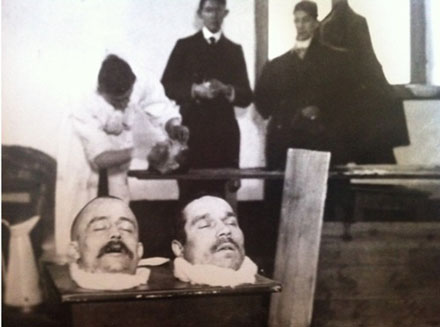
Warning: Graphic severed head pictures await at the bottom of this post.

On this date in 1909, the guillotine returned France after an absence of more than three years.

The sitting president was a staunch death penalty opponent and had blocked all executions since his term began in 1906. That was about the same span of time that the Pollet gang had, in the words of a New York Times wire report,* “infested the Belgian-French frontier, robbing churches, houses, and inns, holding up stage coaches and belated travelers, and torturing and slaying their victims according to the old piratical adage that dead men tell no tales.”

Abel Pollet had been a smuggler who put his native gift for leadership to good use organizing his fellow traffickers into a more lucratively violent line of work. Thanks, presumably, to the syndicate’s pre-existing professional aptitude for evasion, it persisted for years and authored a quantity of robberies and murders that authorities could only guess at. (The official homicide estimation ran north of 50.) It was a spree so atrocious that it helped force the end of the whole death penalty moratorium since sentiment was so strong against the Hazebrouck gang .

Incited by the many depredations and perhaps starved from years without the bloody spectacle of public execution, a vast concourse of 30,000 mobbed the guillotine at Bethune.

“At midnight there were 2,000 watchers in the square,” one report ran. “The main street of the town was crowded as on the eve of a fete. Soon after midnight men brought ladders and benches to the square and mounted them to obtain an uninterrupted view. Others climbed into the branches of trees, where their presence was revealed by the glow of cigarettes and pipes in the dark among the branches.”

Undeterred by the steady winter’s drizzle, they would wait all the night through, their numbers continually augmented as road-trippers arrived by train.

At four in the morning the dread traveling executioner Anton Diebler, who had already plied this trade for a generation and more and would continue in the role for another 30 years, arrived with four assistants to set up the guillotine. It was only with difficulty that police restrained the pawing mob.

By half-past five the public prosecutor officially informed the condemned men what they surely already knew — that there would be no mercy. The crowd on the square would have its prey.

As the first robber, Theophile Deroo, emerged at 7:25 a.m., “there was a painful silence, and then an outbreak of hoots and curses from the crowd.” A wilting Deroo had to be hustled to the board amid the jeers. “A mort! A mort!” came the howls.

Three times in the next eight minutes the executioners furiously scrubbed the apparatus clean while guards (per the Times) “held the crowd back with main force.”

Canut Vromant followed coolly; Auguste Pollet was third, fighting and shouting. His brother, the leader Abel Pollet, went under a rain of curses that he answered with the words “Down with the priests! Long live the Republic!”

People are ghoulish. Far be it from us to deny them.


Top: the heads of the Pollet brothers. Middle: The heads of their two accomplices. Bottom: Canut Vromant’s headless trunk awaits autopsy. All images from the invaluable Bois de Justice, via this goregrish forum.


After the quadruple executions, the heads are cleaned up. (Source)

Perhaps, dear reader, you find the public exhibition of these severed heads objectionable. If so, you have an ally in the French state that did the severing.

For years, French elites had been fretting the indecorous behavior of the crowd at what was supposed to be a solemn occasion. The advent of photography only made matters worse, for now the discomfiting head-chopping exercise could be shared with those indisposed to sitting up all night smoking pipes in trees.

But as the moratorium gave way, the rising media form of cinema promised even more debased exhibitions. Enterprising cinematographers were already staging execution re-creations; now there was the prospect for film audiences to be incited to countless bloodlust frenzies by on-the-scene deathporn footage of hated criminals going under the blade. It was in response to just this fear that France a bit later in 1909 promulgated (French link) its first film censorship rules — forbidding in this case the public display of film liable to disturb the public tranquility.

* Jan. 16, 1909 … under the excited headline “THIRST FOR BLOOD AMONG THE FRENCH”,

On this day..

1554: Guillaume Dalencon, defrocked priest

Felix Platter is our narrator for Guillaume Dalencon’s death at the stake on this date in 1554.

This book portrays the 16th century through the remarkable Platter family.

Platter (English Wikipedia entry | German) was a 16-year-old Swiss student, and we find him on the midpoint of his family’s upward arc in the world. His father, Thomas, had as a child been put out of the house by his impoverished mother and made his way for a time as a beggar; by dint of lifelong struggle and application, he had gained a precarious foothold among the bourgeoisie of Basel. Thomas Platter nurtured still greater ambitions for his son.

Accordingly, the very genial Felix, who had never before traveled, set out in 1552 on the 400-mile journey to the city of Montpellier in southern France. Young Platter was an energetic diarist, and his impressions of the journey and of Montpellier were published in English as Beloved Son Felix. (That’s how Felix’s father addressed him in letters.) Though the book is out of print, it’s available online at archive.org.

One of its immediately striking features is the omnipresence of danger and death. Platter luckily left Basel just ahead of a plague outbreak, but he nearly lost his life in the frightening Jurthen forest. Taking shelter from the rain there in “a wretched inn” at a squalid hamlet called Mezieres, Platter and his companion found the place full of aggressive Savoyard peasants, and having no choice but to stay overnight they blockaded their door with a bed and kept a waking vigil all night with weapons at the ready. Three hours before dawn, they crept through the snoring mass of drunken thugs and slipped away, and a good thing it was too: the boys’ French guide told them as they set out that he had overheard the brutes plotting to murder the hapless travelers that morning.

The bandit “Long Peter”, who was then active in this forest, was eventually caught and executed on the breaking-wheel in Berne. Only in his old age did Platter learn that the brigand’s confession included a declaration that he had planned, but failed, to kill some students in Mezieres.

They had escaped by the skin of the teeth, but seemingly every page of the journal finds others who succumbed to the many paths to abrupt death the 16th century had to offer. (Not a few of them are corpses that Platter stole from their graves with fellow-students in order to anatomize.) This was, too, the age of spectacular public execution: the travelers’ road on October 18th, 1552, passed numerous “bodies of men hanging from the trees” and as darkness fell Platter gave himself a fright when he nearly rode into one. By the 20th they approached Lyons, where they beheld “several men hanging from gibbets and others exposed on wheels.” As they entered that city, they passed a Protestant “being led out to be burnt outside the gate; he was in his shirt with a truss of straw fastened on his back.”

Platter makes no further comment on this sight, but it must have touched him with pity — if not fear. Platter had been born in Basel about the same time that John Calvin, fleeing French persecution, arrived there; it was in Basel that Calvin first published his seminal theology Institutio Christianae religionis. To this faith, predominant in Swiss cities but illicit in France, Platter too subscribed. The French Wars of Religion loomed around the corner in the next decade, and Montpellier would become a Huguenot stronghold during that conflict. While Platter was there, an uneasy peace prevailed between growing ranks of Protestants and the official religion. The University of Montpellier attracted numerous Protestant students (the city lay in the heart of the Languedoc, a center of resistance to the papacy from long before the Reformation), and Platter’s own mentor, the brilliant doctor Guillaume Rondelet, had ambiguous religious affiliations.

Day to day, these students kept their heads down in matters religious and went about mostly unmolested. Taking a vocal stand on theological controversies here would be to embark upon a different path than Thomas Platter had in mind for his son, for heretics were among the many executions Platter recounts in his journal.

Guillaume Dalencon, the boy learned, was a former priest of Mountauban, “unfrocked on the 16th of October” when it was discovered that he had gone Protestant and brought back heretical books from Geneva. “Dressed in his priestly robes, he was brought on to a platform before the bishop” for his defrocking. “After protracted ceremonies in Latin he was divested of his chasuble and the rest, and given secular clothing. Hishead was then shaved, and two fingers were cut off his hand. After this he was delivered to the civil justice and once more thrown into prison.” The secular power took it from there.

On the 6th of January Guillaume Dalencon, unfrocked eleven weeks before, and since then held in prison, was condemned to death. In the afternoon a man carried him on his shoulders out of the town towards the monastery, to the place of execution. A pyre had already been built there. Beind the condemned man two other prisoners walked, one a cloth shearer, in his shirt, with a bale of straw fastened to his back; the other of good appearance, and well dressed. Both of them had recanted and denied the true faith. [i.e., both had recanted Protestantism under the threat of execution. -ed.] Dalencon, however, sang psalms all the way. At he pyre, he sat down on a log and himself took off his clothes as far as his shirt, and arranged them beside him tidily, as though he would be putting them on again. He exhorted the other two, who were about to apostasize, so touchingly that the sweat stood out in great drops, as big as peas, on the forehead of the man in the shirt. When the monks, formed in a curve around him, and mounted on horseback, told him that it was time to make an end, he leapt joyously on to the pyre and sat down at the foot of the stake that rose in the center of it. This stake was pierced by a hole, through which ran a cord with a running noose. The executioner put the cord round Dalencon’s neck, tied his hands across his breast, and placed near him the religious books he had brought from Geneva. Then he set fire to the pyre. The martyr remained seated, calm and resigned, with his eyes raised towards heaven. When the fire reached the books the executioner pulled on the cord and strangled him; his head dropped to his breast and he made no further movement. Little by little the body was reduced to cinders. His two companions stood at the foot of the fire, where they were made to watch his sufferings, and could feel the heat of the flame.

After the execution they were both taken to the Hotel de Ville. Near there, in front of the church of Notre-Dame, a platform had been set up, with a statue of the Virgin on it, before which they would have to recant. The crowd had to wait for them for a long time. At last only one of the two men was brought out. The cloth shearer had refused to abjure and demanded that he should be executed without mercy for having failed his beliefs. He was therefore taken back to prison. The other man, who seemed to be a man of substance, was placed on his knees before the statue of the Virgin, with a lighted candle in his hand. A clerk read out various charges, to which he had to reply. In this way he saved his life, but he was sent to the galleys and there put in chains.

On the following Tuesday, the 9th of January, it was the turn of the cloth shearer again. He was strangled and burnt as the priest had been. He showed great courage, and no less repentance for having come so near to denying his faith. It had rained on that day, and the fire would not burn. The victim, who was not completely strangled, endured great suffering. At last the monks of the neighbouring monastery brought some straw, and the executioner took it and sent for oil of terebinth from my master’s pharmacy to ignite the fire. Afterwards I reproached the assistants who had given it to him, but they advised me to hold my tongue, for the same fate could befall me also, as a heretic.

During these affairs an extraordinary phenomenon occurred. On the 6th of January, immediately after the execution of the first man, it began to thunder violently. I heard it plainly and so did many others with me; but the priests deried us and said that it was the smoke from the burning of heretics that produced that effect.

On this day..

1943: “Native parachutists” in Morocco

LONDON, Jan. 4 (U.P.) — The Morocco radio tonight quoted an announcement from General Henri Honore Giraud’s headquarters that an unspecified number of “native” parachutists, dropped in North Africa from German planes, had been executed for trying to swing local populations to the Axis cause. [Vichy North Africa had only recently gone over to the Allies -ed.]

The “fifth column” chutists found “only rare complicity,” the announcement said.

“The natives and their accomplices have all been arrested and executed immediately after court-martial,” it continued. “Military authorities contributed efficiently to the arrest of these enemy agents.

“Large rewards have been distributed to all those who helped capture the culprits.”

(Source: New York Times, Jan. 5, 1943.)

On this day..

1022: Medieval Europe’s first heresy executions

The first documented executions of heretics in medieval Europe occurred on this date in 1022 in Orleans, when 13 or so were burned at Orleans.

The French king at this time was Robert II, known to history as “Robert the Pious” because he was so violent with the sub-orthodox.* In addition to this date’s burnings, he’s noted for inciting anti-Jewish persecutions that in some places drove local Jewry to drown themselves fleeing pogroms.

For those within Christianity, starting now, Robert’s Piety meant much tighter scrutiny of potentially deviant doctrines.

Now, these were not the first-ever Christian-on-Christian heresy executions in the West. But so far as is known they marked a revival of the practice after some six centuries of disuse — dating back to the Roman Empire when rival strains of early Christianity fought things out. That was ancient history, and not only literally; by this point in the Middle Ages, “heresy” was not nearly so dangerous a charge among Christian disputants as it would come to be after 1022.

The period’s chronicles paint the early eleventh century as a time of rising heresies, or rather rising fear of heresies. It’s an idea that would have a blazingly bright future.

What’s remarkable is that this tradition was resuscitated not for the exemplary punishment an itinerant band of outsiders or some marginal, radical sect, but for canons of the Orleans Cathedral — “certain clerks, raised from childhood in holy religion and educated as deeply in sacred as in profane letters … Some were priests, some deacons, some sub-deacons. The chief among them were Stephen and Lisois.” Their positions situate them as elite, establishment characters.

The “heresy” in question has in the past been speculatively associated with the gnostic Bogomils on the strength of one account that describes them as “Manicheans”. It hints at a tantalizing underground history of fugitive Bulgarian mystics. Unfortunately the author of that account was an epic swindler, and was not a firsthand witness to the trial. Besides, thanks to St. Augustine, “Manicheaism” was the medieval byword for heresy of any sort. There’s no concrete reason to ascribe Manicheaism to those burnt this day.

According to R.I. Moore‘s engaging The War On Heresy: Faith and Power in Medieval Europe** (from which all quotes in this post derive), it was precisely because of their high ranks that the Orleans “heretics” were targeted — and so far from being the purveyors of some devilish doctrine, they were basically the victims of a political purge for which “heresy” was the stalking-horse.

Moore’s argument, in fine, is that King Robert, who was the scion of the new and uncertain Capetian dynasty, was in a tight spot vis-a-vis his powerful neighbors. He had previously married one Bertha, the mother of one of the Count of Blois; Robert, however, put her aside in favor of Constance, kin to the Count of Anjou. However, he had flip-flopped a couple of times between these two spouses, and the domestic relations mirrored the king’s political maneuvering opposite Blois, Anjou, and Normandy, where the trial was held. Richard II, Duke of Normandy,† was a Blois ally; it was Richard’s uncle who claimed to have busted the heresy by infiltrating the group.

The heresy charge, Moore argues, “was a manoeuvre by the supporters of the Blois faction, still hoping for the restoration of Bertha, against those of Constance and her Angevin connections.” They were able to attack Constance’s circle via her spiritual (and temporal) allies, and they were able to force the deposition of the Constance-friendly Archbishop of Orleans in favor of their own candidate.

It was a move very dangerous to the king. He was able to counter it only by dissociating himself from his former favourites at a hastily summoned trial. As Paul of St Père described it, ‘The king and Queen Constance had come to Orléans, as Harfast had asked, with a number of bishops, and at his suggestion the whole wicked gang was arrested by royal officials at the house where they met, and brought before the king and queen and an assembly of clerks and bishops at the church of Ste Croix.’

It was, Moore says, “like a kangaroo court.” Stephen had been Queen Constance’s own confessor; one later chronicler, exaggerating events he did not witness, claimed that Constance actually struck out Stephen’s eye with her staff as the condemned were hauled out of their home church for the stakes.

We have no way to know if the representation of the prelates’ beliefs that comes down to us bears any relationship to their real thoughts. If so, the grounds upon which this “wicked gang” were targeted does indeed read like heresy: denying the Virgin birth, the Resurrection, the efficacy of baptism, and transubstantiation. Certainly a rap sheet like that would be enough to get a body burned in the heretic-hunting centuries to come.

Moore speculates that these “heretics” were basically neoplatonists who had some off-script ideas or experiences and got demagogued by Bertha’s people on that basis. The disdainfully condescending supposed riposte of the condemned certainly sounds calculated to put their persecutors in their place.

You may tell all this to those who are learned in earthly things, who believe the fabrications which men have written on the skins of animals. We believe in the law written within us by the Holy Spirit, and hold everything else, except what we have learned from God, the maker of all things, empty, unnecessary and remote from divinity. Therefore bring an end to your speeches and do with us what you will. Now we see our king reigning in heaven. He will raise us to his right hand in triumph and give us eternal joy.

Being heretics, of course, they didn’t get to drop the mic with their noble defiance ringing from the page.

when the flames began to burn them savagely they cried out as loudly as they could from the middle of the fire that they had been terribly deceived by the trickery of the devil, that the views they had recently held of God and Lord of All were bad, and that as punishment for their blasphemy against Him they would endure much torment in this world and more in that to come. Many of those standing near by heard this, and moved by pity and humanity, approached, seeking to pluck them from the furnace even when half roasted. But they could do nothing, for the avenging flames consumed them, and reduced them straight away to dust.

For more on the primary(ish) sources that document this event and their various problem points, see this pdf.

* Notwithstanding his piety, Robert had actually been excommunicated for his marriage to Bertha, who was his cousin.

** Of interest in the same vein, Moore’s The Formation of a Persecuting Society: Authority and Deviance in Western Europe 950-1250.

† More about Richard II, Duke of Normandy, in this podcast episode from Lars Brownworth’s Norman Centuries. You might be familiar with his grandson, William the Conqueror.

On this day..

1475: Louis de Luxembourg, Count of Saint-Pol

On this date in 1475, the Louis de Luxembourg, Count of Saint-Pol was beheaded.

The French King Louis XI “had need of a head such as his” because of Louis de Luxembourg’s part in the pompously self-styled League of the Public Weal. The “public weal” in question comprised civil war on behalf of feudal prerogatives that had slipped from aristocratic hands during the Hundred Years’ War.

They were led by the ruthless Duke of Burgundy Charles the Bold.

Louis de Luxembourg’s allegiance with Charles the Bold netted him, during the League’s successes, the title of Constable of France and the hand of the queen’s sister as inducements from Louis XI.

But Saint-Pol was not the type to stay bought.

Treacherously maneuvering between the Burgundian party, the royals, and the English (Luxembourg’s uncle sold Joan of Arc to the English, so they went way back) Louis eventually managed to irritate them all. He ultimately hatched a plan to assassinate Louis XI himself and fracture the French realm among a variety of great lords.

The English and French kings having acquainted each other with the comte’s underhanded schemes on their respective sides of the channel, Saint-Pol was obliged to seek Charles the Bold’s protection — but the latter had himself contracted with the French crown to hand him over if captured, and duly forwarded the traitor to the Bastille. (There’s more about Saint-Pol’s prosecution in this volume.)

Louis did his sovereign one last little injury on his way off this mortal coil: sixty additional sous were required by the executioner of Paris “for having the old sword done up, which was damaged, and had become notched whilst carrying out the sentence of justice upon Messire Louis de Luxembourg.”

On this day..

1794: Jean-Baptiste Carrier, of the Noyades de Nantes

On this date in 1794,* a revolutionary Montagnard who had overstayed his welcome made his departure through the guillotine’s window.

Carrier (English Wikipedia entry | French) was the Revolutionary Convention’s proxy in Nantes where he distinguished himself in bloodthirstiness while putting down a counterrevolutionary revolt.

He’s most particularly noted for the Noyades de Nantes, a series of mass drownings in the Loire that claimed two thousand or more victims — mostly priests and civilians viewed as refractory. Overall the casualties in the Vendee ran to six figures; there’s been latter-day debate over whether the Republican policy there rose to the level of genocide.


Les noyades de Nantes en 1793, by Joseph Aubert (1882).

He was “one of those inferior and violent spirits, who, in the excitement of civil wars, become monsters of cruelty and extravagance” Adolphe Thiers judged him. (Ironically, considering Thiers’ subsequent career.) “This frantic wretch imagined that he had no other mission than to slaughter.”

Now, one could author a bloodbath in the provinces and still stick around for posterity, but that play depended on a timely volte-face with the Thermidorean reaction.

Unlike Fouche and Tallien, Carrier couldn’t pull that off. He was left in an increasingly untenable position after Robespierre fell.

What would follow Robespierre? Carrier’s own person and the Noyades de Nantes were central to this question in the tumultuous latter half of 1794. His beheading would be the climax of a string of pivotal trials.

Ninety-four Bretons already under arrest by the revolutionary committee were put to trial in the weeks following Thermidor. En route to their spectacular acquittal, these accused

subpoenaed as witnesses the members of the Nantes revolutionary committee, who had also been arrested … [and] charged that they were guilty of summary executions and of mass drownings in the Loire; they acknowledged these acts but placed the responsibility for them on Carrier. This meant that there were three trials — that of the ninety-four, that of the Nantes revolutionary committee, and that of Carrier — each revealing ghastly atrocities, which were given wide coverage in the anti-Jacobin press throughout France. (Gilded Youth of Thermidor)

The atrocious stories from Nantes promulgated in Paris by these first trials soon had the city in an uproar and dealt the already-reeling Jacobins “a terrible blow in public opinion” according to one newspaper also quoted in Gilded Youth. The Nantes revelations would provide the impetus (or the pretext) for the riots that soon shuttered the Jacobin Club and placed the Parisian bourgeoisie firmly in control.

If Carrier was the casualty in all this, well, he wasn’t exactly in a position to complain about being sacrificed for someone’s ideology.

Gracchus Babeuf, later to drop his own head into the basket, campaigned against Carrier furiously during a robust pamphlet war.

Carrier: this horrible name strikes all ears, is issued from all mouths. Merely speaking it causes a shiver of horror. There is not a single Frenchman for whom this word does not suffice to tell the story of the man it designates. It reminds all of his contemporaries of the most irascible of carnivorous beings. Posterity will not be able to find in any tradition an exterminator who was his equal. The crimes of this master villain are recognized by, and proven to, all, and yet he has unofficial defenders in the National Convention, and it even appears that there exists a strong party that wants to save him. Even more, there are signs that announce that there are those who want to influence, even terrify the just tribunal that, with its usual wisdom, is investigating the affair of the infamous drowner who has far surpassed Nero and all the other great executioners. …

they’ll justify the mass killer of the west with the excuse that the terrorism he provided the earth an example of was necessary for the salvation of the Fatherland.

Exterminable system! It was necessary for the salvation of France to erase the entire population of its western parts! It was necessary for the salvation of the Fatherland to turn its most beautiful countryside into a horrible desert, to make it the lair of voracious animals both terrestrial and aquatic by covering the waters, fields, and woods with corpses! …

In order to save the Fatherland were the 23 noyades of Nantes, one of 600 children, needed? Were “republican marriages” necessary, where young boys and girls tied together naked were knocked unconscious with saber blows and then tossed into the Loire? (Deposition by Philippe Tronjoli and Bourier) Was it necessary (another deposition of 25 Vendémiaire) to cause to die in the prisons of Nantes through hunger, infection, and misery, 10,000 citizens, 30,000 if we include the executions and noyades? Were the sabrades necessary (deposition of Laéné) on the departmental square, which occupied 300 men for six weeks filling the mass graves with those who perished from this torture? Was it necessary for Carrier (deposition of Tronjoli of the 27) to sleep with three beautiful women and then drown them? Was it necessary to execute (deposition of Renaudot) infantry and cavalry detachments of the rebel army who had voluntarily surrendered? Was it necessary to drown or execute (deposition of Thomas) 500 children, the oldest of whom wasn’t fourteen and who Carrier called vipers that must be suppressed? Was it necessary (same deposition) to drown 30-40 women eight and eight and a half months pregnant and to offer horrified eyes the still palpitating corpses of the babies tossed into a tub filled with excrement? Was it necessary (deposition of Abraham and goodwife Puchotte) to kill in one night by suffocation (caused by infection and lack of air) 50-60 prisoners in a galleon whose side panels were shut expressly to cause suffocation?

Carrier’s likeness is preserved in wax at Madame Tussaud’s.

* A few sources give November 16; this is unambiguously mistaken. (See e.g. London Times, Jan. 15, 1795, reporting the December 16 execution.)

On this day..

1793: Jean-Jacques Ampère, father of a savant, for Joseph Chalier

(Thanks to Amelia Fedo, a graduate student in French literature, for the guest post.)

He didn’t know it yet, but on this date in 1793, a brilliant adolescent named André-Marie Ampère lost his father to the guillotine. If the name sounds familiar, it’s because it would eventually become the SI unit of electrical current.

Andre-Marie Ampere, one of the founding pioneers of electromagnetism (Ampere called the new field “electrodynamics”) lost his father to the French Revolution’s guillotines.

The father in question was Jean-Jacques Ampère, an intelligent and levelheaded man whose sense of duty outweighed his instincts of self-preservation.

He was determined to do every job he had to the best of his ability — whether the task was educating a son or discharging the office of justice of the peace — and this diligence cost him his life.

A bourgeois silk merchant (a quintessentially Lyonnais occupation), he lived with his wife and son in a tiny village outside of Lyon called Poleymieux-au-Mont-d’Or. It was there that he and his wife, who were one of only five bourgeois families in a primarily peasant population, raised the boy who would grow up to be the father of electrodynamics.

In 1782, he retired and devoted himself full-time to his children’s upbringing — particularly that of his son, whom he soon realized was not an ordinary child. Born partly of necessity (Poleymieux lacked a school) and partly of choice (Jean-Jacques had, after all, opted to move to Poleymieux, and some speculate that he wished to give his son an upbringing like the one advocated by Rousseau in Émile), André-Marie’s unorthodox education resembled what today’s DIY pedagogues might call “unschooling”: he was encouraged to take charge of his own learning, given access to his father’s library, and taught a variety of eclectic subjects according to what most held his interest at the moment.

For most children, this technique is questionable; but when your kid happens to be a genius and a polymath, it works just fine. André-Marie was an audodidact and proactive in his learning, which would be a force for good in his life: as we’ll see, it was what pulled him out of his depression after his father’s death.

When the Bastille fell in 1789, not much changed at first. Jean-Jacques embraced the ideals of the Revolution and even wrote a play called Artaxerxe ou le Roi constitutionnel [Artaxerxe or the constitutional king], which James Hofmann, author of André-Marie Ampère: Enlightenment and Electrodynamics, sees as a parable containing Revolutionary themes.

A month after the fall of the Bastille, he lost his job as local aristocrat Guillin Dumontet’s procureur fiscal (a “judicial and administrative position,” according to Hofmann). Then, in the fall of 1791, he took another bureaucratic job: justice of the peace and “presiding legal functionary for the police tribunal” in Lyon. He may have done it voluntarily, out of sincere political fervor; but he may also have done it to protect his family, since his former boss, Guillin Dumontet, had been beheaded and partially cannibalized by his peasants a few months prior. If he had indeed taken this post for the good of his family, his plan backfired horribly…

As has been detailed in the post on Joseph Chalier, 1793 was not a good year for the Lyonnais.

The Revolution ran counter to the grain of Lyonnais culture for a number of historical reasons (the strong Catholic tradition and the silk trade being two of them). More immediately, famine and taxes had not disposed the people of Lyon towards the local Revolutionary government — particularly the far-left Jacobin faction, which continuously struggled for control of the city.

When the Jacobins seized power in March 1793, they provoked opposition from Girondins and royalists alike, and on May 29 important members of the Jacobin leadership were arrested. Among those apprehended was Joseph Chalier, head of a major Jacobin club known as the “Central Club.” Someone had to open the case against Chalier, and that someone was Jean-Jacques Ampère.

In spite of the Convention’s attempts at negotiation (which quickly turned to threats), Chalier was sentenced to death on July 16 and guillotined the next day. It was not Jean-Jacques who condemned Chalier to death — that does not appear to have been part of his job — but it was he who sent out the warrant for his arrest, and this was more than enough to get him sentenced to death when the political tides turned. (If the judges who actually sentenced Chalier to death — Cozon, Pourret, Régnier, and Maret — were ever punished, I haven’t found any evidence for it.)

Paris responded by placing Lyon under siege on August 9, and two months later, the city surrendered to the Convention. Rather than flee, Jean-Jacques remained in the city, resolved to see his duty through to the bitter end. Throughout the siege, he instructed his wife not to tell their children of the danger he was in. When Lyon was taken, he was immediately arrested, and in the six weeks he spent in prison, he had little doubt about his fate.

Trial and execution

Much of his trial is preserved in court documents. They refer to Lyon as “Ville-Affranchie” — “Liberated City,” the name Bertrand Barère gave to the town before declaring, “Lyon has made war against liberty; Lyon is no more” — so you know they mean business.

During his interrogation, Ampère père was accused not only of having issued the warrant for Chalier’s arrest, but also of having sentenced male and female Jacobin club members to public humiliation and having their eyebrows shaved off, respectively — as well as just generally having been a jerk to Jacobin detainees during interrogations.

The responses he gives show a man resolved to keep both his pride and his honor in the face of certain death, a functionary convinced that he had committed no wrong. Ampère admits to having had Chalier arrested but vehemently denies the other charges. He was also asked if he had left his post and/or sent a revocation to Paris, and responded that he had kept his post and had “no revocation to make.” This probably sealed his fate.

Here’s the full text of his interrogation, from Histoire des tribunaux révolutionnaires de Lyon (take my translations of legalese with a grain of salt; I don’t speak it in any language):

Frimaire 2, Year 2 (November 22)

Interrogation of Jean-Jacques Ampère, 61 years of age, justice of the peace of the canton of Halle-aux-Blés, residing in Lyon, Quai Saint-Antoine, Number 44. — Responses he gave.

I was in Lyon during the siege.

I never had any correspondence with the so-called constituent authorities in Lyon.

Question: You are accused of having filed the whole procedure against the patriots, of having been president of the correctional police during the whole time of the counter-Revolution, and of having judged those who had committed no crime other than belonging to the [Jacobin] club, sentencing the men to be tied to the post [this refers to a punishment formally known as “exhibition,” which was sort of like the pillory] and the women to having their eyebrows cut off; of having condemned, among others, Cadet Rufard, member of the [Jacobin] club, to six months of imprisonment for having sought bread for his brother, put in chains on May 29. You are reproached with having said to all of those whom you interrogated, “You are scoundrels, you people with your clubs; you had agents all the way out in the country, and your plot was the destruction of honest people.” In a word, you are accused of the assassination of the virtuous Chalier, since it was you who filed the first procedure, and it’s thanks to your arrest warrant that he mounted the scaffold.

Response: I never had any part in the judgments against patriots, men or women, which pronounced the sentence of pillory against the men and shaved eyebrows against the women; I admit to having filed the procedure against Citizen Chalier, on the declaration that had been made to me on May 27 by the public prosecutor who had the right to provoke my ministry; I also made several investigations against certain municipal officers after May 29, and in ruling on these procedures, I followed the law in sending back the accused in the presence of the director of the jury, the indictment alone regulating the jurisdiction. I conformed to the investigation of the functions of police officers who are uniformly employed to gather the vestiges of crimes and send the judgment back to the courts who should be informed of them. The circumstances were such that prudence joined with my sense of duty in making me carry out the measure indicated by the law. Before ruling on the procedure against the municipal officers, I had also ruled on the fate of a municipal named Sautemouche. I let him out under an oath to return, and soon after his release, the unfortunate Sautemouche succumbed to the blows of malicious persons. He was murdered, and most of the sections shouted for my arrest, because I had obeyed my conscience and my opinion by delivering an innocent man.

Question: Did you leave Lyon and did you send your revocation to the Committee of Public Safety, according to the law?

Response: I have no revocation to make.

Question: Did you continue your functions during the siege in a city in revolt?

Response: Yes, from May 27 until the beginning of August.

Question: Did you issue the warrant for Chalier’s arrest?

Response: Yes, on June 7.

On November 22, the same day as his trial (other sources give the date as November 23, 24 or 25, but I’m going by the date of execution given in legal documents), he was guillotined in Place Bellecour along with three men who appear not to have been involved in the affair: Étienne Chazottier, a lawyer and the president and secretary of the “permanent section” (a local political office), for “offenses against patriots”; Pierre-Elisabeth Chaponnay, an aristocrat, for “giving considerable sums to, and favoring the plans of, counterrevolutionaries”; and Jean Freidière, a geometer and secretary of the “surveillance committee” — no crime given. Ampère was 61 years old.

Shortly before his execution, he was allowed to write a final letter to his wife. Here’s the most complete version I can find, taken from Portraits Littéraires by Charles-Augustin Sainte-Beuve:

My dear angel, I have received your comforting letter; it was a life-giving balm to the emotional wounds that had been inflicted on my soul by my regret at being misunderstood by my fellow-citizens, who have denied me, through the most cruel separation, a homeland that I have cherished so much and whose prosperity is so close to my heart. I wish for my death to be the seal of a general reconciliation between our fellow-men. I pardon those who rejoice in it, those who caused it, and those who ordered it. I have reason to believe that the national vengeance, of which I am one of the most innocent victims, will not extend to the few possessions that have been sustaining us, thanks to your wise money-saving and our frugality, which was your favorite virtue … After my trust in the Eternal, to whose breast I hope will be taken that which remains of me, my sweetest consolation is that you will cherish my memory as much as I cherished you. That much is owed me. If from my home in Eternity, where our dear daughter has preceded me, I am able to attend to things on earth, you and my dear children will be the object of my care and concern. May they enjoy a better fate than their father and always have before their eyes the fear of God, that salutary fear that makes innocence and justice act on our hearts in spite of the fragility of our nature! … Do not speak to Josephine [André-Marie’s younger sister, then about eight years old] of her father’s misfortune — make sure she does not know about it; as for my son, there is nothing I do not expect of him. As long as you have them, and they have you, embrace each other in my memory: I leave you all my heart.

The author then explains that “There follow a few pieces of advice concerning the household economy, notes about paying off debts, and meticulous scruples regarding antique probity, signed with these words: J.-J. Ampère, husband, father, friend, and forever-faithful citizen.”

He continues with a sentiment shared by most nineteenth-century commentators on this affair: “Thus died, with resignation, with grandeur, and expressing himself almost as Jean-Jacques [Rousseau] would have been able to, this simple man, this reclusive merchant, this justice of the peace from Lyon. He died like so many members of the National Assembly, like so many Girondins, sons of [the spirit of] ’89 and ’91, children of the Revolution, devoured by it, but pious to the end, and not cursing it!”

We are also treated to some of Ampère’s actual notes (it would have been nice if Sainte-Beuve had just reprinted them in their entirety instead of only snatches): “It is impossible, my dear friend, for me to leave you rich, or even moderately comfortable; you cannot attribute this to my bad conduct nor to any spendthrift behavior. My greatest expense was the purchase of books and geometrical instruments which our son could not do without; but that expense was itself a bargain, because he never had any tutor except for himself.”

The Jacobins greatly spun the proceedings against Ampère; in a November 25 letter to the Convention, Collot d’Herbois and Fouché claimed that: “It was liberty that they wanted to assassinate in killing Chalier; his executioners have confessed it; before coming under the blade of justice, they were heard to say that they were dying for the king, that they had wanted to give him a successor.” It goes without saying that there is no reason to believe that Ampère said any such thing on the scaffold—he lived and died a Republican.

Aftermath

To say the execution was a shock to the eighteen-year-old André-Marie would be an understatement.

He never truly recovered from the death of his father, which was neither the first nor the last personal tragedy that would befall him; his older sister Antoinette had died a year earlier, and he would also lose his first wife after only four years of marriage. James Hofmann points out in Enlightenment and Electrodynamics that Jean-Jacques was André-Marie’s only link to the world outside Poleymieux, where he was socially isolated in addition to being intellectually stimulated (his undersocialization did indeed have a permanent effect; he was extremely awkward all his life).

Although André-Marie made a “return to normalcy” through study, he was scarred for life; Hofmann asserts that the event “contributed to the permanently melancholy cast of his adult temperament.”

After hearing the news, André-Marie became catatonic for a year; according to his friend and fellow-scientist François Arago, “The blow was too hard; it was beyond the strength of a young man of eighteen: Ampère was shattered. His intellectual faculties, so active, so intense, so developed, suddenly gave way to a veritable idiocy. He spent his days mechanically contemplating the earth and sky, or making little heaps of sand.”

Yikes. Arago claims that André-Marie was able to snap out of it with the help of Rousseau’s writings on, of all things, botany: “This lethargy of all moral and intellectual feeling had lasted for more than a year, when the letters of J.-J. Rousseau, on botany, came into Ampère’s hands. The limpid and harmonious language of this work entered the soul of the sick young man and partially gave him his nerves back, as the rays of the rising sun pierce the thick fogs of morning and bring life to the heart of plants stiff from the night’s chill.” With that, Ampère’s intellectual life reawakened; he began to study, and eventually became more or less functional — although, according to Hofmann, direct discussion of the event remained a taboo subject.

Indirect references are another matter; he named his son Jean-Jacques, in memory of his father and also, some speculate, as an homage to Jean-Jacques Rousseau.

On this day..

1806: Fra Diavolo, royalist guerrilla

On this date in 1806, the Neapolitan partisan Michele Pezza was hanged as a bandit.

Better known by his infernal nickname “Fra Diavolo” — “Brother Devil” — Pezza (English Wikipedia entry | Italian) was forced into the army of the Kingdom of Naples as punishment for manslaughter in 1797, just in time to experience its thrashing at the hands of the French Republicans rolling down the peninsula.

By 1799, Naples was no longer a kingdom at all, but a French-modeled and -backed republic, one of several in Italy.

Populist, Catholic resistance to these impositions commenced almost immediately. Fra Diavolo was destined to become the enduring legend of this sanfedismo movement.

Pezza’s band, which eventually numbered as much as 4,000, stalked the roads around Rome and Naples, terrorizing French soldiers and Republicans. They had a reputation for cruelty.

Francis Maceroni, a writer and an aide (and eventual biographer) for Napoleonic marshal Murat, charges that Fra Diavolo was merely “a well known assassin and highwayman [who] could not but be infamous, in any service. Brief, he was put upon his trial, — found guilty of as many horrid felonies as would fill a dozen volumes like that of ‘Rookwood,’ and hanged upon a gibbet of extraordinary height, at the Ponte della Maddalena at Naples.” The author is disgusted that the name Fra Diavolo “has not only been immortalized by his atrocious crimes, but by the appliances of fine music and operatic representation” for the outlaw “was a most unmitigated mass of evil, without one redeeming point.”

Actually, his effectiveness with irregulars was a very significant redeeming point in a dirty-war environment.

After Naples’ Parthenopean Republic was deposed by France’s foes, Pezza was retired with an aristocratic title, a substantial pension, and a trophy bride: just the Bourbons’ way to say thanks.

But he was recalled to the field when the French re-invaded Naples in 1806, briefly installing Napoleon’s brother Joseph Bonaparte as the new Neapolitan king, and again set to raiding with a mass of guerrillas. This time the French hunted him to ground, defeating his irregulars in an October 1806 engagement and capturing Fra Diavolo himself days later.

Pezza hanged as a brigand in Naples, but the city’s exiled royalty funded a funeral mass for their lost commander in the cathedral of Palermo.

Maceroni wasn’t kidding about the “fine music and operative representation,” by the way. Daniel Auber composed a hit 1830 debut, Fra Diavolo.

On this day..

1918: Louis Harris and Ernest Jackson, the last British soldiers shot at dawn

(Thanks to Meaghan Good of the Charley Project for the guest post. -ed.)

On November 7, 1918, mere days before the end of World War I, British privates Louis Harris and Ernest Jackson were shot for desertion and cowardice. Jackson, of the 24th Battalion Royal Fusiliers, and Harris, of the 10th Battalion West Yorkshire Regiment, were the last British soldiers shot for military offenses in the First World War.

Jackson had been conscripted into the military in July 1916 and sent to France in November. He first ran into trouble in April 1917, when he went AWOL for 28 hours and was sentenced to two years in prison. In most cases the sentence would have been suspended, but for some reason that didn’t happen with Jackson and he spent sixteen months behind bars before he was released and returned to his battalion in August 1918.

A little over a month later, on September 29, he disappeared from his battalion transport lines near Flesquières, where he’d been sick and waiting to be sent to the field ambulance.

Arrested on October 3, Jackson got sent back to the to the 24th Battalion, which was then at Noyelles, 3,000 yards from the front lines. By mid-afternoon he had dropped out of sight again, but was arrested by the military police the next day at Douellens. On October 8, Jackson’s NCO found his arms and equipment in a shelter not far from where he’d gone missing.

Jackson faced a Field General Court Martial (FGCM) on three charges:

  1. Going AWOL on September 29
  2. Deserting on October 4
  3. “Shamefully casting away his arms, ammunition and equipment in the presence of the enemy” on October 4

When asked to explain himself before the tribunal, Jackson said, “I left because I could not stand the treatment I was receiving. I wanted to get away from everything … I have been looked down on by everyone and that is the cause of my being here today.” He added that both his parents had died in insane asylums and he himself suffered from “mental problems caused by worries.”

The FGCM would have none of it and sentenced Jackson to death. He was shot at St. Python in northern France at 6:10 a.m. He was 32 years old.

Nineteen minutes later and 25 kilometers away, at Locquignol, Private Louis Harris faced the firing squad.

Harris had volunteered for the Army in 1915, but was discharged as unfit. He got conscripted in 1916, however, and was sent to France in July, where he served as part of a Lewis gun team. On September 2, in the middle of an attack at Rocquigny, while there was “no firing and practically no opposition,” Harris ditched his kit and his comrades and vanished. He was arrested the next day and faced an FGCM for desertion and cowardice.

The book Blindfold and Alone: British Military Executions in the Great War notes,

Harris — surprisingly … was not defended at his trial and made no attempt to cross-examine any of the witnesses, nor did he make a statement in his own defence. It would appear that the 23-year-old soldier either did not understand the seriousness of his position, or was resigned to his fate.

He was found not guilty of cowardice, but guilty of desertion, and his bad record (which included repeated charges of insubordination) was held against him. His CO wrote, “Pte. Harris L. has not got a good record in this Battalion. His fighting value is NIL.” The Brigade Commander agreed, summing up his case thusly:

I recommend that the extreme penalty be carried out for the following reasons:

  1. Pte. Harris’s action was deliberate.
  2. He has previously attempted to desert unsuccessfully.
  3. He is worthless as a soldier.
  4. During an action he deliberately abandoned his comrades.
  5. His example is a disgraceful one.

Harris’s execution was, as previously stated, the last. Four days later on November 11, the war ended and all death sentences for military offenses were commuted to penal servitude. In 1929 the death penalty was abolished for desertion and other military crimes.

On this day..