1789: Joseph-Francois Foulon, corrupt financier, lynched

On this date, just days after the Bastille fell, so did the head of widely-loathed ancien regime pol Joseph-Francois Foulon (or Foullon) de Doue.

“This is that same Foulon,” says Carlyle, “named ame damnee du Parlement; a man grown gray in treachery, in griping, projecting, intriguing and iniquity: who once when it was objected, to some finance-scheme of his, ‘What will the people do?’ — made answer, in the fire of discussion, ‘The people may eat grass:’ hasty words, which fly abroad irrevocable, — and will send back tidings!”

Marie Antoinette, eat your cake out.

Foulon’s grass tidings would arrive courtesy of the king‘s July 11, 1789 dismissal of Finance Minister Jacques Necker and attempt to rule through an ultra-royalist government. It was fury over this apparent reactionary coup that led to the storming of the Bastille and catalyzed the French Revolution.

Foulon, now the Controller-General of Finances — and as Carlyle puts it, “a scoundrel; but of unmeasured wealth,” who had gorged himself at the public trough while the kingdom’s finances grew thin, and who was widely suspected of having manipulated the food supply out of cruel rapacity — apprehended the danger and fled town. He even staged a lavish funeral to put about word that he had died suddenly.

But “some living domestic or dependant, for none loves Foulon,” betrayed him (Carlyle’s version) — or by whatever means, the Parisian mob sniffed him out. Then it quickly did to him what the Parisian mob would soon become famous for. “His old head, which seventy-four years have bleached, is bare; they have tied an emblematic bundle of grass on his back; a garland of nettles and thistles is round his neck: in this manner; led with ropes; goaded on with curses and menaces, must he, with his old limbs, sprawl forward; the pitiablest, most unpitied of all old men.”

Carlyle spares little but the most animal pity for Foulon, but the mob did not even muster that. Summoned to be judged at the Hotel de Ville — the Marquis de Lafayette and the new mayor of Paris, Bailly, unsuccessfully attempted to intercede for proper procedure — Foulon found himself instead subject to the revolutionary judgment of the masses.

For Dickens, in A Tale of Two Cities, this incident forms one of the mileposts of the Revolution, when the waiting sans-culottes of Saint Antoine are transfigured, and leads the fictional long-time revolutionary conspirator Defarge to sigh to his even more implacable wife, “At last it is come, my dear!”

“Does everybody here recall old Foulon, who told the famished people that they might eat grass, and who died, and went to Hell?”

“Everybody!” from all throats.

“The news is of him. He is among us!”

“Among us!” from the universal throat again. “And dead?”

“Not dead! He feared us so much—and with reason—that he caused himself to be represented as dead, and had a grand mock-funeral. But they have found him alive, hiding in the country, and have brought him in. I have seen him but now, on his way to the Hotel de Ville, a prisoner. I have said that he had reason to fear us. Say all! Had he reason?”

Wretched old sinner of more than threescore years and ten, if he had never known it yet, he would have known it in his heart of hearts if he could have heard the answering cry.

A moment of profound silence followed. Defarge and his wife looked steadfastly at one another. The Vengeance stooped, and the jar of a drum was heard as she moved it at her feet behind the counter.

“Patriots!” said Defarge, in a determined voice, “are we ready?”

Instantly Madame Defarge’s knife was in her girdle; the drum was beating in the streets, as if it and a drummer had flown together by magic; and The Vengeance, uttering terrific shrieks, and flinging her arms about her head like all the forty Furies at once, was tearing from house to house, rousing the women.

The men were terrible, in the bloody-minded anger with which they looked from windows, caught up what arms they had, and came pouring down into the streets; but, the women were a sight to chill the boldest. From such household occupations as their bare poverty yielded, from their children, from their aged and their sick crouching on the bare ground famished and naked, they ran out with streaming hair, urging one another, and themselves, to madness with the wildest cries and actions. Villain Foulon taken, my sister! Old Foulon taken, my mother! Miscreant Foulon taken, my daughter! Then, a score of others ran into the midst of these, beating their breasts, tearing their hair, and screaming, Foulon alive! Foulon who told the starving people they might eat grass! Foulon who told my old father that he might eat grass, when I had no bread to give him! Foulon who told my baby it might suck grass, when these breasts were dry with want! O mother of God, this Foulon! O Heaven our suffering! Hear me, my dead baby and my withered father: I swear on my knees, on these stones, to avenge you on Foulon! Husbands, and brothers, and young men, Give us the blood of Foulon, Give us the head of Foulon, Give us the heart of Foulon, Give us the body and soul of Foulon, Rend Foulon to pieces, and dig him into the ground, that grass may grow from him! With these cries, numbers of the women, lashed into blind frenzy, whirled about, striking and tearing at their own friends until they dropped into a passionate swoon, and were only saved by the men belonging to them from being trampled under foot.

Nevertheless, not a moment was lost; not a moment! This Foulon was at the Hotel de Ville, and might be loosed. Never, if Saint Antoine knew his own sufferings, insults, and wrongs! Armed men and women flocked out of the Quarter so fast, and drew even these last dregs after them with such a force of suction, that within a quarter of an hour there was not a human creature in Saint Antoine’s bosom but a few old crones and the wailing children.

No. They were all by that time choking the Hall of Examination where this old man, ugly and wicked, was, and overflowing into the adjacent open space and streets. The Defarges, husband and wife, The Vengeance, and Jacques Three, were in the first press, and at no great distance from him in the Hall.

“See!” cried madame, pointing with her knife. “See the old villain bound with ropes. That was well done to tie a bunch of grass upon his back. Ha, ha! That was well done. Let him eat it now!” Madame put her knife under her arm, and clapped her hands as at a play.

The people immediately behind Madame Defarge, explaining the cause of her satisfaction to those behind them, and those again explaining to others, and those to others, the neighbouring streets resounded with the clapping of hands. Similarly, during two or three hours of drawl, and the winnowing of many bushels of words, Madame Defarge’s frequent expressions of impatience were taken up, with marvellous quickness, at a distance: the more readily, because certain men who had by some wonderful exercise of agility climbed up the external architecture to look in from the windows, knew Madame Defarge well, and acted as a telegraph between her and the crowd outside the building.

At length the sun rose so high that it struck a kindly ray as of hope or protection, directly down upon the old prisoner’s head. The favour was too much to bear; in an instant the barrier of dust and chaff that had stood surprisingly long, went to the winds, and Saint Antoine had got him!

It was known directly, to the furthest confines of the crowd. Defarge had but sprung over a railing and a table, and folded the miserable wretch in a deadly embrace—Madame Defarge had but followed and turned her hand in one of the ropes with which he was tied—The Vengeance and Jacques Three were not yet up with them, and the men at the windows had not yet swooped into the Hall, like birds of prey from their high perches—when the cry seemed to go up, all over the city, “Bring him out! Bring him to the lamp!”

Down, and up, and head foremost on the steps of the building; now, on his knees; now, on his feet; now, on his back; dragged, and struck at, and stifled by the bunches of grass and straw that were thrust into his face by hundreds of hands; torn, bruised, panting, bleeding, yet always entreating and beseeching for mercy; now full of vehement agony of action, with a small clear space about him as the people drew one another back that they might see; now, a log of dead wood drawn through a forest of legs; he was hauled to the nearest street corner where one of the fatal lamps swung, and there Madame Defarge let him go—as a cat might have done to a mouse—and silently and composedly looked at him while they made ready, and while he besought her: the women passionately screeching at him all the time, and the men sternly calling out to have him killed with grass in his mouth. Once, he went aloft, and the rope broke, and they caught him shrieking; twice, he went aloft, and the rope broke, and they caught him shrieking; then, the rope was merciful, and held him, and his head was soon upon a pike, with grass enough in the mouth for all Saint Antoine to dance at the sight of.

That grass-stuffed head on a pike was there waiting when the bloody banquet’s digestif arrived later that evening in the form of Foulon’s son-in-law Louis-Jean Bertier de Sauvigny: another government official arrested that day and drug to the same place, for the same fate.


Bertier de Sauvignon, Intendant of Paris, Is Led to His Punishment (Source, specifically image 25)

On this day..

1730: Olivier Levasseur, “La Buse”

On this date in 1730, the pirate Olivier Levasseur was hanged at Reunion Island– legendarily hurling into the crowd cryptic directions to his vast hidden treasure.

Supposedly a bourgeois son of Calais, Levasseur (English Wikipedia entry | French) made his start on the briny deep as a French naval officer-turned-privateer during the War of Spanish Succession, transitioning to full-time buccaneer after that conflict ended in 1714.

By the 1720s — and with a bad eye necessitating that most trite of pirate accessories, the eyepatch — Levasseur had a mixed-race crew raiding the east African coast and the Indian ocean.

His most renowned exploit put him decisively in piracy’s 1%.

Descending upon the Portuguese galleon Cabo — fat with gems and gold bars and loose guineas and silks and a gigantic decorative cross and a noble’s diamond-encrusted +3 vorpal sword, all en route from the wealthy colony of Goa but disarmed at anchor off Reunion Island after having barely survived a storm — Levasseur’s band was able to plunder something on the order of a present-day value well north of £1 billion.


A lot more than that.

This stupendous fortune, even after dividing it democratically with the crew, would cinch Levasseur’s fame, and his fate.

La Buse (“the Buzzard”; alternatively, “la Bouche”, “the mouth”) naturally tried to take advantage of the next available pirate amnesty to cash out and retire, but found that he’d be expected to cough up his loot as part of the deal. So he hoarded his treasure instead, hung up his pirate’s cutlass, and tried to hide out. He was eventually captured casually working as a ship’s pilot off Madagascar and strung up by the French; you can still pour out a rum for him at his grave at Saint-Paul.


By Tonton Bernardo (Own work) [CC-BY-SA-3.0 (http://creativecommons.org/licenses/by-sa/3.0)], via Wikimedia Commons

So much for Levasseur.

The reason we’re still talking about him three centuries on is that he’s alleged,* just before he dropped, to have hurled a bundle of parchments and/or a cryptogram necklace into the crowd assembled to watch him die, crying “find my treasure, who can!” or “my treasure for he who understands!”

And that’s pretty tantalizing stuff, considering the treasure has never since been found.

Levasseur’s boodle, if it did then and does still exist, is thought to be stashed somewhere on the Seychelles island of Mahe, and the slow and tantalizing unraveling of our corsair’s mysterious clues have seduced generations of treasure-hunters right into the present — like this fellow, or this one,** chasing after Masonic codes and rock etchings and Labors of Hercules and the promise of turning a five-figure investment in dynamite and scuba gear into a nine-figure payday and all the Discovery channel specials you can handle.

Until that day comes, Olivier is only a minor cinematic fixture. Basil Rathbone portrayed him (loosely) in the 1935 Errol Flynn vehicle Captain Blood (in that version, Rathbone dies by Flynn’s sword). An accessible treasure of this production, courtesy of YouTube: this 1937 radio drama of that same adventure, voiced by the principal actors:

* Here’s a skeptical take on the whole thing.

** If someone does have to find it, we’re rooting for this guy.

On this day..

1804: Georges Cadoudal, Chouan

On this date in 1804, royalist counterrevolutionary Georges Cadoudal was guillotined in Paris with eleven of his chouan brothers-in-arms.

Cadoudal (English Wikipedia entry | the much more detailed French) was the French Revolution’s ultimate antagonist, a Breton notary (and commoner, obviously) who obstinately resisted the bloody progress of those years to the last of his strength.

His decade of royalist adventures (French) reads* like an adventure novel, a mind-bogglingly perilous series of revolts, captures, escapes, rappelling, martial exploits, diplomatic intrigue, terrorist plotting, high principles, low politics … a desperately heroic (or anti-heroic) struggle using every resource of a changing world to claw back the lost age of Bourbons.

After that dynasty’s last (up until then) king was guillotined in 1793, the intrepid Cadoudal staked his life to the 1793 Vendee rising, mounted an insurrection at Brest, and became one of the principal leaders of the anti-revolutionary Chouannerie fighting les bleus around northwest France through the 1790s.

Beaten but not bowed, Cadoudal took refuge in England when those campaigns came to grief following the royalist debacle at Quiberon, but he was never one to retire to the exile social circuit. Cadoudal remained an active schemer against the France of a rising Napoleon Bonaparte, and he was backed now by Britain’s statecraft … and her gold.

Spurning a proffered arrangement with the Corsican — who, say what one will, could recognize ability when he saw it — Cadoudal instead oversaw a dramatic 1800 assassination attempt on Napoleon that didn’t get the dictator but blew a bunch of Parisian bystanders to smithereens.

This effort having failed, our persistent intriguer slipped back into France to attempt an even bolder venture to kidnap Napoleon and elevate the Duke of Enghien — the going Bourbon candidate, who lurked on the French frontier to rush into the power vacuum.

This didn’t work either. As outlandish as the idea seems with benefit of hindsight, it was hardly a crackpot plan — as attested by the credentials of its participants.

“All Europe laughs at the conspiracy in Paris; it was, however, a well-built machine. Men, money, everything was ready. Bonaparte was to be taken alive and carried out like lightning from one post to the sea and the English fleet … I am inconsolable that it missed its mark. Those who criticize the French princes that they do not risk themselves while others fight for them, they will be the first to cry: What madness! How childish! [that d’Enghien risked himself] That is how men are made.”

Joseph de Maistre (Source)

Which is a long way of saying that it still comes down to wins and losses.

Having lost, the Bourbon pretender (he’s a pretender because he lost, of course) d’Enghien was arrested and immediately shot for his trouble; Cadoudal, taken on the streets of Paris,** was around long enough to see the hated Bonaparte take sufficient warning from the conspiracies against him to vest his governance in the imperial dignity. That was proclaimed on May 18. (The famous coronation wasn’t until December.)


Happy now, Georges? Napoleon on his Imperial throne, by Jean-Auguste-Dominique Ingres.

“We have done better than we hoped,” the doomed Cadoudal remarked caustically from his dungeon. “We intended to give France a king, and we have given her an emperor.”

He was rock-ribbed in his royalism to the very last.

He’d met Napoleon face to face years before in an abortive parley — when Cadoudal was offered, and rejected, the bribe of a lucrative Republican military commission — and now Cadoudal’s proposed victim let it be known to him that mercy was his for the asking. The indignant Breton scorned as dishonorable the very idea of supplicating Napoleon, even when the invitation was refreshed as he underwent the fatal toilette on his final day. His dozen-strong party went to their deaths this date taking heart from following the very footsteps of their martyred king.


The Execution of Georges Cadoudal, by Armand de Polignac … who portrayed several scenes of the conspirators.

A very lovely mausoleum in his native village of Kerleano preserves Cadoudal’s remains (reburied honorably there after his Bourbon Restoration finally came to pass), and his memory.

* A descendant wrote this now-public-domain book about our man.

** Reproached for orphaning a policeman’s family as he resisted capture, Cadoudal sneered, “then you should have sent a bachelor.”

On this day..

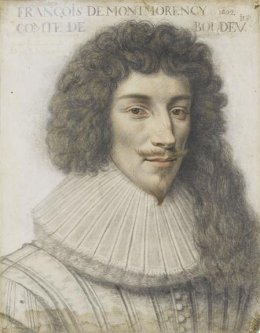
1627: Francois de Montmorency and his second, for dueling

On this date in 1627, the Comte de Bouteville plus his cousin Des Chapelles lost their heads for fighting a duel — ultimately (because of the execution) one of the most notorious duels in French history.

Though this is the duel that everyone knows, Francois de Montmorency-Bouteville (English Wikipedia entry | French) had engaged in 22 such affairs of honor between the tender ages of 15 and 28. Like as not, he was the duellist par excellence in an age where demanding lethal satisfaction was all the rage among devil-may-care aristocratic straplings.

And this, of course, is why he was nominated for condign punishment in Louis XIII’s struggling anti-dueling campaign. One might say he nominated himself.

Dueling, a mano-a-mano vindication of feuds between fops, was an archaic holdover of Burgundian clan violence turned preposterous baroque ritual of conspicuous consociation.

It was also incredibly epidemic in France at this period.

During the reign of Louis’s predecessor Henri IV, 7,000 to 8,000 people are reported to have died in duels, which works out to the suspect rate of one per day for the entire period. Then again, France did have an excess supply of noble progeny whose violent impulses were no longer preoccupied by fratricidal religious warfare.*

Henri IV had tried to ban dueling, even in 1610 executing for lese majeste a couple members of his own guard who defied the ban. Just weeks later, and for no reason connected to dueling, Henri was assassinated. Then-nine-year-old heir Louis XIII was in no position at the time to follow up his father’s policy, and the naughty sport continued to flourish.

“Duels had become so common among the French nobility that the streets of Paris usually served as the field of combat,” according to the Mercure Francois. And as Richard Herr described in his “Honor versus Absolutism: Richelieu’s Fight against Dueling” (The Journal of Modern History, September 1955; this is also the source of all other quotes in this post), they often arose over utterly trivial “slights.”**

Typical was a duel in Lent of 1626 in which Bouteville [i.e., the subject of our post] with two seconds engaged the Comte de Thorigny and his two seconds. The fight was over a dispute between Thorigny and the Marquis de Chalais, who was in prison accused of treason. Bouteville was merely defending the honor of a friend. All six spent the night before the engagement in an inn outside Paris, and in the course of a fairly amicable conversation, they expressed regret that being good friends, they were going to kill each other over another gentleman’s quarrel. But they agreed that they had gone too far to be able to abandon the project without loss of honor. The next day Bouteville killed Thorigny after the latter’s sword broke.

By the 1620s, Louis was old enough to make another run at this intractable elite-on-elite crime wave, and did so with the full encouragement of his famous consigliere Cardinal Richelieu. Depriving the aristocracy of this weird extra-judicial prerogative fit right into the latter’s going campaign to centralize the French state and bring its quarrelsome lords to heel.

What with all those duels he liked to fight, Francois de Montmorency-Bouteville was a great test case. Fighting a public duel in January 1627 — at which his second was slain — made Bouteville a target, and he fled to the Netherlands for safety.

Our fugitive figured he’d send word that a pardon would be appreciated, and everything would blow over like it always did. But Louis was determined to disabuse this type of any privilege to commit public mayhem, and refused to grant Bouteville his absolution.

Honor offended — his default state, to judge by his career — Bouteville vowed angrily to “fight in Paris and in the Place Royale!” This he did on May 12, 1627, slipping back into France for the express purpose of dueling Guy Harcourt, the Marquis de Beuvron. And Bouteville disdained a private fight for the occasion, insisting, as he had declared, on a daytime melee where everyone could see it at the grand new Place Royale (today, Places des Vosges).


At least the setting was operatic. (cc) image from Christophe Alary.

Bouteville and Beuvron fought to a bloodless stalemate and agreed to call it a draw. But Bouteville’s second Des Chapelles mortally wounded Beuvron’s second.

Everyone fled, and while Beuvron made it out of the country, Montmorency and Des Chapelles were nabbed, and condemned to death by the Parlement of Paris for violating Louis’s royal edict against duels.

From the king’s standpoint, this was just about the most egregious possible arrangement of factors.

  • The guy was a serial offender, and he was already a fugitive for his last duel.
  • The fight had produced a fatality.
  • Worst, the whole scene — sneaking back into Paris, fighting openly within the potential view of the sovereign — had been overtly staged to scorn the royal ban.

If Louis intended his decree to mean anything at all, he had to come down hard on this one. “It is a question of cutting the throat of duels or of your majesty’s edicts,” Richelieu summarized.

But as clear-cut as were the case indicia, this was still a hard one for Louis, and even for the usually-ruthless Richelieu. Bouteville was a well-born noble, with powerful friends and family who were also close to the king, and they besieged the royal person with petitions for mercy. A sorrowing but firm Louis had to personally refuse mercy to Bouteville’s tearful wife. “Their loss affects me as much as it does you,” he said. “But my conscience prevents my pardoning them.”

Although the poor wife couldn’t make any headway for clemency, she had the better of Bouteville’s swordsmanship off the field of honor. The doomed duke bequeathed one last rapier thrust to posterity by leaving his widow-to-be pregnant with a posthumous son who eventually generalled French armies to any number of routs of the Dutch in the late 17th century.

And while Richelieu’s memoirs would depict this instance of executive implacability as a decisive turn, Herr argues that it was nothing but a brief interruption. The pernicious hobby was back in all its glory within a couple of years, an evil that even Richelieu could never master. France’s aspired-to absolutism could not reach that ancient and intimate noble right save in the very most exemplary case.

In Dumas’s Three Musketeers, set in 1620s France, D’Artagnan is charged by his father in the opening pages to “[n]ever fear quarrels … Fight on all occasions. Fight the more for duels being forbidden, since consequently there is twice as much courage in fighting.” And indeed, it is by blundering into silly duels (e.g., the “offense” caused by bumping into Porthos while hurrying down the stairs, the latter of whom considers D’Artagnan’s apology discourteously perfunctory) that D’Artagnan becomes the fourth of their cadre … because Richelieu’s men arrive to break up the illegal D’Artagnan-vs.-Musketeer melees, and D’Artagnan joins with his “foes” to defend, all for one and one for all, their privilege as gentlemen to slaughter one another.

The dueling phenomenon faded significantly under Louis XIV, but still not completely: Voltaire almost fought a duel in 1726; the artist Manet dueled a critic in 1870; and YouTube will favor the viewer with a number of 20th century professors and litterateurs settling long-forgotten affairs of honor — like disputes over wartime collaboration after World War II — in ceremonial swordfights. Dueling pistol shooting (at human silhouettes) was even an event at the 1906 Olympics.†

And elsewhere in Germany, Russia, and everywhere Europe touched, duelling persisted with new practitioners into the 19th and even the 20th and even the 21st centuries.

* Also worth noting relative to the casualty numbers: at this time, each side’s seconds also fought in addition to the principals. A move for taking seconds out of the fight eventually prevailed, long before the end (if there has been a real end) of dueling, but in 1627 that time was not yet come.

** Across the Channel at this time, Francis Bacon was making much the same complaint against English duels.

† This event was an “Intercalated Games” falling between the natural 1904 and 1908 Olympiads. It’s an outlier historical experiment during the modern Olympics’ uncertain early years, and though it was officially sanctioned at the time and winners walked away with proper medals, the International Olympic Committee no longer recognizes the Intercalated Games as an official Olympics.

On this day..

1784: Jean Saint Malo, New Orleans Maroon

On this date in 1784,* Jean Saint Malo was hanged in the New Orleans square that’s since been christened Jackson Square, after American president Andrew Jackson.

Saint Malo, the namesake of a 19th century fishing village that formed perhaps the first Filipino settlement in the U.S., was the leader of outlaw settlements of escaped slaves who found refuge in the French colony’s bayous.

“Prior to the sugar boom,” writes Daniel Rasmussen in his well-received American Uprising, “New Orleans was a poor, multi-cultural city with very few social controls.”

The lines between slavery and freedom were not clearly drawn, and slaves frequently escaped into the swamps to form maroon colonies. There was a history of armed resistance in these areas that drew on French, Creole, and Kongolese traditions. These insurrectionary traditions shaped the lives of the slaves and represented an alternative political culture to that of the planters.

As testimony to that hazy line, Saint Malo had widespread support not only from the escaped slaves who joined him, but from those that remained on plantations. The communities were linked by blood and by trade; attempts to send creole militias out to hunt the maroons tended to founder on the draftees’ fear of retaliation by the kith and kin of their targets.

According to Gwendolyn Midlo Hall, Saint Malo’s prosecutor complained that slaves would grumble, affront their masters, leave land uncultivated … and that owners dared but few disciplinary measures lest they disappear into the swamps.

“Malheur au blanc qui passera ces bornes” (“Woe to the white who would pass this boundary”), was the declaration attributed our man, burying an ax dramatically into a tree outside his largest village, Ville Gaillarde. (The maroons lived in permanent settlements.)

It took several years, several tries, and more than several casualties for Louisiana planters to finally bring Saint Malo’s maroons to heel. And when they did — well, the dirge recorded from a fellow maroon (as related in Creole New Orleans: Race and Americanization) describes Malo’s fate.

Alas, young men, come make lament,
For poor St. Malo in distress!
They chased, they hunted him with dogs,
They fired a rifle at him.
They dragged him from the cypress swamp.
His arms they tied behind his back.
They tied his hands in front of him.
They tied him to a horse’s tail.
They dragged him up into the town.
Before those grand Cabildo men.
They charged that he had made a plot
To cut the throats of all the whites.
They asked him who his comrades were.
Poor St. Malo said not a word!
The judge his sentence read to him,
And then they raised the gallows tree.
They drew the horse — the cart moved off
And left St. Malo hanging there.
The sun was up an hour high
When on the levee he was hung.
They left his body swinging there
For carrion crows to feed upon.

* Coincidentally, June 19 would later become Juneteenth, marking the end of slavery in the United States at the conclusion of the Civil War.

On this day..

1872: Communards Serizier, Boin and Boudin

On this date in 1872, three adherents of the late Paris Commune were shot at Satory (which was doing steady business in the execution of Communards).

We take this story from the dispatch filed the same day for the London Telegraph and reprinted in the New York Times. Paragraph breaks have been added for readability.


Dilatory as the French authorities are in bringing culprits to trial, they dispatch them with terrible haste so soon as their guilt has been certified by the final Court of Appeal. No public notice is ever given of an execution, and few people ever hear of it until it is all over.

A paragraph appeared in an evening paper last night to this effect: “The Commission of Pardons has commuted the sentenced passed on PASCAL and LUCIPIA; the appeals of SERIZIER, BOIN and BOUDIN have been rejected.” To the world at large this paragraph conveys no hint as to the date of execution; the initiated read between the lines that on the following morning, dawn will rise on a dismal military pageant on the plains of Satory.

There is, nevertheless, a certain amount of uncertainty in the matter, so very closely are all such secrets kept in France; and it was only on the receipt of a hint from a high authority that some time after midnight I determined to start with a friend for Satory. The impression made upon me by the ghastly spectacle I shall try to describe in the plainest possible language.

SATORY.

A finer exercising ground than the plain of Satory it is not possible to imagine. The ground is as flat as a billiard-table, and it is not devoid of a certain beauty — the thick turf being singularly fresh, and he vast square plain surrounded by a belt of fine trees.

Troops are marching in companies to take up their appointed positions on the ground. A raised battery is a prominent object, and opposite to it, at some distance, is a huge earthen mound, against which a target stands out distinctly in black and white. The troops are forming in three sides of a square, which is completed by this butt.

It is not until you get quite close to the mound that you perceive on the lower ground immediately in front three white sticks ranged in a line, each about four feet high and five feet apart. These are the poteaux against which the culprits are to stand.

A good many soldiers, not on duty, have turned out en amateur to see the show; they collect on the top of a mound near the butt, but they are driven down by the artillery sentinels and mounted police, who, dressed in a little authority, canter about with superfluous fidgety zeal.

The morning air is chill, and everybody on duty or off duty tries to comfort himself with a smoke. “Nous avons encore trente-cinq minutes,” says a sergent-de-ville, in a grumbling, querulous tone. And the condemned men? They only had thirty-five minutes, and methinks they had as much reason to complain.

A soldier proceeds to work at the target, sqwing it off short; he is going to take it away, perhaps, that it may not divert the soldiers’ aim; and one feels irritated with him for being so slow.

One wonders, too, that they have allowed the red signal flag to remain at the top of the butt. Would not a Communist see an omen or an augury in the accident?

An engineer close to me is coolly fashioning wedges, in preparation for the artillery practice, which is to begin “aussitot que cette affaire est finie.”

Another protests impatiently that he wants his breakfast. Three dogs, which are perpetually frightening the horses of the mounted police, as well as the riders, excite continual merriment. There are scarcely more than a dozen civilians present, but I observe two women.

One — a brazen-looking creature, with a black mustache, and wearing that peculiar kind of hooded cloak which you see constantly in Belgium — was laughing a hoarse, harsh laugh, that chilled one’s blood. The other was charmingly dressed in black silk, and looked like a lady; she spoke to nobody; her face was deadly pale; her eyes were large with tears, and yet there was a strange compression about the lips that told of intesnse firmness of purpose. Her bearing was rigidly calm, but I fancied that the stick of her dainty black parasol was snapped in two.

What had that woman to do at such a scene? I know not; but, assuredly, it was not curiosity that brought her there. There was now a slight diversion. A cart drove up covered with black cloth, and hid itself away to the left of the poteaux.

THE EXECUTIONERS AND THE CONDEMNED.

Then the pelotons or firing parties marched in and piled arms opposite the same slim sticks about which everything in that huge plain seemed to gather of its own accord.

The pelotons were taken, one from the line, two from the Chasseurs de Vincennes. Hardened though they must be by this time and embittered though they are against the Communists, I do not think, to do them justice, that they liked their duty. They looked pale, they were perpetually falling out, and they smoked with suspicious eagerness.

I tried to impress on my own mind that these fellows were murderous ruffians who had slain unoffending fellow-creatures in cold blood. SERIZIER and BOIN, Colonel and Lieutenant in the Communist army, had tortured and killed the very priests who had devoted themselves to the task of tending the wounded on both sides, for no reason but that they were good men. BOUDIN had actually shot down a chemist in the Rue Richelieu because he protested against his son, a mere lad, being impressed into working at a barricade.

But, with the best will in the world, I could not persuade myself that it was right and proper for 5,000 soldiers to be brought out under arms for the mere sake of killing three defenceless wretches. Meanwhile the minutes passed on; the officers rolled up cigarettes, compared watches, and consoled each other with the reflection, “Soyez tranquille, mon cher, ca sera l’heure militaire.”

And so it was; for just as the first silvery tones of a distant church clock were wafted across the heath, striking the hour, the trumpets rang, the drums beat Aux champs, the troops dressed up, and the three ambulance wagons dashed into the square at a sharp trot.

The prisoners had not been apprised of their appeal hvaing been rejected until four o’clock in the morning, but they seem to have accepted their fate with singular philosophy. They had all eaten and drunk, and SERIZIER had asked for a “pipe of tobacc” for the last time. In driving along he said to the two gendarmes by whom he was accompanied, “Wat a mistake I made to quit Belgium! Quelie belle affaire j’ai fait la. C’est egal, je saurai bien mourir.

Strangely enough, he confessed to a Dominican, a priest of the ver order against which he had shown such diabolical hatred.

Each man was accompanied by two gendarmes. And here I cannot help noting one of the strange peculiarities of an over-excited state of mind. When the drums beat “Aux champs,” the merely dramatic feeling of the scene was intensely moving.

And yet when, a moment later, I first caught sight of the tops of the jack-boots of the first tell gendarme who appeared at the ambulance doors, I was so forcibly reminded of “Le Petit Faust,” and scores of other pieces wherein these functionaries are held up to ridicule, that I almost burst out into hysterical laughter.

The tragedy, however, soon proved too terrible, for the gendarme was closely followed by BOIN, who had scarcely touched the ground before he exclaimed, waving his hat in the air, “Vive la Commune!”

The three men walked quickly to the poteaux, and placed themselves in position as coolly as though it were the most natural thing in the world. They then, as though with one accord, flung their hats or caps into the air, and shouted several times in thrilling tones, “Vive la Commune!”

They all three were smoking. SERIZIER threw away his pipe, but BOIN kept his cigar in his hand, and BOUDIN was actually smoking as he fell. The face of the latter was so covered up by the handkerchief with which he alone allowed his eyes to be bandaged that his features could not be discerned.

SERIZIER, who was in the middle, indignantly threw down the handkerchief with such force as to cast it far beyond him. BOIN also refused the bandage wherewith the soldier stationed beyond him offered to cover his eyes, and by an involuntary action he put it into his pocket.

BOUDIN was coarsely clad; and SERIZIER, an undersized man, with heavy sensual features, looked like the type of a London rough. BOIN was a tall, well-built man, having good, clean-cut features and black mustaches. He was dressed in a light-brown velvet coat, Garde Nationale trousers, and a colored-scarf round the waist.

THE EXECUTION.

The priest, going up to each in turn, kissed him on both cheeks, in what seemed to me a hurried and perfunctory manner.

Then, while the sentence was being read to the prisoners in a quick, low, quite inaudible tone, BOIN made a long harangue, much of which was lost in the perpetual rolling of those ghastly drums.

But one could distinguish snatches of sentences such as “Soldiers, you are children of the people as we are, and we will show you how children of the people can die. Nous mourons innocents,” and then opening wide his light coat — he wore no waistcoat — he offered his white shirt-front for a mark, and, striking his heart with his open palm, he exclaimed: “Portez armes en joue! feu! tirez au coeur!”

This he repeated several times, and while he was yet speaking, standing out clear away from the poteaux and looking death at ten paces literally in the face, a sword flashed in the sun, and the three men leaped from the ground only to fall to it in horrible contortions.

The smoke and the report were unheeded, for all the senses of the horrified spectator were arrested by the awful spectacle of writhing limbs and twisting hands.

BOIN seemed to be rewarded for his bravery by suffering less than the others, but SERIZIER literally rolled over, and BOUDIN also moved. The surgeon then went up, examined BOUDIN first, and then directed one of the sergeants in reserve to give the coup de grace in the ear. Then SERIZIER was examined and treated in the same way; and lastly, after a considerable interval, BOIN was dragged into position and dispatched.

I cannot give you any idea of the sickening impression produced by this seemingly deliberate butchery.

I say seemingly, for the men may have been dead, but, in any case, surely if the coup de grace must be given, it should be done at once. I did not time the proceedings, but, long as my description is, I believe that not more than two minutes elapsed from the time that the ambulance wagons came on to the ground to the time that the volley was fired.

Several more minutes, however, elapsed before the dull thud of the last coup de grace delivered a bout pontant right into the poor wretch’s ear struck upon the ground. I have seen something of the horrors of war at Sedan and Strasbourg; I have witnessed the degradations of a public hanging in England, but have never seen anything so horrible as this supplemental butchery of the coup de grace.

AN AFTER SCENE.

When the surgeon and his attendants retired fro the poteaux, it became evident that painfully long as the interval had been, he had not been sparing of trouble. For with an eye to dramatic effect, he had disposed the bodies symmetrically, so that their feet should point towards the defiling troops.

Then the trumpets struck up a lively tune, and all the troops present — three batteries of artillery, carbineers and other caalry, four or five battalions of the line, engineers, &c. — some five thousand men — marched at quick step before the stark, stiff, staring bodies.

I cannot think that such a sight can have any other effect than that of exciting sympathy for the guilty. To see a man lying on his back there, his head a shapeless mass and the large red spot on his breast growing every moment larger and larger, and to think that not ten minutes ago he was speaking with passionate eloquence — this tended rather to make one forget his crimes than to remember his cruelty.

Yet I am bound to confess that this feeling is not shared by all, for when the troops had passed by, and the black van had driven up and unladen its dreadful burden of plain coffins, I saw an officer point with his foot at the yet warm brains of BOIN, and I heard him say, “C’est avec celui qu’il a fait son discours.”

On this day..

1484: Olivier le Daim, diabolical barber

On this date in 1484, the onetime royal barber turned noble scoundrel was hanged at the terrifying Montfaucon gibbet.

Jolly grotesque “Olivier le Necker” (“Olivier the Devil”) statue in Tielt, Belgium. (cc) image from Zeisterre.

The scheming Olivier le Daim (English Wikipedia page | French), who ought to be patron saint of networking, got himself a gig as the sovereign’s coiffeur and glad-handed his way from straight razors all the way to the aristocracy. A presumably smooth-shaved Louis XI created him comte de Meulant.

Louis was an inveterate schemer known as the “Universal Spider”, and Olivier — excuse me, the comte — from his sprawling fortified manor proved an eager confederate. As Louis had a gift for infuriating the realm’s noble houses, he liked to elevate commoners into his entourage, men like our “Meulant” and Cardinal Balue whose loyalty could be relied upon since they owed their positions to the crown.

“That terrible Figaro whom Providence, the great maker of dramas, mingled so artistically in the long and bloody comedy of the reign of Louis XI,” Victor Hugo wrote of our man in The Hunchback of Notre Dame. “This barber of the king had three names. At court he was politely called Olivier le Daim (the Deer); among the people Olivier the Devil. His real name was Olivier le Mauvais.” [Meaning “the bad”, as with “Charles le Mauvais”, the king Charles the Bad — a real bastard.]

With the disintegration of Burgundy following the death of Charles the Bold, le Daim was sent to that duchy’s Belgian reaches to connive them into French hands.

In the great tradition of commoners handpicked for royal favor “the Devil” attracted plenty of resentment displaced from the king himself.

And if, according to everyone else, Oliver the Bad was a swaggering, nasty villain, he still remained loyal to Louis all the way to the latter’s deathbed. Louis recommended him to his successors’ favor, but once the Spider King was gone the put-upon lords of the realm vented their blueblooded spleens upon Olivier. (A servant of Olivier’s named Daniel also suffered the same fate.)

It’s not clear to me that history records the exact charge furnishing the pretext for his execution this date — this suggests abuse of his power to order executions — but it does certainly bequeath us this epitaph:

Cii gist le Diable
Baptisé le Dain
Jugé pendable
Barbier suzerain

On this day..

1474: Peter von Hagenbach, war crimes milestone

On this date in 1474, Peter von Hagenbach was tried in a remarkable judicial proceeding in the Rhine city of Breisach, found guilty, and publicly beheaded by the end of the day.

This Alsatian knight in the train of Charles the Bold had been installed by that Burgundian duke as his satrap in in the Upper Rhine, in lands that Burgundy held on lease from the Habsburgs.

He made a legendary villain of himself in the early 1470s:

His regime of arbitrariness and terror extended to murder, rape, illegal taxation and wanton confiscation of pivate property, and the victim[s] of his depredations included inhabitants of neighbouring territories as well as Swiss merchants on their way to and from the Frankfurt fair … the outrages of Hagenbach, remarkable even by the standards of the late fifteenth century, greatly contributed to forging what, until then, had been considered impossible, that is, alliances against Burgundy by all her neighbours: Austria, Berne, France, and the towns and knights of the Upper Rhine, all formerly at loggerheads with one another.

After overturning Burgundian authority in the Upper Rhine, that unique alliance aired its many grievances with Hagenbach at a unique tribunal. There, the ex-knight was prosecuted before judges drawn from the several Germanic and Swiss principalities who had allied against him.


Breisach: seems like a nice place to oppress. (cc) image from Routard5.

This unusual procedure gained a special prominence in the 20th century postwar era as historical precedent for “war crimes” prosecutions. Since that time, there’s been a going debate over just what kind of precedent it really makes.

Executed Today is pleased to welcome Prof. Gregory Gordon of the University of North Dakota law school — a rising star in international human rights law.

Gordon wrote a 2012 paper re-examining the Hagenbach case attempting to reconcile both the legal and historiographical perspectives on Peter von Hagenbach.

ET: You characterize the present-day understanding of the Hagenbach case as proceeding from Georg Schwarzenberger‘s recovery of the incident further to providing legitimizing precedent for the Nuremberg tribunals. Between 1474 and World War II, did anyone think of this case as one with a wider import for jurisprudence? (And if not, do we know anything about how Schwarzenberger unearthed it?)

GG: To the extent anyone did, from my research, it would have been historians, not jurists per se. Hagenbach was the object of a fair amount of historical scholarship but that had evolved over the years. In the initial period after the trial, Hagenbach was portrayed as the quintessential bogeyman. But over the centuries, historians began to view him in a different light. By 1945, a more nuanced view of Hagenbach had been established. I have not researched Schwarzenberger’s biography in great detail. So I’m not sure how his eureka moment arose. What is clear is that the Nuremberg trial caused him to focus on Hagenbach (my sense is that Hagenbach was fairly well known in Europe — his supposed mummified head was on display in an Upper Alsace museum, for example — but given the absence of anything resembling Nuremberg before Nuremberg, people tended to ignore the details of the Hagenbach legal proceedings).

And my sense is that Schwarzenberger had an agenda — he realized the case could help legitimize what many would claim to be illegitimate ex post facto law at Nuremberg. So he relied on the earlier historical accounts of the Hagenbach case (it seems he based his seminal Manchester Guardian article primarily on the account of French historian Prosper de Barante). And thus he created a fissure between legal scholars and contemporary historians.

Who tried Hagenbach, under what authority, and how were the different interested parties formally represented? Whose idea was all this? What can we tell of the public atmosphere surrounding the trial — was there bottom-up pressure to do this?

After the League of Constance (consisting of various regional polities fed up with Hagenbach) paid off his debt for him, Archduke Sigismund of Austria resumed control over the Upper Alsace territory mortgaged to Charles the Bold. And thus Sigismund made the decision to have Hagenbach tried by the international ad hoc tribunal (another inexplicable link in the chain: Hagenbach escaped lynch-mob justice on Easter Sunday, April 10, 1474 — only thanks to Breisach resident Friedrich Kappelar’s decision to arrest him and await instructions from Sigismund).

Diebold Schilling the Elder made this illustration of the proceedings for a chronicle in 1485.

Sigismund’s decision to convene an ad hoc international tribunal was utterly remarkable for the time. And it is not clear how or why Sigismund came up with it (although historians suggest it had something to do with the prominent position Hagenbach held as representative of the Duke of Burgundy).

Numerous representatives of sovereigns from around the region, twenty-eight in all — including sixteen knights, sat as part of this international ad hoc tribunal.

Eight of the judges were nominated by Breisach, and two by each of the other allied Alsatian and Upper Rhenanian towns [Strasbourg, Sélestat, Colmar, Basel, Thann, Kenzingen, Neuburg am Rhein, and Freiburg im Breisgau] as well as by Berne, a member of the Swiss Confederation, and Solothurn, allied with Berne.

In fact, each sovereign represented a member of the League of Constance (Berne being the only representative of the Swiss cantons).

Thomas Schutz, the chief magistrate of Ensisheim, was designated as the tribunal’s presiding judge. The nominal trial prosecutuor was the new Alsatian bailiff chosen by Sigismund to replace Hagenbach — Hermann von Eptingen. Eptingen, for his part, chose Heinrich Iselin, one of the commissioners from Basel (one of the League of Constance’s members), to present the prosecution’s case to the court. The other representative from Basel, Hans Irmy, took on Hagenbach’s representation. At some point later in the trial, Iselin resigned because, as the evidence came in, he felt the case lacked merit (and even made a motion to withdraw the charges). He was then replaced by Hildebrand Rasp. Hagenbach also requested additional attorneys and the tribunal assigned him two attorneys — one from Colmar and one from Selestat.

The trial was held in open air before the Breisach mayor’s residence and was attended by “a multitude” of people from Breisach and surrounding towns. It appears as if it were somewhat of a circus atmosphere.

Is there a degree to which the pre-modern characteristics of the belligerents — Burgundian duchies, Swiss cantons, the Holy Roman Empire patchwork — set a contradictory precedent for the postwar world?

Let me quote my paper:

Nothing in history leading up to that moment in 1474 would have suggested the remarkable course of action taken by Sigismund. It is tempting to see that decision as an historic anomaly that would not be repeated for centuries to come. But on closer inspection, Sigismund’s choice to hold a trial before an international court fits well within the historical narrative of that era.

It was a time of religious and political disintegration. The Holy Roman Empire was fading into irrelevance and the Catholic Church was on the verge of losing its European hegemony. It was the eve of the nation-state — a unique moment when the old collective structures were dying and the new ones had yet to be born. Given the interstitial political turbulence, the time was ripe for a plural approach to law enforcement in the cosmopolitan geographic center of Europe. Hagenbach’s inter-regional depredations, which helped forge a rare pan-Germanic consensus, provided the perfect forum to experiment with international justice during that fragmented time. The Westphalian order, already on the horizon, would foreclose any such future experiments until Nazi brutality put a chink in the Westphalian armor and inspired an unprecedented transnational justice operation in the wake of a truly global war. In that sense, although on much different scales, Breisach and Nuremberg have much in common. And should the nation-state ever manage to reassert its absolute supremacy again, Breisach will undoubtedly be on the lips of future international jurists seeking, as before, to end impunity at the expense of sovereignty.

You discuss a revisionist thesis about Hagenbach that essentially says he wasn’t a monster, and even that he was a forward-thinking but star-crossed reformer. Why do you think that we can, in fact, conclude that there’s something to the claim that Hagenbach was tyrannous or criminal? What do you consider the most credible charges, and the ones that to his judges would have distinguished Hagenbach from a run-of-the-mill brutal lord or military commander?

What evidence supports the view that the good burghers of Alsace were the victims of Sir Peter’s violence? Their treatment of the wayward knight after his arrest is most revealing in this regard.

While torture may have been commonplace in ordinary criminal inquisitions of the time, the severity of torment inflicted leads one to believe it was inspired by and directed at the kind of mass, depraved criminality of which Hagenbach has traditionally been accused. Significantly, in this regard, in addition to enduring horrific torture, he was stripped of his knighthood. Degradation of knighthood was exceedingly rare in the Middle Ages and reserved only for the most extreme and infamous crimes.

And there is other evidence to suggest Hagenbach’s culpability for atrocities. Most telling perhaps is the trial record itself.

Hans Irmy, it must be remembered, mounted a valiant and spirited defense to the very end. And yet the record does not reveal his even attempting to refute the charge that Hagenbach planned to exterminate the citizens of Breisach or that he murdered the four petitioning residents of Thann. At most, he offered the rejected defense of superior orders. Nor did Irmy (or Hagenbach, for that matter), directly deny the rape charges (merely objecting that taking women in this fashion was common practice and/or he had paid for services rendered). Rape, as opposed to murder, appears to have been Hagenbach’s preferred weapon of terror and atrocity.

And there is a plausible explanation for why Hagenbach would have wanted to murder the citizens of Breisach.

Hagenbach was aware of other towns that had plotted to kill him during the previous year and, when requesting entry to create defensive fortifications in anticipation of an attack by the League of Constance, he had already been denied admittance with his troops into Thann and Ensisheim. He was only able to gain entry into Breisach because his mercenaries were already present there. Given the animosity shown him in these other towns and the previous conspiracy to kill him, Hagenbach did not want to take any chances. Killing Breisach’s citizens would have permitted him to use the town as a defensive fortification without the risk of an uprising from its citizens.

Did Hagenbach slaughter thousands of innocent civilians in concentrated liquidation campaigns? There is no evidence to suggest he did — he was not a fifteenth century proto-Nazi. But the record suggests that he terrorized the local population by murdering civilians, raping numerous women and conspiring to commit a large-scale massacre in Breisach. It should be noted that the rape charges are the most persuasive as there are numerous examples and they were never directly refuted.

And Hagenbach’s back story further validates this view of him. He was the product of a Burgundian ducal culture that was steeped in and glorified violence — the reflection of its bellicose chief, Charles the Bold (known to his enemies as Charles the Terrible). The duchy was in almost a permanent state of war with one enemy or another during Charles’s reign. Charles the Bold’s Burgundy was in the practice of laying siege to towns and routinely killing civilians who resisted — Liege, Dinant, Neuss — all were subjected to horrific violence by Burgundian troops, and Hagenbach played a leading role in the first two. And within that violent culture, Hagenbach was Charles’s fiercest, most loyal lieutenant. In that regard, Sir Peter’s steadfast reliance on superior orders at trial speaks volumes.

And it is not to be overlooked that a criminal disposition was apparent even before Hagenbach cast his lot with Charles the Bold. The reported kidnapping of Marquard Baldeck, the Swiss banker for whom Hagenbach demanded ransom, is telling in that regard. As noted previously, Hagenbach supposedly demanded ransom from Baldeck’s family and the scheme was scuttled only when Philip the Good ordered Baldeck released without any extortion payment. Hagenbach also seems to have fabricated a murder plot against Charles the Bold, which he falsely pinned on a court rival to have him eliminated.

Add to this Hagenbach’s contempt for the emerging bourgeoisie and townspeople, as well as a deep animosity toward the Swiss, and his stewardship of the Upper Rhine represented the perfect storm. By 1474, he had indeed become the scourge of the Sundgau. In this regard, it is interesting to note Burgundy expert Richard Vaughan’s insight that, in fact, it may have been Hagenbach driving policy and tactics in Charles’s Alsatian territory, not the other way around:

Many of Hagenbach’s activities were undertaken at [Charles’s] express command, though often as a result of representations made to him by Hagenbach in the first place. It is possible, for example, that Charles only agreed to sign the treaty of St. Omer on Hagenbach’s persuasion. In the duke’s letters to Hagenbach of 8 August 1470 he orders him to undertake the siege and conquest of Ortenberg castle, ‘in accordance with your memorandum (advertissement)’, which seems to imply that Charles was here acting on detailed advice to take Ortenberg sent him by Hagenbach. As to other mortgaged places, the bailiff wrote to Charles describing how he had seized possession of Landser and seeking the duke’s approval, which was given on 6 January 1474. . . . On 26 December 1470 he wrote congratulating Hagenbach on taking Ortenberg . . .”

Finally, it should be pointed out that Hagenbach may be responsible for atrocities in the region, even if he personally did not commit or order or was unaware of all of them. In particular, the Picard and Wallon mercenaries he hired toward the end of his reign had a well-known reputation for being unruly, violent and hostile toward the local Alsatian population. French historian Emile Paul Toutey, for example, describes Picard soldiers engaging in mass rape of Breisach’s women toward the very end of 1473. These troops may have acted on their own initiative but Hagenbach was their superior and, at the very least, he bore command responsibility. And this may also have contributed toward the writing of Hagenbach’s black legend.

Did the Hagenbach case, in your opinion, actually break new legal ground relative to what had occurred up through 1473? Does it have any analogues you’re aware of over the next century or two, prior to the advent of the Westphalian system?

In my opinion, nothing in the historical record up through 1473 suggests the possibility (certainly not the likelihood!) of what actually took place in 1474.

Eminent German historian Hermann Heimpel does note that the contemplated trial was consistent with other legal actions in late fifteenth century Swabia. What must have seemed entirely unprecedented, though, was the make-up of the court that would sit in judgment of Peter von Hagenbach. He was not to be tried by a local judge. Instead, numerous representatives of sovereigns from around the region, twenty-eight in all — including sixteen knights — would sit as part of an international ad hoc tribunal. Nothing after this, until the Versailles Treaty’s Article 227 contemplated international ad hoc tribunal trial of Kaiser Wilhelm II post-World War I (which never took place since the Dutch refused to extradite), even suggested such a procedure.

Hagenbach tried to raise a “superior orders” type of defense, claiming that Charles the Bold had ordered him to do the nasty things that were imputed to him. The dismissal of this defense does sound pretty modern, but was it mere expedience on the part of the court since it had no way to compel evidence from Charles the Bold?

That’s a great question! I don’t think so. Why? Because Hans Irmy asked for a trial continuance to contact Charles the Bold to appear before the tribunal and corroborate Hagenbach’s claims of superior orders. The tribunal flatly denied the motion for continuance. There was not even an attempt to contact the Duke of Burgundy. Like the decision to try Hagenbach before an ad hoc international tribunal, the decision to deny the motion (and flatly reject the defense) seems nothing other than ground-breaking. In short, it was an epochal precedent.

What interpretive conflicts does this case raise for you when considering it as a legal scholar, versus as a historian? How do you think people today should understand Peter von Hagenbach’s prosecution?

Again, I quote from my paper:

My piece attempts to identify and resolve certain vertical and horizontal dissonances in Hagenbach scholarship. With respect to the former, this has amounted to an exercise in historiographic and historical archeology. The recent attention lavished on the case by international criminal law (ICL) experts is informed by a cartoonish conception of the defendant — an ultra-violent, sexually depraved monster who ran amok for years along the Upper Rhine and terrorized its population. Consistent with that interpretation, the authorities who captured and tried him engaged in a righteous and visionary justice enterprise. They came out on the winning side of a Manichean struggle that gave birth to ICL and ennobled its pedigree.

Digging deeper, though, one finds a very different narrative developed initially by nineteenth century historians and embraced by most of their twentieth century confreres. They saw Hagenbach as a would-be administrative reformer whose efforts were thwarted by xenophobic subjects and a parsimonious superior. In trying to transform a fragmented archipelago of city-states into a cohesive governmental entity, Hagenbach was despised because he threatened an ingrained culture of seigneurial privilege and parochial complacency. In his efforts to redeem property put in hock by Sigismund, he likely reinforced views of Burgundy as excessively acquisitive and bent on conquest (this was exacerbated by Charles’s own efforts to accede to the imperial throne). And in levying taxes to pay for good government, Hagenbach stoked local fears of financial servitude and ruin. But in doing the Duke’s bidding, he did not have the Duke’s support. And so he was left to flounder, his undoing hastened by his admitted crass and prurient behavior. They point out that his trial, a marketplace spectacle based on torture-extracted confessions, was little more than drumhead justice. It was akin to executing Charles the Bold in effigy. Peter von Hagenbach may not have been the most adroit governor and perhaps he did manifest contempt for the rising merchant and urban classes. But, the revisionists would contend, his final deserts were not just at all.

Digging deeper still, the bottom layer of historiography consists of the journalistic rough draft and the first generations of historians that followed. It is largely consistent with the modern ICL expert view but without the larger historical perspective and legal focus. And it is more regionally tinged and archaic. This layer is at once more reliable, given its comtemporaneity or relative proximity, and less reliable, given the inherent biases of its initial chroniclers and the disproportionate influence they exerted on sixteenth through eighteenth century historians.

But my piece demonstrates that each layer is not necessarily inconsistent with the others. In fact, there are many points of convergence. And it is there that a unified, coherent narrative can be stitched together. Hagenbach was coarse and confrontational. But he was also hardworking and loyal and wanted to do right by his master. His entire career had been built on pleasing Charles the Bold. He undoubtedly meant to reform and upgrade the administration of his Alsatian fiefdom. And consequently resentment of the bailiff grew over the years as he pushed while the Alsatians pulled. Hostilities boiled over in 1473 and matters came to a head in 1474. Charles’s loyal lieutenant with a criminal past and odd sexual predilections felt increasingly boxed in and he eventually lashed out. The almost exclusive procedural focus of his defense at trial strongly supports accounts of the resulting crime spree.

It should also be noted that modern Hagenbach scholarship is characterized by a certain horizontal dissonance as well — between jurists and historians. Given the historical points of convergence just noted, however, these two schools ought to find common ground too. Certain views of the revisionist historians concerning the Hagenbach judicial proceedings are not without merit. The Breisach ad hoc tribunal may not have been a kangaroo court but it bears no resemblance to the well-oiled machine of modern international criminal justice administration. The defendant was hideously tortured for days before the trial. He was given no notice of the charges or allegations against him in advance of the hearing. He had no time to speak with a lawyer before standing in front of the judges. The proceeding itself was held on a market square in a circus atmosphere and concluded within a matter of hours. He was not able to call his most important (and only) witness to the stand – Charles the Bold. And there is no indication of a high burden of proof or that any such burden even rested with the prosecution. The Breisach Trial was certainly not the paragon of due process.

On the other hand, this was the late Middle Ages — centuries removed from our modern notions of due process. Torture was part of standard pre-trial procedure at that time. And the trial itself seems relatively fair for that era. Hagenbach was represented by a zealous advocate in Hans Irmy and he was given two additional lawyers of his choice. There is as well a flip side to the “public spectacle” aspect of his trial — transparency. Hagenbach could have been summarily condemned in front of a secretive Star Chamber but his trial was held in public (and that was consistent with local custom). He was able to confront witnesses called against him. He had twenty-eight finders of fact (compared to twelve in the modern jury system). And Charles the Bold, his sole designated witness, was not allowed to testify because the defense of superior orders was rejected ab initio. As well, the proceedings lasted from early in the morning until late at night — which could equate to two or three modern court days. There seems to have been significant deliberation among the twenty-eight judges suggesting that a consensus was cobbled together after carefully sifting through the evidence. In an age of witch-hunts, trials by ordeal, the Star Chamber, and the Inquisition, this was an exceedingly fair trial.

And in many ways it seems inappropriate to use twenty-first century ICL terminology to analyze a fifteenth century judicial proceeding. But if that terminology is used, this piece has demonstrated that the Breisach Trial has many of the hallmarks of a modern international atrocity adjudication. As a threshold matter, regardless of anything else, it is the first recorded case in history to reject the defense of superior orders. In itself, that distinction invests the trial with universal historic importance in the development of atrocity law.

On this day..

1318: Four Fraticelli friars

[Spiritual Franciscans record] the names of the condemned and the days or calends on which they suffered like martyrs.

-Inquisitor Bernard Gui (the gui from Umberto Eco’s Name of the Rose)

On this date in 1318, four Franciscans — Jean Barrani, Deodat Michel, Guillem Sainton, and Pons Rocha — were burned at the stake in Marseilles.

This illustration of the martyred friars also adorns the cover of the book So Great a Light, So Great a Smoke: The Beguin Heretics of Languedoc … which tells the story of what happened next.

These Fraticelli were part of the great and multi-headed 13th-14th century movement towards spiritual poverty — movements like the Apostolic Brethren, of Fra Dolcino fame.

The worldly wealth of the Church, as Eco’s narrator explains it,

generated movements of men bent on a poorer life, in protest against the corrupt priests … [the Fraticelli] claimed that Christ and the apostles had owned no property, individually or in common; and the Pope condemned this idea as heretical. An amazing position, because there is no evident reason why a pope should consider perverse the notion that Christ was poor.

Distinct from Dolcino et al (who were outside any official institutional order) but mutually sympathetic with their like, the Fraticelli were “Spiritual” Franciscans who rejected the more worldly accoutrement that even their humble order had taken on.

“Hardly a handful [of Franciscans] can be found who will abstain from luxuries, wearing cheap, patched tunics, and going without shoes, like the first brethren and the blessed Francis,” complained the ascetic Ubertino of Casale in 1311. “It seems as if all the spiritual offices of the order were rated at a price.”

In the hands of a more supple pope, this popular energy might have helped the Church, but John XXII — who held his court at Avignon in the care and feeding of the French crown — rejected his predecessors’ attempts at brokering compromises and just cracked down.

“Great is poverty,” said the papal bull ordering an end to the disputation. (Quoted here.) “But greater is blamelessness, and perfect obedience is the greatest good.”

And you have to enforce perfect blamelessness.

It began in the Avignon papacy’s Provencal back yard: southern France, which had felt the papal whip before, had proven very fertile soil for the Fraticelli, with its own similar Beguin movements among the laity.

Soon after Pope John ascended the seat of St. Peter, 25 obdurate Spiritual Franciscans were summoned to Avignon to answer to the Inquisition; 21 of them succumbed to the menacing proceedings and produced their “obedient” recantations, leaving the four stern enough to persevere unto the stake.

Many more, too many to track from the era’s sketchy documentation, followed them in the ensuing years.

The fires kindled at Marseilles were a signal for the extermination of the Spiritualists throughout Provence. We hear of burnings at Narbonne, Montpelier, Toulouse, Lunel, Lodvfere, Carcassonne, Cabestaing, Beziers, Montreal. Mosheim tells us of a band of a hundred and thirteen Spirituals sacrificed at Carcassonne from 1318 to 1350. Wadding tells us that the Franciscan inquisitors alone burned one hundred and fourteen of the zealots in a single year (1323). And Angelo compares the indiscriminate frenzy of the persecutors to the fierceness of rabid dogs and wolves. The works of Olivi were condemned at the Pentecostal chapter of 1319 at Marseilles, and even the bones of many saints who had died uncondemned (though suspected), were cast out of their tombs. The result of the fierce persecutions was to stamp out the Spirituals in Provence.

Beguini combusti or “burned Beguins” (doc link) inspired their synoptic brethren, and strains of the persecuted movement persisted for many years.**

John XXII reaped the hatred of the put-upon Franciscans. According to Bernard McGinn’s study of reputed “papal antichrists”† John was “the pope who bears the distinction of being the most popular candidate for the role of Papal Antichrist in medieval history.”


Image of Pope John XXII as the Antichrist. 15th century image from the Vaticinia de Summis Pontificibus, adapted from a c. 1340 illustration of the apocalyptic pro-Spiritual text as described in The Use and Abuse of Eschatology in the Middle Ages.

* Theologically, it was a dispute over whether Christ and the Apostles owned anything, singly or jointly. Politically, it pitted the Holy See against the Holy Roman Emperor, the classic Guelph-Ghibelline contest. (A few years on, there would be a Spiritual Franciscan appointed as antipope by the emperor.)

** William of Ockham — the Occam’s Razor guy — had to flee to imperial protection because, although not a radical Fraticello, he merely considered well-founded the doctrine that Christ and company didn’t own anything.

† In “Angel Pope and Papal Antichrist”, Church History (Jun., 1978)

On this day..

1857: Francis Richeux, witnessed by Tolstoy

On this date in 1857, a robber-murderer named Francis Richeux was publicly guillotined in Paris before a crowd of 12,000 to 15,000 people.

One of those onlookers was a 28-year-old Russian noble, fresh from the Crimean War and abroad on his first European trip: Leo Tolstoy.*

Overcome with curiosity, Tolstoy (as he recorded in his diary; here it is in Russian)

rose at seven o’clock and drove to see an execution. A stout, white, healthy neck and breast: he kissed the Gospels, and then — Death. How senseless … I have not received this strong impression for naught. I am not a man of politics. Morals and art I know, love, and [understand]. The guillotine long prevented my sleeping and obliged me to reflect.

And he developed the impression into a full-on rant that same day, in his running correspondence with Russian litterateur Vasily Botkin. The following is as translated in Dialogues with Dostoyevsky: The Overwhelming Questions.

The spectacle made such an impression on me that it will be long before I get over it. I have seen many horrors in war and in the Caucasus, but if a man were torn to pieces in my presence it would not have been so repulsive as this ingenious and elegant machine by means of which they killed a strong, hale, healthy man in an instant. There [in war] it is not a question of the rational [will], but the human feeling of passion, while here it is a question of calm and convenient murder finely worked out, and there’s nothing grand about it. The insolent, arrogant desire to carry out justice, the law of God. Justice, which is determined by lawyers every one of whom, basing himself on honor, religion, and truth, contradicts each other. With these same formalities they have murdered both the king and Chenier, both republicans and aristocrats.† . . Then the repulsive crowd, the father explaining to his daughter what a convenient and ingenious mechanism it is, and so forth. The law of man — rubbish! The truth is that the state is a conspiracy not only for exploitation, but chiefly to corrupt its citizens. But all the same states exist, and moreover in this imperfect form. And they cannot pass from this system into socialism . . . For my part, I can only see in all this repulsive lie what is loathsome, evil, and I do not want to, and cannot, sort out where there is more and where there is less. I understand moral laws, the laws of morality and religion, binding on no one, that lead people forward and promise a harmonious future; I feel the laws of art which always bring happiness; but the laws of politics constitute for me such an awful lie that I cannot see in them a better or worse. All this is what I felt, understood, and recognized today. And this recognition at least to some extent relieves the burden of the impression for me . . . From this day forward I will not only never go to see such a thing again, but I will never serve any government anywhere.**

He wasn’t kidding about that long insomnia, either: the impression startled him, permanently. Recalling the effect years later in his Confessions, Tolstoy still attributed to it an important confirmation of his egalitarian philosophy.

When I saw the head separate from the body, and how they both thumped into the box at the same moment, I understood, not with my mind but with my whole being, that no theory of the reasonableness of our present progress can justify this deed; and that though everybody from the creation of the world, on whatever theory, had held it to be necessary, I know it to be unnecessary and bad; and therefore the arbiter of what is good and evil is not what people say and do, and is not progress, but is my heart and I.

Tolstoy developed the same theme further a few years later in What Is to Be Done? … the shade of the long-forgotten Francis Richeux still haunting the great man of letters.

Thirty years ago in Paris I once saw how, in the presence of thousands of spectators, they cut a man’s head off with a guillotine. I knew that the man was a dreadful criminal; I knew all the arguments that have been written in defence of that kind of action, and I knew it was done deliberately and intentionally, but at the moment the head and body separated and fell into the box I gasped, and realized not with my mind nor with my heart but with my whole being, that all the arguments in defence of capital punishment are wicked nonsense, and that however many people may combine to commit murder — the worst of all crimes — and whatever they may call themselves, murder remains murder, and that this crime had been committed before my eyes, and I by my presence and nonintervention had approved and shared in it. In the same way now, at the sight of the hunger, cold, and degradation of thousands of people, I understood not with my mind or my heart but with my whole being; that the existence of tens of thousands of such people in Moscow — while I and thousands of others over-eat ourselves with beef-steaks and sturgeon and cover our horses and floors with cloth or carpets — no matter what all the learned men in the world may say about its necessity — is a crime, not committed once but constantly; and that I with my luxury not merely tolerate it but share in it. (PDF source | Original Russian)

* Among Tolstoy’s other activities in Paris was hanging around Turgenev … but the two mostly irritated one another. Nevertheless, they shared a distaste for the guillotine, at least to judge by Turgenev’s repulsion at seeing it in action years later.

** Two days after the execution, Tolstoy left Paris for Geneva. Execution-disgust is a suggestive speculation, although Henri Troyat argues that it merely gave him a “dramatic excuse” to stop putting off travel plans he had already made.

On this day..