Six hundred years ago today, onetime royal favorite Jean de Montagu* was, at the instigation of his powerful noble rival, beheaded in Paris and his body hung up at Montfaucon.
Montagu (French link) was the 50-something scion of an ennobled notary — or else the illegitimate produce of King Charles V, whose ennobled notary had been induced to claim him. Regardless his blood, the lad made himself quite wealthy with a virtuous cycle of administrative acumen and political connection, winning a variety of honorary posts and riches aplenty he did not shy from displaying. Typical “New Money” type.
Sadly for Montagu, this cycle crested during the reign of Charles VI, also known as Charles the Mad for his bouts of illucidity.
“History,” wrote Barbara Tuchman, “never more cruelly demonstrated the vulnerability of a nation to the person of its chief of state than in the affliction of France beginning [with Charles’ first spell of insanity] in 1392.”
Charles the Mad’s erratic tenure would help bring French fortunes to the low ebb from which Joan of Arc would retrieve them.
Montagu’s period sob story was that his wealth earned him the enmity of nasty Duke of Burgundy John the Fearless,** who induced King Charles during one of the latter’s episodes to affix on Montagu responsibility for the crown’s financial shortfalls. Our day’s victim was arrested on October 7, 1409, tortured into a confession, and beheaded in Paris October 17.
Montagu’s surviving family had the verdict reversed within three years, which would have been a better deal for them had the family’s main branch not been wiped out three years after that at the Battle of Agincourt.
For the wider benefit of posterity, the beheaded lord also left a fair collection of endowed building projects in his lands in Marcoussis, including (French links all): the usual village church; a Celestine monastery; and a picturesque castle unfortunately devastated during the French Revolution but once resembling this:
Victor’s justice was never better served than this date in 1946, when the brass of Third Reich hung for crimes against humanity during the late World War II.
Apart from trailblazing international law, the trial was notable for the gut-punching film of German atrocities; this relatively novel piece of evidence is available for perusal thanks to the magic of the Internet. Caution: Strong stuff. An hour’s worth of Nazi atrocities.The climactic hangings in the predawn hours this day in Nuremberg were conducted by an American hangman who used the American standard drop rather than the British table calibrated for efficacious neck-snapping. As a result, at least some hangings were botched strangulation jobs, a circumstance which has occasionally attracted charges of intentional barbarism.
At that instant the trap opened with a loud bang. He went down kicking. When the rope snapped taut with the body swinging wildly, groans could be heard from within the concealed interior of the scaffold. Finally, the hangman, who had descended from the gallows platform, lifted the black canvas curtain and went inside. Something happened that put a stop to the groans and brought the rope to a standstill. After it was over I was not in the mood to ask what he did, but I assume that he grabbed the swinging body of and pulled down on it. We were all of the opinion that Streicher had strangled.
There were in all 12 condemned to death at Nuremberg; all hanged this day except Martin Bormann (condemned in absentia; it was only years later that his death during the Nazi regime’s 1945 Gotterdammerung was established) and Hermann Goering (who cheated the executioner with a cyanide capsule two hours before hanging). The ten to die this day were:
Foreign Minister Joachim von Ribbentrop, whose name adorns Nazi Germany’s shortlived truce with Stalin.
Arthur Seyss-Inquart, Reichskommissar of the occupied Netherlands.
Field Marshal Wilhelm Keitel, a career military man whose “only following orders” defense was rejected by the tribunal.
Waffen-SS General Ernst Kaltenbrunner.
Nazi intellectual Alfred Rosenberg.
Gauleiter of Poland Hans Frank, notable for his postwar conversion to Catholicism and profession that “a thousand years will pass and still Germany’s guilt will not have been erased.”
Minister of the Interior Wilhelm Frick.
Slave labor organizer Fritz Sauckel.
General Alfred Jodl, who signed the German capitulation in May 1945 and was posthumously acquitted of his war crimes charges by a German court.
Streicher, whose anti-Semitic frothing on the scaffold was the only overtly Nazi display of the night.
* Its resultant Nuremberg Principles comprise a lofty articulation of principles whose actual application, as Noam Chomsky has observed, would have meant that “every post-war American president would have been hanged.”
On this date in 1815, French Marshal-cum-Neapolitan King Joachim Murat was shot in Pizzo, Italy, for a failed attempt to regain his throne.
The charismatic cavalryman cuts a snazzy figure in the Napoleonic era, from its very infancy: it was Murat who secured for the 26-year-old Bonaparte the cannon used to deliver the “whiff of grapeshot” whose odor set Napoleon on the path to becoming Emperor.
Murat knew a good thing when he had it, and thereafter zipped around with the peripatetic conqueror, finding time between dashing mounted charges to marry Napoleon’s sister Caroline.
Murat’s honors multiplied with his commander’s victories: “First Horseman of Europe” (whatever that means); Grand Duke of Berg and Cleves; at last, in 1808, he was appointed King of Naples and Sicily, beneficiary via Caroline of the Corsican’s policy of installing family members to helm his satellite kingdoms.
Still, that elevation didn’t mean Murat would just retire to his Mediterranean villa and his mistresses: he was on call when Bonaparte went to invade Russia.
Leo Tolstoy, undoubtedly a hostile witness in his epic War and Peace, renders Murat as something of an oblivious dunderhead:
Though it was quite incomprehensible why he should be King of Naples, he was called so, and was himself convinced that he was so, and therefore assumed a more solemn and important air than formerly. He was so sure that he really was the King of Naples that when, on the eve of his departure from that city, while walking through the streets with his wife, some Italians called out to him: “Viva il re!” he turned to his wife with a pensive smile and said: “Poor fellows, they don’t know that I am leaving them tomorrow!”
But though he firmly believed himself to be King of Naples and pitied the grief felt by the subjects he was abandoning, latterly, after he had been ordered to return to military service — and especially since his last interview with Napoleon in Danzig, when his august brother-in-law had told him: “I made you King that you should reign in my way, but not in yours!” — he had cheerfully taken up his familiar business, and — like a well-fed but not overfat horse that feels himself in harness and grows skittish between the shafts — he dressed up in clothes as variegated and expensive as possible, and gaily and contentedly galloped along the roads of Poland, without himself knowing why or whither.
Like his fellow-Marshal Michel Ney, Murat nevertheless had the realpolitik chops to get on after their thrust to Moscow had so calamitously reversed — in Murat’s case, by cutting a deal with the Austrian Empire to retain his kingship.
But also like Ney, he couldn’t resist joining Napoleon’s ill-fated 1815 reunion tour. Murat could have survived the consequent loss of his throne, but made a quixotic bid to invade with only a handful of men the former possession whose people he quite wrongly imagined would rally to his cause.
Not the realization of the day-dreams of the most dreaming youth, not the visible acting of the strangest visions which the dramatist and romance-writer have conceived, could strike us with more wonder than the simple narration of that which befel the son of the baker of Cahors in his passage from the ranks of the French army to the throne and sceptre of Naples; and, alas! one step farther, an unquiet and a mournful one, to that small court in the castle of Pizzo, where the hero of a hundred fights, — the Achilles of the chivalrous French, — gazed for a second, with uncovered eye and serene brow on the party drawn out to send the death-volley home to his heart.
Well, this depiction of Murat’s end is plainly of more sympathetic character than Tolstoy would have done.
… the disgraceful tribunal, after consultation, declared, “That Joachim Murat, having by the fate of arms returned to the private station whence he sprung, had rashly landed in the Neapolitan dominions with twenty-eight followers, no longer relying upon war, but upon tumults and rioting; that he had excited the people to rebellion; that he had offended the rightful King; that he had attempted to throw the kingdom of Naples and the whole of Italy into confusion; and that therefore, as a public enemy, he was condemned to die, by authority of the law of the Decennium, which was still in vigour.” This very law, by a strange caprice of fortune, was one which Joachim himself had passed seven years before. He had, however, humanely suspended its operations many times, at particular seasons of his rule; and yet this very law, so passed, and so suspended by him, was made the instrument of his death.
The prisoner listened to his sentence with coolness and contempt. He was then led into a little court of the castle, where he found a party of soldiers drawn up in two files. Upon these preparations he looked calmly, and refused to permit his eyes to be covered. Then advancing in front of the party, and, placing himself in an attitude to meet the bullets, he called out to the soldiers, “Spare my face — aim at the heart.” No sooner had he uttered these words than the party fired, and he, who had been so lately King of the Two Sicilies, fell dead, holding fast with his hands the portraits of his family …
The Emperor did not cherish for Murat the sincere friendship which he entertained for the other officers of the army of Italy. He used frequently to make him the subject of derision; and many of us have heard him laugh at the King of Naples, whom he used to call a Franconi King.
The fraught relationship between the enlisted and the officers had boiled over in the Etaples Mutiny just a few weeks before, which saw military police fire into a crowd of troops protesting the heavy-handed arrest of a fellow for slipping into the town of Etaples for a little (unauthorized, but widely practiced) R&R.
The shooting left a man dead and the camp in an uproar for several days, with some enraged rank-and-file men trying to break into army facilities hunting for MPs.
The excellent, but now defunct, site Shot At Dawn had a thorough recounting of the Etaples mutiny, still archived at the Wayback Machine.
Short, whose disciplinary record was otherwise clean, was picked out seemingly more or less arbitrarily to be the demonstration execution for this affair. He was doomed for an (unsuccessful) incident of incitement to mutiny, described by the officer thus:
“The picket was armed as regards 150 & the remainder were unarmed. At about 9.10 pm a lot of men, about 70 or 80 with notice boards torn away from the camps and waving flags which were handkerchiefs of all colours including red attached to sticks approached me. These men pushed through, the picket practically standing on one side … officers who stood out were also pushed aside. The picquet was absolutely unreliable at that moment so I called the officers together & made them fall their men in by Regts. I then addressed the picket & whilst doing so … [Short] came back from the crowd of men who had just broken through & told the men they were not to listen to men. ‘What you want to do to the Bugger is to put a stone round his neck & throw him into the river’… he told the men to fall out & join the mob who had just broken through.”
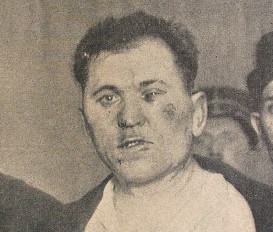
On this date in 1932, deranged Russian emigre Paul Gorguloff was guillotined for murdering President Paul Doumer four months before.
The forgettable Paul Doumer — distinguished for reasons quite beyond his control as the penultimate President of the Third Republic — was a week short of his one-year anniversary in office when the nutbar gunned him down at a Parisian book fair.
Disturbed 37-year-old Gorguloff had some impenetrably incoherent justification for the murder having to do with some “Idea” formed in a trance-like state.
From the moment of my arrival in Paris, and even in the train, I had a sort of hypnotic obsession that I must kill the President. I went and prayed in Notre Dame; then I drank heavily, and gradually decided to kill myself, the idea almost supplanting that of assassination. After drinking I conceived the idea of getting arrested to prevent me from committing the crime, so I asked a policeman on the Boulevard Saint-Michel a lot of stupid questions, hoping that he would ask for my papers and, finding them not to be in order, arrest me. All the time the Devil was saying: “Kill yourself, if you like, but only after you have killed the President.” Until 2 o’clock in the afternoon on the day of the crime I drank in a bar, emptying a bottle of cognac in the hope that I would get too drunk to do anything. Nevertheless I finally went to the book exhibition in the Rue Berryer, where the President was expected. After I had spoken with M. Farrere [he was later shot in the arm by Gorguloff] and looked at a few books, the President arrived. I was in a kind of hypnotic sleep, and fired without really knowing what I was doing. (The Times of London, May 18, 1932)
Whatever this daemon may have amounted to in Gorguloff’s mind, he cherished it; the brief trial was punctuated by repeated invocation of the never-explicated “Idea”:
France, listen to me! I am the apostle of my Idea. My crime was a great protest in the name of the miserable ones who wait ‘over there’ [in Russia] … My Idea is more precious than my life. Take my life, but save my Idea. (The Times of London, July 26, 1932)
The “idea” may have been fame. Gorguloff’s defense counsel — understandably pinning its hopes on an insanity defense (French link) — entered into the record a request the assassin had forwarded Czech authorities to be launched in a rocket to the moon; a correspondent for Le Matindiscovered that the killer had nursed similarly half-baked plots to do in Hindenburg, Lenin, and Czech President Thomas Masaryk instead/as well.
Gorguloff was beheaded just before 6 a.m. outside La Sante Prison in Paris.
General de Maud’huy had just been roused from sleep on the straw of a shed and was standing in the street when a little group of unmistakable purport came round the corner. Twelve soldiers and an NCO, a firing party, a couple of gendarmes, and between them an unarmed soldier. My heart sank and a feeling of horror overcame me. General de Maud’huy gave a look, then held up his hand so that the party halted, and with his characteristic quick step went up to the doomed man.
He asked what he had been condemned for. It was for abandoning his post. The General then began to talk to the man. Quite simply, he explained discipline to him. Abandoning your post was letting down your pals, more it was letting down your country that looked to you to defend her. He spoke of the necessity of example, how some could do their duty without prompting but others, less strong, had to know and understand the supreme cost of failure. He told the condemned man that his crime was not venial, not low, and that he must die as an example, so that others should not fail. Surprisingly, the wretch agreed, nodding his head. He saw a glimmer of something, redemption in his own eyes, a real hope, though he knew he was about to die. Maud’huy went on, carrying the man with him to comprehension that any sacrifice was worthwhile while it helped France ever so little. What did anything matter if he knew this? Finally, de Maud’huy held out his hand: ‘Yours also is a way of dying for France,’ he said.
The procession started again, but now the victim was a willing one. The sound of a volley in the distance announced that all was over. The general wiped the beads of perspiration from his brow, and for the first time perhaps his hand trembled as he lit his pipe.
The execution stemmed from a civil war fought by crown against nobles struggling to preserve their feudal rights — and specifically, a 1465 battle won by the nobles’ intrepid standard-bearer Charles the Bold. Louis was grumpy at his governor of Paris for not relieving him in time, and when the wheel of courtly politics turned sufficiently, that incident supplied enough suspicion to destroy Melun.
The war, caused by the League of the Public Good, which restored liberty and fortune to Chabannes, deprived his enemy, the count de Melun, not only of both, but of life also. When we are told that Melun was so addicted to pleasure, luxury and sloth, as to have acquired the name of the Sardanapalus of his times, we can form no very flattering estimate of his character. Yet he stood high in the good graces of Louis XI, and participated largely in the spoils of Chabannes. In his capacity of governor of Paris and the Bastile, he was also entrusted with the custody of that nobleman. It was not till after the battle of Montlheri that Louis began to suspect him. The monarch had, indeed, some excuse for suspicion. Melun had at least been criminally negligent, in a post which demanded the utmost vigilance. He had prevented a sally from the city during the battle, which might have turned the scale in the king’s favour, and he had been ignorant of, or winked at, a correspondence carried on with the chiefs of the League by some of the disaffected citizens. These indications of treachery were strengthened by two circumstances; some of the cannon of the Bastile had been spiked, and the gates of the fortress, on the side next the country, had been left open while the besiegers were making an attack. The escape of Chabannes might also afford a reason for doubting his keeper’s fidelity. Louis, however, was, at this moment, too closely pressed by his numerous enemies to enter into an investigation of the subject; and he, therefore, only dismissed the governor.
The Battle of Montlhery
Melun retired to his estates, and imagined that the storm was blown over. He was mistaken. As soon as Louis had disembarrassed himself, he instituted a rigid enquiry into the conduct of his disgraced favourite. One of the most active in pushing it on was a man who was indebted to the count for his rise in life; the cardinal Balue, of whom further mention is about to be made. The result of the enquiry was, a charge of having maintained a secret correspondence with the heads of the League, especially with the duke of Britanny. Melun was in consequence arrested, and conveyed to Chateau Galliard, in Normandy, by the provost Tristan l’Hermite, of infamous memory.*
The trial was commenced without delay, and, as he refused to confess to any crime, he was put to the torture. With respect to his correspondence with the chiefs of the League, he avowed it, but pleaded that it had the king’s sanction. It is probable that this was really the case. Many motives might have induced the king to allow of his officer corresponding with the enemy. But Louis had now resolved upon the destruction of Melun; and, as he never scrupled at falsehood when he had any point to gain by it, he denied that he had given the permission. By adding that he had long had cause to be dissatisfied with the prisoner, he gave a broad hint as to what kind of verdict he desired.** The judges, as in duty bound, pronounced Melun guilty, and he was consigned to the scaffold. His execution took place in 1468. Of his confiscated property, a considerable portion was bestowed on Charbannes.
It is said, that the executioner having only wounded him at the first stroke, Melun raised his head from the block, and declared, that he had not deserved death, but that, since the king willed it, he was satisfied. If this be true, we must own that tame submission to the injustice of a despot was never more strikingly displayed.
Had Melun lived but a little longer, he might have triumphed in the downfall and punishment of his ungrateful enemy, the cardinal, which took place in 1469 … The cardinal, and his his friend and agent William d’Harancourt, bishop of Verdun, were in close correspondence with his enemies.†
Though Melun generally goes down as a guy who caught a bum rap — probably even Louis XI thought so, given the subsequent fall of Melun’s rivals — this 19th century history of France observes that such consideration turns on noblesse oblige, for while “such crime on the part of a burgess was considered worthy of death, nobles practised breach of faith as a pastime, and a lucrative one, until it was rendered a serious matter by sending the guilty to the scaffold.”
* For instance, in Victor Hugo’s The Hunchback of Notre Dame, Tristan l’Hermite is the man dispatched by Louis XI to seize Esmeralda from the cathedral for hanging.
In 1626, Henri de Talleyrand-Périgord, Comte de Chalais, head of wardrobe to King Louis XIII, was one member of that house whose neck was shortened for an offense against the king’s court.
Henri — as he shall be herein known, so as not to confuse him with his many relatives — was the youngest of three children. Born in 1599, he served in the military at the unsuccessful Siege of Montauban in 1621 and 1622. (The defeat (temporarily) preserved Huguenot rights in France.)
In 1623, Henri returned from war and married Charlotte de Castille (not to be confused with the modern porn star!). It was not long after that rumors of Castille’s impropriety started making the rounds, as immortalized in Tallemant de Réaux‘s verse, whose rough translation is as follows:
Pontgibault boasts,
On seeing the slit
Of the Countess of Alais
Who likes the strong ballet,
And says hers is more charming
Than the Chalais’.
And that, not so roughly translated, is why Pontgibault received a visit from an irate Henri.
Henri is alleged to have challenged a duel, where he cock-blocked his cuckold — permanently. The European ideals of chivalry yet persisted, so there was some question whether this affair constituted murder, and the trial was the talk of France through the winter of 1623.
Madame de Chevreuse, former lover of Henry Rich (later Earl of Holland), had a string of lovers, and it’s questionable whether Henri was among them. Whether he was or not, she ignited in him a passion that would lead to his execution.
The impetus for this execution was ostensibly a plot to save Gaston d’Orléans, who, by decree of Louis XIII, was to marry Marie de Bourbon, duchesse de Montpensier. The union would bring significant wealth into the family of Louis XIII.
Backed by his First Minister Cardinal Richelieu, the king was insistent. For several years, Richelieu had also been reducing the power of the nobility and consolidating central authority around the king, which was not the way Madame de Chevreuse envisioned the world.
Instead, she sought to install Gaston d’Orléans on the throne, thus advancing her agenda to restore power to the nobility. The forced marriage became a convenient excuse to enact her plan against Richelieu. And her charming way with men made it easy to find participants.
Madame de Chevreuse and d’Ornano were at the heart of the conspiracy, but their reach extended as far as England and Spain. She was also supported by Anne of Austria, who is thought to have played a critical role in organizing the conspirators. At the very least, the collective hope was to make Monseiur abandon Louis XIII’s court and seek an alliance with the Hugenots, who would be sympathetic to a cause against the Catholic Church.
At some point, Richelieu caught wind of d’Ornano’s involvement in a conspiracy against the throne; not knowing the extent of the effort, he had d’Ornano detained. Lest their plot be found out, the conspirators encouraged Gaston to initiate a war; this was particularly true of Comte de Soissons, who posted a reward should Monseiur take up arms against his brother.
Gaston hesitated, and a new plan was enacted.
Instead, some of the conspirators would take audience with Richelieu and either detain or kill him, depending on the story. Needless to say, the plan failed, and the conspirators were found out. Chalais tried to lay low while the plot against the king and his minister unfolded, but he did not sufficiently distance himself from Madame de Chevreuse: Gaston was exposed and named names, and Chalais, not well-connected enough to fight the charges against him, was captured at Nantz on July 8.
Henri de Talleyrand-Périgord, Comte de Chalais, was sentenced to death by beheading for lèse-majesté, and on August 19, 1626, he mounted the scaffold at Place de Bouffay in Nantz. In a last, cruel twist, the conspiracy had bought off the town executioner in hopes that, lacking a practitioner of the macabre art, Chalais might be spared. But a replacement had been hastily found: a man himself condemned to death:
The [replacement] was so unskillful that, besides two blows from a Swiss sword, which had been purchased on the spot, he gave him thirty-four with an adze such as carpenters use; and was obliged to turn the body round to finish the severing of the neck, the patient exclaiming up to the twentieth blow: ‘Jesus, Maria et Regina Cali!’
No other conspirators were put to the sword, and Gaston and his brother eventually made up. Richelieu, meanwhile, gained more power and transitioned France from a feudal state to an absolute monarchy under Louis XIII and his successor, Louis XIV. His dealings form the backdrop of The Three Musketeers.
As for Madame de Chevreuse — who also figures in The Three Musketeers, scheming behind the scenes against Richelieu and crushed on by Aramis — she fled to Château d’Dampierre, then was exiled to England, where she fell in with the Duke of Lorraine (and became his mistress); she attempted to organize several more coups against the Red Eminence, but each fell short of the mark.
Madame de Chevreuse eventually ended up in Spain, then moved back to England, then shipped out to Flanders, where she connected once again with the Comte de Soissons and attempted to usurp the throne before it could be passed to Louis XIV. When Richelieu finally passed, she sought to oust his replacement, this time relying on César de Bourbon, duc de Vendôme, who was also involved in the Chalais conspiracy. After this failure, Madame de Chevreuse retired to Gagny.
Elizabeth Stone writes of Madame de Chevreuse in Political Women, “It was not she evidently who made of Buckingham a species of paladin without genius; a brilliant adventurer of Charles IV of Lorraine; of Chalais a hair-brained blunderer, rash enough to commit himself in a conspiracy against Richelieu, on the faith of the faithless Duke d’Orleans; of Châteauneaf, an ambitious statesman, impatient of holding second rank in the Government, without being capable of taking the first.”
Be that as it may, she is a compelling historical figure, and the Chalais conspiracy formed the basis for the operatic tragedy Maria di Rohan.
(A complete discussion of Talleyrand-Périgord’s life can be found here. (French link) Breathless French court gossip in a 19th century biography of Chevreuse here.)
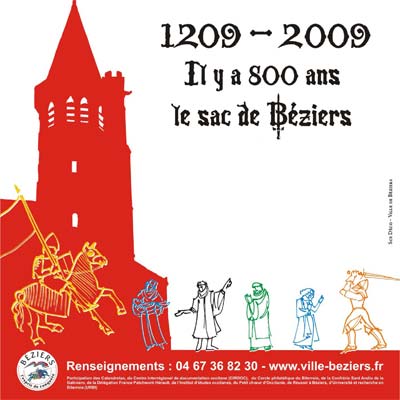
Today the French town of Beziers remembers the 800th anniversary of the first sack and massacre of the Albigensian Crusade.
Rome was alarmed by the advent in southern France of a mass religious movement, Catharism, with such scandalous doctrines as spirit-body dualism and not giving tons of money to Rome.
Naturally, God said to cut them to pieces.
Beziers was the first town invested by the invading crusader army, left to its fate as the Cathars mustered in Carcassone. Interestingly, this particular city did not so much present that familiar spectacle of Christians killing Christians who thought differently — unless the thought in question was about handing over their neighbors to a throng of land-grabbing nobles.
Part of the Catholic faith did itself honor this day: those Biterrois who refused to abandon to the glories of martyrdom the Cathars in their midst, who are thought to have numbered merely a few hundred. So when the walls fell, it was mostly orthodox Catholics killing orthodox Catholics.
Well, what’s a crusading army with other cities to sack supposed to do?
When they discovered, from the admissions of some of them, that there were Catholics mingled with the heretics they said to the abbot “Sir, what shall we do, for we cannot distinguish between the faithful and the heretics.” The abbot, like the others, was afraid that many, in fear of death, would pretend to be Catholics, and after their departure, would return to their heresy, and is said to have replied “Kill them all for the Lord knoweth them that are His” (2 Tim. ii. 19) and so countless number in that town were slain.
And they killed everyone who fled into the church; no cross or altar or crucifix could save them. And these raving beggarly lads, they killed the clergy too, and the women and children. I doubt if one person came out alive … such a slaughter has not been known or consented to, I think, since the time of the Saracens. (William of Tudela, cited in Cathar Castles)
Ten to twenty thousand are thought to have been slain this day — in what proportions Catholic and heretic, only God can say.
She is of stately Norman figure; in her twenty-fifth year; of beautiful still countenance: her name is Charlotte Corday, heretofore styled d’Armans, while Nobility still was … A completeness, a decision is in this fair female Figure: ‘by energy she means the spirit that will prompt one to sacrifice himself for his country.’ What if she, this fair young Charlotte, had emerged from her secluded stillness, suddenly like a Star; cruel-lovely, with half-angelic, half-demonic splendour; to gleam for a moment, and in a moment be extinguished: to be held in memory, so bright complete was she, through long centuries!–Quitting Cimmerian Coalitions without, and the dim-simmering Twenty-five millions within, History will look fixedly at this one fair Apparition of a Charlotte Corday; will note whither Charlotte moves, how the little Life burns forth so radiant, then vanishes swallowed of the Night.
Hapless beautiful Charlotte; hapless squalid Marat! From Caen in the utmost West, from Neuchatel in the utmost East, they two are drawing nigh each other; they two have, very strangely, business together.
Or was it strange at all?
Implacable in her purpose, utopian in her design, unafraid to plant a butcher’s knife into the chest of an enemy of France, Corday has a little something in common with her mortal foe.
These make casting too easy: Marat, bad because he was ugly and ugly because he was bad; Charlotte, therefore, just the reverse. (She was also a virgin; they made sure to check at the autopsy.) Our Norman assassin’s looks have inordinately exercised her interlocutors from the moment of her arrest; her prosecutors, too, understood them as essential.
“Not at all pretty,” a contemporaneous government article (cited in Crisis in Representation) put about. “She was a virago, brawny rather than fresh, without grace, untidy as are almost all female philosophers and eggheads … an old maid … with a masculinized bearing … [who] had thrown herself absolutely outside of her sex.”
And there it is. Charlotte Corday’s power to excite both rapture and repulsion is plainly rooted in the unexpected contradiction between her sex and her crime. If she is a resolute political assassin, surely she is not feminine … or is it the other way around?
Take Andre Chenier‘s engorged ode: “Fair, young, resplendent, led to the executioners, you seemed to be riding in your bridal car … You alone were a man and vindicated the human race. And we, vile eunuchs, a cowardly and soulless herd, we know how to repeat some womanly whimper, but the steel would weigh heavy in our feeble hands. … One scoundrel less crawls in this slime. Virtue applauds you. Hear the majestic sound of its virile praise, heroic maid.” This is “throwing herself outside of her sex” in the affirmative sense of uplifting herself beyond mere womanhood, a girl so heroic she might almost qualify as a dude.
Place it at the historical pivot into a modernity unready to reckon with the place of the woman, and confusion reigns.
“The spectacle of such wickedness, beauty, and talent united in the same person,” a newspaper recorded, “the contrast between the magnitude of her crime and the weakness of her sex, her appearance of actual gaiety, and her smile before the judges, who could not fail to condemn her, all combined to create an impression on the spectators that is difficult to portray.”*
Still, this judgment offers more insight than some latterly “tributes,” like this Anglo magazine piece 30 years later: “an ornament and an honour to the sex of woman … Woman is the child of feeling. From this source spring up all her good and bad qualities. It is seldom ambition or policy which leads her on to any enterprise: it is the passions. … it was under the influence of such feelings that Charlotte Corday performed that act, which virtuous and generous minds, so far from considering a crime, will look upon as one of the most heroic deeds of recorded history.”
Which is a fascinating form of sexism, since it was precisely Corday’s unearthly calm — masculine virtue! — that awed the Revolutionary Tribunal. But everything about Charlotte Corday is up for interpretive grabs; Nina Rattner Gelbart even argues, in “The Blonding of Charlotte Corday” (Eighteenth-Century Studies 38.1 (2004)) that though a real-life brunette, her depictions trend increasingly flaxen-haired.**
As for Charlotte Corday her work is accomplished; the recompense of it is near and sure. The chere amie, and neighbours of the house, flying at her, she ‘overturns some movables,’ entrenches herself till the gendarmes arrive; then quietly surrenders; goes quietly to the Abbaye Prison: she alone quiet, all Paris sounding in wonder, in rage or admiration, round her. …
On Wednesday morning, the thronged Palais de Justice and Revolutionary Tribunal can see her face; beautiful and calm: she dates it ‘fourth day of the Preparation of Peace.’ A strange murmur ran through the Hall, at sight of her; you could not say of what character. Tinville has his indictments and tape-papers the cutler of the Palais Royal will testify that he sold her the sheath-knife; “all these details are needless,” interrupted Charlotte; “it is I that killed Marat.” By whose instigation? — “By no one’s.” What tempted you, then? His crimes. “I killed one man,” added she, raising her voice extremely (extremement), as they went on with their questions, “I killed one man to save a hundred thousand; a villain to save innocents; a savage wild-beast to give repose to my country. I was a Republican before the Revolution; I never wanted energy.” There is therefore nothing to be said. The public gazes astonished: the hasty limners sketch her features, Charlotte not disapproving; the men of law proceed with their formalities. The doom is Death as a murderess. To her Advocate she gives thanks; in gentle phrase, in high-flown classical spirit. To the Priest they send her she gives thanks; but needs not any shriving, or ghostly or other aid from him.
On this same evening, therefore, about half-past seven o’clock, from the gate of the Conciergerie, to a City all on tiptoe, the fatal Cart issues: seated on it a fair young creature, sheeted in red smock of Murderess; so beautiful, serene, so full of life; journeying towards death,–alone amid the world. Many take off their hats, saluting reverently; for what heart but must be touched? Others growl and howl. Adam Lux, of Mentz, declares that she is greater than Brutus; that it were beautiful to die with her: the head of this young man seems turned. At the Place de la Revolution, the countenance of Charlotte wears the same still smile. The executioners proceed to bind her feet; she resists, thinking it meant as an insult; on a word of explanation, she submits with cheerful apology. As the last act, all being now ready, they take the neckerchief from her neck: a blush of maidenly shame overspreads that fair face and neck; the cheeks were still tinged with it, when the executioner lifted the severed head, to shew it to the people. ‘It is most true,’ says Foster, ‘that he struck the cheek insultingly; for I saw it with my eyes: the Police imprisoned him for it.’†
In this manner have the Beautifullest and the Squalidest come in collision, and extinguished one another. Jean-Paul Marat and Marie-Anne Charlotte Corday both, suddenly, are no more. ‘Day of the Preparation of Peace?’ Alas, how were peace possible or preparable, while, for example, the hearts of lovely Maidens, in their convent-stillness, are dreaming not of Love- paradises, and the light of Life; but of Codrus’-sacrifices, and death well earned? That Twenty-five million hearts have got to such temper, this is the Anarchy; the soul of it lies in this: whereof not peace can be the embodyment! The death of Marat, whetting old animosities tenfold, will be worse than any life. O ye hapless Two, mutually extinctive, the Beautiful and the Squalid, sleep ye well,–in the Mother’s bosom that bore you both!
While the assassin went contentedly to her death, and left smitten admirers in her passing, more realistic politicians saw that all her magnificent stoicism, all her self-sacrifice, had doomed the liberals who were her political fellow-travelers and opened the door to the very Terror she meant to avert. (And also that the gesture might have been better directed elsewhere, since Marat was already dying.)
What meaning this leaves one with — any at all? — is the subject of the Peter Weiss play-within-a-play Marat/Sade, which sets a cast of lunatics in the Napoleonic era under the direction of the Marquisde Sade to portraying Marat’s rendezvous with Charlotte Corday.
* Cited by Elizabeth R. Kindleberger in “Charlotte Corday in Text and Image: A Case Study in the French Revolution and Women’s History,” French Historical Studies, Vol. 18, No. 4 (Autumn, 1994).
** Also of interest from Gelbart is the Vichy government’s affinity for our murderess: “Antisemitism made of Marat a Jew and a vile creature, dark, dirty, satanic, a bloodthirsty monster. In contrast, Corday was pure, saintly, beautiful, virginal, and of course fair.”
† The slap given Charlotte Corday’s severed head is historically attested by the French press (which was aghast); the famous story about it of a much more fantastic quality is that the severed head blushed — and, in the phrasing of Englishwoman Helen Maria Williams, “exhibited this last impression of offended modesty.” The legend of Charlotte’s crimsoned cheeks always comes up in the backstory of the guillotine’s experiments to determine if a head retained consciousness; Charlotte’s blush may in fact be credited as one of the reasons these experiments actually came to pass.


 The charismatic cavalryman cuts a