1794: Three generations of Noailles women, but not the Marquise de Lafayette

On this date in 1794, three women of the Noailles family were guillotined in Paris.

The grandmother, mother and sister of Adrienne Noailles all shed their blue blood on the scaffold (grandpa, with impeccable timing, had died of natural causes the previous summer) for their aristocratic stock — the eldest had been Marie Antoinette‘s etiquette tutor.

They are noteworthy of themselves because their courageous Catholic confessor, one Abbe Carrichon, made good a promise to accompany them to the very shadow of the blade to give them absolution and left to us in a description of these pious ladies’ nerve-wracking journey on the tumbrils one of the surprisingly few first-hand narrative descriptions of the Terror’s guillotine at work. We’ll come to it momentarily.

But they are noteworthy, too, for the fourth kinswoman who stood in the same mortal peril but did not join them. Adrienne was the wife of the the Marquis de Lafayette.

Adrienne and Lafayette had hitched wagons in their teens — an arranged match, but one that evidently blossomed into real love between like-minded partners — before the Marquis ran off to become that famous imported general and patron of the American Revolution.

Such liberal credentials made him an early star in the French Revolution, but by the time of the Terror the reformist gentleman rated a hidebound right-winger on the political spectrum and in short order a refugee in Prussia and Austria; neither his name nor (obviously) his title would have availed him safety had he had the misfortune to be captured in France.

A (possible) portrait of the Marquise de Lafayette, c. 1790. (More.)

But American regard for the name remained high — and at a time when virtually the whole world set its hand against France. Future U.S. president James Monroe arrived in Paris as ambassador just after the Terror, when his predecessor Gouverneur Morris had delicately impressed upon the Committee of Public Safety the damage Adrienne’s beheading would do to one of France’s few remaining friendly foreign relations. Together with his wife Elizabeth, who visited the still-imprisoned Adrienne in an intentionally theatrical gesture, Monroe was able to procure her eventual her release.

(Adrienne decamped to Austria where her husband was considered not a dangerous reactionary but a dangerous radical, and had been imprisoned on that ground. She voluntarily shared his dungeon until Napoleon forced their release. There’s a short account of her life from the New York Times here (pdf))

If Adrienne’s married name was insufficient to purchase the lives of her own family, the latter have acquired a measure of remembrance in their death in one of the Revolution’s most human and emotional scenes, and not least because one is conscious in the account that the priest who gives them comfort and absolution and whose narrative remains for us was himself running a mortal risk at every step (he confesses in the narrative to his nerve having failed him in such a mission on a previous occasion, as it nearly fails him this time).

Here — because it is of such deep interest not only to the theme not only of this week, but of this blog altogether — is the Abbe Carrichon’s account excerpted at length, as drawn from Madame de Lafayette and Her Family, a biography in the public domain and available free at Google Books. (There is another free biography whose focus is the Marquis Lafayette that also treats this episode here.)

One day, as the ladies were exhorting each other to prepare for death, I said to them, as by foresight: ‘If you go the scaffold and if God gives me strength to do so, I shall accompany you.’

They took me at my word and eagerly exclaimed: ‘Will you promise to do so?’ For a moment I hesitated.

‘Yes,’ I replied, ‘and so that you may recognize me, I shall wear a dark blue coat and a red waistcoat.’ … On the 22nd of July on a Tuesday morning, as I was just going out, I heard a knock. I opened the door and saw the Noailles children with their tutor. The children were cheerful … the tutor looked sad, careworn, pale, haggard. ‘Let us go to your study,’ said he, ‘and leave the children in this room.’ We did so. He threw himself on a chair.

‘All is over, my friend,’ he said. ‘The ladies are before the Revolutionary Tribunal. I summon you to keep your word. I shall take the boys to Vincennes to see [their sister]. While in the woods I shall prepare those unfortunate children for their terrible loss.’

Although I had been prepared for this news, I was greatly shocked … I soon recovered myself, and after a few questions and answers full of mournful details, I said to M. Grellet:

‘You must go now, and I must change my dress. What a task I have before me! Pray that God may give me strength to accomplish it.’

Thoughtful and irresolute, I slowly retraced my steps to the ‘Palais de Justice,’ dreading to get there and hoping not to find those for whom I was seeking. I arrived before five o’clock. There were no signs of departure. Sick at heart, I ascended the steps of the Saint-Chapelle, then I walked slowly unto the Grande salle, and walked about. I sat down, I rose again, but spoke to no one. From time to time I cast a melancholy glance towards the courtyard, to see if there were any signs of departure. My constant thought was that in two hours, perhaps one, they would be no more. I cannot say how overwhelmed I was by that idea, which has affected me all through life on such occasions, and they have been only too frequent. While a prey to these mournful feelings, never did an hour appear to me so long or so short as the one which elapsed between five and six o’clock on that day. Conflicting thoughts were constantly crossing my mind, which made me suddenly pass from the illusions of vain hopes to fears, alas! too well founded. At last I saw from a movement in the crowd, that the prison door was on the point of being opened. I went down and placed myself near the outer gate … The first cart was filled with prisoners and came toward me. It was occupied by eight ladies whose demeanor was most edifying. Of these seven were unknown to me. The last, who was very near me, was the Marechale de Noailles. A transient ray of hope crossed my heart when I saw that her daughter and grand-daughter were not with her, but alas! they were in the second cart.

I heard one near me say: ‘Look at the young one; how anxious she seems. See how she is speaking to the other one.’ For my part, I felt as if I had heard all they were saying. ‘Mama, he is not there.’ ‘Look again.’ ‘Nothing escapes me — I assure you he is not there!’ The first cart stopped before me during at least a quarter of an hour. It moved on, the second followed. I approached the ladies, they did not see me. … I followed the cart over the bridge, and thus kept near the ladies, though separated from them by the crowd. Mme. de Noailles still looking for me, did not perceive me. … I felt tempted to turn back. Have I not done all that I could, I inwardly exclaimed? Everywhere the crowd will be greater; it is useless to go any further. I was on the point of giving up the attempt. Suddenly the sky became overclouded, thunder was heard in the distance. I made a fresh effort. A short distance brought me before the carts to the Rue Saint-Antoine, nearly opposite the too famous La Force [prison]. At that moment the storm broke forth, the wind blew violently; flashes of lightning and claps of thunder followed in rapid succession; the rain poured down in torrents. I took shelter at a shop door. In one moment the street was cleared; the crowd had taken refuge in the shops and gateways. … By a precipitate and involuntary movement I quitted the shop door and rushed towards the second cart and found myself close to the ladies. Mme. de Noailles perceived me, and, smiling, seemed to say:

‘There you are at last! How happy we are to see you! How we have looked for you! Mama, there he is!’

… all the irresolution vanished from my mind. By the grace of God, I felt possessed of extraordinary courage. Soaked with rain and perspiration I continued to walk by them …

We were close to the carrefour preceding the Faubourg Saint-Antoine. I went forward, examined the spot, and said to myself, ‘This is the place for granting them what they so much long for.’

The cart was going slower. I turned towards the ladies and made a sign which Mme. de Noailles understood perfectly.

‘Mama, M. Carrichon is going to give us absolution,’ she evidently whispered. They piously bowed their heads with a look of repentance, contrition and hope. Then I lifted my hand, and, without uncovering my head, pronounced the form of absolution and the words which follow it distinctly and with supernatural attention. Never shall I forget the expression on their faces. From that moment the storm abated, the rain diminished, and seemed only to have fallen for the furtherance of our wishes. I offered up my thanks to God, and so did, I am sure, those pious women. Their exterior appearance spoke contentment, security and joy. …

At last we reached the fatal spot. I cannot describe what I felt. What a moment! What a separation! What an affliction for the children, husbands, sisters, relations, and friends who are to survive those beloved ones in this valley of tears! There they are before me full of health, and in one moment I shall see them no more. What anguish! Yet not without deep consolation at beholding them so resigned. … A ring of numerous spectators soon formed, most of whom were laughing and amusing themselves at the horrible sight. It was dreadful to be amongst them.

While the executioner and his two assistants were helping the prisoners out of the first cart, Mme. de Noailles’s eyes sought for me in the crowd. She caught sight of me. What a wonderful expression there was in those looks! Sometimes raised towards heaven, sometimes lowered towards earth, her eyes so animated, so gentle, so expressive, so heavenly, were often fixed on me in a manner which would have attracted notice if those around me had had time for observation. I pulled my hat over my eyes without taking them off her. I felt as if I could hear her say: ‘Our sacrifice is accomplished; we have the firm and comforting hope that a merciful God is calling us to him. How many dear to us we leave behind! but we shall forget no one. Farewell to them, and thanks to you. Jesus Christ who died for us is our strength. May we die in Him. Farewell. May we all meet in heaven!’

It is impossible to give an idea of the animation and fervour of those signs, the eloquence of which was so touching that a bystander exclaimed: ‘Oh, that young woman, how happy she seems, how she looks up to heaven, how she is praying! But what is the use of it all?’ and then, on second thoughts, ‘Oh, the rascals, the bigots!’

The mother and daughter took a last farewell of each other and descended from the cart. As for me, the outer world disappeared for a moment. At once broken-hearted and comforted, I could only return thanks to God for not having waited for this moment to give them absolution, or, what would have been still worse, delayed it until they had ascended the scaffold. We could not have joined in prayer while I gave and they received this great blessing as we had been enabled to do in the most favourable circumstances possible at such a time. I left the spot where I was standing and went over to the other side, while the victims were getting out. I found myself opposite to the wooden steps which led to the scaffold. An old man, tall and straight, with white hair and a good-natured countenance, was leaning against it. I was told he was a fermier general. Near him stood a very edifying lady whom I did not know. Then came the Marechale de Noailles [the grandmother] exactly opposite me, dressed in black taffetas, for she was still in mourning for her husband. She was sitting on a block of wood or stone which happened to be there, her large eyes fixed with a vacant look. … All the others were drawn up in two lines looking towards the Faubourg Saint-Antoine. From where I stood I could only see Mme. d’Ayen [the mother], whose attitude and countenance expressed the most sublime, unaffected, and devout resignation. She seemed only occupied with the sacrifice she was about to make to God, through the merits of the Saviour, his divine son. She looked as she was wont to do when she had the happiness of approaching the altar for holy communion. I shall never forget the impression she made on me at that moment. It is often in my thoughts. God grant that I may profit by it!

The Marechale de Noailles was the third person who ascended the scaffold. The upper part of her dress had to be cut away in order to uncover her throat. I was impatient to leave the place, yet I wished to drink the cup of bitterness to the dregs and to keep my promise, as God was giving me strength to do so, even in the midst of all my shuddering horror. Six ladies followed; Mme. d’Ayen was the tenth. How happy she seemed to die before her daughter! The executioner tore off her cap, as it was fastened by a pin which he had forgotten to remove; he pulled her hair violently, and the pain he caused was visible on her countenance.

The mother disappeared; the daughter took her place. What a sight to behold that young creature, all in white, looking still younger than she really was, like a gentle lamb going to the slaughter! I fancied I was witnessing the martyrdom of one of the young virgins or holy women whom we read of in the history of the church. What had happened to the mother also happened to her; the same pin in the removal of her cap, then the same composure, the same death. Oh! the abundant crimson stream that gushed from her head and neck; how happy she is now, I thought, as her body was thrown into that frightful coffin!

May Almighty God in his mercy bestow on the members of that family all the blessings which I ask and entreat them to ask for mine! May we all be saved with those who have gone before us to that happy dwelling where revolutions are unknown, to that abode which, according to the words of Saint Augustine, has truth for its King, Charity for its law, and will endure for eternity!

(Also in this batch: Gen. Louis-Charles de Flers, who was recalled on trumped-up charges of treason by Revolutionary commissars after he lost a battle against the Spanish in the War of the Pyrenees.)

Part of the Themed Set: Thermidor.

On this day..

1766: Jean-François de la Barre, freethinker martyr

On this date in 1766, a 20-year-old French chevalier’s freethinking proclivities got him beheaded and burned for impiety in one of Bourbon France’s most notorious episodes of religious chauvanism.

Check that date again. This is 69 years after the British Isles’ last execution for blasphemy; Voltaire was alive, and already in his dotage — and the fact that young Chevalier de la Barre was reading him was proclaimed as evidence. Such a benighted proceeding with the French Revolution on the horizon calls Dickens to mind:

it was the epoch of belief, it was the epoch of incredulity,
it was the season of Light, it was the season of Darkness

The luckless youth and a couple of friends had pissed off a local judge, which got ugly for them when the unexplained vandalism of a town crucifix availed the opportunity for the magistrate to wield a sledgehammer against a fly.

De la Barre’s volume of Voltaire was tossed onto the pyre with him. That Enlightenment colossus made a measured posthumous effort at having the boy rehabilitated* — primarily for the benefit of his more judicious friend, who had fled the country and required his death sentence in absentia be lifted in order to inherit the family estate — but the verdict was not set aside until the French Revolution, a few months after the end of the Terror.

France’s overall secular trajectory since has rendered this date a sort of national freethinkers’ holiday, Chevalier de la Barre Day. A statue of its namesake stands in Paris’ Montmarte:

* Voltaire’s writings on the case in the original French are collected by the Association Le Chevalier de la Barre here.

On this day..

1358: Guillaume Cale, leader of the Jacquerie

On this date in 1358, 14th-century France’s most serious peasant uprising was crushed when its capable commander was lured into his enemies’ power and torturously put to death in Clermont.

The Jacquerie (English Wikipedia entry | French) sprang from the fertile farmlands north of Paris. It had a hundred fathers, no one of them self-evidently the decisive cause but many in debatable combinations and proportions conspiring to render a perfect storm of catastrophe for the despised villeins who sweated out their masters’ chivalrous living.

The Calamitous 14th Century, historian Barbara Tuchman subtitled her popular work on this period: France was buffeted by famine, the Black Death, and attendant social and economic shocks; the Hundred Years’ War opened, laying the countryside waste at the hands of crossing armies, and then marauding mercenaries during the downtime between battles, and then “friendly” forces pillaging for sustenance and pressing peasants into uncompensated labor. In 1356, the English captured France’s King John II at the Battle of Poitiers, opening a yawning gap in the country’s political authority and undermining the mounted nobility’s military prestige vis-a-vis the (smaller) yeoman army that had routed it.

We do not seem to have a certain record of what match was set to this tinderbox — the most suggestive proximate cause is a fresh tax for fortifying noble citadels in the area — but the conflagration singed the gentry’s beard. Froissart, who wrote a few years after the fact and from a distinctly hostile standpoint, captured the aristocracy’s view of rising:

[C]ertain people of the common villages, without any head or ruler, assembled together in Beauvoisin. In the beginning they passed not a hundred in number they said how the noblemen of the realm of France, knights and squires, shamed the realm, and that it should be a great wealth to destroy them all: and each of them said it was true, and said all with one voice: “Shame have he that cloth not his power to destroy all the gentlemen of the realm!”

Thus they gathered together without any other counsel, and without any armour saving with staves and knives, and so went to the house of a knight dwelling thereby, and brake up his house and slew the knight and the lady and all his children great and small and brent his house. … And so they did to divers other castles and good houses; and they multiplied so that they were a six thousand, and ever as they went forward they increased, for such like as they were fell ever to them, so that every gentleman fled from them and took their wives and children with them, and fled ten or twenty leagues off to be in surety, and left their house void and their goods therein. These mischievous people thus assembled without captain or armour robbed, brent and slew all gentlemen that they could lay hands on, and forced and ravished ladies and damosels, and did such shameful deeds that no human creature ought to think on any such, and he that did most mischief was most praised with them and greatest master. I dare not write the horrible deeds that they did to ladies and damosels; among other they slew a knight and after did put him on a broach and roasted him at the fire in the sight of the lady his wife and his children; and after the lady had been enforced and ravished with a ten or twelve, they made her perforce to eat of her husband and after made her to die an evil death and all her children.

Froissart’s Chronicle is the most notable of the age and (calumniously) the most defining one on the event; it helped establish the word “jacquerie” as a synonym for bloodthirsty insurrection that would be pinned to countless riots and risings for centuries to come. Some other chronicles suggest more deliberate and purposeful (and less maniacal) organization by these original Jacques, and the trenchant “charge against these noble traitors, who have shirked on their duties to defend the kingdom, who desire to do nothing but devour the sustenance of the commoners.” (Source)

Interestingly, and seemingly contrary to the obvious reading of a downtrodden underclass driven to desperation, more recent scholarship has pointed out that the rising broke out in the best farmland, seemingly among the wealthiest of the rural third estate — artisans, proprietors, petty bureaucrats and clergy.

Leadership fell to this day’s victim, Guillaume Cale, also known by the folksy sobriquet “Jacques Bonhomme” (Goodman, or Goodfellow). A charismatic man of some fighting experience, he was able to marshal this mob into a creature of passable military capacity.

His short appearance on our stage also suggests a character of strategic vision not the less impressive for its failure to materialize.

Cale was a well-off farmer, like the backbone of his movement, and reached out to make common cause with the nearby Parisian bourgeoisie then in rebellious possession of their own city — a far more consequential challenge to authority that was soon to meet its own violent termination.

The terrorized nobility turned to Charles the Bad, King of Navarre at that time attempting to exploit the captivity of John II to hoist himself onto the throne of France. Even though Charles was also treating with the Parisian bourgeoisie in this endeavor, as Jonathan Sumption puts it in his authoritative The Hundred Years’ War: “The opportunity to present himself as the leader of the united nobility of France was not to be missed.”

Charles handled the rebels with efficiency, if not with honor. Tuchman relates:

[Charles of Navarre] invited Cale to parley, and upon this invitation from a king, Cale’s common sense apparently deserted him. Considering himself an opponent in war to whom the laws of chivalry applied, he went to the parley without a guard, whereupon his royal and noble opponent had him seized and thrown into chains. The capture of their leader by such easy and contemptuous treachery* drained the Jacques’ confidence and hope of success. When the nobles charged, the commoners succumbed … To consummate his victory, Charles of Navarre beheaded Guillaume Cale after reportedly crowning him, in wicked mockery, King of the Jacques with a circlet of red-hot iron.

The potentially tricky Battle of Mello turned into a butchery that shattered the Jacquerie, and relieved nobles gorged themselves for weeks to come on peasant blood — no less horribly than any depredation of the Jacquerie. “Our mortal foes, the English, would not have done what the nobles then did in our homeland,” wrote another 14th century scribe, Jean de Venette. (Cited by Robert Knecht; some additional Venette commentary on the Jacquerie is here, in French.)

If Cale’s decision to risk parley seems madness in retrospect, picture his situation. Sumption says the Jacquerie’s bands were already beginning to dissipate; Cale himself was known and surely in line for execution — practically the preordained denouement of every medieval peasant uprising — if he were to throw in the towel peaceably. He had no way forward but forward, and even supposing that Cale-commanded peasant lines would have held at the battle that particular day, his forces had no military prospects beyond a few more weeks.

The Jacques needed something — an exit strategy, perhaps, with the opportunity to return to life pardoned of reprisal and guaranteed against the next onerous levy; or, a cemented part in the alliance of Navarre and the Parisian bourgeoisie. To get that something, Guillaume Cale had to throw the dice, and what better odds would he get than in a pavilion face to face with the man who might become king of France? Staying in the field at the head of his ill-armed peasant horde must have looked the more improbable gamble.

Cale’s wager failed horribly this day, but from the luxurious vantage of centuries, the movement of people in those days shows the germ of an altogether more revolutionary future. Thierry‘s history of the Third Estate (available free at Google Books):

The destruction of the Jacques was followed almost immediately by the failure of the revolution of the bourgeoisie in Paris itself. Those two movements, different as they were, of the two great classes of the commonalty, terminated simultaneously — one to revive and carry all before it when its time should come; the other to leave nothing behind it but an odious name, and sad recollections.

The Tiers Etat, displaced from the dominant position which it had prematurely won, resumed its ordinary part of patient industry, less pretentious ambition, and slow but uninterrupted progress.

Update: Nice tangential follow-up from The Naked Philologist into a fantasy literature recommendation. Also see more about those jittery nobles.

* You’re supposed to think this is okay because chivalric codes written by nobles say nobles don’t have to keep oaths to commoners. Readers still appalled at Charles the Bad’s bad faith: enjoy the Schadenfreude of his bad end.

On this day..

1431: Joan of Arc

On this date in 1431, Joan of Arc (also Jeanne d’Arc, even though d’Arc wasn’t really her name at all) was burned at the stake for heresy in the marketplace of Rouen, France.

A Joan of Arc statue in Philadelphia, Pennsylvania.

Very much has been written and said about this strange figure, the Maid of Orleans — not quite so much larger than life as she seems otherworldly to it: in her mystical exaltation, in her unthinkable elevation from the illiterate peasantry to military command (and bizarrely effective intervention in the intractable Hundred Years’ War).

Apotheosis to the ranks of France’s national heroes is the least of it; Joan’s iconography extends well outside her homelands and well beyond the project of feudal restoration that was her short life’s concern.

Her myth has had a robust afterlife, but her accomplishments in the flesh were quite real — staggering, even. At the nadir of France’s fortunes, she convinced the French dauphin Charles VII of her divine inspiration in April 1429 and, far more aggressive (and some would say lucky) than the army’s noble commanders, immediately relieved the English siege of Orleans. By July, she had captured Reims, where Charles was crowned king.

The next year, Joan was captured by the Burgundians, who sold her to the British, who in turn subjected her to an ecclesiastical inquiry — what became a remarkable, exhaustively documented three-week interrogation, in which she deftly matched wits with academic persecutors over the reality and nature of her divine visions.

She was immediately considered a martyr by her own side — and twenty years later, when the war had finally ended, another court reversed the verdict against her — but her universal appeal and cultural ubiquity remained a long time off.*

“Dark-minded man!”
The Maid of Orleans answered, “to act well
Brings with itself an ample recompense.
I have not reared the oriflamme of death —
Now God forbid! The banner of the Lord
Is this; and, come what will, me it behooves,
Mindful of Him whose minister I am,
To spare the fallen foe: that gracious God
Sends me a messenger of mercy forth,
Sends me to save this ravaged realm of France,
To England friendly as to all the world;
Only to those an enemy, whose lust
Of sway makes them the enemies of man.”

Robert Southey

The romantic 19th century took up her standard when the trial records were uncovered — liberals cottoned to her lowly birth, conservatives to her monarchist project, all France to her proto-nationalism, all Catholics to her faith (she was elevated to sainthood in the early 20th century; May 30 is also her feast day). The Vichy government and the French Resistance both claimed her in World War II. Her gender and sexuality have invited modern attention, just as they did for her judges: she works (anachronistically, of course) as a girl-power pop feminism icon, and her masculine social role gives her queer cachet; she made a point of keeping her virginity, but may have been sexually assaulted in prison, an event that figures in Andrea Dworkin’s Intercourse.

Joan stands equal to such varied identities because the mysteriously personal qualities of her story invite the observer into it, and those qualities hold precisely because of her fiery end this day. What would Joan have been in five or ten years’ time, had she escaped capture or held to her temporary renunciation of wearing men’s clothes (the head-scratching but subtly profound charge that finally doomed her)? An aging commander with the gloss off her, a partisan of some faction of the abject French court, a hostage somewhere being ransomed for gold plate or quietly poisoned off?

Her myth and its antithesis work because she came in radiance from dust, and followed her conscience — her God, her will, her destiny, or what have you — back to dust.

Though adapted many times for the screen, the definitive Joan of Arc film remains the 1928 silent treament La Passion de Jeanne d’Arc, scripted largely from the original trial transcripts. The movie’s lead Maria Falconetti — and indeed the very silence of the medium — convey something of that mysterious, multifaceted meaning left to us tantalizingly suspended between the 19-year-old who stood at the stake this day and the legend that arose from her ashes.

Books about Joan of Arc

(The Mark Twain book is in the public domain and available free at Project Gutenberg in both text (part 1 | part 2) and audio (part 1 | part 2) forms.)

* Shakespeare, for instance, writing Henry VI Part I about Charles VII’s English opposite number, has Joan in a rather more negative light than a modern reader is used to seeing — as a witch and a whore. In her last battlefield appearance, she summons demons …

Enter Fiends
This speedy and quick appearance argues proof
Of your accustom’d diligence to me.
Now, ye familiar spirits, that are cull’d
Out of the powerful regions under earth,
Help me this once, that France may get the field.

… who fail to aid her although she offers them her body. Later, condemned to the stake, she cravenly tries to plead her belly by claiming that she slept with several other characters.

On this day..

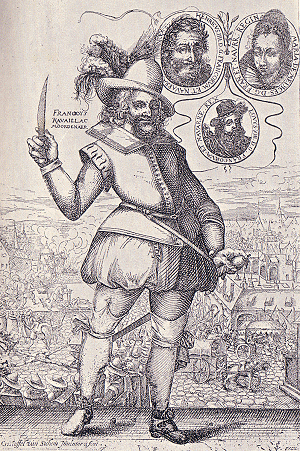
1610: Francois Ravaillac, because Paris was worth more than a mass

On this date in 1610, the fanatical Catholic who assassinated Henri IV of France was ripped apart on the Place de Greve.

The road to this man’s calvary begins long before his infamous crime, even long before the birth of his illustrious victim.

The Protestant Reformation — so richly represented in the executioner’s annals — had fractured France in the 16th century.

After decades of voluptuously indecisive Catholic-versus-Hugeunot slaughter, matters had finally been settled by the man upon whom French absolutism would erect its (ill-fated) edifice.

Henri IV, the first Bourbon monarch and a Huguenot, had unified the country by the sword, capped by his memorably politic conversion to Catholicism in 1593 to win over the holdout capital of Paris — the occasion of his understated declaration that “Paris is worth a mass”.

Let us tarry here to appreciate “the good king Henri” in a kaleidoscope of flattering artwork to the tune of Vive Henri IV, the monarchy’s unofficial anthem after its subject’s passing:

Did you catch that last image?

Henri’s fine gesture of sectarian triangulation and the reign of relative calm it inaugurated were naturally resented by godly partisans of both camps who either considered his conversion a betrayal or considered the king a closet Protestant.

At the crazed end of this latter spectrum, we meet our day’s principal, Francois Ravaillac.

Readers unconstrained by time may enjoy this Tolstoyan trek into the regicide’s mind and milieu, but it will suffice us to say that the modern shotgun-wielding postal clerk who just seemed like a quiet, harmless type to all his coworkers might like the cut of Ravaillac’s jib. A bit of a loner, a bit of a professional washout, with a penchant for religious visions and a passel of ill-arranged grievances … by this point in the movie, that’s about what you expect the police profiler to be reciting.*

It is only right that such a contemporary-sounding lone nut story ought to have a vigorous conspiratorial counternarrative.

There has always been a strong suspicion that behind Ravaillac’s hand was the work of the scheming Catholic Duc d’Epernon, perhaps even with the complicity of Henri’s wife Marie de’ Medici, who had conveniently been crowned as queen the day before the murder** and promptly teamed up with Epernon to cement an alliance with a traditional French rival, the ultra-Catholic Habsburgs.

Balzac, for one, had no doubt about it:

all of [her] actions were prejudicial to France … Marie de’ Medici wasted the wealth amassed by Henri IV.; she never purged herself of the charge of having known of the king’s assassination; her ‘intimate’ was d’Epernon, who did not ward off Ravaillac’s blow, and who was proved to have known the murderer personally for a long time. … [T]he victory Richelieu at last won over her (on the Day of the Dupes) was due solely to the discovery the cardinal made, and imparted to Louis XIII, of secret documents relating to the death of Henri IV.

The historical jury is out on that question, presumably for good.

If Ravaillac was a conspirator, he proved to be a damned good one, denying under repeated torture that he had any accomplices. On this date, the tortures reached their crescendo and conclusion — to the horrible delight of the Parisian mob, as reported by Alistair Horne (via The Corner):

On 27 May, still protesting that he had acted as a free agent on a divinely inspired mission, Ravaillac was put to death. Before being drawn and quartered, the lot of the regicide, on the Place de Grève scaffold he was scalded with burning sulphur, molten lead and boiling oil and resin, his flesh then torn by pincers. Then his arms and legs were attached to horses which pulled in opposite directions. One of the horses “foundered,” so a zealous chevalier offered his mount; “the animal was full of vigour and pulled away a thigh.” After an hour and a half of this horrendous cruelty, Ravaillac died, as the mob tried to prevent him receiving last rites. When he finally expired,

“…the entire populace, no matter what their rank, hurled themselves on the body with their swords, knives, sticks or anything else to hand and began beating, hacking and tearing at it. They snatched the limbs from the executioner, savagely chopping them up and dragging the pieces through the streets.”

Children made a bonfire and flung remains of Ravaillac’s body on it. According to one witness, Nicholas Pasquier, one woman actually ate some of the flesh. The executioner, supposed to have the body of the regicide reduced to ashes to complete the ritual demanded by the law, could find nothing but his shirt.

Ravaillac was the last Frenchman drawn and quartered for a century and a half — but his punishment as a regicide formed the precedent for that handed down in 1757 to Damiens.

* No need, though, as Francois wasn’t hard to catch: he stepped up to Henri’s carriage when it was caught in a traffic jam on May 14, 1610, and stabbed the king to death plain as can be. He was lucky (sort of) to avoid a lynching.

** Rubens later painted a gaudy celebration of this event.

On this day..

1923: Albert Leo Schlageter, Nazi martyr

On this date in 1923, a German paramilitary was shot by a French firing squad near Dusseldorf for his anti-occupation sabotage efforts.

Albert Leo Schlageter, a World War I veteran and conservative Catholic who signed up with the right-wing Freikorps and tangled with communists after the war, joined the fledging Nazi party when it absorbed his Freikorps unit in 1922.

The next year, France occupied the Ruhr to secure war reparations payments then crippling Germany, which would do much to speed the rise of the Nazis in the years ahead.

Schlageter was nabbed sabotaging railroad lines in resistance, and Berlin’s protests didn’t help him much.

He became a Nazi martyr literally overnight, and as the nationalist right ascended, the place of his passion was marked with a 90-foot cross and used for party rallies. His name christened a naval vessel, a Luftwaffe fighter wing, two SA units, and several Nazi badges and decorations:

A 1923 NSDAP pin honoring Schlageter.

There was also a play about him, Schlageter, whose debut performance was for Hitler’s first birthday as Chancellor in 1933. The most famous work of Hanns Johst, it was notable for the line “Wenn ich ‘Kultur’ höre, entsichere ich meinen Browning!” — “When I hear the word ‘culture’, I reach for my gun!” — subsequently adopted by so many gun-reaching Nazi kulturkampfers that it is provenance is regularly misattributed.

Unsurprisingly, Schlageter’s cult has waned into obscurity since 1945. But one needs not endorse his philosophy or its horrifying posthumous expressions to appreciate the man’s struggle against foreign occupation and bravery in what he took to be the country’s interests.

For the Communist Karl Radek, this martyr of the right stood for many more whose sincere intentions had been bent against themselves — “those German Fascisti, who honestly thought to serve the German people.” Addressing the Communist International’s Executive Committee in the days after the officer’s execution, Radek anticipated Schlageter pointing the way to a future very different from that which came to pass:

Schlageter, a courageous soldier of the counter-revolution, deserves to be sincerely honoured by us, the soldiers of the revolution.

Schlageter went … to the Ruhr, not in the year 1923 but in the year 1920. Do you know what that meant? He took part in the attack of German capital upon the Ruhr workers; he fought in the ranks of the troops whose task it was to bring the miners of the Ruhr under the heel of the iron and coal kings. The troops of Waters, in whose ranks he fought, fired the same leaden bullets with which General Degoutte quelled the Ruhr workers. We have no reason to believe that it was from selfish motives that Schlageter helped to subdue the starving miners.

The way in which he risked his life speaks on his behalf, and proves that he was convinced he was serving the German people.

[The German Communist Party] believe[s] that the great majority of the nationalist-minded masses belong not to the camp of the capitalists but to the camp of the workers. We want to find, and we shall find, the path to these masses. We shall do all in our power to make men like Schlageter, who are prepared to go to their deaths for a common cause, not wanderers into the void, but wanderers into a better future for the whole of mankind; that they should not spill their hot, unselfish blood for the profit of the coal and iron barons, but in the cause of the great toiling German people, which is a member of the family of peoples fighting for their emancipation.

Schlageter himself cannot now hear this declaration, but we are convinced that there are hundreds of Schlageters who will hear it and understand it.

On this day..

1916: Syrian and Lebanese nationalists, who christen “Martyr’s Day”

On this date in 1916, a landmark and a holiday — and a founding story of national betrayal — were born with the Ottoman Empire’s hanging separatist nationalists simultaneously in Damascus and Beirut.

The lightning-rod British journalist Robert Fisk has referenced this event numerous times. Here’s his description, focusing on the Beirut location:

Prior to the First World War, 33 Arabs in what is now Lebanon and was then Syria had appealed to the French consul in Beirut to help them to gain independence from the Turks – or at least offer French protection.

The letters — from both Muslims and Christians, one from a Palestinian and another from a senior officer in the Ottoman army — were written in secret and duly reached the consul. But when France broke off relations with the Sublime Porte on the outbreak of war, the diplomat — rather than pack those subversive letters off to his new residence in Egypt — hid them in the abandoned consulate.

And so it came to pass that the local French-language interpreter at the consulate, imprisoned in Damascus, sought to gain his freedom with Ahmed Jemal Pasha, commander of the Turkish Fourth Army in Syria, by betraying to him the exact location where the consul had hidden the documents. Ottoman security agents then broke into the consulate — which was supposed to be under the protection of the still-neutral United States — and found the incriminating letters. Jemal Pasha’s fury was now directed against these treacherous letter writers with Saddam-like fury.

They were dragged from their homes, taken to the hill town of Aley, brutally tortured and sentenced to be hanged by a drum-head military court. And hanged they duly were, only a few feet from the spot where the sea will now wash up to the square and scarcely 50 metres from the tomb where Rafiq Hariri now lies. A priest was hanged in his robes. The Ottoman officer went to his death in full military uniform.

And three days after the last batch of Lebanese patriots were hanged in 1916, François Georges Picot signed his infamous secret agreement with Sir Mark Sykes to divide up the Middle East, taking Syria for France — and Palestine for the Brits — which would ensure that the French government rather than an independent Lebanese government took over Lebanon.

Now here’s the rub. Not only had every leading Lebanese patriot been liquidated just before the Sykes-Picot agreement. But the French diplomat who had shamefully left those fatal letters behind in his consulate in Beirut was – wait for it – the very same François Georges Picot.

Convenient.

It is as martyrs that this day’s victims are best known, rather than their particular individual achievements. But Abdul-Karim al-Khalil had the day’s picturesque exit; just before he kicked away his own ladder, denying the executioner the pleasure, he declared:

O paradise of my country, carry our feelings of brotherly love to every Lebanese, to every Syrian, to every Arab, tell them of our tragic end and tell them: “For your freedom we have lived and for your independence we are dying!”

As a result of this day’s dealings, May 6 is known in both countries as Martyrs’ Day — an apt occasion for renewing the two states’ ties — and both Beirut and Damascus have a Martyrs’ Square. This is the monument in Beirut:

On this day..

1808: The Executions of the Third of May

Two centuries ago today, Napoleon’s troops executed hundreds of prisoners taken during a quashed uprising against them in Madrid.

The carnage gives posterity an 1814 Goya masterpiece. (And this blog’s frontispiece.)

More reading: Napoleon’s Cursed War, by Ronald Fraser.

On this day..

1315: Enguerrand de Marigny, on Montfaucon

On this date in 1315, an obscure petty noble who had become the king’s right-hand man was hanged by his rivals a few months after his royal sponsor expired.

Late in the epoch-making reign of King Philip the Fair — under whose rule the papacy was hijacked to Avignon and the Templars were crushedEnguerrand de Marigny was the man loyally keeping the books.

Since Philip was a stubbornly spendthrift fellow, that meant Marigny’s chief pursuit was the creative extraction of new revenues, through fresh taxes and the debasement of coinage. His public esteem suffered commensurately, little aided by the fact that his duties made him fabulously wealthy and the most powerful man in the country, give or take a king.

Said monarch was vigorous in that age-old pastime of the feudal monarchy, centralization of the power scattered among the nobility, further to which end he was happy to promote a competent administrator of scanty lineage and dependable loyalty.

Aggrieved lords, like the grasping Charles de Valois, were ready with their grudges against the unpopular minister when Philip shuffled off in November 1314. When charges of financial impropriety didn’t stick, they cooked up an allegation of sorcery — just then coming into vogue as a trump card in the game of judicial homicide.

Enguerrand hung two years upon the monumentally terrifying Montfaucon Gibbet (the link is to the structure’s French Wikipedia page), but everyone felt just terrible about it later. (the link is French, again) An actual inquiry — they skipped that step when they strung him up — exonerated the luckless minister, allowing his heirs to retrieve his body and a chunk of his fortune from the sympathetic king; Charles was so pursued by guilt that on his deathbed, he sent out a fat dispensation of alms with the request that recipients pray for both Enguerrand de Marigny and himself.

It worked … at least for Marigny’s reputation.

None can tell, after this lapse of time, whether this remorse proceeded from weakness of mind or sincerity of heart, and which of the two personages was really guilty; but, ages afterwards, such is the effect of blind, popular clamor and unrighteous judicial proceedings, that the condemned lives in history as a victim and all but a guileless being. (Source)

It was no hard feelings from Enguerrand’s little brother, Jean. The family influence had landed him a bishopric, and he held the job until his death in 1350, even repelling an English siege of Beauvais during the Hundred Years’ War.

A European Haman?

Enguerrand de Marigny comes in for a passing notice as T.H. White affectionately surveys the Middle Ages in The Once and Future King:

What an amazing time the age of chivalry was! Everybody was essentially himself — was riotously busy fulfilling the vagaries of human nature … [a] coruscating mixture of oddities who reckoned that they possessed the things called souls as well as bodies, and who fulfilled them in the most surprising ways.

[Y]ou might have seen Enguerrand de Marigny, who built the enormous gallows at Mountfalcon, [sic] himself rotting and clanking on the same gallows, because he had been found guilty of Black Magic.*

That Marigny erected the gallows on which he hung is an oft-repeated claim, an instance of a whole subgenre of moralistic folklore in which death-dealing inventors are hoisted on their own petard. These stories are not always dependablecontra rumor, for instance, Dr. Guillotin was not guillotined — and today’s protagonist may not have a firm hold on this small consolation, either.

Here is Victor Hugo’s rendering of the structure’s history in The Hunchback of Notre Dame.

Montfauçon was, as Sauval says, “the most ancient and the most superb gibbet in the kingdom.” …

Let the reader picture to himself, crowning a limestone hillock, an oblong mass of masonry fifteen feet in height, thirty wide, forty long, with a gate, an external railing and a platform; on this platform sixteen enormous pillars of rough hewn stone, thirty feet in height, arranged in a colonnade round three of the four sides of the mass which support them, bound together at their summits by heavy beams, whence hung chains at intervals; on all these chains, skeletons; in the vicinity, on the plain, a stone cross and two gibbets of secondary importance, which seemed to have sprung up as shoots around the central gallows; above all this, in the sky, a perpetual flock of crows; that was Montfauçon.

At the end of the fifteenth century, the formidable gibbet which dated from 1328, was already very much dilapidated; the beams were wormeaten, the chains rusted, the pillars green with mould; the layers of hewn stone were all cracked at their joints, and grass was growing on that platform which no feet touched. The monument made a horrible profile against the sky; especially at night when there was a little moonlight on those white skulls, or when the breeze of evening brushed the chains and the skeletons, and swayed all these in the darkness. The presence of this gibbet sufficed to render gloomy all the surrounding places.

The mass of masonry which served as foundation to the odious edifice was hollow. A huge cellar had been constructed there, closed by an old iron grating, which was out of order, into which were cast not only the human remains, which were taken from the chains of Montfauçon, but also the bodies of all the unfortunates executed on the other permanent gibbets of Paris. To that deep charnel-house, where so many human remains and so many crimes have rotted in company, many great ones of this world, many innocent people, have contributed their bones, from Enguerrand de Marigni, the first victim, and a just man, to Admiral de Coligni, who was its last, and who was also a just man.

Hugo — who, let us admit, is not to be depended upon for history — has elevated Marigny to the very first victim of the Montfaucon gallows, but the reader will also notice that the same passage dates the edifice’s construction thirteen years after Marigny’s own execution.

Helpless Historiography

Montfaucon the execution site had a rich history. There seem to have been at least two separate gallows sites (the link is French) on the hill, and its vintage as an execution space dates back to the 13th century. (more French)

About this point, this blog runs against the limits of its writer’s access to primary documentation and werewithal to pursue it. Sources seem mightily confused on the embryonic era of Montfaucon; at least two other ministers — Pierre de La Brosse, a confidante of the previous king, and Pierre Remy, another royal treasurer hanged a generation after Marigny — also have their own claim to have been hanged on the structure they erected.

It may be that this was actually true of Remy, a less dramatically captivating figure with an official portfolio similar to Marigny’s, and the two simply became conflated in legend. Something certainly seems to have been built during his time, and it may have been the stone replacement for the original gallows.

The suggestion of someone who researched it more thoroughly than I have (another French page, but worth the visit if only for the pictorial schematics) is that the landmark structure may have predated all these men.** Brosse and Marigny, in this conception, may simply have worked various repairs upon it that became magnified in the retelling, while the gallows Remy set up might have been those on the secondary location, erected as a stopgap during a more thorough reconstruction of the permanent site, and/or reserved for more vulgar elements than ministers of the crown.

* Readers may appreciate an annotation of other references White makes in his fantasy classic.

** We find repeated claims that the alleged “sorceror” Marigny engaged for his capital crime was hanged below him, which would support that notion; I have been unable to identify the provenance of this detail, however.

On this day..

1792: Nicolas Pelletier, Madame Guillotine’s first kiss

On this date in 1792 — a surprisingly late date, just nine months before the king himself would die under its blade — debuted the iconic symbol of the French Revolution, the guillotine.

Today, it turned a thief and killer named Nicolas Pelletier from thug to trivia. Much more illustrious names would follow, and anon.

Though predecessors of the grim machine had been used centuries before in Scotland, Italy and Switzerland, the guillotine ushered in a distinctly modern era of technological application to capital punishment informed by egalitarianism — prior to the French Revolution, nobles and commoners had different modes of execution — and by legal and medical expertise aimed at minimizing pain.*

In fact, the device’s namesake, physician Joseph-Ignace Guillotin, opposed the death penalty altogether; he approved scientific and “painless” execution as a stopgap measure.**

For his troubles, the humane doctor’s name became synonymous with terror, enough so that his descendants changed their handle. One wonders how the doctor judged his own legacy; certainly better for any condemned person to die on the guillotine than the breaking wheel, but the mechanical efficiency of the “French razor” and the depersonalization of the condemned in relation to the headsman and the witnesses also made possible the mass executions the French Revolution is known for.

Singular Guillotin, respectable practitioner: doomed by a satiric destiny to the strangest immortal glory that ever kept obscure mortal from his resting-place, the bosom of oblivion! … “With my machine, Messieurs, I whisk off your head (vous fais sauter la tete) in a twinkling, and you have no pain;”–whereat they all laugh. (Moniteur Newspaper, of December 1st, 1789 (in Histoire Parlementaire).) Unfortunate Doctor! For two-and-twenty years he, unguillotined, shall near nothing but guillotine, see nothing but guillotine; then dying, shall through long centuries wander, as it were, a disconsolate ghost, on the wrong side of Styx and Lethe; his name like to outlive Caesar’s.

Carlye

Whither the ethical role of the physician dedicated to life in the protocol of dishing out death? It’s a strikingly current dilemma.

Want to know more about how the guillotine was built? Want to build your own?

* Pain reduction was distinctly not the order of the day under the ancien regime. Often, quite the opposite.

** It was still another physician, Antoine Louis, who actually designed the decapitation machine; for a time, it was known as the Louisette. The working model was built from Louis’ design by a piano maker — and it may be more than coincidence that the science of constructing this mechanically complex musical instrument was also bursting with creativity on the cusp of the Industrial Revolution.

On this day..