1943: The Zalkind family

(Thanks to Meaghan Good of the Charley Project for the guest post. -ed.)

Sometime in the autumn of 1943, a refined actor had a family of Vilna/Vilnius Jews summarily hanged on a public gallows.

Vilna* was one of the major Jewish ghettos in Nazi-occupied Eastern Europe.

Noted for its rich cultural life, the Vilna Ghetto, which at its peak contained approximately 40,000 people, lasted from September 6, 1941 to September 24, 1943. By the end of its existence, however, through starvation, overwork, disease, and bullets, the ghetto’s population had been reduced by three-quarters.

In late September 1943, the ghetto was liquidated. Most of the inhabitants were taken to the nearby forest in Ponar and shot, or sent to extermination camps in Poland or work camps in Estonia, where almost all of them died.

The convivial Bruno Kittel

The liquidation was supervised by German Oberscharführer Bruno Kittel. (He is not to be confused with Otto “Bruno” Kittel, the Luftwaffe flying ace.)

Kittel was an actor. He graduated from the theater school in Berlin and from the plundering school in Frankfurt. On Sundays he played songs on his saxophone at the Vilna radio station. Kittel was not only the youngest of his colleagues; he was the most zealous … [His] reputation extended from Riga to Lodz to Warsaw.

At first glance, you would never guess that Kittel was an executioner. Constantly smiling with his dazzling white teeth, he was perfumed, elegant, polite, and refined.

After the ghetto was no more, a few skilled craftsmen and artisans whose work was essential to the war effort remained within the city at one of three labor camps.

Karl Plagge, a German major in charge of the HKP 562 camp, was sympathetic to the plight of his workers and worked to save their lives, albeit without much success. For this, he would later be honored as a Righteous Gentile by Yad Vashem.

During the liquidation, in an attempt to avoid capture, many of the Vilna Jews concealed themselves in hiding places and bunkers, called “malines” or “malinas”. Sadly, the Nazis caught almost all of them, but a few were able to wait out the carnage and then escape.

The Zalkind family were among the fortunate people who were able to remain in hiding throughout the liquidation.

But they did not survive for very long afterwards.

Their final days are described in The Complete Black Book of Russian Jewry, a collection of accounts of atrocities in the Soviet Union from which the observation about Kittel above is also drawn.

Journalists and historians began gathering eyewitness statements before the war was even over, and Ilya Ehrenburg and Vasily Grossman assembled and edited the accounts and finished the Black Book in 1946. It was the first major documentary work on the Holocaust. However, Stalin refused to allow its publication and had the type-plates and galley proofs destroyed in 1948.

A few copies survived, and the book was finally published in Russian in 1993. The English translation came out in 2002.

The full names of the Mr. and Mrs. Zalkind and their son are not recorded. Yad Vashem’s Central Database of Shoah Victims’ Names lists a Masha Zalkind, age 34, a store manager who was married to Moshe, and Hone Khona Zalkind, 2, whose parents were Masha and Moshe. Both lived in Vilna during the war and were killed in 1943; they might well be the mother and son from this story.

There are several Moshe Zalkinds listed. One, a tailor who was born in 1907, lived in Vilna and was married to Masha. He’s the closest match, but it says he was in Estonia during the war and was killed in 1944.

In any case, the Zalkinds were on the Aryan side of Vilna, probably posing as Christians with forged identity papers, when they were spotted in the street by Bruno Kittel. The Black Book records::

Suspecting they were Jews, Kittel stopped them and had them sent to the concentration camp [at 37 Suboch Street], where he determined that their name was Zalkind and that up until now they had been hiding in a malina. He ordered a gallows to be erected in the middle of the yard and summoned sixty SS men from the Gestapo. When everything was ready and the yard was full of SS surrounding the doomed Zalkinds — husband, wife and child — Kittel said:

“For having violated my order and hiding in the city, you will now be hanged in front of everyone.”

Kittel went over to the gallows to be sure that the rope was strong; then he began the execution process. The child was the first to be hanged. Then the mother. When the noose was tightened around the father’s neck, the rope broke.

Kittel ordered a new noose to be made. But as soon as Zalkind was hanging from it, the rope broke again.

Kittel was simply amused by it all.

“If the rope should break a hundred times, I’ll hang you a hundred times,” he said. And he ordered the hangman to prepare another rope.

Following the rule of collective responsibility, after Mr. Zalkind finally died, Kittel randomly selected fifty inmates of the camp, loaded them into a van and hauled them off to their deaths at Ponar.

Only a few hundred of the Vilna Ghetto’s Jews, mostly those assisted by Major Plagge, survived the Nazi era. Some of the Germans who helped wipe out this city’s once-vibrant Jewish community were apprehended after the war and prosecuted.

Bruno Kittel, however, disappeared without a trace and was never found at all.

* At the time, Vilna was part of Poland. Vilna was its Yiddish name; the Polish name was Wilnow. The city is now the capital of Lithuania and called Vilnius.

On this day..

1848: Robert Blum, German democrat

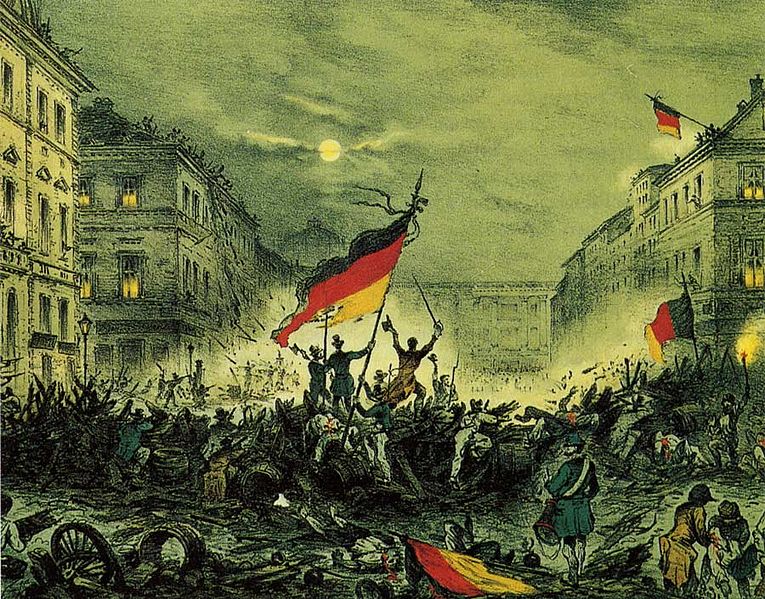
On this date in 1848, a day short of his forty-second birthday, the German revolutionist Robert Blum was summarily shot in Vienna — a tragic victim of Germany’s Revolutions of 1848.

Marker at Robert Blum’s birthplace in Cologne reads “I die for the German liberty that I fought for. May the fatherland remember me.” (cc) image from Elke Wetzig.

Blum grew up in a penniless proletarian family but drifted into the literary set. He spent the 1830s penning liberal-minded plays, poetry, newspaper correspondence. He uncovered a magnetic personality and a gift for organization.

By the 1840s he was a — maybe the — preeminent left-liberal in the Kingdom of Saxony: pro-parliamentary democracy, anti-violence, for a wide grant of civil liberties and mass education.

The pressures, both liberal and radical, pushed to the brink the small realms in the German Confederation, as well as the neighboring Austrian Empire. Both struggled to handle even the liberals’ demands like expanding the franchise and freedom of the press, with old hereditary polities that might not be up to changing times. Germany, Marx and Engels wrote in the Communist Manifesto (1847), “is on the eve of a bourgeois revolution.”

Right on cue…

That pregnant year of 1848 found Blum in the Frankfurt parliament, and his neither-fish-nor-fowl leftism — a little too out there for mainstream liberals; a little too bourgeois for real radicals — made Blum the perfect pick for a solidarity mission.

When in September 1848 the Austrian army was defeated trying to crush a Hungarian rebellion, the Habsburg capital of Vienna took the example and mounted a revolution of its own, putting the government to flight.

Blum was sent as sympathetic delegate to this abortive Viennese commune, but found himself trapped in the city when the Austrian army encircled it in late October.

The Austrians, when they caught him, sent their own message back by denying him any form of deference for his parliamentary rank. Blum’s direct condemnation was a stark warning by the Habsburg state to agitators, but also to their putative brethren dreaming of a Greater Germany. Austria wasn’t buying what the Großdeutsche people were selling.


Detail view (click for the full image) of Carl Steffeck’s painting of Robert Blum’s execution. Here’s a YouTube recreation (in German).

Blum went on to a posthumous career as a star liberal martyr among the German circles who had use for such a character.

Blum’s seven-year-old son Hans grew up to follow his father’s literary footsteps … but from quite the other side of the aisle. He was a pro-Bismarck nationalist.

On this day..

1676: Anna Schmieg and Barbara Schleicher, Langenburg witches

On this date in 1676, the tiny German principality of Hohenlohe strangled and burned to death its last convicted “witches”.

This story is the subject of the recent book The Last Witch of Langenburg: Murder in a German Village by Thomas Robisheaux. (Interview with the author.)

Almost a full year had elapsed since Anna Fessler had received a few shrovetide cakes from the daughter of the neighboring millers.* Hours later, Fessler (who had delivered a child just a week before) took painfully ill and died in her bed.

The cakes led back to the miller’s wife Anna Schmieg, of course. But decades after the Thirty Years’ War, the whole witchcraft construct was on its way out. Robisheaux builds a powerful micro-history of the local magistrate’s painstaking effort to satisfy the era’s rigorous legal standards for witch-persecution.

These standards would soon break down entirely, but in the here and now (or there and then), the authorities had to establish Schmieg’s malevolent reputation, and figure out if there was sufficient evidence to license torture. There wasn’t, the legal doctors whom Hohenlohe consulted advised; Hohenlohe made up a justification to do it anyway.

Hey, times hadn’t changed that much. Maybe still haven’t.

Anyway, the torture did to a co-accused what torture usually does. That luckless itinerant local woman was named Barbara Schleicher: she’d been under a pall from the accusation of a previously-tortured “witch” in a nearby village a few years before, and with the requisite pressure she soon copped to everything. Schmieg denied and fought and repelled, but eventually she too broke down and made the fatal confession. So, on November 8, 1676, before a court constituted of local grandees,

Anna Elisabeth Schmieg and Barbara Schleicher had to confess one more time, openly and publicly.

This was the moment of danger. Were Anna now to curse the judges as she had cursed the executioner before she was tortured, “asking them to join her for God’s Judgment in the Valley of Jehosaphat,” the proceedings might break up. She could be tortured again, but the curse would have had a shocking effect and raised the question about whether an injustice was about to be committed.

Because of these dangers, instead of asking the women to speak for themselves, the county’s officer spoke for them, saying that the two poor sinners had freely confessed their crimes and were ready to be given over to justice. The scribe read of Anna’s use of witchcraft and murder, as well as her seduction by Satan. He pronounced that she had done so many evil things that she could not even remember them all. He then read out a list of Schleicher’s crimes, which included witchcraft, murdering two husbands, turning herself into a wolf, and attempting to commit suicide. Whoever these two poor sinners had been before that day, they were now publicly branded as witches, poisoners, and murderers.

Talk about speak now or forever hold your peace. For not raising a ruckus, the court threw a bone to the wicked and now-confessed hags and mitigated the sentence of tearing at their flesh with iron tongs followed by burning at the stake to tearing at their flesh with iron tongs followed by strangulation followed by burning at the stake.

Chief Justice Assum turned to the court assessors and asked them whether the sentence had been decided as the court scribe had read it. Together they replied yes. Assum then rose, broke the ceremonial staff in two, and threw the pieces to the floor. With this old legal gesture, the blood court was symbolically breaking its staff over the lives of the prisoners. Then he said, “God help their poor souls.” [Local Count] Heinrich Friedrich’s representative then asked that the executioner carry out the sentence. According to prescription, the command to the executioner was repeated three times. At the close the chief justice forbade everyone present, on penalty of bodily punishment, from seeking revenge for this act of justice. No one was to take up violence against the law or question what was being done. The court scribe repeated his admonition.

The executioner then led the women out of the court, across the drawbridge, and over into the market square, where they joined the procession that had assembled. Drummers beat out a cadence, schoolboys sang hymns, and the sober procession marched down Langenburg’s long main street and out the gate at the east end of the town.

Once past the town gate, Anna’s and Barbara’s expulsion from the community was complete. From many perspectives, as we have seen, Anna’s emotional world was not like our own. It would be wrong to assume that Anna and Barbara felt the same anxiety and fear that we would today as they climbed the “Path of Straw” to Gallows Hill. The belief that someone who received absolution before an execution, and who did not sin again by resisting, would go right to heaven may help explain why prisoners rarely resisted at this point. Most tried to meet their fate as best as they could. Considering the suffering of the last ten months, Anna may have welcomed her end. She and Schleicher may also have been fortified for the ordeal by wine. Prayer may have brought them solace. However she felt about her fate, no record mentions her resisting or cursing the executioner or members of the court.

The scene at the gallows must have been crowded. The execution was seen as an example, and it was considered essential that the Langenburg schoolchildren be let out of school to join the procession. There, with the rest of their neighbors, they would have watched Anna and Barbara torn with hot irons and then strangled with a rope. After the bodies were burned to ashes, the last ritual gesture was made. “Lord Chief Justice,” Master Endris asked, “Have I carried out the law?” To which Assum would have replied, “If you have executed what the law and the sentence require, then the law has been fulfilled.”

This verbal exchange was critical for the execution to have fulfilled its purpose. At this moment the law, formally in suspense since Anna’s arrest, had been restored. The breach in public order that had opened on Shrove Tuesday was now mended. Count Heinrich Friedrich had seen to it. The chief justice and the assessors filed back into town and into the courtroom. Once they took their seats, it was announced that justice had been done. A lavish feast awaited them.

Just stay away from the cakes.

* A delicious tradition. Here’s a recipe for vanilla-frosted custard-filled shrovetide buns, from Denmark. Deadly deadly Satanpoison is optional.

On this day..

1942: Helmuth Huebener, Mormon anti-Nazi


Poster announces Helmut Hubener’s execution.

On this date in 1942, 17-year-old Helmuth Hübener was executed at Plotzensee Prison for listening to the BBC.

Huebener was a Mormon youth with the political perspicacity to abhor fascism from a very young age: the former Boy Scout (Mormons really take to scouting) ditched the Hitler Youth after Kristallnacht, which happened when Huebener was only 10 years old.

As Germany forged ahead towards worse horrors in the years, conscientious people of all ages had moral dilemmas to resolve. Mormons in Nazi Germany weren’t persecuted per se and to keep it that way that small community generally kept its head judiciously down.

Not Huebener.

Horrified by the privations of their Jewish neighbors, Huebener with fellow Mormon teens Karl-Heinz Schnibbe and Rudi Wobbe began illegally listening to foreign radio broadcasts and using the material to compose anti-fascist pamphlets for distribution around Hamburg.

Themes like Germany’s coming defeat (a Huebener circle favorite) never went over well with the authorities; a 1939 law decreed that “Whoever willfully distributes the broadcasts of foreign stations which are designed to endanger the strength of resistance of the German people will, in particularly severe cases, be punished with death.”

Huebener’s friends, aged 18 and 16, were judged only sufficiently severe for hard labor sentences; both survived the war but have since died. Huebener as the ringleader got the death penalty. (The local Mormon congregation expediently excommunicated him, a judgment later reversed from church headquarters in Salt Lake City.) And clearly Huebener was failing to “support the troops”, in the present-day parlance: his own older brother Gerhard had been drafted into the Wehrmacht and was away at the front.

“My Father in heaven knows that I have done nothing wrong,” young Helmuth wrote shortly before his beheading. “I know that God lives and He will be the proper judge of this matter.”

The Latter-Day Saints church, not usually thought of as a hive of anti-authority activity, has only gradually warmed up to celebrating its appealing young resistance martyr.

In addition to a number of books, Huebener is the subject of the documentary Truth & Conviction as well as the forthcoming feature film Truth & Treason.

A few books about Helmuth Huebener

Three Against Hitler and When Truth Was Treason were written by Huebener’s un-executed confederates.

Novels inspired by Helmuth Huebener

On this day..

782: 4,500 Saxons by order of Charlemagne

On an unknown date in the latter half of 782, Charlemagne did some seriously nasty business with a captured army of Saxons.

In the late 8th century, the King of the Franks was fighting a decades-long running campaign against Saxon tribes at the edge of his sprawling European empire.

One part Christianizing the pagans and two (or more) parts territorial aggrandizement, Charlemagne’s exertions on the Rhinish frontier were opposed by Widukind, or Witikind, or Widochind, whose “forest-child” name belies its owner’s legendary ferocity.


Widukind was reclaimed in the Renaissance as a patriotic or national figure. (Source)

In the summer of 782, when Charlemagne perhaps thought he had whatever passed for peace among the querulous Saxons, Widukind raised a revolt and dealt the Franks a stinging defeat that put a couple of imperial legates into the ground and made some martyrs out of clerics he found in the wrong place at the time.

Charlemagne’s forces counterattacked and routed the Saxons at the Battle of Suntel (or Sonnethal) Mountain, and thereupon

questioned the primores of the Saxons, all of whom be had summoned to attend him, as to who was responsible for the rebellion which had taken place. And since they all declared that Widukind was the author of this wickedness but were unable to deliver him up in view of the fact that he had taken himself off to the Northmen once the deed had been done, no fewer than 4500 of the others, those who had fallen in with his promptings and committed such a gross outrage, were handed over and at the place on the river Aller called Verden, at the king’s command, all beheaded in a single day. Thus was punishment executed; and the king then retired to winter-quarters at Thionville, where he celebrated both the Lord’s birthday and Easter in the customary fashion.

This merciless slaughter of prisoners is one of the lasting blights on Charlemagne’s impressive reputation. Even so, the reputation had the last word: three years later, Witikind was finally defeated and delivered up, in person, to the Frankish ruler … who accepted the Saxon pagan’s submission and forced him to convert to Christianity.


Charlemagne receives Witikind’s submission at Paderborn in 785.

On this day..

1944: Noor Inayat Khan, SOE operative

(Thanks to Meaghan Good of the Charley Project for the guest post. -ed.)

On either September 12 or (as we’re going with here) the early hours of September 13* in 1944, 30-year-old French spy Noor Inayat Khan (also known as Nora Baker, or by her code name Madeleine) was executed at Dachau for her activities on the behalf of the Resistance in Nazi-occupied France.

Noor, the first woman radio operator to be sent into France, came from a rather unusual background: her father was a Sufi religious leader descended from Indian royalty, and her mother an American from New Mexico.

Born in Russia, raised in England and France, Noor studied psychology and wrote poetry and a book of Buddhist-inspired short stories before the war intervened and her she and her family fled to England.

Although Noor had strong pacifist leanings, she decided to join in against Nazi Germany. Because she was fluent in French and English and was a good radio operator, they decided to send her to France. She went in June 1943.

Many of those who had trained her had grave doubts about her suitability as a spy. As part of her Sufi upbringing she had been taught that lying was the worst of all sins. Leo Marks, who taught her cryptography, later wrote his initial impressions of her in his book Between Silk and Cyanide:

She was cycling towards her ‘safe-house’ to practice transmitting when a policeman stopped her and asked what she was doing.

“I’m training to be an agent,” she said, “here’s my radio — want me to show it to you?” She then removed it from its hiding place and invited him to try it. […]

She’d been so startled by an unexpected pistol-shot that she’d gone into a Sufi-like trance for several hours, and finally emerged from it to consult a Bible.

Once in France, however, she displayed lion-like courage.

Even when the Nazis were making mass arrests of the French agents she associated with and the British forces offered to let her come home, she refused to desert her post.

After three and a half months she was betrayed, and pacifism notwithstanding she fought so furiously on arrest that her Nazi guards were afraid of her. In spite of considerable pressure (and we know what that means) she refused to provide them with any information about herself or her Resistance colleagues. On top of all that, she also made two escape attempts.

They decided to send her to Germany to better keep an eye on her.

Noor spent the rest of 1943 and most of 1944 in prison in KahrsruleKarlsruhe, subject to repeated interrogations by the Gestapo. She never gave anything away. In September 1944 she was sent to Dachau and shot to death with three other female agentsYolande Beekman, Madeleine Damerment, and Eliane Plewman — their bodies cremated.

Her last word? “Liberté.”

After her death she was awarded with the French Croix De Guerre and the British George Cross, and made a Member of the Order of the British Empire. Shrabani Basu published her biography, Spy Princess, in 2007 … and there’s a memorial in the works for her for London’s Gordon Square.

* Not everyone buys these dates or the story of these SOE agents’ execution.

On this day..

1942: Ten for Meir Berliner’s murder of a Treblinka officer

(Thanks to Meaghan Good of the Charley Project for the guest post. -ed.)

On September 11, 1942, Meir Berliner, an inmate of the Treblinka Extermination Camp, stabbed Unterscharführer Max Bialas to death with a penknife during evening roll-call. The Nizkor Project summarizes:

Max Bialas

At the evening roll-call of the prisoners, Max Bialas instructed those who had arrived that same day to line up on the side. It was not clear who was to be liquidated — the new arrivals or those who had arrived earlier. At that moment Berliner jumped out from the ranks of the prisoners, lurched toward Bialas and stabbed him with a knife. A great commotion followed. The Ukranian guards opened fire. Berliner was killed on the spot. and in the course of the shooting more than ten other prisoners were killed and others were wounded. When the tumult subsided the prisoners were lined up again for roll-call. Christian Wirth, who was in Treblinka at the time, arrived on the scene accompanied by Kurt Franz, the second in command of the camp. Ten men were removed from the ranks and shot on the spot in full view of all the others. On the following day, during the morning roll-call, another 150 men were taken out, brought to the Lazarett [the so-called “hospital” which was in fact an execution site] and shot there.

Little is known about Berliner.

According to the testimony of fellow-inmate Abraham Krzepicki, he was a middle-aged Jewish citizen of Argentina who had lived in that country for many years.

He and his wife and young daughter traveled to Poland on vacation in the summer of 1939. They could have picked a better time: when Germany invaded on September 1, 1939, the Berliners were unable to return home. Their Argentine passports should have protected them, but they ended up in the Warsaw Ghetto and were transported to Treblinka. Berliner’s wife and child were gassed immediately, but he was spared to work.

This reprieve would be expected to last days, or a few weeks at the most before he too would go to the gas chamber. Berliner became consumed with rage and the thirst for revenge, supposedly saying, “When the oppressors give me two choices, I always take the third.”

And so he took the first opportunity he could to kill one of his tormentors. As Yitzhak Arad said in his book Belzec, Sobibor, Treblinka: The Operation Reinhard Death Camps*: “His was an individual act of heroism and despair.”

As he must have known he would, Berliner died a horrible death — according to Krzepicki, he was beaten to death with a shovel.

Ironically, following Bialas’s murder, conditions for prisoners at Treblinka actually improved.

This was strictly for pragmatic reasons, as Arad noted: “The Jews selected for temporary work were a danger to the Germans, and the Berliner incident had proved it … When people knew they had nothing to lose, an act of despair like that of Meir Berliner could happen again and again.”

Rather than constantly killing and replacing their workers, the Nazis in charge of the camp decided to create a permanent staff of prisoner-workers and treat them with relative humanity. In this way, they hoped to prevent further acts of suicidal violence on the part of the Jews.

The existence of a permanent cadre of workers made it possible to plan and organize a revolt and mass escape from the camp. In August 1943, after months of conspiring and gathering the necessary weapons, the inmates killed most of the guards and made a run for it. About 300 or so actually made it outside of camp; of those, approximately 60 would survive the war.

* Operation Reinhard is presumably named for Reinhard Heydrich.

On this day..

1942: Irene Nemirovsky, Catholic Jewish writer

(Thanks to Meaghan Good of the Charley Project for the guest post. -ed.)

On this date in 1942, 39-year-old French/Ukrainian novelist Irene Nemirovsky was gassed at the Auschwitz Concentration Camp in Poland.

She was a victim of the Nazis’ racial laws: anyone with even one Jewish grandparent, even if they themselves did not practice the Jewish religion, could be considered a Jew. Nemirovsky, born to a wealthy Russian-Jewish family in what is now the Ukraine, had converted to Catholicism in 1939 — sincerely, insofar as anyone can discern.

Irene Nemirovsky fled Russian territory after the Bolshevik Revolution and spent a short time in exile in Finland and Sweden before eventually settling in France. There she married a banker, had two daughters, and published her first novel in 1930.

The book, called David Golder, was about a ruthless businessman (described by modern readers as “a Bernie Madoff of her time”) who in old age and poor health begins to regret the way he lived his life. It was a success and was made into a 1930 film.

Her second novel, Le Bal, also hit the silver screen. She penned several other books as well: Dimanche and Other Stories, Jezebel, The Dogs and the Wolves, The Courilof Affair, and more.

Although she was widely acclaimed as a writer in France, even by anti-Semites, she was denied citizenship in 1938. By then she had lived in the country for twenty years.

Following the German invasion of France in 1940, Nemirovsky’s books were pulled off the presses and she was required to wear the yellow star. If she and her family had succeeded in obtaining French citizenship, this would have provided some protection; the French were reluctant to deport their own Jews, filling the cattle cars with foreigners instead. Irene was instead classified as a “stateless person of Jewish descent” and the high-ranking Nazi official Ernst Kaltenbrunner called her a “degenerate artist of deluded Jewish hegemony.”

The “stateless” Irene was arrested on July 13, 1942. She had time to write a letter to her family, asking them not to worry about her, before she was deported to Auschwitz four days later.

Although she survived the initial selection and was tattooed with a prisoner number, it was reported a month later that she had died of typhus, a common and deadly disease in the concentration camps. However, later investigation showed she had in fact been sent to the gas chamber. Her husband was also gassed in Auschwitz in November of that year, but their two children survived the war.

One of Nemirovsky’s books, All Our Worldly Goods, was posthumously published in France in 1947. However, for sixty years following the war this once-famous author was largely forgotten.

In 2004, however, she became a literary sensation when a previously undiscovered manuscript, Suite Francaise, hit the press. The “suite” consisted of two books out of a projected five, titled “Storm in June” and “Dolce”. Irene had written them while in hiding in 1940. When she was arrested she gave the manuscripts in a suitcase to her daughter Denise, who safeguarded them all those years.

The book was received to great acclaim and became a bestseller, and publishers blew the dust off her novels from the 1930s and brought them back into print. In 2007, another of Nemirovsky’s works, Fire in the Blood, was published. The book was a companion to Suite Francaise — and like Suite, Nemirovsky had worked on it while in hiding during the Nazi occupation.

Nemirovsky never escaped controversy, in her life or after her death. Several critics and scholars have accused her of being an anti-Semite, a “self-hating Jew,” as detailed in this article from the Australian publication The Age.

Novelist Paul LaFarge charged her as “a Jew who disliked other Jews.” Primo Levi‘s biographer wrote of her, “She has taken on board the idea that Jews belong to a different, less worthy ‘race’, and that their exterior signs are easily recognizable: frizzy hair, hooked noses, moist palms, swarthy complexions, thick black ringlets, crooked teeth…”

There is evidence to support this assertion.

Some of her books were serialized in anti-Semitic magazines, and during the occupation Irene also wrote a letter to Marshal Petain, head of France’s collaborationist Vichy government, to say she disliked Jews and shouldn’t be classified as a Jew, racial laws notwithstanding. Her husband wrote a similar letter to the German ambassador after her arrest, saying his wife “did not speak of the Jews with any affection whatsoever.” The ambassador never bothered to reply.

Irene, however, also has her defenders in this matter: “She didn’t dislike Jews,” said one. “She disliked some Jews. Big difference.” Patrick Marnham, who wrote the introduction to the reprinted David Golder, argued that, “Her choice of an unsympathetic Jewish character [in the book] does not make Nemirovsky anti-Semitic; any more than Robert Louis Stevenson was anti-Scottish because he created the diabolical figure of Ebenezer in Kidnapped.”

You could argue that if she appeared to be anti-Semitic it was because she was trying to conceal her own Jewish origins and thereby protect her family from the deadly consequences. Her daughters believed this was the reason for her assertions that she hated Jews.

In any case, whatever Irene may have said or thought about her religious origin did not save her life. She was just one of many thousands of Christian converts who fell victim to Nazi Germany’s madness.

Irene’s younger daughter, Elisabeth Gille, who died in 1996, wrote a novel titled Shadows of a Childhood which was based on her parents’ disappearance. She had only been five years old when Irene was arrested. In 2010, Olivier Philipponnat and Patrick Lienhardt published the first major biography of Irene, The Life of Irene Nemirovsky, 1903-1942.

On this day..

1527: Leonhard Kaiser, Lutheran

On this date in 1527, Lutheran evangelist Leonhard Kaiser burned for his heresy at the Bavarian (today, Austrian) city of Scharding.

Kaiser (German link) was a middle-aged vicar hailing from a comfortable Bavarian family when Luther’s reformation fired a new evangelical zeal; he relocated to Wittenberg to absorb the new doctrines and became not only Luther’s exponent, but his friend.

In 1527, however, our man returned to his native Raab to nurse his ailing father — a calculated risk but a reasonable one, since Bavaria had not been killing its heretics.

Unfortunately for Kaiser, the region had a fresh new anti-Lutheran authority, and Kaiser’s continued preaching while he was in town set him up to be made an example of. Lutheran nemesis Johann Eck personally participated in the investigation.

According to Martin Luther as Comforter: Writings on Death, Luther personally wrote Kaiser a short letter of comfort in May of 1527, exhorting him to “patiently endure with the strength of Christ” his imminent martyrdom.

The great Reformer seems to have been profoundly affected by the death of his fellow-traveler, even (says this) questioning his own ministry relative to the sacrifice of flesh made by Leonard Kaiser. “I daily expect the death of a heretic,” Luther had written a friend a few years before … yet those martyrs’ laurels were not for him.

Instead, Luther did his proselytizing with his pen, and he found in Leonhard Kaiser a powerful subject indeed.

Luther took an early martyr’s hagiography written by Michael Stifel and greatly expanded it into a tribute, Concerning Leonhard Kaiser, Burned in Bavaria For the Sake of the Gospel that remained continuously in print in the 16th century. In that volume (I have not found a public link to it available online) Luther uses the burned man’s suggestive name: Leonard, “Lion-Hearted”, and Kaiser, “King”, to exalt the martyr’s courage and ultimate triumph.

It was also about this period — 1527 to 1529 — that Luther composed the hymn A Mighty Fortress Is Our God. Based on the Bible’s Psalm 46, this enduringly popular (even with Catholics) piece has been thought (though it’s just one speculative hypothesis among several) to be Luther’s tribute to his lion-hearted friend.

On this day..

1941: Josef Jakobs, the last executed in the Tower of London

In its day, the Tower of London has seen off with many an illustrious head.*

Its last use as an execution grounds occurred, all but invisibly, on this date in 1941, with the shooting of German spy Josef Jakobs.

It’s safe to say that Jakobs won’t be competing with Anne Boleyn in the book sales department any time soon. He was, truth be told, barely a spy at all: parachuted into Huntingdonshire on January 31, 1941 with intent to reconnoiter, the guy was observed in his descent by (undoubtedly excited) local defense volunteers. They raced to the landing point but needn’t have: Jakobs was practically immobile, having broken his ankle upon landing. So that was the end of the espionage mission.

After a secret trial under the Treachery Act of 1940, Jakobs was shot at a small rifle range where a number of his countrymen and predecessors from the First World War had met their own ends.

To: The Constable of H.M. Tower of London. 13th August 1941.

Sir,

I have the honour to acquaint you that JOSEF JAKOBS, an enemy alien, has been found guilty of an offence against the Treachery Act 1940 and has been sentenced to suffer death by being shot.

The said enemy alien has been attached to the Holding Battalion, Scots Guards for the purpose of punishment and the execution has been fixed to take place at H.M. Tower of London on Friday the 15th August 1941 at 7.15am.

Sgd. Sir Bertram N. Sergison-Brooke,

Lieutenant-General Commanding London District.

The Royal Armouries artefacts store still preserves the chair (pdf) Jakobs was strapped to for this historic execution. All subsequent executions of World War II spies took place by hanging at Pentonville Prison or Wandsworth Prison.

* It should be added that the Tower’s bloody reputation correctly associates more with the doomed men and women it held than with actual executions: only a very few, mostly high-ranking, folk actually got the chop in the Tower prior to 20th century spies: people such as Thomas More, Thomas Cromwell, and Monmouth were more commonly put to death at the adjacent (and public) Tower Hill.

On this day..