1969: Joseph Blösche, Der SS-Mann

On this date in 1969, Joseph Blösche was executed in Leipzig, German Democratic Republic, for his part in the Holocaust.


Blösche (far right) chills out at the Warsaw Ghetto with, among others, Jurgen Stroop (fourth from right, in profile).

Blösche (English Wikipedia entry | German) was an SS Rottenführer and a Nazi Party member whose particular contribution to deporting Jews from the Warsaw Ghetto to Treblinka was fitting in some opportunistic rape, typically followed with summary murder. The ghetto’s wards called him “Frankenstein”.

Blösche was eventually captured by the Red Army, which you’d think might augur ill for his survival prospects. However, with the aid of a horrible accident he suffered in a postwar labor camp that helpfully disfigured his face, Blösche managed to fade quietly into East German society, wed, and raise a family.

He would need that facial anonymity, because the un-disfigured version is there full-frontal gazing over his submachine gun in one of the war’s most iconic and chilling images — snapped for the benefit of the Stroop report documenting the ghetto’s liquidation.


An SS trooper, eventually identified as Joseph Blösche, looms over a frightened Jewish boy in the Warsaw Ghetto. (The child might be one of Artur Dab Siemiatek, Levi Zelinwarger, Israel Rondel, or Tsvi Nussbaum)

This photo was published in the U.S. in Life magazine on November 28, 1960. The terrible image haunted Holocaust survivor Peter Fischl into writing his poem “The Little Polish Boy”.

Blösche’s luck ran out when his name came up in a West German war crimes trial in 1961; East Germany’s follow-up eventually zeroed in on the man, and he was convicted in April 1969 for directly killing up to 2,000 people, and participating in deportations that killed 300,000 more. He was executed in Leipzig with a single shot to the neck.

Joseph Blösche is the subject of the German documentary Der SS-Mann (there’s also a book of the same title).

On this day..

1916: Captain Charles Fryatt, illegal combatant

On this date in 1916, Captain Charles Fryatt was shot at Bruges, Belgium as an illegal combatant.

Fryatt was a 42-year-old civilian mariner captaining the SS Brussels on the Harwick-Hook of Holland route when, in March 1915, a German U-Boat ordered him to heave to.

Fryatt wheeled the Brussels around on the submarine and attempted to ram it. The German ship escaped by a whisker only by scrambling an emergency dive. The Admiralty gave Fryatt a gold watch and a pat on the head for bravery.

It was not until the following year that the Germans captured that same vessel with that same captain on board. When they realized who they had, they subjected him to a snap tribunal for violating the laws of war: he’d participated in combat (by trying to ram the U-Boat) whilst being not a member of his country’s armed forces. That made him an illegal combatant, a franc-tireur in the still-current term for a civilian partisan left over from the Franco-Prussian War.

The Germans mightily loathed such terrorists, feared they would bedevil their steps in Belgium and France: people not sporting enough to stay beaten, people with the effrontery to fight back without being a duly enrolled member of a nation-state’s standing army. They did not scruple to push an expansive line on the definition of civilian non-participation.

“Every non-uniformed person,” read the a Moltke directive to the army, “if he is not designated as being justified in participating in fighting by clearly recognizable insignia, is to be treated as someone standing outside international law, if he takes part in the fighting … [or] participates in any way in the act of war without permission. He will be treated as a franc-tireur and immediately shot according to martial law.” (Source.)

So … that’s exactly what happened to Captain Fryatt.

This shooting set off a flurry of international recriminations and rebuttals.

People of normal moral sense can see readily enough that a merchant captain who scares off a submarine has not committed a grave crime any more than has a teen who chucks a grenade at commando firing at his home. The legal question for deliberation in Fryatt’s case was all about whether the merchant mariner had or had not committed an impermissible belligerent act by charging* … and as always, the definition of a war crime turned out to mirror precisely the political interest of the definer.

The British at this point had the Germans handily bottled up in a naval blockade that even seized food as “contraband”. (A tactic angrily denounced as a war crime in Berlin.) The Germans needed to get out of this stranglehold, and lacking anything approaching parity on the high seas, they staked their hopes on the U-boat. So the German interest was for maximum latitude for submarine activity; in fact, early in 1915, it was just in the process of rolling out its unrestricted submarine warfare policy of unannounced attacks on civilian freighters carrying war materiel. This does not seem to be what the U-boat stopping the Brussels did, but it gives you an idea of the scene. German military judges naturally said that German submarines who stopped a British merchant ship were not to be defied.

And the British interest, and by wonderous coincidence also its policy and legal position, naturally maintained maximum restrictions on a U-Boat’s potential targets, and maximum rights for the realm’s Captain Fryatts to resist.**

Fryatt, indeed, had followed the directives laid down by that Lord of the Admiralty, Winston Churchill. Churchill threatened to prosecute any ship captain who surrendered his vessel to a U-boat without opposing it “either with their armament if they possess it, or by ramming”: the theory was that routine resistance would maximize costs to the German navy, and maybe lead slow and vulnerable U-boats to skip the parley stage in favor of sneak attacks on unflagged steamers, which would sooner or later sink an American ship, which would help pull the U.S. into the war. (In May 1915, making no mistake at all about its target, a German U-boat intentionally torpedoed the Lusitania, generating a helpful stateside scandal also attended by dickering over the legality of the attack.)

So, the initial German announcement tersely reported that Fryatt

was condemned to death because, although he was not a member of a combatant force, he made an attempt on the afternoon of March 20, 1915, to ram the German submarine U-33 … One of the many nefarious franc-tireur proceedings of the British merchant marine against our war vessels has thus found a belated but merited expiation.

Britain replied that the captain had exercised only his “undoubted right of resistance,” and pointed out that a different merchant vessel that did obey such an order on the very same day had been sunk before it could evacuate — drowning 104 souls.

[T]he experience of German methods of warfare warned him that surrender would be no guarantee that the lives of his crew would be spared.

He determined therefore to take the best chance of saving his ship, and to steer for the submarine in order to force her to dive, and, if she were not quick enough in diving, to ram her.

This was his undoubted right under international law – to disregard her summons and resist her attack to the best of his power. It was a contest of skill and courage in which each side took their chance.

This led Germany to reiterate, on August 10, its view that Fryatt’s

act was not an act of self-defence, but a cunning attack by hired assassins …

The German War Tribunal sentenced him to death because he had performed an act of war against the German sea forces, although he did not belong to the armed forces of his country. He was not deliberately shot in cold blood without due consideration, as the British Government asserts, but he was shot as a franc-tireur, after calm consideration and thorough investigation …

Germany will continue to use this law of warfare in order to save her submarine crews from becoming the victims of francs-tireurs at sea.

There’s a 1917 monument to Captain Fryatt still displayed at London’s Liverpool Street Station, as well as a mountain in Alberta named in his honor.

Nobody was ever prosecuted for Fryatt’s execution.

* The distinction as parsed by Germany hung on whether the intended merchant prize was armed (allowed to resist) or unarmed (not).

** U-boats were new legal territory in 1915. The 1930 London Naval Treaty — although Germany was not party to it — attempted to clarify the status of these machines.

On this day..

1941: Not Shaike Iwensky, “standing in line to be killed”

(Thanks to Meaghan Good of the Charley Project for the guest post. -ed.)

On this day in 1941, seventeen-year-old Shaya “Shaike” Iwensky came within seconds of being shot by the Einsatzgruppen outside the city of Daugavpils, Latvian SSR. Sheer dumb luck — and a slight miscalculation by the Germans — saved his life.

Shaike was born and raised in Jonava, Lithuania and fled to Daugavpils with his brother when the Germans invaded the Soviet Union in June 1941. On June 29, he was arrested along with the other Jewish male adults in town. His brother, who was fifteen years old, was arrested alongside him, but released the same day because of his age.

For the next week and a half, Shaike was held in a crowded prison cell, fed almost nothing, and forced to work during the day.

On July 8, he noted “a change for the worse in our guards, an extraordinary meanness … In my worst fears, I could not have conjured up the kind of hell in which I now found myself.”

That day he and his comrades were stuck in a truly Sisyphean ordeal: forced to roll rocks up a hill, three men to a rock. They kept losing their grip and the rocks would slide back.

That night some other prisoners told him they had been forced to dig huge ditches, which were covered in chlorine.

The next day, the eighteenth day of Operation Barbarossa, Shaike found out what the ditches were for:

A series of shots … a short interruption and again shots … and again … It wasn’t long before we got the confirmation of what we’d been suspecting all along. One of the men in a neighboring cell stuck his head in the doorway, and said, “They are killing Jews. From the washroom window someone saw people lined up in the yard. They are from the first floor.”


Though this testimony specifically concerns a different massacre, in November of 1941, it gives a sense of the environment.

A couple of hours later, Shaike and the others from his part of the prison were ordered to leave and take all their belongings. They were marched down to the basement and made to empty their pockets into the “knee-deep rows of wallets, documents, pictures, watches, trinkets worthless to anyone else.” Then they were marched into the yard and formed into groups of twenty. Hoping to at least die with people he knew, Shaike stuck together with his old friends from Jonava.

The blue sky was almost clear, with only here and there a wisp of cloud. I looked up, and the thought hit me hard: I will never see the sky again.

It is said that, when a person faces death, his whole life flashes before him. But my thoughts were disjointed, disorderly; they tumbled through my mind rather like the flimsy clouds above, forming, changing shape, disappearing and reappearing … Catching myself picking at a hangnail, I thought, How silly. In a few minutes it will make no difference at all …

It occurred to me that reality was often quite unlike what we expect it to be. People standing in line to be killed didn’t look very different from those waiting to buy bread. Their faces, their eyes betray nothing of what is going on in their minds. People stand in line under the hot sun, they move ahead, then their times comes to die, and it is over.

Shaike and his friends waited in line for over two hours in the heat. He had not thrown out his handkerchief and was glad to have it to wipe the sweat from his face. Finally he and his group of twenty arrived at the gate … but when the soldiers came out, they didn’t escort them to the ditches. Instead they ordered everyone to turn around and march back to the prison.

That evening, the prisoners were ordered out again and taken to the killing ground, and then they realized what had happened: the Nazis had spared them because they had run out of ditches. The Jews had to cover the mass graves with earth, stamping down on the bodies and packing them together, and also to dig new trenches, presumably for themselves, until evening when they were sent back to the prison again.

That night, Shaike and some of his friends hid in an empty cell under blankets. The Nazis didn’t find them the next morning when they ordered the survivors out to get shot. They hid in the cell for two days before they were caught. Fortunately the Latvian guards who found them didn’t realize who they were, and merely beat them and tossed them in with some prisoners who’d arrived that same day.

Eventually, Shaike was released from the prison and taken to the Daugavpils Ghetto. He would eventually escape from there and spent some time living in the woods with a Soviet partisan detachment, going back and forth between there and the ghetto. Finally he was captured and taken first to the Stutthof Concentration Camp, then to Dachau. There he was liberated by Americans on April 29, 1945. At twenty years old, he was the sole survivor of his family.

Shaike moved to the United States in 1948 and changed his name to Sidney Iwens. He wrote a book about his experiences, titled How Dark the Heavens: 1400 Days in the Grip of Nazi Terror. Sidney Iwens died in Florida in 2010, at the age of eighty-four.

On this day..

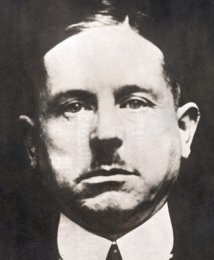
1931: Peter Kürten, the Vampire of Düsseldorf

On this date in 1931, the “Vampire of Düsseldorf” was beheaded for that city’s most infamous serial murder binge.

It was, perhaps, the logical end of a terrible journey.

A factory moulder and World War I deserter in his late forties, Peter Kürten commenced a series of uncommonly bestial rape-murders in early 1929 … the harvest of a lifetime’s twisted brutality.

He’d been the oldest of 11 children stuffed in a hellish one-room apartment with a violent drunk of a father who battered the children and openly raped their mother. Well, “if they hadn’t been married, it would have been rape,” in Peter’s words.

The future vampire took his refuge turning his own abuse on younger siblings and, with the help of a degenerate dogcatcher in the neighborhood, on obliging animals he could lay his hands on — which creatures he was soon learning to torture, and to rape, alongside more conventional human delinquencies like arson and burglary.

Kürten is known to have strangled at least one ten-year-old prior to World War I (he would also claim to have surreptitiously drowned a couple of school chums in his boyhood) but it was on the far side of the Great War — which he’d spent mostly in miserable prisons, nursing increasingly twisted fantasies of vengeance — that the beast truly emerged.

The spree that carried him to these pages began in Febuary 1929, when he slew an eight-year-old, attacked a middle-aged woman, stabbed a mechanic to death. Kürten’s crimes were irregular, but distinguished by a fiendish wrath: he abducted one young woman and hammered her to death in the woods outside town; he stabbed a five-year-old to death with scissors as he achieved his orgasm; he asked a teenager to run off and get him some cigarettes, so he could use her absence to slit her younger sister’s throat; he stabbed strangers randomly.

“I derived the sort of pleasure from these visions” of mayhem and cruelty, he said, “that other people would get from thinking about a naked woman.”

Düsseldorf endured a year of terror, finally aborted when Kürten’s own wife — whom he seems to have loved genuinely — turned him in, at Kürten’s own request, for the reward money.

At a packed trial, the accused’s accumulated hatred for the sadistic world poured out in words just as it had done in deeds over the months preceding.

I said to myself in my youthful way ‘You just wait, you pack of scoundrels!’ That was more or less the kind of retaliation or revenge idea. For example, I kill someone who is innocent and not responsible for the fact that I had been badly treated, but if there really is such a thing on this earth as compensating justice, then my tormentors must feel it, even if they do not know that I have done it …

Never have I felt any misgiving in my soul; never did I think to myself that what I did was bad, even though human society condemns it. My blood and the blood of my victims will be on the heads of my torturers. There must be a Higher Being who gave in the first place the first vital spark to life. That Higher Being would deem my actions good since I revenged injustice. The punishments I have suffered have destroyed all my feelings as a human being. That was why I had no pity for my victims.

-Kürten

Amateurs though we are, we incline to doubt the sufficiency of the tit-for-tat explanation. Kürten might well have believed that about himself, but the “vampire” moniker gets at an essential, organic sensuality about his crimes whose roots go quite a bit deeper than revenge.

“Tell me,” the doomed murderer is supposed to have asked a prison doctor shortly before facing the guillotine, “after my head has been chopped off will I still be able to hear; at least for a moment, the sound of my own blood gushing from the stump of my neck?”

The doctor indeed thought it possible the head might survive a few seconds.

“That,” mused the killer, “would be the pleasure to end all pleasures.”

Kürten is one of several predatory sex-slayers — also see the likes of Fritz Haarman and Carl Grossman — who prospered in interwar Germany, and helped to inspire Fritz Lang’s cinematic classic M. (Kürten is often thought the most direct model for that movie’s murderer, played by Peter Lorre. Lang denied that was the case, but in some countries’ releases it went out under the title not of M, but of The Vampire of Düsseldorf.)

Sources:

Murderpedia

TruTV

On this day..

1943: Marianne Elise Kurchner condemned for a joke

(Thanks to Meaghan Good of the Charley Project for the guest post. -ed.)

Sometime in the summer of 1943 in Nazi Germany, a young woman from Berlin named Marianne Elise Kürchner was guillotined for telling a joke.

Kürchner, who worked at an armaments factory, told the following joke to a coworker who denounced her:

Hitler and Göring are standing atop the Berlin radio tower. Hitler says he wants to do something to put a smile on Berliners’ faces. So Göring says: “Why don’t you jump?”

Not exactly a side-splitter. More like a neck-splitter: making jokes at Hitler’s expense was, in theory at least, a capital crime.

Mind you, most people who made nasty wisecracks about the Nazis faced no consequences at all. They were rarely denounced, and if they did come before a court they were usually given a warning, or at most a few months of “re-education” in Dachau.

The Nazis did occasionally use sedition as an excuse to arrest and execute people who’d gotten on their bad side for one reason or another, but ordinary Germans initially had little to fear.

However, as the tide of war began to turn against Germany, the punishments for sedition became ever more severe.

Marianne was called up before the People’s Court, whose president, Roland Freisler, was famous for both his long raving speeches berating defendants, and his death sentences. She admitted to making the joke but said she hadn’t been herself at the time, feeling bitter about the recent loss of her husband at the front.

Freisler would have none of it. In fact, he considered Marianne’s status as a war widow to be an aggravating factor. “The People’s Court,” Rudolf Herzog said of this case in his book Dead Funny: Humor in Hitler’s Germany, “made it a point of pride to take no account of individual suffering.” In his ruling, Friesler wrote:

As the widow of a fallen German soldier, Marianne Kürchner tried to undermine our will to manly defense and dedicated labor in the armaments sector toward victory by making malicious remarks about the Führer and the German people and by uttering the wish that we should lose the war … She has excluded herself from the racial community. Her honor has been permanently destroyed and therefore she shall be punished with death.

The People’s Court’s judgment was rendered on June 26, 1943. Marianne lost her head shortly thereafter.

On this day..

1953: 32 merciful Soviet soldiers

(Thanks to Meaghan Good of the Charley Project for the guest post. -ed.)

In June 1953, some discontented young citizens of Magdeburg, East Germany revolted and began demonstrating against the repressive Communist regime. On June 17, in the spirit of totalitarian governments everywhere, the authorities ordered a platoon of soldiers to open fire on a crowd of protesters.

Incredibly, the soldiers refused.

Every one of them vanished shortly thereafter, never to be seen again.

It was long assumed that the entire platoon had been executed for insubordination. This wasn’t confirmed until 1998, however. Four years previously, Magdeburg construction workers digging the foundation for a new building accidentally unearthed a mass grave containing 32 bullet-riddled skeletons. From the condition of the remains, authorities determined the victims — all of them young men — had died sometime between 1945 and 1960.

They could have been the missing Soviet platoon, but they could also have been prisoners executed by the Gestapo mopping up in May 1945, just before the Germans fled the city in advance of the Red Army.

As Jessica Snyder Sachs noted in her 2001 book Corpse: Nature, Forensics, and the Struggle to Pinpoint Time of Death, the victims all had extensive tooth decay and no sign of dental work, which was consistent with Russia but not central Europe. This was hardly conclusive, however.

To solve the mystery, investigators turned to Reinhard Szibor, a biologist at the nearby Otto von Guericke University.

Szibor had helped in criminal cases before and was famous for using pollen to link suspects to crime scenes. Pollen clings to people’s hair, skin and clothes and is, of course, also inhaled. The stuff is nearly indestructible and will remain long after human remains have disintegrated. Authorities hoped Szibor could use pollen samples from the mass grave to determine what time of year the victims died.

Discover Magazine explains how he did it: Szibor rinsed out the skulls’ nasal cavities, had a look, and found pollen from lime trees, plantains and rye, all of which release their pollen during June and July. In other words, the Magdeburg victims had died during the summer months, the time when the Soviet platoon was reportedly executed, and not in the springtime when the Nazis retreated from the city.

Though we still don’t know the precise date of their deaths, and likely never will, the soldiers who paid for their humanity with their lives had finally been identified.

Die Lösung (The Solution)

After the uprising of the 17th of June
The Secretary of the Writers’ Union
Had leaflets distributed in the Stalinallee
Stating that the people
Had forfeited the confidence of the government
And could win it back only
By redoubled efforts. Would it not be easier
In that case for the government
To dissolve the people
And elect another?

-Bertold Brecht

On this day..

1944: Johanna Kirchner, Frankfurt antifascist

“Keep Goethe‘s words in mind. ‘Die and become’. Don’t cry for me. I believe in a better future for you.”

-Johanna Kirchner’s last letter to her children

On this date in 1944, former social worker Johanna (“Hanna”) Kirchner was beheaded in Plotzensee Prison for treason.

(cc) image from Fran Behnsen of a Kirchner commemoration plaque in Frankfurt’s St. Paul’s Church.

Kirchner English Wikipedia entry | German) co-founded with Marie Juchacz after World War I the still-extant Workers’ Welfare organization: Arbeiterwohlfahrt, or “the self-help of the workers.”

These self-helping workers — both members of the socialist Social Democratic Party; Juchacz was a Reichstag member — had to flee to League of Nations-administered Saarland with the rise of the Nazi dictatorship … and from there, soon enough, on to France.

There the Vichy government arrested her in 1942 (Juchacz got out to the United States), and deported Kirchner to Germany to answer as a traitor.

She had a sentence of “only” ten years at hard labor, but the case was unexpectedly reopened in 1944 so that the cartoon villain of fascist jurisprudence, Roland Freisler, could give her a spittle-flecked death sentence for having “treasonably rooted herself in the evilest Marxist high-treason propaganda.”

Kirchner’s native Frankfurt has a Johanna-Kirchner-Straße, and in the 1990s awarded a Johanna-Kirchner-Medaille to anti-fascists.


View Larger Map

On this day..

1416: Jerome of Prague, the first Hussite martyr

On this date in 1416, the Council of Constance had Jerome of Prague burned at the stake in the town square.

This eloquent, injudicious theologian studied at Prague, Oxford, Paris, Cologne, Heidelberg … accumulating Master’s degrees along the way like a career graduate student, but repeatedly finding himself run off the premises on suspicion of heresy.

Jerome’s “heresy” was an excessively combative hostility to ecclesiastical corruption. And although Jerome was known for his rapier tongue, he didn’t always find the pen mightier than the sword: he got into a few physical scraps with his foes.

While in England, he copied out a manuscript of preacher John Wycliffe — whose radical piety (or pious radicalism) inspired the rebellious Lollard movement.

Back on the continent, Jerome fell in with Jan Hus. Ten years Jerome’s senior, Hus was and remains the first name in Bohemian religious reform, and the “Hussite” church he founded still retains his name.

After Hus unwisely accepted a guarantee of safe conduct to dispute at the Council of Constance, the more ornery Jerome slipped into town to propagandize on his mentor’s behalf. After placarding his way to trouble, he slipped back out and must have thought he’d had his cake and eaten it too … until he was caught in the Black Forest.

Jerome spent nearly a full year in a dungeon — the Council met for four years; it had a massive schism to sort out — and at one point the privations of imprisonment led him recant. He later bitterly regretted that concession to “pusillanimity of mind and fear of death,” but on a strictly doctrinal level Jerome of Prague wasn’t anti-Catholic: he just wanted the church to be less of a bunch of corrupt, overweening racketeers.

By the time he was ready to answer for himself, and his soul, he was well past any spirit of capitulation. A witness to the procedure wrote of Jerome on trial for his life:

I have never seen any one, who, in pleading, especially in a capital offence, approached nearer the eloquence of the ancients, whom we so greatly admire. It was so amazing to see with what fluency of language, what force of expression, what arguments, what looks and tones of voice, with what eloquence, he answered his adversaries and finally closed his defence. It was impossible not to feel grieved, that so noble, so transcendent a genius had turned aside to heretical studies, if indeed the charges brought against him are true.

When that part of his indictment was read in which he is accused of being “a defamer of the papal dignity, an opposer of the Roman pontiff, an enemy of the cardinals, a persecutor of the prelates and clergy, and a despiser of the Christian religion,” he arose, and with outstretched hands and with lamenting tones, exclaimed: “Whither now, conscript Fathers, shall I turn myself? Whose aid can I implore? Whom supplicate, whom entreat for help? Shall I turn to you? Your minds have been fatally alienated from me by my persecutors, when they pronounced me an enemy of all mankind, even of those by whom I am to be judged. They supposed, should the accusations which they had conjured up against me, seem trivial, — you would, by your decisions, not fail to crush the common enemy and opposer of all, — such as I had been held up to view, in their false representations. If, therefore, you rely upon their words there is no longer any ground for me to hope.”

Some of them he wrung hard by the sallies of his wit; while others he overwhelmed with biting sarcasms; and from many, even in the midst of sadness, he forced frequent smiles, by the ridicule which he heaped upon their accusations.

At length, launching out in praise of John Huss who had been condemned to the fire, he pronounced him a good, just, and holy man, altogether unworthy of such a death, — adding that he was also prepared to undergo, with fortitude and constancy, any punishment whatsoever, yielding himself up to his enemies and the impudent lying witnesses, “who would, at length, have to give an account of all they had uttered, before God, whom they could not possibly deceive.” Great was the grief of all that stood around him. Thee was a universal desire among them to save so noble a personage, could his own consent be obtained. Persevering, however, in his opinions, he seemed voluntarily toseek death; and continuing his praise of John Huss, he declared that man had never conceived any hostility to the church of God; but that it was to the abuses of the clergy, and the pride, pageantry and insolence of her prelates alone he felt opposed; for, since the patrimony of the church was due, in the first place, to her poor; then to her guests; and finally to her on workshops; it seemed to that good man, a shameful thing, to have it expended upon courtezans and in banquets; for the sustenance of horses and dogs, the adornment of garments and other things unworthy of the religion of Christ.

Most exalted was the genius of which he showed himself possessed! Often was he interrupted in his discourse by various noises; and greatly vexed by those who carped at his opinions; yet he left none of them untouched, but equally avenging himself upon all, he either covered them with confusion, or else compelled them to hold their peace. A murmur arising against him, he paused for a moment; and then, having admonished the crowd, proceeded with his defence, — praying and beseeching them to suffer one to speak whom they would soon hear no more. At none of the noise and commotion around him did he tremble, or lose, for a single instant, the firmness and the intrepidity of his mind.

“You will condemn me iniquitously and unjustly,” he prophesied to his judges, “and when I am dead, I shall leave remorse in your consciences and a dagger in your hearts; and soon, within a hundred years, — you will all have to answer me, in the presence of a Judge most high and perfectly just.”

Reports differ as to the subsequent standing of all these men’s souls. But for the church as a going earthly concern, Jerome nailed it almost exactly: 101 years after he followed Jan Hus to the stake,* that long-suppressed spirit of reform irrevocably splintered papal authority.

* In the very same spot where Hus himself was burnt.

On this day..

1944: Admiral Inigo Campioni

On this date in 1944, Italy’s fascist rump government shot its former naval commander in Parma.

Inigo Campioni (English Wikipedia page | Italian) was both a Senator and the Admiral in charge of Italy’s main battle fleet when war came in 1940.

Knocked for overcaution during a few engagements with the British, he was relieved of his leading command position by the end of that year.

Come September 1943, he was at the island of Rhodes when Italy agreed to an armistice with the Allies. This was actually quite an unlucky spot to be, since the Germans, anticipating this development, had prepared a lightning Dodecanese Campaign to seize Italy’s positions in the Greek islands.

Many Italians resisted the German incursion, and suffered some of the war’s more infamous massacres for their trouble.

Campioni, who likewise recognized the government that signed the armistice, was captured within three days.

Unlike those recalcitrant Italians who met a summary fate, the admiral’s stature made him worth the trouble of trying to persuade. He was shipped first to a camp in Poland then to a prison in the northern Italian fascist statelet still headed by his former boss, Mussolini.

Campioni just kept refusing to recognize this Italian Social Republic: even to the end, he had a reprieve from shooting on offer for the price of an expedient word.

For never speaking that word, and instead suffering the fusillade with fellow-admiral Luigi Mascherpa, Admiral Campioni has been well-honored in posterity.

On this day..

1474: Peter von Hagenbach, war crimes milestone

On this date in 1474, Peter von Hagenbach was tried in a remarkable judicial proceeding in the Rhine city of Breisach, found guilty, and publicly beheaded by the end of the day.

This Alsatian knight in the train of Charles the Bold had been installed by that Burgundian duke as his satrap in in the Upper Rhine, in lands that Burgundy held on lease from the Habsburgs.

He made a legendary villain of himself in the early 1470s:

His regime of arbitrariness and terror extended to murder, rape, illegal taxation and wanton confiscation of pivate property, and the victim[s] of his depredations included inhabitants of neighbouring territories as well as Swiss merchants on their way to and from the Frankfurt fair … the outrages of Hagenbach, remarkable even by the standards of the late fifteenth century, greatly contributed to forging what, until then, had been considered impossible, that is, alliances against Burgundy by all her neighbours: Austria, Berne, France, and the towns and knights of the Upper Rhine, all formerly at loggerheads with one another.

After overturning Burgundian authority in the Upper Rhine, that unique alliance aired its many grievances with Hagenbach at a unique tribunal. There, the ex-knight was prosecuted before judges drawn from the several Germanic and Swiss principalities who had allied against him.


Breisach: seems like a nice place to oppress. (cc) image from Routard5.

This unusual procedure gained a special prominence in the 20th century postwar era as historical precedent for “war crimes” prosecutions. Since that time, there’s been a going debate over just what kind of precedent it really makes.

Executed Today is pleased to welcome Prof. Gregory Gordon of the University of North Dakota law school — a rising star in international human rights law.

Gordon wrote a 2012 paper re-examining the Hagenbach case attempting to reconcile both the legal and historiographical perspectives on Peter von Hagenbach.

ET: You characterize the present-day understanding of the Hagenbach case as proceeding from Georg Schwarzenberger‘s recovery of the incident further to providing legitimizing precedent for the Nuremberg tribunals. Between 1474 and World War II, did anyone think of this case as one with a wider import for jurisprudence? (And if not, do we know anything about how Schwarzenberger unearthed it?)

GG: To the extent anyone did, from my research, it would have been historians, not jurists per se. Hagenbach was the object of a fair amount of historical scholarship but that had evolved over the years. In the initial period after the trial, Hagenbach was portrayed as the quintessential bogeyman. But over the centuries, historians began to view him in a different light. By 1945, a more nuanced view of Hagenbach had been established. I have not researched Schwarzenberger’s biography in great detail. So I’m not sure how his eureka moment arose. What is clear is that the Nuremberg trial caused him to focus on Hagenbach (my sense is that Hagenbach was fairly well known in Europe — his supposed mummified head was on display in an Upper Alsace museum, for example — but given the absence of anything resembling Nuremberg before Nuremberg, people tended to ignore the details of the Hagenbach legal proceedings).

And my sense is that Schwarzenberger had an agenda — he realized the case could help legitimize what many would claim to be illegitimate ex post facto law at Nuremberg. So he relied on the earlier historical accounts of the Hagenbach case (it seems he based his seminal Manchester Guardian article primarily on the account of French historian Prosper de Barante). And thus he created a fissure between legal scholars and contemporary historians.

Who tried Hagenbach, under what authority, and how were the different interested parties formally represented? Whose idea was all this? What can we tell of the public atmosphere surrounding the trial — was there bottom-up pressure to do this?

After the League of Constance (consisting of various regional polities fed up with Hagenbach) paid off his debt for him, Archduke Sigismund of Austria resumed control over the Upper Alsace territory mortgaged to Charles the Bold. And thus Sigismund made the decision to have Hagenbach tried by the international ad hoc tribunal (another inexplicable link in the chain: Hagenbach escaped lynch-mob justice on Easter Sunday, April 10, 1474 — only thanks to Breisach resident Friedrich Kappelar’s decision to arrest him and await instructions from Sigismund).

Diebold Schilling the Elder made this illustration of the proceedings for a chronicle in 1485.

Sigismund’s decision to convene an ad hoc international tribunal was utterly remarkable for the time. And it is not clear how or why Sigismund came up with it (although historians suggest it had something to do with the prominent position Hagenbach held as representative of the Duke of Burgundy).

Numerous representatives of sovereigns from around the region, twenty-eight in all — including sixteen knights, sat as part of this international ad hoc tribunal.

Eight of the judges were nominated by Breisach, and two by each of the other allied Alsatian and Upper Rhenanian towns [Strasbourg, Sélestat, Colmar, Basel, Thann, Kenzingen, Neuburg am Rhein, and Freiburg im Breisgau] as well as by Berne, a member of the Swiss Confederation, and Solothurn, allied with Berne.

In fact, each sovereign represented a member of the League of Constance (Berne being the only representative of the Swiss cantons).

Thomas Schutz, the chief magistrate of Ensisheim, was designated as the tribunal’s presiding judge. The nominal trial prosecutuor was the new Alsatian bailiff chosen by Sigismund to replace Hagenbach — Hermann von Eptingen. Eptingen, for his part, chose Heinrich Iselin, one of the commissioners from Basel (one of the League of Constance’s members), to present the prosecution’s case to the court. The other representative from Basel, Hans Irmy, took on Hagenbach’s representation. At some point later in the trial, Iselin resigned because, as the evidence came in, he felt the case lacked merit (and even made a motion to withdraw the charges). He was then replaced by Hildebrand Rasp. Hagenbach also requested additional attorneys and the tribunal assigned him two attorneys — one from Colmar and one from Selestat.

The trial was held in open air before the Breisach mayor’s residence and was attended by “a multitude” of people from Breisach and surrounding towns. It appears as if it were somewhat of a circus atmosphere.

Is there a degree to which the pre-modern characteristics of the belligerents — Burgundian duchies, Swiss cantons, the Holy Roman Empire patchwork — set a contradictory precedent for the postwar world?

Let me quote my paper:

Nothing in history leading up to that moment in 1474 would have suggested the remarkable course of action taken by Sigismund. It is tempting to see that decision as an historic anomaly that would not be repeated for centuries to come. But on closer inspection, Sigismund’s choice to hold a trial before an international court fits well within the historical narrative of that era.

It was a time of religious and political disintegration. The Holy Roman Empire was fading into irrelevance and the Catholic Church was on the verge of losing its European hegemony. It was the eve of the nation-state — a unique moment when the old collective structures were dying and the new ones had yet to be born. Given the interstitial political turbulence, the time was ripe for a plural approach to law enforcement in the cosmopolitan geographic center of Europe. Hagenbach’s inter-regional depredations, which helped forge a rare pan-Germanic consensus, provided the perfect forum to experiment with international justice during that fragmented time. The Westphalian order, already on the horizon, would foreclose any such future experiments until Nazi brutality put a chink in the Westphalian armor and inspired an unprecedented transnational justice operation in the wake of a truly global war. In that sense, although on much different scales, Breisach and Nuremberg have much in common. And should the nation-state ever manage to reassert its absolute supremacy again, Breisach will undoubtedly be on the lips of future international jurists seeking, as before, to end impunity at the expense of sovereignty.

You discuss a revisionist thesis about Hagenbach that essentially says he wasn’t a monster, and even that he was a forward-thinking but star-crossed reformer. Why do you think that we can, in fact, conclude that there’s something to the claim that Hagenbach was tyrannous or criminal? What do you consider the most credible charges, and the ones that to his judges would have distinguished Hagenbach from a run-of-the-mill brutal lord or military commander?

What evidence supports the view that the good burghers of Alsace were the victims of Sir Peter’s violence? Their treatment of the wayward knight after his arrest is most revealing in this regard.

While torture may have been commonplace in ordinary criminal inquisitions of the time, the severity of torment inflicted leads one to believe it was inspired by and directed at the kind of mass, depraved criminality of which Hagenbach has traditionally been accused. Significantly, in this regard, in addition to enduring horrific torture, he was stripped of his knighthood. Degradation of knighthood was exceedingly rare in the Middle Ages and reserved only for the most extreme and infamous crimes.

And there is other evidence to suggest Hagenbach’s culpability for atrocities. Most telling perhaps is the trial record itself.

Hans Irmy, it must be remembered, mounted a valiant and spirited defense to the very end. And yet the record does not reveal his even attempting to refute the charge that Hagenbach planned to exterminate the citizens of Breisach or that he murdered the four petitioning residents of Thann. At most, he offered the rejected defense of superior orders. Nor did Irmy (or Hagenbach, for that matter), directly deny the rape charges (merely objecting that taking women in this fashion was common practice and/or he had paid for services rendered). Rape, as opposed to murder, appears to have been Hagenbach’s preferred weapon of terror and atrocity.

And there is a plausible explanation for why Hagenbach would have wanted to murder the citizens of Breisach.

Hagenbach was aware of other towns that had plotted to kill him during the previous year and, when requesting entry to create defensive fortifications in anticipation of an attack by the League of Constance, he had already been denied admittance with his troops into Thann and Ensisheim. He was only able to gain entry into Breisach because his mercenaries were already present there. Given the animosity shown him in these other towns and the previous conspiracy to kill him, Hagenbach did not want to take any chances. Killing Breisach’s citizens would have permitted him to use the town as a defensive fortification without the risk of an uprising from its citizens.

Did Hagenbach slaughter thousands of innocent civilians in concentrated liquidation campaigns? There is no evidence to suggest he did — he was not a fifteenth century proto-Nazi. But the record suggests that he terrorized the local population by murdering civilians, raping numerous women and conspiring to commit a large-scale massacre in Breisach. It should be noted that the rape charges are the most persuasive as there are numerous examples and they were never directly refuted.

And Hagenbach’s back story further validates this view of him. He was the product of a Burgundian ducal culture that was steeped in and glorified violence — the reflection of its bellicose chief, Charles the Bold (known to his enemies as Charles the Terrible). The duchy was in almost a permanent state of war with one enemy or another during Charles’s reign. Charles the Bold’s Burgundy was in the practice of laying siege to towns and routinely killing civilians who resisted — Liege, Dinant, Neuss — all were subjected to horrific violence by Burgundian troops, and Hagenbach played a leading role in the first two. And within that violent culture, Hagenbach was Charles’s fiercest, most loyal lieutenant. In that regard, Sir Peter’s steadfast reliance on superior orders at trial speaks volumes.

And it is not to be overlooked that a criminal disposition was apparent even before Hagenbach cast his lot with Charles the Bold. The reported kidnapping of Marquard Baldeck, the Swiss banker for whom Hagenbach demanded ransom, is telling in that regard. As noted previously, Hagenbach supposedly demanded ransom from Baldeck’s family and the scheme was scuttled only when Philip the Good ordered Baldeck released without any extortion payment. Hagenbach also seems to have fabricated a murder plot against Charles the Bold, which he falsely pinned on a court rival to have him eliminated.

Add to this Hagenbach’s contempt for the emerging bourgeoisie and townspeople, as well as a deep animosity toward the Swiss, and his stewardship of the Upper Rhine represented the perfect storm. By 1474, he had indeed become the scourge of the Sundgau. In this regard, it is interesting to note Burgundy expert Richard Vaughan’s insight that, in fact, it may have been Hagenbach driving policy and tactics in Charles’s Alsatian territory, not the other way around:

Many of Hagenbach’s activities were undertaken at [Charles’s] express command, though often as a result of representations made to him by Hagenbach in the first place. It is possible, for example, that Charles only agreed to sign the treaty of St. Omer on Hagenbach’s persuasion. In the duke’s letters to Hagenbach of 8 August 1470 he orders him to undertake the siege and conquest of Ortenberg castle, ‘in accordance with your memorandum (advertissement)’, which seems to imply that Charles was here acting on detailed advice to take Ortenberg sent him by Hagenbach. As to other mortgaged places, the bailiff wrote to Charles describing how he had seized possession of Landser and seeking the duke’s approval, which was given on 6 January 1474. . . . On 26 December 1470 he wrote congratulating Hagenbach on taking Ortenberg . . .”

Finally, it should be pointed out that Hagenbach may be responsible for atrocities in the region, even if he personally did not commit or order or was unaware of all of them. In particular, the Picard and Wallon mercenaries he hired toward the end of his reign had a well-known reputation for being unruly, violent and hostile toward the local Alsatian population. French historian Emile Paul Toutey, for example, describes Picard soldiers engaging in mass rape of Breisach’s women toward the very end of 1473. These troops may have acted on their own initiative but Hagenbach was their superior and, at the very least, he bore command responsibility. And this may also have contributed toward the writing of Hagenbach’s black legend.

Did the Hagenbach case, in your opinion, actually break new legal ground relative to what had occurred up through 1473? Does it have any analogues you’re aware of over the next century or two, prior to the advent of the Westphalian system?

In my opinion, nothing in the historical record up through 1473 suggests the possibility (certainly not the likelihood!) of what actually took place in 1474.

Eminent German historian Hermann Heimpel does note that the contemplated trial was consistent with other legal actions in late fifteenth century Swabia. What must have seemed entirely unprecedented, though, was the make-up of the court that would sit in judgment of Peter von Hagenbach. He was not to be tried by a local judge. Instead, numerous representatives of sovereigns from around the region, twenty-eight in all — including sixteen knights — would sit as part of an international ad hoc tribunal. Nothing after this, until the Versailles Treaty’s Article 227 contemplated international ad hoc tribunal trial of Kaiser Wilhelm II post-World War I (which never took place since the Dutch refused to extradite), even suggested such a procedure.

Hagenbach tried to raise a “superior orders” type of defense, claiming that Charles the Bold had ordered him to do the nasty things that were imputed to him. The dismissal of this defense does sound pretty modern, but was it mere expedience on the part of the court since it had no way to compel evidence from Charles the Bold?

That’s a great question! I don’t think so. Why? Because Hans Irmy asked for a trial continuance to contact Charles the Bold to appear before the tribunal and corroborate Hagenbach’s claims of superior orders. The tribunal flatly denied the motion for continuance. There was not even an attempt to contact the Duke of Burgundy. Like the decision to try Hagenbach before an ad hoc international tribunal, the decision to deny the motion (and flatly reject the defense) seems nothing other than ground-breaking. In short, it was an epochal precedent.

What interpretive conflicts does this case raise for you when considering it as a legal scholar, versus as a historian? How do you think people today should understand Peter von Hagenbach’s prosecution?

Again, I quote from my paper:

My piece attempts to identify and resolve certain vertical and horizontal dissonances in Hagenbach scholarship. With respect to the former, this has amounted to an exercise in historiographic and historical archeology. The recent attention lavished on the case by international criminal law (ICL) experts is informed by a cartoonish conception of the defendant — an ultra-violent, sexually depraved monster who ran amok for years along the Upper Rhine and terrorized its population. Consistent with that interpretation, the authorities who captured and tried him engaged in a righteous and visionary justice enterprise. They came out on the winning side of a Manichean struggle that gave birth to ICL and ennobled its pedigree.

Digging deeper, though, one finds a very different narrative developed initially by nineteenth century historians and embraced by most of their twentieth century confreres. They saw Hagenbach as a would-be administrative reformer whose efforts were thwarted by xenophobic subjects and a parsimonious superior. In trying to transform a fragmented archipelago of city-states into a cohesive governmental entity, Hagenbach was despised because he threatened an ingrained culture of seigneurial privilege and parochial complacency. In his efforts to redeem property put in hock by Sigismund, he likely reinforced views of Burgundy as excessively acquisitive and bent on conquest (this was exacerbated by Charles’s own efforts to accede to the imperial throne). And in levying taxes to pay for good government, Hagenbach stoked local fears of financial servitude and ruin. But in doing the Duke’s bidding, he did not have the Duke’s support. And so he was left to flounder, his undoing hastened by his admitted crass and prurient behavior. They point out that his trial, a marketplace spectacle based on torture-extracted confessions, was little more than drumhead justice. It was akin to executing Charles the Bold in effigy. Peter von Hagenbach may not have been the most adroit governor and perhaps he did manifest contempt for the rising merchant and urban classes. But, the revisionists would contend, his final deserts were not just at all.

Digging deeper still, the bottom layer of historiography consists of the journalistic rough draft and the first generations of historians that followed. It is largely consistent with the modern ICL expert view but without the larger historical perspective and legal focus. And it is more regionally tinged and archaic. This layer is at once more reliable, given its comtemporaneity or relative proximity, and less reliable, given the inherent biases of its initial chroniclers and the disproportionate influence they exerted on sixteenth through eighteenth century historians.

But my piece demonstrates that each layer is not necessarily inconsistent with the others. In fact, there are many points of convergence. And it is there that a unified, coherent narrative can be stitched together. Hagenbach was coarse and confrontational. But he was also hardworking and loyal and wanted to do right by his master. His entire career had been built on pleasing Charles the Bold. He undoubtedly meant to reform and upgrade the administration of his Alsatian fiefdom. And consequently resentment of the bailiff grew over the years as he pushed while the Alsatians pulled. Hostilities boiled over in 1473 and matters came to a head in 1474. Charles’s loyal lieutenant with a criminal past and odd sexual predilections felt increasingly boxed in and he eventually lashed out. The almost exclusive procedural focus of his defense at trial strongly supports accounts of the resulting crime spree.

It should also be noted that modern Hagenbach scholarship is characterized by a certain horizontal dissonance as well — between jurists and historians. Given the historical points of convergence just noted, however, these two schools ought to find common ground too. Certain views of the revisionist historians concerning the Hagenbach judicial proceedings are not without merit. The Breisach ad hoc tribunal may not have been a kangaroo court but it bears no resemblance to the well-oiled machine of modern international criminal justice administration. The defendant was hideously tortured for days before the trial. He was given no notice of the charges or allegations against him in advance of the hearing. He had no time to speak with a lawyer before standing in front of the judges. The proceeding itself was held on a market square in a circus atmosphere and concluded within a matter of hours. He was not able to call his most important (and only) witness to the stand – Charles the Bold. And there is no indication of a high burden of proof or that any such burden even rested with the prosecution. The Breisach Trial was certainly not the paragon of due process.

On the other hand, this was the late Middle Ages — centuries removed from our modern notions of due process. Torture was part of standard pre-trial procedure at that time. And the trial itself seems relatively fair for that era. Hagenbach was represented by a zealous advocate in Hans Irmy and he was given two additional lawyers of his choice. There is as well a flip side to the “public spectacle” aspect of his trial — transparency. Hagenbach could have been summarily condemned in front of a secretive Star Chamber but his trial was held in public (and that was consistent with local custom). He was able to confront witnesses called against him. He had twenty-eight finders of fact (compared to twelve in the modern jury system). And Charles the Bold, his sole designated witness, was not allowed to testify because the defense of superior orders was rejected ab initio. As well, the proceedings lasted from early in the morning until late at night — which could equate to two or three modern court days. There seems to have been significant deliberation among the twenty-eight judges suggesting that a consensus was cobbled together after carefully sifting through the evidence. In an age of witch-hunts, trials by ordeal, the Star Chamber, and the Inquisition, this was an exceedingly fair trial.

And in many ways it seems inappropriate to use twenty-first century ICL terminology to analyze a fifteenth century judicial proceeding. But if that terminology is used, this piece has demonstrated that the Breisach Trial has many of the hallmarks of a modern international atrocity adjudication. As a threshold matter, regardless of anything else, it is the first recorded case in history to reject the defense of superior orders. In itself, that distinction invests the trial with universal historic importance in the development of atrocity law.

On this day..