1537: “Silken Thomas” FitzGerald, Earl of Kildare

On this date in 1537, an Irish lord and his five uncles were hanged and beheaded at Tyburn for revolting against Henry VIII: the last act in an entire cycle of executions.

The Rumored Execution

Thomas FitzGerald‘s father, the king’s Lord-Deputy of Ireland, had been summoned to London to answer the complaints of his rivals and there committed to the Tower.

Said rivals then cunningly circulated reports that dad had been beheaded, inducing the hot-headed (and finely-appareled) heir Thomas to renounce his allegiance and rebel with a dramatic retinue of 140 silk-bedizened gentlemen.

The Summary Execution

The Earl of Kildare hadn’t really been executed at all: he just died of shock and grief upon reading the reports of what his son had got up to in his absence.

Stuff like, besieging Dublin Castle where he hunted down the fleeing Archbishop (a longtime enemy of the Kildares) and had him instantly put to death.

(This might have been more pardonable had he at least managed to take Dublin Castle.)

The Maynooth Pardon
(Euphemism for Execution)

Instead, Silken Tom holed up in Maynooth Castle where he soon found himself on the receiving end of a siege.


Maynooth Castle in its present, romantically ruined state. (cc) image from Bart Busschots.

Thomas and his silk went off to find some allies to relieve it, hoping to play a Catholic-resentment card against Henry VIII’s rift with Rome.

But the local response was desultory and while the new Earl of Kildare was busy beating the bushes, the English took the castle — issuing to its garrison the “Maynooth Pardon”, the ironical sobriquet for executing most of the lot.

Silken Thomas’s Execution

His rebellion having been all downhill since the big silken resignation, Thomas was eventually induced by promises of safekeeping to surrender himself to the royal mercy.

But said mercy was not forthcoming, and he endured a year-plus locked up in something less than his trademark finery — “I have had neither hosen, doublet, nor shoes, nor shirt but one; nor any other garment but a single frieze gown … so I have gone wolward, and barefoot and barelegged,” he complained in a letter — until, attainted by the Irish Parliament, he was executed with his kinsmen.

Although the Kildare title disappeared for a time, Thomas FitzGerald’s young but hunted half-brother escaped to the continent, bounced all over Europe for a decade, picked up an education, fought the Turks, and returned to receive his family’s peerage re-granted so he could practice alchemy in his castle as “the Wizard Earl”.

When next in Kildare Town, stand a drink or two for these hearty bygone Geraldines at the Silken Thomas pub.

On this day..

1961: Robert McGladdery, the last execution in Northern Ireland

Northern Ireland checks in today at a half-century death penalty-free, dating back to the hanging this date in 1961 of Robert McGladdery.

An agricultural laborer and “well known bad lad”, McGladdery followed a young woman named Pearl Gamble out of a dance hall one night and strangled and stabbed her. It became an open-and-shut case when the police tail surveilling him witnessed McGladdery tramping into some undergrowth where his bloody dance-hall clothes were stashed.

This was all the more remarkable because McGladdery knew he was being watched. In fact, the Daily Mail later got into hot water with the crown because it went and interviewed the suspect: that interview was published while McGladdery was still free, the day before he decided to pay his respects to the evidence that could hang him.*

The case is the subject of the BBC “dramatised documentary” Last Man Hanging, as well as a couple of books.

Books about Robert McGladdery

(Review of Orchid Blue.)

* See London Times, Feb. 18, 1962.

On this day..

1880: Ned Kelly

On this date in 1880, legendary bushranger Ned Kelly hanged at Melbourne Gaol.

The Dick Turpin of Australian outlawry — in the sense that he’s the first name on the marquee — Kelly was the son of an Irishman shipped to Van Damien’s Land on the British convict transportation plan.

Setting down in Greta, Victoria the Kelly family cultivated a keen reputation for criminality (e.g., see this 1880 newspaper article; also, here).

When Ned was all of 11, pa died doing a six-month prison stint at hard labor for stealing a neighbor’s cow, and it wasn’t much longer before young master Edward was making the acquaintance of the law himself: arrested for assault in 1869 at age 14; arrested once again the following year as an accomplice to the bushranger with the pornstar name, Harry Powers; imprisoned later in 1870 for three years for receiving stolen goods … and then he got into the family horse-rustling racket upon his release. Crime and gaol were just part of Ned’s world.

So was police antagonism.

The man’s famous last years started with what reads as a trumped-up run-in with a cop who turned up at a station complaining that the Kellys had shot him. (The Kelly story is that he got fresh with Ned’s sister and got whacked by a shovel.) Whatever the facts of the matter, it sent Ned and his brother Dan into the bush as fugitives.

At Stringybark Creek, the “Kelly gang” got the drop on the police posse sent to arrest them, and three officers died in the firefight. Now there was real trouble.

An 1878 “Felons Apprehension Act” immediately proscribed the men, making it “lawful for any of Her Majesty’s subjects whether a constable or not and without being accountable for the using of any deadly weapon in aid of such apprehension whether its use be preceded by a demand of surrender or not to apprehend or take such outlaw alive or dead.”

The ensuing two-year saga was a captivating cycle of dramatic robberies, escalating government bounties, state hostage-taking in the form of imprisoned family and friends, and Kelly’s own Joycean self-vindication.

he would be a king to a policeman who for a lazy loafing cowardly bilit left the ash corner deserted the shamrock, the emblem of true wit and beauty to serve under a flag and nation that has destroyed massacreed and murdered their fore-fathers by the greatest of torture as rolling them down hill in spiked barrels pulling their toe and finger nails and on the wheel. and every torture imaginable more was transported to Van Diemand’s Land to pine their young lives away in starvation and misery among tyrants worse than the promised hell itself all of true blood bone and beauty, that was not murdered on their own soil, or had fled to America or other countries to bloom again another day, were doomed to Port Mcquarie Toweringabbie norfolk island and Emu plains and in those places of tyrany and condemnation many a blooming Irishman rather than subdue to the Saxon yoke Were flogged to death and bravely died in servile chains but true to the shamrock and a credit to Paddys land.*

The hunt culminated in a cinematic shootout at the Glenrowan Inn, Kelly an accomplices entering the fray clad in bulky but effective homemade body armor they’d literally hammered out of ploughshares. (It’s thanks to the armor’s protection of his head and trunk that Ned Kelly survived the Glenrowan siege so he could be hanged instead.) Now on display at the State Library of Victoria, it’s the most queer and recognizable artifact of an era that was already then slipping into the past.

Ned Kelly in his armor (left), and the logo of the Victoria Bushrangers cricket club patterned after it (right).

I do not pretend that I have led a blameless life or that one fault justifies another; but the public, judging a case like mine, should remember that the darkest life may have a bright side, and after the worst has been said against a man, he may, if he is heard, tell a story in his own rough way that will lead them to soften the harshness of their thoughts against him and find as many excuses for him as he would plead for himself.

-Ned Kelly, during his trial

This cut no ice with the men who judged him guilty of murder, but the brawler, cop-killer, bank-robber Kelly seems to have found a way to tell that story to posterity and its thoughts have softened very much indeed.

Everything from his hardscrabble upbringing to his romantic man-against-the-world criminal career to his iconic robot-suit armor to his existentially heroic last words “such is life” equips his image for posthumous appropriation. He seems one-half charming anachronism, one-half hirsute postmodern avatar, especially when you go sculpt a mailbox out of him.

131 years dead today, Ned Kelly remains very much alive in memory. To this day, descendants and supporters lay flowers at the Melbourne Gaol where he hanged, and the recent decision to release his remains for reburial (as Kelly himself requested) made national headlines.

As to Kelly in the wider culture … well, you can’t escape him.

* All this Celtic stuff because the cop whose allegation started the trouble was named Fitzpatrick.

On this day..

1324: Petronilla de Meath, the first Irish woman burned for heresy

On this date in 1324, Ireland entered the witch-burning club by burning to death servant Petronilla de Meath for the infernal traffickings of her escaped mistress.

Alice Kyteler, the stock of a successful family in the prosperous medieval trading hub, was the real target of what Jeffrey Burton Russell reckoned “complex machinations prompted by politics and greed.”

Kyteler was on to her fourth husband and had done well from her previous matches: a little too well, in fact. The various stepchildren from Kyteler’s various marriages were aggrieved that she took the assets she married into, and lavished them on her own son from the first union — a lad sporting the unfortunate handle of William Outlaw, and the unfortunate profession of moneylender.

When these restive relations presented to the local bishop a complaint couched in a supernatural hocus-pocus, family spat met an emerging and violent continent-wide jurisprudence around hunting impiety. That bishop was English-born and French-trained Franciscan Richard de Ledrede, who saw behind the tissue of rumor and folklore a diabolical hand bent on tearing down the edifice of faith.

In this he was merely a man before his time. Civil law in these parts had previously treated witchcraft as a petty criminal offense, but in the century to come it would be promoted to existential menace, with the body count to match. That transformation was already well underway closer to Europe’s continental heart.

A veritable witches’ brew of dangerous charges against Alice ensued: that she spellbound men to steal their money; that she conducted arcane magical rituals to summon demonic aid; that she took a supernatural familiar to bed; and more. Alice and William had their own clout, however, and the case graduated into a rousing political donnybrook against the controversial bishop, “this vile, rustic vagabond from England”** — who, not obtaining the cooperation expected, outraged and/or terrified his congregants further by placing his diocese under an interdict.*

Alice eventually escaped Ireland no worse the wear — at least bodily — while William Outlaw got off with a penance.

But their politically punchless servant Petronilla (or Petronella) de Meath was left holding the bag and achieving an unwanted milestone. She would be made to confess to a litany that, while familiar by now, must have been exotic stuff in 1324 Kilkenny — a brand-new import courtesy of the church hierarchy. We’ll give this as translated from the Latin Contemporary Narrative of the proceedings by William Renwick Riddell in “The First Execution for Witchcraft in Ireland,” Journal of the American Institute of Criminal Law and Criminology, Mar. 1917

On this same day was burned Petronilla of Midia, the heretic, one of the accomplices of the said Dame Alice, who after she had been flogged by the Bishop through six parishes for her sorceries, then being in custody, confessed publicly before all the clergy and the people that at the instance of the said Alice she had wholly denied the faith of Christ and of the Church, and that she had at Alice’s instigation sacrificed in three places to devils, in each of which places she had sacrificed three cocks at cross-roads without the city to a certain demon. who called himself Robert Artson (filiam Artis) one of the inferior order from Hell, by shedding their blood and tearing them limb from limb, from the intestines of which, with spiders and black worms like scorpions with a certain plant called millefoil and other plants and disgusting worms along with the brain and the swaddling bands of a child dead without baptism, she, in the skull of a certain thief who had been beheaded, and on the instruction of the said Alice, made many confections, ointments, and powders for afflicting the bodies of the faithful, and for producing love and hatred and for making the faces of certain women on the use of certain incantations appear to certain persons to be hored like goats. She also confessed that many times she at the instance of the said Alice and sometimes in her presence had consulted devils and received responses; and that she had agreed with her (Alice) that she (Alice) should be the mediator between her and the said devil Robert, her (Alice’s) friend.

She also confessed publicly that with her own eyes she was a witness when the said demon in the form of three Ethopians carrying three iron rods in their hands appeared to her said mistress (Alice) in broad daylight and (while she was looking on) knew her (Alice) carnally, and after such a shameful act he with his own hand wiped clean the place where the crime was committed with linen from her bed.

Amongst other things she said that she with her said mistress often made a sentence of excommunication against her own husband with wax candles lighted and repeated expectoration, as their rules required. And though she was indeed herself an adept in this accursed art of theirs, she said she was nothing in comparison with her mistress, from whom she had learned all these things and many more; and indeed in all the realm of the King of England there was none more
skilled or equal to her in this art …

Publicly confessing her detestable crimes, she was burned in presence of an infinite multitude of people with due solemnity.

And this was the first heretical sorceress burned in Ireland.

A podcast about this case for Irish Heritage Week can be found here or here. (Two different links, but the same podcast.)

Feminist artist Judy Chicago set a place for this unfortunate woman at her Dinner Party, an installation piece featuring dining places for 39 notable women from history.

Here’s a picture of Petronilla’s place setting at the “dinner party”, and an interpretive description from the Brooklyn Museum.

* More on the political jousting in Bernadette Williams, “The Sorcery Trial of Alice Kyteler,” History Ireland, Winter 1994.

** Comment by one of Dame Kyteler’s kinsmen and allies.

On this day..

1803: Thomas Russell, the man from God knows where

On this date in 1803, Irish revolutionary Thomas Russell was hanged at Ireland’s Downpatrick Gaol.

Russell was such a republican original gangster that as a young junior officer in the British army in the late 1780s, he refused to eat sugar because it was the product of the empire’s slave plantations. (Hardly a bygone issue.) And while his own family was Anglican, Russell was also a staunch supporter of the then-radical (to Anglicans) position of Catholic equality.

For Russell, this personal stuff was all most intently political. And his politics in no way ended with the dumbwaiter.

After leaving the army, he fell in with Irish separatists and in 1795 co-founded the United Irishmen movement, along with a lot of other guys who would wind up in these executioners’ annals. He joined Henry Joy McCracken, Wolfe Tone, and Samuel Neilson in a convocation of Celtic martyrs atop Belfast’s Cave Hill to pledge one another “never to desist in our effort until we had subverted the authority of England over our country and asserted her independence.”

Subversion was Russell’s game for the remaining years of his life; his Letter to the People of Ireland unveils a Tom Paine-like vision of a revolutionary world — a world that the ancien regime would remain violently vigilant against in the wake of the recent French example. Like many of the most dazzling egalitarian dreams of that insurrectionary moment at the end of the 18th century, it’s still never been realized.

Great pains have been taken to prevent the mass of mankind from interfering in political pursuits; force, and argument, and wit, and ridicule, and invective, have been used by the governing party, and with such success, that any of the lower, or even middle rank of society who engage in politics, have been, and are, considered not only as ridiculous but in some degree culpable … Those insolent enslavers of the human race, who wish to fetter the minds as well as the body, exclaim to the poor, ‘mind your looms, and your spades and ploughs; have you not the means of subsistence; can you not earn your bread … leave the government to wiser heads and to people who understand it, and interfere no more!’

-Russell, Letter to the People of Ireland

Russell actually spent most of his final decade imprisoned without trial while tragic Irish insurrections came and went. England finally released him to Hamburg in 1802, and as might be expected, Russell was so itchy by then to get back in the scrap that he immediately broke his parole to return to Ireland for the next available rising.

And as also might be expected, he showed more haste than discrimination in his project. Hey, he did vow “never to desist.”

He joined up with Robert Emmet‘s rebellion — another doomed patriot; Russell was his designated organizer of the north — but found little success canvassing for potential rebels and took the field on July 23, 1803 in a gesture of little more than hopeless romanticism. His band fell apart and fled without a shot fired.


Memorial plaque in Downpatrick commemorating Russell’s execution. (cc) image from Ardfern.

The British did what the British always did and hunted down the Irish rebel, while the Irish did what the Irish always did and stuffed his remains in a ballad.* It’s called “The Man from God Knows Where” — and God knows, two centuries later, where that man has gone.

Whiles I said “Please God” to his dying hope
And “Amen” to his dying prayer,
That the Wrong would cease and the Right prevail.
For the man that they hanged at Downpatrick Jail
Was the Man from God-knows-where!

Peter Linebaugh, author of the indispensable scaffold social history The London Hanged, surveyed Russell’s life and times on the occasion of his 200th death-day here

* Russell tried his own hand at verse, and some Jacobin lines in his hand helped to hang him, e.g.

Proud Bishops next we will translate
Among priest-crafted martyrs;
The guillotine on Peers shall wait,
And Knights we’ll hang in garters;
These Despots long have trod us down,
And Judges are their engines;
These wretched minions of a crown
Demand a people’s vengeance.

Part of the Themed Set: Illegitimate Power.

On this day..

1798: Henry Joy McCracken

On this date in 1798, Henry Joy McCracken was hanged by the British for that year’s Irish Rebellion.

The Belfast Presbyterian and cotton trader co-founded the republican Society of United Irishmen in 1791, and spent that revolutionary decade trafficking in ideas that the British crown did not approve at all.

He got busted in 1796 for his radical politics, but ill health prompted his release from prison shortly before the misfortunately ill-organized rising.

McCracken led an attack on Antrim — he dated his call to arms with a French Revolution-esque calendar reboot, “the first year of liberty” — but lost the fight and was captured a few weeks later.

He spurned offers of clemency in exchange for informing on his comrades and was parted at the gallows from his sister, Mary Ann McCracken — herself one of Ireland’s best renowned social reform activists. (She lived to the ripe old age of 96, a furious anti-slavery activist to the end.)

Say what you will about those Irish Republican revolutionaries, they know how to commemorate a body in song:

On this day..

1883: Joe Brady, the first of the Invincibles

“All patriots on earth must respect him (Joe Brady).”

John Boyle O’Reilly

On this date in 1883, Britain set about the grim work of avenging the assassination of its Irish plenipotentiaries by hanging Joe Brady at Kilmainham Gaol.

“He was brought up as a stonemason,” the May 15, 1883 London Times recalled of the by-then-hanged man, “of herculean strength, his occupation developing the muscular power of his arms, which told with such terrible effect when he drove the knives into the bodies of his victims.”
Those knife-driven bodies belonged to Irish civil servant Thomas Henry Burke (a quisling figure, in the eyes of Irish nationalists) and the English politician Lord Frederick Cavendish, who were jumped while taking a stroll in a Dublin park on May 6, 1882.

The authors of their destruction — beyond Joe Brady, personally — were the splinter of radical Fenians known as “the Invincibles”, who figured on the vincibility of the collaborators and informers who made British control of Ireland possible. Especially their vincibility to stonemason-wielded surgical knives.

Efficient, and surely less than genteel, police work busted up the cell after those spectacular homicides, inducing leadership figures to turn state’s evidence against their subordinates. Four more men consequently hanged in the month following Brady’s execution. The stool pigeons got to walk.

History did not delay her verdict on these characters.

While Invincible-turned-informer James Carey was promptly murdered in retaliation, Brady et al joined nationalist mythology as martyrs who “died a Fenian blade.”

Ballad of Joe Brady

I am a bold undaunted youth, Joe Brady is my name,
From the chapel of North Anne Street one Sunday as I came,
All to my surprise who should I espy but Moreno and Cockade;
Says one unto the other: “Here comes our Fenian blade”.

I did not know the reason why they ordered me to stand,
I did not know the reason why they gave me such a command.
But when I saw James Carey there, I knew I was betrayed.
I’ll face death before dishonour and die a Fenian blade.

They marched me up North Anne Street without the least delay,
The people passed me on the path, it filled them with dismay.
My sister cried, “I see you Joe, if old Mallon gives me lave,
Keep up your heart for Ireland like a true-born Fenian Blade.

It happened in the Phoenix Park all in the month of May,
Lord Cavendish and Burke came out for to see the polo play.
James Carey gave the signal and his handkerchief he waved,
Then he gave full information against our Fenian blades.

It was in Kilmainham Prison the Invincibles were hung.
Mrs Kelly she stood there all in mourning for her son.
She threw back her shawl and said to all:
“Though he fills a lime-pit grave,
My son was no informer and he died a Fenian blade.”

And if the Times‘ report (the same May 15 article) is to be believed (reporters weren’t actually allowed to witness the execution itself), Brady wore that invincible conviction to the scaffold.

“Up to the last moment,” the paper reported, “he retained the animal courage which he displayed in the deed itself, which, though dastardly as regards the unarmed men whom he attacked, was daring in its other circumstances.”

Speaking of animal courage.

Our man Brady, very famous in Ireland around the turn of the century, makes a little appearance in the referential soup of James Joyce’s Ulysses* for animal spirits of a different sort: a conversation about his hanging provides the departure point for a Joycean meander into the phenomenon of scaffold priapism.

–There’s one thing it hasn’t a deterrent effect on, says Alf.

–What’s that? says Joe.

–The poor bugger’s tool that’s being hanged, says Alf.

–That so? says Joe.

–God’s truth, says Alf. I heard that from the head warder that was in

Kilmainham when they hanged Joe Brady, the invincible. He told me when they cut him down after the drop it was standing up in their faces like a poker.

–Ruling passion strong in death, says Joe, as someone said.

–That can be explained by science, says Bloom. It’s only a natural phenomenon, don’t you see, because on account of the …

And then he starts with his jawbreakers about phenomenon and science and this phenomenon and the other phenomenon.

The distinguished scientist Herr Professor Luitpold Blumenduft tendered medical evidence to the effect that the instantaneous fracture of the cervical vertebrae and consequent scission of the spinal cord would, according to the best approved tradition of medical science, be calculated to inevitably produce in the human subject a violent ganglionic stimulus of the nerve centres of the genital apparatus, thereby causing the elastic pores of the CORPORA CAVERNOSA to rapidly dilate in such a way as to instantaneously facilitate the flow of blood to that part of the human anatomy known as the penis or male organ resulting in the phenomenon which has been denominated by the faculty a morbid upwards and outwards philoprogenitive erection IN ARTICULO MORTIS PER DIMINUTIONEM CAPITIS.

* As was Brady’s getaway driver James “Skin-the-Goat” Fitzharris, who became a national celebrity by serving a long prison sentence for refusing to inform on anyone.

On this day..

1883: Patrick O’Donnell, avenger

On this date in 1883, Fenian Patrick O’Donnell was hanged at Newgate for the murder of James Carey.

O’Donnell — or Padraig O Domhnaill, more Gaelically — was a casualty of the Irish nationalist struggle; his path to the gallows began on May 6, 1882, when an Irish republican group known as the Invincibles stabbed to death two prominent officials of the British crown as they walked through Dublin’s Phoenix Park.

The Invincibles were ultimately collared — and then hemp-collared — with the assistance of one of their own number who turned queen’s evidence and put five of his former confederates in the noose.

Now in peril of life and limb himself, the turncoat James Carey got a new identity and a ticket on a passenger ship from his recent British enemies. But Carey either got sloppy and blew his cover — provoking O’Donnell to take the opportunity to kill him — or was found out by the Fenians before he left — and O’Donnell sent to stalk him.

The matter is still disputed, and it was disputed at O’Donnell’s trial (further to the question of motive and premeditation; the defense claimed that O’Donnell killed in self-defense during an affray).

That defense didn’t fly. Even advancing it, O’Donnell’s defenders would rather celebrate the intrepidity of his action than plead its extenuating circumstances; riotous celebrations with Carey burned in effigy were reported in Ireland when the news of Carey’s murder broke.

O’Donnell was apparently an American citizen, and his case generated a considerable groundswell from the ample Irish immigrant community stateside.*; he had lived in the anthracite mining regions of Pennsylvania and the Pennsylvania O’Donnells were big players in the shadowy Irish labor-terrorist-revolutionary Molly Maguires.

Now he’s dead, he’s laid to rest,
Let honour be his name,
Let no one look upon him
With scorn or disdain;
His impulse it is human,
Which no one can deny,
I hope he’ll be forgiven
By the infinite Lord on high.

If every son in Erin’s Isle
Had such a heart as he,
Soon they’d set their native land
Once more at liberty;
They’d unfurl their flag unto the British,
Their rights they would redeem
In unity and friendship,
In the lands far over the sea.

Source

O’Donnell was one of the very few hanged by the great English executioner William Marwood‘s subpar successor Bartholemew Binns. Binns and his assistant were arrested in the process, having attempted to skip the fare for the train to London.

* For instance, the Dec. 10, 1883 Freeman’s Journal and Daily Commercial Advertiser in Dublin reported that President Chester A. Arthur received a deputation urging him to press for clemency consisting of congressmen “Cox and Robinson, New York; Mirrosn, Springer, and Sinertz, Illinois; Lefevre and Foran, Ohio; Murphy, Iowa; Mabury, William Lamb, Indiana; M’Adoo, New Jersey; Collins, Massachusetts, and O’Neill and Burns, Missouri.”

On this day..

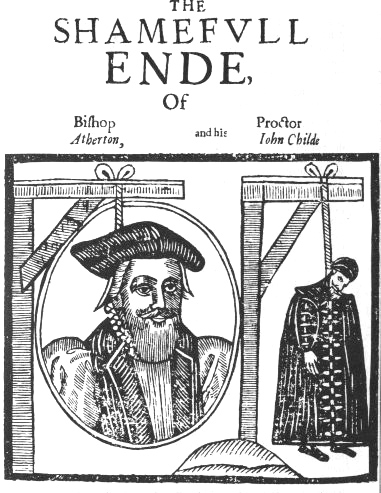
1640: Bishop John Atherton, buggerer

On this date in 1640, John Atherton achieved the unenviable distinction of being the only Anglican bishop hanged for buggery.* (His proctor, and alleged lover, John Childe, got the same treatment a few months later.)


Suppose a Devill from th’infernall Pit,
More Monsterlike, then ere was Devill yet,
Contrary to course, taking a male fiend
To Sodomize with him, such was the mind
Of this Lord Bishop, he did take a Childe
By name, not years, acting a sinne so vilde
-From the text of the pamphlet this image decorates

The Oxford-educated Englishman was appointed Lord Bishop of Waterford and Lismore by King Charles‘s hated governor Thomas Wentworth.

It may well have been the internecine politics of the day that claimed Atherton’s life, just as the civil wars they engendered in the ensuing decades claimed the original trial records.

While posterity is left to speculation, Atherton was defended in print in those years as well. (Defended as no homo, that is — not defended on principle against ubiquitous anti-gay laws.) If it wasn’t really a voracious sexual appetite (not exclusively same-sex**), goes this argument, it was intra-Protestant infighting, with Atherton’s successful clawback of land for the weak Irish Anglican church stepping on the toes of the local land barons who had recently expropriated it.

This politics outside the boudoir argument gets compelling treatment in Mother Leakey and the Bishop, a historical investigative thriller that links Atherton to a weird ghost story† in his native Somerset — that of “Old Mother Leakey,” the Minehead ghost.

Mother Leakey was Atherton’s mother-in-law, and Somerset family members claimed she haunted them — including with a message for the bishop that one of his sisters-in-law actually went to deliver in Ireland. The message isn’t known; in legend, this was a warning from beyond against the prelate’s ungodly behavior; in reality, it was more probably a family shakedown.‡

Despite the skepticism of the Leakey family’s own contemporaries, the facts, allegations, suppositions, and pure flights of fancy somehow managed to blend and recombine into a lasting tale of the paranormal that Minehead still retails to this day.

And it goes right back to the public opprobrium Bishop Atherton endured — as described in that 1641 hanging pamphlet:

“demonstrates the link between the stories of Mother Leakey and Bishop John Atherton … in a highly readable and often entertaining fashion”

… through pride, high fare, and lustfull life,
Incest committed with the Sister of his wife,
For which he sued his pardon, and then fled
To Ireland, where a worser life he led

He surely warned was to mend his life,
By his own Sister Master Leakies wife,
Which Master Leakies Mother being dead,
And in her life-time conscious how he led
His lustfull life, her Ghoast in gastful wise
Did oft appeare before her Sisters Eyes,
But she feare-strucken durst not speak unto it,
Till oft appearing forced her to doe it:
Then thus she spake, Mother in Law what cause
You from your rest, to my unrest thus drawes?
Who answered, daughter tis the wicked life
Your Brother leads, warne him to mend his life;
If not, then plainely tell him tis decreed,
He shall be hangd, bid him repent with speede:
Then shall my restless spirit be at rest,
And not till then; Thus vanisht. She addrest
Herselfe for travaile, Into Ireland went
With this sad message unto him was sent:
Which how he tooke to heart may plaine appeare
By the slight answer he returned her,
What must be, shalbe: If I must, I must dye,
Mariage, and hanging, come by destiny.
Thus scoft her counsell, sent her back, and when
Shee was returnd, he grew farre viler then
He was before, if Viler man may be,
For one bad Act before, committed three.

* According to Who’s Who in Gay and Lesbian History, Atherton and Childe were the second pair of alleged homosexual lovers executed in the British Isles. The first was the Earl of Castlehaven in 1631, along with his manservants.

** “[O]ne should note the compound sexual nature of the ‘sodomy’ charge in this context, a portmanteau omnibus of non-procreative sex, which is what ’sodomy’ was widely held to be.”

† Walter Scott footnotes this legend in Rokeby: “Mrs Leakey … dispatched her [daughter-in-law] to an Irish prelate, famous for his crimes and misfortunes, to exhort him to repentance, and to apprize him that otherwise he would be hanged; and how the bishop was satisfied with replying, that if he was born to be hanged, he should not be drowned.”

‡ Archbishop William Laud dispatched a team of ghost-whisperers to investigate the Leakey story well before the ectoplasm hit the fan for Atherton, and they weren’t buying: “certainly it is a fiction and a practice … it may be some money business.” Bishop Atherton had left home under a cloud with the suspicion that he’d had an affair with his wife’s sister, and this was part of the eventual Irish complaint against the horny goat.

On this day..

1920: Bloody Sunday in Ireland

Sunday, Nov. 21 in 1920 was “Bloody Sunday” in Ireland, a date begun with the IRA execution of British agents in Dublin, and concluded with three IRA men killed in British custody.

Thirty-one people lost their lives on this 1920 Bloody Sunday, a signal event of the Irish War of Independence; the thirteen of them who were British intelligence officers or assets targeted for an en masse morning liquidation suffices to qualify the affair for these grim pages.

“Executions”, assassinations or otherwise, the killings were ordered by Irish revolutionary Michael Collins in the escalating dirty war between his Irish Republican Army and the Black and Tans dispatched by London to crush the IRA.

My one intention was the destruction of the undesirables who continued to make miserable the lives of ordinary decent citizens. I have proof enough to assure myself of the atrocities which this gang of spies and informers have committed. If I had a second motive it was no more than a feeling such as I would have for a dangerous reptile. By their destruction the very air is made sweeter. For myself, my conscience is clear. There is no crime in detecting in wartime the spy and the informer. They have destroyed without trial. I have paid them back in their own coin.

-Michael Collins, on the executions

There were a couple of hitches in the plan: most particularly, that out of an initial list of 50 targets, Collins had been forced by his own government to trim to 35 … and then his hit teams “only” actually managed to get about a third of them.

And, of course, it drew a British rampage that day, most famously at a football match at Croke Park* concluding when Dirk McKee, Peadar Clancy and Conor Clune were killed that evening in a British police station — “trying to escape.”

But in all, the day was a coup for the Republicans, who crippled British intelligence in Dublin and gave any future recruits grave reason to think twice about the engagement, while reaping a public relations bonanza both domestic and international from the indiscriminate English response against civilians.

Occurring as it did while the fight for Ireland everywhere intensified — and that fight culminating in Ireland’s independence** — 1920’s Bloody Sunday is a sacred day for Irish nationalism.

Just to be clear, however, this is not the Bloody Sunday of U2 “Sunday Bloody Sunday” fame, which was an altogether different bit of carnage in 1972. “Bloody Sunday” actually has a disturbingly populous Wikipedia disambiguation page, with at least four Ireland-related entries and others from Turkey, Canada, South Africa, and points beyond.

* An England-Ireland rugby match in that stadium in 2007 grabbed headlines for its associations this date; you can see the respective anthems played before a respectful Irish crowd here.

** Leading, of course, to further assassinations, including Michael Collins’s own, and the internecine Irish Civil War.

On this day..