1354: Fra Moriale, condottiero entrepreneur

On this date 1354, the Provencal mercenary Montreal d’Albarno was beheaded in Rome by order of the tribune Cola di Rienzi.

Known locally as Fra Moriale (English Wikipedia entry | Italian), our man was a former Knight Hospitaller who turned his knack for violence into an entrepreneurial career — for he led one of the very first of those condottiero companies whose profitable ravaging the peninsula would pave the way for generations of unscrupulous mercenaries.

It was really Moriale’s predecessor, a Swabian knight named Werner von Urslingen, who first perceived that Italy’s wars had potential for such lucrative disruption. Reputed to have rode into battle with a breastplate blazoned with his Thielesque motto “The enemy of God, of pity and of mercy”, Urslingen had about 1342 founded a swords-for-hire business known as “The Great Company”.

While not literally the first gang of condottieri, it was the gang that changed the way Italians fought. By 1385 one pact between city-states cursed Werner in its preamble as the man who “first devised this plague of societies.”*

Fielding a massive army of some 3,000 cavalrymen at the outset — its fighting strength was north of 10,000 by Moriale’s day — the Great Company could put more muscle in the field than Italy’s little principalities could readily deal with, and Werner et al were soon realizing dividends hand over mailed fist by alternately hiring themselves out to this or that city, or squeezing them for tributary payoffs by the threat of pillage.

As the inability of the squabbling communes to suppress this racket became manifest, mercenaries fast multiplied into “a multitude of villains of various nations associated in arms by the greed to appropriate the fruits of labor of innocent and unarmed people, let loose to every cruelty, to extort money, methodically devastating the countryside.”** Condottieri would plague, and often dominate, Italy into the 16th century, with some of their more illustrious number ascending ducal palaces and others the scaffold.

By the time we reach events in this post, Werner von Urslingen is several years into comfortable retirement. But like any successful startup, the firm he launched still thrived.

Indeed, the Great Company had a stable, nigh-professional organization to match its bottom-line objectives. “Structurally, [the Great Company] resembled a corporation,” according to William Caferro. It had “a well-articulated hierarchy” which a governing board comprised “of Werner and a council made up of the leaders (corporals) of the various contingents.”

The booty derived from pillage and plunder was carefully divided by the leader and the council among the company’s rank and file. The company drew to its service lawyers and notaries to deal with legal issues and make contracts (condotte), treasurers and bankers to handle money, priests and prostitutes to cater respectively to spiritual and carnal needs.

In the early 1350s, Moriale delighted all these vendors by banking record profits in central Italy. And in the freebooting business, the balance sheets pleasingly compounding the success: “Because of the enormous booty which the company was taking, many soldiers, having completed their terms of service, without wanting further pay, went off to join Fra Moriale,” the Florentine chronicler Matteo Villani wrote in 1354. “Sometimes they had themselves dismissed in order to join him.” Matteo also notes that the businesslike Moriale “guaranteed safety to the purchasers [of his pillage] and treated them correctly in order to facilitate his commercial dealings [and] set up councillors and secretaries through whom he directed everything.” (Via Michael Mallett’s Mercenaries and their Masters: Warfare in Renaissance Italy)

A few books about the emergent mercenary business

In August of 1354, this captain of industry rode to Rome to collect on a debt: his brothers’ loan to Cola di Rienzi which had helped the latter re-establish his power in Rome after a spell in exile.

But Rienzi, who was short on cash himself (the exhausted treasury would in a few weeks’ time cost the tribune his life) resolved the debt and did a little opportunistic expropriation of his own by having his wealthy creditor seized and condemned to death. This strangely attracted the opprobrium of treachery among contemporaries, as if its victim were not a man who had founded his devastating career on infidelity. But the definitions of honor and knightly conduct at this juncture were flexible enough to admit the legitimacy of Moriale’s operation: indeed, Caferro even gives us the priceless scene of the buccaneering Hospitaller being dragged to his Roman executioner as he howls, “Don’t you see that I’m a knight? How can you be so despicable?”

After the beheading, a fighter named Konrad von Landau took leadership of the Great Company. The cutthroat business continued profitably shaking down city-states until 1363, when a burgeoning new rival startup, John Hawksood‘s White Company,† thrashed its predecessor into irrelevance at the Battle of Canturino.

* Cited in Caferro’s Mercenary Companies and the Decline of Siena; the book argues (pdf review) that its titular commune slipped into its spiral towards political irrelevance and eventual absorption due largely to the military and financial ravages imposed by the condottieri. From a historical perspective safely distant from the companies’ day-to-day predations, the condottieri arguably helped to drive the slow consolidation of Italy’s many micro-states into a handful of larger polities.

** The words are those of Pope Urban V in a 1364 bull, cited by Caferro’s “Italy and the Companies of Adventure in the Fourteenth Century” in The Historian, June 1996.

† The Englishman Hawkwood formed the core of his team out of veterans availing a pause in the Hundred Years’ War.

On this day..

1916: Nazario Sauro, Italian patriot

On this date in 1916, Italian nationalist and sailor Nazario Sauro was hanged by an Austro-Hungarian military court in Pula, Croatia.

Born in the Habsburg-controlled port of Koper at the crown of the Adriatic Sea,* young Sauro (English Wikipedia entry | Italian) evinced a much greater affinity for the seas than his schooling and had his first command — a merchant ship — by the tender age of 20.

Besides seamanship, his birthplace blessed or cursed him with the fin de siecle‘s ferment of Italian irredentism: his native Istria was one of those outlying lands with an ample Italian heritage laboring under the moldering Austrian boot. Patriots pined to append it to Mazzini’s energetic young state.

So, Sauro alongside his nautical career developed an avocation in remaking the map. He took pains to monitor harbor defenses during his shipping runs around the Adriatic; nor was his conviction in national self-determination confined to his own country, for he won admiration in Albania by smuggling supplies to anti-Ottoman rebels there.

With the outbreak of World War I, Sauro — then nearing 34 years of age — hopped a train over the border into his true nation and enlisted in Venice to fight against Austria. Considering that he was still a subject of Austria, this action invited a treason charge were he ever to be captured … and this finally occurred when now-Lt. Sauro ran aground in a submarine in the Austrian Bay of Kvarner on July 30, 1916. Once someone recognized him from his long prewar career at sea, his fate was sealed.


Lyrics here

Still a celebrated patriotic martyr to this day, number of cities around Italy host monuments to Sauro and streets named for Sauro; he’s also honored by the Italian navy’s Sauro-class submarine. Mussolini had a grand statue of the illustrious native son erected in Koper in 1935, when that city was under Italian control … but Nazi Germany tore it down in 1944 once relations between the former Axis partners went pear-shaped.

* Koper is in present-day Slovenia, but within literal (and littoral) walking distance of Italy.

On this day..

A Day in the Death Penalty Around the Martyrology

The Roman martyrology distinguishes August 9 as the feast date of several minor ancient saints of questionable veracity purportedly martyred by the persecutions of Rome.

Firmus and Rusticus

The Virgin of the Rosary with Saints Firmus and Rusticus (1603) by Pietro Marone

Saints Firmus and Rusticus are two gentlemen of Bergamo who are supposed to have wound up martyred in Verona under Diocletian‘s persecutions. There’s an Acts of Firmus and Rusticus that the contemporary church does not consider authentic; it’s possible that if they really existed they might have been North African Christians whose remains were translated to Verona.

Firmus and Rusticus are not the patron saints of Romeo and Juliet‘s hometown; that honor instead goes to Zeno.

Numidicus

Much more obviously African is St. Numidicus, who under the short-reigning but heavy-persecuting emperor Decius was burned at the stake in Carthage and/or survived burning to accept ordination at the hands of St. Cyprian.

Romanus Ostiarius

August 9 is the vigil of St. Lawrence‘s martyrdom in Rome. St. Romanus is a legendary spinoff on Lawrence: a Roman guard who is supposed to have been so moved by Lawrence that he solicited baptism from the saint, and was immediately martyred for his trouble. Although his dubious historicity — one can’t but suspect outright fiction — has ushered him into the martyrology’s footnotes, he was formerly consequential enough to be sculpted for the colonnade of St. Peter’s.

There are several other martyrs also named Romanus; still, this guy in his day was the most important and the most Italian which makes me fairly confident that he also conferred his name upon the Tuscan town San Romano, and through its position amid the Florentine conflict with Siena and Lucca, to Uccello‘s triptych series The Battle of San Romano, a great pathbreaker for lance-aided linear perspective in the early Renaissance.


Noccolo Mauruzi da Tolentino unseats Bernardino della Ciarda at the Battle of San Romano, by Paolo Uccello (c. 1435-1455).

Secundian, Marcellian and Verian

At last we have St. Secundian, another Decian martyr who was supposedly a Senator or similar VIP. August 9 marks his martyrdom perhaps near Civitavecchia, along with two bookish minions — students or scholars of some sort.

On this day..

1735: Nicholas Bighelini, Mantua betrayer

Mantua, August 10

A Dangerous Conspiracy was happily discovered here; the Author of it M. Nicholas Bighelini, took a Plan of the weakest Parts of this City, and communicated the same, by means of his Father who lives at Verona, to the Generals of the Allies. He was hang’d the 8th Instant, and the Effigies of his Father and a Nephew were hanged; the Nephew was here, but found means to make his Escape. Another named Nicholazzo was concern’d, but having impeach’d his Confederates has been pardon’d.

-London General Evening Post, Aug. 19, 1735

This vanished conspiracy occurred in the northern Italian theater of the 1733-1738 War of Polish Succession, a dynastic war whose best-remembered consequence was the delivery during the postwar settlement of the former Habsburg territory of Lorraine into what turned out to be permanent French control that still continues to this day.

This seems an apt outcome for a conflict over the Polish throne that we notice by way of Italy. Like the War of Spanish Succession thirty years before, a contested throne became the pretext for a continental imbroglio between those rivals, Austria and France.

Up and down Europe these powers and their allies and proxies tangled.*

In the “down” part, Italy was then still a warren of small principalities, which though independent stood generally in the thrall of Austria. While France did rather well besieging Sicily and the south, in the north of the peninsula things ground to a stalemate after France’s initial push gobbled up Milan.**

The city of Mantua, capital of a a duchy of the same name in the middle of the north, came under the siege of France and her allies in 1734. The “allies” part really started to matter: Spain was one of those allies, and still laid its own claim to Mantua from its bygone days of imperial glory; Savoy was another ally and did not want to see Spain resume dominance in Italy. The siege was not energetically maintains, and one starts to wonder whether the Duke of Savoy himself might not have quietly arranged the betrayal of poor Nicholas Bighelini.

In any event, Mantua or no neither France nor Austria had much offensive potential left in Italy and by this late date they were doing little but marking time until that autumn’s ceasefire arrangements. The French would then lift the siege and even withdraw from Milan, allowing Austria to re-establish its hegemony unopposed.

Nicholas Bighelini, poor fool, is justly forgotten: he gave his life for nothing.

* In contrast to its behavior in the War of Spanish Succession, Great Britain stayed out of this fight, eventually mediating the peace that settled things. Still, this war has an ancillary part in England’s own gallows history, since it was under French colors that the young English pretender Charles Edward Stuart first cut his teeth in combat — enjoying better fortune than when he tried to seize the British crown in 1745.

** The Duc de Noailles took over French forces in northern Italy in 1735, after distinguishing himself in the Rhineland at the outset of the war. His great-granddaughter wed Lafayette, a family alliance that helped doom many Noailles descendants to the guillotine.

On this day..

326: Crispus and Fausta, incestuous lovers?

On an uncertain date perhaps around late July of 321,* the Roman emperor Constantine the Great had his son and also his wife mysteriously put to death.

It’s mysterious because besides execution, Constantine had a damnatio memoriae passed over his former family to bury any record of their sins in Time’s obscurity. These edicts didn’t always work … but in this case, if there were any who dared to record what happened, that illicit account did not survive its journey from antiquity.

But it was surely a shocking scandal in its time.

Crispus was Constantine’s first-born son and very much in the father’s favor. He was the child of a wife or concubine named Minervina. In 307, Constantine put this woman aside to make a more politically expedient marriage to Fausta, the daughter of Diocletian‘s retired-now-unretired co-emperor Maximian who with his son Maxentius held sway in Italy at that moment of the Roman Tetrarchy‘s ongoing collapse.**

Although Crispus didn’t offer his dad much in this situation by way of family alliances, Constantine kept him in his favor — by all appearances grooming him as an heir. Call it paying it forward: as a young man, Constantine himself had been in a similar position when his father Constantius dumped Constantine’s peasant mother in favor of an imperial marriage. That moment might have strangled a world-historic career before it even began, but Constantius instead chose to keep Constantine on the paternal cursus honorum.

So it went with Crispus — for a while.

In 317, Constantine, now emperor in the western part of the empire,† made Crispus into his Caesar; the boy ruled in Gaul and Germania for several years, thrashing barbarian tribes as he ought. Dad, meanwhile, was maneuvering towards victory over his eastern opposite number Licinius, with Crispus contributing an important naval victory in 324.

The young man (in his twenties at this time; his precise year of birth is uncertain) seemed on his way to a scintillating future.


Bronze coin from the mint of Rome depicting Crispus.

Things went pear-shaped suddenly in 326 when his father had him executed without any kind of warning that survives in the scant records available to us — and not only Crispus, but also Constantine’s own wife, that Fausta whose marriage might have threatened the boy’s status.

We don’t know why but the rumor as trafficked by the much later Byzantine historian Zosimus suggests a possible Parisina and Ugo scenario: “He put to death his son Crispus, styled Caesar, on suspicion of debauching his mother-in-law Fausta, without any regard to the ties of nature … [and] causing a bath to be heated to an extraordinary degree, he shut up Fausta in it, and a short time after took her out dead.”

It is down to conjecture what one ought to make of this nth-hand scandal-mongering; for impugning someone’s character one can hardly do better than an incest accusation. The story does appear to fit the few available facts, however, and Fausta was much closer in age to Crispus than to Constantine. It might also be noteworthy that three of Fausta’s sons went on to become Emperor and one daughter Empress but none of them ever rehabilitated mom.

Damned memory be damned, Crispus was rediscovered during the Renaissance and favored with several dramatic renditions embellishing the young man as a tragic hero, often with speculation that he was wrongly condemned to Constantine’s everlasting shame.‡ The events surrounding Crispus’s death being almost entirely obscured, writers could really go nuts with it; for example, Sir Walter Scott‘s Count Robert of Paris (set in Constantinople during the Crusades) features the story of an entirely fictitious penance built into subsequent Byzantine execution rituals by a remorseful Constantine:

But the death-blow had no sooner struck the innocent youth, than his father obtained proof of the rashness with which he had acted. He had at this period been engaged in constructing the subterranean parts of the Blacquernal palace, which his remorse appointed to contain a record of his paternal grief and contrition. At the upper part of the staircase, called the Pit of Acheron, he caused to be constructed a large chamber, still called the Hall of Judgment, for the purpose of execution. A passage through an archway in the upper wall leads from the hall to the place of misery, where the axe, or other engine, is disposed for the execution of state prisoners of consequence. Over this archway was placed a species of marble altar, surmounted by an image of the unfortunate Crispus — the materials were gold, and it bore the memorable inscription, TO MY SON, WHOM I RASHLY CONDEMNED, AND TOO HASTILY EXECUTED. When constructing this passage, Constantine made a vow, that he himself and his posterity, being reigning Emperors, would stand beside the statue of Crispus, at the time when any individual of their family should be led to execution, and before they suffered him to pass from the Hall of Judgment to the Chamber of Death, that they should themselves be personally convinced of the truth of the charge under which he suffered.

* Approximate times around the spring and summer of 326 have been proposed by various authors based on the very vague allusions of ancient sources. This author argues that numismatic evidence permits a more precise triangulation. Constantine in 326 journeyed from his new capital in the east to Rome: an imperial mint traveled with him, striking coins as it went — and some of those coins show Crispus. His presence on coins from various stops of this journey indicates that Crispus must have been alive as the procession reached Rome on July 21, 326, but the Caesar vanishes from them, and from history, immediately thereafter.

** The History of Rome Podcast narrates this period, with Constantine’s rise into political relevance in episode 130.

† The Tetrarchy was still tetrarching along pending Constantine’s victory over all: the system featured separate senior emperors East and West each dignified Augustus, and each Augustus had a junior fellow-emperor and heir titled Caesar. Constantine was Augustus of the West, and Crispus was a Caesar.

‡ Fausta tends to get somewhat shorter shrift than her putative lover. Crispus’s presence in the literary culture would appear to make him the namesake of the Boston American Revolution martyr Crispus Attucks. African-descended men in North America often carried Roman names, though “Crispus” was by no means a common one.

On this day..

1768: Francesco Arcangeli, Winckelmann-Mörder

For murdering German Enlightenment intellectual Johann Joachim Winckelmann, Habsburg Trieste on this date in 1768 inflicted a breaking-wheel execution straight out of antiquity.

A Saxon cobbler’s son, Winckelmann (German Wikipedia link) showed academic aptitude from youth and spent his twenties reading theology and medicine at the Universities of Halle and of Jena while he tutored to pay the bills. This scuffling scholar got his big break when his gifts were noticed by the visiting papal nuncio, who recruited him to court service in Rome on condition of his conversion to Catholicism — a spiritual epiphany which dovetailed perfectly with his growing interest in art and drew him to Italy. (pdf)

Winckelmann traveled and read widely in Italy. He was a great admirer of the restrained classical Grecian aesthetic whose celebrated exemplars were being unearthed throughout the Mediterranean world;* some papers he wrote during the 1760s are regarded as seminal documents in the study of art history and of archaeology, and he in turn became a celebrity intellectual sought-after in the salons of visiting art-fanciers.

Having begun so mean and climbed so very high, Winckelmann was set up for golden years savoring the view from the pinnacle — but he was never destined to receive them.

Taking ill on a trip with friend and fellow classicist Bartolomeo Cavaceppi in 1768, Winckelmann tapped out and returned alone to Trieste where he shared a room at a seaside hotel** with a chance acquaintance of the road: our post’s subject, Francesco Arcangeli. (German Wikipedia again)

Arcangeli, it turned out, was a thief who had already been expelled from Vienna and now compounded his villainy by throttling and stabbing Winckelmann. Though the wounds were mortal, Winckelmann lived on for several hours in full command of his senses, evenly providing every bit of information that would be needed to avenge his murder. The self-evident inference of robbery forms Arcangeli’s accepted motive, but alternative hypotheses have attracted attention over the years: in particular, Winckelmann is thought to have been homosexual, so it’s possible their shared lodging was really an assignation that went very bad; more exotic is the idea that Winckelmann was intentionally assassinated further to some inscrutable plot among Vatican rivals or art cognoscenti.

A Winckelmann Society in the man’s hometown of Stendal, Germany maintains its native son’s scholarly focus on classical antiquity. Readers of German might also appreciate Goethe’s essay on the man.

* Notably, the excavation of Pompeii and Herculaneum had only just begun in 1748; Winckelmann visited the sites.

** It’s the present-day Grand Hotel Duchi d’Aosta.

On this day..

1375: Niccolo di Toldo, in the arms of St. Catherine of Siena

I have one body
And to you I offer and return it.
Here is my flesh;
Here is my blood;
Let me be slain, reduced to nothing;
Let my bones be split apart
For those for whom I am praying, if such is your will.

-Prayer of St. Catherine of Siena (Source)

This date in 1375 is the best data point we have for the beheading of Niccolo di Toldo.

The Sienese archives offer scant documentation of this political execution; a decree of June 4, 1375 orders his examination for “the discord sowed by him in the city of Siena, pernicious and deadly to the state of the present government” — and a couple of letters on Niccolo’s behalf from the governor of neighboring Perugia. Francis Thomas Luongo in The Saintly Politics of Catherine of Siena — we will come to Catherine presently — next points in lieu of any remaining record of Niccolo’s execution to “the necrology of the Sienese Dominican friary [which] includes an entry for one ‘Nicholaus, familiarius of the Lord Senator,’ who died and was entombed in the cloister of San Domenico on 20 June, the vigil of the feast of Corpus Christi.” It’s not certain that this is the same man but the description fits him, and the date is one week after the last known letter on his behalf from Perugia — which was an appeal for mercy.

We are as ignorant of Niccolo di Toldo’s offense as we are of the date of his death. But his position (in the household of a senator) and his Perugian affiliation suggest him an agent of papal subversion.

Siena’s centuries-long decline from the ranks of Italy’s city-state powers dates ultimately to the Black Death outbreak of 1348. The Plague devastated Siena.

The ensuing generations saw authority in the great Tuscan city furiously contested; the government turned over repeatedly in the 1360s — the Dodici (the Twelve), the Tredici, the Quindici, each an executive committee of interested parties in the coalition of the day.

From the late 1360s and through the 1370s, the Quindici held sway: reformist guild leaders* who were opposed by the the deposed (and by now proscribed) ex-Dodici, Siena’s great magnates in alliance with the papacy. (Luongo delves into Sienese politics in considerable detail in his book.) By year’s end Siena would join a city-state coalition led by Florence that fought a three-year war against the papal states with the excellent name “the War of Eight Saints”.

That coalition and that thrust of policy is likely what a “political subversive” in 1375 Siena would be subverting. And the governor of Perugia appealing to the Sienese for Toldo’s life? He was a French cardinal, kin to Pope Gregory XI.**


Little as we know of Niccolo di Toldo prior to his death, that execution is one of the most famous in all of medieval Europe.

The wretch was comforted in his last days by Catherine of Siena, a young mystic — and, not incidentally, an increasingly influential opponent of the anti-curial political climate. Today, Catherine is the patron saint not only of Siena but of all Europe, and her dessicated head (sawed off her body by devotees for use as a fetish) greets the reverent and the gawker alike, enthroned in its grisly reliquary in the Basilica San Domenico.


(cc) image by Patrick Denker.

Catherine found Niccolo angry at his impending fate, initially refusing to see any spiritual counselor: no state of mind for a soul to meet its maker. Any of the confraternities tasked at this time with succoring those about to face execution would have been charged with bringing such a person to a condition of resignation and penitence.

Catherine achieved her mission to join the doomed man to God but much, much more than that: her account of their relationship, up to the moment when she ecstatically catches his falling bloody head, is a celebration of erotic mysticism. It’s also one of the most famous episodes of the saint’s life.

Niccolo’s virgin helpmate was herself noted for her mystical “marriage to Christ”: in it, Catherine presented her heart to the phantom Savior, and he his ritually circumcised foreskin to her.

Converging religious fervor and carnality mark her interaction with Niccolo, too; at one point she implies that she has sublimated the condemned traitor’s attraction to her into piety, and (as Catherine wrote a follower),

God’s measureless and burning goodness tricked him, creating in him such an affection and love in the desire of me in God, that he did not know how to abide without God, and he said: ‘Stay with me and do not leave me. Like this I cannot but be alright, and I will die content!’ and he had his head resting on my breast. I sensed an intense joy, a fragrance of his blood, and it was not without the fragrance of my own, which I wait to shed for the sweet husband Jesus.

Catherine saw Niccolo di Toldo only twice in the days leading up to his execution. When he went to the block, she was there to meet him: in fact, she was there early and made bold to occupy the condemned’s place on the scaffold, and to stretch her own neck out over the headsman’s block that her kindred spirit would soon soak in gore. It was as if preparing his bridal bed, where she would embrace Niccolo even as the executioner struck — the two as passionately near to one in soul and body as the logistics of a heavy blade’s arc can permit.

[H]e arrived, as a meek lamb, and seeing me, he began to laugh, and he wanted me to make the sign of the cross. When he received the sign, I said, “Come on! to the nuptials, my sweet brother! for soon you will be in life without end.” He got down with great meekness, and I stretched out his neck, and leaning down, I reminded him of the blood of the Lamb. His mouth said nothing but “Jesus” and “Catherine.” And, as he was saying thus, I received his head in my hands, closing his eyes on divine goodness and saying, “I want this!” (“lo voglio”)†

She clutched to herself the lifeless head that had dropped into her lap and beheld “with the greatest envy” Niccolo’s soul ascending in the martyrdom Catherine aspired to. Afterwards, she was reluctant to wash out the clothes spattered with blood from the sacred climax of death.

The Dominican friar Caffarini, an ally of Catherine who was later to become of the principal exponents of her canonization, wrote of the tableau that Niccolo

accepted death while still at a young age, in the presence of the Virgin and with her receiving his head into her hands, with such marvelous devotion that it was like the transitus of some devout martyr and not the death of one who was condemned for a human crime. And everyone watching among whom I was only one was so moved internally and from the heart that I do not remember any previous burial accompanied with as much devotion as that one.


Panel of Francesco Messina‘s 1962 monument to St. Catherine of Siena outside Rome’s Castel Sant’Angelo.

* Apart from the enmity of the papal party, the powerful guild leaders of the Quindici faced working-class opposition that resulted in a 1378 revolt.

** Gregory XI was the guy who moved the papacy back from Avignon to Rome.

† Translated excerpts culled from snippets and excerpts in various locations. Original Italian versions of Catherine’s poetic letters are available in public-domain Google books here; there’s also a recent English translation by Susan Noffke.

On this day..

1548: Giulio Cybo, Andrea Doria disaster

On this date in 1548, Giulio Cybo was beheaded in Genoa for plotting against his father-in-law Andrea Doria.

Cybo (English Wikipedia entry | Italian) was a babe of barely 20 when he died, the whole of his short life lost to frustrating defeats in the skein of peninsular and familial politics.

His parents were the original Cybo and Malaspina whose union founded the Cybo-Malaspina house that until the 18th century ruled the small Duchy of Massa and Carrara where Liguria meets Tuscany.

Successful though their line might prove, theirs was a house divided and the parents’ rivalry for precedence in their territory transferred to their two sons. Thus Giulio, the father’s favorite, makes his first appearance on history’s stage invading Massa with a cohort of gendarmes to seize power from his own mother.

The success of his rude maneuver was short-lived and mom soon restored her authority — backed by the imperial forces haunting the land during the interminable Italian Wars. Although Giulio was married to the daughter of the Genoese admiral Andrea Doria,* whose word was law in that city, the in-laws frustratingly stiffed him out of the dowry payment that Giulio intended to use to restore his Freudian conquest.

These material grievances, and a young man’s wide streak of tragic impetuousity,** drove Giulio into the arms of Giovanni Luigi Fieschi. The latter was a Genoese nobleman whose dramatic plot to topple Doria failed with operatic† absurdity in 1547 when Fieschi mid-coup fell off a gangway and drowned in the harbor. Only in Genoa.

Cybo’s complicity in this scheme could not be proven because he arrived too late to do anything other than make a politic show of support for the already-victorious Doria. But now, encouraged by the French — the Habsburg empire’s enemy in the aforementioned Italian Wars and therefore the sponsor of its every rival faction — Cybo gathered some fellow malcontents in Venice and began working up a plot to oust Doria, restore the liberty of Genoa, and really put all the parents in their place. Once bitten, however, the wily old Doria was on the lookout for these troublemakers and had Cybo’s circle infiltrated early. The young man was arrested en route back to Genoa to implement his design.

The letters of the Fieschi [family] which were found on his person left no room to doubt his guilt. Some tell us that he was several times tortured and confessed that Farnese, Maffei, Ghisa and the Pope himself were accomplices in the plot, and that the Fieschi and Farnese were its instigators.

The emperor did not wish to execute Cybo; and we find evidence in documents of the period that even the bloodthirsty Gonzaga made every exertion to save him. On the other hand Graneville and Doria laboured with all their power to secure his punishment. In fact, so soon as Doria heard of this plot, committed rather in intention than act and excusable by the youth of the conspirator, “the prince (I use the words of Porzio) inflamed to wrath by the offence and full of vengeful animosity, disregarded the double tie which bound him to the young man, and made incessant appeals to Caesar for the blood of his relative.”

Many Italian and foreign princes asked grace for the prisoner, and the emperor was at first undecided; but severity triumphed over mercy — Doria desired vengeance and he obtained it. The victim met his fate with manly intrepidity. He was beheaded and his body exposed between two wax candles in the public square … on the 18th of May, 1548. He was scarcely twenty years of age.

Porzio says: —

His courage and military capacity inspired all who knew him with the conviction that, if he had not perished in boyhood, he would have become one of the first captains of his age. He made a single mistake: that of endeavouring to expel one foreigner with another — to drive out the Spaniards in order to establish the French in Italy.

* This man, one of the great naval captains of his age, was of course the namesake of the Genoese ocean liner Andrea Doria that sank in 1956.

** Cybo “liked not to rest contented in the battle of life,” was James Bent’s judgment, although it is difficult to tell that he ever had the option to do so.

** Well, stage-worthy at any rate: Fieschi’s fiasco is the basis of Schiller’s play Fiesco.

On this day..

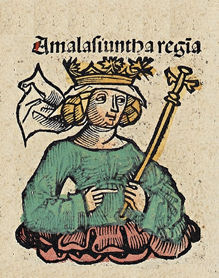
535: Amalasuntha, daughter of Theodoric

On or around this date in 535,* the Ostrogothic queen Amalasuntha was put to death in the Italian lake island of Martana (You can also find her name rendered Amalasountha and Amalaswintha.)

The Roman-educated princess had inherited rulership of the Ostrogothic Kingdom, a successor state to the lately fallen Roman Empire, from its redoutable founder Theodoric. Technically the crown had passed to Amalasuntha’s 10-year-old kid; ruling as regent in a perilous situation, mom cultivated an alliance with the Byzantine emperor Justinian.

Her son took to boozing and carousing and died as a teenager, so Amalasuntha sought a new male imprimatur for her reign by the expedient of marrying a wealthy cousin, Theodahad. Though the nuptial deal had been for Theo to butt out of actual governance, he immediately strove to convert his power from titular to actual and became his wife’s deadliest rival — and then clapped her in prison. From the History of the Wars of Byzantine scribbler Procopius:

Theodahad, upon receiving the supreme power, began to act in all things contrary to the hopes she had entertained and to the promises he had made. And after winning the adherence of the relatives of the Goths who had been slain by her — and they were both numerous and men of very high standing among the Goths — he suddenly put to death some of the connections of Amalasuntha and imprisoned her, the envoys not having as yet reached Byzantium. Now there is a certain lake in Tuscany called Vulsina, within which rises an island, exceedingly small but having a strong fortress upon it. There Theodatus confined Amalasuntha and kept her under guard.

A Roman diplomat named Peter had already been dispatched by this time from the court of Constantinople to do some routine statecraft with the Goths, and he learned of the surprise reshuffling of power when he met Theodohad’s envoys on the road.

Procopius says — or does he? — that Byzantium tried to twist the Goths’ shaggy arms in support of their matronly ally, but could not prevail against the vengeance of the deposed queen’s foes.

When the Emperor Justinian heard these things, he formed the purpose of throwing the Goths and Theodahad into confusion; accordingly he wrote a letter to Amalasuntha, stating that he was eager to give her every possible support, and at the same time he directed Peter by no means to conceal this message, but to make it known to Theodatus himself and to all the Goths. … Now when Peter arrived in Italy, it so happened that Amalasuntha had been removed from among men. For the relatives of the Goths who had been slain by her came before Theodahad declaring that neither his life nor theirs was secure unless Amalasuntha should be put out of their way as quickly as possible. And as soon as he gave in to them, they went to the island and killed Amalasuntha, — an act which grieved exceedingly all the Italians and the Goths as well. For the woman had the strictest regard for every kind of virtue … Theodahad, such was his stupid folly, while still holding the slayers of Amalasuntha in honour and favour kept trying to persuade Peter and the emperor that this unholy deed had been committed by the Goths by no means with his approval, but decidedly against his will.

The “stupid folly” helped to trigger Justinian’s war against the Goths, which resulted in Byzantium’s conquest of Italy and (temporary) reunification of the empire. It also led Amalasuntha’s son-in-law Vitiges to depose and murder Theodahad in his own turn: just another turn of the wheel among backstabbing aristocrats.

Speaking of which: despite the pious good faith Procopius presents for Byzantium in his history above, his gossipy Secret History rewrites the story to attribute Amalsuntha’s fall not to the Ostrogoths’ internal political rivalries but to a catty assassination by Byzantine empress Theodora, whose low-born origin shows through here in murderous insecurity:

At the time when Amalasuntha, desiring to leave the company of the Goths, decided to transform her life and to take the road to Byzantium, as has been stated in the previous narrative, Theodora, considering that the woman was of noble birth and a queen, and very comely to look upon and exceedingly quick at contriving ways and means for whatever she wanted, but feeling suspicious of her magnificent bearing and exceptionally virile manner, and at the same time fearing the fickleness of her husband Justinian, expressed her jealousy in no trivial way, but she schemed to lie in wait for the woman even unto her death. Straightway, then, she persuaded her husband to send Peter, unaccompanied by others, to be his ambassador to Italy. And as he was setting out, the Emperor gave him such instructions as have been set forth in the appropriate passage, where, however, it was impossible for me, through fear of the Empress, to reveal the truth of what took place. She herself, however, gave him one command only, namely, to put the woman out of the world as quickly as possible, causing the man to be carried away by the hope of great rewards if he should execute her commands. So as soon as he arrived in Italy — and indeed man’s nature knows not how to proceed in a hesitant, shrinking way to a foul murder when some office, perhaps, or a large sum of money is to be hoped for — he persuaded Theodahad, by what kind of exhortation I do not know, to destroy Amalasuntha. And as a reward for this he attained the rank of Magister, and acquired great power and a hatred surpassed by none.

* The allusion to April 30 comes from Procopius but is ambiguously presented. When it comes to the age of antiquity, however, we’re typically grateful to get any date whatever.

On this day..

Unspecified date: Mariotto Mignarelli, proto-Romeo

On a never-specified date in 15th century Siena, the tragic lover Mariotto Mignarelli was beheaded in Masuccio Salernitano‘s story Mariotto and Ganozza — the apparent wellspring (via an English interlocutor) for Shakespeare’s Romeo and Juliet.


Mid-16th century translation of Romeus and Juliet by Arthur Brooke. (via)

Masuccio’s tale is itself an Italian Renaissance gloss on an old Ovid story; its outline will be instantly recognizable to devotees of the Capulets and Montagues. But instead of dueling suicides, Masuccio ends one of the star-crossed lovers with an executioner’s blade.

In Mariotto and Ganozza, which can be enjoyed for free in the original Italian here or here, the young lovers secretly wed only to find “that wicked and hostile fortune reversed all their present and future desires.”


These violent delights have violent ends
And in their triumph die, like fire and powder …

“Fortune’s” inscrutable hand turns out to be that of Mariotto himself, who gets into a fight with some other nobleman and, slaying him, must flee into exile. Posterity must excuse Mariotto/Romeo his hotheadedness, for were he not the type to wreck his own life by murdering a guy in a street fight he also wouldn’t be the type to pursue forbidden tragic romance. That’s art.


Fortune’s fool …

“How great was the supreme grief of the two most wretched lovers, so lately wed, and how bitter their tears at the thought of what they believed to be their endless separation, he alone who has been pricked by such wounds can truly tell.” (Translation source.)

“So deep and bitter it was, that at their last parting, they seemed for a long while to have died in each other’s arms.”

It next comes to pass that Gianozza’s father, ignorant of her secret marriage to the town fugitive, arranges a match for her. This development leads our Juliet figure to seek out the aid of the friar who has secretly wed them in a scheme that is precisely Shakespearean.

The friar “made up a certain water with certain concoctions of various powders that, when the draught was ready and she had drunk it, it would not only make her sleep for three days, but seem to be really dead.” With this potion they stage Gianozza’s death; then, the friar secretly steals her hibernating “corpse” from its tomb, revives her, and packs her off to find her beloved.

He, of course, has separately received word of Gianozza’s death — and (also of course) the courier that had been dispatched pre-death elixir to clue him into the plan has been waylaid by pirates and left his essential plot spoilers at the bottom of the sea.

Disconsolate, Mariotto returns to Siena with the unproductive object of mooning over Gianozza’s grave and “weep[ing] as if their lives were ended.” Don’t worry, he has a backup plan! “If by misfortune he was recognized, he thought he would gladly be condemned as a murderer, knowing that she was already dead whom he loved more than himself and who loved him with equal love.”

This works as well as you expect, albeit with less panache than Shakespeare’s crypt climax: Mariotto gets caught in a transport of the macabre trying to break into Gianozza’s sepulcher, and is recognized as a condemned outlaw.

Before dawn, all Siena was full of the news, which reached the ears of the Court, who ordered the mayor to go and arrest him and quickly do that which the laws and the State commanded.

So, a prisoner in fetters, Mariotto was led to the palace of the mayor. When he was flogged, without needing long tortures, he faithfully confessed the cause of his desperate return. Though all alike had the greatest pity for him, and amongst the women he was bitterly wept for and thought the only perfect lover in the world, and each of them would have willingly redeemed him with her own life, yet he was at once condemned by the law to be beheaded. When the time arrived, without his friends or parents being able to aid him, the sentence was carried out.

Three days later, Gianozza — having reached Mariotto’s former refuge of exile and there learned of his misapprehension — turns up in Siena again only to discover that she is too late. Rather than stabbing herself to death right then and there as the Bard’s heroine would do, she shuts herself up in a convent “with intense grief and tears of blood and little food and no sleep, continually calling for her dear Mariotto, [and] in a very short time ended her wretched days.”


Prokofiev’s unwilling balletic finale

On this day..