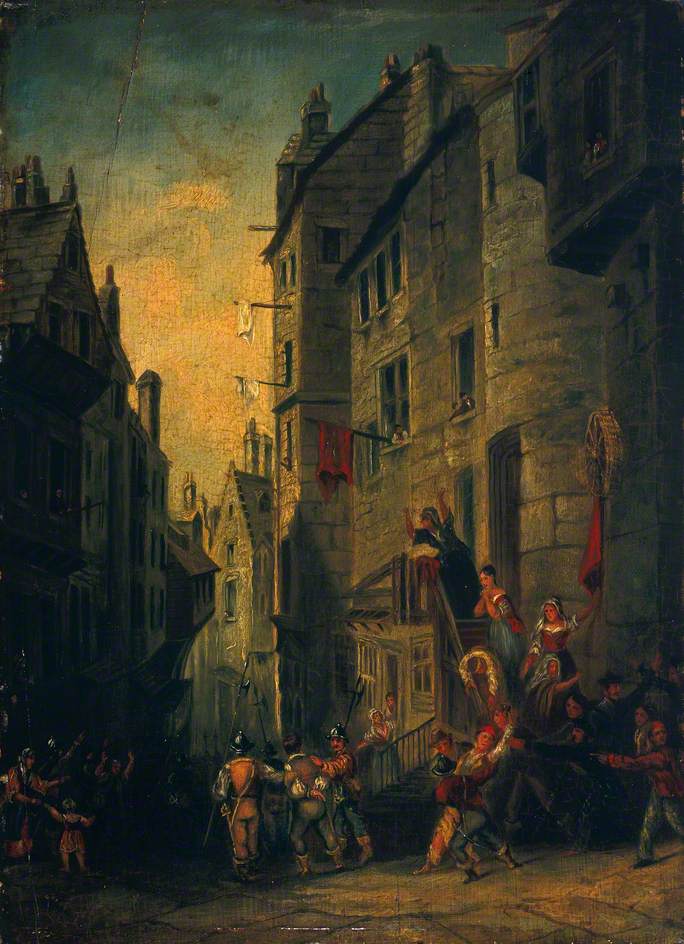
1719: Patrick Carraghar and Two Arthur Quinns

The Last Speeches of
Patrick Carraghar, Nephew to the great Collmore, and Two Arthur Quinns

who were Executed on Saturday the 21st of this Instant February 1718-19 at Dundalk. Together with the Tryal of Capt. Collmore.

The Speech of Patrick Macallaher

Dear Christians,

I Patrick Carraghar am the Nephew of that Collmore who was Executed last Wednesday, who was the Ruin of me, who am but Eighteen Years of Age now, tho’ of these Tender years, I am very sensible of the great Follies and Sins that I have been Guilty of, my Father and Mother Liv’d in the Place call’d Loghross, in the County of Armagh, as for my Father People may say what they please of him; for he is Alive, but for my Mother she was never charg’d with anything that was ill, and the Neighbours in the Country knew her to be an honest good Woman she dy’d when I was very young, neverthleess I was bound Prentice to a Taylor, but did not serve my Master long, but followed my Uncle, which is the Cause of my coming to this untimely End, tho’ I was Try’d for keeping Company and assisting one Gillaspy M’Culum, a Proclaimed Tory, for my part I was neither Guilty of Murhter nor Robbery of my self, but I have been by when Robberry was committed, I have no more to say but that I die a Roman Catholic, and I beg of thee O my great God to have Mercy on my poor Soul. Dear Christians Pray for me.

The Speech of the Two Quins

Good Christians,

For our Parts we have but little to say for our selves, only that we were born in the Fews, in the County of Armagh, and our Parents Lived Poor and Honest, but many honest Parents has had Wick’d Idle children as we both have been very Disobedient to our Parents or Friends, which gave us good advice, but we follow’d too much of our own, which Brings too many young Fellows either to the Gallows or to be Transported, and as we are Dying Persons, we desire all young People to take the Advice of their Parents and Friends, here we die for Robbing a poor honest Man’s House in the County of Cavan, his name is one Coleman, we can’t deny the Fact, it being prov’d so home on us, though we thought what we took there did not deserve Death, but this with other wicked Sins and Crimes is the Cause of our being Brought to this shameful End, O great God we Crave Mercy, and Begs of thee O merciful Father to receive our Souls, O good People pray for us, for we die Roman Catholicks, and sweet Jesus receive us Amen. One of the Quinn’s had the Impudence to Curse and Abuse the High Sheriff, the Grand Jury and the whole Court, and told them that they Murdered him.


The Whole Tryal and Examination of Capt. Collmore a Proclaim’d Tory, and was Noted for being Guilty of Bloody Murthers, Rapes and Robberies in the County of Armagh

When Collmore was brought to the Bar to be Tryed, he denied himself to be the Man, then the Clerk of the Crown was obliged to Swear to the Proclamation where he was nam’d; so when the Jury was call’d and Sworn, he was asked several Questions, but answered to no Purpose, then one Andrew Thompson appear’d, and the Book was given him, who Swore that he was the same Charles Carraghar who Liv’d formerly with Mr. Blykes of Darcy in the Fews, and that he Stole Two Heffers from Aldarman Grimes, and was for the same Indicted and Proclaimed at Ardee[.] Collmore objected against the Evidence, because he said that Thompson had formerly forsworn himself, to which the Evidence answered, that as he was coming home late to his House one Night, that he was met by this Collmore, and was forced in Defence of his Life, which was so much threaten’d by him, to Swear that he never Presented him, the Jury immediately brought him in Guilty.

Councellor Townly gave him the following sentance, That he should be Hanged; and be Cut down before he was dead, his Privy Members to be Cut Off, his Bowels burn’d, and his Quarters to be dispos’d off at the King’s Pleasure.

When Collmore was brought to the Gallows, he Hang for a small Time, he was Cut down while alive, when the Hangman was cutting off his Privities, he cry’d out, then the Sheriff ordered his Throat to be Cut, the Hangman could not do it readily, for he strugled very much, his Head was afterwards Cut off, his Chops open’d and shut, tho’ his Head was a Yard from his Body, his Carcass was divided into 4 parts, and set up in 4 several Parts of the Country. He died very obstinately.

On this day..

1810: Andreas Hofer, Tyrolean patriot

On this date in 1810, Tyrolean hero Andreas Hofer was shot in Mantua.

Andreas Hofer monument at Bergisel, where Hofer fought four battles in 1809. (cc) image by Mathias Bigge.

Hofer (English Wikipedia entry | German) was the heir to his father’s Sandhof Inn in tiny St. Leonhard — a village today that’s just over the Italian border but was in Hofer’s time part of a Tyrol undivided by nation-state borders.

This county took pride in its ancient affiliation to the House of Habsburg, who had once even made its imperial headquarters in Tyrolean Innsbruck. When in the aftermath of crushing Austria at Austerlitz the rampant Corsican transferred Tyrol to the overlordship of his ally the King of Bavaria, he did not transfer their affections: indeed, when Bavaria imposed upon its new prize the Bavarian constitution, along with added levies of taxation and military conscription, she sowed the dragon’s teeth.

Hofer emerged as one of the leaders of the anti-Bavarian party in the Tyrol’s south, and joined an 1809 delegation to Vienna to secure Habsburg support for an internal rising.

The Tyrolean Rebellion broke out in March 1809 with direct coordination from Austria — which declared war on April 9, and attacked France on several fronts hoping to regain Tyrol and various other baubles of Germanic patrimony lately lost to Napoleon. Unfortunately for the irregulars in the south Tyrol, who under Hofer and others won several early skirmishes, the French once more handed Austria a decisive defeat at Wagram July 5-6 of that year, knocking Vienna out of the war almost as speedily as she had entered it.

The consequences of Wagram were far-reaching: still more choice provinces (Salzburg, West Galicia, Trieste, Croatia) stripped away from an empire stumbling into second-ratehood. Not yet numbered among them, one could readily discern the imminent fate of our party — as did the English editorialist who cried, “O, the brave and loyal, but, we fear, lost Tyrolese!”

By this time the self-described “Imperial Commandant”, Hofer’s successful engagements could not disguise an increasingly untenable position. The militiamen who had so brightly embarked on national liberation that spring withered up and blew away in the ill autumn wind. Hofer himself hid from his enemies in one of the panoramic mountain refuges that still decorate his homeland’s inviting hiking-grounds — but the price on his head could reach him even there, and a countryman betrayed his humble hut to the French. He was surprised there and removed to Mantua for a condemnation that was allegedly came ordered straight from Napoleon.

Hofer’s martyrdom has lodged firmly in Tyrolean lore. A plaque in the town of Menan marks the spot where he was kept overnight en route to his fate in Mantua. A folk song that emerged in the 1830s and 1840s, Zu Mantua in Banden, celebrates Hofer’s sacrifice and is now the official Tyrolean anthem. (“To Mantua in chains / Loyal Hofer was led / From Mantua to Death / The enemy had him sped …”)

On this day..

2009: Abdullah Fareivar, by the rope instead of the stone

According to an AFP report, 50-year-old music teacher Abdullah Fareivar was hanged on this date in 2009 for “illicit relations” with a 17-year-old girl in the city of Sari.

Fareivar had been sentenced to the more dramatic adulterers’ death of stoning — notwithstanding his family’s insistence that he had entered into a legal “contract marriage” with the full knowledge of his wife. The sentence apparently was moderated to the noose.

Though scholars continue to believe that stoning remains available in Iran for crimes of sexual impropriety, the Iranian elite has made a great show over the past decade or so of disclaiming the practice. Such a sentence does not appear to have been enforced since the first decade of the 21st century.

On this day..

1719: Collmore, Hang’d, Quarter’d and his Intrals burn’d

The Last Speech and Dying Words of
Charles Calahar alias Collmore
who was Try’d on Tuesday the 17th Inst. Feb. 1718/19 at the Sessions of Dundalk, for being a Proclaim’d Tory, and was the next Day Hang’d, Quarter’d and his Intrals burn’d.

Deliver’d at the Gallows to Will Moore Esq.
High Sheriff of the Country of Lowth

Good People,

Almighty God has by a just Providence brought me to this untimely End, He has been Mercifully pleas’d not to Cut me off in the midst of my Sins, but to allow me some Time to reflect on my unhappy mis spent Life, and to Implore Forgiveness for my many Iniquities, which I trust he will graciously Pardon.

And as my Crimes have been of publick crying Nature, so I think myself Bound to make a publick Confession of them both to God and my Country.

And first with Shame and Confusion of Face I confess I have been Guilty of many Robberries and Thefts, and have also Seduced and Encouraged others to do the like.

I Barbarously and Unjustly Embru’d my Hands in the Blood of my Fellow Creatures, and in particular I Murder’d Martin Grey and Christopher Betty, and suffer’d that worthy honest Gent. Mr. Edmond Reily to be wrongfully Executed at Cavan Assizes for the said Murders; He being no ways Privy or Accessary to them, but entirely Innocent of that bloody Fact which was the ruin of his Wife and several small Children. [emphasis mine, not in the original -ed.]

I likewise Confess I was at the Inhumane Murders and Butchery of Bryan O’Hanlan, and M’Gibbin, for all which I most humbly beg the Almighty’s Pardon, and the Pardon of all whom I have in any way Injur’d, and declare I have a thorow sence of my former Impietys and an utter Abhorence and Detestation of them, and hope God will please to look on me, and accept of my Blood, tho’ a most unworthy Offering, since my Punishment is not half what I deserve.

I die a Member of the Church of Rome, tho’ an unworthy one, and do freely forgive every one that have Injur’d me, especially John M’Keoine who betray’d me, and I declare I wou’d have Fought my way thro’ the Soldiers who surrounded the Cabbin where I was, and had new Charged and Prim’d my Pistols in order to it, but was prevented by the Entreaties of my Nephew, and am now thankful to God for it since I have by that had opportunity to think of my Soul. I humbly Recommend into the Hands of my most Merciful Redeemer, and beg the Prayers of all good People.


After he was Executed there was 3 Kishes of Turff lighted, wherein his Harts Livers Lights and Members were Burned, and his Head set on the Goal, Two Yards higher than any of the rest, with His Hat and Wigg on; his Nephew James McCaraghar and 3 more are to be executed on Saturday 21st.

On this day..

1688: James Renwick, to end the Killing Time

Though none of the crowd that thronged Edinburgh’s Grassmarket this day in 1688 could know it, that date’s execution of minister James Renwick would make an end to the Killing Time, the great 1680s persecutions that scattered martyrs’ bones across Highland and Lowland.

Renwick, at any rate, was the last of many Covenanters who submitted to the public executioner; only a few months yet remained when officers in the field were empowered to force an oath of abjuration upon suspected dissidents, on pain of summary death in the field. By year’s end, the absolutist Catholic King James II — with whose brother and predecessor the movement had such a tortured history — fled to exile as the Glorious Revolution brought the Protestant William of Orange to power: royal recognition of Scottish Presbyterianism ensued.*


Monument to Renwick at his native Moniaive. (cc) image by Scott Hill.

The son of a village weaver, Renwick manifested a martyr’s uncommon zeal for the faith early in life and matriculated at the University of Edinburgh. There in 1681 he witnessed the hanging of Covenanter preacher Donald Cargill. Here, muses the hagiography, “the mantle of Elijah fell upon young Elisha.”

After studying — and ordination — abroad in the Netherlands Renwick returned to his native soil in 1683. He managed some five years of secret ministering in hidden homes and conventicles, and all the while the law sought him ever closer. By the time it finally hunted him to ground in 1688, so many of the faith’s august champions had already taken their martyrs’ crowns that at age 25** Renwick was among the biggest game remaining.

How often cowled on ghostly moors by torchlight had the young reverend rehearsed the steadfast refusal he might one day deliver to his persecutors? Had he prayed that the weakness of flesh would not betray his spirit with an unbecoming attachment to his own life? “I cannot own this usurper as the lawful king, seeing both by the word of God such an one is incapable to bear rule, and likewise by the ancient laws of the kingdom which admit none to the crown of Scotland until he swear to defend the Protestant religion, which a man of his profession cannot do,” he declared to his captors when pressed for the formula of abjuration.

Renwick passed this test but little could even he have imagined how speedily would be fulfilled his gallows prayer:

Lord, I die in the faith that Thou wilt not leave Scotland, but that Thou wilt make the blood of Thy witnesses the seed of Thy church, and return again and be glorious in our land. And now, Lord, I am ready.


Condemned Covenanters on Their Way to Execution in the West Bow, Edinburgh. Artist unknown. (Source)

James Renwick has enjoyed tender biographical treatment from posterity; see here and here for some longer-form examples.

* While good news for the Presbyterians, this put many an Episcopal and Catholic in a tight spot of their own, setting up decades of bloody tragedy for Jacobite loyalists … but this is a subject for other posts.

** The captain who finally caught Renwick is supposed to have exclaimed at seeing his youth, “Is this the boy Renwick that the nation has been so much troubled with?” The outlaw minister turned 26 two days before his execution.

On this day..

1943: Mildred Fish-Harnack, an American in the German Resistance

On this date in 1943, the Milwaukee-born translator and historian Mildred Fish-Harnack was beheaded at Plotzensee Prison — the only American woman executed by Hitler’s order.

A graduate student at the University of Wisconsin Milwaukee,* she met German jurist Arvid Harnack when the latter was a visiting scholar at the university’s sister campus in Madison.

In 1929, the couple moved to Germany where they worked as academics: Mildred, a teacher of language and literature; Arvid, of economics and foreign policy.

Both watched the rise of Third Reich with growing horror, and soon began converting their circles of academics, artists, and expats into a hive of opposition doing what they could to aid the many classes of excommunicate humans Berlin was busily proscribing. As the Nazi enterprise intensified, that opposition demanded ever more dangerous — more treasonable — extremities.

Good friends with American diplomats, the Harnacks for a time used Arvid’s placement in the Reich economic ministry to pass information to the United States. In 1940, they made contact with Soviet intelligence and from that time until the Gestapo snatched them in September 1942 the so-called** Red Orchestra sent furtive coded radio transmissions to Moscow reporting war preparations, economic data, and whatever else their circle could lay hands on among their various posts.

We have treated the fate of the Red Orchestra elsewhere in these pages; Mildred Harnack did not go to the meathook-nooses with her husband Arvid and others on December 22 because she was sentenced initially only to a term of years. These judgments came down at just the same time as the USSR was drowning the Wehrmacht in blood at Stalingrad, so there might have been a bit of personal pique when the Fuhrer personally quashed Mildred’s lenient sentence and demanded a, ah, reconsideration.

“And I have loved Germany so much,” she murmured as she was thrown under the fallbeil.

There’s a Mildred-Harnack-Schule in Berlin (also a Mildred-Harnack-Straße); her birthday, September 16, is observed every year in Wisconsin schools — although Mildred’s red associations meant that widespread recognition in her native country had to await the end of the Cold War.


Trailer for a Wisconsin Public Television documentary that can be viewed in full here.

* Then known as the Milwaukee State Normal School.

** Though this is the name history remembers them by, Red Orchestra (Rote Kapelle) was conferred by the German intelligence working to stop them. Confusingly, the name was applied to multiple different, and unrelated, spy networks.

On this day..

1926: Josef Jakubowski, Weimar Germany wrongful execution

On this date in 1926, Weimar Germany beheaded Josef Jakubowski for a murder he did not commit. Though a notorious miscarriage of justice in Germany, it is not widely known elsewhere and most of the links about Jakubowski are in Germany.

A Pole reared in the tsar’s Lithuania, Jakubowski emigrated by way of that great ravager of imperial borders, the First World War: taken as a POW, he preferred sticking around as a Mecklenburg farmhand over returning to a now-Bolshevik Russia engulfed in civil war.

Jakubowski never married, but if he had done it would have been to Ina Nogens, a local woman with whom he fathered a daughter out of wedlock. But his lover died (in non-suspicious circumstances) leaving Jakubowski to support not only the infant girl but also Ina’s three-year-old son by another man, Ewald — who were nonetheless being raised not by Jakubowski but by the Nogens relatives.

On November 9, 1924, Ewald disappeared: he was found outside the village the next day, strangled to death.

The Nogens family immediately made known their suspicions of the almost in-law from a foreign land, and in no time at all Jakubowski was caught in that still-familiar gaze of official tunnel vision and its mirrors of endlessly receding self-vindication. The most substantial evidence against Jakubowski was the shaky — and in fact, manipulated — eyewitness report of a mentally impaired teenager made to sort of put the Pole on the path to the Nogens house on the morning of the little boy’s disappearance. That’s it. It’s the sort of case would have to level up several times to achieve the stature of laughability, but when everyone already knows you did it, actual evidence is really just a luxury. Jakubowski was an outsider who maybe wanted to stop paying child support. Work backward from there!

Two years after the luckless migrant lost his head to the fallbeil, it came out that some of the Nogens clan were the ones really behind the murder, a two birds, one stone scheme to take off their hands both bastard whelp and Auslander. Three were judicially convicted of the very same murder, and one, Ina’s brother August, was actually sentenced to death — although the sentence was remitted. Despite issuing these other convictions, no German state organ has ever officially reversed Jakubowski’s condemnation.

The case was portrayed in a two-part West German TV series in 1964, Der Fall Jakubowski.

On this day..

1873: John Gaffney, hanged by a President

On this date in 1873, John Gaffney hanged in Buffalo — the last of two executions conducted by future U.S. President Grover Cleveland.

The man whom future foes on the national stage would deride as the “Buffalo Hangman” got his political start as sheriff for that Erie Canal port. It was the Sheriff’s honor not only to drop the trap on a condemned man like Gaffney, but, in the first days of February, to successfully petition Gov. John Adams Dix* for a short delay pending execution of the sentence.

Having been condemned for a drunken murder the year prior, Gaffney was then engaged in playing vigorously his last card for clemency: “either insane through fear of death or pretending insanity,” as press reports put it. (We find this one all the way down in Texas’s Galveston Tri-Weekly News of Feb. 7, 1873.) “He has become very violent and uses the foulest language to all who approach him. He walks incessantly, and is said to have abused his spiritual adviser in the most outrageous manner to-day, and threw a crucifix at him through the grating.” Most everyone supposed this was a put-on, but a group of physicians wanted some time to examine him for propriety’s sake.

This ruse kept Buffaloans quite excited for the next week, butteressing the already-vigorous movement among its best citizens for sparing Gaffney’s life.

But in the end, his life was only spared for a week.

To give the killer his due, he had the dignity not to continue the pretense once the governor made it clear that the attempt had failed. Sheriff Cleveland delivered to Gaffney the bad news, and with it, an instantaneous return to reason. (Gaffney admitted once again under the gallows that his madness was shammed.)


From the Feb. 12, 1873 New York Herald.

For the whole of his short adult life, and even years before then, Gaffney was a rough customer down in Buffalo’s seedy dockside canal district — where “a life didn’t count for much.”

One night in May the previous year, Gaffney had been on one of his frequent benders through the district’s cutthroat dive bars. While gambling that night at Sweeny’s saloon, he fell into a senseless quarrel with another of his depraved ilk named Patrick Fahey — which ended when Gaffney produced a pistol and the evident intent to use it. Fahey fled as Gaffney fired errantly, making it all the way to the street before his whiskey-addled assailant finally aimed true. The noise of the volley brought a pair of police running — they only ventured into this part of town in pairs — and they arrested Gaffney on the spot while Fahey breathed his last into the iniquitous gutter.

Gaffney’s usual crew zipped their lips. But police were able to find a minstrel named McQueeney who was witness to the mayhem and prepared to talk (and testify) about it.

By the end — after eight months’ worth of legal maneuvers, clemency appeals, and faux-insanity — Gaffney affirmed his guilt to the witnesses who attended his Valentine’s Day hanging, blaming drink for escalating the encounter and regretting that he had not admitted all and thrown himself on the mercy of the court. “I beg pardon for all the crime I have done, and I forgive all who have injured me,” he said. Then at two minutes before noon, the 22nd and 24th** U.S. president touched the spring to open eternity beneath Gaffney’s feet, and efficiently snapped his neck.

* Dix was one-half of the namesake of the Dix-Hill cartel under whose auspices the belligerents of the recent Civil War managed their prisoner exchanges. The breakdown of this exchange system in 1863 helped create the conditions for the humanitarian catastrophe at Andersonville.

** As all U.S. civics nerds know, Grover Cleveland was President from 1885 to 1889, then lost an election to Benjamin Harrison, then defeated Harrison in a rematch in the next election and returned to the Oval Office from 1893 to 1897: the only president who served multiple terms non-consecutively.

On this day..

1945: 59 collaborationists in Bulgaria

New York Times, Feb. 14, 1945

59 Are Executed in Bulgaria

ISTANBUL, Turkey, Feb. 13 (U.P.) — The People’s Court at Philippopolis, Bulgaria, pronounced fifty-nine death sentences against collaborationists today, and those who were sentenced were executed.

On this day..

1661: Maeyken de Smet, Olsene witch

On this date in 1661, 62-year-old Maeyken de Smet was strangled and burned in Olsene

Implicated a sorceress by the last “witch” they tortured during the witch trials of Olsene-Dentergem in the early 1660s, Maeyken had little likelihood of resisting her own bout with enhanced interrogation and duly settled upon a vast register of infernally aided mischief plus 23 more humans to accuse.

On the advice of five witchcraft lawyers, Maeyken De Smet was sentenced to burning at the stake and the confiscation of all of her property. Because she had concluded a written contract with the devil, which she had signed with her own blood; had renounced God, Our Lady and all of the saints; had had sex with the devil several times; had attended several meetings of witches and their devils; had bewitched people and cows with a grey powder; and had contaminated flax with flee-beetles and trees with pernicious insects, she was strangled at the stake on a scaffold on the gallows-field and then burnt to ashes. All of her goods were confiscated. The trial had lasted eighteen days and had cost 301 pounds, 8 Schellings and 10 groats. (Six Centuries of Criminal Law: History of Criminal Law in the Southern Netherlands and Belgium)

The hecatomb this situation would seem to portend did not quite come to pass, as many of the other accused mounted vigorous defenses — often successfully exploiting judicial mechanisms to tie up the juggernaut long enough that they could get out of its way. (One even successfully used a hunger strike to avoid execution.) This particular witch hunt fizzled out by the end of 1662.

On this day..