1951: Ospan Batyr, Kazakh freedom fighter

On this date in 1951, Kazakh national hero Ospan Batyr was executed in Urumqi.

Ospan — the second name is an honorific, not a family name — hailed from an ethnic Kazakh region in China’s eastern Xinjian region, noted today for its still-robust Uighur separatist movement.

Executed Today does not envy any ethnic group attempting to sort out its national aspirations on the frontiers of great powers, and this was the dangerous matter to which our day’s principal applied himself.

The powers in question here are the Soviet Union and China; their degree of sway over Xinjiang (or “East Turkestan”) shapes the parameters of the struggle.

During the early 1940’s, the Soviets’ dire wartime position gave them less weight to throw around; accordingly, the formerly Soviet-allied local warlord Sheng Shicai — an ethnic cleanser of Kazakhs from way back — made nice with the Koumintang.

As Moscow gained the upper hand over Berlin, however, it had leave to tend its eastern ambitions as well.

Since Sheng’s attempt to sell out to Stalin failed, he left Xinjiang with 50 trucks full of loot, and retired to Taiwan to write this 1958 volume on his erstwhile demesne.

When Sheng got bounced from his post trying to re-defect to the victorious Soviets, Ospan Batyr (alternatively, Osman or Uthman Batur) led Kazakh forces in a multi-ethnic Muslim rebellion that established a short-lived East Turkestan Republic, allied with the Soviet Union.

But what the political expediency of great powers giveth, it also taketh away.

The postwar partition of the globe left Xinjiang in China’s sphere of influence, drawing down the East Turkestan Republic’s Soviet support. When that state-like entity became involved in a border conflict with Soviet-backed Mongolia, Osman and the Kazakhs lined up with the Koumintang — not Russia.

As a matter of straight realpolitik, this was an inauspicious moment to get with Chiang Kai-shek since he was on the verge of finally losing China’s long civil war. But it’s a move that would be subsequently vindicated by the way Kazakhs voted with their feet under Mao.

Ospan Batyr had to settle for the judgment of history when the People’s Liberation Army absorbed Xinjiang, and in 1950 finally corralled the remnants of his Kazakh resistance. He repelled demands under torture that he sign on with the Reds and make an appeal to his people in their name: “I can give a life. My nation will continue the struggle.”


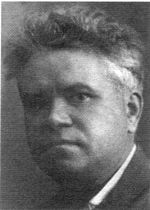
Ospan Batyr awaits execution.

Most of the information readily available online about this Kazakh martyr is not in English, and a good deal of it tends to the hagiographical — like this Turkish-language page, lavishly illustrated.

On this day..

1882: George Henry Lamson, aconitine poisoner

On this date in 1882, George Henry Lamson was hanged at England’s Wandsworth Prison for poisoning his brother-in-law in pursuit of an inheritance.

Once decorated for his volunteer medical practicioning in the benighted lands of eastern Europe, Dr. Lamson fell prey upon his return to England to morphine addiction which cleaned out his assets.

Desperate to resolve his debts, he administered a lethal aconitine dose to the paraplegic 18-year-old Percy John.

Apparently, the good doctor had learned all about this efficacious chemical at the knee of Queen Victoria’s own physician, Robert Christison.

Unfortunately, Lamson hadn’t been keeping up with his technical journals in the meantime: Christison had taught him that aconitine poisoning was undetectable, but a forensic technique to identify it had subsequently been developed.

(Minor-league milestone: Lamson’s was the first recorded criminal defense that attempted to blame ptomaine poisoning, a now-discredited theory that death can be induced by alkaloid toxins from decomposing food. But the lawyer making that defense would later write that he not only believed his client guilty, he also thought Lamson had iced his wife’s older brother, Herbert.)

The particulars of Lamson’s trial are recounted at length in this free book, from which we excerpt the interesting description of executioner William Marwood’s craft in arranging the scene.

Lamson was a more powerfully built man than he appeared, weighing upwards of 11 stone 12 Ibs., and the executioner, evidently fearing that hie strength would operate somewhat against a sharp and quick fall, fastened back his shoulders in a manner which precluded all possibility of the culprit resisting the action of the drop …

When the convict was pinioned the procession moved on, the clergyman the meanwhile reading the service of the Church appointed for the burial of the dead, the doomed man respondnig almost inaudibly to the words as they were uttered by the chaplain. It was with great difficulty now that he could walk at all; indeed, it is certain that had he not been supported by the two warders who stood on either side of him, he would have fallen to the earth. Suddenly he came in sight of the gallows, a black structure, about 30 yards distant. The grave, newly dug, was close at hand. The new and terrible spectacle here acted once more with painful effect upon the condemned man, for again he almost halted and fell. But the warders, never leaving hold of him, moved on, while Marwood came behind. At last the gallows was reached, and here the clergyman bade farewell to the prisoner, while Marwood began his preparations with the rope and the beam overhead. With a view to meet any accretion of fear which might now befall the culprit, a wise provision had been made. The drop was so arranged as to part in the middle, after the fashion of two folding doors ; but, lest the doomed man might not be able to stand upon the scaffold without assistance, two planks of deal had been placed over the drop, one on either side of the rope, so that up to the latest moment the two warders supporting the convict might stand securely and hold him up, without danger to themselves or inconvenience to the machinery of the gallows. In this way Lamson was now kept erect while Marwood fastened his legs and put the cap over his eyes. He must have fallen had the arrangement been otherwise, for his effort to appear composed had by this time failed. Indeed, from what now occurred it is evident that the convict yet hoped for a few moments more of life, for, as Marwood proceeded to pull the cap down over his face he pitifully begged that one more prayer might be recited by the chaplain. Willing as the executioner possibly might have been to listen to this request, he had, of course, no power to alter the progress of the service, and was obliged to disregard this last demand of the dying man. Signalling to the warders to withdraw their arms, he drew the lever, which released the bolt under the drop, and so launched the prisoner into eternity, [the] clergyman finished the Lord’s Prayer, in the midst of which he found himself when the lever had been pulled, and then, pronouncing the benediction, moved slowly back to the prison.

Though aconitine poisoning dates back to antiquity (the Greeks figured that the original dog from hell, Cerberus, drooled aconitine) and has been used as a literary device by Oscar Wilde, James Joyce, and J.K. Rowling, Dr. Lamson’s was long the last known case of criminal homicide by aconitine — until the 2009 conviction of a west London woman for slipping this illustrious mickey to her paramour in his chicken curry.

On this day..

1649: Robert Lockyer, Leveller

On this date in 1649, Robert Lockyer (or Lockier) was shot before the scenic backdrop of London’s St. Paul’s Cathedral* for the Leveller-inspired Bishopsgate mutiny.

These weeks following the epochal execution of the late king Charles I were also the climax of a pivotal intra-party conflict among the triumphant Parliamentarians … one whose class dimensions map a lot more readily to a modern template. Levellers were, “in a small way, the precursors of the ‘Socialists’ of 1849” in the words of this popular history.

The prosperous gentry represented by the Grandee faction were just fine with the whip hand they’d obtained in government by overturning the monarchy; against them were arrayed the more radical Levellers (or “Agitators”) who could not fail to notice that they had no say in electing the Parliament upheld by their victorious arms, and an oligarchy governing them that bore a suspicious resemblance to the supposedly defeated nobility.

So there was that.

Meanwhile, up in high statecraft, Oliver Cromwell was preparing to make his name accursed of Ireland by smashing up the island and the Grandees hit upon an arrangement as expedient for fiscal ambitions as for territorial: the soldiers assigned to this expedition would have the opportunity to opt out of it, for the low low price of forfeiting the substantial back pay they were due from those years of civil war — pay whose fulfillment was naturally a chief Leveller demand.

How did this cunning plan to pillage the soldiery’s pensions to conquer Ireland go over in the ranks? Reader, not well.

Since the same reason that shall subject them unto us in generall, or any of us singly, may subject us unto them or any other that shall subdue; now how contrary this is to the common interest of mankind let all the world judge, for a people that desire to live free, must almost equally with themselves, defend others from subjection, the reason is because the subjecting of others make(s) the subdued strive for Dominion over you, since that is the only way you have left them to acquire their common liberty.**

So there was that, on top of that.

Grumblings gave way to refusals to march, and the refusal by a regiment stationed in Bishopsgate to leave London lest it also leave its leverage soon became the eponymous mutiny of this post — the Bishopsgate Mutiny.

Grandees quelled this particular insubordination without need of bloodshed, but thought it meet to deliver a little anyway as proof in this fraught political environment against the next such affair. Six of the soldiers drew military death sentences; Cromwell pardoned five, but let known Leveller/Agitator firebrand Lockyer go to his death over the appeals of Leveller leaders like John Lilburne and Richard Overton.

The signal was unmistakable — certainly to the thousands who donned Leveller colors to follow Lockyer’s funeral procession through London.

In the days following Lockyer’s execution, several Leveller-inspired regiments would openly rise … what proved to be the movement’s last great stand, efficiently crushed by Cromwell.

*The Parliamentarians had twisted high church dogmatists by putting Old St. Paul’s Cathedral to profane use as a cavalry stable, which employment actually made it a sort-of suitable place for a military execution. (The current structure was rebuilt on the same site after the previous church succumbed to the Great Fire of London.)

** From Mercurius Militaris, quoted by Norah Carlin, “The Levellers and the Conquest of Ireland in 1649,” The Historical Journal, June 1987 — which, however, makes the case that while the Levellers were obviously not cool with the pay expropriation, their opinion on the Ireland conquest in the abstract was far from uniformly anti-imperial.

On this day..

1843: Ewen Cameron, black bean leftover

On this date in 1843, a Mexican firing squad disposed of Texan commander Ewen Cameron.

A Scottish immigrant, Cameron arrived in Texas just as it broke free of Mexico. His reputation for martial prowess on the frontier earned him a newsman’s tribute as “the Bruce of the West.”

High praise indeed: but his end would better resemble Wallace.

Cameron hitched on to the ill-fated Mier Expedition plundering raid over the border.

He was among the men forced to participate in the Black Bean Lottery wherein 176 Texan prisoners picked beans from a pot to determine who would live and who would die. Cameron picked a white bean, saving his life … but only briefly.*

The verdict refused by Fortune was reinstated by the hands of men.

Abrasive characters like the Bruce are not so well appreciated across their respective frontiers, and Cameron had built some ill-will in the Mexican army with his intrepidity the previous year.

The officer thereby embarrassed, Antonio Canales, was loath to let this reviled prisoner escape his clutches, and urgently petitioned Santa Anna to dispose of him.

This was duly done at Perote Prison, where the other lottery survivors languished for months or years along with other captives of various Mexican-Texan skirmishes.

Cameron County, Texas (the state’s southernmost) is named for Ewen.

* According to this account, the Mexicans loaded the fatal black beans onto the top layers in an effort to get the officers (who drew first) to pick them. Cameron was wise to the scheme, and foiled it by thrusting his hand all the way into the pot.

On this day..

1938: Yakov Peters, Siege of Sidney Street survivor

On this date in 1938, a Soviet purge claimed (among others*) Yakov (Jacob) Peters, former Cheka executioner and once the subject of a headline-grabbing trial in England.

Peters was a trusted (and ruthless) operator in the Soviet internal police from the start of the Revolution: he helped interrogate Lenin‘s would-be assassin Fanya Kaplan in 1918.

And he was the guy Trotsky had on speed-dial when Cheka founder Felix Dzerzhinsky was arrested by the Left SRs during their abortive 1918 uprising against their erstwhile revolutionary allies, the Bolsheviks.**

Dzerzhinsky was disarmed and locked in a room. his assistant, M.I. Latsis, was captured in the Cheka Lubianka headquarters. “No point in taking him anywhere, put this scum against the wall!” shouted a sailor, but one of the leaders, Alexandrovich, intervened, saying, “There is no need to kill, comrades; arrest him, but do not kill.” Dzerzhinsky’s assistant Yakov Peters was urgently summoned by Trotsky, who ordered him to crush the uprising by attacking the Left Eser headquarters. Alexandrovich was caught at a railway station, and Latsis, whom he had saved from execution, personally shot him. Mass executions in Cheka prisons followed. (Source)

Like a lot of old Bolsheviks, Peters’s early service to the cause didn’t age too well. He ran afoul of some bureaucratic intrigue or point of party discipline or other and caught a bullet in 1938. (Khrushchev rehabilitated him.)

For anyone in England watching the fate of this distant apparatchik, the proximity to bloodbaths would have had a familiar hue.

Peters was one of a gang of Latvian revolutionaries who came to cinematic public attention in London when, in the course of being rounded up for a December 1910 murder, they engaged the police in a stupendous East End firefight on January 2, 1911 — the Siege of Sidney Street. (It’s also known as the Battle of Stepney.)

Armed like soldiery, the Latvians easily outgunned the bobbies who had them hemmed into a cul-de-sac, and they fired on John Law with ruthless effect. This necessitated a call to the Scots Guard — whose deployment was okayed by Home Secretary Winston Churchill, the latter captured on film that day awkwardly milling about the scene of the urban combat.


(Translated directly to the city’s cinemas as soon as that same evening, Churchill’s image came in for public catcalls owing to his support for a relatively open immigration policy for eastern Europeans.)

This incident was a landmark in crime, policing, media — recognizably modern in its trappings of nefarious immigrant terrorists, politicized state funerals for policemen, and of course, the live-on-the-scenes camera work.

Since Britain was a ready hand with the noose at this time, one might think an execution would have been just the denouement.

However, responsibility for the policememen slain in the affray had been officially assigned to a different gang member, George Gardstein — who was killed when the besieged house burned down — and there was little usable evidence against those who were finally put on trial for the gang’s various crimes. Most of the witnesses were dead, fled, or completely unreliable, so the surviving Latvians all walked.

(Since the identity of one of the first guys to start shooting when the police rang always remained murky, there are some theories — such as in this out-of-print book — that Peters himself had been one of the gunmen on-site, and/or that he could be identified with the absconded and never-captured gang leader “Peter the Painter”.)

Whatever the exact measure of blood on Yakov Peters’s hands from Sidney Street, there would be a lot more where it came from.

While Peters went off to his different fate in revolutionary Russia, the dramatic scene he left behind has naturally attracted continuing retrospective attention in England. The testimony of witnesses, who also recollect the shootout’s anti-immigrant fallout, is preserved in this BBC Witness radio program:

[audio:http://downloads.bbc.co.uk/podcasts/worldservice/witness/witness_20110127-0950a.mp3]

And, on this BBC Four television special:

* e.g., Russian Civil War officer Nikolay Gikalo and Romanian Jewish revolutionary Leon Lichtblau.

** And in favor of resuming Russia’s ruinous involvement in World War I!

On this day..

1655: Massacre of Waldensians

On this date in 1655, Catholic forces under the Duke of Savoy carried out a notorious massacre of Waldensians* in the Piedmont.

This interesting, excommunicate sect had persisted for centuries in those hard-to-reach places in Alpine foothills, intermittently ignored and hunted. After Martin Luther, many Protestants inclined to see them as a proto-Reformation movement, or even a counter-papal apostolic succession reaching back to ancient Christianity.

At any rate, they sure weren’t Catholic.

And our friend the Duke decided — perhaps piqued by the murder of a missionary Catholic priest, or for whatever other reason — to mount one of those heresy-extirpating sorties and make them Catholic in 1655.

On April 17, the Marquis of Pianezza appeared with an overwhelming force of mixed Piedmontese, French, and Irish** troops. They conducted a few skirmishes, then made nice with the Waldensian civic leaders and induced them to quartering their troops temporarily further to some expedient pretext.

Alas! alas! these poor people were undone. They had received under their roof the executioners of themselves and their families. The first two days, the 22d and 23d of April, passed in peace, the soldiers sitting at the same table, sleeping under the same roof, and conversing freely with their destined victims …

At last the blow fell like a thunderbolt. At four of the clock on the morning of the 24th April the signal was given from the Castle of La Torre. But who shall describe the scenes that followed? On the instant a thousand assassins began the work of death …

Little children were torn from the arms of their mothers, and dashed against the rocks; or, more horrible still, they were held betwixt two soldiers, who, unmoved by their piteous cries and the sight of their quivering limbs, tore them up into two halves. Their bodies were then thrown on the highways and the fields. Sick persons and old people, men and women, were burned alive in their own houses; some were hacked in pieces; some were bound up in the form of a ball, and precipitated over the rocks or rolled down the mountains … Some were slowly dismembered, and fire applied to the wounds to staunch the bleeding and prolong their sufferings; some were flayed alive; some roasted alive; others were disembowelled; some were horribly and shamefully mutilated, and of others the flesh and brains were boiled and actually eaten by these cannibals.

Source, whose atrocity accounts channel those in this French tome

Without doubting the capacity of man’s inhumanity to man, the cannibalism charge reminds that we’re dealing with propaganda alongside historiography. And what great propaganda — like, babies-torn-from-incubators great.

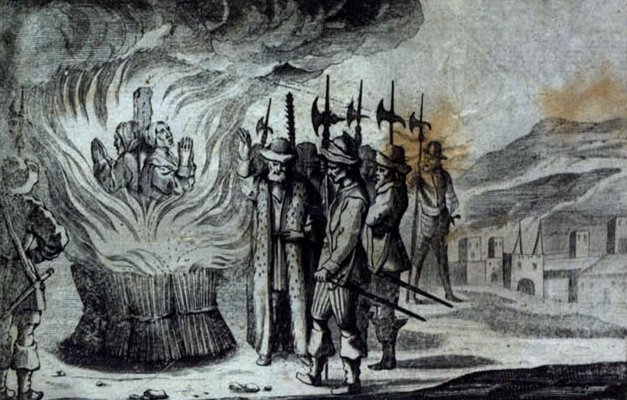
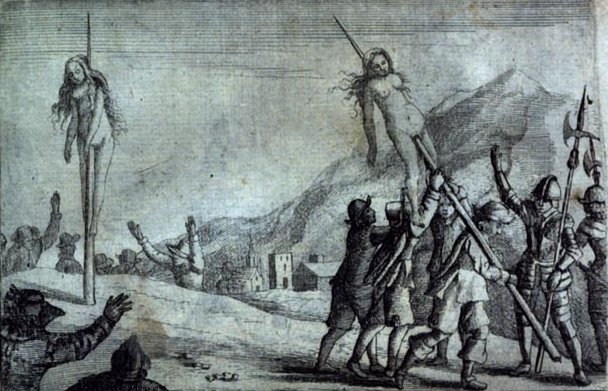
Thumbnails (click for a larger, disturbing view) of selected images of this date’s atrocities from Samuel Morland’s The History of the Evangelical Churches of the Valleys of Piedmont

And there’s little doubt as to the overall savagery of the affair, which could well have become the opening salvo in a full-scale sectarian cleansing campaign. (A later addendum to Foxe’s Book of Martyrs narrates the ensuing Piedmontese armed struggle, petering out before any definitive resolution in the field.)

Outrage at this hecatomb spread in Protestant Europe — which would also refer to the day’s doings as the “Bloody Easter,” since it corresponded with the eve of that celebration as reckoned by the Julian Calendar (source).

It was felt especially in Protectorate England, which intervened diplomatically.

A “day of solemn fasting and humiliation” was promulgated in Albion, along with collections for the relief of the survivors. Oliver Cromwell personally put £2,000 into the kitty.

More importantly, he dispatched diplomat Samuel Morland† to force the House of Savoy to lay off the persecution; in fact, he threatened to disrupt high statecraft between England and France unless the French twisted arms on behalf of the Waldensians.

Written correspondence for Morland’s diplomatic tour addressed to Louis XIV of France and various other continental potentates, as well as a fiery bit of oratory that Morland delivered to Savoy, all seem to have originated from the pen of Republican scribbler John Milton — the future author of Paradise Lost.‡

Milton, for whom the whole thing was more than just a day job, was further moved to put his umbrage at the slaughter into sonnet form:

Avenge O Lord thy slaughter’d Saints, whose bones
Lie scatter’d on the Alpine mountains cold,
Ev’n them who kept thy truth so pure of old
When all our Fathers worship’t Stocks and Stones,

Forget not: in thy book record their groanes
Who were thy Sheep and in their antient Fold
Slayn by the bloody Piemontese that roll’d
Mother with Infant down the Rocks. Their moans

The Vales redoubl’d to the Hills, and they
To Heav’n. Their martyr’d blood and ashes sow
O’re all th’ Italian fields where still doth sway

The triple Tyrant: that from these may grow
A hunder’d-fold, who having learnt thy way
Early may fly the Babylonian wo.

* The Waldensians in question here are interchangeably known as the Vaudois for their geographic region, actually above the Piedmont and abutting the Swiss region also known as Vaud. (These pages have visited the latter.)

** Fresh from being on the receiving end of another infamous massacre.

† Morland is more regarded for his post-Restoration labors as an inventor; he created an early calculator and internal combustion engine.

‡ The speech in particular is not definitively attributed; see Robert Fallon, “Milton in Government: Denmark and Savoy,” Milton Quarterly, May 1989.

On this day..

Feast Day of St. George

This is the feast date, and the traditionally-ascribed execution date in 303, of St. George — legendary dragon-slayer and patron saint of half the world and darn near everything that the original apostles didn’t nail down.

Saint George is supposed to have been a well-favored officer in Diocletian‘s army who suicidally announced his Christian faith during the latter’s persecutions, and refused every sop and entreaty to renounce it. He was martyred at Nicomedia.

Pretty standard persecution fare — and there’s next to nothing that can be reliably verified about his life — but George did well by his future cult to get into the martyr’s game right before Christianity’s official triumph. Still, at the end of the day, it’s one of those unaccountable accidents of history that this particular fellow ended up as perhaps Christendom’s most widely venerated champion.

He’s most immediately recognizable for the story of having slain a dragon, a plain metaphor for paganism (and usable metaphor for anything and everything else) that’s been depicted in all its scaly corporeality by innumerable artists.

England has liked him jolly well ever since his suitability to the chivalric ethos positioned him to supplant Edmund the Martyr as that realm’s patron saint during the Middle Ages. The red cross on the English flag is a St. George’s cross.

And so there he is, too, in one of Shakespeare’s most rousing patriotic monologues:

I see you stand like greyhounds in the slips,
Straining upon the start. The game’s afoot:
Follow your spirit, and upon this charge
Cry ‘God for Harry, England, and Saint George!’

But George gets around, and England has to share him.

That St. George’s Cross also adorns the flag of Georgia (the country, that is: it’s so hard core that it’s named for the guy), and he’s claimed as a sponsor throughout Orthodox Christendom: Serbia (which celebrates a major holiday when April 23 hits on the Julian calendar); Bulgaria; Greece; Ethiopia; the city of Constantinople and its heir, the city of Moscow, and Russia generally. There were two George’s [Yuri’s] Days on Old Russia’s calendar, and the autumn one was marked as the one time in the year that serfs were permitted to change their landlords, at least until Boris Godunov canceled the privilege and left Russian with the idiom “so much for Yuri’s day!” to mark an expectation disappointed.

George is big in Spain, and even bigger in Portugal; through its Portuguese heritage, he’s also venerated in Brazil, where he’s the patron saint of the Corinthians football club. He’s the sponsor (via that dragon connection) of the snaky Hungarian military order that gave Vlad the Impaler the immortal sobriquet of Dracula.

There are other countries and any number of cities who also trust the dragon-slayer’s patronage; George accepts the further devotions of saddle-makers, lepers, animal husbandmen, shepherds, Crusader knights, butchers, the Maltese, gypsies, farmers, archers, syphilis-sufferers, cavalrymen and therefore also armored tankmen, Palestinian Christians, and the Boy Scouts of America. He’s generally got a stupendous worldwide collection of churches, art, legends, and devotional rites dedicated to his name.

On this day..

1930: William Henry Podmore, inculpated

On this date in 1930, criminal forensics claimed an apparent — albeit controversial — victory with the hanging of William Henry Podmore.

Podmore was noosed by a chain of circumstantial evidence investigators used to connect him to a murder scene — that, specifically, of his former employer Vivian Messiter, whose badly decomposed corpse was found tucked in a garage nine months after it went missing.

The ensuing investigation went like a Roaring Twenties version of CSI.

First, famed pathologist Bernard Spilsbury established a cause of death: blunt force to the skull, apparently delivered by a bloodied hammer found nearby.

After that, it was a matter of connecting some malefactor to the handle of the hammer.

[A] scrap of paper, about two inches square, which was found behind a barrel in [the] garage … led ultimately to the conviction of the murderer. This fragment was caked with dirt and soaked in oil, and had been repeatedly trodden under foot, and the problem was to remove the dirt and oil, without also removing the pigment of the copying ink pencil.

After numerous experiments with various makes of copying ink pencil, petroleum spirit was found to be suitable for the purpose, and a message from a man calling himself “W. F. Thomas” was left upon the paper. Until then, it was not known that anyone of the name of “Thomas” (an alias of Podmore) had been in any way connected with the victim.*

This was still very far from placing a fellow on the gallows until a further bit of investigative prestidigitation produced an apparent motive:

a leaf from a note-book showing indentations which had, presumably, been made by the pressure of a pencil on another leaf of the book subsequently torn out. By means of photography with the use of oblique lighting to illuminate the edges of the indentations, words relating to bogus orders, with the initials of “Thomas,” were rendered visible.*

From such paper was the crown able to craft a case which the reader will readily discern: Podmore, a mechanic only temporarily in Mr. Messiter’s employ, had entered some fraudulent transactions upon which he claimed a commission, and a fatal altercation presumably ensued upon Messiter’s discovering the con. The fact that Podmore was already wanted for fraud and robbery elsewhere did not help the defendant’s situation.

The “Garage Murder” investigation played out for months throughout 1929, much of which Podmore spent in jail on the other larceny charges while the cloud of suspicion gathered over him. In early March 1930, trial bulletins on counsels’ disputes over this novel evidence — its admissibility, its weight and application to the theory of the crime, and the sleuthing techniques employed to gather it — filled the papers almost daily.


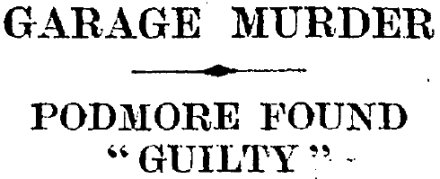
The “Blog” of “Unnecessary” Quotation Marks agrees. (Headline from London Times, March 10, 1930)

Evidence that fit “like a crossword puzzle” (in the summing-up of the state’s attorney) nevertheless did not amount to anything so ironclad that Podmore wanted for public support: in the couple of weeks between a rejected appeal and Podmore’s execution, 12,000 people signed a petition for his reprieve, including 79 Members of Parliament.**

(Those crossword forensic clues had been buttressed by that classic recourse of the prosecutor, dubious jailhouse-snitch testimony as to the convenient spontaneous confession of the accused allegedly delivered to perfect strangers in the most injurious possible situation: that such specious evidence might have proved decisive in a matter of life and death seems to have moved a lot of signatures to the clemency petition.)

Given the circumstances, the Home Secretary took the unusual step of issuing a statement on its denial of this measure to calm the “disquiet in the public mind” — and expressing his confidence beyond any “scintilla of doubt as to the prisoner’s guilt.”†

* C. Ainsworth Mitchell, “Scientific Documentary Evidence in Criminal Trials,” Journal of Criminal Law and Criminology Vol. 23, No. 2 (July-August, 1932)

** London Times, April 16, 1930

London Times, April 21, 1930. “I searched for many days,” Secretary Clynes said after the hanging (Times, April 23, 1930), “in the hope that I would find a reason for recommending a reprieve. I searched in vain.”

On this day..

1988: Stanislaw Czabanski, the last in Poland

On this date in 1988, in its last full year of Communist rule, Poland carried out its last hanging.

Stanislaw Czabanski, who killed a woman in Tarnow, was hanged in Krakow’s Montelupich Prison.

According to this 1996 survey of worldwide death penalty trends by British death penalty abolitionist Peter Hodgkinson,

In Poland, courts of regular jurisdiction rendered altogether 318 final death sentences between 1956 and 1988 (the last full year of communist rule), that is, on average, 10 death sentences per year … Seven death penalty sentences were passed on average each year in the 1960s; this number almost doubled in the 1970s. The decade of the 1980s was marked by the emergence of Solidarity, the first independent civic body ever in existence in a communist country, by the imposition of Martial Law in December of 1981, and by the repressive political climate in the subsequent years. However, one notices a pronounced decrease in the number of death sentences compared to the previous decade. Altogether sixty such sentences were passed between 1980 and 1988, an average of 7.7 per year … Jaruzelski‘s military regime used more carrots than sticks when dealing with the political opposition.

The contemporary artistic reflection of elites’ growing concern over capital punishment was the 1989 Krzysztof Kieslowski flick critiquing the death penalty in his Dekalog series.

Though Poland continued to hand out death sentences until the mid-Nineties, a moratorium on actual executions took hold.

One can, of course, never say what shall be for all time; while death penalty abolition was a condition for Poland’s European Union membership, the conservative-nationalist Kaczynski brothers have openly mooted reintroducing capital punishment.

On this day..

1534: Elizabeth Barton, the Holy Maid of Kent

On this date in 1534, Elizabeth Barton was hanged at Tyburn with her “conspirators” for having prophesied the death of Henry VIII and (in the words of the parliamentary attainder against them) “traterously attempted many notable actes intendyng therbye the disturbaunce of the pease and tranquyllytie of this Realm.”

A country servant-girl, this Elizabeth Barton had begun having divine visions around Easter 1525, and developed a popular following for her gift of prophecy, generally delivered during spooky (perhaps epileptic) fits and trances.

This was all just fine with everyone, since King Henry was still a good Catholic at the time; Barton took orders in the St. Sepulchre Nunnery and continued her career in the seer business.

Elizabeth Barton wasn’t going to leave her place in Henrician England … but to paraphrase Ronald Reagan, Henrician England was about to leave her.

And like so many entries that age has given this site, it all went back to Henry’s leaving his first queen, Catherine of Aragon.

If one likes to see in the prophetic tradition a refracted expression of popular sentiment, speaking a religious rather than a political language, Elizabeth Barton’s divine gift set her up to be the mystical exponent of the English populace’s visceral reaction against Henry’s ascending paramour, Anne Boleyn.

Rather rashly, Barton began publicly warning her sovereign against his bedchamber gambit, threatening that if the proposed Boleyn union should come to pass, he “should no longer be King of this realm…and should die a villain’s death.”

That would be compassing the death of the king — which is treason.

Barton articulated a fear of Henry’s policies which was shared by many of his subjects. The anticipated breach with Rome made the citizens of England insecure about the future stability of the realm, and prognostications concerning the state of the country abounded. Barton was not alone in foretelling that wars and plagues would soon rack the country; or in prophesying that the King would be overthrown, that his death was imminent, that he would die as a villain. Many people were discussing such prophecies, by means of which they could “objectify their fears and hopes” in an age of change and disruption.

-Diane Watt, “Reconstructing the Word: the Political Prophecies of Elizabeth Barton (1506-1534)”, Renaissance Quarterly, Spring 1997

So it’s probably only fitting that this creature of her times would be devoured by the Tudor state which made its Reformation from the top.

Devoured, not only bodily.

As the Tudor king breaks with Rome, Barton becomes almost totally obscure to us, the real person who dared to stand openly against her king subsumed entirely by the edifice of state propaganda. As Watt observes, “as a result of her fate … almost all the first-hand evidence concerning Barton’s life and revelations has been destroyed” and “the surviving image of her has therefore been shaped by those who suppressed her visions and prophecies.”

We have her mystical utterances mostly indirectly, through the interlocutors charged with refuting her, and we have the expedient charges against her of fraud, contumacy, and (of course) sexual indiscretion leveled by her foes.


“The Imposture of the Holy Maid of Kent”

Arrested with a circle of supporters, Barton was forced into a public recantation in November 1533 by her persecutors. One supposes such a recantation was in any event obtained under some duress; undoubtedly it was, as the disgusted Spanish ambassador recorded, staged “to blot out from people’s minds the impression they have that the Nun is a saint and a prophet.” (Cited by Watt)

If said duress included an easing of the charges against herself or her associates, Barton was to be disappointed.

She was attainted for treason* in January (the evidence against her being insufficient for a judicial verdict of treason); the bill of attainder also required the public to hand over any writings about her alleged prophecies or revelations, like the popular pamphlets that had circulated with official approval in the 1520’s: there would be nothing to nurture a people’s cult for this exponent of resistance. Over the decades to come, the early writings sympathetic (and proximate) to Barton would be almost completely annihilated, supplanted by Protestant works that rendered Barton a trickster, a puppet, a sham — magnified her retraction into the definitive statement. It was a propaganda victory almost as chilling as Barton’s corporeal fate: even her potentially sympathetic Catholic audiences can latterly make no reliable judgment about her.

And so Barton moulders.

In April 1534, the usurping consort once more apparently pregnant with Henry’s long-sought heir, the once-popular, now-deflated prophetess of the old queen and the old faith was emblematically put to death with her former adherents on a most significant day in the city of London.

[T]his day the Nun of Kent, with two Friars Observant, two monks and one secular priest, were drawn from the Tower to Tyburn, and there hanged and headed. God, if it be his pleasure, have mercy on their souls. Also this day the most part of this City are sworn to the king and his legitimate issue by the Queen’s Grace now had and hereafter to come, and so shall all the realm over be sworn in like manner.

-Letter from John Husee to Lord Lisle, April 20, 1534 (Source)

We trust everybody got the message.

But in case anyone missed the point, there would be plentiful reminders still to come.

* Chancellor Thomas More had some traffic with Barton — very cautious, as befits a skeptical elite’s approach to a loose cannon commoner — and was briefly in some danger of being named in the indictment against her. When his loyal daughter Meg joyously reported to him that he’d been cleared, he’s supposed to have replied, “In faith, Meg, ‘quod differtur non aufertur’, what is put off is not put away.” But it probably didn’t require heavenly foresight for More to perceive the wheel of fortune about to turn on him, too. By the time of Barton’s actual execution, More had already been clapped in the Tower himself.

On this day..