Feast Day of St. Nicholas

Today is the feast day of Santa Claus himself, St. Nicholas.

Nicholas was a real-life bishop in fourth century Asia Minor. He’s among the prelates to sign off on the Nicene Creed, Christianity’s official profession of orthodox doctrine hammered out at the emperor Constantine’s epochal Council of Nicaea.

Living as he did amid the triumph of his once-persecuted faith, Saint Nick was not called upon to offer God his own martyrdom. Our death penalty context comes from one of the stories in his hagiography — that on one occasion, returning to the seat of his diocese at Myra, Nicholas discovered that three innocent men had been condemned to imminent execution by a wicked magistrate. Hastening to the scene, he dramatically averted their beheading by seizing the executioner’s sword.

The great Russian artist Ilya Repin depicted the scene.


St. Nicholas Saves Three Innocents from Death, by Ilya Repin (1888).

Repin did not love this painting — he slinked out of its 1889 exhibition, allegedly dissatisfied with its rigidity and melodrama* — but it did express the liberal-minded artist’s distaste for capital punishment. The era we now know to be the late tsarist period in Russia saw violent (and sometimes indiscriminate) crackdowns on revolutionary terrorism following the 1881 assassination of Tsar Alexander II, to the great grief of her dissident intelligentsia. Philosopher Vladimir Solovyov called the death penalty “absolute murder”; with a like attitude, tsarist Russia’s “liberal politicians, academics and journalists repeatedly campaigned against this form of punishment.” (Source)

Around the time that Repin depicted St. Nicholas’s great act of clemency, Leo Tolstoy — who abhorred capital punishment — wrote of his youthful experience witnessing the guillotine in action in Paris, “at the moment the head and body separated and fell into the box I gasped, and realized not with my mind nor with my heart but with my whole being, that all the arguments in defence of capital punishment are wicked nonsense … [that] murder remains murder, and that this crime had been committed before my eyes.”**

Repin was forever being read and misread by the ideologues afoot in Russia, but this Tolstoyan horror at the scaffold he shared unambiguously. In a later era, by which time Repin was the established senior figure of the Russian art scene, the painter was exercised enough by Stolypin‘s wholesale use of capital punishment following Russia’s abortive 1905 revolution to issue a public denunciation of executions. But it was only ever by the hand of St. Nicholas that he had the experience of preventing one.

* See David Jackson, “The ‘Golgotha’ of Ilya Repin in Context”, Record of the Art Museum, Princeton University, Vol. 50, No. 1 (1991).

** Repin also painted Tolstoy in 1887.

On this day..

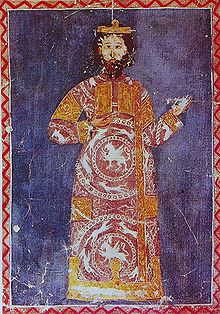
764: St. Stephen the Younger, iconodule martyr

This is the supposed martyrdom date, in the year 764 or perhaps 765, of St. Stephen the Younger in Constantinople at the hands of an iconoclastic emperor.

Ancient and “dark ages” history characteristically comes with all kinds of problems arising from the paucity and prejudice of primary sources. Byzantium’s century of Iconoclastic controversy is a fine example.

In this period from approximately 726 to 842, the empire was rent by a conflict between iconophiles or iconodules — proponents of the use and adoration of religious imagery in Christian worship — and iconoclasts — who abhorred same as a form of sacrilegious idolatry.

This was deadly serious stuff in the way that only Byzantine sectarian conflict could be, but the controversy was not strictly about defining the Biblical injunction on graven images. As the excellent History of Byzantium podcast explains in its iconoclasm episode,* it likely manifests “an empire-wide reaction to the trauma of defeat” — battlefield defeat by the rising armies of Islam, and with it a shaken confidence in the favor of God. (Islam’s hard line against idolatry surely can’t be coincidental.)

But in posterity we are reduced to these muddy qualifiers because as the winning party in the dispute, iconodules wrote the history. That’s no moralistic stab: iconoclasts, too, burned the enemy’s tracts when they had the opportunity; had they prevailed in the end, they would have blurred out the background, motivations, and achievements of their rivals as readily as the iconodules did and leave those who followed to read between the lines of a partisan history. Indeed, Bissera Pentcheva’s recent Icons and Power: The Mother of God in Byzantium even contends that the legendary centrality of icons to Byzantine religiosity was an invention of the post-iconoclastic era, with events like the Marian icon’s saving Constantinople during the Avar siege of 626 backfilled to replace the original story about Marian relics working the divine intervention.


Iconoclasts plastering over an icon.

The iconoclastic era opens in the late 720s; according to the (iconodule, naturally) saint and historian Nicephorous, its immediate trigger was the devastating 726 eruption of the Greek island Thera (Santorini) — and affrighted by the apparent divine wrath, “the impious emperor Leo [III] started making pronouncements about the removal of the holy and venerable icons.” He’s alleged to have taken down a particularly revered icon of Christ on Constantinople’s Chalke Gate.

Nevertheless, it is difficult to get a firm fix on what specific anti-icon policies Leo promulgated, if indeed there were any at all. (The Greek term for “pronouncements” could be understood simply as “comments” instead of “edicts”.) It is Leo’s son Constantine V, succeeding the purple in 741, who clearly brings an overt imperial turn against icons, for “He cannot be depicted. For what is depicted in one person, and he who circumscribes that person has plainly circumscribed the divine nature which is incapable of being circumscribed.” Constantine convened an ecumenical council that ruled for his anti-icon position and set about removing images from churches.

Against this campaign was ranged the bulk of the clergy — church vs. state is another possible and difficult-to-measure dimension of the whole dispute, although Constantine’s ability to win the acquiescence of hundreds of bishops must complicate this interpretation.

The great champion of and martyr for the iconodule position in this time was St. Stephen the Younger. That’s “younger” vis-a-vis the original St. Stephen, Christianity’s protomartyr.

As befits that exalted company, this monk and hermit was credited by his adherents with a supernatural power in the iconoclasm debate.

A man blind from his birth visits the saint with suppliant outcry for relief. “If you hast faith in God,” he replies, “if thou art a worshipper of His image, thou shalt behold the light and the beauty of hidden things.” Scarcely had the words gone forth, when the blind man rejoiced in beholding light. A woman brings to him her son “grievously vexed with a devil,” and a distressing scene is described. Stephen bids a disciple to apply the sign of the Cross to the whole afflicted body. The saint calls upon God with many tears. Finally he delivers the boy safe to his mother, when the image of Christ has been adored. An infirm soldier comes with entreaty for relief. The saint bids him adore the images of Christ and His Mother, and immediately he is restored. The soldier afterwards repudiates image-worship before the Emperor, who at once promotes him to the rank of centurion. Leaving the imperial presence he would mount his horse; the horse rears, throws him to the ground, and tramples him to death. Such is the life of the younger Stephen as related with awe-struck delight in Greek and Roman martyrologies. (Source)

And so forth.

The emperor is alleged by the hagiographies to have sought Stephen’s destruction for many years, being continually frustrated even to the point where Stephen’s torturers in prison seemed unable to finish him off. “Will no one rid me of this monk?” Constantine cries, anticipating Thomas a Becket by a good four centuries. His soldiers finally clubbed to death the obdurate cleric on November 28, 764. (For a critique of Stephen’s hagiography, including a death date that proves questionable (no surprise), see this pdf.)

But not for the first time, an imperial innovation in theology failed to outlast the patronage of its sovereign. After Constantine’s death, Empress Irene** restored the iconodules to favor† — and set the stage (after some hiccups) for a great flowering of Orthodox icons in the centuries to come.

* Also see Episode 75, delving into Constantine’s iconoclasm.

** The fact that the extant remnant of the Roman Empire had no emperor — merely a woman ruler — formed part of the rationale for the western church crowning Charlemagne “Holy Roman Emperor”. This slap in the face to Constantinople could occur because a papacy long deferential to Byzantium had at last broken with the East in the mid-8th century … in part, over iconoclasm.

Emperor Leo V restored official iconoclasm in 813 for another 29-year run as imperial policy before the movement’s final defeat.

On this day..

1512: Five young Ottoman princes

For many generations from the 14th to 17th centuries, new Ottoman heirs maintained themselves by the cruel practice of preventive fratricide.

Enforced at varying levels of systematicity, the destruction of the men best positioned to assert a claim of bloodline legitimacy against the new sultan might arguably have been one of the bulwarks of the empire’s prosperity. It insulated the Sultanate from protracted succession crises, civil war, and political fragmentation. With each generation’s passing, power coalesced into one man.

Precedent for this sanguine consanguity policy runs back at least to the 1389 Battle of Kosovo, where the death of the sitting sultan resulted in the soldiers’ enforcing their acclamation of Bayezid I as his heir by putting to death the sultan’s brother Yakub.

The sagacity, if not the humanity, of Bayezid’s action was underscored in 1402 when Bayezid was captured in battle by the Timurids and the ensuing 11-year “Ottoman Interregnum” saw the empire strained near to breaking as brother fought brother for succession until Mehmed I emerged victorious in 1413. Having attained power by killing off three siblings, he got the nickname “Mehmed Kirisci” — “Bowstring Mehmed”, after the implement by which the mighty were strangled out of the Turkish game of thrones.

His grandson Mehmed II, the man who conquered Constantinople, formalized what had been simply wise practice into written law, e.g.:

And whoever of my children manages to reach the throne, it is fitting that he should kill his brothers, for the sake of the order of the world. Most of the ulema permit that. Let them act on that. (Source)

In Mehmed the Conqueror’s day, the child “managing to reach the throne” was the winner among the sons, who were posted to various regional outposts to earn their spurs in governance, in a scramble back to the Porte upon word of the old man’s death. This meant that in life, the boys were in a constant struggle for the privilege of central assignments and to nurture their own palace networks who when the day came could provide speedy notification of the impending succession and smooth recognition of a claim by the state apparatus. “The first son to reach the capital and win recognition by the court and the imperial troops became the new ruler,” Donald Quataert writes. “This was not a very pretty method; nonetheless it did promote the accession of experienced, well-connected, and capable individuals to the throne, persons who had been able to win support from the power brokers of the system.” The sitting sultans naturally put their own thumbs on the scale, too.

We are arriving, ever so circuitously, to the date’s honorees, and as one might suppose they were princes of the blood.

Come 1512, we find Mehmed the Conqueror’s son Bayezid II forcibly deposed by his son Selim. All those incentives favoring experienced, well-connected and capable individuals could also induce such a figure to take his advantage when it presented itself rather than awaiting the mischance of racing messengers. In Selim’s case, the father openly favored a different brother, Ahmet, so Selim and Ahmet were at each other’s throats (and dad’s too) well before Bayezid departed the scene.

Long story short, Selim got the kingmaking Janissaries on his side and lodged himself in the palace but his brother fought on against him. Selim would have to secure his power in 1512-1513 by an unusually thorough purge that set him up to earn the nickname “Selim the Grim”.*

Selim had seven brothers, five of whom were fortunate enough to predecease their father, and these seven brothers had collectively fathered nine sons of their own. Selim had quite a number possible rivals to dispose of.

In the months after his conquest of power, Selim wintered in Bursa, where he had interred five of his young nephews. (The other four nephews were all Ahmet’s sons, and still at large.) Some bout of fresh resistance by Ahmet induced Selim, on November 27, 1512, to do the grim thing:

The eldest of them, Osman, son of Prince Alemshah, was twenty years old; the youngest, Mahomet, son of Prince Schehinshah, was only seven. Selim sent Janissaries to apprehend them, and they were shut up by his orders in one apartment of the palace. On the next morning, the Sultan’s mutes entered to put them to death. A fearful scene ensued, which Selim witnessed from an adjoining chamber. The youngest of the captive princes fell on their knees before the grim executioners, and with tears and childish prayers and promises begged hard for mercy. The little Prince Mahomet implored that his uncle would spare him, and offered to serve him all the days of his life for an aspre (the lowest of all coins) a day. The elder of the victims, Prince Osman, who knew that there was no hope of mercy, rushed fiercely upon the murderers, and fought hard for a time against them. One of the mutes was struck dead, and another had his arm broken. Selim ordered his personal attendants to run in and assist in the execution; and at length the unhappy princes were overpowered by numbers, and strangled. Their bodies were deposited with all display of royal pomp near the sepulchre of Amurath II. (Source)

Six months later, Ahmet — defeated and in his own turn throttled with a bowstring — joined them in the same tomb.

* All told, Selim the Grim ordered something like 30,000 executions in his eight-year reign.

On this day..

1730: Nevsehirli Damat Ibrahim Pasha, Tulip Era Grand Vizier

On this date in 1730, the Ottoman Grand Vizier Nevsehirli Damat Ibrahim Pasha was deposed by strangulation.

Ibrahim Pasha (English Wikipedia entry | Turkish)* was the minister of Sultan Ahmed III; more than that, he was the sultan’s son-in-law.**

It was the Lâle Devri in Istanbul, whose great families thrilled to the voluptuary pleasures of tulips — a consumption conspicuous not only of wealth but of European affectation.†

Ibrahim himself was a great connoisseur of the fashionable bulb that defines his 1718-1730 administration as the “Tulip Period”. Arts and culture in the empire — there’s no other way to say it — flowered.

But neither horticulture nor family ties were safety in Istanbul when events required of the sultan a politically expedient purge.

For the mass of Turks unable to entertain French noblemen in their cultivated gardens, resentments both economical and cultural accumulated during in Tulip Period until they were discharged by a ham-handed tax imposition in 1730 into a huge mob rising. We have previously covered this revolt; suffice to say that it was briefly a mortal threat to which the ruling dynasty was obliged to sacrifice a few elites: an Albanian shopkeeper named Patrona Halil basically ruled Istanbul for a few weeks, and one of the concessions his angry supporters required of the sultan was the death of his son-in-law. Ahmed himself got off “easy” and was simply made to resign in favor of his nephew.

The end for Nevsehirli Damat Ibrahim Pasha also meant the end of the Tulip Era; periodization aside, however, the flower does remain a popular Turkish symbol. (Even the word for tulip, Lale, is used as a feminine name.) They’re planted all over in present-day Istanbul, and bloom gloriously in the spring; Turkish Airlines also uses a stylized tulip as its logo.

* Not to be confused with the Damat Ibrahim Pasha who was Grand Vizier from 1596 to 1601, and still less with the Grand Vizier executed by Suleiman the Magnificent, Pargali Ibrahim Pasha.

** His wife Hatice Sultan wielded considerable power of her own; after her husband’s death and her father’s resignation, she played a leading role in statecraft for the government-averse successor sultan.

† This is, however, a century after the completely unrelated Dutch tulip mania. The flower is native to Anatolia, not to the Low Countries.

On this day..

1204: Alexios V, precipitated Byzantine emperor

Around this time in the year 1205, the fleeting Byzantine emperor Alexios V Doukas was put to a dramatic death in Constantinople’s Forum of Theodosius by being hurled from the top of the ancient Column of Theodosius.

Nicknamed “Mourtzouphlos” for his prominent brow, Alexios obtained his Pyrrhic purple by being the only elite with wit and courage in Constantinople during the horror of the its sack by a Venetian Crusader army.

Vanity, vanity, all is vanity! Hands in mailed gauntlets and silk gloves grasping after glory and treasure were our Emperor Eyebrow’s rise and his fall.

The prime desideratum was the prime desideratum, Jerusalem. In a monument to bad management, a Crusader army of 12,000 was mustered to Venice in 1202 for a flotilla suitable to thrice its number. Venice had taken on an enormous contract to assemble this fleet and since the soldiers who showed up could in no way pay what the Serene Republic had been promised, Venice simply repossessed the army to make good its debt by means of pillage.

First, it sacked Venice’s Dalmatian rival Zadar. Then, having picked up the exiled nephew of the reigning Byzantine emperor — the uncle had overthrown the father to get the job — the Crusader-mercenaries made for Constantinople, become now shameless Praetorians by dint of young Alexios’s assurance of all the liberalities the East’s treasuries could bear.

Constantinople in 1202 was the jewel of Christendom. Its mighty walls had preserved the city inviolate since antiquity — a city of half a million souls reposing in the splendors of the Roman world, augmented by eight more centuries’ imperial surplus.

A morsel so ripe needs but one unguarded moment for some ruffian to pluck it. The Crusaders’ attack so happened to catch Constantinople, at long last, at such a moment. The city was lightly defended and unable to summon more aid — while under the direction of an emperor, Alexios III, who had been cruel and profligate in the enjoyment of his power but vacillated fatally when he was required to defend it.

In a matter of days in July of 1203, Alexios’s rule collapsed, and the emperor himself fled, when the Crusaders besieged Constantiople. These Crusaders of course installed their scheming moppet as Emperor Alexios IV, actually co-emperor with his father who despite having been brutally blinded by his brother was liberated and acclaimed by the populace.

The ensuing months make painful reading — and surely much worse than that to experience at first hand. The new emperors feuded with each other despite their kinship. They also had to squeeze every revenue they could for the Crusader army, which stubbornly refused to depart as its leader, the nonagenarian Doge of Venice, schemed to establish lasting Venetian authority in Byzantium. Irritated residents, enduring the continued presence of a Crusader army that thought it was supposed to be going to Jerusalem all along, rioted and fought with one another.

(For a ready summary of this situation and the entire buildup of the Fourth Crusade, grab episode 15 of Lars Brownworth’s outstanding 12 Byzantine Rulers podcast.)

The bottom line was that young Alexios was no more impressive in power than had been his predecessor and he had the added disability of having been installed by a foreign invader. He also discovered to his chagrin that the staggering sum of 200,000 he had so lightly promised the Venetians in exchange for his throne was double what he could actually find in the capital. When the situation unmanned him in January of 1204, he cowered in the imperial palace and sent his chamberlain to petition the Crusaders to back him in the latest exigency.

That chamberlain was our man, Alexios Mourtzouphlos.

Acting with an alacrity that might have spared Constantinople a horror had an earlier prince exercised it, Alexios instead arrested the co-emperors and spirited them off to a dungeon where they were quietly murdered.

The usurper then turned the city’s energies towards reinforcing its battered defenses and attempted to mount an attack against the Crusaders. This proved, however, much too late to spare the Second Rome its most awful tribulation.

In a matter of days in April 1204, the rude band of Latins who set out to win Jerusalem for Christ overran glorious Constantinople and put it to the sack. Tourists today who gawk at the bronze horses decorating Venice’s St. Mark’s Basilica are in fact enjoying the plunder of Byzantium. In time Constantinople would be retrieved from the Latins, but neither the city itself nor the Byzantine Empire ever fully recovered from the blow. This is also the event that made the schism between Eastern and Western confessions of Christianity permanently irretrievable.*

It was not given Alexios Mourtzouphlos to see what horrors ensued for Constantinople, never mind to get a start on finagling an imperial comeback of his own. Fleeing the sack of the city, he wound up in Thrace in the company of yet another deposed ex-emperor. But after first allowing Mourtzouphlos to marry his daughter, that old schemer had Alexios V blinded and in November 1204 abandoned him to an advancing Latin army — and its eventual death-by-precipitation — while his former in-laws fled to Corinth.

* One of Alexios IV’s promises to his Crusader buddies was to submit the Byzantine patriarchate to Papal authority — another pledge that could never have been realistically delivered.

On this day..

1730: Patrona Halil, Ottoman rebel

On this date in 1730, Patrona Halil, the virtual ruler of the Ottoman capital at the head of a popular rabble, was lured to Istanbul’s Topkapi Palace on the pretext of receiving an imperial honorific — and there seized by the sultan’s guards and put to summary death.

An Albanian shopkeep and Janissary, Halil (English Wikipedia entry | Turkish) had been at the fore of an extraordinarily successful rebellion that bears his name in Turkish histories.

Very recently the mortal terror of Europe, the Ottoman Empire was into its midlife crisis by the early 18th century — a long transition, as it would transpire, into its terminal “sick man of Europe” stage.

Incensed at the splendor of the grandees during the so-called “Tulip Period” — elites’ 1720s fad for that flower, which accompanied years of decadent, and perhaps impious, openness towards Europe — struggling* Istanbul artisan guilds revolted in 1730 over taxes imposed to pay for war with Persia.

Not for the last time, the impositions of the taxman only served to catalyze wider grievances that had already been mounting. Janissaries cast a gimlet eye on the sultan’s dalliances with European military innovations — which those feudal infantrymen rightly perceived as an existential threat. Everyday Turks and the ulama alike resented the cultural inroads of the West. In the paroxysm of 1730, these factions combined with the petite bourgeois guilds to shake the Porte far more deeply than some riot ought.

There had been many rebellions in Istanbul before, but this was the first to show a syndrome that was thereafter often repeated: an effort to Westernize military and administrative organization propounded by a section of the official elite, accompanied by some aping of Western manners, and used by another interest group to mobilize the masses against Westernization.*


Jean-Baptiste van Mour, a Flemish painter residing in Istanbul at the time. He’s notable for numerous paintings of the Tulip Era Ottoman Empire, including that of the sword-brandishing Patrona Halil further up this post.

The rebellion forced the execution of the grand vizier, and the abdication of Sultan Ahmed III in favor of his nephew Mahmud. Rioters sacked the estates of the wealthy and put a definitive end to the Tulip Period by trashing the delicate gardens emblematic of their sybaritic lords.

For nearly two months, the impertinent Halil was virtually the master of the capital. He rode with the new sultan to the ceremony investing him with Osman’s sword; he dictated appointments for his rude associates, like a Greek butcher named Yanaki who was to become Hospodar of Moldavia. At Halil’s whim, Mahmud was forced to order mansions put to the torch and (of course) that hated war tax rescinded.

Halil probably ought to have been better on his guard against the maneuver the sultan executed this date — and was always likely to attempt in some form. Then again, what he had already achieved, however briefly, was outlandish, and pointed to weaknesses in the Ottoman state far more durable than Halil himself. By slaying the insurgent chief, Mahmud got himself some breathing space: popular dissatisfaction, however, was too widely rooted to be destroyed at a single stroke, and would resume again with intermittent disturbances and purges well into 1731, with a successor revolt in 1740.†

And over a still longer arc, the parties of the Halil revolt would guard their prerogatives so jealously and effectively over the generations to come as to fatally compromise the capacity of the sultanate to compel the modernization that the Empire required. Patrona Halil’s revenge was two centuries in coming … but it was worth the wait.

* According to Robert W. Olson’s “The Esnaf and the Patrona Halil Rebellion of 1730: A Realignment in Ottoman Politics?”, Journal of the Economic and Social History of the Orient, September 1974, the major beefs of the esnaf (guilds) were a spiral of inflation brought by the devaluing Ottoman currency, the influx of immigrants to the capital, and taxes.

** Serif Mardin, “Center-Periphery Relations: A Key to Turkish Politics?”, Daedalus, Winter 1973.

† See Olson, “Jews, Janissaries, Esnaf and the Revolt of 1740 in Istanbul: Social Upheaval and Political Realignment in the Ottoman Empire”, Journal of the Economic and Social History of the Orient, May 1977.

On this day..

610: Phocas, “will you rule better?”

It was on this date in 610 that the Byzantine Emperor Phocas was overthrown and put to summary execution — by the very hand, legend says, of his successor Heraclius.*

Perhaps Byzantium’s most anathematized emperor — one Byzantine historian elided his whole 8-year reign because “speaking of suffering is itself suffering” — Phocas’s own rise to the purple owed itself to extrajudicial executions.

That gentleman was a mere army officer of no regal proximity during the previous emperor’s campaigns to ward off the incursions of the Slavs and Avars into the Balkans. While this campaign on the whole enjoyed its successes, Phocas enters the historical scene about 600 as the leader of a delegation sent from the legions to Constantinople to object when the cash-poor imperial court refused to pony up ransom money for comrade soldiers taken prisoner. Phocas was abused at court, and the Avars executed their hostages.

By 602 the policy of having the soldiery take it in the braccae (soldiers’ own allotments had also been pinched by the same budget strictures) blew back when the foul-tempered army was ordered to winter on the far side of the remote Danube. The government collapsed in the face of a military mutiny; Phocas was crowned emperor; and he executed the former emperor Maurice, plus Maurice’s six sons. Much as we are accustomed to think of the old Roman emperors ever on the edge of violent overthrow, this event was for its contemporaries a great novelty and a dangerous precedent. There had not been a regime change by coup d’etat in Constantinople since that city’s namesake set it up as his capital nearly three centuries before.

This fact is a small part of Phocas’s vile reputation for later historians. But — and we will come to this — that reputation is also heavily colored by the perspective of the regime that would eventually overthrow Phocas himself. For Phocas’s subjects, while he had subjects, he was very far form universally hated. He found particular favor with the church, delivering the gorgeous pagan Pantheon to the pontiffs for use as a church. When touring Rome, you might learn that the very last imperial monument in the Forum is the Column of Phocas.**


Erected in gratitude by the Exarch of Ravenna.

Phocas’s reign, however, was defined by war with the Persians. And it was in the time of Phocas that King Khosrau, who actually owed his throne to previous Roman support, started breaking through the weakened Byzantine frontiers and tearing off huge pieces of territory.

By the last years of Phocas the Persians had taken Upper Mesopotamia and Armenia, and begun pressing into Anatolia where resistance collapsed with frightful ease. A Persian raid reached as far as Chalcedon in 608. There’s just something about having an enemy army in the suburbs of your capital that tends to overwhelm the value of any goodwill you got from cozying up to the pope.

In that same year (and this was surely a factor in the Persians’ shocking penetration into Anatolia) the Exarch of Africa began a revolt against the former centurion wearing the purple. From his position he was able to cut off grain shipments to the capital from the empire’s breadbasket, Egypt, which put Phocas in a truly desperate position. This exarch’s name was Heraclius but it was the man’s son, also named Heraclius, who would do the usurping.

Approaching the capital in 610, the Heraclii were able to quickly gather allies. Even the Excubitors, Constantinople’s Praetorian Guards under the leadership here of Phocas’s own son-in-law, saw where the winds were blowing and deserted immediately.

The rebels took Constantinople without a fight, and two patricians seized Phocas and presented him to the new sovereign.

“Is this how you have ruled, wretch?”

To which Phocas sneered,

“And will you rule better?”

Heraclius wasn’t in in the mood to be upstaged by his doomed predecessor, and got the latter’s execution, together with his own immediate coronation, enacted straighaway.

his right arm was removed from the shoulder, as well as his head, his hand was impaled on a sword, and thus it was paraded along the Mese, starting from the Forum. His head was put on a pole, and thus it too was paraded around. The rest of the body was dragged along on the belly, and was brought in the direction of the Chalce of the Hippodrome … And about the ninth hour of the same Monday, heraclius was crowned emperor in the most holy Great Church by Sergius patriarch of Constantinople. And on the following day, Tuesday … the head of Leontius the syrian [the former finance minister] was brought in and burnt in the Hippodrome, along with the image of Phocas which during his lifetime, foolish men wearing white robes had conducted into the Hippodrome with lighted candles. (Chronicon Paschale, as quoted here)

As if in retort to Phocas’s dying taunt, Heraclius held power for 30 distinguished years — “the brightness of the meridian sun,” in the estimation of Gibbon, for “the honor of Rome and Heraclius was gloriously retrieved by the exploits and trophies of six adventurous campaigns” that rescued Byzantium from the brink of destruction, drove back the Persians, enlarged the empire, and even returned the True Cross to Jerusalem. Heraclius himself commanded the army in the field, a practice long out of fashion for emperors. “Since the days of Scipio and Hannibal, no bolder enterprise has been attempted than that which Heraclius achieved for the deliverance of the empire.”

Phocas’s reputation did not profit from the comparison, and for Heraclius the last guy made a convenient foil to whom every evil of the realm could be attributed. We know Phocas almost exclusively through the accounts of later historians dating to this period, which is undoubtedly a factor in the black name our principal enjoys all the way to the present. The excellent History of Byzantium podcast attempts a balanced portrait of this era in an episode aptly named “In Fairness to Phocas”. The subsequent episode, “Heraclius to the Rescue”, deals with Phocas’s unpleasant exit from the scene.

* The new emperor personally executing his rival had a Roman precedent.

** Other Phocas achievement: he re-introduced the beard onto the imperial fashion scene. His predecessors had almost universally gone for the clean-cut look.

On this day..

1526: 2,000 Hungarian prisoners after the Battle of Mohacs

The Sultan, seated on a golden throne, receives the homage of the viziers and the beys, massacre of 2,000 prisoners, the rain falls in torrents.

-Sultain Suleiman the Magnificent (writing of himself in the third person), diary, 31 August 1526

On this date in 1526, two days after the pivotal Battle of Mohács, the Ottomans executed all their Hungarian captives from that battle.

After the 1490 death of Hungary’s greatest king Matthias Corvinus, the Hungarian kingdom began to crumble. Ottoman incursions ate away at that realm’s Balkan possessions.

Squeezed between two stronger empires, Hungary’s King Lajos II put a ring on the non-Turkish one by marrying a Habsburg princess. Fair enough.

Less successful statecraft was his decision not to cut a deal for peace with the Turks and instead force a decisive confrontation … especially since that battle was a tactical debacle. Eschewing a coy retreat towards nearby friendly forces, the belligerent Hungarian nobles hurled their heavy cavalry straight at the numerically superior Turks, basically duplicating the gameplan that the West’s last Crusaders had used when they got their lances handed to them by the Ottomans a century before at Nicopolis.

And those who did not learn from history were here doomed to repeat it. “The Hungarian nation will have twenty thousand martyrs on the day of the battle, and it would be well to have them canonized by the Pope,” a priest is reported to have said when he heard about the decision. By sundown, the Hungarians were routing in disarray, the wounded Lajos himself falling into the Danube in the disorder and drowning in his heavy armor.


Well, we’re boned. The Battle of Mohacs, by Hungarian painter Mor Than (1856).

“May Allah be merciful to him, and punish those who misled his inexperience,” said Suleiman of his 20-year-old opposite number. “It was not my wish that he should thus be cut off, while he had scarcely tasted the sweets of life and royalty.”

Not so tender were Suleiman’s pities for those 2,000 anonymous prisoners of war … and, for that matter, for anyone in the surrounding countryside unfortunate enough to find him- or herself in the path of the now-unchecked Ottoman force.

The cavalry, knowing no mercy, dispersed into the provinces of the wicked one like a stream overflowing its banks and, with the fiery meteors of its sparkling sabers, burned every home to the ground, sparing not a single one…. The contemptible ones were slain, their goods and families destroyed…. Not a stone of the churches and monasteries remained.

Within the fortnight the Turks were sacking defenseless Buda(pest); they would take it for good in 1541 and hold it for 145 years, pressing the Ottoman frontier deep into Europe. It wouldn’t be a Hungarian polity that recaptured it, but the Habsburg empire into which the Magyar wreckage was subsumed — retaking Buda in 1686 in the counterattack after the failed Ottoman Siege of Vienna.

On this day..

476: Basiliscus, victim of the fine print

At some point around August 476 — the exact date(s) lost to history — the deposed Eastern Roman Emperor Basiliscus was executed most cruelly with his family.

But having himself played for power with ruthlessness to equal his rivals, Basiliscus was hardly in a position to complain about the treatment. Besides, his killers were just playing by the rules.

The mid-470s saw a confused succession of countercoups toppling short-lived successors to the able Leo I.

The succession went initially to a a 7-year-old grandson whose father, an Isaurian warrior, was proclaimed co-emperor to give the state adult supervision. When the kid died mysteriously (or “mysteriously”) months into his reign, the dad became Emperor Zeno.

As a “barbarian” who had married into the imperial family, Zeno couldn’t catch a break from the capital. He was run out of town in January 475 by a conspiracy of grandees, who elevated our man Basiliscus to power. (Basilicus nailed down the throne by executing his chief rival among the plotters for Big Man in Constantinople.) Basiliscus had been a general in his own right with a somewhat mixed track record; the highlight entry on his c.v. was a gigantic 468 invasion of Carthage that came to such catastrophic grief tht Basiliscus upon his return had to hide out in the basilica of Hagia Sophia claiming sanctuary to protect himself from popular fury.* Eventually the lynch mob died down and Basiliscus copped a pardon from Emperor Leo and returned to prominence in time to be a leading player in the putsch.

Demonstrating his customary aptitude for great undertakings, Basiliscus immediately busted as emperor. A huge fire ravaged Constantinople under his watch. He recalled exiled Monophysite clergy, leading the patriarch of Constantinople to drape icons in the Hagia Sophia in black.

It wasn’t long before daggers were drawn for Basiliscus in his scheming court, just as they had been for Zeno.

In fact, it was Zeno himself who would be the instrument of his successor’s destruction.

A general dispatched to Isauria to take care of the absconded Zeno got word of the gathering discontent and switched to backing the former and now future emperor. As they marched together on Constantinople, a second general sent to stop them also backstabbed Basiliscus by making an arrangement with Zeno to march his defending army down the wrong road. The barbarian warlord looked pretty good to the Senate by now, and it threw open the gates of Constantinople to welcome back its former master in August of 476. Basiliscus for the second time in his life made tracks for the sanctuary of Hagia Sophia.

It’s said that the restored Zeno got rid of Basiliscus without violating the church via a nasty little ruse: he got the former emperor to abandon sanctuary with a promise never to spill his blood, then promptly had Basiliscus together with his wife and his son thrown into a dry cistern at some Cappadocian fortress to desiccate from exposure. Zeno would have made a great lawyer.


Basiliscus forced into the cistern.

The restored Emperor Zeno reigned for 15 more years, during which he caused a schism in the church and played a lot of backgammon. Legend has it that he too met a horrific end by deprivation when he drank himself into such a stupor** that he was buried as dead, and finally awoke to find himself entombed. By now quite unpopular himself, he was roundly ignored as he pounded on the inside of his sarcophagus shouting for aid.

Robin Pierson’s History of Byzantium podcast handles this period in episodes 2 and 3.

* Procopius accuses Basiliscus of negligence verging on treason in this operation by accepting a plea (and a bribe) by the defending Vandals to defer the attack for a few days on some pretext. “If he had not purposely played the coward and hesitated, but had undertaken to go straight for Carthage, he would have captured it at the first onset.”

** Or alternatively (but less expressively, in moral terms), fell very ill — an epileptic coma, perhaps.

On this day..

1714: Constantine Brancoveanu and his sons

Three centuries ago today, Wallachian prince Constantine Brancoveanu was beheaded in Istanbul with his four sons.

Brancoveanu (English Wikipedia entry | Romanian) had fallen foul of the Sublime Porte, which dominated Wallachia, by dallying with the Ottomans’ European rivals, the Habsburgs and the Russians.

During the then-current installment the oft-renewed Russo-Turkish War derby, he actually massed armies for a potential swing all the way to the anti-Ottoman team. Breaking those up and returning Peter the Great’s gifts after the Russian clock got cleaned did not a tribute of loyalty make in the eyes of Turkey.

Not only Contantine but his entirely family — wife, four sons, and six daughters — were carried thereafter to Istanbul prisons. On the Feast Day of the Blessed Virgin, in the presence of the Sultan himself and of Christian diplomats who would be sure to put the word out, his four sons Constantine, Stefan, Radu and Matei were beheaded in his presence, as was the Wallachian treasurer Enache Vacarescu. The 60-year-old prince exhorted them as they endured their martyrdoms to remain steadfast, until at last he too lost his head. (Istanbul Christians managed to give the bodies honorable burials after fishing them out of the Bosphorus. The remains were later translated to Bucharest.*)

Most of the web sites about Branacoveanu and family are in Romanian; he was in his quarter-century reign a great cultural patron. The first Romanian Bible was completed in his time, and he undertook a great building program whose distinctive architectural stile still bears his name — Brancovenesc.

The Romanian Orthodox church conferred upon the martyred family the laurels of sainthood in 1992, a fine time to honor Romanian independence from foreign domination although of course by that time the Ottomans were yesteryear’s news and the outside heavy in question was the Russians.


Brancoveanu and his sons, from a mural at a monastery Brancoveanu founded.

Constantine also has a full panoply of secular miscellany in his honor: roads, statues, ballads, a metro station named after him, and so forth.

* At least, the alleged remains; it is well not to turn a forensic lens on saintly relics, and when Brancoveanu’s tomb was opened at the bicentennial of his death the skeleton therein appeared by the state of its teeth to be that of a man half Brancoveanu’s age. (Source)

On this day..