1880: Daniel Searles, the first hanging in Tioga County

From the New York Evening Express, January 21, 1880.

DANIEL SEARLES HANGED.


THE NEGRO MURDERER OF OLD MR. REWEY

Sketch of a Brutal Crime — The Condemned Man Owns His Guilt and Admits the Justice of His Sentence.

OSWEGOOWEGO, N.Y., January 21. — The first instance of capital punishment in Tioga county occurred here to-day at noon. The extreme penalty of the law was inflicted upon Daniel Searles, an illiterate negro, who in June last murdered Eldridge Rewey, an aged farmer, who lived alone in the neighboring vilage of Newark Valley.

The murder was for the purpose of robbery, and was one of fiendish atrocity. Calling at the farmer’s house in the early evening of June 25, Searles felled him senseless to the floor, and then cut his throat with a razor.

He obtained about $300 by searching the house, and, on preparing to leave, noticed that his victim had revived. Rewey had also drawn a knife from his pocket, as if to defend himself, which the negro wrested from him, and with which he nearly decapitated his helpless victim.

He was arrested next day, tried before Judge Follett at OswegoOwego, and on December 8 was sentenced to be hung to-day.

Searles has made no attempt to deny his guilt, openly confessing the crime and saying he deserved to die for it. He has preserved a brave exterior throughout, and passed his last night on earth seemingly with less anxiety than did his executioner.

The execution took place in a temporary frame structure in the jail-yard, erected for the purpose. A cordon of military attended. The gallows was the same on which Penwell was executed at Elmira in July, 1877, for wife murder. The ponderous drop weighed three hundred pounds.

The spectators were in attendance at 11:45, some two hundred being present. Prayers were said in the prisoner’s cell at noon and the death warrant read to him.

Part of the Daily Triple: 1880 and Death.

On this day..

1876: Marie Louise Houghton escapes capital murder prosecution

Thanks to Undine of the blog The World of Edgar Allan Poe for breaking her posting hiatus with this guest entry. -ed.

When reflecting upon the life and times of Edgar Allan Poe, Edward Wagenknecht once wrote that “One might also say of Poe that he lived in a Gothic novel. Hardly anybody behaves normally in this history.” Of all the names one finds in Poe’s biographies, no one better illustrates these words than Marie Louise Barney Shew Houghton. While there were many players in Poe’s life story who undoubtedly deserved to be put in the dock, (the Reverend Rufus Wilmot Griswold being merely the most famous example,) Mrs. Houghton was the only one of the lot who faced the prospect of being tried, and very possibly convicted and executed, of first-degree murder.

This was the date in the year of the nation’s centennial that Houghton slipped the noose.

Mrs. Houghton is known to history as having been the nurse of Poe’s wife Virginia during her final illness, as well as an all-around Poe family benefactor. This saintly reputation, unfortunately, comes largely from her own boasts on the matter, made many years after the poet’s death. In 1875, she began a correspondence with Poe’s early biographer John H. Ingram. Her avowed intent was to insure that she—as opposed to other ladies who were vying for the title—would be remembered as Poe’s dear friend and guardian angel. Unfortunately, at the time she contacted Ingram, she was clearly in appalling shape, mentally and emotionally. The numerous extant letters she wrote him—which date from January to June of 1875–are always rambling, usually incoherent, and occasionally quite insane. She related to Ingram many colorful stories about Poe that are completely uncorroborated, patently absurd, and often at complete variance with the known facts. Ingram privately acknowledged that Mrs. Houghton was mentally unstable, and he suspected as well that she was enhancing, or even completely inventing, many Poe anecdotes, in order to keep their correspondence alive. He wound up dismissing her with the euphemism, “imaginative.” In spite of all this, Ingram—who was desperately in need of original source material about the ever-elusive Poe—wound up relaying far too much of her dubious information in his 1880 biography, and, even more unforgivably, Poe’s modern-day historians repeat unquestioningly this same apocrypha to this day.

One wonders what Ingram’s reaction would have been if he had known anything about his pen-pal’s personal life. Marie Houghton was a predecessor to today’s “New Age” devotees. Her first marriage, to the “water-cure” practitioner Joel Shew, gave her an avenue into what were the more extreme circles of Transcendentalist faddism, which embraced alternative medicine, “free love,” “freethinking,” communal living, and disdain for established institutions. Ironically, she represented everything Poe most despised in contemporary society.

In the mid-1840s, Marie Louise separated from her husband and entered into an affair with another member of their circle, Dr. Ronald Houghton, although she continued to live with Dr. Shew. In 1849, she gave birth to a son, Henry, who was probably acknowledged as Houghton’s, although at least one historian has theorized that the father was a third man who was living with (and financially aiding) the Shews. The next year, the Shews divorced and she married Houghton. Although they had several more children, the marriage proved unhappy, and they too separated. She continued to work as a nurse, while indulging in a number of extremely complicated and very dodgy financial and property transactions on the side.

However, it was this son Henry who proved to be the catalyst that brought Mrs. Houghton serious trouble. After a varied and exciting career out west where he was charged with adultery, mule thievery, swindling, and “open and notorious lewdness,” Henry Houghton returned to the family home in New York, bringing with him his mistress, a Mary E. Stanley, who had evidently been Henry’s partner in crime as well. With them was a toddler who was understood to have been their child, even though Mary was at the time married to another man.

In 1876, the now-pregnant Mrs. Stanley was living with the Houghton family, although by this point Henry appears to have tired of her. Her common-law mother-in-law, Mrs. Houghton, acted as her sole medical attendant. Unfortunately, Mrs. Stanley died soon after giving birth. The Houghtons failed to summon a doctor until she was obviously at death’s door. Very curiously, she was quickly buried without a death certificate having been issued, apparently at the instigation of Marie Houghton. After her burial, the undertaker prevailed upon the physician who had been at her deathbed, a Dr. Bleecker, to provide him with some sort of certificate. Bleecker was reluctant to do so, as he had never actually treated the deceased, but finally issued one with the noncommittal statement that the cause of death appeared to be “congestive chills.”

“To Mary Louise”
by Edgar Allan Poe

Of all who hail thy presence as the morning–
Of all to whom thine absence is the night–
The blotting utterly from out high heaven
The sacred sun–of all who, weeping, bless thee
Hourly for hope–for life–ah, above all,
For the resurrection of deep buried faith
In truth, in virtue, in humanity–
Of all who, on despair’s unhallowed bed
Lying down to die, have suddenly arisen
At thy soft-murmured words, “Let there be light!”
At thy soft-murmured words that were fulfilled
In thy seraphic glancing of thine eyes–
Of all who owe thee most, whose gratitude
Nearest resembles worship,–oh, remember
The truest, the most fervently devoted,
And think that these weak lines are written by him–
By him who, as he pens them, thrills to think
His spirit is communing with an angel’s.

Mary Stanley’s death would have passed unremarked had it not been for a collection of letters she had written to a friend, which was soon brought to the attention of the authorities. In brief, these letters stated that Mrs. Houghton wished to perform an abortion on her. (It was alleged that Houghton supplemented her income as a professional—and, on occasion, fatally incompetent—abortionist.) When Mrs. Stanley refused, she attempted to give her patient certain “medicines” which Mrs. Stanley believed were intended to permanently rid the Houghtons of her as well. Faced with this uncooperative attitude, Mrs. Houghton “became cruel to her, and starved both herself and her child.” The question of why she remained in the household appeared to be answered by murky and never-clarified issues regarding the estate of Mrs. Houghton’s late estranged husband. It was said that she stubbornly stayed put in an effort to defend the interests of Mrs. Houghton’s other son, Frank, who was involved with a legal dispute with his mother over a certain piece of property. There was a good deal of nightmarishly complex litigation surrounding Dr. Houghton’s estate, and evidently Mrs. Stanley played some crucial role regarding the dispute over the distribution of Roland Houghton’s properties. According to these letters, Mrs. Stanley was attempting to act as some sort of a roadblock in schemes Henry and his mother were attempting in relation to the matter.

After the local coroner and District Attorney had read their fill of these missives, their first act was to have Mrs. Houghton arrested.

An inquest was soon held, and these letters, as well as testimonies of friends of the dead woman, were presented to the jury. A lurid picture was painted of Mrs. Houghton’s long career of poisoning (including two alleged attempts against her husband,) abortions both successful and fatal (Mrs. Stanley wrote of seeing “terrible things” in the Houghton’s cellar that related to this practice—other testimony agreed that she literally knew where the bodies were buried,) financial fraud, and all-purpose cruelty. Mrs. Stanley wrote that “I do not think there is another woman as bad as her living,” and if half of what was related about her at the inquest was true, this was a genteel understatement. Mrs. Stanley also declared that the Houghtons wanted her dead, not only for the fact that she “knew too much” about their depraved dealings, but because she was threatening to “swear her child” on Henry Houghton—i.e., hit him with a paternity suit. (The inquest also included testimony that Mrs. Houghton expressed great joy that Mary Stanley’s death freed her son from taking responsibility for his mistress and their child.)

When Mrs. Houghton took the stand in her defense, it was said that she gave her testimony “fairly and with much plausibility.” She simply denied everything the dead woman had written. Mrs. Stanley, she said, was a designing criminal who had robbed her son “not only of his money, but of his good name.” She had allowed the pregnant woman to live in her house out of pure Christian charity. Mrs. Stanley’s death, on September 12th 1876, was of a “congestive chill” that came on so suddenly there was no time to send for a doctor. She admitted that she had practiced medicine from 1851 until the previous year, when she was threatened with imprisonment if she did not cease her unaccredited ministrations. She also conceded that Mrs. Stanley had threatened to “crush” the Houghton family, and that “something disagreeable” had occurred several months before that had inspired Mrs. Stanley to write these accusatory letters. However, it was also revealed that at the time of Mrs. Houghton’s arrest, certain family papers were seized by the authorities which corroborated much of what the deceased had alleged.

When Dr. Bleecker testified, he could say only that an autopsy on the dead woman “could not determine the cause of death satisfactorily.”

After all this, it is quite startling to read that the jury ruled that Mary Stanley died of natural causes, “from hemorrhage and exhaustion while in labor.” The only way of explaining this conclusion (which seemed to have no evidence to back it up) is to note that from the newspaper reports, the jury was clearly on Mrs. Houghton’s side from the beginning. In fact, the jury attempted to halt the inquest very early on, claiming they had heard enough evidence to reach a verdict. The coroner and DA overruled them, insisting that they hear additional witnesses. Also, one of the jurors questioned a doctor who testified, asking if it wasn’t true that pregnant women were often prone to paranoid fancies, where they imagined dangers that did not exist. When the doctor admitted that such things were possible, this obviously sealed the deal for this panel. The reason for this obvious bias in favor of the defendant is, most unfortunately, unknown.

The case was left open for further investigation, but as far as can be ascertained by a search of contemporary newspapers, the matter was closed as far as the authorities were concerned. Marie Houghton left the court a free woman, if not exactly one without a stain on her character. She died less than a year later, at the age of fifty-five, on September 3, 1877.

One of the strangest things about this case is the fact that it has attracted so little attention, from that time to this. The only detailed contemporary accounts I have been able to uncover are a handful of articles from one newspaper, the Brooklyn Eagle, and two columns in the New York Herald which simply repeated some of the information published in the Eagle. Even though the story contained enough scandal to keep a platoon of yellow journalists in clover for years, it was otherwise ignored. Despite the fact that the central character was a figure well-known to anyone who has the slightest interest in Poe’s life, this odd little episode appears to be unknown to his biographers. It is a great pity deeper investigation in the matter appears impossible at this late date, as from what was reported, Marie Houghton was either the most viciously slandered woman of her era, or a monster Poe himself could not have created in his darkest fits of imagination.

Sources:
Brooklyn Eagle, Sept. 21, Sept. 23, Sept. 25, Sept. 30, Oct. 3 1876
New York Herald, Sept. 22 and 23, 1876
Building Poe Biography, ed. John Carl Miller

On this day..

1903: Willis, Frederick, and Burton van Wormer

I know the vicinity of our old Dutch settlements to have been very subject to marvelous events and appearances. Indeed, I have heard many stranger stories than this …

-Washington Irving, “Rip Van Winkle”

On this date in 1903, an“unusual if not unprecedented” execution occurred when three brothers died one after the other in the Sing Sing electric chair. (Correction: at Clinton Prison, not Sing Sing.)

Willis, Frederick, and Burton van Wormer — stock, as their name suggests, of vintage Dutch family whose more reputable products ca be found on various Empire State placenames — were doomed for the Christmas Eve, 1901 murder of their uncle.

The family tree’s branching over generations had put family enmities between relatives; in this case, working stiff John van Wormer’s home in Columbia County, N.Y. was mortgaged to his brother-in-law (and the eventual murder victim), richie-rich Peter Hallenbeck. After John passed away, Peter lowered the boom and foreclosed on the widow, booting John’s sons out of the house.

The boys got even with an unsubtle gangland masked home raid, riddling their Uncle Scrooge with bullets.

(Signs of the times: the murder happened mere weeks after William McKinley‘s assassination, and testimony had one of the boys bragging with reference to the fatal gut-shot wound inflicted on the late president. “I made a Czolgosz shot. I shot him in the stomach.”)

Though these three attracted national public sympathy — someone even telegrammed a bogus reprieve signed, “The President of the United States” in a vain stab at delay — their case was pretty open-and-shut.

Since they were doing death as a brother act, it was only fair that they sort out precedence within the family: the condemned themselves decided the order of their execution, with Willis first, Frederick second, and Burton third. The whole thing took 15 minutes.

But leave it to the youngest child to stick out from the crowd. Frederick, the baby of the family, actually managed to survive the electric chair, sort of. Not walk clean away from it like Willie Francis would do, but impolitely revive when he was supposed to be laid out dead like folk used to do back in the bad old hanging days.

The executions went off without a hitch and the brothers were pronounced dead. Later, after they’d been laid out in the autopsy room, a guard saw one of them out in the autopsy room, a guard saw one of them, Frederick Van Wormer, move a hand. Then an eye flickered. The prison doctor was immediately summoned. Putting a stethoscope to the “dead” man’s heart, he discovered it was still beating. Frederick’s heart (it was determined later) was bigger than that of anyone executed up to that date, so two charges of full current had failed to kill him. The convict was carried back to the chair and kept in it until he was dead beyond the shadow of a doubt. [he died without actually being re-executed -ed.]

In part because of accidents like these during the early decades of the electric chair, numbers of people weren’t convinced it was as deadly as it was supposed to be. (Source)

They’re not kidding about that brain bit, either.

A fellow by the name of Edward Anthony Spitzka autopsied the van Wormers, “direct[ing] my attention especially to the brains. The opportunity afforded by this triple execution was certainly most rare, and a similar case will not soon occur again,” and found Frederick with a robust 1.6 kg brain, compared to less than 1.4 kg for his siblings. Now that JSTOR has opened its oldest journal content, you can read all about Spitzka’s meddlings in the van Wormer grey matter here.

Additional historical artifacts: an original invitation to the proceedings.

On this day..

1814: Mary Antoine, jealous lover

On this date in 1814, while the nation as a whole was consumed by the War of 1812, Mary Antoine stopped for death at the Peterboro, N.Y. gallows.

We’ve already met Mary’s father in these pages. The old man would outlive his child, which no parent ought to do, but he made it up to her by the way he checked out.

The two cases are closely related. The father killed one John Jacobs, a half-breed, because he had been the chief witness against his daughter. The daughter allegedly killed a “female” who had “alienated her husband’s affection.” Despite public sympathy being associated with the Indian Abram, the law was obliged to take its course. (Source)

On this day..

1811: John Andrews, whisky man

This date is the bicentennial of the first public execution in Seneca County, New York. (There would only be one other.)

Future New York Gov. Joseph C. Yates — for whom the adjacent Yates County is named — was already a state Supreme Court justice when he repaired to the newly-built county courthouse in tiny Ovid to judge the case of the cottonmouthed contract clodhopper.

Yates duly condemned John Andrews to hang on account of murdering (pdf) a local distillery worker for the rather disproportionate offense of not ladling Andrews a drink of whisky after Andrews had completed some odd job or other for the place.

Sometimes a man takes a drink. Sometimes a drink takes a man.

Surrounded by the usual contingent of Militia and the surging crowd that had assembled from the town and surrounding contryside through the earlier circulation of handbills that had declared the unusual event as a sort of holiday, the noose was adjusted and Andrews quickly jerked into eternity. Some of the spectators had taken to the roof-tops, others were perched in nearby trees, and parents held their children high on their shoulders for a better view. No other event, save the General Trainings of Militia, called together so many people as did a hanging in those early times. Years afterwards, the stumps of the gallows were pointed out, as a spectator recalled the details of that momentous day. Some three years later, Reuben Tingley, who lived in close proximity to the Court-House in this village, killed his wife by a blow on the head with an axe, and then cut his own throat. The murder and suicide on October 28, 1814, saved the county the expense of an execution, but deprived the curious of an opportunity to witness a second public hanging, a fact that might have well been foremost in the mind of the murderer after having dispatched his wife. (Source)

Part of the Themed Set: Americana.

On this day..

1915: Charles Becker

On this date in 1915, New York City cop and New York City mafioso Charles Becker was electrocuted at Sing Sing for engineering a hit on bookie Herman Rosenthal.

This case of police corruption and gangland gunplay owned the Big Apple’s headlines in the early nineteen-teens — it even gets a callout in The Great Gatsby. Whether it was rightly decided has been hotly contested ever since.
Author Mike Dash, who maintains a dashing historical blog, delved into this Jabba’s Palace in Satan’s Circus: Murder, Vice, Political Corruption and New York’s Trial of the Century. He was generous enough to grant Executed Today permission to excerpt Satan’s Circus for the narration of Becker’s last hours.


Sing Sing had already prepared for Becker’s death.

Invitations had been despatched in the middle of July to those chosen to witness the execution. There were three dozen in total, and they went to doctors and to a sanitary engineer, to representatives of the press, and to the operators of several wire services. One, scarcely surprisingly, was sent to Swope of the World, but the reporter — to his undoubted chagrin — was recuperating from a bout of rheumatic fever and his doctor had forbidden him to attend. Swope despatched another World reporter in his stead; the man arrived at Ossining bearing a large sheaf of handwritten instructions setting out in considerable detail exactly how the story should be covered. Preparations were also made to cater for the needs of the large body of newsmen expected to descend on Sing Sing without the benefit of invitations. Linemen spent several days installing additional telegraph wires and Morse code senders in a shack opposite the death–house.

Inside the condemned cells, white curtains were fitted across the bars of all the cells that Becker would have to pass on his way to the execution chamber, so that the other inmates would not be able to see him as he walked by. In the execution chamber, guards tested each piece of equipment. The lieutenant’s electrocution was scheduled to be the first at which a new system of signals would be used, as the New York Times reported:

Instead of the old method, by which the executioner signalled with his arm to the man in charge at the power plant, there is a little electric button behind the chair, and above it is tacked a placard bearing the following gruesomely suggestive instructions: “Five bells, get ready; one bell, turn on the current; two bells, turn on more current; three bells, turn on less current; one bell, shut off current; six bells, all through.”

New York’s newspapers remained predominantly hostile to the condemned man. The Times spoke for most of the Manhattan press when it observed that Becker’s death sentence was a punishment not just for Herman’ s death, but for the arrogance Rosenthal’s killer had displayed during his strong–arm days: ‘He paid for the times when “Big Tim” called him “Charlie”. He paid for his one–time power, that almost of a dictator, over the underworld of New York. And he paid for his pride in all this.’ Several dailies had issued their reporters with instructions to study Becker carefully for signs of weakness or incipient collapse; in the end, opinion seemed evenly divided between those who thought that the policeman continued to display an ‘iron nerve in the face of doom’ and those who discerned the onset of a nervous breakdown.

The lawyers were more generous. [Williiam] Bourke Cockran paid tribute to his client’s astounding self–control: ‘His hand is just as cool and his voice as steady as can be.’ John McIntyre said that he had never previously doubted the verdict of a jury in a murder trial. ‘But in this case I say that if Becker is executed tomorrow I will carry to my grave the conviction that at least one innocent man has suffered the death penalty.’ And Joseph Shay, another of the lieutenant’s old attorneys, released a statement of his own: ‘I believe that Becker is dying a martyr, and that his innocence will be established in time, perhaps by the deathbed confession of Vallon or Webber. Rose is too low to confess even on his deathbed.’

Becker himself was woken early on his last morning. At 8am his prison clothes were exchanged for special black cotton shirt and trousers, made without metal buttons or wire stitching; he was given black felt slippers instead of shoes. A guard shaved a spot on his temple, ready for the electrode. Another appeared carrying a pair of shears and neatly slit Becker’s trouser leg almost to the knee. When the time came this would allow the death–house guards to affix a second wire to the condemned man’s calf.

The next portion of the day was passed in writing: a love letter for his wife, a final statement for the press. At two in the afternoon the policeman saw his relatives for the last time. His brothers John, the detective, and Jackson, now a Wall Street broker, found him sitting in his cell, gazing at a small photograph of Helen that he kept on the wall. The meeting was so difficult that the two men were relieved when one of the other prisoners along death row broke the awkward silence by singing ‘Rock of Ages’. Becker joined in with the chorus.

Helen Becker reached Sing Sing, pale and breathless from her journey, soon after 11pm. Her husband had been waiting for her with increasing anxiety for most of the evening. Becker was so popular in the death–house that he had received special permission to spend more than an hour and a half with his wife in the warden’s room. The guards, who had been given strict instructions to keep their eyes on the prisoner at all times, turned their backs as the couple embraced for the final time. ‘No condemned man at the prison had ever had such sympathetic treatment,’ observed the World.

Helen left the prison at 1.30 in the morning, and Becker was returned to his cell. ‘I am tired of the world and its injustice to me,’ he told Father Curry, the New York priest. ‘My happy life has been ruined; I have not been given a chance a mere dog would get.’ Warden Osborne, coming to say good-bye at 2.30am, found his prisoner awake and sitting on the edge of his cot, ‘his chin sunk in his hands’. At four, Father Cashin heard Becker’ s last confession, which contained no admission of guilt and ended with the firm assertion: ‘I am sacrificed for my friends.’

The execution was set for 5.45am. Outside the walls, a double line of guards poked long sticks through the fence that marked the limit of the prison grounds to keep back the crowds assembling there. Inside, the executioner – a small, sharp-faced, balding electrician dressed in a baggy grey sack suit, a striped shirt, polka–dot tie and pointed patent leather shoes – checked his equipment for the final time.

Becker was the one hundred and sixteenth prisoner to die at Sing Sing since electrocution was first used to execute a man in August 1890. The victim on that occasion had been an axe-murderer named William Kemmler, who was accidentally subjected to ‘a far more powerful current than was necessary’ and died ‘in convulsive agony’, flames jetting from the base of his spine and purplish foam spewing from his lips. The technique for electrocuting a man had been refined somewhat since then, but it was still common for the death-house to fill with the odour of burning flesh and scorched hair as the moistened electrical conductors placed against the condemned man’s skin dried out. A lengthy electric shock could ‘turn blood into charcoal and boil a brain’. When a prisoner was ready to enter the chamber, he was issued with thick muslin underwear, and little wads of cotton would be forced into his ears and nostrils to prevent scalding brain fluids spurting forth uncontrollably when the current was applied.

Thomas Mott Osborne, who had vowed never to be present when a man in his charge was being executed, walked away from the death–house at 5am, leaving Deputy Warden Johnson to bring the policeman from his cell. Becker, who was still awake when Johnson came for him, went quietly to his death. A dozen steps took him from his cot to the door leading to the execution chamber. At 5.42 the witnesses clustering inside saw a narrow red door swing open, and the condemned man entered the room. He walked with a strange, hobbled gait, his knees locking involuntarily. His face was a mask. The chair, surprisingly insubstantial, stood on a thick rubber mat almost in the centre of the room. There was no glass and no partition to separate Becker from the witnesses who had come to watch him die, the nearest of whom sat only 10 feet away. The electric chair itself, the man from the American observed, ‘had had a double coat of varnish and its metal fixtures had been burnished for the occasion.’ Straps dangled loosely from its arms and legs, and a heavily–insulated wire hung from a goose-necked fixture above it. The policeman’s guards, anxious to spare the condemned man the agony of a lengthy wait, hurried so much with the buckles that they neglected to secure one of the restraints that stretched over his chest. Becker’s last words, uttered as another leather strap was fastened across his mouth, were a recitation of the Catholic litany: ‘Into Thy hands, O Lord, I commend my spirit.’

Five bells rang, then one. The executioner took his hands out of his pockets and threw a long wooden lever on the wall. The raucous drone of electricity filled the room, a green flash shot from the equipment and Becker’s muscular body lurched forward against the straps, his head twisting sideways and upwards as though attempting to escape the shock.

Charley Becker was the largest man ever brought into the execution chamber at Sing Sing, and it may be for this reason that his electrocution was horribly botched. Too little current was applied at first, so that the death agonies became protracted. The temperature within the dying man’ s body rose to 140 F, the loose strap across his chest burst open, flames were seen to spurt from his temple, and despite the administration of 1,850 volts for a full 60 seconds, Charles Farr, the death–house doctor, found Becker’s heart ‘not only still beating, but pounding strongly.’ In the end it took nine minutes and three separate jolts to kill the prisoner, though the representative of the World observed that ‘to those who sat in the grey-walled room and listened to the rasping sound of the wooden switch lever being thrown backward and forward, and watched the greenish-blue blaze at the victim’s head and feet and the grayish smoke curling away from the scorched flesh, it seemed an hour.’ The whole affair was described in later years as ‘the clumsiest execution in the history of Sing Sing.’

As the reporters gathered to witness the execution filed out of the chamber, they were handed copies of Becker’s final letters. The first was addressed to Governor Whitman:

You have proved yourself able to destroy my life. But mark well, Sir, these words of mine. When your power passes, the truth about Rosenthal’s murder will become known. Not all the judges in this State, nor in this country, can destroy permanently the character of an innocent man.

The second letter was a final testament. Becker had spent much of the night memorising it, in the hope of being allowed to deliver it himself, but the guards had not permitted this.

‘I stand before you,’ this statement began,

in my full senses knowing that no power on earth can save me from the grave that is to receive me, and in the presence of my God and your God I proclaim my absolute innocence of the crime for which I must die. You are now about to witness my destruction by the State … And on the brink of my grave, I declare to the world that I am proud to have been the husband of the purest, noblest woman that ever lived, Helen Becker. This acknowledgement is the only legacy I can leave her. I bid you all goodbye. Father, I am ready to go.

CHARLES BECKER

When most of the reporters had left, Becker’s corpse was removed to the autopsy room for the usual examination, arms dangling, head hanging back, legs swinging. Dr Farr stripped the black cotton shirt from the lieutenant’s hulking body, and was startled to discover that it concealed the little photo of Helen that Becker had kept on the wall of his cell. The dead man had pinned it to his undershirt, with the face turned inward, over his heart.

I have no idea.

On this day..

1891: Four to save the electric chair

After its famously inauspicious debut the previous summer, this date in 1891 marked the second, third, fourth and fifth uses of New York’s pioneering electric chair.

Having grotesquely botched its maiden execution of William Kemmler, there was a considerable sentiment to retire the electric chair immediately.

The second round of “electrocutions” — 19th century papers still put this then-neologism in quotes — were closely watched as an acidelectric test of the chair’s staying-power. If these men burned to death, slowly and horribly, as Kemmler had, that might have been it. And had New York reverted to hanging or moved on to lethal injection,* the chair’s subsequent adoption by other states and its journey into the iconic popular culture would likely have been aborted.

But, they fixed up the chair, tested it on some more large animals, and moved the electrode combination from head+spine to head+leg … and voila!

There was nothing about the executions of the horrible nature that shocked the country when Kemmler was made the first victim of the law. If the testimony of a score of witnesses is to be believed, the executions demonstrated the use of electricity for public executions to be practical whether or not it is humane. While the Kemmler butchery, with all its terrible details cannot be forgotten, against that one awful failure the advocates of the law now point with unconcealed pride to four “successes.”

New York Times, July 8, 1891

“Unconcealed” pride would be an interesting choice for these advocates, since these prophets of brave new death technology had themselves feared a calamitous failure of their apparatus as much as anybody — well, as much as anybody except the condemned.

Consequently,

every witness of the execution was made to pledge himself in writing never to reveal any detail of it unless requested to do so by the authorities. No newspaper representative was admitted. As THE TIMES has repeatedly stated, it was the intention of the advocates of the law to keep the public from knowing anything about these executions … Therefore, Gov. Hill** and his henchman, Warden Brown, made up their minds that these experiments with the law should not go before the public as anything else than successes, and they packed the jury accordingly with picked men.

The Times dilates considerably in this vein; ever the helpful courtier, it is concerned principally that the state’s orchestrated public relations campaign would have had more credibility had the successful executions been witnessed by third parties who have newspapers to sell. You know?

But … if only the state’s handpicked friendly witnesses were allowed to see what went down, do we actually know that it wasn’t another dog’s breakfast? The July 8, 1891 London Times — for the executions had a global audience — cobbled together a less reassuring wire report.

There are, however, many conflicting statements current as to what actually occurred, and it is extremely difficult to discriminate as to which are true and which are false … Dr. Daniels, one of the witnesses of the executions this morning, said, in an interview this afternoon, that he might tell a great deal about the affair if he were not bound to silence. He added that the Kemmler scene was practically repeated in each case, there having been two shocks given to each of the condemned men. The truth, Dr. Daniels said, would make a thrilling story.

Wait, what!?

If Dr. Daniels actually said anything like that, someone got this electric chair proponent rewrite (pdf) pretty quickly.

I was misquoted. I simply said that if I were at liberty to give a detailed account of the scenes in the death chamber the public would no doubt be interested in knowing that the executions had been a pronounced success.

You could totally see how the guy would say “pronounced success”, and this British rag would hear, “the Kemmler scene was practically repeated in each case.” Separated by a common language and all that.

For the record, the chair salvaged itself upon these unfortunates:

  • James Slocum (a former minor league baseball player†), for murdering his wife
  • Levy Smiler, for murdering his mistress
  • Joseph Wood, for murdering a fellow-laborer
  • Shibuya Jugiro, a Japanese seaman, for murdering one of his comrades

History has all but forgotten them … save that their deaths were officially ruled a great technological triumph, sufficient to rescue “the chair” from abortive 19th century penal cul-de-sac and set it on its way to becoming a pop culture icon.

* The modern-seeming method of lethal injection was actually one of the options vetted to replace the rope in the 1880s.

** Hill at this time was flirting with a presidential run, which ultimately didn’t happen: he won a Senate seat instead.

Thanks to @LisaWinston for the tip to Slocum’s sports career.

On this day..

1691: Jacob Leisler, “a Walloon who has sett at the head of the Rable”

On this date in 1691, Jacob Leisler was executed in New York, a New World casualty of the Glorious Revolution back in the mother country.

In an era when transatlantic communication moved at the speed of a galleon, the 1688 overthrow of England’s Stuart monarchy initiated an agonizing period of political uncertainty in Albion’s far-flung American provinces.

And to the question of who was really in charge were appended the many local political issues of the colonies — religious, economic, political.

One of the empire’s dominant fault political fault lines in the foregoing years had been the succession to follow England’s last Catholic monarch, James II. For Calvinists whose dynastic champion was the House of Orange, the marriage of their guy William III to James’s daughter raised the prospect of an eventual claim on the English throne. Those hopes seemed dashed when James fathered a son, to the elation of Catholics who now aspired to a lasting Catholic line.

When word reached New York, still a majority-Dutch city thanks to its original mother country, of the ascent of that their countryman William III and England’s Protestant establishment had forcibly disinherited the infant prince and his dad, it did not take long for local Dutch factions to run off the former King James’s plenipotentiaries. (An irony, since New York was named for that very same now-deposed King James: he’d been the Duke of York when it was seized for the Dutch in the 1660s.)

That ex-monarch’s brief reign had seen the establishment of a much-resented Dominion of New England, welding together everything from New Jersey to Maine into a super-colony whose high-handed boss was arrested by a Boston mob. (He sailed for England.) That gentleman’s lieutenant, in New York, likewise absconded as his own authority crumbled … a sort of American Glorious Revolution shadowing the one across the pond.

The Frankfurt-born Leisler was a colonial mercantile magnate, one of the 17th century’s wealthiest New Yorkers, notable for his Orangist sympathies and Calvinist religious inclination. It was to this important private citizen (who was also a militia captain) that de facto executive power fell in the New York colony — and it was indeed the New York colony specifically, since the reassertion of local prerogatives and pre-1685 administrative units had been one of the immediate consequences of the shakeout in America.


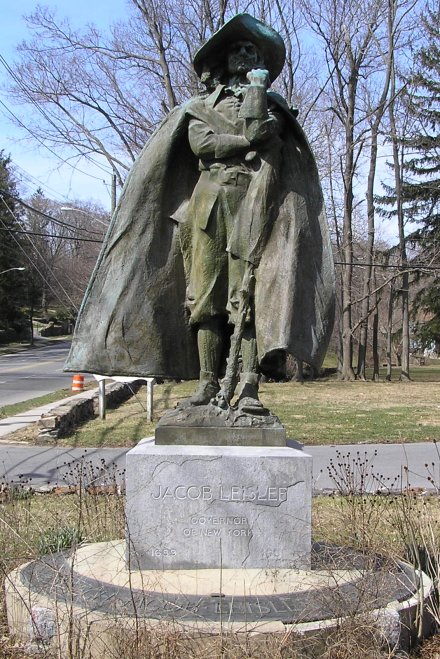
Statue of Jacob Leisler in New Rochelle, N.Y. — which Leisler helped create as a settlement for refugee Huguenots.

And once in the saddle, the Dutch Calvinist Leisler essentially ran a populist administration against the colonial oligarchy, which replied by vilifying him as a “usurper” and “rebel”.

Internal politics in New York and its neighbors during those months make fascinating reading.* Quakers and Catholics aligned against Protestants. Albany aligned against New York, until Leisler brought the former to heel. Clergy chose up sides. Leisler summoned a sort of proto-continental congress of colonial representatives (all the way to the West Indies) to hash out their situation.

And what was that situation? There had been a revolution, after all, and there was no agreed-upon representative of the royal authority present in New York. An assembly of militia leaders had asked Leisler to assume leadership, so was he really outside his rights to treat as his the London dispatches addressed to “such as, for the time being, take care for preserving the public peace and administering the law in New York”?

It’s a moment whose ferment of democratic energy can be read to presage the next century’s (proper) revolution.

Yet it was also not a revolution in the Cromwellian, world-turned-upside-down sense. For the English polity, and certainly for the conduct it preferred in its frontier possessions, continuity was the order of the day. Even in England herself, William and Mary were more than pleased to govern with Tories who could see their way to releasing their fealty to the Stuarts.

There was an empire to run, after all.

From that standpoint, Leisler’s anti-oligarchical policies and fractious disputes with other colonial elites were a bad business. There’s no sense in letting France make inroads because your governors are bickering over predestination or some such.

So formally, the realm’s new rulers continued all non-Catholic personnel in their posts. With the Dominion governors ejected, it was just a matter of dispatching fresh executives to take over. It’s just that this process required months … during which Leisler was managing New York the way he figured it ought to be managed, and his enemies were consequently painting him as a rebel.

Leisler pronounced himself, this whole time, anxious to submit his authority to the new governor upon the production of proper credentials. If he was surprised that the new monarchs tendered appointees of the very same factions recently expelled,** Leisler showed it only in his exactitude for procedure: because of a logistical cock-up, an aide to the new colonial governor arrived first, and when Leisler refused to hand over his fort without the royal warrant, a tense standoff ensued. It was resolved when the real governor, Henry Sloughter of ominous name, finally showed up.

Sloughter had his “predecessor” immediately arrested, along with others of his circle and harshly tried for treason and murder by a court stacked with anti-Leisler political enemies.†

Ultimately Leisler was condemned to die along with his secretary and son-in-law Jacob Milborne, but even Sloughter was loath to enforce the sentence. The story goes that Leisler’s most implacable foes had to get Sloughter drunk to put his signature on the death-warrant. (Sloughter died a couple of months later himself, for maximum operatic effect.)

On Saturday morning, May 16, 1691, the largest crowd ever gathered in New York City stood, rain soaked and weeping, all eyes fixed as a limp body was cut from the gallows and placed on the block. With a clean blow, the executioner’s ax cut off the head of the “halfe dead” Jacob Leisler — loyal lieutenant governor or rebel tyrant, depending on one’s point of view. Amid the “shrieks of the people,” fainting women (some “taken in labour”), and tumultuous jostling for “pieces of his garments” and strands of his hair, as “for a martyr,” the newly arrived and unfortunately named royal governor, Henry Sloughter, worried that his decision to execute Leisler might not, after all, end the “diseases and troubles of this Government.” Indeed, for years afterward New Yorkers bitterly divided over Leisler and the 1689 uprising that, in the wake of England’s Glorious Revolution, had led to his assumption of power in the provincial government.

-David Voorhees, who elsewhere contends that these divisions “continue to inform American politics to the present day.”*

A few years later, a more Leisler-friendly Parliament restored the dead man’s estate to his heirs, a sort of implicit admission that the whole head-chopping thing might have been a bit much.

This character figures to bear more historical consideration than he has heretofore enjoyed; further to that end, there’s a Jacob Leisler Papers Project devoted to marshaling at New York University the primary documents connected with Leisler.

* See, for instance, David Voorhees in “‘to assert our Right before it be quite lost’: The Leisler Rebellion in the Delaware River Valley” in Pennsylvania History, Winter 1997 — and, Voorhees again in “The ‘fervent Zeale’ of Jacob Leisler,” The William and Mary Quarterly, July 1994.

** Literally so: Francis Nicholson, whom Leisler ousted from New York, tried to get himself appointed governor; he was instead sent to Virginia and continued in royal service in the colonies for decades to come.

† e.g., Joseph Dudley, one of Leisler’s judges, whose penchant for authoritarian justice has been noted elsewhere in these pages.

On this day..

1873: William Foster

On this date in 1873, William Foster — who spent two years warding off execution — finally succumbed to New York’s hangman.

Foster’s case was a long-term headline-grabber: he drunkenly accosted a couple of perfect strangers on the Broadway Line (think horses, not trains), then smashed the man of the party, Avery Putnam, with a conductor’s device going by the sinister name of “car-hook”. His case turned, both juridically and in the public eye, on the question of whether Foster had formed an “intent” sufficient to justify a first-degree murder conviction; the killer’s own jury later joined appeals for his reprieve, having felt buffaloed by public opinion in the immediate aftermath of the crime.

This case also clearly had a significant class component — a respectable gentleman randomly slain by a workingman — and the newspapers’ coverage frequently touches on obvious bourgeois anxiety, or uncertainty as to just how badly those of Foster’s socioeconomic position would take the hanging.

These and other themes of the media coverage will look very familiar a century and a half later. The only things missing are the tweets.

The Editorial Board

New York Times, May 28, 1871

Abolish the Car-Hook.

… the fatal weapon which slew Mr. Putnam … a weapon which we know to be deadly is so familiar to the hands, and possibly the heads of a large portion of the population, that they think nothing of using it at all. Of course the statement on which we found these conclusions may be incorrect. But it seems probable enough, and is confirmed by the numerous cases of assault with car-hooks reported since the Putnam murder. Before the light of that great tragedy brought into unusual prominence the fatal tool, it is fair to presume that it was not less active in its work of evil than at present.

It is not pleasant, then, to reflect that every time we travel on a horse-car whose conductor or driver hapens to be a trifle drunk, or unusually passionate and vindictive, we run a certain risk, slight it may be, still an appreciable risk, of being brained with an instrument to which the assailant’s hand instinctively turns. And since temptation is the firmest ally of crime, we might very properly begin our street-car reform by abolishing the car-hook altogether … Even if the replacing appliance be less convenient for the purposes, and less satisfactory in its workings, it is better that the driver should have a little more trouble and delay than that he should have constantly at hand a means and a provocative to murder. We do not doubt, however, that the present model of car-hook may readily be improved on, and at the expense of a little ingenuity, made not only harmless, but more complete.

The Murderer

New York Times, June 4, 1871

FOSTER’S APPEAL.

The Condemned Prisoner Reviews His Case.

He Never Intended to Kill Mr. Putnam — The Verdict of Death the Result of Public Resentment — He Thinks He Has Been Unjustly Treated.

TO THE PUBLIC: Sufficient time has elapsed since my conviction for the murder of Mr. Putnam to allow me to make that appeal to the cool judgment of the public which my counsel could not make in a court-room, oppressed by the usual legal formalities. I have not much to say, but in my awful position what little appeal I make is invested with a terrible importance, to me at least. After a short and impartial trial, before the case was submitted to the jury, Judge Cardozo* charged almost directly in my favor — at least, in modification of the verdict. He directed the jury that a fit of passion did not imply the requisite degree of malice justifying a verdict of murder in the first degree. He almost as much as told them that in my case there was no evidence proving that I intended to kill Mr. Putnam — that death was a result I never contemplated, and that however furious the resentment of the public might be, it would not be in accordance with their oath to convict me of a malicious purpose to kill Mr. Putnam.

The jury was evidently inclined to regard this direction of Judge Cardozo, but they were afraid to abide by it thoroughly. Public opinion was too strong; and because, I believe, it did not stop to consider my case coolly, it compelled that jury to bring me in guilty of downright murder in the first degree. But even then they went as far as they dared in recommending me to mercy. They recommended me to mercy because they felt that there was something wrong with the rest of their verdict, and they wanted to make the best balance they could without taking any responsibility themselves. Now I make this appeal from my condemned cell, because the public are beginning to believe with Judge Cardozo. Judge Cardozo said the truth. He said I never meant to kill Mr. Putnam. He knew from the very evidence that there was nothing further from my intention — and it is the intention which makes the crime.

What are the facts of the case? I had been drinking heavily — God knows I can’t excuse that. I was stupid drunk, mad drunk, and I got into a drunken difficulty with a strange man. That was Mr. Putnam. He said something which aggravated my drunken madness. Without any thought, without any calculation, on the impulse of blind fury, I struck him with the first thing that came to hand. That blow was never intended to kill Mr. Putnam. It was struck with hardly any intention at all. It was the work of a madman, not of a deliberate murderer. It was struck with no recognized weapon — just the first thing that came to hand. If it had fallen on the top of his head it would probably never have killed him. But it did kill him, and for the blow which I struck, without having any definite intention, resulting in his death, I am condemned to death in revenge. No one will pretend to say that I deliberately set about to effect Mr. Putnam’s death. I made no attempt to escape. I identified myself. I claimed to have struck him, having no idea, no earthly notion that my drunken blow would result in bringing about my conviction of murder.

Public resentment and exasperation brought about the verdict. There are men in the Tombs who have killed others soberly, in cold blood, and there has been no hue and cry after them. A man who had a quarrel with another and then went home and procured a knife with which he came back and stabbed him to death, deliberately and in cold blood, was sent to Sing Sing for four years the other day. There are others in this prison convicted of murder with weapons known to be deadly — so that their intentions in using them could not be doubted a moment — and they are safe. … I was tried out of my turn … while the public was resolved to have my blood as soon as possible. Out of these I alone am selected to undergo capital punishment, because mine was a sensational case.

No one can doubt the truth of this, and it is because this is the truth known to God and sworn to by me in the shadow of death, that I make my appeal to the public. I am doomed to die because a wicked drunken freak resulted in the death of a man, whom I no more intended to harm seriously than I would my own child … Is the recommendation to mercy to mean nothing? Does anybody refuse to see in it the protest of the jury against the pressure which forced them to bring me to the gallows? The public, which was furious, compelled the jury to act as it did, and I make my appeal, therefore, to the public.

I implore the public to consider my case, now that I am sentenced, and any evasion of law in my favor is impossible, coolly and dispassionately. I appeal to the public to be just and fear not. And what I have to say in my behalf I say with the solemnity of my situation. I make my appeal as a condemned murderer, sentenced to a speedy and ignominious death, helpless and powerless, but confident that the same feeling which on an impulse secured my conviction, will, when cool and deliberate, do even me proper justice.

WILLIAM FOSTER.

The Widow

New York Times, Nov. 22, 1872

THE PUTNAM MURDER.

The Widow Sues the Railroad Company for Damage.

The murder of Avery D. Putnam, for which William Foster now stands condemned, has been revived in the Courts in a new form. it appears that Mrs. Putnam, the widow, some time since, instituted a suit against the Broadway and Seventh-avenue Railroad Company, to recover damages to the extent of $5,000, (the limit of the law.) for the loss of her husband, which loss she charges to have been the result of the culpable negligence of the Company and its servants.

[she won -ed.]

The Minister

New York Herald-Tribune, March 6, 1873

(One letter among more than an entire page’s worth of clemency petitions the Tribune reprinted, with a note of scorn.)

LETTER FROM THE REV. DR. TYNG.

This young man has been familiarly known to me from his childhood. He grew up in the Sunday school and congregation of my church … of which his family have made a part since his birth. He was always a quiet, orderly, and good boy — he grew up an industrious and well behaved young man — he has never been a bad man or a drunkard.

The whole circumstances of this sad event which has placed him in his present position, he has personally related, very minutely, to me … I have visited him regularly as his pastor. He has presented himself to me as a gentle, quiet, penitent young man, and I have had much encouragement in visiting him.

Foster does not in the least excuse himself from the just infliction and endurance of his sentence, if it be the will of God that he must meet it …

I really think the young man entitled to a commutation of a sentence for willful murder in the first degree … He acted in blind haste, with no malicious intent, and he has groaned in anguish over the remembrance of his crime. His honored parents and excellent family, his young wife and little children, his own industrious life, his really quiet and habitual deportment, his expressions of anger, hostility, or self-defense, unite to present his case to me as one peculiarly appropriate for Executive mercy. … I do not know what efforts others may make in his behalf; but, as the pastor of his family — and of all his early life, and as now his gratefully accepted pastor in the hour of his sorrow — I feel compelled to implore for him the mercy which you alone can exercise.

Stephen Tyng

[Tyng, an Episcopal, was a celebrity preacher in the Big Apple, and built an early “megachurch”. He is the namesake of, but unrelated to, the man who founded the U.S. National Park System — Stephen Tyng Mather. -ed.]

The Humorist

New York Herald-Tribune, March 10, 1873

Sir: I have read the Foster petitions in Thursday’s Tribune. The lawyers’ opinions do not disturb me, because I know that those same gentlemen could make as able an argument in favor of Judas Iscariot, which is a great deal for me to say, for I never can think of Judas Iscariot without losing my temper. To my mind Judas Iscariot was nothing but a low, mean, premature Congressman.** The attitude of the jury does not unsettle a body, I must admit; and it seems plain that they would have modified their verdict to murder in the second degree if the Judge’s charge had permitted it. But when I come to the petitions of Foster’s friends and find out Foster’s true character, the generous tears will flow — I cannot help it. How easy it is to get a wrong impression of a man. I perceive that from childhood up this one has been a sweet, docile thing, full of pretty ways and gentle impulses, the charm of the fireside, the admiration of society, the idol of the Sunday school. I recognize in him the divinest nature that has ever glorified any mere human being. I perceive that the sentiment with which he regarded temperance was a thing that amounted to frantic adoration. I freely confess that it was the most natural thing in the world for such an organism as this to get drunk and insult a stranger, and then beat his brains out with a car-hook because he did not seem to admire it. Such is Foster. And to think that we came so near losing him! How do we know but that he is the Second Advent? And yet, after all, if the jury had not been hampered in their choice of a verdict I think I could consent to lose him.

The humorist who invented trial by jury played a colossal practical joke upon the world, but since we have the system we ought to try to respect it. A thing which is not thoroughly easy to do, when we reflect that by command of the law a criminal juror must be an intellectual vacuum, attaching to a melting heart and perfectly macaronian bowels of compassion.

I have had no experience in making laws or amending them, but still I cannot understand why, when it takes twelve men to inflict the death penalty upon a person, it should take any less than twelve more to undo their work. If I were a legislature, and had just been elected, and had not had time to sell out, I would put the pardoning and commuting power into the hands of twelve able men instead of dumping so huge a burden upon the shoulders of one poor petition-persecuted individual.

Mark Twain

The Future Attorney General

New York Times, March 20, 1873

THE FOSTER CASE.

Letter to Gov. Dix by Edwards Pierrepont.

Judge Edwards Pierrepont has addressed a letter to Gov. Dix on the case of Foster. He says:

The decision of the Court of Appeals affirmed the judgment of the court below, whereby William Foster was condemned to be hanged for the murder of Avery D. Putnam. But that decision would have been precisely the same if Mr. Putnam had appeared in court, and proved that he was still alive … The rigid rules of law do not allow an appellate court to look beyond the record, even though the court might behold the living man, for whose murder the accused was condemned to die.

It is for this very reason, and to meet cases like the one before you, that the high Executive is clothed with extraordinary powers, adequate to correct all such mistakes, and to consider all facts and circumstances outside of the legal record, in furtherance of the highest justice, and beyond the functions of a court of law …

If William Foster is put to death for the premeditated murder of Mr. Putnam, very few of the reflecting community will not believe that he was executed for a greater crime than he in fact committed, and, to avoid the repetition of such an act of injustice, the aggrieved sentiment of the public may demand the abolition of the death penalty entirely.

Foster was convicted a few days after Mr. Putnam died, while the public mind was fevered and alarmed, and the verdict was not in accordance with the real convictions of the jury, nor in harmony with any reasonable deductions from the evidence …

the hanging of Foster would savor more of vengeance than of justice … and the reaction likely to take place in the public mind might cause a repeal of those laws which are now a wholesome restraint upon evil men.

The Aftermath

New York Herald, Nov. 1, 1873

TO THE EDITOR OF THE HERALD:

Justice can no longer be said to be blindfolded in New York. The verdict in the case of Stokes [murderer of bankster James Fisk -ed.] is a mockery and a farce. Jack Reynolds said, “Hanging for murder is played out in New York;” but his assertion would have been much truer if he ahd added, “for the rich.” If Stokes was not guilty of murder in the first degree then the hanging of Foster was nothing but downright murder. Stokes had not the slightest excuse, while Foster had a great many … The jury must have been influenced by some outside influence or there must have been some flaw in the presentment of the case by the prosecution. This verdict should cause our citizens to blush. It shall be recorded in the history fo our city as an everlasting disgrace and humiliation. Our citizens, it is true, are looking on patiently at this way of administering law; but the time will yet come when they will take the administration (if driven so far) of it into their own hands and adopt the rule of the pioneers of the West for murders – viz., “Lynch law.”

AN ADMIRER OF THE HERALD.

* Father of eventual Supreme Court justice Benjamin Cardozo.

** Congress-bashing is a timeless sport, but the body was in particularly low esteem at this moment because of the Credit Mobilier scandal.

On this day..

1951: The Lonely Hearts killers, tortured by love

“Who would give a law to lovers? Love is unto itself a higher law. ”

Boethius

On this date in 1951, the made-for-tabloids killer couple Raymond Fernandez and Martha Beck were electrocuted at New York’s Sing Sing prison for murder.

He was a toupeed middle-aged lothario with a knack for conning personal ad denizens. She was a lovelorn obese single mother* with a serious dark side. Together — through a chance meeting through the personals — they became the Lonely Hearts Killers.

Martha Beck started off as just another of Raymond Fernandez’s targets: charm them, promise engagement or undergo a faux-wedding, and then rob them. He’d pulled this off a few times before; he might have even killed at least one of them.

But something clicked when he met Martha.

Or rather, Martha made it click.

Fernandez did the love ’em and leave ’em routine with Martha, whom he soon realized was penniless. But their passionate hotel rendezvous had been spied by the local bluenoses, who promptly got Martha fired for her indiscretions. She showed up unannounced at Fernandez’s door, and pushed her way right into his life.

Ere long, they were cohabiting — lurid media accounts would later savor their “abnormal sexual practices” and their, er, lifestyle relationship. She caused near-riots among the crush of spectators at their circus trial when she got into specifics of freaky stuff like voodoo fetish play.

“A request from Mr. Fernandez to me is a command,” Martha testified. Since this was so — though the power dynamic between them really seems to have run in the other direction — she willingly joined in Mr. Fernandez’s scam, posing as his “sister” when he went to meet and charm his next mark.

Once such assets as could be had were signed over, the pigeon was disposed of: often, they’d just make the “honeymoon” so unbearable that the target got the picture and left, so humiliated she wouldn’t dare come forward with the story.

And sometimes — nobody seems to know exactly how many times — Raymond and Martha killed together.

Martha (whose own sob story of ostracism and childhood neglect is really quite sad) supplied much of the vengeful energy that impelled the murders. One of their victims was a woman Beck attacked in a jealous rage when Fernandez actually slept with her. (The “sister” would often impose on the sleeping arrangements to obstruct consummation.)

The Lonely Hearts Killers’ crime spree is thoroughly covered elsewhere. It carried them to Michigan, a non-death penalty state where they were arrested. There, they confessed in a ploy to draw a local sentence and avoid execution.

Michigan instead extradited them to New York to stand trial in a sweltering courtroom and on every Gotham newspaper’s daily headlines for the murder of a Long Island widow. That confession given in Michigan helped seal their fate in New York.

Though separated from one another on death row (but they kept up the treacly correspondence), Martha and Raymond were joined in death.

On International Women’s Day of 1951, both were executed in New York’s electric chair, along with two unconnected, run-of-the-mill murderers.

My story is a love story. But only those tortured by love can know what I mean … in the history of the world, how many crimes have been attributed to love?

-Martha Beck

Given the newspaper ink spilled over these two, it’s no surprise that they’ve inspired plenty of subsequent writers and directors. The Honeymoon Killers (review) is a creepy 1970 classic, with a couple of latter-day imitators.

* She abandoned her two kids to the Salvation Army when she hitched her wagon to Fernandez.

On this day..