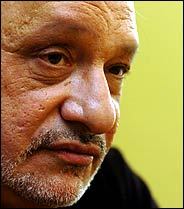
1865: John Yates Beall, well-connected Confederate

On this date in 1865, Confederate John Yates Beall was hanged at Governors Island, New York, as a spy and saboteur.

This Virginian was knocked out of regular service through injuries early in the Civil War, but proceeded to a privateering career harassing Union shipping.

The pinpricks inflicted by Beall’s couple of ships was hardly calamitous for the North, but what he lacked in resources he made up in persistence.

Captured and exchanged midway through the war, he returned to his swashbuckling ways. But sneaking into New York from Canada in a bid to free rebel prisoners, Beall was caught again trying to derail trains — and secretly condemned by a military tribunal.

When the news of his impending execution got out, six Senators and 85 other members of Congress* appealed for leniency.

Despite Lincoln’s reputation for clemency, he did not grant it in this case.

“For days before the execution,” it was said, “the President closed the doors of the executive palace against all suppliants, male or female, and his ears against all appeals, whether with the tongue of men or angels in behalf of the unfortunate prisoner. From the first Mr. Lincoln had responded to all applications for his interposition — ‘Gen. Dix may dispose of the case as he pleases — I will not interfere.’ Gen. Dix on his part replied, ‘All now rests with the President — as far as my action rests there is not a gleam of hope.’ Thus they stood as the pillars of the gallows, on which Beall’s fate was suspended and between them he died.” (Source)

Here’s the capture-trial-and-execution portions of a homemade documentary on Beall (also check the preceding parts 1, 2, and 3)

There’s a strange tradition that the hanged man was a personal friend of John Wilkes Booth, and that the actor’s assassination of Honest Abe seven weeks after Beall’s hanging was partly motivated by personal revenge.

* One of Beall’s clemency supporters was future assassinated U.S. President James Garfield.

On this day..

1901: Leon Czolgosz, William McKinley’s assassin

Back ’round the fin de siècle, everybody who was anybody* was being whacked by anarchists.

On this date in 1901, unemployed (and seemingly unbalanced) steelworker Leon Czolgosz rode the lightning at New York’s Auburn Prison for inducting the late U.S. President William McKinley into the club.

It hadn’t even been eight weeks since Czolgosz met McKinley gladhanding a receiving line at the Pan-American Exposition in Buffalo, and fatally (though it took the victim a week to succumb) shot the second-term Republican president.

Matters progressed from there as one might expect.

In a one-day trial that lasted 8 hours from jury selection to sentence, Czolgosz was condemned to die in New York’s electric chair. He went to his death unapologetic, but also alone; most anarchists disavowed him for hurting the cause.**

Here’s the New York Times account of the assassin’s final moments.

As he was being seated [in the electric chair] he looked about at the assembled witnesses with quite a steady stare and said:

“I killed the President because he was an enemy of the good people — of the working people.”

His voice trembled slightly at first, but gained strength with each word, and he spoke perfect English.

“I am not sorry for my crime,” he said loudly, just as the guard pushed his head back on the rubber headrest and drew the strap across his forehead and chin. As the pressure on the straps tightened and bound the jaw slightly he mumbled: “I’m awfully sorry I could not see my father.”

It was just exactly 7:11 o’clock when he crossed the threshold [into the execution chamber], but a minute had elapsed and he just had finished the last statement when the strapping was completed, and the guards stepped back from the man. Warden Mead raised his hand, and at 7:12:30 Electrician Davis turned the switch that threw 1,700 volts of electricity into the living body.

The rush of the immense current threw the body so hard against the straps that they creaked perceptibly. The hands clinched suddenly, and the whole attitude was one of extreme tension. For forty-five seconds the full current was kept on, and then slowly the electrician threw the switch back, reducing the current volt by volt until it was cut off entirely.

They made good and sure by dissolving the body in sulfuric acid.

Thomas Edison made a video recreation of the scene — not to be confused with actual film of the execution, though some sites present it as such — shortly after. Whether its creation was influenced by Edison’s now-doomed project of discrediting Alternating Current, a business rivalry that had helped introduce the electric chair in the first place, I have been unable to determine; the Edison labs produced a number of silent films exploiting “a whole string of news events surrounding the Pan-American Exposition in Buffalo … both through a monumental display of lights (including test bulbs on the reproduction of the electric chair) and by a booming output of scenics, actualities, and even a historical topical.”

Glum.

More lighthearted (and more audible) is “The Ballad of Leon Czolgosz,” from Stephen Sondheim’s offbeat Broadway hit Assassins, here presented with liberal use of the Edison labs’ Pan-Am Expo footage.

… it’s not the first pop culture ephemera generated by McKinley’s martyrdom; folk ballad variations under different titles (“The White House Blues,” “McKinley,” “McKinley’s Rag,” or this version, “Zolgotz”) were in circulation in the early 20th century. Other variations and some background can be had here.

[audio:Zolgotz.mp3]

This third assassination of an American chief executive in the span of 36 years (with similar fates for James Garfield’s killer and the Lincoln conspirators) led the Secret Service, originally a Treasury Department anti-counterfeiting unit, to assume responsibility for bodily safeguarding the President in 1902.

* We’ve met a few of anarchism’s greatest hits in these pages … as well as their greatest martyrs.

** Anarchist titan Emma Goldman was blamed for inciting the murder and initially arrested; she was also one of the few anarchists to defend Czolgosz: “He had committed the act for no personal reasons or gain. He did it for what is his ideal: the good of the people. That is why my sympathies are with him.”

On this day..

1814: Four of five deserters, in Buffalo

On this date* in 1814, an American army in Buffalo, N.Y., shaken by desertions lined up five absconding soldiers for execution.

The memoirs of one Jarvis Hanks, a drummer, recalled the singular scene that ensued.

In this alternative history of the war of 1812, the sergeant commanding the firing party and the soldier not executed make their way down the continent as an odd couple and fight in the Battle of New Orleans.

During the time we remained at Buffalo, five men were sentenced to be publicly shot for the offence of desertion. They were dressed in white robes with white caps upon their heads, and a red target fastened over the heart. The army was drawn up into a hollow square to witness the example that was about to be made of their comrades who had proved recreant to the regulations of the service. Five graves were dug in a row, five coffins placed near them, also in a line, with distance between coffins and graves to enable the criminals to kneel between them. About twelve men were assigned to the execution of each offender. Their guns were loaded by officers, and they were not permitted to examine them afterwards until they had fired.

All things being in readiness, the chaplain made a prayer, the caps were pulled down over the eyes of the poor culprits, and the word of command given: “Ready! Aim! Fire!” They all fell! Some into their graves, some over their coffins. One struggled faintly and the commanding officer ordered a sergeant to approach and end his misery. He obeyed by putting the muzzle of his piece within a yard of his head, and discharging it. This quieted him perfectly!

At this time one of the condemned slowly arose from his recumbent position to his knees and was assisted to his feet. His first remark was, “By God, I thought I was dead”. In consequence of his youth and the peculiar circumstances of his case, he had been reprieved, but the fact was not communicated to him until this moment. He had anticipated execution with his comrades, and when the report of the guns took place, he fell with them, though not a ball touched him. The platoon assigned to him had guns given to them which were not charged, or at least had nothing but powder in them.

Even Dostoyevsky didn’t get to the point where the mock executioners actually “fired”.

These executions took place during the Niagara campaign in the latter stages of the war — the Americans’ last push in their unsuccessful bid to conquer Canada.

* This execution, which obviously has a folklorish quality, has somewhat slippery particulars. The not-necessarily-dependable dating of the Espy file (pdf) places it on this date, as does The Rivers of War, which squares with the quoted soldier’s account of timing and the known troop movements. Hanks’ writings (and that of two other War of 1812 soldiers) is published in Soldiers of 1814: American Enlisted Men’s Memoirs of the Niagara Campaign. (Review.)

Espy names the executed soldiers as John Black, Mahlon Christie, George Orcote, and Isaac Kent.

On this day..

1887: Roxalana Druse, the last woman hanged in New York

On this date in 1887, 40-year-old Roxalana Druse was hanged in Herkimer, N.Y.

Ms. Druse and her daughter* had slain, chopped to pieces and destroyed the remains of Roxalana’s 72-year-old husband William.

Attention to her case ran toward the hyperbolic.


Detail of image courtesy of Special Collections Department, Harvard Law School.

As Roxalana Druse’s fatal date approached, said the Saturday Globe (an early national paper here mining the product-moving public fascination with mayhem we have noted across the pond), “she has dwindled to a mere shadow of her former self and would hardly tip the scales at 85 pounds.”

Still, this infamous-at-the-time crime would be little more than a piece of period folklore were it not for the horrible end Druse suffered.

Shrieking with terror as she was hooded (so says the New York Times account, which also reports that she deferred her last statement to her Universalist spiritual counselor, who made a general denunciation of the death penalty), Roxalana Druse was hanged on an upward-jerking gallows — and the rope reportedly failed to snap her neck, leaving her to slowly strangle to death.

This botched job in a high-profile hanging intensified pressure on the New York legislature to do away with the gallows; the next year, it became the first jurisdiction in the world to adopt electrocution for death sentences.

And Roxalana? She’s preserved in local lore in Herkimer, where she is said to haunt the courthouse where she heard her sentence.

* Roxalana Druse insisted that her teenage daughter Mary had nothing to do with it. Mary received a prison sentence, and was pardoned in 1895.

On this day..

1939: Three Men For Murder, But Not Isidore Zimmerman

On this date in 1937, Isidore “Beansy” Zimmerman spent the day preparing for death in New York’s electric chair … but was spared by an 11th-hour clemency from New York Governor Herbert Lehman.

Here’s the scene, as laid in the anti-death penalty tome of wrongful convictions In Spite of Innocence:

As dawn broke over Sing Sing Prison, Beansy Zimmerman had every reason to think it would be his last day.

Zimmerman numbly went through the pre-execution rituals. The last meal (choose whatever you want), and music (you get to choose that, too) played on the wind-up phonograph. The barber shaves your scalp so the electrodes can fit snugly against your bare skin. The tailor slits one of your trouser legs for another electrode. Officials treat you with unaccustomed politeness. A final family visit — how do you say good-bye when you know it is forever? What should your last words be? Beansy’s mother stayed away, unable to face such finality.

Two hours before execution, Gov. Lehman commuted his sentence.

In this blog, we lay aside each story day by day, but for those affected, it’s rarely so easy — which is why the mothers of the five men condemned today put in their personal clemency appeals to the governor.

For Zimmerman and a fellow “accomplice” named Philip Chaleff whose respective roles in a robbery/murder were doubted, it had the desired effect. (Dominick Guariglia, Arthur Friedman and Joseph O’Loughlin weren’t so lucky.)

Chaleff, a diabetic being kept alive just for execution, soon succumbed. For Zimmerman, the execution that did not happen was to define the rest of his 66 years. He was alive, but to what end?

“I wasn’t dead, no,” he remembered. “But every day from now on they’d bury me a little more.”

Zimmerman fought, by becoming a skilled jailhouse lawyer and in 1962 finally winning exoneration from the New York Supreme Court, which held that the testimony against him had been perjured with the connivance of the prosecutor.

He’d spent nearly a quarter-century in prison. Now, he was just another ex-con scrabbling after dead-end employment.

For years thereafter, Zimmerman fought for a special bill that would allow him to sue the Empire State for wrongful imprisonment, finally winning approval in 1981.

His suit asked for $10 million. The judge reckoned Zimmerman’s time and trouble were worth a tenth of that.

Expenses deducted, Zimmerman walked away with $660,000 — that, and sweet vindication.

Fourteen weeks later, he dropped dead of a heart attack.

On this day..

1928: Ruth Snyder and Judd Gray

On this date in 1928, a suburban femme fatale and the corset salesman who had murdered her husband were electrocuted at Sing Sing prison.

“A cheap crime involving cheap people,” one writer called it.

“Ruthless Ruth,” as the press inevitably called her, was on the wrong side of 30 and married to a wet blanket on the wrong side of 40 from whom she couldn’t even get away during the day because they worked for the same boating magazine.

The banal hell of the bourgeoisie.

Ruth had a banal solution: commence affair with handsome, limp-willed corset salesman (also married) from New Jersey.

Given a large enough metropolis with a large enough pool of adulterous data points, it must be statistically inexorable that a certain proportion will resolve the love triangle by throttling the cuckold with a wire.

But only that remorseless calculator in the sky can compute why these two, of all those thousands, were the ones not to run off together, or let the affair fizzle, or just continue to rendezvous indefinitely into the future. They certainly weren’t constitutionally cut out for crime; they set up the room in a poor simulacrum of a robbery, and told of a couple of unknown Italians* who’d broke in and done poor Albert Snyder to death.

For their poor judgment and for the speedy collapse of their crummy alibi, journalism owes them a debt of gratitude.

The execution of a woman was quite sensational; Ruth Snyder was to be the first electrocuted since 1899.

For the occasion, The New York Daily News hired a Chicago Tribune journalist to witness the execution … and at the moment the current struck, Tom Howard hoisted his pant leg and secretly snapped with a one-use camera one of the most indelible images the death chamber offered the 20th century, to be splashed in a few hours’ time on the Daily News‘ cover under the headline

DEAD!

The Snyder-Gray adulterous melodrama and its violent conclusion inspired novelist James Cain‘s Double Indemnity, and the noir film of the same title with Barbara Stanwyck as the black widow at the center of the web.

It also inspired the state of New York to begin searching official witnesses to its electrocutions.

* Blame-the-Italians here is a Roaring Twenties Queens version of fingering the black man. The murder was committed in May 1927, just as the Sacco and Vanzetti case was approaching its climax.

On this day..

1903: William Ennis, wife-murdering cop

On this date in 1903, a nine-year veteran of the Brooklyn police became the first member of the thin blue line to die in the electric chair.

Then 31-year-old William Ennis had gunned down his estranged wife (and, not fatally, his mother-in-law) early the preceding year, and his attempt to claim insanity at trial was rejected as shamming.

This slice of New York color is the second story in this New York Times column reporting the day after the crime.

While in a frenzy of rage, as a result of heavy drinking and brooding over family troubles, William H. Ennis, a policeman attached to the Adams Street Station, Brooklyn, early yesterday morning broke into the hime [sic] of Mrs. Alice Gorman, his mother-in-law, in Canarsie, wounded her seriously with a bullet from his revolver, and then shot and killed his wife, who was living there.

He then rushed from the house and ran along the railroad tracks to East New York, two miles distant, where he was found asleep in a room in a hotel by the police several hours later. …

Two weeks ago Mrs. Ennis had her husband in court on a charge of non-support, and he was ordered to pay her a weekly stipend. At that time Ennis declared that he would “rot in jail” before he would pay his wife any money unless she left her mother’s house and returned to live with him. …

Early on Saturday morning he reported sick at Adams Street Station and was excused from duty. It was learned that he came to Manhattan and in the evening was arrested at Forty-second Street and First Avenue for intoxication and disorderly conduct, but at the East Thirty-fifth Street Station was allowed to go when it was found that he was a policeman.

On this day..

1858: Marion Ira Stout, for loving his sister

It’s the sesquicentennial of a then-sensational, now-forgotten hanging in Rochester, N.Y.

At dawn on December 20, 1857, the city had awoken to the discovery of a mangled corpse by the Genesee River’s High Falls … and more than enough evidence to have the corpse’s killers in hand by tea time.

Marion Ira Stout — he just went by Ira — had made a dog’s breakfast of the job, according to History of Rochester and Monroe County New York from the Earliest Historic Times to the Beginning of 1907.

[W]hen they got near the edge of the bank, Ira struck his victim a sudden blow with an iron mallet, smashing the skull and producing death instantly. Stout then threw the body over the precipice, supposing that it would fall into the river and be swept into the lake before sunrise, but instead of that it landed on a projecting ledge thirty feet below the upper level. Perceiving that there had been some failure in the matter, Ira started to go down a narrow path that led sideways along the cliff, but in the darkness he missed his footing and fell headlong, breaking his left arm in the descent and landing beside the corpse. Summoning all his remaining strength he was just able to push the body over the bank, when he sank in a dead faint. On recovering from which in a few minutes, he called to his sister, who was still above, to come and help him. When she started to do so, the bushes to which she clung gave way; she stumbled, broke her left wrist, and fell beside her prostrate brother. But it would not do to remain there, wretched as was their plight. So, after searching in vain for Ira’s spectacles, which they had to leave behind them, but taking with them the fatal mallet, they scrambled slowly and painfully up the bank and made their way laboriously to their home on Monroe Street.

In lieu of a last statement, Stout referred his audience to this writing, which was published posthumously. Courtesy of the New York State Historical Association Library, Cooperstown, N.Y.

Sure enough, the glasses were waiting near the victim for the cops to find come daylight.

How did Ira, his sister, and the late Charles Littles — the sister’s husband — find themselves in this macabre dance?

That’s the murky bit, though it’s fair to say there was some negative energy in the family.

Littles was a violent, jealous, philandering drunk. His wife Sarah seems like the classic abused spouse. Ira was an ex-con who seemingly had his life back together. Oh, and Ira and Sarah were sleeping together — professedly true in the literal sense (they were observed to sleep in bed together in their underthings), and possibly true in the Biblical sense.

Now, where in this tangled knot of incestuous desire, domestic violence, protectiveness, jealousy and intrigue lies the motive is less than self-evident, but Ira and Sarah most definitely schemed to lure Charles to his demise. (Charles was found with a club which he’d brought to clobber a lover of Sarah that he’d been told would make a rendezvous.)

Still, the condemned charmer garnered sympathy for having saved his sister from an abusive marriage; Susan B. Anthony and Frederick Douglass rallied to his defense, and a female admirer smuggled him poison to cheat the hangman … which said admirer managed to end up ingesting herself, and barely survived.

Death got all ten-thumbed around Ira Stout, it seems. His hanging was no different.

The New York Times‘ archive has free access to the report of Stout’s execution, interestingly detailing the upward-jerking “sudden suspension” hanging apparatus in use for the job:

The gallows is the same which has always been in use in the jail — the rope, a hempen cord, alone being new. A weight of 186 pounds rests upon a swing door set in the garret floor of the jail. From this weight, the rope runs over two pulleys above, and the end of it drops through two doors, and nearly to the main floor of the jail. The weight falls about eight feet, jerking the slack end that distance. The halter attached to the main rope is a long distance below the main enginery of death, and the latter is not seen by the spectators or prisoner. The Sheriff stood at the foot of the stairs, some forty feet from the prisoner, and by a small cord pulled the latch which let the fatal weight fall.

But since this is Ira Stout, you know it didn’t come off without a hitch.

The death of the ill-fated man was not as sudden as could be desired. His struggles for eight or ten minutes were severe, and caused the spectators to turn away in disgust.

His neck was probably not dislocated, and he died by a slow process of strangulation. Doctors Hall, Avery, James and Miller stood near, and in eight minutes after the drop fell they said his pulse was as full as in life.

Sort of puts a grim twist on Stout’s own (fairly self-pitying) letters to the papers, in one of which he remarked, “I do not wish to show a cowardly tenacity for life, but I consider it my right and duty to live as long as I can.”

According to a feature story in the newsletter of Mount Hope Cemetery where Ira Stout takes his eternal rest, he might have tried to hang on quite a bit longer.

A rumor was current last night at a late hour that Stout was not dead, and that efforts were being made to resuscitate him by the use of galvanic batteries and other means sometimes employed for the restoration of persons supposed to be dead. How much truth there is in the rumors thus made we cannot say, as we have not taken pains to inquire at the house of Mrs. Stout.

No surprise, that didn’t work either.

On this day..

1780: Major John Andre, Benedict Arnold’s handler

On this date in 1780, the honorable British Major John Andre got what Benedict Arnold had coming to him.

Piqued that his (quite considerable) brilliance in the field did not earn honors he thought his due, General Benedict Arnold contrived to betray West Point to the British during the American Revolution — the plot that made his name a synonym for treachery.
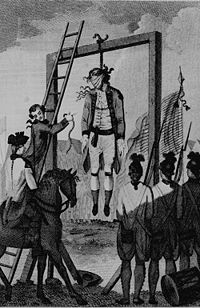
As the scheme ripened, the turncoat asked Sir Henry Clinton for “a personal interview with an officer that you can confide in.”

Enter Clinton’s adjutant John Andre, head of British Special Intelligence.

The dashing officer, well-liked in society on either side of the permeable divide between Tories and Patriots on the continent, slipped into Haverstraw, N.Y. to make the arrangements. On his way back — when he already thought himself safely clear of American-held territory — he was nabbed with the incriminating documents.

The narrowly-averted betrayal was mirrored by the narrowest of escapes: luckily for Benedict Arnold, Andre was received in custody by a subordinate officer of his, whose initial report to Arnold alerted the general to his danger and enabled him to escape to the British a whisker ahead of the law.

Treason, of the blackest dye, was yesterday discovered. General Arnold, who commanded at West Point, lost to every sentiment of honor, of private and public obligation, was about to deliver up that important post into the hands of the enemy. Such an event must have given the American cause a dangerous, if not a fatal wound; happily the treason has been timely discovered, to prevent the fatal misfortune. The providential train of circumstances which led to it, afford the most convincing proofs that the liberties of America are the object of Divine protection.

It was a gentlemanly war, and Andre didn’t seem like the guy to hang in the whole exchange. But his argument before a court-martial that he was merely availing “an advantage taken in war” by agreeing to talk to an enemy general who wanted to hand them the keys to a fort didn’t fly: he’d been behind enemy lines, out of uniform, sneaking around. That made him a spy.

And the British refused to obtain Andre’s liberty by trading the man the Americans really wanted to execute.

Instead, by year’s end, the hero of Saratoga was commanding redcoats in the field — perhaps a little nervously; when he asked a captured American what might happen to him should he be taken, the reply was “Cut off your right leg, bury it with full military honors, and then hang the rest of you on a gibbet.”

John Andre was left holding the bag, to the dismay of just about everyone American and British alike. This extended account of the luckless major’s last moments* is from the pen of Continental Army surgeon James Thacher.

Major Andre is no more among the living. I have just witnessed his exit. It was a tragical scene of the deepest interest. During his confinement and trial, he exhibited those proud and elevated sensibilities which designate greatness and dignity of mind. Not a murmur or a sigh ever escaped him, and the civilities and attentions bestowed on him were politely acknowledged…

The fatal hour having arrived, a large detachment of troops was paraded, and an immense concourse of people assembled; almost all our general and field officers, excepting his excellency [George Washington] and his staff, were present on horseback; melancholy and gloom pervaded all ranks, and the scene was affectingly awful … Major Andre walked from the stone house, in which he had been confined, between two of our subaltern officers, arm in arm; the eyes of the immense multitude were fixed on him, who, rising superior to the fears of death, appeared as if conscious of the dignified deportment which he displayed. He betrayed no want of fortitude, but retained a complacent smile on his countenance, and politely bowed to several gentlemen whom he knew, which was respectfully returned. It was his earnest desire to be shot, as being the mode of death most comformable to the feelings of a military man, and he had indulged the hope that his request would be granted. At the moment, therefore, when suddenly he came in view of the gallows, he involuntarily started backward, and made a pause. “Why this emotion, sir?” said an officer by his side. Instantly recovering his composure, he said, “I am reconciled to my death, but I detest the mode.” While waiting and standing near the gallows, I observed some degree of trepidation; placing his foot on a stone, and rolling it over and choking in his throat, as if attempting to swallow. So soon, however, as he perceived that things were in readiness, he stepped quickly into the wagon, and at this moment he appeared to shrink, but instantly elevating his head with firmness, he said, “It will be but a momentary pang,” and taking from his pocket two white handkerchiefs, the provost-marshal, with one, loosely pinioned his arms, and with the other, the victim, after taking off his had and stock, bandaged his own eyes with perfect firmness, which melted the hearts and moistened the cheeks, not only of his servant, but of the throng of spectators. The rope being appended to the gallows, he slipped the noose over his head and adjusted it to his neck, without the assistance of the awkward executioner. Colonel Scammel now informed him that he had an opportunity to speak, if he desired it; he raised the handkerchief from his eyes, and said, “I pray you to bear me witness that I meet my fate like a brave man.” The wagon being now removed from under him, he was suspended, and instantly expired; it proved indeed “but a momentary pang.” He was dressed in his royal regimentals and boots, and his remains, in the same dress, were placed in an ordinary coffin, and interred at the foot of the gallows; and the spot was consecrated by the tears of thousands.

Thus died, in the bloom of life, the accomplished Major Andre, the pride of the royal army, and the valued friend of Sir Henry Clinton. He was about twenty-nine years of age, in his person well proportioned, tall, genteel and graceful. His mien respectable and dignified. His countenance mild, expressive and prepossessing, indicative of an intelligent and amiable mind. … considered as a skilful, brave and enterprising officer, and he is reported to have been benevolent and humane to our people who have been prisoners in New York. … The heart of sensibility mourns when a life of so much worth is sacrified on a gibbet. General Washington was called to discharge a duty from which his soul revolted; and it is asserted that his hand could scarcely command his pen, when signing the warrant for the execution of Major Andre. … Could Arnold have been suspended on the gibbet erected for Andre, not a tear or a sigh would have been produced, but exultation and joy would have been visible on every countenance.

Andre makes a sort of loyalist counterpart to Nathan Hale. Interestingly, Thacher’s account — in which he uses his old diaries for a book that was published in 1823 — footnotes an extended narration of Nathan Hale in a comparative vein, complaining that “whilst almost every historian of the American Revolution has celebrated the virtues and lamented the fate of Andre, Hale has remained unnoticed, and it is scarcely known that such a character ever existed.” Today, in terms of their public recognizability, the two are rather reversed.

* Andre was to have been hanged October 1, but the matter was stayed when a British deputation arrived under flag of truce to make one last parley for their man’s life.

On this day..

1776: Nathan Hale, with regrets

On this date in 1776, Revolutionary spy Nathan Hale was hanged by the British in Manhattan — allegedly uttering the immortal last words, “I only regret that I have but one life to lose for my country.”

Nathan Hale statuary (with bound feet and hands) ironically stationed at Washington D.C.’s Department of Justice. Like statues are at the Chicago Tribune building and the Yale University campus; dueling plaques in New York contend to mark the execution spot.

Two years out of Yale when the Revolution broke out in 1775, the Connecticut-born Hale hitched onto the Continental Army and was directly promoted to captain.

When British Gen. William Howe landed at New York in the summer of 1776, Nathan Hale volunteered to slip behind enemy lines and reconnoiter enemy strength for George Washington. It turned out to be his mission into eternity.

As one might suspect, there’s a great deal more to Nathan Hale than his last words — and a fair bit of uncertainty about what his last words really were. Hale’s Wikipedia page retails many versions of the line from many sources.

The sentiment commonly attributed him (formulated in slight variations, e.g., “I only regret that I have but one life to give to my country”) was supposed to have been reported by a British officer attending him; it’s certainly a punchier version than, e.g., a Revolutionary War era report of “I am so satisfied with the cause in which I have engaged, that my only regret is, that I have not more lives than one to offer in its service.” Gah.

If all these presumably paraphrased reports have the gist right, it’s possible the 21-year-old recited an identical sentiment in the tragic play Cato:*

How beautiful is death, when earn’d by virtue!
Who would not be that youth? What pity is it
That we can die but once to serve our country.

There’s much more about this short-lived character and his larger-than-life transfiguration in mythologia Americana. The Library of Congress has a collection of links, and William Phelps recently penned this new (and surprisingly, first) biography of the revolutionary legend.

* The play was all the rage among patriots; Patrick Henry might have plucked his immortal “give me liberty or give me death” line from it, too. (“It is not now time to talk of aught/But chains or conquest, liberty or death.”)

Part of the Themed Set: Counterrevolution.

On this day..