1999: Gary Heidnik, serial kidnapper

On this date in 1999, Gary Heidnik was executed in Pennsylvania for a horrific spree that saw him kidnap five African-American women to a makeshift torture dungeon in his Philadelphia basement.

Intelligent but socially maladroit and diagnosed from his youthful U.S. Army service as mentally ill, Heidnik gave a preview of his later notoriety by signing his girlfriend’s sister out of a mental hospital in 1978 and locking her up in his basement to rape. He spent most of his resulting sentence in a mental institution of his own, refusing even to speak for two-plus years after claiming in 1980 that Satan had stopped up his throat.

Afflictions of the infernal and the criminal justice variety somehow failed to impede the growth of Heidnik’s personal sham church and tax dodge, the “United Church of the Ministers of God” from piling up a half-million in assets operating from the mid-1970s until Heidnik’s last arrest in 1987.

Heidnik got out of detention for the 1978 kidnap-rape in 1983. After a short mail-order marriage to a Filipina woman who ditched him in 1986 for beating and raping her, he finally went full Gary Heidnik.

On November 25, 1986, Heidnik authored the first of the abductions that would etch his name in serial killer lore, snatching Josefina Rivera and imprisoning her in the cellar of his house at 3520 North Marshall Street. (Rivera recently published an autobiographical account of her captivity.)

For the next five months, Heidnik’s underdark played host to its owner’s unspeakable depravities. Five women he kept there for various periods, shackled to pipes and subject to the gratifications of his violent sexual predilections. One woman, Sandra Lindsay, died of the maltreatment, leading to Heidnik’s closest accidental brush with the law: the stench of incinerating pieces of her dismembered corpse in his oven attracted the complaints of neighbors. Heidnik coolly shooed away the responding police officers with a story about burning the roast.

His prison’s most distinctive chilling feature was a tomblike hole handy for punishing resistance; a second woman, Deborah Dudley, died when Heidnik flooded and electrocuted this crevasse with her in it.

Considering the diabolically systematic nature of the torture dungeon, it’s actually a lucky job that it didn’t go on much, much longer. Remarkably, Heidnik’s last kidnap victim Agnes Adams was able to talk her way into a spot of temporary leave which she naturally used to summon disbelieving police and arrest Heidnik on March 23, 1987.

Once exposed to public view the Marshall Street monster could scarcely fail to leave a cultural impression. Among other things, Heidnik is one of several serial killers on whom Thomas Harris based the fictional murderer “Buffalo Bill” in his 1988 novel Silence of the Lambs.

On this day..

1730: Neither James Prouse nor James Mitchel, much to their surprise

January 14, 1730, was the date appointed for the public hanging in Philadelphia of James Prouse and James Mitchel for burglary.

Prouse, for his part, admitted the crime but insisted that James Mitchel had nothing to do with it — and Mitchel insisted the same. This ultimately generated considerable support for clemency which the authorities did not seem inclined to act upon.

Naturally the young newspaperman Benjamin Franklin — just turning 24 in January 1730 — was keen to publish this affecting story in his Philadelphia Gazette. Through the magic of public domain, he’s generously allowed us to republish his account from the January 20, 1730 Gazette as our guest post today.

Hyperlinks are, as one may surmise, Executed Today‘s own annotations.


We think our Readers will not be displeased to have the following remarkable Transaction related to them in this particular Manner.

Wednesday the 14th Instant, being the Day appointed for the Execution of James Prouse and James Mitchel for Burglary, suitable Preparations were accordingly made. The tender Youth of one of them (who was but about 19) and the supposed Innocence of the other as to the Fact for which they were condemned, had induced the Judges (upon the Application of some compassionate People) to recommend them to His Honour‘s known Clemency: But several Malefactors having been already pardoned, and every Body being sensible, that, considering the great Increase of Vagrants and idle Persons, by the late large Importation of such from several Parts of Europe, it was become necessary for the common Good to make some Examples, there was but little Reason to hope that either, and less that both of them might escape the Punishment justly due to Crimes of that enormous Nature. About 11 o’Clock the Bell began to Toll, and a numerous Croud of People was gathered near the Prison, to see these unhappy young Men brought forth to suffer. While their Irons were taken off, and their Arms were binding, Prouse cry’d immoderately; but Mitchel (who had himself all along behaved with unusual Fortitude) endeavoured in a friendly tender Manner to comfort him: Do not cry, Jemmy; (says he) In an Hour or two it will be over with us, and we shall both be easy. They were then placed in a Cart, together with a Coffin for each of them, and led thro’ the Town to the Place of Execution: Prouse appear’d extreamly dejected, but Mitchel seemed to support himself with a becoming manly Constancy: When they arriv’d at the fatal Tree, they were told that it was expected they should make some Confession of their Crimes, and say something by Way of Exhortation to the People. Prouse was at length with some Difficulty prevailed on to speak; he said, his Confession had been taken in Writing the Evening before; he acknowledged the Fact for which he was to die, but said, That Greyer who had sworn against him was the Person that persuaded him to it; and declared that he had never wronged any Man beside Mr. Sheed, and his Master. Mitchel being desired to speak, reply’d with a sober compos’d Countenance, What would you have me to say? I am innocent of the Fact. He was then told, that it did not appear well in him to persist in asserting his Innocence; that he had had a fair Trial, and was found guilty by twelve honest and good Men. He only answer’d, I am innocent; and it will appear so before God; and sat down. Then they were both bid to stand up, and the Ropes were order’d to be thrown over the Beam; when the Sheriff took a Paper out of his Pocket and began to read. The poor Wretches, whose Souls were at that Time fill’d with the immediate Terrors of approaching Death, having nothing else before their Eyes, and being without the least Apprehension or Hope of a Reprieve, took but little Notice of what was read; or it seems imagined it to be some previous Matter of Form, as a Warrant for their Execution or the like, ’till they heard the Words PITY and MERCY [And whereas the said James Prouse and James Mitchel have been recommended to me as proper Objects of Pity and Mercy.] Immediately Mitchel fell into the most violent Agony; and having only said, God bless the Governor, he swooned away in the Cart. Suitable Means were used to recover him; and when he came a little to himself, he added; I have been a great Sinner; I have been guilty of almost every Crime; Sabbath-breaking in particular, which led me into ill Company; but Theft I never was guilty of. God bless the Governor; and God Almighty’s Name be praised; and then swooned again. Prouse likewise seemed to be overwhelmed with Joy, but did not swoon. All the Way back to the Prison, Mitchel lean’d on his Coffin, being unable to support himself, and shed Tears in abundance. He who went out to die with a large Share of Resolution and Fortitude, returned in the most dispirited Manner imaginable; being utterly over-power’d by the Force of that sudden Turn of excessive Joy, for which he had been no Way prepared. The Concern that appeared in every Face while these Criminals were leading to Execution, and the Joy that diffused it self thro’ the whole Multitude, so visible in their Countenances upon the mention of a Reprieve, seems to be a pleasing Instance, and no small Argument of the general laudable Humanity even of our common People, who were unanimous in their loud Acclamations of God bless the Governor for his Mercy.

The following are Copies of the Papers delivered out by Prouse and Mitchel the Evening before, with little or no Alteration from their own Words.

I James Prouse was born in the Town of Brentford in Middlesex County in Old England, of honest Parents, who gave me but little Education. My Father was a Corporal in the late Lord Oxford’s Regiment of Horse, (then named the said Lord’s Blues) and I was for some Time in the Care of an Uncle who lived at Eling near Brentford aforesaid, and who would have given me good Learning; but I being young would not take his good Counsel, and in the 12th Year of my Age came into Philadelphia, where I was recommended to one of the best of Masters, who never let me want for any Thing: But I minding the evil Insinuations of wicked People, more than the good Dictates of my Master, and having not the Fear of God before my Eyes, am deservedly brought to this wretched and shameful End. I acknowledge I justly merit Death for the Fact which condemns me; but I never had the least Design or Thought of the like, until often press’d, and at length seduced to it by John Greyer, who was the only Person that ruined me. He often solicited me to be guilty of other Crimes of the like Nature, but I never was guilty of any such, neither with him or any one else; neither did I ever wrong any Man before, save my too indulgent Master; from whom I now and then pilfer’d a Yard or the like of Cloth, in order to make Money to spend with the said Greyer. As for James Mitchel who dies for the same Fact with me, as I hope to receive Mercy at the great Tribunal, he the said James Mitchel is intirely innocent, (*) and knew nothing of the Fact until apprehended and taken. I am about Nineteen Years of Age and die a Protestant.

JAMES PROUSE.

(*) N. B. He declared the same Thing at the Bar just before he received Sentence.

The Speech or Declaration of James Mitchel written with his own Hand.

I James Mitchel, was born, at Antrim in the Kingdom of Ireland, of good and honest Parents, and brought up with them until the Age of 13 Years, and had a suitable Education given me, such as being taught to read and write English, with some Latin; and might have been further instructed, but at my earnest Request was bound Apprentice to a Book-binder, and served 4 Years to that Trade; after which I left the Kingdom and went for England in order to be further improved in my Business; but there had the Misfortune to be press’d on board the Berwick Man of War, commanded by the Honorable George Gordon, and having been at several Parts abroad, returned to England in Octob. 1728. where I was by Sickness reduced to a very sad Condition, through which I came over to this Country a Servant; here I was it seems unfortunately led into bad Company, and one Evening by James Prouse was raised out of my Bed to go and drink with him and one Greyer, the which Greyer after parting gave to the said James Prouse Six-pence, which was all the Money I saw that Night and till next Morning, and then James Prouse took out of his Pocket a 15 Shilling Bill, and desired me to get it changed for him, in order to spend some of it; but coming unto Town I was apprehended for the robbing of Mr. George Sheed, and now am to die for the same. I die a Protestant.

JAMES MITCHEL.

On this day..

1720: Edward Hunt, the first counterfeiter executed in colonial Pennsylvania

On November 19, 1720, Edward Hunt was hanged in Philadelphia. He was the only Pennsylvanian executed for treason prior to the American Revolution — that treason being not the betrayal of the state (in the sense we might think of it today), but counterfeiting.

In the bitterness of his scaffold speech, which disdains the customary acknowledge-my-guilt, pray-for-my-soul form of the genre to complain about his case, Hunt made plain that he was not reconciled to the justice men had rendered him.

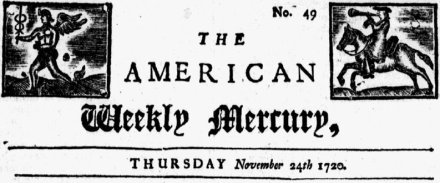
The American Weekly Mercury of Thursday, November 24 published “this extraordinary Piece” only with a preface complaining that “it is evident, that the following Speech was intended to misrepresent the Administration and Justice of this Government, as well as to infuse both ill Principles and Practices into the Minds of the People.”

The Dying Speech of Edward Hunt, formerly taken in Rebellion at Preston, and transported a bound Servant to the Island of Antigua, before his Execution upon the 19th Instant, at Philadelphia, where he had been legally convicted of High Treason, and most justly condemn’d for his Counterfeiting Spanish Silver Coin, made current* by Act of Parliament within all his Majesties Colonies in America.

It may be expected, that I should say some thing now concerning my Life and Conversation, which i must with Sorrow own to God and the Word has not been according to the Precepts and Principles of the Church, in which I was bred and educated: But with a sincere repentance and hearty Sorrow I do lament all the Errors of my past Life, firmly believing in my Saviour Jesus Christ, in whose Merits and ever flowing Mercy I do only trust for Salvation and Pardon, who has promised Eternal Life on no other Terms to the most Righteous upon Earth.

As to the Crime that now I suffer for in particular, I must own it is an Offence against the Laws, which I hope God will pardon me since he knows that I did not do it with any Design to cheat or defraud any one, or to make a Practice of Coining; but being ignorant of the Breach of any Laws of God or Man, I thought I might cut those Impressions as innocently as any other, or the Stamps that the Gentlemen of this place imploy’d me about, to make Farthings.** I am an English Subject, and desired to have the Privilege of the Laws of England, but it was not granted in any Point, except in Condemning me.

I am the first unhappy Instance of this kind that ever suffered in the King’s Dominions, pray God it may be a Warning to all, not to offend wilfully in the same that I did through Ignorance: For if I had known it, I would not have taken all the World to have done it. God give me a patient Resignation to submit to his blessed Will, in whatsoever he please.

I do heartily ask Forgiveness of all that I have offended in any manner of way, and do sincerely forgive all that have injured or offended me; particularly Mr. John Moore and Morris Birchfield, and the Evidence that swore against me in that Tryal. I do solemnly declare, That I know not any thing, or have been guilty of any one thing laid to my Charge in that Matter, or any of the other things laid to my Charge, by John Butler, either in England or Ireland.

I did petition the Honourable Governor for a Reprieve, until the King’s Pleasure was known concerning me, being I could not be tried by the Laws of England in all Points, as a Church of England Man ought to be: But it was a Privilege too great for me to obtain. Pray God to forgive them all, and every one that has a hand in taking away my Life any manner of way, and that my Blood be not required at their Hands, for they know not what they do. I am on Earth judged and condemned to die for the Breach of a Law of Man that was not duly published, which for that Reason I transgress’d it ignorantly, though the first that suffers for the Transgression of unknown Laws, or that was sentenced according to the Laws of England, without the Privilege of a Subject, which I desired of the Judge, which I know was not qualified by the same Laws to try me.

I do not know what Advantage there can be to any in my Death, and that I could not appeal to my King, neither before nor after my Tryal. I do not speak this because I am not in Charity with all the World, I do, from the Bottom of my Heart, forgive all in Obedience to my Saviour’s Command and Example, who suffered more for me, being innocent, and had not only done no Harm, but Good, and pray’d even for is cruel Persecutors and Murderers, and promised, That those that follow his Examples in this World by patiently enduring the Cross, shall reign with him to all Eternity: To Him therefore I commit all, an my poor Wife, beseeching him to help her, and be her Support and Comfort, and preserve her poor Soul free from the Polutions [sic] of the World, that through his precious Merits we may meet where we shall be both happy to all Eternity, in the merciful Arms of our dear Lord and Saviour Jesus, who I do beseech to receive my poor Soul.

According to Kenneth Scott’s Counterfeiting in Colonial America, Edward Hunt’s wife, Martha, got a £500 fine and a lifetime prison sentence for misprision of treason. (If that book is up your alley, Scott has an even more specific Counterfeiting in Colonial Pennsylvania.)

* Early colonial American commerce was severely hampered by a shortage of English/British currency. As a result, coins minted in Spain’s lucrative southern territories served as the colonies’ primary currency in the 17th and 18th centuries, particularly the iconic eight-real silver “pieces of eight”.

This is the reason why the currency of the present-day U.S. isn’t an “American pound sterling” but the almighty dollar: Dutch colonists had brought a coin called the leeuwendaalder to their former New Amsterdam (New York) province, the name deriving from the German thaler. As the pieces of eight corresponded to the thaler/daalder, it inherited the same name. Indeed, the “Spanish Dollar” remained legal tender in the post-colonial United States until 1857.

This is also the reason for reckoning of the eight constituent bits that comprised the dollar, and hence of the American colloquialism “two bits” to denote $0.25 … and, later, the adjective “two-bit” to man something cheap, mean, or small-time.

** They may have been Spain’s coins, but it’s wildly implausible that any Englishman could think he could counterfeit “innocently.”

On this day..

1888: William Showers, “pathetic soul”

(Thanks to Meaghan Good of the Charley Project for the guest post. -ed.)

On this date in 1888, after a hearty breakfast of beefsteak, eggs, sweet potatoes and coffee, William Showers became the eighth man judicially hanged in Lebanon County, Pennsylvania.

He had been condemned for the murder of his grandson, William “Willie” Kahler. An account of his trial and death, assembled by the Lebanon County Historical Society, describes the condemned man as he appeared on the day of his execution: “The aged Bill Showers [he was sixty-two] looked like what he was, a pathetic soul. He was only five feet two inches in height and weighed less than one hundred twenty-five pounds.”

Showers had been dealt a hard hand in life, and he didn’t have a good reputation among his neighbors in the village of Annville. Much to the shame of the family, his only daughter Sara had borne six children out of wedlock. Sara died young in 1886, and her father was left in charge of two of her children: six-year-old Willie Kahler and his brother, Samuel “Sammy” Speraw, age four. (What happened to the other four children has not been recorded.)

Bill Showers was a widower by then. For about six months, with the help of his son and his daughter-in-law, Showers did the best he could to provide a home for his grandsons.

But in April 1887, Showers’s son and his wife stopped helping him care for Willie and Sammy. Bill had never wanted the boys in the first place, and he couldn’t afford to feed them on his own.

For about a month the three of them lived alone and Bill tried to get someone to take the children off his hands. He tried a few different foster homes, but he couldn’t afford to pay the foster parents for the boys’ keep. He took them to an orphanage, but they were refused admission. The county almshouse rejected them also.

Bitter and desperate, Bill complained to a friend, “If no one will take them, I have one place to put them. I won’t be a damned fool and raise other people’s children.”

In mid-May, however, Showers’s normally sulky and reclusive attitude suddenly changed and he went to the neighbors and cheerfully announced that he had finally found another home for the children. Two brothers in Schuylkill County were willing to adopt them and take them to Texas to start a new life, and they would be out of Bill’s hair forever. Showers asked his daughter-in-law to mend the boys’ clothing in preparation for their journey.

Then, on May 17, he borrowed the local minister’s buggy and set off over the mountains to Sammy and Willie’s new adoptive home. A few of the neighbors noticed Showers riding out of town that morning. They also noticed that he was alone.

By May 30, the good citizens of Annville were suspicious enough to go to the local constable, Joseph Fegan. When Fegan questioned Showers as to the whereabouts of his grandchildren, Bill told them a most extraordinary story: on the way to Schuykill County, he said, he’d encountered two black men and asked them for directions.

He then stopped to water his horses, letting the children out of the buggy as he did so. When he returned to the wagon, Willie and Sammy were gone. He believed they’d been abducted by the two black men. But he never reported their disappearances, he said, because he was “too upset.”

No one believed this wild story, and the people of Annville organized search parties to look for the two children, whom they were sure had been murdered. They found their tiny, nearly naked bodies that very same day, in a ditch only about 70 yards from Showers’s house. They had both been beaten and strangled to death.

Showers was arrested, charged with murder and lodged in the county jail. Which was just as well for him, because his neighbors were inclined to lynch him. His son hired a very able local attorney, Frank Seltzer, to defend him. Seltzer selected Frank Lanz, a former state senator, as co-counsel.

The Commonwealth of Pennsylvania charged the defendant only with the murder of Willie. The idea was that if they lost that case, they could go forward and try Showers for the murder of Sammy.

The trial date was in mid-June, and the first thing Showers’s attorneys did was move that it be delayed. As the Lebanon County Historial Society puts it:

Seltzer…had a different view of the situation. He rose and objected to the call of the case with a voice that could be heard in the county jail one-half block away. Promptly and resignedly, his tone of voice changed. As if explaining a baptismal font to a heathen, he told the judges that he and Senator Lantz had been retained for less than a week. Their request for a continuance was not made :in the spirit of vexatious delay” but rather for lack of time to prepare the case for trial and, of prime importance, the inability to have a fair trial in the county at the time in light of the prevailing rumors. Adverse pretrial publicity, pleaded Seltzer, rendered a fair trial impossible at this time.

[The prosecutor] Ehrgood replied to Seltzer that he had been given prompt notice he was going to press for immediate trial and Seltzer would have ample time to prepare, since it was only Monday and he would not be ready for trial until the following Thursday. This was a concession which Seltzer and Lantz hardly appreciated.

The judge agreed with the defense, and set a new trial date for September. This would give time for his lawyers to prepare, and maybe for the rumor mill to stop spinning. These were some of the stories floating around:

  • Seltzer murdered his wife in 1886.
  • He also killed his daughter Sara, Willie and Sammy’s mother.
  • He was in love with a local seamstress, Elizabeth Sargent, and killed his family members to get them out of the way so he could marry her.

The press didn’t help matters.

Headlines in the local papers included shockers like “Annville the Scene of a Murder Most Foul!” and “William Showers Dyes His Hands with His Grandchildren’s Blood!”

During the summer of 1887, Showers’s attorney, Seltzer, fell ill and was confined to bed, unable to assist with the defense. It seemed unlikely that the trial would really take place in September. Perhaps Showers couldn’t stand the suspense anymore, for on September 23 he summoned his sons Stephen and William Jr. to the jail, along with the lawyer Luther F. Houck.

Showers made an oral confession to all of them, speaking in his native German, and Houck wrote it down and translated it into English.

The substance of Showers’s confession was that Elizabeth Sargent had agreed to marry him on the condition that he got rid of the boys, and they had agreed to kill them. Elizabeth, he said, helped him strangle Willie and Sammy and dump their bodies in a pre-dug grave.

In court later that day, Showers pleaded guilty to both murders, and his confession was read out for everyone to hear. Elizabeth Sargent was in the audience and she leaped up and shouted, “That’s a lie!” The judge had her removed from the courtroom. The next day she and her parents took a train out of town. Because Showers had implicated her and the police weren’t sure as to whether she was involved in the children’s deaths, the court issued a bench warrant for her arrest.

The townspeople, however, didn’t believe Showers’s second story any more than they had his first one. They were convinced of Elizabeth’s innocence. She subsequently reappeared and presented an alibi, proving she had not been with Showers on the dates he specified in his statement.

When he heard the news about his client, Selzer rose from his sickbed and rushed to court to try to undo the damage. He begged the judge not to accept the guilty plea. In private, Showers told his attorney the confession was completely untrue and he made up the story because he’d been sick and weak, and people who visited him in jail told him he would be hanged if he didn’t own up to what he did.

Selzer’s argument persuaded the judge: Showers’s guilty plea was withdrawn. He finally went to trial on December 15, 1887.

He testified on his own behalf and gave yet another bizarre story, this time implicating a local man named George Matterness and his dead daughter Sara’s husband, a man named Huffnagle. He said Matterness and Hufnagle, along with two other men in blackface, had visited Showers’s home on the night of May 17 and lead Willie and Sammy out of the house. Matterness, Showers said, had later told him the children were buried in the ditch. Showers had told no one about this before because Hufnagle had repeatedly threatened his life.

The prosecution immediately called George Matterness as a rebuttal witness. Matterness, a teacher, freely admitted he knew Showers slightly, but said the whole story was a lie and he was baffled as to why the old man would have implicated him.

Given the circumstances, it’s surprising the jury actually deliberated till midnight and then on to 8:00 a.m. the next morning before pronouncing Showers guilty.

He told Seltzer, “I’m glad they didn’t find me innocent so they can’t go ahead and try me on the indictment for the murder of Sammy.” He expressed hope that he would prevail on appeal, but the Pennsylvania Supreme Court denied him and the governor quickly issued a death warrant.

Three hundred people were allowed into the prison courtyard to witness the execution. Thousands more clogged the streets around the jail into a “solid mass of morbid minded humanity bent on seeing Bill Showers tripped into endless time.”

The morbid mass got its wish. The small, slight man fell only three feet, and his neck was not broken. He strangled slowly for seventeen minutes.

As Showers’s sons all refused to take custody of the body, he was buried on the grounds of the county almshouse. This was the same institution that had refused to accept his grandsons, an act that would have saved their lives.

On this day..

1822: David Lamphier

On this date in 1822, David Lamphier was hanged for “a deed of unparalleled atrocity” as multiple newspaper reports put it: striking Sadsbury Township constable Samuel W. Smith dead with an ax blow that nearly beheaded the lawman.

Smith had been out to arrest Lamphier in Crawford county near the Ohio-Pennsylvania border for what’s described in the documents as “obtaining goods upon false pretense,” which seems like it could mean a great many possible malfeasances.

Whatever they were, Lamphier’s pretenses to Constable Smith were perfectly plain.

“As I Came to Mr. Campbell’s bars I saw Abel Freeman and one or two other Persons & bid them good evening I Stept over the Bans and walk’d along towards the Porch,” the strapping six-footer said later under interrogation. He had a heavy ax slung over his shoulder. (Not during the interrogation, of course.)

I got along towards the end of the house and saw Mr. Smith the Constable Coming out of the entry partly behind me. I turned Round and spoke to him and said I understand you want to take me tonight but I don’t mean that you Shall. Mr. Smith then step’d up to me I took my ax off my shoulder and I told him to stand back or I would strike him, as he Came up I step’d back a few steps intending to run and get out of his way. As he advanced upon me I made use of my ax I hardly know how, whether with the edge or the head or how, as soon as I made the blow I turned and run but did not know that I injured him untill I saw men coming to my father’s in Ohio with guns and supposed they might be after me.

Lamphier fled into a nearby swamp but gave himself up a few days later. He was shocked to learn that the constable was dead.

Although Lamphier would maintain on the scaffold that he had not intended Smith’s life, but “had given the fatal blow from the suddenness with which Smith had pressed upon him,” the fact that he admitted explicitly warning his Javert not to approach him put the fatal chop squarely into premeditation territory.

Shortly after noon this date, according to Murders, Mysteries and History of Crawford County, Pennsylvania 1800-1956, Lamphier appeared at the Meadville courthouse with a rope about his neck. Escorted by the local militia and fortified by a swig of wine, he walked the mile to the gallows on Baldwin Street, where three or four thousand souls had turned up to see him bravely die (after an hour-long exegesis there on the scaffold by the local minister).

“It is stated that the wretched man manifested the greatest resignation and composure to the last moment of his existence; but whether it was the composure of hardened depravity, the resignation of contrition for past sins, or of despair, it is not necessary for us to decide.” (Baltimore Patriot & Mercantile Advertiser, Nov. 16, 1822; this same story made the rounds of many other papers.)

His friends, less resigned, tried in vain to resuscitate Lamphier when he was cut down after hanging only a survivable twenty minutes.

On this day..

1884: Two Pennsylvania murderers

On this date in 1884, Joseph Sarver was hanged as a parricide at Indiana, Pennsylvania.

Sarver became enraged by his father’s affair with their housekeeper Mary Kelley, and shot the father dead in his doorway. (He also shot Mary Kelley; she survived.)

As if the parricide rap wasn’t enough to get the blood up, he “greatly intensified the popular feeling against him” by behaving after his arrest like an all-around jerk. Sarver reportedly fought with jailers over the timeliness of his breakfast, made merry in prison, and blithely boasted that “they could never hang him because he was a Democrat, and so was Governor Pattison.” (St. Louis Globe-Democrat, Nov. 14, 1883; Galveston Daily News, same date. It made the national crime blotter.)

He eventually made a full confession, and was said to have died firmly.


Executed on the same date in Cambria County, Penn., Michael Murray “dictated a letter, to be made public after his death, in which he charged that certain persons, possessing the powers of witchcraft, had exercised a spell over him, and while under its influence, he committed the deed.” The deed created by this sorcery was shooting a man on the Pittsburgh turnpike who called Murray a name.

On this day..

1917: “John Nelson”, mystery man


(Salt Lake (Utah) Telegram, Dec. 31, 1916)

On this date in 1917, someone was electrocuted in Rockview, Pennsylvania.

“John Nelson”, the cipher alias by which authorities were eventually content to call him, was 5′ 8″ tall and 165 pounds, and looked like an African-American. (“Nelson” himself said that neither white men nor black were of his race.) Papers put this about quizzically because he was also utterly steadfast in refusing to identify himself or his background.

He eventually allowed that he came from Canton, Ohio (but who knows if that’s true). “He reads Shakespeare and seeks high grade newspapers and magazines,” ran news-of-the-weird wire copy all around the country. He boasts “long hair which bears the appearance of having been done up in kids to give a ‘Sis Hopkins’* effect” as well as “long gray whiskers, sideburns and a heavy mustache.” He looked maybe 60 years old.

Anyone?

Aw, heck.


The Scranton Times sent 5,000 of these postcards around the country hoping to scare up information about their mysterious murderer.

Tips poured in from all over — but nothing definitive. An upstate New York sheriff reported discharging a guy named John Nelson from jail a couple of years before. A woman in Butte, Montana recognized the picture and thought it might be her vanished father. The prisoner also resembled a missionary from Ohio and a bank president from Richmond, Va., also both missing; a Scranton woman thought he maybe used to be her gardener. (All but the last of these indefinite tips via Cheryl Kashuba’s two-part series on this case in the March 17 and March 24, 2013, issues of the Scranton Times-Tribune.)

Although nobody could figure out who he was, everyone was pretty sure what he’d done.

On the evening of Oct. 30, 1915, he’d trudged into Mill City, a Wyoming County township outside of Scranton, and made an unexplained sudden attack on three men lolling about a barbershop porch.

According to those three men’s story — and they’re all we have to work with since Nelson kept mum on this, too — a little white boy running down the darkened street bumped into the mystery pedestrian. At that, “Nelson” suddenly produced a knife and charged at the trio of nearby men, bellowing “White people in a tank town like this can’t run over me!”

J.M. Sickler, a prosperous local farmer, bravely intercepted the attacker before he reached Judge Robert Westlake, and suffered mortal stab wounds for his trouble. The attacker fled, but other locals roused by the commotion overpowered him as he escaped; Sickler lived long enough to give a deathbed positive identification.

Of course, it wasn’t really “positive” — that’s the whole point. And “John Nelson”, whoever he might have been, kept his nose in his Shakespeare and his lips enigmatically sealed on the crime and its causes; on his background and biography; on everything whatsoever. “I just wouldn’t care to talk about that,” he would reply when questioned, or similar versions of that polite deflection.

He kept his queer peace all the way to the electric chair.

* Maybe Mr. “Nelson” was just taking Sis Hopkins’ good advice: “There ain’t no sense in doin’ nothin’ for nobody what won’t do nothin’ for you.” As Nelson blithely put it (and who could contradict him?) any name at all would do for his circumstances.

On this day..

1866: Anton Probst, “I only wanted the money”

(Thanks to Meaghan Good of the Charley Project for the guest post. -ed.)

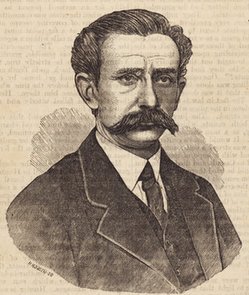
On this date in 1866, mass murderer Anton Probst (sometimes called “Antoine”) was hanged in Philadelphia, Pennsylvania. He made national headlines in its time, but today he is forgotten except among serious students of violent crime.

Probst was a native of Germany, the son of a carpenter. He later claimed he had a normal childhood and “never did anything wrong” until after he had left his home country.

He moved to the United States in 1863, in the middle of the Civil War, and became a professional “bounty jumper”: he would join up with a Union Army regiment, collect the $300 enlistment bonus, desert as soon as he could, then enlist with another regiment and start the cycle over again. He made a tidy living for himself this way until 1865, when he accidentally shot his thumb off and was discharged from the military for good.

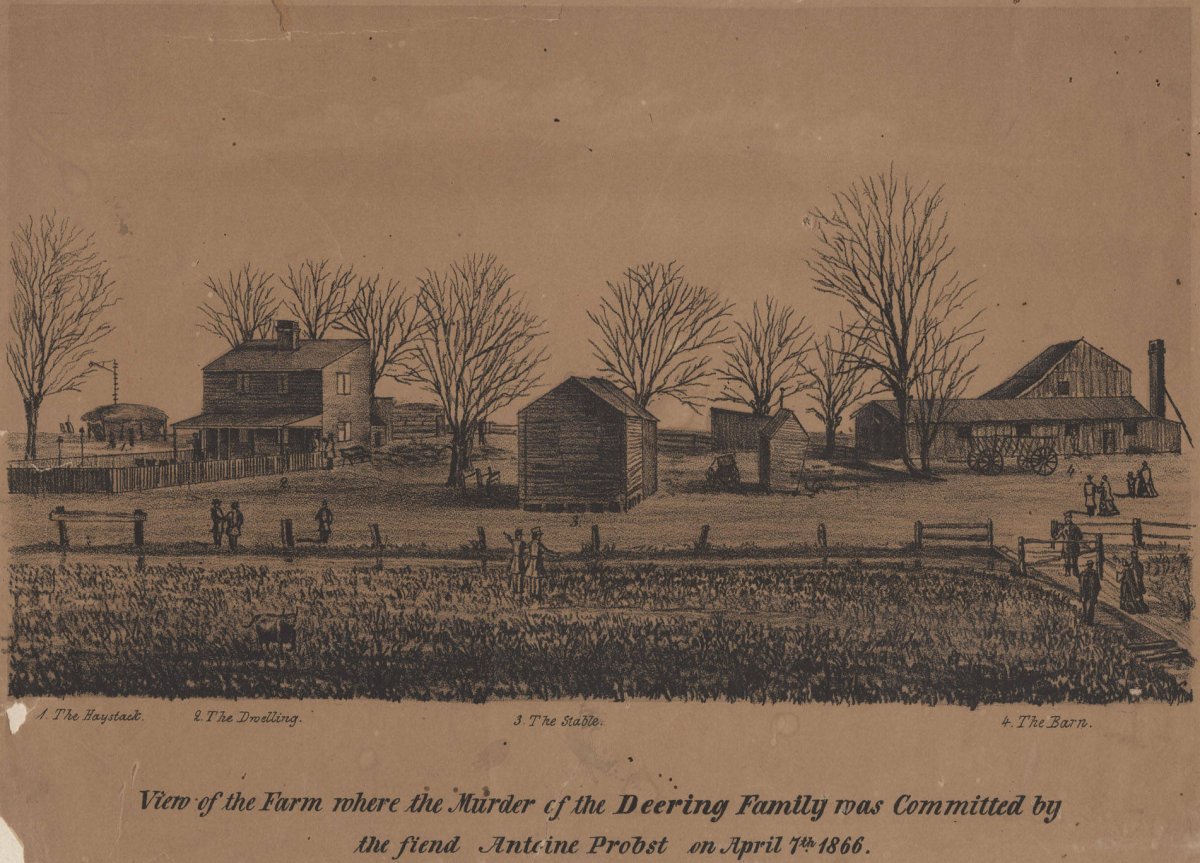
Probst squandered his enlistment bounties on liquor and and rapidly fell into post-discharge penury. This was why, in the fall of 1865, he hired himself out as a farmhand to Christopher Deering, an Irish immigrant who lived in a rural part of Philadelphia with his wife and five children.

Deering offered Probst a salary of $15 a month plus room and board. Probst quit after only a few weeks, though, not being accustomed to honest labor.

He soon fell ill and, without a source of income, wound up in the workhouse. In dire straits, he returned to the Deering farm on February 2, 1866 and begged for his job back. And, although Probst’s behavior from before had given Christopher’s wife the creeps, the farmer took pity on him and re-hired old Thumbless.

Things went well for the next two months. But unbeknownst to his employer, Probst had thought of another way to get money.

Christopher’s nearest neighbor, Abraham Everett, lived a quarter of a mile away. Everett subscribed to several local weekly newspapers and, every weekend, Christopher would send his son to borrow the previous week’s editions.

One Saturday, the boy never showed up.

Nor did he arrive on Sunday.

Or for the next several days after.

By Wednesday, Everett was getting worried and decided to go to the Deering place and see if they were all right. He found the farm deserted and the horses inside the barn, nearly dead of thirst and starvation. After giving food and water to the distressed animals, he went and looked through the window into the Deering family’s house and saw it had been ransacked.

Seriously alarmed now, Everett forced the window open and climbed inside, and found every room in the house in a state of disarray. In the bedrooms, the beds had been torn and flipped upside down, dresser drawers had been rifled through and clothes were scattered everywhere. There was not a soul to be seen.

At this point, Abraham Everett went off to get help, summoning another neighbor and then the police. Inside the barn they found something Everett had missed while he was helping the horses: Christopher Deering’s body, partially covered in hay, alongside the body of a cousin visiting from New Jersey.

“His head,” crime historian Harold Schechter reports in his book Psycho USA: Famous American Killers You Never Heard Of, “was crushed to pieces, almost to powdered bone, and his throat was cut … from ear to ear.” Christopher’s cousin had similar injuries. A search of the barn turned up the bodies of Christopher’s wife, Julia, and four of the couple’s five children, stacked in the corncrib.

All of them had their throats cut and their skulls bashed in.

The only survivor in the family was the oldest child, ten-year-old William Deering, who had been staying with his grandparents at the time of the murders. And so the family line did not die out: according to this Philadelphia Inquirer article, William has 60 descendants.

The murder weapons were lying around bloodstained and in plain sight on the property: a hammer, a small hatchet and a full-sized ax. Hours later, the police found the last body hidden in a haystack a few hundred yards from the barn: seventeen-year-old Cornelius Carey, one of the Deerings’ farmhands.

The other farmhand was missing and, under the circumstances, had to be viewed as the prime suspect in this massacre. Nobody knew much about him, but the neighbors recalled that missing right thumb, spoke poor English with an accent, and was called something like “Anthony.”

Fortunately, he would not prove hard to find. “It might be supposed,” Harold Schechter says,

that a man who had methodically slaughtered eight people, including three prepubescent children and a fourteen-month-old infant, would lose no time in putting as much distance between himself and the crime scene as possible. For all his low cunning, however, Anton Probst was incapable of prudent calculation. Indeed, from all available evidence, he thought of nothing beyond the gratification of his immediate physical needs.

Hours after the murders, Probst was no further away than a house of ill repute on Front Street in Philadelphia, where he spent the night with a $3 prostitute. For the next few days he hung around his favorite bars drinking, making occasional excursions to pawn items he’d stolen from the Deering farm. He was in no hurry to leave.

Only the day after Probst’s grisly crimes were discovered, a police officer named James Dorsey spotted him strolling around near Market Street. Something about his bearing, and the way his hat was pulled low over his eyes, made the lawman suspicious. He walked up to him and noticed the stranger’s right thumb was missing.

Dorsey pulled Probst’s hat off to have a look at his face and said, “Good evening.” Probst mumbled a reply and Dorsey, noting the accent, said, “You’re a Dutchman?”

“No,” Probst answered. “Me a Frenchman.”

“You are, are you? Take a walk with me.” Dorsey grabbed the murderer’s arm and hauled him off to the nearest station house. There the police searched him and determined he was wearing Christopher Deering’s clothes, and carrying the farmer’s snuffbox and pistol. Probst had left Elizabeth Dolan’s carpetbag at a tavern earlier that day; it contained a number of small items, including cheap children’s toys, all of which were from the Deering farm.

The police had to transfer Probst from the Philadelphia City Jail to Moyamensing State Prison for his own safety, after a would-be lynch mob stormed the jail. Probst claimed he had only killed Cornelius Carey and tried to blame the other murders on an imaginary accomplice; at his trial (which began on April 25, less than three weeks after the murders) his lawyers argued that the case against him was strictly circumstantial and not proved beyond a reasonable doubt. But the trial’s outcome was clear from the beginning. The jury deliberated for only twenty minutes before convicting.

Death row agreed with Probst; he seemed at ease and actually gained twelve pounds in the five weeks between his trial and execution. On the morning of May 7, exactly one month after the murders, he finally confessed that his accomplice didn’t exist and he’d acted alone. He was “quiet, undemonstrative, cool and unembarrassed” as he told his story, “without the least trace of shame or remorse.”

You can read it all here in his very own words, or below, in mine. At first his intention had just been to rob the family of everything they had, then flee. But he found himself unable to accomplish this because there were always too many people around.

About a week before the murders, it occurred to Probst that perhaps murder might be necessary to facilitate the robbery. At first he thought he could just kill Christopher Deering, but as he mulled the matter over he decided the rest of the household would have to die as well.

First to go was Cornelius Carey as they were working together in the field. Then Probst went into the barn and lured the others in one by one, killing them as they each came inside: eight-year-old John Deering, then the mother, Julia, then the rest of the children: six-year-old Thomas, then four-year-old Annie, and finally the baby, Emma. Probst estimated that it all took about half an hour.

Christopher Deering was off picking up that visiting cousin from the ferry, and they didn’t arrive back at the farm until the afternoon. Probst was waiting for them. While the guest Elizabeth Dolan went into the house, Probst told Christopher one of the animals was sick and he had to go inside the barn. There he killed him like the others, then called Miss Dolan to the stable. She was the last one to die.

If we are to believe the killer’s account, the victims all died quickly and quietly, and did not suffer. None of them, he said, so much as cried out after the first blow.

Once finished, Probst tore the house upside down looking for things to steal, washed, shaved, changed out of his bloody clothes and put on some of Christopher’s, and had himself a snack of bread and butter. At sunset he headed off to town.

Schechter records:

When asked by Chief Franklin why on earth he had perpetrated such an atrocity, Probst gave a little shrug. “I only wanted the money,” he said. “I killed the boy Cornelius first so that he could not tell on me. I killed the two oldest children so they would not afterwards identify me. I killed the two youngest as I did not wish to leave them in the house alone without someone to care for them. I had no ill feeling to anyone in the family. They always treated me well.”

Probst submitted meekly to his execution, which went off without a hitch. The public understandably rejoiced at his death and the New York Times, in its report of how Probst “shuffled off his mortal and disreputable coil,” called him “the greatest criminal of the nineteenth century.”

Probst was permitted to write to his family in Germany. He told them of “the terrible fate which has befallen me,” admitted to the eight slayings, and blamed his bad behavior on his experiences in the Union Army, where he “heard nothing but cursing and swearing, and soon became a sharer in every wickedness.”

Whatever, Anton.

After his death, Probst’s body was handed over to the physicians at Jefferson Medical College, who subjected it to a series of bizarre experiments with electricity. When they finished with their fun they performed an autopsy. Probst’s brain turned out to be unusually small, almost a full pound lighter than average. What, if anything, this has to do with his apparent psychopathy is anyone’s guess. His head and arm were later displayed in the Jefferson Medical College museum.

On this day..

1879: Benjamin Hunter, in the Hunter-Armstrong Tragedy

(Thanks for the guest post to Robert Wilhelm of the Murder By Gaslight historic crime blog, and author of the book Murder And Mayhem in Essex County. Executed Today readers are sure to enjoy Wilhelm’s detailed investigations into long-lost historic crime. This post, reprinted with permission, first appeared last February on Murder By Gaslight. -ed.)

John Armstrong

The night of January 23, 1878, a man was found on the ground with a serious head wound, not far from the home of Ford W. Davis in Camden, New Jersey. Near the wounded man, a hammer and a hatchet were found, each marked with the initials F. W. D. The man was identified as Philadelphia music publisher, John M. Armstrong and when it was learned that he owed Ford W. Davis a sizeable amount of money, Davis was arrested. But Armstrong also owed $12,000 to Benjamin F. Hunter who had insured Armstrong’s life for more than double that amount.

Date: January 23, 1878

Location: Camden, New Jersey

Victim: John M. Armstrong

Cause of Death: Blows from a hammer and an axe

Accused: Benjamin F. Hunter

Synopsis:

Benjamin Hunter

Armstrong was taken to his home in Philadelphia, across the Delaware River from Camden, to be treated for head wounds. As a friend of the Armstrongs, Benjamin Hunter was among the first sent for by the stricken family. In the guise of helping, Hunter suspiciously rearranged the bandages on Armstrong’s head, reopening the wound. But when Armstrong died, Ford Davis was charged with his murder.

Some days later a young man named Thomas Graham was drowning his sorrows in a Philadelphia saloon. Laden with guilt, Graham made statements about the Armstrong murder that were incriminating enough to have him arrested. In jail, Graham made a full confession. Graham was an employee at Benjamin Hunter’s hardware concern and Hunter had offered him $500 to kill John Armstrong. Graham was in need of money and readily agreed.

They made a plan and set a date for the murder and Hunter made arrangements to be in Virginia that day. But Hunter returned to find Armstrong still alive — Graham’s nerve had failed him. Undaunted, Hunter came up with a more detailed plan to murder Armstrong. He gave Graham a hammer which bore the initials F. W. D. then had Graham mail a postcard to Armstrong, purporting to be from Ford Davis, asking Armstrong to meet him in Camden. Graham was to kill Armstrong with the hammer then leave it behind to frame Davis. Graham lost his nerve again but this time lied and said Armstrong never showed up.

Thomas Graham

Hunter decided not to leave anything to chance and met Armstrong, face to face, and persuaded Armstrong to accompany him on the ferry from Philadelphia to Camden. Graham, armed with the hammer and a hatchet that Hunter had given him, also initialed F.W.D., followed after them, riding in a different section of the boat. In Camden they took a streetcar and Graham followed on foot. They got off the car on Vine Street and Hunter left Armstrong and went back to give Graham the signal.

Graham hit Armstrong once with the hammer, but lost heart before he was able to finish the job. He threw the hatchet away and ran back to the ferry. Hunter grabbed the hatchet and attacked Armstrong, striking him on the head. He left Armstrong severely wounded, with a fractured skull.

After Graham’s confession, Ford Davis was released and Benjamin Hunter was arrested for murder.

Trial: June 10, 1878

Benjamin Hunter pled not guilty to the murder of John Armstrong. The defense asserted that there was no evidence that Hunter was in Camden that night. They also provided numerous witnesses that testified to Hunter’s good character. And they challenged the indictment on the grounds that since Armstrong died in Philadelphia, the murder could not be prosecuted in New Jersey.

It came out in court that Hunter had loaned Armstrong a total of $12,000 and to insure his loan Hunter had persuaded Armstrong to agree to a life insurance policy with Hunter as beneficiary. The amount of the policy was $26,000.

Thomas Graham had turned state’s evidence and it was his eye-witness testimony which tightened the noose around Hunter’s neck. The trial lasted 23 days and at the end the jury, with almost no deliberation, found Hunter guilty.

Verdict: Guilty of first degree murder

Aftermath:

Hunter’s attorneys appealed the verdict on the grounds that since Armstrong died in Philadelphia, Hunter could not be convicted of murder in Camden, New Jersey. The appeal was denied and Hunter was sentenced to hang on January 10, 1879.

With all hope gone, Benjamin Hunter confessed. The amount of money he had loaned Armstrong had been so large that he had been losing sleep worrying about it. Armstrong appeared to be using the money to maintain a lavish lifestyle rather than improving his failing business. Hunter’s only hope of retrieving his money was Armstrong’s death.

A week before the execution, Hunter attempted suicide, trying to spare his family and himself the indignity of a hanging. He was not allowed a knife or fork when eating, but he was able to tear away the top of a tin cup and used sharp edge to cut into his leg. Under a blanket he was able to cut an artery without the knowledge of the jailers on his deathwatch, and he had lost a pint and a half of blood before passing out and alerting them. He was saved from death and the execution went on as scheduled.

It was reported that Hunter, due to weakness from the loss of blood, and fear of death had to be carried to the gallows; though some claimed he had been given brandy and was dead drunk when carried in.

The hanging was to be done using a method adopted by the state of New Jersey — used in the case of Antoine La Blanc, among others — in which, rather than falling through a trap, the condemned man is pulled upward when a counterweight is dropped. Hunter’s execution was horribly botched as this eye-witness account attests:

“There was no scaffold. He was hanged in the corridor of the Court House, with a rope reaching up into the Court House over a pulley and to a weight in the cellar below. He was hanged at a cross-like arrangement, made by two corridors populated by men from some of whom the Sheriff demanded ten dollars apiece, and Eli Morgan, Deputy Sheriff to Sheriff Daubman, was to cut a little rope that held a stronger rope that controlled a three-hundred pound weight that was intended to hoist up the murderer into the air. The narrator was within two feet of Hunter when he was hanged. The rope was so long that it failed of its purpose and stretched, and the man went up in the air for but a few feet then tumbled down like a bunch of wet rags. Then Eli Morgan grabbed the rope and hauled him up hand over hand and held him there until he was throttled to death.”

It took Hunter at least fourteen minutes to die of strangulation.

Benjamin Hunter’s brother tried to collect on the life insurance policy and agreed to give the money to the Armstrong family. The insurance company refused to pay and Armstrong’s wife and administratrix of his estate, sued the company. The court sided with the insurance company saying they did not need to pay. The case was appealed all the way to the U.S. Supreme Court who overturned the verdict and called for a new trial. If the insurance company could prove that the policy had been taken out by Hunter as part of the crime of murder, then policy need not be paid, if there was no fraud, then the money must be paid.

The false accusation and imprisonment of Ford Davis had completely prostrated him. Shortly afterwards, partly out of consideration for his innocent sufferings, Davis was appointed crier of the Camden Courts, and he held that position for many years.

Resources:
Books:

Hunter, Benjamin F., and Thomas Graham. Hunter-Armstrong tragedy the great trial : conviction of Benj. F. Hunter for the murder of John M. Armstrong. Philadelphia: Barclay, 1878.

Lawson, John Davison. American state trials: a collection of the important and interesting criminal trials which have taken place in the United States from the beginning of our government to the present day. St. Louis: Thomas Law Books, 1921.

Seen & heard by Megargee, Volume 4, Part 1. Philadelphia: Louis N. Megarcee, 1904.

The Medico-legal journal … New York: Medico legal journal, 1886.

On this day..

1778: Patrick McMullen, repeat deserter

On this date in 1778, Patrick McMullen was hanged on the Philadelphia commons for deserting, repeatedly, the Continental Army.

This poor fellow had started off (promisingly enough for the colonies) by deserting the British.

Such documentation as remains easily accessible isn’t very detailed about his pre-war background; the British had recently passed a Recruiting Act authorizing press gangs to shanghai Scotsmen into the royal army, but that measure was only 99 days old at this time. There were also many Scots-Irish who had already immigrated to the Pennsylvania colony or thereabouts.

This Irishman, however, enlisted pre-1775 in the British 38th Regiment of Foot, deserted, presumably served in a Continental Army unit at some point thereafter, and then by 1778 was back in British colors for the Battle of Monmouth, after which he deserted once again. Maybe he even changed teams four times, instead of twice.

Don Hagist is the author of the forthcoming book British Soldiers, American War.

This sort of “treachery” was not at all unusual.

“A good number of men switched sides, some several times, during the war,” said Don Hagist of the fascinating British Soldiers, American Revolution blog. “For many of them it did not impugn their reputations as soldiers; for example, many British prisoners of war escaped from captivity, joined in the American army as a means to get close to the front lines, then deserted again to rejoin the British army.

“At least, that is the story they’d give when brought to trial. Even when acquitted, sometimes these same men deserted yet again. When McMullen returned to the British army, he may have given the popular story that he was kidnapped by Bostonians and carried away from the garrison. This happened to a number of British soldiers in 1774 and early 1775; some turned up years later and gave their stories in court.”

McMullen had the bad luck to have to give this story to a court in Philaelphia at the time of that patriotic city’s maximum hostility following the British occupation.

Philadelphia’s Revolutionary military governor at this time was Benedict Arnold — still two years from his infamous betrayal, but even now finding himself stressed by the revolutionary extremism of his charges. Never a fire-eater himself, Arnold personally wrote to the Continental Congress with his own pitch for showing McMullen a bit of brotherly love, vouchsafing the view that our deserter’s culpability “is in his [Arnold’s] opinion insufficient” to warrant execution.

A Congressional committee respectfully disagreed, judging McMullen “a person of a most atrocious character” and directed that the hanging proceed.

Short review of these volumes about Revolutionary War desertion.

On this day..