1927: Sacco and Vanzetti (and Celestino Madeiros)

America Sacco & Vanzetti must not die

-Allen Ginsberg, “America” (mp3)

We have now reached a stage of the case the details of which shake one’s confidence in the whole course of the proceedings and reveal a situation which undermines the respect usually to be accorded to a jury’s verdict.

-Felix Frankfurter in The Atlantic

America our nation has been beaten by strangers who have turned our language inside out who have taken the clean words our fathers spoke and made them slimy and foul

their hired men sit on the judge`s bench they sit back with their feet on the tables under the dome of the State House they are ignorant of our beliefs they have the dollars the guns the armed forces the powerplants

they have built the electricchair and hired the executioner to throw the switch

all right we are two nations

. . .

but do they know the old words of the immigrants are being renewed in blood and agony tonight do they know the old American speech of the haters of oppression is new tonight in the mouth of an old woman from Pittsburgh of a husky boilermaker from Frisco who hopped freights clear from the Coast to come here …

the men in the deathhouse made the old words new before they died.

John Dos Passos, The Big Money (part of the U.S.A. trilogy)

Let us abandon then our gardens and go home
And sit in the sitting room.
Shall the larkspur blossom or the corn grow under this cloud?
Sour to the fruitful seed
Is the cold earth under this cloud,
Fostering quack and weed, we have marched upon but cannot conquer;
We have bent the blades of our hoes against the stalks of them.

Let us go home, and sit in the sitting room.
Not in our day
Shall the cloud go over and the sun rise as before,
Beneficent upon us
Out of the glittering bay,
And the warm winds be blown inward from the sea
Moving the blades of corn
With a peaceful sound.
Forlorn, forlorn,
Stands the blue hay-rack by the empty mow.
And the petals drop to the ground,
Leaving the tree unfruited.
The sun that warmed our stooping backs and withered the weed uprooted
We shall not feel it again.
We shall die in darkness, and be buried in the rain.

What from the splendid dead
We have inherited —
Furrows sweet to the grain, and the weed subdued —
See now the slug and the mildew plunder.
Evil does overwhelm
The larkspur and the corn;
We have seen them go under.

Let us sit here, sit still,
Here is the sitting-room until we die;
At the step of Death on the walk, rise and go;
Leaving to our children`s children this beautiful doorway,
And this elm,
And a blighted earth to till
With a broken hoe.

-Edna St. Vincent Millay, “Justice Denied in Massachusetts”

If it had not been for these things, I might have lived out my life talking at street corners to scorning men. I might have died, unmarked, unknown, a failure. Now we are not a failure. This is our career and our triumph. Never in our full life could we hope to do such work for tolerance, for justice, for man’s understanding of man as now we do by accident. Our words — our lives — our pains — nothing! The taking of our lives — lives of a good shoemaker and a poor fish-peddler — all! That last moment belongs to us — that agony is our triumph.

-Bartolomeo Vanzetti


Ben Shahn, The Passion of Sacco and Vanzetti

A recently discovered letter indicates that Upton Sinclair was convinced of his subjects’ guilt.

“Alone in a hotel room with Fred [Moore], I begged him to tell me the full truth … He then told me that the men were guilty, and he told me in every detail how he had framed a set of alibis for them … I faced the most difficult ethical problem of my life at that point … I had come to Boston with the announcement that I was going to write the truth about the case.”

But Sinclair had reasons beyond the “ethical” to tell what he saw as the larger truth. From a different letter:

“My wife is absolutely certain that if I tell what I believe, I will be called a traitor to the movement and may not live to finish the book … Of course, the next big case may be a frame-up, and my telling the truth about the Sacco-Vanzetti case will make things harder for the victims … It is much better copy as a naïve defense of Sacco and Vanzetti because this is what all my foreign readers expect, and they are 90% of my public.”

Well, the dying time came, the legal midnight hour,
The moment set by law for the Chair to be at work,
To substantiate the majesty of the State of Massachusetts
That hour was at hand, had arrived, was struck by the clocks,
The time for two men to be carried cool on a cooling board
Beyond the immeasurably thin walls between day and night,
Beyond the reach of airmail, telegrams, radiophones,
Beyond the brotherhoods of blood into the fraternities
Of mist and foggy dew, of stars and ice.
 The time was on for two men
 To march beyond blood into dust —
 A time that comes to all men,
 Some with a few loved ones at a bedside,
 Some alone in the wilderness or the wide sea,
 Some before a vast audience of all manking.

 Now Sacco saw the witnesses
 As the straps were fitted on
 Tying him down in the Chair —
 And seeing the witnesses were
Respectable men and responsible citizens
And even though there had been no introductions,
 Sacco said, “Good-evening, gentlemen.”
And before the last of the straps was fastened so to hold
Sacco murmured, “Farewell, mother.”

Then came Vanzetti.
He wished the vast audience of all mankind
To know something he carried in his breast.
This was the time to tell it.
He had to speak now or hold his peace forever.
The headgear was being clamped on.
The straps muffling his mouth were going on.
He shouted, “I wish to forgive some people
  for what they are now doing.”
 And so now
 the dead are dead????

-Carl Sandburg, “Legal Midnight Hour”


(The executions took place just after midnight Aug. 22-23)

THE names of the “good shoe-maker and poor fish-peddler” have ceased to represent merely two Italian workingmen. Throughout the civilised world Sacco and Vanzetti have become a symbol, the shibboleth of Justice crushed by Might. That is the great historic significance of this twentieth century crucifixion, and truly prophetic, were the words of Vanzetti when he declared, “The last moment belongs to us–that agony is our triumph.”

Vanzetti was right when he declared that his execution was his greatest triumph, for all through history it has been the martyrs of progress that have ultimately triumphed. Where are the Caesars and Torquemadas of yesterday? Who remembers the names of the judges who condemned Giordano Bruno and John Brown? The Parsons and the Ferrers, the Saccos and Vanzettis live eternal and their spirits still march on.

-Alexander Berkman and Emma Goldman, “Sacco and Vanzetti”

Starting points for the many Sacco and Vanzetti resources online: Famous American Trials | Wikipedia | Massachusetts Supreme Court virtual tour | American Writers and the Sacco-Vanzetti Case

On this day..

1936: Aboune Petros, Ethiopian bishop

On this date in 1936, the Italian forces occupying Ethiopia executed anti-occupation cleric Aboune Petros.

War on Ethiopia had been Benito Mussolini‘s monument to muscular Italian nationalism.

By May of 1936, it had forced Haile Selassie into exile and established control of the country. Mission accomplished!

At last Italy has her empire.

-Mussolini

As is often the case, the war of conquest instead transmogrified into a war against continuing resistance to foreign military occupation, and the colony of Italian East Africa was a short-lived and bloody affair.

The Duce will have Ethiopia, with or without the Ethiopians.

-Italian Gen. Rodolfo Graziani

(Though the progressive counterpart to Italy’s iron-fisted approach to troublemakers was monumental construction, and 1930s-era fascist architecture is still to be seen in Addis Ababa today.)

Ethiopian Orthodox patriarch Aboune — it’s a title that can also be rendered Abuna or Abune — Petros cut a public profile a little too sympathetic to the native subversives. When the Italians demanded that he tone it down, he replied (according to a hagiography that appears several places online),

The cry of my countrymen who died due to your nerve-gas and terror machinery will never allow my conscious to accept your ultimatum. How can I see my God if I give a blind eye to such a crime?

On July 28, Italians repelled a large* Abyssinian insurgent attack by the sons of Ras Kassa between Addis Ababa and Petros’s stomping-grounds of Dessie; the next day, Petros was escorted to an abrupt martyrdom to the mirroring causes of national self-determination and anti-insurgency realpolitik.

His sacrifice is commemorated in statuary as well as a couple of notable theatrical pieces, Yedam Dems (The Voice of Blood) by Makonnen Endalkachew** and Petros Yachin Saat (Petros At That Hour) by Tsegaye Gebre-Medhin.

* On the scale of thousands. It “showed a certain tenacity,” according to the London Times‘ droll Rome correspondent in a July 30 story.

** Not the same guy as the post-colonial Prime Minister who was executed in a 1974 purge.

On this day..

1749: Samuel Henzi, excluded

What happens to a dream deferred?

Does it dry up
like a raisin in the sun?
Or fester like a sore–
And then run?
Does it stink like rotten meat?
Or crust and sugar over–
like a syrupy sweet?

Maybe it just sags
like a heavy load.

Or does it explode?

Langston Hughes

Those lines, written for 20th century America’s struggle with racism, are rooted in the timeless conflict between the haves and the have-nots, and those “exploding” dreams deferred have provided more than a few subjects for these morbid pages.

This date in 1749 saw the beheading of writer and reluctant revolutionary Samuel Henzi (German Wikipedia page), along with two fellow-conspirators in a plot to overthrow the aristocratic government of Bern(e).

Still operating off a 13th century constitution, Berne had ossified into an oligarchic society with privilege derived from heredity and the capable but low-born frustratingly locked out. This arrangement had provoked intermittent uprisings and challenges, but as of the mid-18th century, it was still going strong, and “patricians mockingly observed that the citizens must be stripped of their feathers, that they might not want to fly.” (Source)

Henzi was a man with the ambition and the talent to soar above his place.

Eloquent, cultured, a guy to bang out some French poetry on the side, Henzi had been among a group of lower gentry who in 1744 petitioned for a change to Bern’s governing council, which at that time had become a privately held dynastic trust among a few top burghers.

For a suggestion as incendiary as allocating council seats by lot the better to represent the class, Henzi was treated as a rebel and exiled to Neuchatel.

dass ein eingewurzelter Staatskrebs mit Demuth nicht geheilt werden kann; nein! man muss den Degen in die Faust nehmen, wenn man die verlorne Freiheit wieder erobern will.*

Returning on a pardon, he found that not much had changed. The doors to employment in the civil administration shut tight against him, and not being bought off with a minor sinecure he fell in with a circle of malcontents dreamily conspiring to blow the whole thing up.

These plotters were exposed and three considered ringleaders — merchant Samuel Niklaus Wernier, Stadtlieutenant Emanuel Fueter, and Henzi — were beheaded on this date, each reputedly requiring more than one stroke of the sword.

On embarking with their two sons to quit the Helvetic territory, the wife of Henzi exclaimed, “I would rather see these children sink in the Rhine-stream than they should not one day learn to avenge the murder of their father.” However, when the sons came to manhood, they displayed more magnanimity than their mother; and one of them, who rose to distinction in the service of the Netherlands, requited with good offices to the burghers of his native town the unmerited misfortunes which they had brought upon his family. (Source)


Henzi’s fate greatly excited German dramaturg (and original Conehead) Gotthold Lessing — indeed, he would remark that no other event moved him so deeply.

Almost immediately after Henzi’s decapitation, Lessing wrote his first tragedy, the never-finished but aptly-titled Samuel Henzi, which is available in the original German here.**

Wann man des Staates Flehn, der sie aus Gunst erkoren,
Der nur aus Nachsicht fleht, empfängt mit tauben Ohren;
Wann wer der Freiheit sich das Wort zu reden traut,
Zum Lohn für seine Müh ein schimpflich Elend baut;
Freiheit! wann uns von dir, du aller Tugend Same,
Du aller Laster Gift, nichts bleibet als der Name:
Und dann mein weichlich Herz gerechten Zorn nicht hört,
So bin ich meines Bluts –– ich bin des Tags nicht wert.

* That is, “humility cannot cure the cancer of the state; one must take the sword in fist.” The comment is cited in Edward M. Batley, “‘Tu executes comme tes maitres jugent!’ – The Henzi Affair and the question of Lessing’s political judgment”, German Life and Letters, July 1984.

** Lessing’s next stab at stagecraft in the key of seria produced what’s generally described as the German theater’s first domestic or bourgeois tragedy, Miss Sara Sampson (German Wikipedia entry).

On this day..

1683: James Smith and John Wharry, Covenanter bystanders

Inscription on a marker on the road from Kirkintilloch to Kilsyth* in Scotland:

In this field lies the corpse of John Wharry and James Smith, who suffered in Glasgow, 13 June 1683, for their adherence to the Word of God, and Scotland’s Covenanted Work of Reformation: ‘And they overcame them by the blood of the Lamb, and by the word of their testimony; and they loved not their lives unto the death'” (Rev. xii. 11)

Halt, courteous passenger, and look on
Our bodies dead, & lying under this stone.
Altho’ we did commit no deed,** nor fact
That was against the Bridegroom’s contract,
Yet we to Glasgow were as prisoners brought,
And against us false witness they sought.
Their sentence cruel and unjust they past,
And then our corps on scaffold they did cast.
There we our lives and right hands also lost.
From Glasgow we were brought unto this place
In chains of iron hung up for certain space.
Then taken down interred here we ly–
From ‘neath this stone our blood to heaven doth cry.
Had foreign foes, Turks, or Mahometans,
Had Scythians, Tartars, Arabian Caravans,
Had cruel Spaniards, the Pope’s blood seed,
Commenced the same, less strange had been the deed;
But Protestants, profest our Covenants to,
Our countrymen, this bloody deed could do.
Yet notwithstanding of their hellish rage
The noble Wharry stepping on the stage
With courage bold and with a heart not faint,
Exclaims, This blood now seals our covenant–
Ending, They who would follow Christ should take
Their cross upon their back, the world forsake.


Image (c) Maria ‘Mia’ Gaellman | http://www.mariaphoto.co.uk/

The epitaph above is from this Victorian text, which further observes:

The probability is, that what is called on the new stone “the old tombstone” is not much older than this [the 19th] century, and that it is the successor of an older one on which may have been inscribed the following epitaph:

Halt, passenger, read here upon this stone
A tragedy, our bodies done upon.
At Glasgow Cross we lost both our right hands,
To fright beholders, th’ enemy so commands;
Then put to death, and that most cruelly.
Yet where we’re slain, even there we must not lie,
From Glasgow town we’re brought unto this place,
On Gallow tree hung up for certain space.
Yet thence ta’en down, interred here we lie
Beneath this stone; our blood to heaven doth cry.
Had foreign foes, Turks or Mahometans,
Had Scythian Tartars, Arabian caravans,
Had cruel Spaniards, the Pope’s bloody seed,
Commenc’d the same, had been less strange their deed.
But Protestants, once Covenanters too,
Our countrymen, this cruel deed could do:
Yet, notwithstanding this, their hellish rage,
The noble Wharrie leapt upon the stage.
With courage bold, he said, and heart not faint,
‘This blood shall now seal up our covenant,’
Ending, ‘they who would follow Christ, should take
‘Their cross upon their back, the world forsake.'”

* Kilsyth lays claim to be the birthplace of curling.

** Smith and Wharrie, apparently uninvolved civilians, were seized as the nearest available guys to punish after a Covenanter guerrilla attack near Inchbelly Bridge.

On this day..

1985: Mohammed Munir, Indonesian Communist

On this date in 1985, the onetime General Secretary of the Indonesian Communist Party (PKI) was suddenly executed for subversion.

Not to be confused with Egyptian pop singer Mohamed Mounir.

Though the date here says 1985, Munir was actually a very late casualty of the 1960s: specifically, the murky attempted “coup” of 1965 whose authorship the army quickly ascribed to the Communists and on that doubtful basis unleashed a ferocious bloodletting in 1965-66.*

Along with the hundreds of thousands of leftists slaughtered — many in Muslim sectarian violence, as distinct from being specifically hunted down by the army — some 200,000 wound up in prison.

According to a U.S. Department of Defense publication, Low-Intensity Conflict in the Third World (pdf),

the vast majority [of those 200,000 prisoners] were gradually released and rehabilitated during the first seven to 10 years of President Suharto’s New Order. By the mid-1970s, although Western sources could not agree on the remaining number, probably no more than 30,000 people remained in custody; but their living conditions and situations were often extremely bad. In the late 1970s, responding to the Carter administration, Vatican, The Hague, and Amnesty International remonstrances, the Suharto government implemented a series of staged, publicized releases of remaining PKI prisoners. All told, between 25,000 and 30,000 were released between 1977 and the early 1980s. In the early 1980s, most western sources estimated that no more than 5,000 hard-core PKI and other radical personnel remained in custody.

As the former head of the PKI-affiliated trade union SOBSI, Munir was “radical personnel” in the eyes of the Suharto dictatorship.

He’d been condemned on subversion charges in 1973, but the government had simply left that sort of people to rot in prison. (It had been five years between Munir’s arrest and his trial in the first place; clearly, nobody in Jakarta thought him a clear and present danger.)

According to this doctoral thesis,

On 14 May 1985 he was taken from his cell, and without explanation, shot. On 19 July 1985 there were further executions of Rustomo, Gatot, Lestario and Djoko Untung — all former senior members of the PKI in East Java. It was unclear whether the government had other agendas, or if the condemned had simply come to the end of a long, tedious and inhumane process … What the imprisonments and executions did, however, was to illustrate the continued power and convenience of state violence and anti-communism.

That “convenient” anti-communism helped clamp down on internal dissension.

The official campaigns made reformist sentiment in the civil service and the pro-democracy aspirations of students synonymous with communism. The fear generated served as a warning to progressive elements within the bureaucracy not to tamper … It was, in effect, a warning to all sections of society not to challenge the relationship between the ruler and the ruled.

* With the blessing of the West, naturally.

On this day..

1939: Evgeny Miller, White Russian

On this date in 1938, former tsarist Gen. Evgeny Miller was executed in Moscow, having been brazenly kidnapped by the Soviet NKVD from exile in France.

Miller opposed the 1917 Russian Revolutions (both of them) and ended up on the wrong side of the ensuing civil war as Aleksandr Kolchak‘s man in Archangel.

There, Miller (he was half-German) was the beneficiary of the Entente powers’ anti-Soviet incursion of British, French, American and Canadian troops.

These powers soon found that their respective peoples, wearied by the late world war, had little appetite for spilling more blood in the service of enthroning a Romanov, and cut bait in 1920.

Miller wisely did likewise, and watched the great workers’ and peasants’ republic take shape from the safety of Paris — where, in the 1930s, he chaired the anti-communist Russian All-Military Union (ROVS).

Soviet intelligence had infiltrated this body, however, and hatched a bold plot* to shanghai Miller and smuggle him out of the country in order to cause ROVS leadership to pass to the Soviets’ own agent, Nikolai Skoblin. Although they got Miller, they didn’t quite pull off the putsch, since the wary general had left behind a note outlining his suspicions of Skoblin in the event foul play should befall him.

Imprisoned at Lubyanka, Miller was personally interrogated by NKVD boss Nikolai Yezhov, but according to Vladislav Goldin and John Long,

little or nothing of what Miller had to report about the recent activities of the ROVS was unknown to the NKVD … the leaders of the NKVD found themselves saddled with a prominent prisoner of no significant value to Soviet intelligence and from whose capture, at the same time, nothing useful could be derived by way of publicity or propaganda.

The fall of Ezhov sealed the doom of General Miller, whose abduction had from the outset been his inspiration. In these circumstances, given his continuing uselessness to the NKVD, Miller’s elimination became an inevitable element in Commissar Beria‘s liquidation of the so-called Ezhovshchina, an operation which lasted from late 1938 through at least 1940. Although part of this undertaking involved the release of up to 200,000 of Ezhov’s prisoners, no such option was available in the case of General Miller for whose disappearance the Soviet government had consistently denied any responsibility. Accordingly, on 11 May 1939, after more than nineteen months of agonizing solitary confinement, Commissar Beria, with no viable alternative, ordered the trial and execution of the long-suffering General Miller in a process, ironically, that was fully implemented in less than twenty-four hours.

[it was] an ill-conceived, poorly executed and totally unnecessary adventure that, in the end, failed to benefit any of its apparent perpetrators.**

Skoblin, for his part, fled, disappearing to a still-unknown fate. His wife, Nadezhda Plevitskaya, copped a 20-year sentence for helping arrange the kidnapping, and died in prison.

They may not have gotten ROVS, but at least they made celluloid. Skoblin’s shadowy activities in France in this period are the inspiration for the 2004 French film Triple Agent.

* Georgy Kosenko, who we’ve previously met in these pages, helped orchestrate the kidnapping. (Times being dangerous as they were, the wheel of Red Terror turned against Kosenko so quickly that Miller actually outlived him.)

** Goldin, Vladislav I. and Long, John W. “Resistance and Retribution: The Life and Fate of General E.K. Miller”, Revolutionary Russia, 12:2 (1999), pp. 19-40.

On this day..

2003: Guillermo Gaviria Correa and nine other FARC hostages

On this date in 2003, the Colombian military mounted a raid in an attempt to free 13 hostages of the narco-trafficking guerrilla organization FARC — causing the rebels to summarily execute their hostages. (Three survived.)

Most notable among the victims of what Colombian President Alvaro Uribe called “another massacre” in that country’s long-running civil war were two men:

Scion of a political family, Gaviria had become a notable exponent of nonviolence; he and Echeverri had been captured leading an unarmed, 1,000-person solidarity march in April of 2002.

It was part of the governor’s visionary (or quixotic) bid to transform his society.

As time passes, my confidence about the benefits of spreading and promoting nonviolence in Antioquia grows stronger. It is not about using nonviolence as a tool to try to transform FARC-EP attitudes. Before we can aim that high, it is absolutely necessary for the people of Antioquia to familiarize themselves with the concept of nonviolence and to adopt it, to the best of their abilities, as their own. We need nonviolence as a society to overcome our mistakes and transform the cruel reality suffered by so many in Antioquia. Here I have pondered about what kind of message I could offer as a leader. I came to the conclusion that the only message I want and can give is about the transforming power of nonviolence, its tremendous capacity to bring out the best in human beings, even in the worst of circumstances.

Peace activist Glenn D. Paige paid Gaviria the tribute of comparing him to Mahatma Gandhi and Martin Luther King, and nominated the governor for a posthumous Nobel Peace Prize.

The diary Gaviria kept during his year’s captivity, reflecting on his “journey toward nonviolent transformation,” has been published.

On this day..

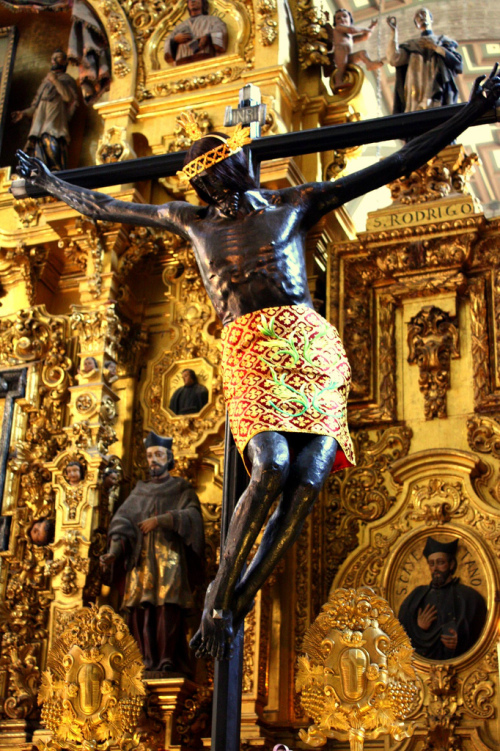
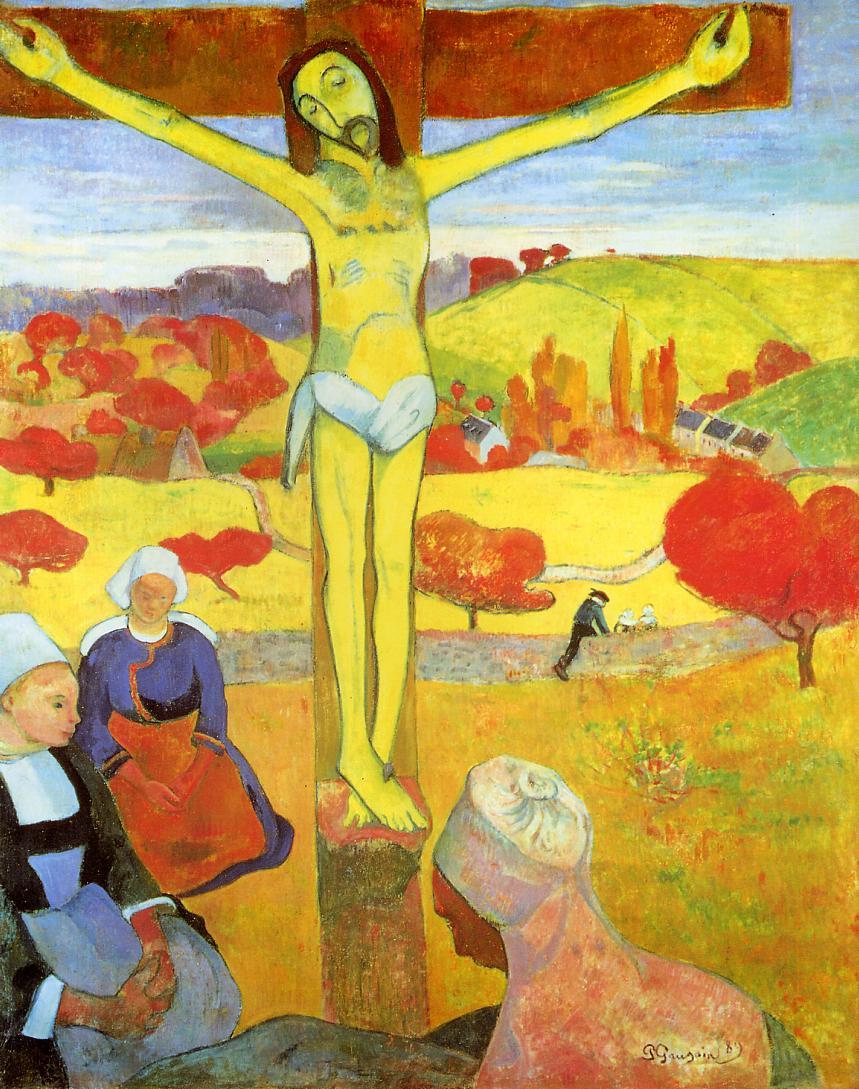
Jesus of Nazareth, King of the Jews

Images of the Crucifixion


(Thanks to Jeffrey Fisher [jeffreyfisher at me.com] for the guest post.)

On Good Friday every year,* Christians around the world commemorate the death by crucifixion of Jesus of Nazareth, rabbi, prophet, Son of God, Son of Man, messiah, and all-around trouble-maker.

The truth is that very little is known of Jesus’ life and teachings from verifiable accounts, but this has not stopped generation after generation of Christians from telling his story, beginning with Jesus’ semi-official biographers, the evangelists of the New Testament. Almost everything we know about the life and teachings of the physical human being Jesus are in those writings, which do not portray him always in compatible ways, and which are almost entirely unconfirmed by any external source. The Roman historian Tacitus mentions (with disdain if not disgust) Jesus’ cult following, as does the Jewish historian and philosopher Josephus, but neither gives us anything to work with as historians (or, for that matter, as theologians). For the record, Suetonius and Pliny also talk about Christians, but these piecemeal sources tell us much more about Roman perceptions of Christians than about Christ and his teachings, or even necessarily Christian beliefs and practices.

What, then, can we reasonably say about Jesus?

It is almost impossible to find universal agreement around anything more than a few basics, including most importantly Jesus’ crucifixion. The Gospels narrate it; Paul the Apostle (who never met Jesus in the flesh, as it were) hangs his theology on it, together with the equally important resurrection; and no contemporary sources (Christian or otherwise) dispute it.

But it’s when we ask why Jesus was crucified that things start to get interesting.

What did he do? The two men he is traditionally said to have been crucified with are commonly understood to be “robbers,” but that they were common criminals is highly unlikely. Crucifixion is a horrible death designed to make a very public statement about the crucified, the sort of thing you use on gladiator-slave rebels like Spartacus, not on pickpockets and roustabouts. The Greek term used for these two men (lestai) is consistent with the description of the released Barabbas as one who had participated in rebellious activities, whose “criminality” was related to his revolutionary business. Moreover, the name “Barabbas” means literally “son of the father,” a purely symbolic and surely entirely fictional name, and that the people choose to have him released indicates their affinity for him as a thorn in the side of the Romans. He is thus contrasted with Jesus, the other son of the father, the peaceful (apocalyptic) revolutionary.

So Jesus would have been crucified as a political criminal, a rebel. This would make sense of accounts of his having been identified by the Romans as “Iesus Nazarenus Rex Iudaeorum”: “Jesus of Nazareth, King of the Jews.” Anyone claiming to be king (and “son of God” was a Jewish way of talking about the king of Israel recorded clearly in Psalm 2), would, if taken seriously, be understood as challenging Roman authority.

Insofar as Jesus seems to have been deliberately poking the Romans’ local running dogs, the Sadducees and the Temple priests, his seizure and termination were surely inevitable. If his teaching is as opposed to violence and unconcerned with “politics” as it seems to have been, it’s hard to believe the Romans would have noticed him without some prodding, this coming not from the “crowd,” but from the leadership (who in Mark and Matthew incite the crowd). Indeed, the priests and scribes look for ways to arrest him when the crowds are not around, because they fear a riot.

If we take the Gospel of Mark at all seriously, Jesus was preaching a new kingdom of God, an apocalyptic redemption of the people of the earth by God’s direct intervention (and with Jesus as the sacrificial pesach lamb). If we take the Gospel of Luke seriously, Jesus spoke in a classic prophetic mode, calling people — Jew and Gentile both — to care for the oppressed of the earth, the poor and the hungry and the helpless. Both Jesuses called for people to be better to each other, to love each other, and indeed to love each other when love was, according to common sense, the foolish thing.

Why would this get you executed?

Well, in itself, it wouldn’t. But the Gospel of Mark tells us of Jesus speaking with a man who realizes that all the animal sacrifices in the world don’t amount to a hill of beans (in that crazy world). When love counts more than sacrifice, we are undermining the Temple. When we go into the Temple, start knocking things over, and say it’s become about robbing the poor and not about loving God and one’s neighbor, we are undermining the Temple. And to undermine the Temple’s authority is also to undermine Rome’s authority, and Rome’s cash flow.

Jesus, like the Essenes he may or may not have associated with, was a purist.

The Temple was full of collaborators and exploiters, the kind seen before in the history of Israel (and berated by prophets like Isaiah and Amos), the kind hated also by the Dead Sea community of apocalyptic purists awaiting a final showdown between God and evil (i.e., the Roman Empire and their local potentates, the Temple authorities).

Jesus, like other Jewish prophets before him, thought that Judaism was about something. That it was somehow about justice and not just about following rules or waiting around for things to get better: that it was about our making the world a better place, and not just making our own lives better.

Start talking that way and get people on your side, and you’re fairly likely to get killed, even twenty centuries later.

* Though the actual date (even the year) of the execution marked by the movable feast of Good Friday is fundamentally unknowable, there are some present-day astronomer types who’d like to sell you April 3, 33 A.D.

On this day..

1965: John Harris, white anti-apartheid martyr

On this date in 1965, John Harris hanged in Pretoria Central Prison for an anti-apartheid bombing: the first and only white person put to death for political crimes in apartheid South Africa.

An idealistic young teacher, Harris planted a bomb in a whites-only section of Johannesburg’s Park Station, intending to demonstrate that whites, too, opposed racial segregation. But the bomb threat he phoned in was not acted upon, and the symbolic device killed a 77-year-old woman and badly burned many others.

5.30 am was the time set for the execution. We were all awake, thinking of John. Not long afterwards the phone rang. Ad Hain answered. The voice said: “Your John is dead.” She recognised the voice as one of the Special Branch men’s.

-John Harris’s widow’s testimony to the post-apartheid Truth and Reconciliation Commission

His death (reportedly with “We Shall Overcome” on his lips) earned affecting tribute and flattering comparisons from his black countrymen.

Mr. Harris, a teacher and a member of the Liberal Party since 1960, is one of those few courageous White men in South Africa who believed passionately in racial equality, identified himself with the oppressed people and suffered persecution. His passport was seized in 1963. He was served with banning orders in February 1964 preventing him from continuing his work with the Liberal Party and the Non-racial Olympic Committee.

Like many others, he became convinced that there was no way left to influence the situation except by clandestine activity. When most of his colleagues in the underground organization, the African Resistance Movement, were jailed or fled the country, he tried to plan a spectacular demonstration. He placed a bomb in the Johannesburg station and telephoned the police so that the area would be cleared. The police did not act promptly and an elderly lady lost her life as a result of the explosion.

Under the prevailing circumstances in South Africa, the means of struggle are for the liberation movement to decide in the light of the conditions in the country.

The responsibility for the consequences lies very much on the rulers of Pretoria who, in defiance of the world and all sense of decency, created a situation which left no other alternative to decent people than to engage in violence.

In mourning the execution of Mr. Frederick John Harris, let me say that it will not be forgotten that in the struggle of the South African people this man, a member of the privileged group, gave his life because of his passionate belief in racial equality. This will serve to strengthen the faith of all those who fight against the danger of a “race war” and retain their faith that all human beings can live together in dignity irrespective of the colour of their skin.

I have recently received a message sent by him from his death cell in Pretoria Central Prison in January. He wrote:

“The support and warm sympathy of friends has been and is among my basic reinforcements. I daily appreciate the accuracy of the observation that when one really has to endure one relies ultimately on Reason and Courage. I’ve been fortunate in that the first has stood up — my ideals and beliefs have never faltered. As for the second, well, I’m not ashamed — I know I’ve shown at least a modicum of the second. ”

When I think of John Harris, the first White martyr in the cause of equality in South Africa, I am reminded powerfully of a great White American, a man who gave his life over a century ago — on December 2, 1859, to be exact — because of his passionate hatred of slavery: I mean John Brown.

People said then that John Brown was eccentric, that he was unwise in attacking the arsenal at Harper’s Ferry, Virginia, and that his act would only strengthen the slave lords.

History has made a very different judgement. Whether the particular act of John Brown was right or wrong, wise or unwise, his cause was right and invincible.

-1965 statement on this date’s hanging by Achkar Marof

Harris’s conviction was secured with the states-evidence turn of one of his compatriots in the white anti-apartheid African Resistance Movement. For this betrayal, John Lloyd earned his freedom and had already moved to England by the time Harris was executed.

Lloyd built a public service life of his own in the UK. However, his bid for parliament on the Labour ticket in the 1990s was scotched when public exposure of his past (as (a) a leftist terrorist; and (b) a betrayer of his fellow-leftists) brought him more baggage than one man can tote in a general election.

Harris’s rough treatment under arrest also continues to haunt his former interrogators in South Africa.

On this day..

1910: Ahn Jung-geun, Korean nationalist

A century go today, Korean independence martyr Ahn Jung-geun (or An Jung-geun) hanged at Port Arthur for assassinating Japanese statesman Ito Hirobumi.

Ahn Jung-geun, who was also a skilled calligrapher (his epigram, “Unless reading everyday, thorns grow in the mouth” is well-known in Korea), actually had a more visionary pan-Asianist agenda than his nationalist byline might initially suggest.

But he militantly opposed Japan’s annexation of the peninsula, and won his hero stature for gunning down Ito in Manchuria.

Ito, for his part, is a national hero in Japan for establishing that country’s parliamentary government and serving as its first Prime Minister.

So, yeah. Still a spot of tension over this incident.

Because the Japanese worried that “if Ahn Jung-geun’s body is handed over to the surviving family or impudent Koreans … it will not be good in the future,” its ultimate deposition has become an enduring historical mystery, with China the current likely suspect. Koreans’ intensified hunt for records pointing to Ahn’s grave has been much in the news during the centennial run-up.

Wherever his bones rest, the Korean patriot (as the saying has it) lives on. He’s even been posthumously promoted by the South Korean army to the rank of “General”.

The recent Korean film 2009 Lost Memories is premised on an radically different alternate timeline starting when Ahn is prevented from killing Ito. Here’s its aesthetically appealing climax, when history is righted.

Scrabbel put the Ahn Jung-geun story to music.

On this day..