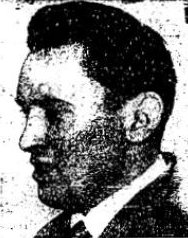
1952: Lennie Jackson and Steve Suchan, of the Boyd Gang

On this date in 1952, Steve Suchan and Lennie Jackson were hanged at Toronto’s Don Jail for the murder of a policeman.


Lennie Jackson (top) and Steve Suchan

Both Such and Jackson were members of the Boyd Gang, a swashbuckling troupe of show-stealing bank robbers in post-World War II Toronto … but in the timeless mold of the folk hero outlaws.

Not hanged with them (or ever; he died in British Columbia in 2002) was the gang’s leader and namesake, Edwin Alonzo Boyd.

The wartime commando legendarily launched his stick-up career by robbing a bank so unrecognizably made-up that he was able to walk back in and change a $20 without notice a few days later.

Boyd’s further exploits (and occasional close scrapes: he seemed to have a gift for not getting hit when people shot back at him) plundering banks, and then escaping jail with the cohorts who became the “Boyd Gang” to plunder some more, threw a splash of color across the headlines of staid 1950s Ontario that moved newspapers.

Toronto historian Mike Filey remarked in this CBC documentary

When the Boyd Gang stuck up a bank and it made the front page, people started cheering for them, because it put some excitement in their lives. And of course the interesting thing about Edwin was, if there is such a thing, he was a “good” bad guy.*


More about this movie here

Jackson and Suchan were two of that group who helped author the Boyd Gang’s most notorious larcenies. And they put a screeching halt on the “fun” of the Boyd gang’s crime spree in March 1952 when they shot a Toronto cop dead at a traffic stop.

Suddenly, it wasn’t just the banksters getting hurt. The crooks couldn’t dodge the ensuing manhunt.

But somehow the quartet of criminals locked up in the Don Jail with this murder rap hanging over them actually managed to escape again, hours ahead of their arraignment. It turned out to be the bandits’ last great exploit, worth only a few days of liberty before they were recaptured.

Jackson and Suchan went from trial to gallows — said to be a badly botched hanging — in mere weeks. Boyd and another gang member named Willie Jackson (the two Jacksons weren’t related) drew long prison sentences from which they were paroled in 1966.

Some Books about Edwin Boyd

* Or was he?

On this day..

1401: Klaus Stortebeker, Victual Brother pirate

On this date in 1401,* “Victual Brother” Klaus Störtebeker was beheaded in Hamburg.

Statue of Klaus Stortebeker. (cc) image from blariog

This legendary freebooter terrorized the Hanseatic League‘s trading channels from Novgorod to London in the 1390s.

He was the most famous of a company of privateers who’d been hired out in 1392 to place their thumb on the scale of Scandinavian dynastic politics** — notably, supplying Stockholm during a siege, from which service they obtained† the nickname Victual Brothers. It stuck, even when operations had moved far beyond the larder.

In the mid-1390s, the “brothers” turned against Danes and Hanse alike, raiding coasts and plundering sea trade from their base in the shattered port of Visby.

Klaus, the most famous of them, is still remembered today “like Che Guevara, a freedom fighter, but also like Robin Hood, because he fights the rich in the name of the poor”:‡ folk hero-outlaws, men of the pirate utopia.

Whatever debunking that legend might invite, its existence speaks to that timeless romance of the road. And then there’s that kernel of truth, or so one hopes: after Stortebeker’s death, the remnants would persist as the Likedeelers, “those who share equally.”

The buccaneer’s end, after capture by Simon of Utrecht, was equally legendary: he’s supposed to have made a scaffold pact with the headsman to spare any of his mates he could walk past once decapitated.

Rising from the chop like St. Denis, the headless trunk of Stortebeker lurched past 11 of them before the executioner himself tripped it up. (In the most embroidered version of this story, Hamburg not only didn’t honor the promise, it executed the executioner when all was said and done. But we’re pretty comfortable saying that once we reach the headless zombie pirate part of the story, the reader has carte blanche to rewrite anything not to liking.)

Drink up me hearties yo ho! “Stortebeker” itself just means, “quaff the mug.”

Klaus Störtebecker is our master
advised by Godeke Michels!
Shoot through the waves like storm, just faster
The Flying Dutchman’s godfather
Gaffer is the ships goblin
Let’s tackle, crew!
Life is bauble!
We are the hell of Helgoland

Our bloody flag is cracking the mast
Rats scurrying on the floor
A skeleton is our guest
On the sail there are strange shadows
The mermaid is swimming in our wake
Laugh, crew!
Life is bauble!
Still ruling is the hell of Helgoland

And when our ship makes its last run
Laugh while like a coffin she goes down
We die an ancient pirate’s way
Today we fight, tomorrow we drown
In green algae and white sand
Land ho, crew, land!
Life is bauble!
Such dies the hell of Helgoland

-Folk song honoring Klaus Stortebeker
(translated here)

* As often for events at this distance of time, the dates are a little bit shaky; 1400, rather than 1401, has been proposed for the actual year of Stortebeker’s execution; October 21 rather than October 20 is also given on some sites. Folklore more so than almanac blogs has the luxury of indifference to such particulars.

** The Victual Brothers were initially retained to oppose the adroit Danish Queen Margaret. She would face (and brush aside) even weirder challenges to her rule en route to lashing together the Kalmar Union under Danish regional hegemony.

Alternate explanation: food-based euphemisms for piracy trace to armies’ victual officers, and their unscrupulous methods of filling the mess hall.

‡ In a continuing spirit of democratic larceny — or as a gang symbol for the local Hell’s Angels, whatever — our man’s alleged skull was stolen from a Hamburg museum earlier this year.

On this day..

1846: William Westwood, aka Jackey Jackey

On this date in 1846, the Australian outlaw William Westwood — better known as Jackey Jackey — was hanged with 11 others for a prison riot/escape attempt that claimed several guards’ lives.

“To the old hands,” relates George Boxall in this volume of bushranger folklore, “he was always the gentleman bushranger.”

More legends have collected round the name of Jackey Jackey than round that of any other of the bushrangers, and many of them are obviously variants of the stories told of the historical highwaymen of England. For instance, Jackey Jackey is said to have bailed up the carriage of the Commissary. When he discovered that the Commissary’s wife was inside he dismounted, opened the door and, sweeping the ground with his cabbage tree hat, as he bowed low before her, he invited her to favour him with a step on the green.* He rode incredible distances in incredibly short periods of time** … [and] never did anything mean or brutal or unworthy of a gentleman bushranger, until he was almost goaded to madness by the cruel discipline of Norfolk Island.

Transported to Australia at the age of 16, Jackey Jackey made that reputation with only a scant few months in the bush. The Victorian era was already underway in our young outlaw’s mother country; the day of the highwayman had long since given way to the day of romanticizing the highwayman.

Only on the empire’s distant fringes could the profession persist; there, men like our day’s principal self-consciously took their chivalrous forebears as their templates: Jackey Jackey thrashed a confederate who did violence to a woman, and threatened to murder the man if they should meet again.

Jackey Jackey had only a few months out in the bush in 1840-41 to trace the outlines of the gentleman bandit figure he aspired to. Caught in an inn in 1841, he spent the next several years exercising that other great craft of the folklore criminal: escape.

A cycle of jailbreaks, fleeting moments of liberty, recaptures, higher-security lockups, and increasingly desperate jailbreaks eventually landed at Norfolk Island, where “the treatment of the prisoners in the island was rigorous in the extreme, and may aptly be described as savage.” (Boxall, again)

Just a few years before Jackey Jackey’s death, they had been savage enough to provoke inmates desperate for the release of death to draw lots between the privileges of being murdered by a fellow-prisoner and hanging as that murderer.

Norfolk experimented with liberalizing its regimen in the early 1840s, but it was in rollback mode when our bushranger landed there. The steady removal of the minute privileges that make incarceration bearable — the right to grow a few potatoes; access to one’s own cooking tin and utensils — eventually triggered a similar suicidal mental break … but this time, on a riot scale.

Jackey Jackey made the following speech: “Now, men, I’ve made up my mind to bear this oppression no longer ; but, remember, I’m going to the gallows. If any man funks let him stand out. Those who wish to follow me, come on.”

A policeman named Morris was standing in the archway or entrance to the yard, Jackey Jackey rushed forward, struck him a fearful blow with an enormous bludgeon, and knocked him down. A large mob of the prisoners snatched up such weapons as came to their hands and followed him.

there were about eighteen hundred prisoners on the island, and of these, sixteen hundred were among the rioters. The soldiers numbered only about three hundred, but their discipline enabled them to overawe the vastly superior force, numerically, opposed to them. Perhaps the habits of obedience and submission, so long enforced on the prisoners, may have had some influence. Perhaps, even among this herd of desperate and reckless men, the sight of the soldiers standing firmly with their guns presented ready to fire may have instilled some fear. However this may have been, there was no fight. The rebels retired slowly and unwillingly to the Lumber Yard, where they permitted the soldiers to arrest them one after the other without making any show of defence until one thousand one hundred and ten of them were placed “on the chain.” Perhaps Jackey Jackey and the more violent of his followers may have thought that they had done sufficient to ensure them that death on the gallows which was the avowed object of their rising, while the majority had been so demoralised by official brutality as to be utterly indifferent as to what might become of them.

Twelve suffered death on the Norfolk Island gallows this date for the murder of the guard, with headline-grabber Jackey Jackey exonerating four of his fellow-sufferers in his dying statement.


The remains of the gallows area at the Norfolk Island gaol, gorgeously captured by Canberra photographer Allyeska. (Image used with permission.)

The bitter letter our despairing bushranger wrote to a gaol chaplain, meanwhile, could have been posted from many a modern penitentiary.

I was, like many others, driven to despair by the oppressive and tyrannical conduct of whose whose duty it was to prevent us from being treated in this way. Yet these men are courted by society; and the British Government, deceived by the interested representations of these men, ontinues to carry on a system that has and still continues to ruin the prospects of the souls and bodies of thousands of British subjects … instead of reforming the wretched man, under the present system, led by example on the one hand, and driven by despair and tyranny on the other, goes on from bad to worse, till at length he is ruined body and soul. Experience, dear bought experience, has taught me this. In all my career, I never was cruel I always felt keenly for the miseries of my fellow-creatures, and was ever ready to do all in my power to assist them to the utmost, yet my name will be handed down to posterity branded with the most opprobrious epithet that man can bestow. … this place is now worse than I can describe. Every species of petty tyranny … is put in force by the authorities. The men are half-starved, hard worked, and cruelly flogged. … Sir, out of the bitter cup of misery I have drunk from my sixteenth year ten long years and the sweetest draught is that which takes away the misery of living death; it is the friend that deceives no man; all will then be quiet no tyrant will there disturb my repose, I hope, William Westwood.†

(Boxall’s History of the Australian Bushrangers is available from archive.org here.)

* This legend is lifted wholesale from the c.v. of English highwayman Claude Duval.

** Warp-speed horsemanship features in many English outlaw legends, including those of Dick Turpin and the lesser-known John Nevison.

† Death as an escape from injustice and misery: another timeless theme.

On this day..

1858: Qualchan

“Qualchan came to see me at 9 o’clock, and at 9:15 he was hung.”

George Wright

It was this morning in 1858 that the gaily dressed Yakama Indian guerrilla Qualchan turned himself in to his Anglo hunter, and was promptly put to death.

Wright was prosecuting the Yakima War in the Pacific Northwest — another characteristic Indian conflict featuring a formerly remote tribe suddenly cursed with valuable land by the discovery of gold.

Qualchan (sometimes “Qualchen”, “Qual-Chen”, or “Qualchien”) was among the Yakima chieftains resisting “encouragement” to give up that part of their territory most desirable to white settlers, and eventually, Qualchan killed encroaching white miners and made himself an outlaw.

For more than two years, the army hunted Qualchan in vain as he harried white settlers around Washington — or, as Wright put it,

Qual-Chen … has been actively engaged in all the murders, robberies, and attacks upon the white people since 1855, both east and west of the Cascade Mountains … committing assaults on our people whenever the opportunity offered.

Late in the game, the American military had been reduced to a Bushian with-us-or-against-us posture:

Kamiakin and Qualchan, cannot longer be permitted to remain at large or in the country, they must be surrendered or driven away, and no accommodation should be made with any who will harbor them; let all know that asylum given to either of these troublesome Indians, will be considered in future as evidence of a hostile intention on the part of the tribe.

The expedient that induced this potent commando to throw his own life away was the capture of Qualchan’s father, Owhi, rather dishonorably effected on an invitation to parley, then parlayed into a threat to execute the hostage lest the wanted Yakima produce himself.

“I thought then the worst that could happen would be a few months’ imprisonment,” remembered Qualchan’s wife (who was also present). “You may imagine my terror and consternation when I saw that they were making preparations to hang my husband. I first thought it was a huge joke, but when I saw the deliberateness of their preparations, the fullness of their treachery and cowardice became apparent.”

And since the U.S. was maintaining that draconian view of Qualchan’s collaborators, Wright followed up his triumph with summary hangings over the next several days of several more Palouse. By the month’s end, he was prepared to declare the Indians “entirely subdued.”

Wright’s rough peace caused the nearby creek in eastern Washington to be christened “Hangman’s Creek”, though there’s been a tendency to steer away from that frightful name in recent times. But what better way to honor an indigenous foe of colonial land conquest than by naming a golf course for him?

The unfolding fate of the Yakimas is further explored in the public-domain book Ka-mi-akin, the last hero of the Yakimas, whose title character was Qualchan’s uncle.

On this day..

1901: “Black Jack” Tom Ketchum, who was left in three pieces

On this date in 1901, a two-bit outlaw from a vanishing frontier made his reservations for hell.

Tom Ketchum — who had become known as “Black Jack” when misidentified with another hombre he resembled — was the last man to hang in America for attempting to rob a train. Given the way the authorities in Clayton, N.M., conducted the job, that’s probably for the best.

This Texas-born outlaw enjoyed a colorful career in the 1890s Southwest plundering trains, killing folk, and other distinctively American pastimes. His name attaches to the [in]famous Hole in the Wall Gang.

He was finally caught attempting a dangerous one-man train robbery, when a conductor (taking part in his third stickup, and tired of being on the wrong end of the gunbarrel) got the drop on Ketchum and winged him with a shotgun. Too weakened by his injury to escape, Ketchum surrendered himself to the law, and his wounded arm to the surgeons.

The un-amputated remainder belonged to Clayton, N.M. — New Mexico Territory, that is, which was not yet a state at this time, but was keen on making an example to stanch the tide of train robberies.

(Formally, the charge that hung Ketchum was “felonious assault upon a railway train”; he was the only person executed for this offense before the Supreme Court decided that a hanging crime needed more victims than just an iron horse. This jurisprudential advance might not have done Black Jack very much good anyway, since neighboring Arizona had also put in an extradition request for murder.)

So far, so good.

Then, they actually dropped him.

When the body dropped through the trap the half-inch rope severed the head as cleanly as if a knife had cut it. The body pitched forward with blood spurting from the headless trunk. The head remained in the black sack and flew down into the pit.

SOME MEN GROANED.

Some men groaned and others turned away, unable to endure the sight. For a few seconds the body was allowed to lie there half-doubled up on its right side, with the blood issuing in an intermittent stream from the severed neck as the heart kept on with its mechanical beating. Then with cries of consternation the officers rushed down from the scaffold and lifted the body from the ground. It was only then apparent exactly what happened.

The drop of the body was seven feet and the noose was made so it slipped easily. Ketchum was a heavy man, and the weight of the body, with the easy-running noose, caused the rope to cut the head cleanly off. Dr. Slack pronounced life extinct a little over five minutes from the time the body dropped through the trap. It is stated too much of a drop was given for so heavy a man.

Just so we’re clear: a seven-foot drop is much, much too far for a man of Ketchum’s 190-plus pounds. Maybe they were distracted by rumors of an escape attempt.

The newspaper account above cites much more forgettable scaffold-talk from Ketchum, but we can’t help but find charm (and obviously, black humor) in his alleged last words,

I’ll be in hell before you start breakfast, boys! Let her rip!

Fictional? If so, they’re more like what Ketchum’s last words ought to be. Although let St. Peter‘s ledger reflect that Ketchum was a decent enough chap to post a letter to President McKinley on the morning of his own execution copping to several robberies for which other people were imprisoned.

Initially buried — naturally — at Clayton’s Boot Hill, this infernal denizen’s grave can now be found (and more than a century on, tourists and admirers do find it) at Clayton Memorial Cemetery.

On this day..

1670: Claude Duval, gentleman highwayman

It’s been 340 years since the immortal highwayman Claude Duval (or Du Val, or Du Vall) went to the Tyburn gallows and was turned off into legend as the ne plus ultra of English gentleman thieves.

Duval, actually, was French, an import to Isles in the train of some forgotten noble migrating with the restoration of royal prerogatives.

On the English highway, this formerly impecunious retainer coruscated as a knight of the road, the very model of the chivalrous outlaw against whom the likes of Dick Turpin would be compared to disadvantage. Macaulay recorded

how Claude Duval, the French page of the Duke of Richmond, took to the road, became captain of a formidable gang, and had the honour to be named first in a royal proclamation against notorious offenders; how at the head of his troop he stopped a lady’s coach, in which there was a booty of four hundred pounds; how he took only one hundred, and suffered the fair owner to ransom the rest by dancing a coranto with him on the heath;


William Powell Frith‘s painting (1860) of Claude Duval dancing with his prey.

how his vivacious gallantry stole away the hearts of all women; how his dexterity at sword and pistol made him a terror to all men; how, at length, in the year 1670, he was seized when overcome by wine; how dames of high rank visited him in prison, and with tears interceded for his life; how the king would have granted a pardon, but for the interference of Judge Morton, the terror of highwaymen, who threatened to resign his office unless the law were carried into full effect; and how, after the execution, the corpse lay in state with all the pomp of scutcheons, wax lights, black hangings and mutes, till the same cruel judge, who had intercepted the mercy of the crown, sent officers to disturb the obsequies. In these anecdotes there is doubtless a large mixture of fable; but they are not on that account unworthy of being recorded; for it is both an authentic and an important fact, that such tales, whether false or true, were heard by our ancestors with eagerness and faith.

Gillian Spraggs justifiably observes that no matter how genuinely gallant the brigand, his profession entailed relieving others of their rightful produce by main force. But then, the same could be said of the lords of the realm.

No, although Duval’s legend invites debunking, this must be for another blog.

We take Duval here at his mythological acme: he is the patron saint of the early modern bandit, the Superman of English outlawry, succoring with the fantasy of freedom upon the road the thousands of porters and scullery maids and apprentices chained to their oars below-decks upon Britannia’s ship of state.

What matter the rest?

This day, we toast Claude Duval, the Knight of the Road, in the manner of the fetching inscription (since destroyed by fire) under which he was reportedly buried:

Here lies DuVall: Reder, if male thou art,
Look to thy purse; if female, to thy heart.
Much havoc has he made of both; for all
Men he made to stand, and women he made to fall
The second Conqueror of the Norman race,
Knights to his arm did yield, and ladies to his face.
Old Tyburn’s glory; England’s illustrious Thief,
Du Vall, the ladies’ joy; Du Vall, the ladies’ grief.

Part of the Themed Set: Resistance and Rebellion in the Restoration.

On this day..

1689: Karposh, Macedonian rebel

On an uncertain date in early December (or possibly late November), the Macedonian* rebel Karposh was executed at Skopje.

The Great Turkish War had seen the Ottomans advance to the gates of Vienna, but an alliance of European powers pushed the Mohammedan back.

Their crisscrossing armies roiled the Balkans, creating the opportunity for a bit of ill-fated separatism.

Arambasha [a title, not a name] Karposh raised a native Macedonian rebellion (detailed account of it here) that waxed and waned with the fortunes of the Austrian army. In his brief heyday, he was acclaimed “Prince of Kumanovo“.

But a November 1689 counteroffensive seriously harshed that vibe; the Turks overran his force and drug Karposh back to Skopje where he and a couple hundred fellow Macedonian captives are said to have been put to death by impalement on the lovely Stone Bridge over the Vardar. (Other versions of this story cite, less picturesquely, hanging.)

You can still see this landmark today in Skopje … capital of the now-independent Macedonia.

* Lest I wade carelessly into the Balkan ethnic crossfire, I hasten to declaim that “Macedonian” here refers to the geographic environs roughly coincident with the present-day Republic of Macedonia. No representation as to the man’s ethnicity or his project is intended, or attempted.

On this day..

1803: Johannes Bückler, “Schinderhannes”

On this date in 1803, the famous German bandit “Schinderhannes” and 19 others of his gang were efficiently guillotined in French-occupied Rhineland.

Schinderhannes with mistress Juliana Blasius and their child.

As low-born as they come, Johannes Bückler (English Wikipedia link | German) hailed from a family of executioners and knackers (his appellation means “John the Knacker”).

But this outcast was born to command, and in the wild Rhineland at the close of the 18th century, his audacity, charisma, and deft cruelty made him a legendary bandit king.

He stole, he blackmailed, he slipped his fetters … “he seemed to contest French authority” recently projected by the revolutionary citizen-army, and he preyed heavily on unpopular Jewish merchants, all of which gave Bückler purchase on folk hero status with the boldness to hold a public “robber’s ball” at the ruined castle his band occupied.

His legend grew in his own lifetime, and as such things do, it inflated quite past any capacity of its originator’s character to support.

When things got too hot on the French side of the Rhine, he ducked over the frontier to the Holy Roman Empire in the east, but was nabbed attempting to lay low in the imperial army under an assumed name, and handed back to the French.

The authorities turned his outlaw gallantry to good effect (or at least, that’s the cover story his apologists have made for his stool pigeoning) by threatening to come down on the mistress who bore him a child, leading Schinderhannes to get her off with a slap on the wrist by giving up his bandit brethren.

And with French law came French execution technology, whose proliferation in the train of Napoleon’s Grande Armee would bequeath the German condemned death by the “falling axe” down to Hitler’s time and even after.

A spectacle here as it was in France, tens of thousands turned up in Mainz this date in 1803 for what sounds like an anticlimactic six-minute show of a score of Schinderhannes’ gang losing their heads to the mechanical contraption.

Scottish scribbler Leitch Ritchie helped convey to posterity the legend with Schinderhannes, the robber of the Rhine, which romantically celebrates a knave who must have been less lovable to those who knew him from the business end of his blade. These, nevertheless, are all long gone, and Ritchie has the authority of historical mythologizing to vindicate his text’s last eulogy with its hero’s foot upon the scaffold:

The bandit-chief preserved his intrepidity to the last, and left to other times, unsullied by many of the basenesses of his tribe, the name of SCHINDERHANNES, THE ROBBER OF THE RHINE.

He sure did. From the practically mandatory ballad …

… to the stage …

… to the screen

… to vicious-looking Cambrian anomalocarid Schinderhannes bartelsi

… the outlaw has long outlived his guillotining, to the profit of the tourist trade in his former stomping-grounds.

On this day..

1726: The Gypsy outlaws of Hesse-Darmstadt

On November 14 and 15, 1726, more than 20 Gypsy outlaws of Hesse-Darmstadt were executed en masse.

Detail view (click for full image) of the execution of the Gypsies at Giessen.

Gypsies in Europe still suffer ample discrimination today, so it’s little surprise to find early modern Europe thick with anti-Gypsy legislation.

No surprise, Angus Fraser writes in The Gypsies, this sort of thing

did in the end produce enormous changes in the life of the Gypsies in Europe. To survive, they had to adapt; they also had to make the most of the loopholes in a system which expressly sought, by denying them food and shelter, to make honest living impossible. Some found a degree of security in inaccessible waste-lands and forests. Some exploited differences in jurisdiction and the spasmodic nature of the authorities’ activity, by making a home in frontier regions … Many broke up into small groups when it was necessary to avoid attention; conversely, others gathered into larger bands to facilitate self-protection … sometimes resorting to violence. Certain Gypsy brigands gained notoriety in eighteenth-century Germany, large tracts of which were overrun with robber companies of mixed and varying origins. Some of these had a strong Gypsy element: numbering perhaps 50 or 100, armed and defiant, they stole for their sustenance and skirmished with the soldier-police sent to confine them.

“The poor Gypsies,” one poor Gypsy lamented to a contemporary German author,* “also want to have the right to live.”

Like the Gypsies’ other necessities, that right went as far as they themselves could secure it … and when secured by brigandage, it eventually brought down an overwhelming response.

The German author in question, J.B. Weissenbruch, relates the tale of a particularly notorious pack of Gypsy outlaws under the leadership of rough characters names of Antoine la Grave, aka “der Grosse Galantho” or “the Great Gallant”, and Johannes la Fortun, aka “Hemperla”.

These were no romantic Johnny Depp-esque Gypsies, at least according to Weissenbruch. Besides “their disposition to wandering, to idleness, to theft, to polygamy, or rather promiscuous license” — well, okay, sort of romantic — these went toe to toe with soldiery dispatched to corral them and had the chops to “take military possession” of a village for the purpose of exacting some corporal revenge.

We know where this ends up.

Though the Great Gallant escaped punishment,† Hemperla and 20-plus of his band (different sources quote slightly different figures) enjoyed the pleasures of the thumbscrew and the Spanish boot to secure confessions necessary to license their sentences. Some were hanged, others (including women) beheaded, and Hemperla and a few comrades were broken on the wheel.

* Cited here; regrettably, I have not been able to locate a browsable original of the Weissenbruch text.

** Same story in yet another Google books freebie.

This German book says his rank got him off the hook, but he lost his head just the same in 1733.

On this day..

1796: Lesurques, wrongly, and Couriol, rightly, for robbing the Lyons Mail

On this date* in 1796, France enacted what was long held to be one of its most notorious miscarriages of criminal justice by cutting off the head of Joseph Lesurques.

Lesurques was taken for the one of a gang who had sensationally robbed and murdered a mail courier early in 1796, and on the basis of slight eyewitness testimony condemned to die. The only reason he was associated with the crime in the first place was because his friend had been mistakenly accused, and then released, and Lesurques accompanied him to the court to retrieve the friend’s papers where he was “recognized.”

Eyewitness testimony having juridical pull far in excess of its dependability,** this “recognition” was worth the man’s life.

The famous French Revolution executioner Sanson was still in the game at this point, and his grandson (not yet born at this time) used the family notes to pull together this quasi-firsthand account in Memoirs of the Sansons. It’s a tale familiar to any present-day wrongful conviction scenario, of bad evidence snowballing, a blinkered prosecutor intent on conviction, pettifogging appellate authorities, and grim, relentless bureaucratic momentum.

(The names the Memoirs render as “Courriol” and “Dubosc” are also given as “Couriol” and “Dubosc” in other sources.)

the instructing magistrate … instead of imitating the prudence of his Parisian colleague and trying to discover the truth, applied himself to the collection of proofs of the guilt of the prisoners …

Fifteen witnesses on behalf of the defence proved an alibi in favour of Lesurques, eighty-three others spoke highly of his well-known respectability; but their evidence went for nothing in opposition to those who, with singular pertinacity, maintained that Lesurques was one of those who had been seen lurking near the scene of the murder on the night when it was committed …

On hearing his condemnation, Lesurques, who had been firm and collected throughout the trial, lost his self-possession, and raising his hands to heaven he exclaimed:

“The crime which is imputed to me is indeed atrocious and deserves death; but if it is horrible to murder on the high road it is not less so to abuse the law and convict an innocent man. A day will come when my innocence will be recognised, and then may my blood fall upon the jurors who have so lightly convicted me, and on the judges who have influenced their decision!”

On the 9th of Brumaire, year 5 (October 30, 1796), my grandfather and father proceeded to the Conciergerie, and found the convicts in the hall, through which so many had passed during the Reign of Terror. David Bernard† was in a state of utter prostration; Courriol, on the contrary, was excited. As to Lesurques, he was as calm and fearless as ever. When he saw my grandfather, whose white hair sufficiently designated him as the chief executioner, he stepped up to him, and said, holding out a sealed letter:

“Citizen, I hope for the honour of human justice that your functions do not often compel you to shed the blood of a guiltless man; I hope, therefore, that you will grant the last request of a man who is about to suffer for what he has not done. Be good enough to keep this letter, which may hereafter contribute to the restoration of the honour of my wife and poor children, whereof they have been so unjustly deprived.”

While one of his assistants was cutting the unfortunate man’s hair, my grandfather read the paper Lesurques had just given him. It was a letter addressed to Dubosc, the man in whose place he was condemned. It ran as follows:

“To Citizen Dubosc.

“Citizen Dubosc, — I do not even know you, and I am going to suffer the death which was reserved for you. Be satisfied with the sacrifice of my life. Should you ever be brought to account, remember my three children and their mother, who are disgraced for ever, and do not prolong their agony. Confess that you are the man.”

All preparations were now concluded. Lesurques, of his own choice, was dressed in spotless white, symbol of his innocence. He was the first to take his place in the cart; Courriol followed him, and Bernard, who had fainted, was deposited on the straw. Then began the most dismal and extraordinary journey that ever was made from the Conciergerie to the Place de Greve. Lesurques and Courriol stood in front. At every turn of the wheel, Courriol exclaimed in a piercing voice:

“I am guilty! Lesurques is innocent!”

And for twenty minutes, that is during the whole way to the guillotine, he perseveringly repeated his awful protest against justice. The crowd was horrified, and there were few who did not believe the murderer who confessed his crime, but who proclaimed his companion’s innocence. Courriol again repeated his words at the foot of the scaffold with extraordinary energy and vehemence, and the thump of the knife but just covered his supreme shriek:

“Lesurques is innocent!”

The judicial authorities have perseveringly refused to recognise this flagrant miscarriage of justice. And yet the innocence of Lesurques was amply demonstrated a short time after his execution: all the real murderers of the courier of Lyons designated by Courriol were captured; Dubosc himself, whose fatal resemblance to Lesurques was the cause of the latter’s death, was taken and tried … he was executed just four years after Lesurques …

The Lesurques heirs were left paupers by the state’s punitive confiscation of the “bandit’s” effects; after a quarter-century (during which the widow died in a madhouse), they were at least able to recoup their material loss, but although repeatedly challenged, the conviction itself was never reversed.

Judicial and literary skirmishing over the Lesurques matter continued for decades, gradually forming into a general consensus (whatever the courts might admit) that the man was wrongly accused.

As a result, Lesurques remained a potent symbol of capricious criminal justice overreach throughout the 19th century and into the 20th: this 1874 reader, Famous Cases of Circumstantial Evidence, has a full chapter on the case; a popular Victorian play titled The Lyons Mail was translated into a now-lost 1915 silent film and a 1931 talkie … albeit with a happy ending.

To a certain, inevitably well-represented, authoritarian demographic, any credence given to the self-evident proposition that wrongful convictions happen smacks of effrontery towards betters, and the Lesurques case was no exception … especially when paired with the coincident low ebb of public esteem for Power during the Dreyfus affair, which hit while The Lyons Mail was in vogue.


An advert insert in an unrelated 1903 book plumps a “Lesurques was guilty” position, riffing on the then-current Dreyfus controversy (“recent efforts in France to bring about the revision of a celebrated case”). This book is listed, but unavailable, on Amazon.com.

L’ affaire Lesurques never (so far as I can determine) reached a resolution; it simply faded away, 140 years or so after its namesake lost his head.

A late (1930) review of its particulars in the Journal of the American Institute of Criminal Law and Criminology (“The Moving Story of the Lyons Stage,” by Max Radin of UC-Berkeley, May 1930) proceeds with ingenuousness embarrassingly unbecoming a professor of the law.

Judicial errors do not occur in the United States. [!!!] Under these circumstances, we can look with some satisfaction on times and places in which this happy condition did not prevail. If in the cycle of existences our perfection should ever become visibly tainted, it may happen that we shall hang men or electrocute them and subsequently regret the fact. Perhaps some one will then recall the moving story of the Lyons stage.

Sounds like it’s ready for a revival.

* A few sources say March 10, 1797, but the most and best clearly lean to October 30, 1796.

** “Juries have an unfortunate faith in the accuracy of eyewitnesses,” William Davis Gross observes. “The propensity for blunder is so great that it is nearly equal to all other forms of error combined.” (“The Unfortunate Faith: A Solution to the Unwarranted Reliance Upon Eyewitness Testimony,” Texas Wesleyan Law Review, spring 1999)

† Bernard is a footnote in the story, but he seems to have received a raw deal himself: he was the liveryman who procured the horses for the highwaymen, but did not participate in the crime. Sanson passingly refers to Bernard as “but slightly guilty.”

On this day..