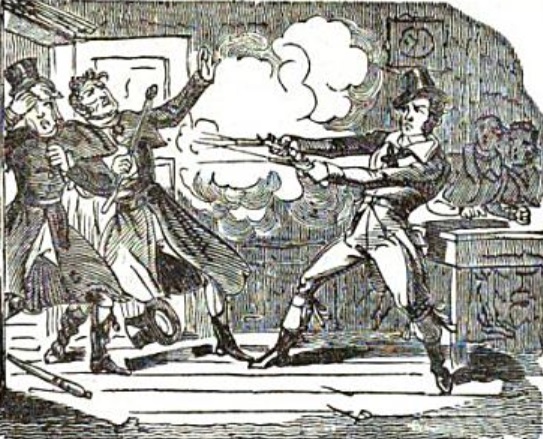
1784: Richard Barrick, Massachusetts highwayman

(Thanks to Robert Elder of Last Words of the Executed — the blog, and the book — for the guest post. This post originally appeared on the Last Words blog. Fans of this here site are highly likely to enjoy following Elder’s own pithy, almanac-style collection of last words on the scaffold. -ed.)

I then went to Boston, and got in company with one John Sullivan … we went to Winter’s-Hill, and there robbed one Mr. Baldwin, for which crime Sullivan and myself are to suffer Death, as being the just reward of our demerits.

— Richard Barrick, convicted of highway robbery and murder, hanging, Massacusetts. Executed November 18, 1784

Richard Barrick was born in Ireland in February 1763 and brought up in the Foundling Hospital. He was an apprentice to a silk-weaver and lived with him for three years. But during those years, he was treated poorly and so he eventually left the silk-weaver and joined a gang of thieves. When he was caught, the authorities agreed to pardon him if he entered on board one of his Majesty’s ships. After arriving in New York, Barrick and some others robbed many people and became a notorious and wanted man. He was an accomplice to murder of a man they first robbed. He was eventually caught by a British Colonel and convicted.

On this day..

1460: Tiburzio di Maso, Roman brigand

The Roman outlaw-slash-rebel Tiburzio di Maso was executed on this date in 1460, with seven other members of his band.

Tiburzio’s father had been put to death seven years before for joining in the anti-papal intrigues of his kinsman (by marriage) Stefano Porcaro. Theirs was the old populist dream of Cola di Rienzi, to throw off the depraved overlordship of Rome’s patricians and resume the tribune of the people.

Their enemy in this endeavor, to speak a bit more specifically, must be the pope himself — for as Gibbon observed, “the policy of the Caesars has been repeated by the popes; and the bishop of Rome affected to maintain the form of a republic, while he reigned with the absolute powers of a temporal, as well as a spiritual, monarch.” It was this throne that had destroyed Tiburzio’s father, and upon which he proposed to revenge himself.

White breast, sweet tongue, kind eyes and ready wit! You marble limbs, full of vigour, when shall I see you again? When again shall I bite those coral lips, or feel again that tremulous tongue murmuring in my mouth, or ever handle those breasts.

Why, Achates, you have scarcely seen this woman. Where she is most feminine, there she is most lovely. I wish you could be me! Not the beautiful wife of Candaules, King of Lydia, was more beautiful than she. I cannot wonder that he wished to show his wife naked to his friend, to give him the greater pleasure. I would do the same myself. If it were possible, I’d show you Lucretia naked, for otherwise I cannot describe to you how beautiful she is, nor can you imagine how full and substantial was my pleasure. But rejoice with me, because my delight was greater than words can tell.

-[the man who would become] Pope Pius II, The Tale of Two Lovers

By the time the son Tiburzio came to avenge his father,* the pope in question was Pius II, once so much the gentleman-humanist that he is the only pontiff to byline an epistolary erotic novel. Come election to the seat of St. Peter, however, he had predictably discovered a newly illiberal affinity for the overweening prerogatives customarily asserted by his office

Among the lesser of these prerogatives was the option to make his residence in the less miasmatic confines of his native Siena, and his extended absence from Rome surely gave some air by which the brash youth could kindle a rebellion. Tiburzio attracted a gang who alternately caroused together and sallied together as highwaymen on the famously dangerous roads. “If in Porcaro the democratic movement had already generated to the level of Catiline, in Tiburzio and Valeriano, the heroes of 1460, it had sunk to that of mere brigandage,” wrote the German historian Ferdinand Gregorovius. (Via)

“Mere” brigandae posed a real danger to papacy’s safety, however, enough so that the governor’s running skirmishes with this most dangerous gang eventually required the returned of Pope Pius to steady the situation: a captured informant gave information that Tiburzio’s band was in league with Ghibelline nobles and had even arranged with the condottiero Jacopo Piccinino to throw open the city gates for his army.

But our man, well into the history-repeating-as-farce cycle, squandered his opportunity and his life by recklessly sallying into the city from refuge in nearby Palombara once one of his party was arrested. The Roman masses turned deaf ears on his calls to arms, and papal gendarmes captured Tiburzio and several misadventuring comrades. Without the inducements of torture, he too admitted the conspiracy with Piccinino — and the whole bunch hanged together on Capitoline Hill.

* Dad’s foe was Pope Nicholas V, who died in 1455.

On this day..

1781: Gaspard de Besse, social bandit

The French robber Gaspard de Besse was broken on the wheel in Aix-en-Provence on this date in 1781.

From a cave in the Esterel Mountains looming over the French Riviera, Gaspard raided the ample traffic wealthy merchants sent to and from the Mediterranean and Italy. He established a Robin Hood-esque “social bandit” profile by dint of his targets and populist provocations like, “the two scourges of Provence are the mistral and the parliament!”

Legend holds that he was unfailingly courteous in his raids and never killed those he preyed upon.

No surprise, he did not enjoy a like deference once one of his gang betrayed him. Hopefully amid the limb-shattering blows of the executioner he could console himself with the prospect of posterity’s renown.

On this day..

1736: Herry Moses, Jewish gangster

On this date in 1736, a Jewish gangster named Herry Moses was hanged as a highwayman at Vlaardingen, Netherlands.

Our source for Moses is Florike Egmond’s “Crime in Context: Jewish Involvement in Organized Crime in the Dutch Republic” from Jewish History, vol. 4, no. 1 (Spring 1989) — for whom Moses forms an window into the criminal life of Netherlands Jews. According to Egmond, Moses hailed from Frankfurt am Main, then an imperial Free City. He had no property or station, and spent the first decades of his life as a wandering beggar, a tinker, and one might guess a petty thief where the opportunity arose.

By 1723, when Moses was around 37 years old, he had washed up in the Dutch Republic — one of many Jews who had migrated to that more tolerant climate from Germany and points east.

In the Low Countries, these arrivistes filled many niches but one of the most noticeable was a burgeoning network of Jewish criminal gangs; per Egmond, in this period “between one-half and two-thirds of all Ashkenazim convicted of burglaries, theft, or robberies had been born outside the Dutch Republic.” The documentary record is far from thorough, but court cases suggest to Egmond the emergence of a small Jewish underground in the mid-17th century following the Thirty Years War, which was bolstered by subsequent immigration waves.

Jews filled plenty of more legitimate places too, of course — and we notice how diligently free of moral panic is the court that handles this minority outlaw. But the Dutch Republic endured in this period the decline of her former trading preeminence, and for the glut of new arrivals — who were sometimes legislated out of certain protected economic spheres — less legitimate occupations could not help but appeal.

Jewish gangs were accordingly quite prominent among the robbers and cutthroats prowling the roads; among other things, they were noteworthy for their willingness to raid churches, which Christian gangs tended to shy from attacking.

Similar “names, geographical background, occupation, travels, meeting places, and variable associations” populate the identifiable records of Jewish criminals, in Egmond’s words. They “were Ashkenazim, most of them poor, and a large majority were first-generation immigrants from Eastern and Central Europe.” Just as with Herry Moses.

So far as I have been able to tell, the annals do not supply us with the why in his strange story … which only deepens the intrigue of the what. Egmond:

In 1735 Herry Moses, alias Abraham Mordechai or Hessel Markus, confessed to a crime he did not commit. According to his version of the story, he murdered a Roman Catholic priest in his house in the Dutch town of Weesp and robbed him of aboug 3,000 guilders. The murder and theft were real enough, and a less scrupulous court than the schepenbank of Weesp (a high jurisdiction some twenty kilometers east of Amsterdam) might have sentenced Herry Moses to death on the strength of his confession alone. Adhering strictly to criminal procedure and confronted with some slight inconsistencies in Moses’ confession, the court tried to obtain more information. Could Moses have murdered the priest, as he declared, when standing behind the bedstead? (There was no room for a man to stand there.) Was he lying when he denounced several Jews and a Christian as his accomplices in both the murder and a burglary at The Hague? His descriptions proved accurate enough to track down some of these men and arrest them in different parts of the Netherlands, but they denied any involvement in the crimes and told the court that they did not even know their accuser. They were eventually released.

Herry Moses was interrogated a number of times during 1734 and most of 1735. Lengthy questioning yielded more detail and added more inconsistencies, but Moses continued to stand by his confession. The court, by now convinced of his innocence, saw no other solution than to torture him — not to obtain a confession but to have him retract it. Moses still did not oblige. The case was subsequently sent to a higher court (the Hof van Holland), which shared the doubts of the local court. Finally, at the end of 1735, Herry Moses was sentenced to whipping, branding, and banishment for life from the provinces of Holland and Zeeland, on account of his false accusations and his contempt for justice in general. Shortly before Herry’s sentencing — after he had been in prison for well over a year — the priest’s housekeeper and her husband confessed to having murdered the priest as well as the woman’s first husband. Both of them were sentenced to death.

As could be expected, Herry disappeared from sight after receiving his sentence, until September 1736, when he again stood trial in a Dutch criminal court. This time, there was no doubt about the indictment or the evidence. Passersby had caught him and his two accomplices in the act of attempting to strangle and rob a woman on a country road near Rotterdam. They arrived in time to save the woman’s life. Herry Moses was sentenced to death, and on 5 October 1736 was hanged at Vlaardingen.

On this day..

1750: James Maclaine

Gentleman highwayman James MacLaine hanged at Tyburn on this date in 1750.

The debauched son of a Presbyterian minister, MacLaine wasted first an inheritance and later a dowry on expensive clothes, gambling, and ladies of easy virtue; want, however, was his ticket to the immortality of the gallows when he joined fellow penniless gentleman William Plunkett to seek his revenue on the roads. (Inspiring the 1999 film Plunkett & Macleane — which uses one of several alternate spellings available for our man’s surname.)

For several months in 1749-1750 they prowled the environs of a lawless London, and notably Hyde Park, with the exaggerated courtesy demanded by romance of their profession. They found noteworthy prey: once, they stole a blunderbuss from the Earl of Eglington, though Eglington survived to suffer a noteworthy murder years later; in November 1749, they robbed M.P. Horace Walpole, even skimming his face with a pistol-ball that was inches wide from depriving posterity of the gothic novel.*
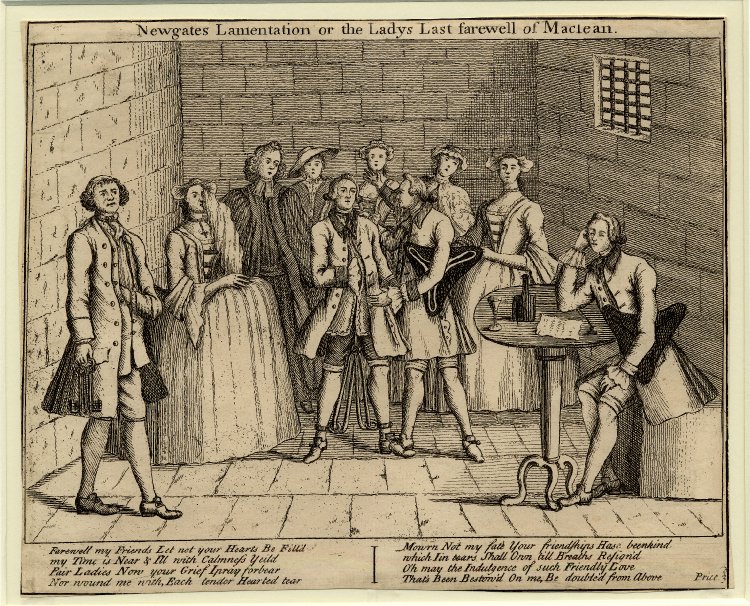
When caught** by mischance, the mannered† Maclaine became the object of public celebration, much to the bemusement of Walpole — who professed no ill will for his assailant but wondered that “there are as many prints and pamphlets about him as about the earthquake.”

Three thousand people are reported to have turned up on a sweltering summer Sunday to pay their admiration to the rogue, not excluding the very cream of society. Walpole teased his friends, court beauty Lady Caroline Fitzroy (wife of the Earl of Harrington) and her sidekick Miss Elizabeth Ashe, for presenting themselves among these masses to starfuck this latter-day Duval. “I call them Polly and Lucy,” he wrote, alluding to female conquests of the outlaw Macheath in The Beggar’s Opera, “and asked them if he did not sing,”

Thus I stand like the Turk with his doxies around.

Maclaine did not have to borrow Macheath’s ballads, for he was celebrated with verse dedicated all to him — like this “Jemmie Maclaine”, to the tune of Derry Down:

Ye Smarts and ye Jemmies, ye Ramillie Beaux,
With golden cocked hats, and with silver laced clothes,
Who by wit and invention your pockets maintain,
Come pity the fate of poor Jemmy Maclaine,

Derry down derry, etc.

He robb’d folks genteely, he robb’d with an air,
He robb’d them so well that he always took care
My lord was not hurt and my Lady not frighted,
And instead of being hanged he deserved to be knighted!

Derry down derry, etc.

William Hogarth‘s 1751 print cycle The Four Stages of Cruelty, one skeleton overseeing the operating theater where a hanged criminal is dissected is subtly labeled — Macleane.

* Walpole once remarked of the ubiquity of violent crime in London that “one is forced to travel, even at noon, as if one was going to battle.”

** Plunkett was never apprehended; it’s alleged that he ultimately escaped to North America.

† Although our man “has been called the gentleman highwayman,” the player-hating Ordinary of Newgate wrote, “and his dress and equipage very much affected the fine gentleman, yet to a man acquainted with good breeding, that can distinguish it from impudence and affectation, there was little in his address or behaviour, that could entitle him to that character.”

On this day..

1795: Jerry Avershaw, contemptuously

From the Newgate Calendar:


A century since highwaymen were as common as insolvent debtors are now.

Public vehicles were then little known. The roads were covered with night travellers, either on horse or foot, who became the easy prey of one or two armed and desperate ruffians. Turpin, Sixteen-String-Jack, and others of less notoriety, almost made these criminals fashionable; for, strange to say, there is a fashion even in crime.

Their daring was great; and in a country where personal prowess and high courage were so much prized, it was not to be wondered at that such characters should obtain a sort of fame. Now that our roads are covered with stage coaches, the race of highwaymen is extinct; solitary individuals of the species may be now and then met with, but the “calling” has decidedly fallen into disuse; pickpockets have succeeded them, and robberies are thus achieved with greater facility, less danger of personal violence, and with less dread of legal punishment.

The callosity of London thieves is dreadful. The Rev. Mr. Cotton is ordinary of Newgate, and in allusion to that gentleman’s spiritual consolation on the fatal platform, they call hanging, “dying with your ears stuffed with cotton.”

A pickpocket lately gave it as his reason for following his profession, “That it didn’t hurt above the arm pits;” i.e. that if discovered, the punishment was transportation, not hanging.

None of the numerous depredators we have already noticed, can excel in villainy, the subject of the present memoir. He was one of the most fierce, depraved, and infamous of the human race.

From early life he exhibited in his disposition a combination of the worst feelings of our nature, which, as the period of manhood approached, settled into a sort of prerogative of plunder and depredation, by which he seemed to consider himself as entitled to prey on the property, and sport with the lives, of his fellow creatures, with the most heartless impunity.

He attached himself to gangs of the most notorious thieves, and imposters, over whom, by a kind of supererogatory talent for all sorts of villainy, he very soon acquired unlimited influence and command, and by whose aid he committed such numerous and daring acts of highway-robbery, house-breaking, and plunder, as made him the dread and terror of the metropolis and its vicinity.

Kennington Common, Hounslow Heath, Bagshot Heath, and indeed all the commons and roads for several miles round London, were the scenes of the predatory depredations of Avershaw and his associates; and such a degree of terror had his repeated acts of robbery and brutality inspired, that the post-boys, coachmen, and all whose duty compelled them frequently to travel over the theatre of his exploits, trembled at his name and dreaded his visitation.

Although the peculiar features of the criminal laws of our country for a long time operated to the impunity of this abandoned ruffian and desperado, the cup of his iniquities was gradually filling, and he at length fell under the hand of outraged justice; but not till, unhappily, he had added a new act of murder to the long and black catalogue of his unatoned crimes: and it is lamentable to record that so base, so villainous, and so bloody a being, should have found creatures, bearing the form and name of men, so entirely forgetful of their duties to society and to God, as not only to become the admirers and apologists of what they misnamed the valour of Avershaw, but who absolutely affected to trace something prophetic in the fiendlike declarations he had too often made, that “he would murder the first ****** who attempted to deliver him into the hands of justice,” because, in the spirit of his diabolical declarations, he did actually shed the blood of a fellow-creature, who in the performance of his duty as a police officer, essayed the arrest of this most notorious of culprits.

Jerry Avershaw was the son of a laboring man who worked at one of the dye houses at Bankside — his father having met with a severe accident, was rendered incapable of following his usual employment — the support of the family consequently devolved upon the mother who took in washing, and was very indulgent to her family.

Jerry was educated in the parochial school of St. Saviour’s, Southwark — and at an early age resorted to places of public amusement which were then established in the neighborhood of St. George’s fields, where he soon became distinguished by his extravagant style of dress and profuse expenditure.

He associated at that time with many respectable young men, who were unacquainted with his real character, and way of living. This however became at length so notorious that he was obliged to seek associates in the lowest pot-houses, where from his superior address and appearance — and the liberal manner in which he spent his money — he was always welcome. Without reference to his other crimes, we shall proceed to give an account of his remarkable trial.

Jeremiah Avershaw, alias Abershaw, was tried before Mr. Baron Perryn, at Croydon, July 30th, 1795.

The prisoner was charged on two indictments; one for having, at the Two Brewers Public-house,* Southwark, feloniously shot at and murdered D. Price, an Officer belonging to the Police-Office, held at Union-hall, in the Borough. The other indictment was for having, at the same time and place, fired a pistol at Bernard Turner, another officer attached the office at Union-hall, with an intent to murder him.

Mr. Garrow, the leading counsel for the prosecution, opened the case to the Court and jury, by stating, that the prisoner at the bar, being a person of very ill fame, had been suspected of having perpetrated a number of felonies. The Magistrates of the Police-Office in the Borough of Southwark, having received information against the prisoner, sent, as was their duty, an order for his apprehension.

To execute the warrant, the deceased Price, and another officer of the name of Turner, went to the Two Brewers, a public-house, in Maid Lane, where they understood he was then drinking, in company with some other persons.

At the entrance of a parlour in the house, the prisoner appeared in a posture of intending to resist. Holding a loaded pistol in each of his hands, he with threats and imprecations desired the officers to stand off, as he would otherwise fire at them.

The officers, without being intimidated by those menaces, attempted to rush in and seize him, on which the prisoner discharged both the pistols at the same instant of time, lodging the contents of one in the body of David Price, and with the other wounded Turner very severely in the head. Price after languishing a few hours died of the wound.

Mr. Garrow was very pathetic and animated in his description of the several circumstances composing the shocking barbarity. To prove it, he would call four witnesses, whose evidence, he said, would be but too clear to establish the prisoner’s guilt.

The Jury would be enabled to judge from the facts to be submitted to them, and would undoubtedly decide on the issue joined between the Crown and the prisoner at the bar.

The learned counsel accordingly called Turner, the landlord of the house, a surgeon, and a fourth witness; but as the substance of their evidence is comprised in Mr. G’s opening of the indictment, it would be superfluous to repeat it. Turner said positively, he saw the prisoner discharge the pistols, from one of which he himself received his wound, and the contents of the other were lodged in the body of Price, who died very shortly after. The surgeon proved that the death was in consequence of the wound.

Mr. Knowles and Mr. Best were counsel for the prisoner, but the weight of evidence against him was too strong to be combatted by any exertions.

Mr. Baron Perryn summed up the evidence, on every essential part of which his lordship made several apposite, pointed, and accurate observations. The counsel for the prisoner, he remarked to the jury, had principally rested his defence on the circumstances of several other persons being present when the pistols were discharged, by some of which they contended the death wound might possibly have been inflicted. But, with respect to that part of the transaction, it would be proper for the jury to observe, that the witness Turner, had sworn positively to his having seen the prisoner in the act of discharging the contents of the pistol.

The jury, after a consultation of about three minutes, pronounced the dreadful verdict of — Guilty.

Through a flaw in the indictment for the murder, an objection was taken by the counsel. The indictment did not state that Price died in St. Saviour’s parish. This was argued nearly two hours, when Mr. Baron Perryn intimating a wish to take the opinion of the Twelve Judges of England, the counsel for the prosecution, waiving [sic] the point for the present, insisted on the prisoner’s being tried on the another [sic] indictment, for feloniously shooting at Barnaby Windsor, the officer who apprehended him after he had shot Price, which the learned counsel said, would occupy no great portion of time, as it could be sufficiently supported by the testimony of a single witness. He was accordingly tried and found guilty on a second capital indictment.

The prisoner, who, contrary to expectation, had in a great measure refrained from his usual audacity, began with unparalelled insolence of expression and gesture, to ask his lordship if he “was to be murderd by the evidence of one witness?” several times repeating the question, till the jury returned him Guilty.

When Mr. Baron Perryn put on the judicial cap, the prisoner, unconscious, and regardless of his dreadful situation, at the same time put on his hat, observing the judge with contemptuous looks while he was passing the sentence. When the constables were removing him from the dock to a coach, he continued to vent torrents of abuse against the judge and jury, whom, he charged with, as he styled it, his murder.

As his desperate dispostion was well known, he was, to prevent resistance, hand-cuffed, and his thighs and arms also bound strongly together, in which situation he was conveyed back to prison.

So callous was this ruffian to every degree of feeling, that on his way to be tried, as he was passing near the usual place of execution on Kennington Common, he put his head out of the coach window, and with all the sang froid imaginable, asked some of those who guarded him, if they did not think he would be twisted on that pretty spot by Saturday.

He was executed on Kennington Common, on the 3rd of August, 1795, with James [John] Little for the murder of Mr. Macevoy and Mrs. King at Richmond, and Sarah King for the murder of her new born bastard, at Nutfield, Surrey, in the presence of an immense multitude of spectators, among whom he recognized many acquaintances and confederates, to whom he bowed, nodded, and laughed with the most unfeeling indifference.

He had a flower in his mouth, and his waistcoat and shirt were unbuttoned, leaving his bosom open in the true style of vulgar gaiety: and, talking to the mob, and venting curses on the officers, he died, as he had lived, a ruffian and a brute! He was afterwards hung in chains upon Wimbledon Common.

The infamy of his life, and the atrocity of his deeds, rendered him a fit object for the posthumous punishment of hanging in chains on the arena of his crimes, and (painful as is the record, the truth must be told,) while the disgusting carcass of this malefactor, devoured by the birds and withered by the elements, gradually disappeared, the spot on which he had been gibbetted was converted into a temple of infamy, to which the thieves and vagabonds of London resorted in a sort of pilgrimage; and while the leading ruffians of the flash school, of which Avershaw was the child and champion, procured from his decaying and piece-meal carcass the bones of his fingers and toes to convert into stoppers for their tobacco-pipes, the tyro villains contented themselves with tearing the buttons from his clothes, as mementos of the estimation in which they held their arch prototype.


The newsmen effected horror that “Abershaw continued to the last moment of his existence in the same hardened state” (Telegraph, Aug. 4, 1795) and “took no notice either of his fellow-sufferers, or what the clergyman endeavoured to say to him” — then “when the executioner took the whip and touched the horse, made a spring from the cart, and was heard to repeat a horrid curse the last word he spoke.”

Avershaw’s larger-than-death performance of “dying game” would in subsequent years be a much-honored exemplar among kindred spirits who would not occasionally be required to attempt to outdo him in dramatic contempt of the gallows.

On this day..

1787: Jacob “Hannikel” Reinhard

Robber Jakob Reinhard, better known as Hannikel, was hanged on this date in 1787 in Sulz am Neckar in Wurttemberg.

The captain of a brigand company stalking the Black Forest, Hannikel (English Wikipedia entry | German) kept one step ahead of pursuers for many years simply by exploiting the fragmented map of southern Germany: the next lord’s border was never more than a few strides away. Like his near-contemporary Schinderhannes, the bandit prince earned the affection due charismatic rogues for the usual reasons, viz., turning the wheel of fortune against the great and the good whom they made to stand and deliver.

Hannikel elevated his crew’s outlawry level from nuisance to anathema in 1786 by killing a guy in the course of a home invasion, which featured the less romantic part of the robber’s job: dripping burning resin on the lady of the house until she yielded up the concealed ducats. This incurred the wrath of the Duke of Wurttemberg, and the great bailiff (and early criminologist) Jacob Georg Schaeffer damned the borders and pursued the marauders all the way to Switzerland before he finally had them all rounded up.

Hannikel hanged along with three others of his gang; other members received lengthy prison sentences at hard labor.


1788 illustration of Hannikel imprisoned in the Schloss Sargans. Via this German-language summary (pdf) of Hannikel’s career.

On this day..

1895: Areski El Bachir, Algerian rebel

Algerian rebel Areski El Bachir was guillotined on this date in 1895 at Azazga with five of his companions.

Our man emerged in the 1880s bedeviling the French from Kabilya where the French had already had to suppress a rebellion. Collective punishment for that rising, onerous taxes, and the empire’s confiscations to benefit colonists all fired continuing resentment.

To French eyes, El Bachir was simply a bandit. But for periods of his nearly 15 years’ activity his word was next to law where the triclor could not reach. Kabilya’s colonial officials lived in fear of his revenge.

It required a dedicated military expedition mounted by the Governor-General of Algiers in order to capture El Bachir and disperse his band. Many of his followers were deported to the New Caledonia penal colony.

On this day..

1685: John Nevison, speed demon

It might have been this date in 1685* that the famously speedy highwayman John Nevison (or William Nevison) was hauled to York’s gallows on the Knavesmire and launched into eternity.

The 1660s and 1670s were his time, when the ex-soldier Nevison made the coachmen of the Great North Road stand and their their passengers deliver from York to Huntingdon. “In all his pranks he was very favourable to the female sex, who generally gave him the character of a civil obliging robber,” the Newgate Calendar would later memorialize. “He was charitable also to the poor, relieving them out of the spoils which he took from them that could better spare it; and being a true Royalist, he never attempted anything against that party.”

Not all that much is really known of Nevison, but he earned his place in outlaw lore with a reputed 1676 escapade. After the pre-dawn robbery of a traveler in Kent, in the southeast of Britain, Nevison hopped on a rocket horse and spurred it north all the way to York. Google Maps makes that 350+ km trip a nearly four-hour drive today, by the A1. Nevison miraculously made it on horseback by sundown, then cleaned himself up and strolled out to the bowling green to lay a friendly, and alibi-establishing, wager with the Lord Mayor.

Unfortunately for Nevison, Harrison Ainsworth appropriated the legend of the bandit’s impossibly fast ride for a later outlaw, Dick Turpin — who in Ainsworth’s Rookwood rides his famous mare Black Bess to death in a wholly fictitious sprint from London to York.

To be completely fair to that fickle muse Clio, it has been postulated that Nevison’s own legend was appropriated from yet another highwayman, Samuel Nicks, which would account for the nickname “Swift Nick” or “Swiftnicks” won by this feat of horsemanship. Nicks and Nevison might be one and the same man, but they might very well be two different humans whose legends were already conflated before Ainsworth was even a twinkle in his father’s eye.** If there was a distinct “Swiftnicks”, Nevison has the considerable advantage over him for our purposes of having some identifiable biography and an identifiable hanging-date. But it is to this other fellow, Nicks, that Defoe attributed the gallop in his A Tour Thro’ the Whole Island of Great Britain, available online here:

it was about four a clock in the morning when a gentleman was robb’d by one Nicks on a bay mare, just on the declining part of the hill [Gad’s Hill, Kent -ed.], on the west-side, for he swore to the spot and to the man; Mr. Nicks who robb’d him, came away to Gravesend, immediately ferry’d over, and, as he said, was stopp’d by the difficulty of the boat, and of the passage, near an hour; which was a great discouragement to him, but was a kind of bait to his horse: From thence he rode cross the county of Essex, thro’ Tilbury, Homden, and Bilerecay to Chelmsford: Here he stopp’d about half an hour to refresh his horse, and gave him some balls; from thence to Braintre, Bocking, Wethersfield; then over the downs to Cambridge, and from thence keeping still the cross roads, he went by Fenny Stanton to Godmanchester, and Huntington, where he baited himself and his mare about an hour; and, as he said himself, slept about half an hour, then holding on the North Road, and keeping a full larger gallop most of the way, he came to York the same afternoon, put off his boots and riding doaths, and went dress’d as if he had been an inhabitant of the place, not a traveller, to the bowling-green, where, among other gentlemen, was the lord mayor of the city; he singling out his lordship, study’d to do something particular that the mayor might remember him by, and accordingly lays some odd bett with him concerning the bowls then running, which should cause the mayor to remember it the more particularly; and then takes occasion to ask his lordship what a clock it was; who, pulling out his watch, told him the hour, which was a quarter before, or a quarter after eight at night.

The public gallows, nicknamed “York Tyburn”, was torn down in the early 19th century. A worn stone labeled simply “Tyburn” today marks the former site of the fatal tree.

* May 4, 1685 is one of several execution dates suggested for Nevison; all appear to lack recourse to any definitive primary document. The Ballads and Songs of Yorkshire, Transcribed from Private Manuscripts, Rare Broadsides, and Scarce Publications is our source here; it attributes its dating to Macaulay, although I have not found it in the latter’s History of England. Other possibilities include May 8, or March 15, in either 1684 or 1685.

** This site suggests that Nicks might also be the same as, or conflated with, yet another highwayman, Captain Richard Dudley.

On this day..

1290: Alv Erlingsson, the Last Viking

Around the spring of 1290, bad-boy Norwegian nobleman Alv Erlingsson was broken on the wheel by a Danish sheriff.

Sometimes remembered as the “last Viking”, Erlinggson (English Wikipedia entry | Norwegian) wasn’t only one of the great lords of the Norse kingdom: he was a prolific pirate.

The 1280s saw Norway warring with the rising German merchant cities, the latter soon allied with Denmark.

Alv Erlingsson made his sea-dog bones in this conflict, terrorizing Hanseatic League fleets and eventually raiding the Danish coast as well. His “Viking” reputation proceeds not only from this mastery of the waves but from his willingness to direct it even against his own king and country.

Although he was a senior enough official to be dispatched as an envoy to the English king in 1286,* a falling-out with King Eric‘s brother Haakon led Erlingsson to actually attack Oslo the following year.** His marauders put it to the torch and murdered the garrison commander — after which Erlingsson was a robber baron in the fullest sense of both words.

He set up as a freebooter operating out of Riga and preying by land and sea on whomever he could lay a sword on: the Teutonic Knights fretted the “harmful wolves led by the Count of Tønsberg.” This too is a part of his Viking image: King Eric and the Hanse made peace soon enough so that everyone could resume getting rich on trade. Erlingsson didn’t, or couldn’t, make that arrangement and so made his way taking plunder from the fringes of proper civilization. From the standpoint of posterity he looks positively anachronistic.

Call it Viking or piratical, romantic or loathsome — it caught up with him quickly in 1290 when he was captured on the Danish coast. Now despite his high birth he had no clout of his own and no diplomatic protection to shield him from revenge against the devastation he had visited upon those lands.

Information on this amazing character is not as widely available as one might hope; there’s a useful biographical sketch of him by Gabriele Campbell here (already cited in this post). The same blogger also has a follow-up post unpacking the games of thrones taking place in the same milieu.

* England and Norway were on a friendly footing, and the countries were maneuvering towards terms for Norwegian-Scots Princess Margaret to come to the Scottish throne.

** Erlingsson’s successful 1287 attack on Oslo led directly to the initial construction (in the 1290s) of Akershus Fortress, to shore up that city’s defenses. This medieval castle still guards the port to this day; it also hosted the execution of Vidkun Quisling and several other condemned traitors after World War II.

On this day..