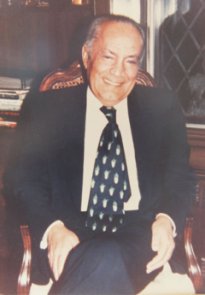
On this day in 1949, Jordan hanged Jacob Bokai. The Syrian Jew was the first Israeli intelligence agent put to death in service of the infant state. (At least, the first that’s been publicly acknowledged.)
Posing as a Palestinian named Najib Ibrahim Hamuda, Bokai’s mission to infiltrate Jordan started at a Palestinian refugee camp in Jaffa, where he was abused by the guards to establish his credentials. Those beatings went for naught, however, as Bokai never made it past the checkpoint: he was arrested immediately upon passing the Mandelbaum Gate into Jordan on 4 May 1949. Since he refused to cop to his mission or his Jewish identity, he was given a Muslim burial after hanging for espionage.
That charge was indeed well-founded: Bokai is now openly honored at a memorial to Israeli agents opened in 1985.
According to the story related by a former Mossad chief who gave a tour of this place to Tom Friedman back when the latter was the Times‘ Middle East scribe and not its leading nutter columnist — just mind the source is what I’m saying here — the doomed “Mr. Hamuda” still managed to get a message back to his Israeli handlers reassuring them that the enhanced interrogation he enjoyed in Jordan prior to execution had not compromised whatever operations he was privy to: “I did not commit treason.”
One of the original Apostles (literally, he and his brother John are the first two whom Jesus calls in the Gospels), James also had the distinction of apparently being the first Apostle to die for Christ.** His execution at the hands of Herod Agrippa† is reported in Acts 12:2;‡ it’s the only apostolic execution in the New Testament.
This, of course, occurred on the southeastern fringe of the Mediterranean, so it’s a wonder that James’s bones came to repose at a Spanish city literally situated on Finisterre, the far western edge of the world as far as Europeans saw it. The Lord works in mysterious ways.
It’s certainly plausible — though impossible to substantiate — that James evangelized in Spain prior to his execution. The whole Mediterranean was a Roman lake. More towards the outlandish is the patriotic story (pdf) that James’s relics were miraculously discovered there in 813 at the moment when Muslim expansion into Iberia gave the hard-pressed Christian kingdoms the greatest possible need for a morale boost.§
“A knight of Christ’s squadrons,” Cervantes wrote. “St. James the moorslayer, one of the most valiant saints and knights the world ever had, and that now the heavens have … this great knight with the vermilion cross has been given by God to Spain for its patron and protection.”
James’s martial prowess is entirely posthumous: when the Son of God recruits him, he’s a humble piscator at labor mending his nets (there are some less-bellicose present-day churches going under the name “Saint James the Fisherman”). Gibbon could not but marvel at the “stupendous metamorphosis [that] was performed in the ninth century, when from a peaceful fisherman of the Lake of Gennesareth, the apostle James was transformed into a valorous knight, who charged at the head of Spanish chivalry in battles against the Moors. The gravest historians have celebrated his exploits; the miraculous shrine of Compostella displayed his power; and the sword of a military order, assisted by the terrors of the inquisition, was sufficient to remove every objection of profane criticism.”
But mythmaking exercises a historicity all its own, and the James legends offered a rallying-point for Spain’s Christians. He stands to this day the patron of Spain as well as a number of places colonized by Spain.
Pilgrims have ever since that stupendous metamorphosis of the 9th century made the journey to the apostle’s purported resting-place; this Way of St. James, actually comprising several different possible routes covering hundreds of kilometers on foot, has in recent years emerged as a major tourist draw. The Way terminates, of course, at Santiago de Compostela and the enormous cathedral there where repose James’s relics.
Saint James’s Day, 25 July, is its celebratory culmination.
James so overawes July 25 on the liturgical calendar that it’s a mere footnote to add that this same day also pays homage to Saint Christopher, a historically dubious Christian martyr from the third or early fourth century Roman Empire.
Christopher is rather nifty, because he’s sometimes depicted in iconography as cynocephalic — that is, having the head of a dog. At least the rest of him is human, unlike Saint Guinefort the Greyhound. (No lie. It’s a doggie saint, albeit of the distinctly unofficial variety. To stamp out folk veneration, an incensed preacher “had the dead dog disinterred, and the sacred wood [where it received offerings] cut down and burnt, along with the remains of the dog.”)
* The name “Santiago” derives from our saint’s name in Latin, Sanctu Iacobu. This is also the source, and James the intended honorary, for other places on the map named Santiago, such as Santiago, Chile.
† Herod Agrippa is not to be confused with his grandfather Herod the Great — the Biblical Massacre of the Innocents guy — nor with his uncle Herod Antipas — the guy who punted Jesus’s prosecution back to Pontius Pilate. Three different Herods; three different New Testament heavies.
‡ James’s death in Acts 12 is followed immediately by Saint Peter staging a supernatural jailbreak out of the same prison. The latter goes on to evangelize for another 20-odd years.
§ The holy remains reached that resting point, goes the legend, only by perilously navigating a path of dragons, pagans, and wagons.
June 29, 1944, saw several noteworthy mass executions around Axis western Europe.
France: Seven Jewish hostages for the assassination of Philippe Henriot
Poet and journalist Philippe Henriot (English Wikipedia entry | French), the “French Goebbels”, was the Vichy government’s able chief propagandist.
On June 28, 1944, Henriot was assassinated by Maquis operatives disguised as milice paramlitaries.
Incensed, the real milice this morning gathered seven Jews already held in prison as hostages at Rillieux, drove them to the cemetery, and shot them one by one.
(Paul Touvier, who orchestrated this retaliatory execution, managed to stay underground until 1989. At his 1994 war crimes trial, he claimed that the Germans wanted 30 hostages killed, and therefore what he actually did was “save 23 human lives.” Touvier was convicted on the charge of crimes against humanity.)
Italy: Massacres in San Pancrazio, Cornia, and Civitella
As dawn broke this date, German soldiers retreating from liberated Rome fell upon several Tuscan villages.
German columns had been beset by partisans on the way, and standard operating procedure was to retaliate against partisans indirectly, by killing civilians — as in the notorious massacre in the Ardeatine caves. This vengeance was visited on the three towns: over 200 civilians were summarily executed on June 29, 1944.
“My mother later said she went to speak to my father,” remembered one San Pancrazio man. “A soldier turned her back and told her they were taking him to be tortured. She and my father both cried.” The father and those taken with him were shot in the basement of a farmhouse.
Caution: Graphic video.
The towns themselves have kept this date in remembrance, but the massacres were swept under the rug in the postwar settlement as Italy, Germany, and their former western enemies realigned for the Cold War. Only in the 21st century have they come to wider attention, when the discovery of secret archives documenting the atrocities enabled an Italian court to convict an aged German soldier in absentia.
There’s a CNN documentary on these events focusing particularly on San Pancrazio. Called “Terror in Tuscany”, it may be viewable here or here, depending on your location.
On this date in 1475, four members of Trent, Italy’s small Jewish community were burned at the stake outside St. Martin’s Gate for the ritual murder of a Christian child.
One of early modern Europe’s most outstanding “blood libel” instances, the Trent case proceeded from the widespread (among Christians) suspicion that Jews used Christian blood in their blasphemous rituals.
Latent under normal circumstances, belief in the blood libel was, er, liable to actuate a violent anti-Semitic outbreak if a Christian child disappeared in a spot where elites didn’t protect Jews. And in the 15th century, this was an increasingly likely situation.
As R. Po-Chia Hia puts it in Trent 1475: Stories of a Ritual Murder Trial, “Overnight the Jews, familiar and somewhat intimate neighbors, were transformed into strange murderers.”
This transformation began at the Good Friday service in 1475, when Master Andreas Unferdorben approached the celebrant, Trent’s Prince-Bishop Johannes Hinderbach. Master Unferdorben hadn’t seen his two-year-old son since last night and searches had turned up nothing. He must have been frantic.
Hinderbach ordered the news, and a description of the lost child, promulgated throughout the city. But when that didn’t turn up any new leads, Unferdorben appealed to the podesta to “send his servants to search the houses of the Jews, and see whether it [the lost child] could be found because he had heard in many places in the city that during these holy feast days the Jews want to kidnap Christian children secretly and kill them.” In fact, it was not such a general suspicion as that. Andreas Unferdorben had been specifically advised to look in the Jews’ houses by a shady character named der Schweizer, the Swiss.*
Trent was a mixed city of Italians and German immigrants, and both languages could be heard in the streets. (Both were used by various different parties in the Simon of Trent investigation.) Its Jewish population, however, consisted of a mere three households — the extended families of Samuel, Tobias, and Engel. Samuel, an emigrant moneylender from Nuremberg, had the largest Jewish household with nine family members ranging in age from toddlerhood to 80, plus two family servants.
On the request of the lost boy’s father, these three homes were searched by the municipal authorities. There was no trace of Simon.
But on Easter night, Samuel’s family cook ducked into the cellar to draw some water for dinner and made a horrifying discovery: the body of the missing little boy, in the water of a bath.
After what must have been a fearful consultation, Samuel and the other two heads-of-households Tobias and Engel reported the find — strictly forbidding anyone to succumb to the entirely reasonable temptation to blow town, lest one flight incriminate all. Nevertheless, every one of Trent’s Jews realized that Simon’s appearance among them could easily trigger pogroms, expulsion, forced conversions … or worse. Much, much worse.
Now, it should be said that a ditch communicating with the outside fed Samuel’s cellar cistern. In the absence of indoor plumbing, it was possible for someone to literally throw a body into a home from the outside; the Trent Jews, in fact, reported discussing this possibility when news of Simon started making the rounds on Good Friday, and made sure to lock up their cellar windows to prevent someone dumping the body from the streets. But the remains of a very small child could also, perhaps, be entrusted to the flow of the public ditch to wash into a house.
This sort of thing might also explain why the child’s penis was gashed. Maybe, maybe not.
Of course, since the hypothesis of freaky Semitic blood rite was already “out there” and then the body went and turned up in a Jewish house, the presence of a gash on the sex organ was always going to be interpreted in a different vein …
During the evening of Easter, the arrest of Trent’s Jews began. A pitiless judicial process which almost immediately became committed to the notion of a blood sacrifice soon began grinding these now-powerless people into dust.
The only other actual evidence touching Simon himself here — besides the admittedly powerful appearance of the body in the basement — was a Christian woman’s recollection that she had been near Samuel’s house on Good Friday and happened to hear an unseen child sobbing … somewhere. She thought it might have sounded like the lost boy.
But they’d soon be pointing fingers at one another.
Subjected one by one — the men, at least — to drops on the excrutiating strappado (“letting the prisoner jump,” in the words of the manuscript that forms the principal primary source about this event), they started to break down.
Tobias provided the critical (though not the first) crack. Looking “senseless or ruined” (in his interrogators’ records) after his strappado session, Tobias
spun this tale of murder, duly recorded and perhaps elaborated by the scribe: on the eve of Passover, Samuel suggested they should get a child; the task fell upon Tobias. He enticed Simon with sweet words to come with him and handed the sacrificial victim over to Samuel. On the day of Passover, Old Moses covered the boy’s mouth while the others stuck the child with pins and tore out his flesh; his blood was collected and distributed. Later, the dead child was thrown into the water by Samuel and Isaac. Tobias was not present at the killing, only rabbis possessed the knowledge of the rituals. In the minds of the prosecuting magistrates, Tobias’s confession established the scenario of the “real crime.” … With details embellished by the moral indignation of the Christians, this fantastic tale would become in time the history of the Trent ritual murder.
For the investigators, they were unraveling an obstinate criminal conspiracy while also attempting to document an arcane ritual. The present-day reader is likelier to see what amounts to a collaborative storytelling process in which torturers and prisoners reciprocally cued one another to the evolving needs of the script. “Tell me what I should say and I will say it,” one household servant at his wits’ end told his judges. This stuff still happens today.
they persisted in asking details of the Seder, trying to reconstruct every shade of meaning of blood symbolism, and recording with great care every Hebrew word associated with the imagined killing rite …
Some of the Jews held out, repeating their innocence over the screams of torment and stern questions; others broke down, blaming themselves and others in this grotesque elaboration of the fictive murder ritual. Still others retracted their confessions during moments of lucidity and respite from the rope, only to be tortured more severely into retracting their retractions. A few wanted to confess but could not anticipate the murder script written in the minds of the magistrates and, thus, continued to suffer; a handful, who desperately held onto reality, tried to incriminate themselves while excusing their loved one and subordinates from the charge, willing victims in a coercive sacrifice that demanded live offerings.
All these quotes, again, are R. Po-Chia Hsia, whose book handles all the horrible details of who copped to which story on what particular day, for the two-plus months of investigation, eventually coalescing into an official version that became the myth of the boy-martyr “Simonino”.**
In the end, nine of Trent’s male Jews were condemned to the stake for June 21-22 in Simon’s blasphemous murder: the three heads of households, plus all the male Jews in Samuel’s own house. The 80-year-old guy we mentioned before had also been tortured in the interrogation and was also among the condemned … but he blessedly committed suicide in prison before they could execute the sentence.
This first date was the turn of the household heads plus Israel, Samuel’s 25-year-old son — and like his father, one of the longest holdouts against the torture. They only broke at the end.
The remaining four were all to die on June 22. Two requested baptism, however, which bought them an extra day of life, plus the easier end of beheading on June 23.
* Der Schweizer, a known personal enemy of Samuel, was suspected by a follow-up apostolic investigation of himself murdering Simon and dumping the body to bring suspicion upon the Jews.
** Rome had long been nonplussed by the blood libel story, and the contemporary-to-Simon curia shut down Bishop Hinderbach’s Trent proceedings. But a century later, Pope Sixtus V promoted Simon of Trent to the official Catholic martyrology. Simon was only stripped of his official martyrs’ laurels, and his cult suppressed, in 1965.
On this date in 1944, Jakob Edelstein, his wife Miriam, their twelve-year-son Arieh and his mother-in-law Mrs. Olliner were shot to death at the Auschwitz Concentration Camp in Poland. They had been inmates in Auschwitz since the previous December; Jakob had been in an isolation cell the whole time while the others stayed in the so-called “Family Camp.”
For two years prior they’d lived in Theresienstadt (also known by its Czech name, Terezin), a the former Czech fortress town that had been turned into a city just for Jews. Jakob Edelstein was named Eldest of the Jews and was nominally in charge of the place, but in practice he had no choice but to cater to the whims of the Nazis. He was assisted by a deputy and a council of twelve.
Edelstein, a Czech Jew born in 1903, had been a leader within the Jewish community in Prague and had had papers for himself and his family to emigrate to Palestine. But when the Nazis took over Czechoslovakia, Edelstein and the other Zionist leaders decided it was their duty to stay and do what they could for the community during this time of crisis.
He became a liaison between the Germans the Jewish community and tried to facilitate immigration to Palestine. From 1939 to 1941 he made several trips back and forth between Czechoslovakia and Palestine, with permission from the Germans, trying to find ways for more Jews to emigrate.
Theresienstadt was a strange place: neither concentration camp nor ghetto but something in-between, it was billed as a “paradise” and a “gift” from Hitler to the Jewish people.
Elderly Jews were sent there, as well as Jews who were “prominent” for some reason or had Aryan connections (such as Jews who had a non-Jewish spouse). It was advertised as a luxurious resort community where they could live out the rest of their lives in ease and plenty.
Residents were allowed to receive food packages from the outside, and send postcards (one per month, limited to 30 words, and censored).
Many people believed the propaganda and were persuaded to go there voluntarily, signing all their possessions and assets to the German government in exchange for what they thought would be a comfortable and peaceful retirement.
The 500-ish Danish Jews who weren’t evacuated to Sweden by the Danish Underground right after the Nazi invasion of Denmark were ultimately sent to Theresienstadt. Many talented artists, actors, musicians and scholars lived there. The Nazis would ultimately make a propaganda film about how wonderful life was in Theresienstadt, and a Red Cross delegation toured the place and came away satisfied.
As you might have guessed, living conditions within the fortress city didn’t exactly live up to what it said in the brochures.
It’s true that it was possible to survive in Theresienstadt for an extended time period, even for the duration of the war. There were no gas chambers and relatively few executions. Certainly it was worlds apart from, say, Auschwitz or Treblinka. But that was as close to “paradise” as it got.
Yes, there were stores, more than a dozen of them, but their stock consisted of “goods the Nazis had originally confiscated from the residents and later found they didn’t need or want.”
Theresienstadt, like the Lodz Ghetto, had a bank and its own money, but there was nothing to spend it on. “The ghetto crowns,” Berkley says, “were used mostly like Monopoly money in playing cards and other games. Still, the bank staff kept themselves busy balancing their books, and auditors arrived regularly from Berlin to ensure the accuracy of the bank’s essentially fictitious accounts.”
Theresienstadt’s population, at its peak, was 58,497, in a town which before the war had a population of less than 10,000. Nearly everyone had lice, toilets and taps were scarce, and disease was rampant.
Families were separated, with husbands, wives and children each residing in different barracks.
“Horrendous as Theresienstadt housing conditions may have been,” Berkley says, “they were not the residents’ chief source of daily suffering. Food, or rather, the lack of it, weighed on them much more heavily.” The menu, he explains,
consisted chiefly of bread, potatoes, and a watery soup. Some margarine and sugar — about two ounces a week of the former and less than one and one-half ounces of the latter — were sometimes included. The residents were also to receive up to four ounces of meat, mostly horseflesh, and up to eight ounces of skim milk a week, though many a week would see less or none of those foodstuffs available. No fruits were ever officially distributed, and turnips were the only vegetable to show up with any regularity.
Estimates of total per capita calories provided daily ranged from 1300 or less, to 1800, with the lower figure being more frequently mentioned. This should be compared with the “Special Regime” given the worst offenders in the Soviet labor camps which provided about 2,000 calories.
According to modern nutritional guidelines, to maintain a healthy weight, the average adult with an average level of physical activity needs 2,000 to 2,500 calories a day. At Theresienstadt all inmates between age 14 and 70 had to work long hours, many of them at strenuous jobs. In addition to being calorie-deficient, the Theresienstadt rations lacked essential vitamins and minerals. It’s no wonder that one survivor later recalled, “After three months in Theresienstadt, there was only one feeling left in my body: hunger.”
Six months after his arrival, Edelstein and the Council of Elders made a difficult decision about the food problem, as Berkley records:
It became apparent that an even distribution of the food supply would not allow the ghetto to survive. Those doing heavy work needed more than those doing normal work, and the latter needed more than nonworkers. In addition, children required extra rations, for they represented the Jewish future…
Thus, heavy workers … began to receive a little over 2,000 calories of food a day. Children were to get 1,800 and regular workers a little over 1,500. But the daily intake for nonworkers, which included most of the elderly, fell to less than 1,000 calories.
This terrible choice, however necessary to the population’s long-term survival, consigned thousands of people to death.
But even though starvation and disease took many lives, the most deadly aspect of life in Theresienstadt was deportation.
Contrary to what the propaganda messages said about people living out their lives in Theresienstadt, it was largely a transit camp. Most people who arrived would be sent on “to the east” sooner or later; some of them lasted only a few days in the fortress city before being deported.
Although certain classes of people, such as decorated World War I veterans, “prominent” people and those over 65, were in theory exempted from deportation, in practice anyone could be sent away and just about everyone ultimately was.
Approximately 145,000 denizens passed through Theresienstadt during the course of its existence, most of them from Czechoslovakia, Germany, and Austria. About a quarter of these inmates died within Theresienstadt itself. Another 88,000 were deported to Auschwitz and other camps in the East, almost all of them dying there. Out of about 15,000 children who passed through Theresienstadt, less than 2,000 survived, and some estimates put the number in the low hundreds.
When the camp was liberated, it had a population of about 17,000, and most of those had arrived in the during the final months of the war.
Jakob Edelstein didn’t know about the gas chambers when he became Eldest of the Jews at Theresienstadt in December 1941, but he knew that conditions in the East were very bad and realized that, in order for the community to sustain itself, as many people as possible had to remain within Czechoslovakia.
As a committed Zionist, he hoped that the young people in the camp would survive and go on to colonize Israel. Like most otherleaders of Jewish communities throughout Nazi-occupied Europe, he made the decision to cooperate with the occupiers in hopes of saving lives.
And as far as that goes, he failed, as the numbers quoted above indicate. But if he failed, so did everyone else.
Unlike many Jewish officials in the Nazi ghettos, he wasn’t corrupt and he wasn’t a toady to the Germans. It’s worth noting that he had many opportunities to flee the country with his family, even after the war started: all he had to do was not come back to Europe after one of his trips overseas.
But he stayed, because he felt he had a responsibility to his beleaguered people.
Edelstein did the best he could with what he had to work with, which is all you can say for anybody. He worked tirelessly, making himself available at all hours, and under his leadership the camp developed a welfare system as well as many cultural and sports activities.
His job as Eldest of the Jews in Theresienstadt, trying to play the balancing act between advocating for his people and not pissing off the Germans, was always extremely stressful, difficult and dangerous.
But things really started to go downhill for him after the city’s first commandant, Siegfried Siedl, got reassigned to Bergen-Belsen in July 1943.
Siedl’s replacement, Anton Burger, hated Czechs and took an immediate dislike to Edelstein as a result. He replaced Edelstein with Paul Eppstein [German language link, as is the next], a German, and demoted Edelstein to first deputy to Eppstein. Benjamin Murmelstein, an Austrian, became second deputy.
This wasn’t enough for Burger, however, as George Berkley records:
As leader of the Czech Jews, [Edelstein] naturally bore the brunt of Burger’s hatred for them. The new commandant had not only deported many of his countrymen and his chief aide … but had also moved Germans and Austrians into key positions formerly held by Czechs. Burger had apparently also stirred up his own superiors against him for during the fall some bakery workers, looking out the window, saw and heard Eichmann sharply dressing down Edelstein and even threatening to have him shot.
The incident alarmed Edelstein’s many loyal followers and the next day the leaders of Hechalutz, the largest Zionist organization in the camp, met with him to urge him to flee. They said they could help him escape … But though he suspected a Nazi scheme to get rid of him, Edelstein refused to run away.
In the end, the Nazis didn’t need to trump up any charges of insubordination or sabotage against their former Eldest of the Jews: they found some real “crimes.” It seems that Edelstein had been saving people from deportation by allowing them to remain in Theresienstadt, off the books, and adding the names of dead people to the transport lists to make the numbers match up.
He was immediately arrested. It was November 9, 1943, the fifth anniversary of Kristallnacht.
Edelstein was kept in custody in Theresienstadt until December 18, when he and his mother-in-law, his wife, and his young son were sent to Auschwitz with a transport of 2,500 others. The transport became part of the Auschwitz “Family Camp”, joining 5,000 Czech Jews who’d arrived there from Theresienstadt in September.
Edelstein’s family was allowed to join the Family Camp. Edelstein himself was put in the punishment block and subjected to interrogation although not, apparently, tortured. He gave nothing away.
In March 1944, the residents of the Family Camp who’d arrived in September were gassed. The December group was allowed to stay alive for the time being.
On June 20, an SS officer went to Edelstein’s cell and told him he’d been sentenced to death. While the condemned man (who’d become quite popular in jail) was taking leave of his fellow inmates, the SS officer got impatient and snapped, “quickly, quickly.”
Edelstein replied, “I am the master of my last movements.”
He was driven to the execution site and then the car went away to fetch Miriam, Ariah and Mrs. Olliner. Miriam had measles and had to be brought on a stretcher. The Nazis forced Jakob Edelstein to watch as his wife, child and mother-in-law were shot to death. He was the last of them to die.
The remaining residents of the family camp were gassed in early July 1944.
Paul Eppstein was executed in Theresienstadt in September. Murmelstein became Eldest of the Jews in his place and actually managed to survive the war. Because he had lived, he spent the rest of his life under a cloud of distrust and suspicion as a possible collaborator.
Siegfried Siedl was hanged for war crimes in 1947. Anton Burger escaped Allied custody (twice) after the war, assumed a new identity and died of natural causes in Essen in 1991. His true identity wasn’t discovered for years after his death.
After the war, the city of Theresienstadt reverted to its former name of Terezin, and the fortress became an internment camp for ethnic Germans, who found themselves quite unpopular in the newly liberated Czechoslovakia and were expelled from the country in droves. The internment camp closed in 1948.
The modern town of Terezin has a population of 3,500 and is noted for its manufacture of knitwork and furniture. Tourists from all over the world come to learn about its important role in one of the most tragic events in modern history.
There he became involved in the Strasserite anti-Hitler “Black Front”. To Hirsch’s grief, this organization had been thoroughly penetrated by pro-Hitler spies.
In December 1936, Hirsch embarked on a train. His mission was to bomb something in Germany. The details of the plan remain murky to this day; Hirsch’s subsequent trial was held in secret and his worried family only learned the whereabouts of their son three months missing when they heard a radio broadcast in March announcing his condemnation for “preparation of high treason and criminal use of explosives endangering the public.”
It seems that Hirsch was supposed to have disembarked in Nuremberg and there picked up some left luggage deposited by a fellow conspirator; he may have been meant to deliver this payload Nazi party headquarters in Nuremberg, or perhaps to the offices of Julius Streicher’s propaganda sheet Der Stürmer.
The young would-be terrorist would tell his family in prison letters that he had instead bypassed Nuremberg and kept going all the way to Stuttgart to meet a friend, hoping the latter would talk him out of his wavering commitment to the plot. Instead, he was arrested that night by the Gestapo.
This case made news in the United States during the spring of ’37 because Hirsch’s father, Siegfried, was a naturalized American. That made Helmut a U.S. citizen, too, even though the son had never set foot in the United States.* U.S. Secretary of State Cordell Hull and the American ambassador to Germany William Dodd lobbied the Nazi government to spare Hirsch** — but to no avail.
Hirsch’s sister Kaete Hirsch Sugarman later donated her brother’s papers — letters, photos, architectural drawings — to Brandeis University, which maintains them as the Helmut Hirsch Collection. They include this touching final letter the young man wrote to his family on the eve of his execution.
Dear Mother, dear Father,
I have just been told that my appeal for clemency was turned down. I must die then.
We need not say anything any more to each other. You know that in these last months I have really found the way to myself and to life. Real beauty must stand before unswerving honesty. You know that I have lived every moment fervently and that I have remained true to myself until the end. You must live on. There can be no giving up for you. No becoming soft or sentimental. In these days I have learned to say “yes” to life. Not only to endure it but to love life as it is. It is our own inner gravity, the force by which we have entered life.
It must help you in some way that I know I have finally reached my own inner image and feel complete. And in this feeling is much of our time and our world.
The only way I know how to thank you is by showing you until the last moment that I have used all your love and goodness towards becoming a whole being of my time and my heritage. Do not think of the unused possibilities, but take my life as a whole. A great search, a foolish error, but on its path to finding of final truth, final peace.
Please care for Vally [his girlfriend, Valerie Petrova] as for a child. I embrace you, dear mother and you, my father, once more for a long, long time. Only now have I realized how much I love you.
Yours forever,
Helmut.
* Siegfried Hirsch was a naturalized American who had lived in the U.S. for a decade prior to World War I. Siegfried’s U.S. citizenship had been revoked in 1926 because he had left to live abroad, but when the matter came to prominence in 1937 it was reinstated and Helmut Hirsch explicitly acknowledged as a U.S. national.
** The shoe has been on the other foot for death-sentenced German nationals in the present-day U.S.
Iranian Revolution firing squads claimed seven lives on this date in 1979, including two multimillionaire businessmen.
One of the businessmen was Rahim Ali Khorram, “an immensely rich contractor who built roads and airports for the government, and sometimes used his 2,000-man work force as a political shock force in support of the Shah.” That quote is from a New York Times profile of Khorram’s son, Hossain, who says that he himself was led out for a mock-execution not long after. (Hossain also says that his father was dead or dying of a heart attack as he was dragged out for execution.)
The charges against Khorram pere consisted of “operating gambling dens, cabarets and a prostitution ring* and feeding a man to a lion in his amusement park.” No lie. He was supposed to have an entire secret necropolis in that park stuffed with the bodies of his enemies. (New York Times, May 10, 1979.)
Habib Elghanian
The other businessman was the Jewish-Iranian plastics mogul Habib Elghanian.
Elghanian was the first Jewish person executed during the Iranian Revolution. His death on charges of spying for Israel, fundraising for Israel, and “friendship with the enemies of God” for having met with Israeli politicians, greatly alarmed Iran’s Jewish community: many fled the country, something Elghanian had pointedly refused to contemplate.
Though Elghanian allegedly claimed not to be a Zionist, he had investments and contacts in Israel — and a radio denunciation made clear to what extent such an association would be anathematized going forward.
He was a disgrace to the Jews in this country. He was an individual who wished to equate Jewry with Zionism … the mass of information he kept sending to Israel, his actions to achieve Israel’s designs, the colossal sum of foreign exchange and funds he kept transferring to Israel; these are only samples of his antinational actions; these were the acts used to crush our Palestinian brethren. (Source)
Weirdly, this execution has made news more recently: the Stuxnet computer worm, which is widely thought to have been engineered in Israel to attack Iran, contains the string 19790509. It’s been hypothesized that this apparent reference to May 9, 1979 might allude to Elghanian’s execution.
On this date in 1945, as Adolf Hitler celebrated his 56th birthday within a Red Army cordon, one of the Second World War’s more tear-jerking little crimes against humanity happened in Hamburg.
Bullenhuser Damm — still to be found today — was a former Hamburg school which fell out of use as World War II progressed, owing to the devastation Allied bombings wrought on the surrounding area.
The school itself sustained little damage, however, which eventually facilitated its appropriation as a satellite building for the nearby Neuengamme concentration camp.
Over at Neuengamme, the SS doctor Kurt Heissmeyer had been conducting a litany of horror medical experiments on 20 Jewish children — mostly from Poland — culled from the concentration camps, seeking medical evidence for Nazi racial theories further to a cushy professorship. But as April 1945 was obviously endgame for the Third Reich, thoughts naturally turned to disposing of evidence of indictable offenses.
Photos of the eventual Bullenhuser Damm victims showing their surgical scars after Heissmeyer injected them with tuberculosis.
Bullenhuser Damm was just the place for disposal.
On April 20, the 20 kids were loaded up on trucks with their four adult caretakers — two French, two Dutch — plus six Soviet prisoners of war.
At Bullenhuser Damm, the kids were parked in a room and hung out, blissfully ignorant of their danger. “They had all their things with them — some food, some toys they had made themselves, etc,” physician Alfred Trzebinski later recalled at his own trial. “They sat on the benches and were happy that they had gotten out. They didn’t suspect a thing.”
In the next room, the 10 adults were being hanged.
According to Admitting the Holocaust, Trzebinski was impressed with his own compassionate use of this bit of down time: he generously gave the children morphine shots to sedate them before their own executions. Or rather, their murders … since the doctor could not but agree that “you cannot execute children, you can only murder them.”
I must say that in general the children’s condition was very good, except for one twelve-year-old boy who was in bad shape; he therefore fell asleep very quickly. Six or eight of the children were still awake — the others were already sleeping … Frahm [an orderly] lifted the twelve-year-old boy and said to the others that he was taking him to bed. He took him to a room that was maybe six or eight yards away, and there I saw a rope already attached to a hook. Frahm put the sleeping boy into the noose and with all his weight pulled down on the body of the boy so that the noose would tighten. (Trzebinski, again)
The other 19 children were disposed of in like manner, and then all 30 corpses cremated overnight … just in time for what must have been a much-needed 5 a.m. coffee.
After the war, the facility went back to use as an actual (creepy!) school, but it was eventually renamed Janusz Korczak School, for a Polish-Jewish educator gassed with his young charges at Treblinka. There’s a permanent exhibition (German) at the site, as well as a memorial rose garden with a variety of plaques commemorating the victims of Bullenhuser Damm.
Trzebinski’s take on his conduct this horrible night might have been good enough for his conscience, but it didn’t pass muster with his judges: he was hanged on a war crimes rap prominently including Bullenhuser Damm on October 8, 1946. Kurt Heissmeyer, however, avoided detection until 1959 and only received a long prison sentence in 1966, shortly before his death.
A sort of social bandit for the Prohibition era, Birger was born Shachna Itzik Birger to a Russian Jewish family that immigrated to the U.S.
Birger was a young saloon-keeper on the make when the U.S. decided to make a go of its first foolish drug war, Prohibition. And in the immortal tradition of drug wars, it made the enterprising purveyor a whole lot richer, and a whole lot violent-er.
This cinematic affair of armored car shootouts, aerial bombings, and gangland assassinations comes off with verve in A Knight of Another Sort: Prohibition Days and Charlie Birger. The bon vivant Birger, bursting with charisma, entertains at his gin joint, aids the misfortunate, corrupts the police, and merrily mobs up Williamson County.
That story reached its conclusion when Birger was arrested for ordering the murder of Joe Adams, mayor of a nearby town who had taken the Shelton Gang’s armored “tank” car in for repairs.
Birger said he hadn’t actually done that, but he went to the gallows grinning, and humorously chatted up reporters before the big show — cementing his myth with that legend-quality indifference to death.
“I’ve played the game and lost, but I’ll lose like a man,” Birger philosophized. “I’m convicted of a crime I didn’t commit, but I’ve committed a lot of crimes. So I guess things are even. We got too strong against the law, and the law broke it all up.” (From the Chicago Tribune, April 20, 1928.)
Birger shakes hands with so-called “humanitarian hangman” Phil Hanna.
Birger insisted on hanging in a black, not a white, hood — owing to his hatred of the Ku Klux Klan.
Birger is still a legend in southern Illinois, and a live one at that: he’s been in the news lately due to a weird custody fight over the rope used to hang him.
This macabre historical memento also happens to be the last rope ever used for any public execution in Illinois.
On this date in 1942, two Jewish men were hanged in the city of Sosnowiec (pronounced sos-no-vitz) in Nazi-occupied Poland, and two more were hanged in the nearby city of Bedzin (pronounced ben-jin).
These executions were witnessed by thousands of people and carefully choreographed, as historian Mary Fulbrook records in her book A Small Town Near Auschwitz:*
The hangings in Bedzin and Sosnowiec had been orchestrated in advance, in meticulous detail, by the Police President in Sosnowiec. The execution in Bedzin was to take place one hour later than the one in Sosnowiec. As much thought was given by the police authorities to questions of security and seating arrangements as might be appropriate for a modern open-air musical concert: this was not to be a simple punishment for an individual offense, as had happened innumerable times, but rather a mass spectacle, intended to have a major impact on the audience…
The identities of the executed Jews in Bedzin have been lost to history. (Correction: Per Yad Vashem, they were Jehuda Warman and “Feffer” (no first name).) They were hanged at the old Jewish cemetery on the corner of Zawale Street, before a crowd of about 5,000, at 5:00 p.m. Jewish workers in the Bedzin Ghetto had their work identity cards confiscated that day and were let out of work early, at 4:00 p.m., and ordered to watch the hangings. Only after they witnessed the executions did they get their work cards back. The bodies remained hanging on the scaffold until 7:30 p.m.
The condemned men in Sosnowiec were 30-year-old Mayer Kohn and his father, Nachun or Nahum.
Nachun (left, with wife) and Mayer.
They’d been caught trading on the black market, probably trying to feed their families, as no one could live long on the official rations. But as Fulbrook points out, the actual offense didn’t matter much to the Nazis:
These coordinated public spectacles of mass hangings do not seem … to have been in direct response to a particular crime; it seems there was a policy of ‘any Jew will do’, although infringements of German rules (including not only black market dealings but also very trivial ‘offenses’) were adduced as the ostensible ‘reason’ for these executions.
Thousands of people, both Jews and Germans, watched Mayer and Nachun Kohn die, then quietly went home.
Although virtually the entire Kohn family perished at the hands of the Nazis, Mayer and Nachun Kohn can claim a bit of immortality by virtue of being mentioned in Maus, Art Spiegelman’s famous graphic novel about the Holocaust: the author’s father, Vladek, hailed from Sosnowiec.


 For two years prior they’d lived in