1875: Jesse Fouks, for murdering the Herndon family


Sunderland (U.K.) Daily Echo and Shipping Gazette, April 6, 1875.

A despatch from Brentville, Prince William County, Va., dated March 19, says: —

Jesse Fouks, the negro who murdered the Herndon family, consisting of Jeremiah Herndon, his wife, and a coloured boy named Addison Russell, near Cedar Run, in the lower part of this county, on the 4th of last December, was hanged this morning.

The circumstances of this murder were very horrible. Mr. Herndon, a well-to-do farmer, was about 70 years of age, his wife was a few years younger, and the coloured boy about 18 years old.

On the morning after the murder, Mr. Summerfield Herndon, a son of the venerable couple, who resided not far from their farm, went to pay a visit to his parents. Entering their yard, he saw bloody footprints, which led to the door of the dwelling. Passing into the house, a ghastly spectacle was presented to his view. Upon a pallet on the floor the coloured boy Russell lay cold in death, with his head split open. Upon the bed lay Mrs. Herndon, weltering in blood. A little later Mr. Herndon was found lying in a field about 400 yards from the house, barefooted and bareheaded, with his head and face cut and bleeding in many places.

On being asked who had done this deed, Mr. Herndon, who seemed bewildered, said he did not know who had done it; that he had been walking about all night, and felt cold when he went into the water.

He was taken to his house, and there told a clearer story to Justices Horton and Woodyard of a quarrel with Jesse Fouks, who had been hauling wood for him.

It was ascertained, on searching the house, that 235 dols. had been taken by the murderer. Fouks was arrested on suspicion at the house of a neighbour the day after the murder.

Both Mr. and Mrs. Herndon lingered some days, Mrs. Herndon dying on the Wednesday following, and Mr. Herndon on the succeeding Friday. Fouks was tried, found guilty, and duly sentenced to be hanged.

On the 31st of last January he made an attempt to escape from gaol. He burned a hole through the partition of his cell, and got out into the passage, where there was nothing to prevent his escape except an iron-grated door, which was unlocked, and the outer door.

On his appearance at the outer door, he was met by the gaoler’s wife, who, with great presence of mind, seized him and called for help, but he managed to get free and got away.

He was captured on the following day in a straw rick, about six miles from Brentsville.

He acknowledged his guilt, and said that on the evening of the murder he took some meat, and that Mr. Herndon threatened to prosecute him; that he went into the house to try to induce the old man not to prosecute him; that he refused to retract, and that they then began quarrelling, and Mr. Herndon took up the axe and threatened to knock his brains out.

Fouks retreated to the door (the door being open), seized the axe handle, and to use his own words, “Old Satan was in me. I struck Mr. Herndon; took da axe from him, and den struck de old woman twice wid de axe. I did’nt strike her wid nuffin else, and den I struck Add (the coloured boy) twice wid de axe also.”

About 1,000 persons were present at the execution. The prisoner exhibited the utmost self-composure, and warned his hearers to escape the effects of bad passion.

Last Tuesday Fouks gave his body to a physician of Fauquier County, saying that the doctors would get it anyhow.

On this day..

1858: William Williams, guano-freighter cook

From the Daily Alta California, April 20, 1858:

Thomas P. Lewis, master of the ship Adelaide, loading guano at Elide Island, off the coast of Lower California, was killed there on the 12th ult. by Wm. Williams, colored cook off that vessel. Three other vessels happened to be there at the time, and the officers united to hold a court, taking six sailors as part of the jury, and tried Williams, convicted him of murder, and then hanged him on the island.

Elide Island is a “naked rock, one mile in circumference” off the coast of Mexico’s Baja California which for a few years in the mid-19th century was heavily exploited for its guano supplies. 28,000 tons of bird crap later, the supply was tapped out.

On this day..

1858: Lucy, vengeful slave

On this date in 1858, a slave named Lucy was hanged in Galveston for killing her mistress.

The innkeeper Maria Dougherty was chagrined in 1857 when her slave voiced disgruntlement by torching her Columbia Hotel. (The fire was detected in time and put out.) So, she stacked additional punishments on the dissatisfied Lucy, who in her turn escalated her revenge. In the first days of the new year, Mrs. Dougherty disappeared — next seen several days onward afloat in a cistern, skull mangled by a furious bludgeon.

“Yes, I killed her, and I would do it again!” Lucy allegedly exulted.

On this day..

1926: Josef Jakubowski, Weimar Germany wrongful execution

On this date in 1926, Weimar Germany beheaded Josef Jakubowski for a murder he did not commit. Though a notorious miscarriage of justice in Germany, it is not widely known elsewhere and most of the links about Jakubowski are in Germany.

A Pole reared in the tsar’s Lithuania, Jakubowski emigrated by way of that great ravager of imperial borders, the First World War: taken as a POW, he preferred sticking around as a Mecklenburg farmhand over returning to a now-Bolshevik Russia engulfed in civil war.

Jakubowski never married, but if he had done it would have been to Ina Nogens, a local woman with whom he fathered a daughter out of wedlock. But his lover died (in non-suspicious circumstances) leaving Jakubowski to support not only the infant girl but also Ina’s three-year-old son by another man, Ewald — who were nonetheless being raised not by Jakubowski but by the Nogens relatives.

On November 9, 1924, Ewald disappeared: he was found outside the village the next day, strangled to death.

The Nogens family immediately made known their suspicions of the almost in-law from a foreign land, and in no time at all Jakubowski was caught in that still-familiar gaze of official tunnel vision and its mirrors of endlessly receding self-vindication. The most substantial evidence against Jakubowski was the shaky — and in fact, manipulated — eyewitness report of a mentally impaired teenager made to sort of put the Pole on the path to the Nogens house on the morning of the little boy’s disappearance. That’s it. It’s the sort of case would have to level up several times to achieve the stature of laughability, but when everyone already knows you did it, actual evidence is really just a luxury. Jakubowski was an outsider who maybe wanted to stop paying child support. Work backward from there!

Two years after the luckless migrant lost his head to the fallbeil, it came out that some of the Nogens clan were the ones really behind the murder, a two birds, one stone scheme to take off their hands both bastard whelp and Auslander. Three were judicially convicted of the very same murder, and one, Ina’s brother August, was actually sentenced to death — although the sentence was remitted. Despite issuing these other convictions, no German state organ has ever officially reversed Jakubowski’s condemnation.

The case was portrayed in a two-part West German TV series in 1964, Der Fall Jakubowski.

On this day..

2016: Brandon Astor Jones

Forty-six minutes after midnight this morning, the U.S. state of Georgia executed its oldest death row inmate, Brandon Astor Jones.

Jones was a prolific penpal correspondent who had won a worldwide following as he fought his death sentence over half a lifetime.

His accomplice Van Roosevelt Solomon was electrocuted all the way back in 1985 for the same convenience store robbery-murder;* as Liliana Segura recently noted in The Intercept, Jones’s case is heavy with the arbitrariness of capital cases — not only that Jones outlived Solomon by three decades, but also that in that span many other Georgians have committed homicides equal to his in tragic banality, served a term of years for it, and been released. It needs hardly even be said that Jones, like 54 of the other 60 people executed by Georgia since the 1970s, had a white victim: that’s a disparity that courts have washed their hands of even though it was one of the constitutional concerns that led a former incarnation of the U.S. Supreme Court to invalidate death penalty statutes in 1972.

While Jones’s death is headline news, his case dates to the earliest years of what is dignified the “modern” death penalty period and as such might more closely resemble the preceding era than the one we inhabit today.

It’s almost a time capsule of the jurisprudence — and sociology — touching capital punishment, even including Jones’s unluckily-timed appeal victory that led to a new sentencing hearing during the gung-ho-to-execute 1990s. Even if the distance of time is extreme, more typical death penalty lags of 8, 10, 15 years mean that most present-day executions are ripples of receding public policy sensibilities — “zombie cases” in the words of Southern Center for Human Rights director Stephen Bright. People like Brandon Jones “almost certainly would not be sentenced to death today,” when prosecutors, judges, and juries all show growing reluctance to don the black cap. But it’s a very different story for those is already tangled in the coils of the system.

* A policeman happened to be arriving right to the same store on a coincidental errand when the crime went down, so the culprits were arrested before they made it off the parking lot.

On this day..

1888: Danny Driscoll, Whyo

On this date in 1888, New York City crime lord Danny Driscoll went to the gallows in the Tombs.

(Co-)leader of the Irish gang the Whyos — so named for a distinctive signaling hoot that once echoed through the Five Points — Driscoll inherited power when his predecessor Mike McGloin hanged in 1884.

This band emerged after the disruptions of the Civil War as Manhattan’s most powerful criminal syndicate. The Whyos’ run in the 1870s and 1880s marks a transitional phase from the wild and woolly Gangs of New York street-brawling era into the more businesslike mafiosos of the 20th century.

Like the Mos Eisley cantina, the Whyos’ seedy tavern of choice (aptly named The Morgue) was notorious for over 100 recorded homicides in gang shootouts and drunken brawls; like Jabba the Hutt, the gang also took a methodical approach to extortion, racketeering, and murder that put the “organized” in their crime. One goon answering to the colorful name Piker Ryan (and old time New York crooks are nothing if not flamboyantly named) was once arrested with an actual ultraviolence menu from which budget-conscious clientele could custom-order thrashings for delivery.

Punching $2
Both eyes blacked $4
Nose and jaw broke $10
Jacked out (knocked out with a Blackjack) $15
Ear chewed off $15
Leg or arm broke $19
Shot in the leg $25
Stab $25.00
“Doing the big job” (murder) $100 and up

These 1884 selections perhaps already represent a moderation from earlier methods; a previous Whyo hoodlum, “Dandy” John Dolan, was noted for the copper eye-gouger he wore on his thumb just in case he needed to — well, you know. Dolan hanged back in 1876.


Wait til they get a load of the clamps.

Driscoll kept a house with his young wife, and was charitable enough also to share it with a whore named “Beezie” Bridget Garrity — with whom Driscoll often caroused in the rough Whyo territory. One night in 1886 their alcoholic peregrinations brought them up against a brothel run by a tough named John McCart(h)y, against whom Driscoll had an existing grudge — and as they entered, Driscoll and McCarty wound up in a threshold gunfight. Beezie Garrity had the bad luck to catch a fatal bullet in the crossfire. Both men would blame each other for firing the shot that killed Garrity, and produce numerous witnesses of variously impaired credibility, but for the city there was no confusion at all: between the two, Driscoll was the man worth getting rid of.

“I’ve got a bad name with the police and they say ‘give a dog a bad name and we’ll hang him,'” Driscoll complained to the court. His criminal record reached back to childhood.

Newspapers in the run-up to the hanging were rife with stories of escape attempts and Whyo menace, but police correctly prophesied that the gang had not the numbers or vigor to make any real disturbance. A cordon of 150 gendarmes around the Tombs saw “small groups of young men with hard, wicked-looking visages whom the police pronounced remnants of the Whyo gang … among them were some of the brazen-faced young women of the class to which Beezie Garrity” belonged. (New Haven Register, Jan. 23, 1888) Driscoll died game, his neck efficiently snapped by a noose of white Italian hemp … which seems by retrospection an apt instrument for his passing.

After Driscoll and his fellow alpha male Danny Lyons both hanged in 1888, the Whyos shrank into memory. They would be overtaken in the 1890s by Monk Eastman‘s gang, one last dinosaur from a fading era of hardscrabble toughs; Eastman was in turn supplanted by the Five Points Gang — a more recognizably sophisticated operation to key the 20th century, composed predominantly of the growing Italian-American emigre demographic that would define organized crime for the Godfather era.

The venerable Bowery Boys podcast of Big Apple history covered the Whyos way back in March 2009.

On this day..

1922: Eleuterio Corral and Rumaldo Losano, escapees

(Thanks to Meaghan Good of the Charley Project for the guest post. -ed.)

On this day in 1922, Eleuterio Corral and Rumaldo Losano were hanged in New Mexico’s Grant County Jail in Silver City for the 1921 murder of a prison guard.


Corral (left) and Losano (right).

Losano and Corral were serving time in the Grant County Jail for robbery (Corral) and attempted larceny (Losano) in the spring of 1921. Losano had only fifteen days days left to go on his sentence. Nevertheless, on April 2, 1921, the two young men decided to make a break for it. The jailer, sixty-year-old Ventura Bencoma, had been sick with the flu and during the early morning hours he decided to have a lie-down. While Bencoma slept, Corral and Losano were able to get out of the cell they shared.

A nearby cell was unoccupied and used for storing coal and firewood, and had an ax. The two convicts sneaked up on Bencoma and brained him with the ax, took his gun and keys, and threatened to shoot the other prisoners if they made any noise. They tried to use the keys to release another prisoner, Jesus Rocha, but weren’t able to get the lock undone and gave up. As soon as the pair had run off into the darkness, the others started screaming for help and woke up the sheriff, who was also enjoying a siesta of his own up on the second floor and had missed the entire jailbreak.

Bencoma died within a few hours, as the sheriff and a posse of men were searching for Losano and Corral. On April 5, after a brief exchange of gunfire, the fugitives were captured hiding in a shack. Their statements are summarized in West C. Gilbreath’s Death on the Gallows: The Story of Legal Hangings in New Mexico, 1847-1923:

Both Eleuterio and Rumaldo bragged out loud of their escape and short freedom. Both men told Sheriff Casey it was Jesus Rocha who planned the escape and was to have joined them. Sheriff Casey learned from the two that after Jailer Bencoma’s keys and pistol were removed, they were to unlock the steel cell door to Jesus Rocha. Once he was released, the three were to go up to the second floor where Sheriff Casey’s quarters were and call him to the door. Once the Sheriff opened the door, he would be shot and killed with the jail’s pistol. The three would then arm themselves with the Sheriff’s rifles and ammunition. They planned to saddle the horses in the Sheriff’s corral and flee to Mexico. The plan began to fall apart after both failed to unlock the cell door to Jesus Rocha.

In light of this information, Jesus Rocha was charged with murder alongside his criminal colleagues. At trial, Losano and Corral recanted their statements about his involvement and claimed Rocha had not been a part of the escape plan. All three were convicted and sentenced to hang, but the Supreme Court of New Mexico subsequently reversed Rocha’s conviction, leaving Corral and Losano to face the noose without him.

Their families in Mexico pleaded for mercy, claiming that at the time of the murders, Corral was just sixteen years old and Losano seventeen. However, three physicians who examined them judged Corral was least nineteen and Losano was probably older than twenty.

A few days prior to the execution, the deputy warden conducted a surprise search of the condemned men’s cell. Both of their mattresses contained hacksaws and makeshift knives: they’d been planning another violent escape attempt. Unsurprisingly, the state governor, Merritt C. Mechem, refused to commute the sentences, telling Sheriff Casey, “Every guard’s life out there would be in danger with those two in the penitentiary.”

Officials set up the scaffold only about fifty feet from where Bencoma was murdered. Corral went first, then Losano. Both of them were calm and offered the standard prayers, apologies for their crimes and pleas for forgiveness.

On this day..

1894: John Hardy, desperate little man

On this date in 1894, West Virginia hanged before a crowd of 3,000 for a mining camp murder three months before.

Hardy was reportedly already at odds with Thomas Drews, a fellow laborer in the booming Appalachian coal industry, over their mutual pursuit of the same woman when Hardy lost big to Drews in a craps game on October 13, 1893.
While it’s true that twenty-five cents doesn’t really seem all that “big”, this sum could represent a decent slice of a day’s pay in the coal mining game, and that in an industry where downward wage pressure had generated a ferocious national strike only months before. Hardy was profoundly nonplussed to have to fork over the sweat of his brow to a love rival and, with the added incitement of whiskey, shot Drews dead. (Ten more spectators at his hanging wound up in stir themselves for drunk and disorderlies.)

Hardy’s execution has pride of place in Americana as the inspiration for the tune “John Hardy Was A Desperate Little Man”. (Or simply, “John Hardy”; as a folk figure, he has occasionally been confused or conflated with John Henry)

One of the most popular folk ballads in American history, the song has foggy origins but amazing reach: it has been performed, covered, and reinterpreted by a scores of artists including the Carter Family, Lead Belly, Duke Ellington, Woody Guthrie, Pete Seeger, and Bob Dylan with the Grateful Dead.

On this day..

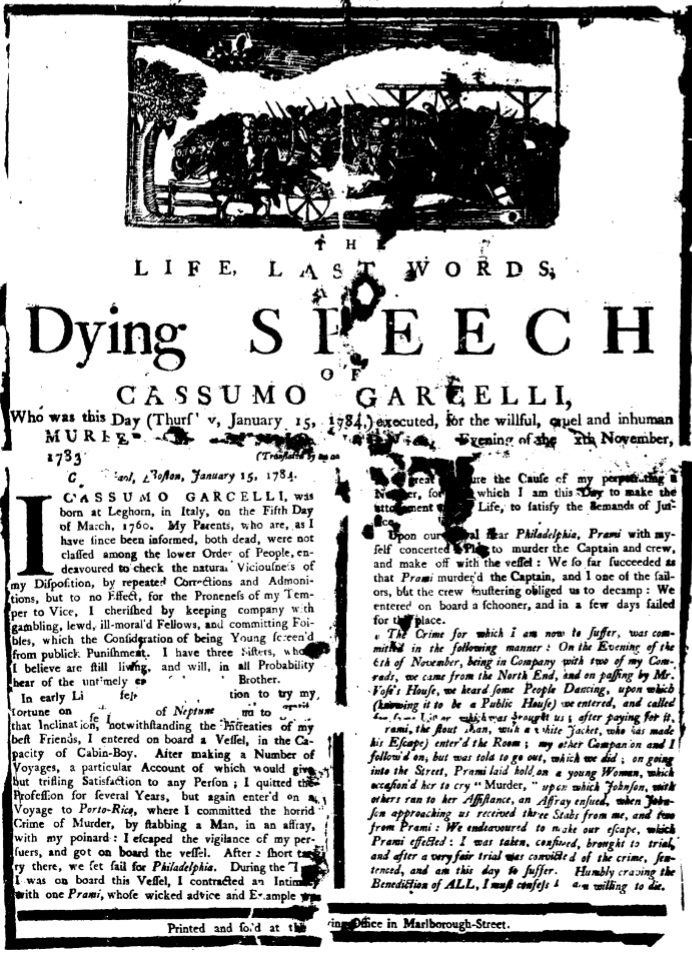
1784: Cassumo Garcelli, a Tuscan sailor on Boston Common

On this date in 1784, for a murder in a bar brawl he had committed with his hard-drinking cronies, Tuscan mariner Cassumo Garcelli was hanged on Boston Common.

To judge by the bog-standard broadsheet purporting to report the condemned man’s gallows’ shade contrition for his youthful vice and wicked examples, piratical Catholic seamen appear to have understood the spectacle of their public execution in a friendless foreign land in a manner quite suspiciously similar to the understanding likely to be held by a New England printer.

In the transcription that follows, I have made a few interpolations, and one outright elision, owing to sections of text obscured by printing faults on the preserved version of this document.


Click on the image to see the full original document.

Who was this Day (Thursday, January 15, 1784) executed, for the willful, cruel and inhuman murder of Mr. John Johnson on the evening of the sixth November, 1783.

I, Cassumo Garcelli, was born at Leghorn, in Italy, on the Fifth Day of March, 1760. My Parents, who are, as I have since been informed, both dead, were not classed among the lower Order of People, endeavoured to check the natural Viciousness of my Disposition, by repeated Corrections and Admonitions, but to no Effect, for the Proneness of my Temper to Vice, I cherished by keeping company with gambling, lewd, ill-moral’d Fellows, and committing Foibles, which the Consideration of being Young screen’d from publick Punishment. I have three Sisters, who I believe are still living, and will, in all Probability, here of the untimely [death of their] Brother.

In early Life […] to try my fortune … notwithstanding the Intreaties of my best Friends, I entered on board a Vessel, in the Capacity of Cabin-Boy. After making a Number of Voyages, a particular Account of which would give but trifling Satisfaction to any Person, I quitted the Profession for several Years, but again enter’d on a Voyage to Porto-Rico, where I committed the horrid Crime of Murder, by stabbing a Man, in an affray, with my poinard: I escaped the vigilance of my persuers, and got on board the vessel. After a short tarry there, we set sail for Philadelphia. During the Time I was on board this Vessel, I contracted an Intimacy with one Prami, whose wicked advice and Example was in a great Measure the Cause of my perpetrating a Number [sic], for [one of?] which I am this Day to make the attonement of my Life, to satisfy the demands of Justice.

Upon our arrival near Philadelphia, Prami with myself concerted a Platt to murder the Captain and crew, and make off with the vessel: We so far succeeded as that Prami murder’d the Captain, and I one of the sailors, but the crew mustering obliged us to decamp: We entered on board a schooner, and in a few days sailed for this place.

The Crime for which I am now to Suffer, was committed in the following manner: On the Evening of the 6th of November, being in Company with two of my Comrads [sic], we came from the North End, and on passing by Mr. Vose’s House, we heard some People Dancing, upon which (knowing it to be a Public House) we entered, and called for some Liquor, which was brought to us, after paying for it.

Vami, the stout man, with a white Jacket, who has made his Escape, enter’d the Room; my other Companion and I follow’d on, but was told to go out, which we did; on going into the Street, Prami laid hold on a young Woman, which occasion’d her to cry “Murder,” upon which Johnson, with others ran to her Assistance, an Affray ensued, when Johnson approaching us received three Stabs from me, and two from Prami: We endeavoured to make our escape, which Prami effected: I was taken, confined, brought to trial, and after a very fair trial was convicted of the crime, sentenced, and am this day to suffer. Humbly craving the Benediction of ALL, I must confess [and am] willing to die.

On this day..

2015: Laila Bint Abdul Muttalib Basim, filmed

Last year on this date, Saudi Arabia’s execution wave consumed a Burmese woman named Laila Bint Abdul Muttalib Basim.

Condemned for the murder and sexual abuse of her seven-year-old stepdaughter, Basim went to her public beheading protesting her innocence and resisting in whatever way she could — which we know, because a cell phone recording of the execution attained worldwide dissemination. In it, the black-shrouded condemned shrieks over and over, “I did not kill! This is unjust!” She denounces her executioners, invokes the Shahada … until her throat is horrifically emptied of its last protest by the blade.

Warning: This is the on-camera death of a human being from just a few meters’ distance, obtained via Liveleak. It’s awful.

Thanks to the outrage this video spawned, a “human rights organization” underwritten by the Saudi government demanded the arrest of the person who recorded the video … which did indeed occur.

On this day..