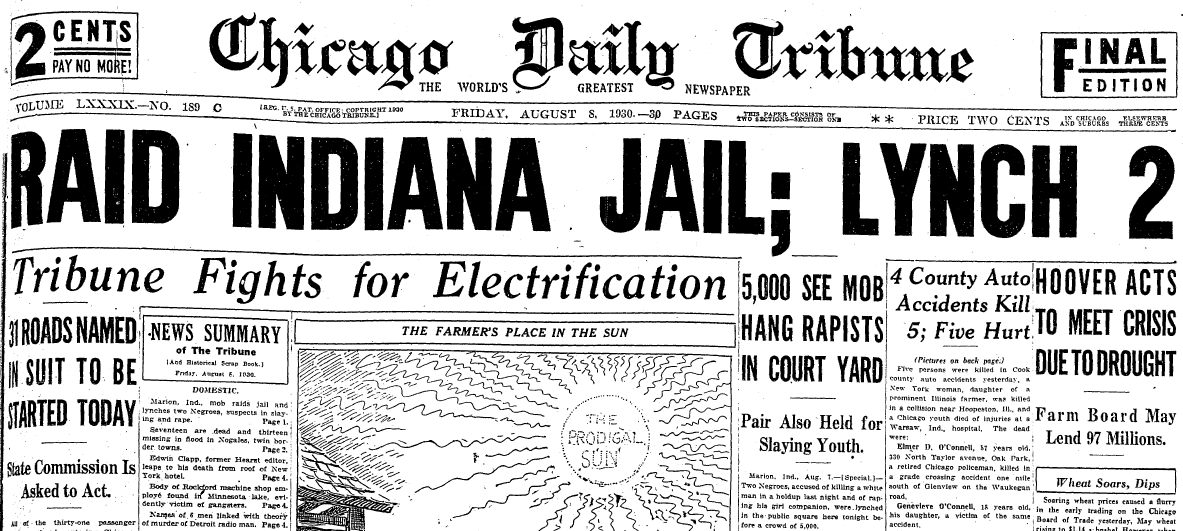
On this date in 1930, two black youths were lynched in Marion, Indiana for murdering a white man and raping his girlfriend.
(The rape allegation — although it, and not the homicide, seems to have been the thing that triggered the lynching — was subsequently withdrawn, and there were even rumors that the white girlfriend was a lover and confederate of one of the lynched men. It’s just one strand in the very human tapestry around the “last classic lynching north of the Mason-Dixon line” explored by Cynthia Carr in Our Town: A Heartland Lynching, a Haunted Town, and the Hidden History of White America.)
Shipp, who is said to have confessed killing the white man, Claude Deeter, 23, of Fairmount, Ind., was hanged from an elm tree in the courthouse yard. Smith, whom the girl identified as her assailant, was thrown from a third floor window of the jail with a noose around his neck and strangled.
…
Reports of the crimes and confessions, published in Marion newspapers this afternoon, stirred this quiet community of 23,000 to intense excitement. There was no hint of the impending violence, however, until 8:30 p.m., when a motorcade of Deeter’s fellow townsmen arrived from Fairmount.
The Fairmount delegation, numbering about 100, gathered in the public square, openly displaying their guns and shouting for a lynching … The sheriff led his deputies to the front door, argued a moment with the leaders of the mob and then ordered the tear bombs thrown. Blinded, the lynchers fell back for a few minutes, but returned and began the sledge hammer siege which forced the jail doors within ten minutes. No shots were fired on either side.
Following the lynching the mob gathered in the square for an hour, some proposing to drive the 2,000 members of the Negro colony from the city and burn their dwellings. Peace officers from Indianapolis, Kokomo, Fort Wayne, and other towns were arriving however, and gradually the mob broke up.
The corpses hung in the square for hours, attracting throngs of gawkers — including a photographer able to snap this picture:
Teacher/poet Abel Meeropol ran across this photo of the Shipp-Smith lynching a few years later in a magazine, and it so “haunted” him — his word — that he penned the anti-lynching poem “Strange Fruit”. You know it from Billie Holiday‘s arresting vocal rendition.
Southern trees bear strange fruit
Blood on the leaves
Blood at the root
Black bodies swinging in the southern breeze
Strange fruit hanging from the poplar trees
Pastoral scene of the gallant south
The bulging eyes and the twisted mouth
The scent of magnolia sweet and fresh
Then the sudden smell of burning flesh
Here is a fruit for the crows to pluck
for the rain to gather
for the wind to suck
for the sun to rot
for the tree to drop
Here is a strange and bitter crop
Abel Meeropol was no passing sentimentalist himself, but a prolific left-wing activist. During the McCarthy years, he adopted the children of the Rosenbergs when the latter were electrocuted as Soviet spies. As faithfully as those two orphaned boys have carried the torch for their lost birth parents, they also still carry an adoptive surname: Michael Meeropol and Robert Meeropol.
A third person was almost lynched in the same Marion, Ind., incident, but 16-year-old James Cameron (sometimes called “Herbert” or “Robert” in the 1930 news reports) managed to convince the mob that he wasn’t involved. Just how he managed this feat and what he’d really been up to is another strand of Carr’s tapestry: many of the Marion blacks as well as whites she interviewed overtly mistrusted Cameron.
At any rate, the crowd let him off with a beating, and Cameron served time as an accessory to the crime.
After release, he became an anti-lynching activist in Indiana and, later, Wisconsin — where he founded a (since-shuttered) Black Holocaust Museum. He started several NAACP chapters.
In the more immediate aftermath, it was far from a given that this date’s effusion of summary justice wouldn’t cascade into a generalized racial pogrom.
As the Tribune article notes, the lynch mob mulled attacking the black community, ultimately dissuaded by the gradual arrival of lawmen. By the next day, the Indiana national guard had occupied Marion. The Tribune on Aug. 10 reported the town “peaceful to all outward appearances but acutely aware of an undercurrent of racial antagonism that it feared might flame into open warfare at any moment.”
Lest this seem a bit over-the-top, recall that all this went down just a few years since a lynch mob in Tulsa had metastasized into one of America’s most notorious race riots. The prospect of wholesale bloodletting was very real.
When the local attorney general and grand jury waved away the small matter of punishing mob leaders, several of whom were publicly known by name, Indianapolis attorney general (and Marion native) James M. Ogden drove up to town and personally filed indictments, to the fury of white residents.
“It was astonishing to see and feel the mob atmosphere that still prevailed nearly seven months after the murder,” wrote a correspondent for The Nation. Ogden’s deputies were “looked upon as enemies of the community, not only by the mob, but also by most of the court officials.” After all-white juries acquitted the first two people tried, the state dropped its remaining indictments.
The maelstrom of race and politics and history that emerged from that first fatal transaction — a brutal but banal Lover’s Lane heist — grew so far beyond the original cast of criminal and victim that they practically became secondary to the story.
On August 8, 1930, a wire story datelined Fairmount, Ind., ran in the Indianapolis Star (but not the Marion papers):
Deep regret that the negro slayers of their son Claude, were lynched in Marion last night by a mob, was expressed today by Mr. and Mrs. William Deeter, members of the Apostolic faith, a sect similar to the Quakers.
“God should have been the judge,” said the elderly Deeter. “They had no right to do it,” his wife assented.
Both are opposed to capital punishment and did not want to see the negroes put to death for their crime.
On August 6, 1942, in the Warsaw Ghetto, Polish/Jewish hero Janusz Korczak marched with his orphans to the death trains and into legend.
The man, his activities in the ghetto, and above all his famed final walk to the Umschlagplatz, are mentioned in many books and memoirs about the ghetto.
Korczak’s real name was Henryk Goldschmidt. He took the name Janusz Korczak (pronounced “ya-nish kor-chok”) for his writing and it wound up taking over his entire life, a la Mark Twain.
Born in an observant Jewish household in Warsaw (which was then Russian Territory) in either 1878 or 1879,* he became man of the house after his father suffered a nervous breakdown in 1889 and eventually had to be hospitalized.
By thirteen, bored by school, he was writing poetry and learning foreign languages by himself. He went to medical school and served as a military doctor with the Russian Army in the Sino-Japanese War of 1905-1906. Eventually he was promoted to the rank of major.
Korczak’s true calling wasn’t in medicine, however, but in writing and in working with children. He found himself drawn to neglected and abused youngsters, and believed in treating every child with honesty and respect.
While he was in China with the military, his first book, Child of the Drawing Room, became famous in Poland. He didn’t realize he was a celebrity until he returned home.
He tried to distance himself from his writing and his fame and be an ordinary pediatrician, but people wanted to see him, to the extent that they would pretend their children were sick in order to entice him to their homes.
Korczak wrote later that one woman claimed her sons had the flu and, when he made a house call, insisted on serving him tea.
“Have you been writing anything lately?” she asked.
“Prescriptions,” he replied, and left, realizing he’d been had.
In 1910, he gave up his medical practice to start an orphanage for Jewish children age seven to fourteen. His institution was very different from most of that time and place, for Korczak had very democratic ideas: the children wrote their own newspaper and had their own parliament and court system.
If one child had a falling-out with another, the urchin could “sue” and bring a case to be decided before the orphanage court, which met once a week. (Even teachers and other staff members could be sued.) The orphanage court also held trials for children accused of violating one of the home’s rules.
Children were rewarded for good behavior, and spanked only as a last resort. Every child had a private, lockable drawer to hold their most precious belongings. Korczak carefully monitored the children’s health and also acted as a sort of informal therapist, encouraging them — most of them orphans from backgrounds of desperate poverty and abuse — to talk about their feelings. The children called him Pan (“Mister”) Doctor.
When World War I broke out, Korczak left the orphanage to serve in the Army again. He left it in good hands, however, in the care of teachers and staff he had trained himself.
“All the world is submerged in blood and fire, in tears and mourning,” he wrote sadly of his war experiences.
It was while in the trenches on the Eastern Front that he began writing a book on child development, titled For The Love of a Child. In 1918, the war finally ended, Poland became a free and independent nation, and Korczak returned to his orphans in Warsaw.
He stayed busy, setting up a second orphanage in 1919, and afterwards writing King Matt the First. The novel, a children’s story about a young boy who becomes king and puts the country’s children in charge, became a bestseller throughout the country in the wake of the calamity lately unleashed by the grown-ups. The sequel, King Matt on the Desert Island, was also a commercial success.
Korczak continued to work for his children, however; he consulted at Warsaw’s juvenile court, and in 1928 founded third orphanage, called Our Home, which had attached dormitories for teachers-in-training and was intended for Catholic children.
In 1925, Korczak wrote another book called When I Am Little Again, told from the point of view of a middle-aged teacher and meant to be read by both children and adults.
He started a children’s newspaper, the Little Review, in 1926. Saying he wanted to “defend children” in his new paper, he invited children from all over Poland to write and tell him the stories of their lives. The newspaper lasted until 1939.
He also hosted a hugely popular radio show, using the name “Old Doctor.” The program was terminated in 1937, however, after only a couple of years; Korczak’s employers with the radio station were reluctant to keep a Jew on the air. When his identity became known, the right-wing press castigated him, saying that as Jew he could never be a real Pole and shouldn’t be allowed to educate Polish children.
Like any public figure, Korczak had his critics. Anti-Semites called Our Home “a new nest of Masonry and potential Communism erected in the heart of the capital.” Communists said his institutions weren’t Communist enough; Zionists criticized him for not directing the children towards a life in Palestine; religious Jews said there wasn’t enough religion in the orphanages while assimilationist Jews said there was too much.
Yet Korczak’s methods worked.
In a follow-up study he conducted of all the former residents 21 years after the first of his institutions was opened, he found that only a few had turned to crime or prostitution as adults. The same could not be said for children who graduated from other children’s homes in Poland.
During the 1930s, many of Korczak’s friends encouraged him to move to Palestine to escape the growing problems in Poland. He actually visited a kibbutz there, but he couldn’t make up his mind whether or to go; he had trouble leaning Hebrew and wasn’t sure a man of his age could start a whole new life.
“I don’t have forty years to spend in the desert,” he wrote to a friend.
Germany’s invasion of Poland in 1939 settled the question for him; leaving the country was no longer an option. Korczak volunteered for the Army again, but was turned down due to his age.
As the Nazis tightened their strangehold around Poland and Poland’s Jews, Korczak did the best he could to shied his orphans from the chaos, suffering and bigotry around them.
He turned his pen to appeals for funds for the children. As a protest against the occupation, he walked around the city openly in his old Polish Army uniform as well as the required Star of David armband.
The uniform proved surprisingly useful: he told a friend that when he went door to door asking for money for the children, “Some people are generous, but not everyone. If they’re difficult, I just undo my coat and reveal my Polish uniform. They get so nervous about having someone in uniform in their place that they give me something just to make me leave.”
The Warsaw Ghetto opened in 1940, and the orphanage was outside its boundaries, so they had to move. (Later, the Germans reduced the size of the ghetto, and Korczak’s orphanage had to relocate again.)
The Warsaw Ghetto was a kind of hell for Jews; allotted rations of only 800 calories a day — if they could get that — people died in droves of starvation and related diseases, including typhus and tuberculosis, as well as deliberate murder by the Nazis and their collaborators.
As recorded in Betty Lifton’s biography, a gentile friend, Igor Newerly, offered to help Korczak escape this fate:
“Everyone’s worried about your going into the ghetto with the children,” Newerly told him. “Just say the word and we’ll get you false identity papers to live on our side.”
“And the children?”
“We’ll try to hide as many as we can in monasteries and private homes.”
Korczak put down his cigarette, took off his glasses in their cheap round metal frames, and began wiping them with his handkerchief as he always did when he was stalling for time.
Finally, he asked: “Do you realize how difficult it would be to hide one hundred and seventy Jewish children — that’s that’s how many we have now.”
“We’d try,” Newerlv repeated.
“But can you guarantee me that every child will be safe?”
Newerly shook his head sadly: “I’m afraid that’s impossible. We can’t guarantee anything” — he
paused — “even for ourselves.”
Korczak thanked his friend, but turned him down. He would take his chances in the ghetto. His decision was sensible for the time — the “Final Solution” had not been conceived of, and no one knew what the eventual fate of the ghetto residents would be.
Lifton records:
On the day they were scheduled to depart, November 29, the children lined up in the courtyard as rehearsed, while Korczak made a final inspection of the wagons filled with the coal and potatoes that he had so arduously procured on his daily rounds. The children waved goodbye sadly to the Polish janitor, Piotr Zalewski, who was staying behind to care for the house. His face was swollen almost beyond recognition from the beating he had received the day before when he and the laundress had applied to the Nazi police for permission to go into the ghetto with the orphans. The Germans had thrown the laundress out, but detained Zalewski for questioning. Didn’t he know that Aryans were no longer allowed to work for Jews? When the janitor replied that after twenty years of service he considered the orphanage his home, the Germans thrashed him with whips and rifle butts.
[…]
The orphans tried to sing as they marched out of the courtyard and into the street, clutching their few possessions. The green flag of King Matt, with a Jewish star on one side, flew over the little parade as it made its way through the teeming streets the short distance to 33 Chlodna Street. When they reached the place where the wall cut along Chlodna, slicing its “Aryan” half off from the ghetto, they found German and Polish police at the gate demanding identification, as if they were crossing a foreign border.
Within the ghetto, Korczak continued his activities for children’s welfare.
He tirelessly solicited aid for the orphanage to keep the children clothed and fed. He and others held benefit concerts and poetry readings, and put posters all around the ghetto saying “OUR CHILDREN MUST LIVE” and “A CHILD IS THE HOLIEST OF BEINGS.”
He took the job as director of a hopelessly underfunded shelter that housed a thousand children; in spite of his efforts, the mortality rate there was sixty percent.
Everywhere children were dying of starvation and disease on the streets or in filthy, overcrowded hovels; Korczak lobbied for the creation of a sort of hospice where they could at least breathe their last in clean, quiet surroundings.
For himself he functioned mostly on pure willpower. It was hard for him to eat when he knew the children were hungry. Five shots of pure alcohol a day, mixed with water, provided precious calories.
Yet his health was failing. His friends noticed how emaciated he had become: “ill, wasted and stooped.” He had a persistent cough and a doctor who examined him diagnosed him with pulmonary edema. Nightmares interrupted his sleep. “How hard it is to live,” he wrote, “how easy to die!”
Yet he carried on.
In the summer of 1942, it became increasingly apparent that the ghetto would be liquidated. Igor Newerly approached Korczak again and offered to help save whoever he could.
Korczak declined his offer again, but gave him his diary for safekeeping — a sign that Korczak, too, knew the end was coming. He had decided to throw his lot in with the children.
In July, the Nazis announced that there were “too many Jews” and they were sending away the children, the old, the sick and anyone else who could not work. Orphans, of course, would be at the top of the list. Resettlement meant death, and many of the ghetto residents knew it, although a substantial number clung to the hope that they would be placed in work camps and find someway of surviving a little longer.
Adam Czerniaków, the Warsaw Ghetto Chairman and Korczak’s personal friend, took his own life rather than supervise the deportations.
For the next few weeks, people were marched or dragged to the death trains, packed inside and driven off to the Treblinka Extermination Camp for gassing.
Many people tried to hide, for the most part unsuccessfully, to escape being deported. Some of the ghetto residents were so hungry that they volunteered to go, because the Nazis promised bread and marmalade to anyone who reported of their own accord.
Korczak’s orphanage’s turn came on August 6. He and the staff had made up their minds earlier: all of them would go together. And they would go quietly, in an orderly fashion, so as not to frighten the children.
Their walk to the death trains, witnessed by thousands, has passed into Holocaust legend.
Lipton records:
The Germans had taken a roll call: one hundred and ninety-two children and ten adults. Korczak was at the head of this little army, the tattered remnants of the generations of moral soldiers he had raised in his children’s republic. He held five-year-old Romcia in one arm, and perhaps Szymonek Jakubowicz…
Stefa followed a little way back with the nine- to twelve year-olds. There were Giena, with sad, dark eyes like her mother’s; Eva Mandelblatt, whose brother had been in the orphanage before her. Halinka Pinchonson, who chose to go with Korczak rather than stay behind with her mother. There were Jakub, who wrote the poem about Moses; Leon with his polished box; Mietek with his dead brother’s prayer book; and Abus, who had stayed too long on the toilet.
There were Zygmus, Sami, Hanka, and Aronek, who had signed the petition to play in the church garden; Hella, who was always restless; big Hanna, who had asthma; and little Hanna with her pale, tubercular smile; Mendelek, who had the bad dream; and the agitated boy who had not wanted to leave his dying mother. There were Abrasha, who had played Amal, with his violin; Jerzyk, the fakir. Chaimek, the doctor; Adek, the lord mayor. , and the rest of the cast of The Post Office, all following their own Pan Doctor on their way to meet the Messiah King. One of the older boys carried the green flag of King Matt, the blue Star of David set against a field of white on one side. The older children took turns carrying the flag during the course of their two-mile walk…
The young protagonist of Jerry Spinelli’s novel Milkweed described it this way:
The orphans were going by. They were marching. Their heads were high and they were singing the song I had learned. I sang along with them. Not one was dressed in rags. Everyone wore shoes. Doctor Korczak lead the way…
“The very stones of the street,” wrote Yehoshue Perle, another chronicler, “wept at the sight of the procession.”
As the group waited for the trains to leave, Korczak’s many friends were seeking out anyone with influence, desperately trying to get them out of Umschlagplatz and back to the orphanage to die another day.
It was said that a German officer, who had been a fan Korczak’s King Matt books as a child, offered him the chance to leave — without the children. Korczak refused.
His presence kept the children calm; if he left them they might panic. He knew what was coming, and he knew he could not force the children to face death alone. The fact that he was in such poor health and probably would not have survived the war in any case does not make his sacrifice any less.
Eventually the orphans and the staff boarded the train and were hauled away. There were no survivors. His name is listed on a memorial stone at the site where Treblinka once stood — the only such stone with a name on it.
Korczak’s legacy is not just in books; his name and image have been used in a lot of memorabilia over the years, and have appeared on stamps in Poland, Israel and Germany. In 1991, Polish filmmaker Andrzej Wajda made a film about Korczak and his last march. There are four statues of him in Warsaw, and a school for street children in Thailand is named after him.
From Andrzej Wajda’s Korczak.
* His year of birth is uncertain; Korczak himself may not have known it.
On this date in 1635, Domingos Fernandes Calabar was garroted at Porto Calvo.
A mulatto plantation owner, Calabar (Portuguese Wikipedia page) did his patriotic duty according to the dictates of Brazil’s Portuguese colonizers when an expansionist Netherlands showed up hungry for a bite of Brazil.
But after rounding up a volunteer militia and helping repel Dutch incursions in 1630 and 1632, Calabar switched sides and joined Holland.
Why he switched sides remains permanently obscure. Popular explanations include: the seductions of Netherlander lucre (Calabar’s detractors like this one); a politically mature calculation that the Dutch would make more progressive colonizers than the Portuguese (this was Calabar’s own defense: “I spilled my blood for … the slavery of my homeland … With its actions, the Dutch have proven better than the Portuguese and Spanish”);* or … somewhere in between
He was rewarded for his devotion [to the Portuguese] by the contempt of his countrymen, who were envious of his prowess. Wounded by this conduct, he left the Portuguese and joined the Dutch.
Whatever the reason(s) for it, Calabar’s switch was efficacious: he knew the lay of the land, and he was vigorous in helping the Dutch foothold of “New Holland” expand. The Dutch commissioned him a Major, and he gained a reputation for his ambushes.
I never met a man so well-adapted to our purposes … the greatest damage he could cause to his countrymen, was his greatest joy.
-English mercenary in the Dutch service
The Portuguese official Matias de Albuquerque eventually turned the tables and captured Calabar in a Portuguese ambush. He not only had the disloyal subject strangled, but quartered the body for public display.
This gruesome warning against collaboration did not prevent New Holland from growing to around half the Brazilian territory … but since Brazilians don’t speak Dutch today, you might have an idea how this is going to end.
After “New Holland” was re-conquered and re-re-conquered, the Dutch Republic under Johan de Witt — preferring a commercial empire to a territorial one — gave up its untenable position in exchange for 63 tons of gold.
As the (eventual) winners of this imperial affray, the Portuguese wrote a distinctly unflattering history of Domingos Fernandes Calabar, the disreputable traitor. He’s a sort of Benedict Arnold character synonymous with disloyalty for any Brazilian schoolchild.
But other interpretations are available.
During Brazil’s Cold War military dictatorship, when traitorousness might seem downright reputable after all, the “official version” was slyly subverted in several different stage productions, the best-known of which is a musical called Calabar: In Praise of Treason.**
Most of the information about Calabar online is in Portuguese; for instance, biographies here and here.
* Let it not be implied that the Dutch were out for anything other than the plunder of empire themselves: Calabar’s own home region of Pernambuco was desirable precisely because of its sugar cane cultivation.
Incidentally, the vicissitudes of war enabled many African slaves to escape to Maroon communities like Palmares — just a few miles away from Porto Calvo.
** See Severino Jaão Albuquerque, “In Praise of Treason: Three Contemporary Versions of Calabar,” Hispania, Sept. 1991. “Less interested in settling the issue of Calabar’s martyrdom than in provoking serious debate about the meaning of loyalty and national identity in times of political repression and in the context of a dependent culture, these plays … bring to the fore the manifold ambiguities the colonized face reacting to the hegemonic rule of the colonizer.”
On this day in 2010, at 10:38 a.m., at the Southern Ohio Correctional Facility in Lucasville, convicted arsonist and quintuple murderer William L. Garner got the needle for the crimes he had committed eighteen years earlier.
Garner had burglarized the Cincinnati, Ohio apartment of Addie F. Mack on January 26, 1992, after he stole her purse and keys while she was being treated in a hospital emergency room.
After taking some electronics, Garner set three fires within the residence, although he knew there were children asleep inside it. Markeca Mason and Richard Gaines, both 11, Denitra Satterwhite, 12, Deondra Freeman, 10, and Mykkila Mason, 8, all died of smoke inhalation. Addie Mack’s oldest child, 13-year-old Rodriczus Mack, escaped through a window; he was the only survivor.
Rodriczus, Denitra, Deondra and Mykkila were siblings, and Markeca was their cousin. Richard was a friend of Rodriczus who happened to be spending the night.
Thanks to a tip from an observant taxi driver, Garner was arrested the next day and quickly confessed. He considered the children’s deaths to be “accidental” because he only set the fires to obliterate his fingerprints and he believed the children would smell the smoke and be able to get out in time.
Unfortunately, the apartment’s smoke detector was inoperable.
Garner was nineteen years old at the time of the murders. He had a criminal record dating back to age eleven, and following his January 1992 arrest he racked up thirteen behavior infractions in prison … including a fire-setting incident.
A psychologist who interviewed him said he functioned at the level of a 14-year-old, and his IQ tested at 76, barely above the juridical cutoff mark for mental retardation. When asking for clemency, Garner’s attorneys cited these factors as well as his “extremely violent and dysfunctional” upbringing, and also argued that he was brain-damaged due to lead poisoning.
In June 2010, the parole board voted unanimously to reject Garner’s clemency request, stating in its report, (pdf)
Considerable weight was afforded the considerable mitigation presented. It is clear that Mr. Garner suffered developmentally and was raised in an exceptionally and horrendously abusive environment. However, we cannot conclude that the mitigating factors are significant enough to outweigh the aggravating circumstances of an offense resulting in the death of five innocent children.
Garner was executed a month later, using Ohio’s recently-adopted “one-drug” lethal injection protocol (most states use, as Ohio had previously, a cocktail of three). It didn’t go smoothly.
A Toledo Blade article provides a detailed account of his last moments. The prison had to open a second viewing room to fit all the people who came to watch him die.
After its famously inauspicious debut the previous summer, this date in 1891 marked the second, third, fourth and fifth uses of New York’s pioneering electric chair.
Having grotesquely botched its maiden execution of William Kemmler, there was a considerable sentiment to retire the electric chair immediately.
The second round of “electrocutions” — 19th century papers still put this then-neologism in quotes — were closely watched as an acidelectric test of the chair’s staying-power. If these men burned to death, slowly and horribly, as Kemmler had, that might have been it. And had New York reverted to hanging or moved on to lethal injection,* the chair’s subsequent adoption by other states and its journey into the iconic popular culture would likely have been aborted.
But, they fixed up the chair, tested it on some more large animals, and moved the electrode combination from head+spine to head+leg … and voila!
There was nothing about the executions of the horrible nature that shocked the country when Kemmler was made the first victim of the law. If the testimony of a score of witnesses is to be believed, the executions demonstrated the use of electricity for public executions to be practical whether or not it is humane. While the Kemmler butchery, with all its terrible details cannot be forgotten, against that one awful failure the advocates of the law now point with unconcealed pride to four “successes.”
“Unconcealed” pride would be an interesting choice for these advocates, since these prophets of brave new death technology had themselves feared a calamitous failure of their apparatus as much as anybody — well, as much as anybody except the condemned.
Consequently,
every witness of the execution was made to pledge himself in writing never to reveal any detail of it unless requested to do so by the authorities. No newspaper representative was admitted. As THE TIMES has repeatedly stated, it was the intention of the advocates of the law to keep the public from knowing anything about these executions … Therefore, Gov. Hill** and his henchman, Warden Brown, made up their minds that these experiments with the law should not go before the public as anything else than successes, and they packed the jury accordingly with picked men.
The Times dilates considerably in this vein; ever the helpful courtier, it is concerned principally that the state’s orchestrated public relations campaign would have had more credibility had the successful executions been witnessed by third parties who have newspapers to sell. You know?
But … if only the state’s handpicked friendly witnesses were allowed to see what went down, do we actually know that it wasn’t another dog’s breakfast? The July 8, 1891 London Times — for the executions had a global audience — cobbled together a less reassuring wire report.
There are, however, many conflicting statements current as to what actually occurred, and it is extremely difficult to discriminate as to which are true and which are false … Dr. Daniels, one of the witnesses of the executions this morning, said, in an interview this afternoon, that he might tell a great deal about the affair if he were not bound to silence. He added that the Kemmler scene was practically repeated in each case, there having been two shocks given to each of the condemned men. The truth, Dr. Daniels said, would make a thrilling story.
Wait, what!?
If Dr. Daniels actually said anything like that, someone got this electric chair proponent rewrite (pdf) pretty quickly.
I was misquoted. I simply said that if I were at liberty to give a detailed account of the scenes in the death chamber the public would no doubt be interested in knowing that the executions had been a pronounced success.
You could totally see how the guy would say “pronounced success”, and this British rag would hear, “the Kemmler scene was practically repeated in each case.” Separated by a common language and all that.
For the record, the chair salvaged itself upon these unfortunates:
James Slocum (a former minor league baseball player†), for murdering his wife
Levy Smiler, for murdering his mistress
Joseph Wood, for murdering a fellow-laborer
Shibuya Jugiro, a Japanese seaman, for murdering one of his comrades
History has all but forgotten them … save that their deaths were officially ruled a great technological triumph, sufficient to rescue “the chair” from abortive 19th century penal cul-de-sac and set it on its way to becoming a pop culture icon.
* The modern-seeming method of lethal injection was actually one of the options vetted to replace the rope in the 1880s.
** Hill at this time was flirting with a presidential run, which ultimately didn’t happen: he won a Senate seat instead.
Early this morning this date in 1925, just hours after his condemnation for an eponymous rebellion against the newborn Turkish Republic, Sheikh Said Piran was publicly hanged.
This founding member of the Kurdish anti-Ankara martyrology had sparked a momentarily-successful rising against Turkey, fired by grievances that have not ceased to resonate since.
“Oppressive and vile towards the Kurds,” Sheikh Said declared. (pdf)
For several years we have been able to read in the newspapers and official documents about the oppression, insults, hatred, and enmity that the Turk Republic [sic] accords to the Kurdish notables and dynasties. There is a lot of evidence available from authentic sources that they want to subject the Kurdish elite to the same treatment to which they subjected the Armenians
The February revolt quickly made him master of the majority-Kurdish eastern province of Diyarbakir, but a massive Turkish counterattack drove him east, encircled him, and had the Sheikh in irons by mid-April.
The government arrogated martial law powers to itself and appointed Orwellian courts called Independence Tribunals to prosecute Kurdish elites, rebels or no. (Some Kurdish intelligentsia were hailed to Diyarbakir from Istanbul.) Hundreds hanged, without even counting wholesale extrajudicial retribution against Kurdish civilians.
the repression of the 1925 rising was accomplished with a brutality which was not exceeded in any Armenian massacres. Whole villages were burnt or razed to the ground, and men, women and children killed.
Mass hanging of Kurds at Diyarbakir, May or June 1925 (Source)
Despite prosecutors’ avowed intention to extirpate the separatist sentiment “root and branch,” ithasn’texactly put the whole Kurdish issue to bed.
* A past-is-prologue artifact from the time: the “Issue of Mosul“, a prickly international relations dispute over control of the historic city, accurately suspected to be sitting on a lot of oil.
Turkey claimed it as part of its historic heartland, but Great Britain had seized it just before World War I ended and wound up hanging onto it for the embryonic Iraqi state. Kurds who also considered it part of their homeland got short shrift altogether. It’s still disputed today among Iraqis, situated as it is just on the edge of Kurdish Iraq.
A quarter-century ago this date, a “scared” mentally disabled prisoner named Jerome Bowden was electrocuted in Georgia for a crime many think he did not commit.
Bowden drew a death sentence for a robbery-murder on the strength of two very suspect pieces of evidence:
the accusation of a juvenile co-defendant who might well have been the real murderer; and
a signed confession Bowden could barely understand
While present-day DNA exonerations are fortunately forcing reconsideration of the ubiquitous problem of false confessions, Bowden’s was understandably doubted even before his execution.
Asked to explain his signature on a document obviously beyond his capacity to compose himself, he gave a confused answer that seemed to indicate he’d been led to sign it by a suggestion that it would keep him out of the electric chair.
“Detective Myles had told me this here … Had told me about could help me, that he could, you know, which I knew that confessing to something you didn’t take part in was-if you confess to something that you didn’t do, as if you did it, because you are saying that you did.”
Bowden’s assent to this fatal “admission” sadly evokes the characteristic eagerness to please one often encounters in the developmentally disabled — sometimes, as with Joe Arridy, to their own destruction.
It’s noticeable, too, in Bowden’s incongruously ingratiating last statements, recordings of which were taken and subsequently leaked publicly. This and others are available at SoundPortraits.org.*
Bowden had been evaluated with an I.Q. of 59 at the age of 14, the examiner reporting him “functioning at the lower limits of mild retardation. He has little or no insight into his situation … He is easily distracted and has a tendency to act on impulse regardless of the consequences.”
And even though the authorities hustled through a test the day before his execution that reckoned Bowden with an I.Q. of 65 — still solidly below the conventional threshold for mental disability, but good enough for the Georgia Board of Pardons and Paroles — the whole affair shook the state. It “unsettled more than a few persons in government and law enforcement,” the Atlanta Constitution later editorialized.
Its [the state’s] reasoning was grievously faulty. Whether Bowden understood his fate or not, whether he knew right from wrong — he was indisputably handicapped …
Most states have progressed beyond the dated right-wrong standard in weighing such cases … and ask: Could the defendant help himself? There is compelling evidence that Bowden could not …
brute whimsy was given full sway. For the state of Georgia, it was a willful lapse of decency.
–Atlanta Constitution, July 1, 1986 editorial**
This lapse of decency rippled over the months ahead until Georgia in 1988 became the first state to enact a law barring the execution of the mentally disabled.
While that decision was reversed in 2002, the putative ban on executing the mentally disabled in the United States remains very far from a bright line. It’s up to the states themselves to decide who falls under that definition,† and at least some have given ample indication that they’re prepared to exploit any expediency necessary to get a fellow onto death row, or keep him there. Earlier this very week, Texas (of course) put to death a man of dubious competence, Milton Mathis, essentially by cherry-picking its data and having federal appellate review barred on a technicality.
A quarter-century on, those ripples started by Jerome Bowden still have a way to go.
** Both Constitution quotes, and the childhood IQ examiner quote, as cited in Robert Perske’s Unequal Justice?.
† As an irony of its early adoption, Georgia later found itself with an unusually stingy legal standard for protecting disabled defendants from the death penalty.
We have received from Constantinople the following further particulars of the revolt of the Janissaries: —
“June 16, 3 o’clock p.m.
“The Sultan was at his summer palace of Bschektash. The Aga Pacha, and the Pacha commanding on the Asiatic bank of the Bosphorus, repaired to Constantinople with their troops: 8,000 topschis, or artillery, also went thither. At length, his Sublimity being resolved to quell the rebellion, caused the standard of the Prophet to be displayed, and proclamations to be made in all the quarters of the city, that all men of honour — that is to say, true believers — had immediately to rally round this standard. The Ulemas met in the Seraglio. The appearance of the Snadgiak Sherif caused some hesitation among the rebels; their numbers were reduced by desertion, while, on the other hand, all the people hastened to assemble round the sacred standard. The energy of the Aga Pacha did the rest; he has crushed the rebles with grape-shot, burnt their barracks in the Ahnudan, and pursued them without mercy.
“The Grand Vizier is in the Court of the Mosque of Sultan Achmet, in the Hippodrome, with the Sandgiak Sherif still displayed; the chiefs of the corps of the Ulemas are met there in council; the Sultan is at the Seraglio, with the great men of the empire. Every moment persons are brought into the Hippodrome, and executed on the spot. Above 100 Oustas have already suffered this fate. This morning all the gates of Constantinople, except one, are shut or guarded by topschis and citizens. The remainder of the rebels have taken refuge in some khans built of stone, where they are invested, and where, to all appearance, famine will soon deliver them to the mercy of the Aga Pacha.
–London Times, July 15, 1826 (translating July 11 reports published in the French papers)
This date in 1826 finds Constantinople in the midst of what history will remember as the Auspicious Incident — an attempted revolt by the Ottoman Empire’s elite Janissary corps that was not at all auspicious for the Janissaries.
Jealous of their material privileges and political prerogatives even as the dawn of industry and conscript armies undermined their combat utility, the Janissaries had become much more trouble than they were worth.†
They had “begun to present a serious threat to the Empire,” wrote Lord Kinross in Ottoman Centuries. “On the battlefield they were gaining a reputation among the modern foreign armies for ineptitude and even cowardice under arms … In the capital … they came to be a dominant power and a focus of sedition.”
Kinross wrote that about the Janissaries of the early 17th century, in the reign of Osman II. (Osman tried to curtail the troop’s power, and was executed by his bodyguards for his trouble.)
A couple of centuries on from that moment, and the Janissaries are still skulking about the Seraglio, still keeping their supposed masters in mortal terror, still arbitrating the succession.
For a generation, Mahmud had waited and readied himself for the opportunity to sweep this piece off the chessboard. This would be a most Auspicious Incident indeed.
Kinross and many other historians suspect that Mahmud intentionally baited the Janissaries to revolt in 1826, but whether or not that is so, they did revolt — in response to a decree reorganizing the corps.
Mahmud was ready for them. He repelled the Janissary mutiny on June 15, and as described by our third-hand correspondent above, proceeded to slaughter them without mercy: under artillery barrage in the barracks they retreated to, or by the summary execution of all who surrendered — not just on this date, but throughout the Incident and extending to the further reaches of the empire where Mahmud’s agents carried his decree abolishing the Janissaries forever.
* Culled from children taken from non-Muslim families and raised as Islamic converts.
† There’s a competing historiography contending (pdf) that, contrary to the corrupt-backwards-military-caste story, it was the Janissaries’ economic and social links that brought on their destruction: they became the entity representing the autonomous Ottoman classes, such as artisans and guilds, who had the most to lose from the elites’ state modernization project.
On this date in 1903, there was a double hanging at the state prison in Michigan City, Indiana: William Jackson, a black man, and Ora E. Copenhaver, who was white.
According to the Indianapolis Star‘s history of capital punishment in Indiana, they were the seventh and eighth persons to be executed since Indiana adopted the death penalty in 1897. Ora (sometimes called “Orie” in press reports) was twenty-six years old at the time of his death; Jackson was forty-five. Copenhaver had murdered his wife (unnamed in the press reports) in Indianapolis on September 7 the previous year:
Shortly before their dinner hour on the day of the tragedy Copenhaver called his wife to the door and without a warning or giving her any inkling of his intent, drew a revolver from his pocket and fired four shots at her, three of which took effect […] Copenhaver, after shooting his wife, calmly walked to a neighboring store and telephoned to the police station, informing the desk sergeant that a murder had been committed. He then awaited the coming of the police and surrendered himself. Jealousy was ascribed as the motive for the deed.
Justice was swift and without mercy: Copenhaver was convicted by a jury of his peers on October 15, a mere 38 days after the shooting. He was formally sentenced on October 28, and the sentence was carried out seven and a half months after that. The Fort Wayne News called the murder “dastardly” and praised the death sentence. The Fort Wayne Journal-Gazette, citing an unnamed “authentic source,” claimed that in the weeks before his death Copenhaver feigned insanity in an effort to evade his punishment. Yet he was calm and ready when the moment came.
Little information can be found about Jackson, described as “an Evansville Negro.”
On some unspecified date in 1902, he killed his coworker, a night watchman named Allan Blankenship, at a mill in Melrose, Indiana. He also robbed his victim of the princely sum of $3.90. Contemporary reports state Jackson seemed “wholly indifferent” about his sentence and spent most of the last day of his life reading the Bible. He had no last words.
On this date in 1675, Puritan colonists’ hanging of three Wampanoag Indians helped trigger a brutal bout of ethnic cleansing, King Philip’s War.
The condemned men’s victim, Wassausmon — known by his Christian, Anglicized name of John Sassamon — was a converted Massachuseuk, briefly a Harvard attendee (1653)*, and eventually a translator for several tribes when dealing with the early settlers. Sassamon fought on the colonists’ side during the Pequot War, which has graced these pages before, and was generally seen as very sympathetic to the colonial cause, at one point becoming a schoolmaster at the inception of the towns of Natick and Ponkapoag.
After his work as a translator, Sassamon returned to the Puritan fold to become a minister in the Plymouth Colony.
Because of his high position in both the white and native worlds, though, he drew some resentment from both sides. It was Sassamon’s sense of loyalty to both sides of the growing tension between the natives and colonists that led to his demise.
Though initially trade-friendly with the burgeoning colonies to the north and east, the Wampanoag were also feeling the squeeze from the Iroqouis Confederation gaining power to the west. In 1671, the colonies presented the Wampanoag with an ultimatum: give up their arms and submit to English law, or be forced out.
The colonists had tried this tactic before with the Pequot (hence the Pequot War), Narragansett, and other native tribes with great success. As expected, Philip blinked, and the English moved in.
But the Sachem was predictably unhappy with the relationship. Three years later, he had assembled a band of warriors and was ready to, er, renegotiate.
Sassamon got wind of Philip’s planned attack on Plymouth Colony and warned its governor Josiah Winslow. Two months later, Sassamon was fished out from under the ice of Assawompset Pond.
With one witness claiming that a trio of King Philip’s men had knocked off the translator and dumped the corpse, the Puritans became convinced that Philip was already getting involved in their affairs.
In June 1675, four months after Sassamon’s body was found, a mixed jury of Indians and colonists convicted three Pokanoket Indians of murdering Sassamon, and on June 8, they were hanged.**
The executions helped bring tensions to the breaking point, and Philip decided it was his time.
On June 18, he launched an attack on homesteads in Swansea, and the war was on. The colonists struck back, laying siege to Mount Hope with the thought of gutting the insurgency by capturing its leader. That move failed, and King Philip escaped to recruit more tribes to his cause. Eventually, the forces included five major native tribes fighting colonists and two other major tribes.
After suffering months of casualties, the colonists finally gained a foothold in the conflict in December. By spring, King Philip’s War was in full swing, with atrocities happening on both sides. But the native forces were being worn down, and the colonists began clawing back. Despite rampant destruction of towns across the colonies (including complete abandonment of a dozen or more), the colonists had fortresses to retreat to and boats to resupply them; the natives needed to trade with the colonists to get their arms. The situation was unsustainable, and when Canadian supply lines fell through, King Philip’s adventure was over.
Persistent enemies of many of the raiding tribes, the Plymouth-allied Mohegans took the offensive and broke up Philip’s warrior bands, scattering them across the Northeast. By the following summer, the Narragansett were defeated and dispersed, and the colonists were granting amnesty to natives who surrendered and could document non-participation. (Others were not so lucky.) In July, King Philip himself was isolated and on the run, taking refuge in Mount Hope. It was there that John Alderman, a Native American, shot him on August 12, 1676.
Philip’s body was mutilated: he was quartered and beheaded, and his head was displayed in Plymouth Colony Fort for years to come.
After the war, Mary Rowlandson, who was taken captive by Philip’s men, wrote a memoir about her experience. Philip’s escapades were also later made into a play.
* Harvard, founded in 1636, started its “Indian Harvard” in 1655 which saw a total of five students: Caleb Cheeshahteamuck (Aquinnah Wampanoag) took a degree in 1665 and died of tuberculosis a year later; classmate Joel Iacoombs (Aquinnah Wampanoag) disappeared in a shipwreck off Nantucket before walking; John Wampus (Aquinnah Wampanoag) bailed after a year and went to sea; and Benjamin Larnell and an otherwise unnamed “Eleazer” caught smallpox and died the year they enrolled.
** One account reports that only two of the Indians died on the first drop; the third was spared by his rope breaking, and after confessing the guilt of all three, he was re-executed.


 The man, his activities in the ghetto, and above all his famed final walk to the Umschlagplatz, are mentioned in many books and memoirs about the ghetto.
 A mulatto plantation owner, Calabar (
 Garner had burglarized the Cincinnati, Ohio apartment of Addie F. Mack on January 26, 1992, after he stole her purse and keys while she was being treated in a hospital emergency room.
 This founding member of the
 Bowden drew a death sentence for a robbery-murder on the strength of two