1483: Henry Stafford, Duke of Buckingham

On this date in 1483, the Duke of Buckingham was beheaded at Salisbury for rebelling against Richard III.


Shakespeare’s treatment of Buckingham’s death in Richard III:

“Why, then All-Souls’ day is my body’s doomsday.
This is the day that, in King Edward’s time,
I wish’t might fall on me, when I was found
False to his children or his wife’s allies

Come, sirs, convey me to the block of shame;
Wrong hath but wrong, and blame the due of blame.”

Buckingham — Henry Stafford by name — resided firmly in the 1% of the 1% for 15th century England: a dangerous neighborhood since the War of the Roses was afoot, felling noblemen hither and yon. (Henry Stafford became the Duke of Buckingham as a toddler when his father was mortally wounded at the Battle of St. Albans.)

Our Buckingham could count five Kings of England among his close relations; he himself was married right into Edward IV‘s household when he was wed at age 10 to Catherine Woodville, the seven-year-old sister of the commoner-queen Elizabeth Woodville. That made Buckingham uncle to the two sons and possible heirs of Edward IV.

But every family has its black sheep. Buckingham wasn’t keen on the Woodvilles despite his presence on their Christmas card list, and when King Edward died relatively young in 1483, Buckingham backed the succession in power not of the Woodvilles, but of Edward’s brother Richard, Duke of Gloucester — the man who indeed became king as Richard III.

Technically, Richard started out as Lord Protector on behalf of the boy-king Edward V and his little brother Richard, before he had the twerps declared illegitimate and disappeared them in 1483 into the Tower of London. Buckingham himself is one of the lead suspects for the man who urged or even carried out the murder of these Princes in the Tower.

The prospect that Buckingham’s alliance with Richard III extended all the way to regicide makes quite curious the former’s turn later that same year to rebellion — for as Thomas More would write, “hereupon sone after [the murder of the princes] began the conspiracy or rather good confederacion, between ye Duke of Buckingham and many other gentlemen against [Richard III]. Thoccasion wheruppon the king and the Duke fell out, is of divers folks diverse wyse pretended.”

Buckingham’s right to the marquee of the autumn 1483 “Buckingham’s Rebellion” has been doubted, for leadership of the various uprisings in southern England and Wales appears to belong to those “other gentlemen” of the gentry.

“Buckingham’s” rebellion was easily defeated but it augured a much deeper threat to Richard’s crown than one peer’s enmity — for the rebellion declared in favor of Henry Tudor, a last-gasp, exiled Lancastrian claimant descended from a Welsh courtier.

Buckingham himself was captured, condemned as a traitor, and publicly beheaded at Salisbury on November 2, 1483. He was one of numerous principals in the rising to go to the scaffold, but Henry’s cause continued to accumulate adherents — until not two years later, Henry defeated Richard at the Battle of Bosworth Field.

In Shakespeare’s treatment, the ghost of the executed Buckingham aptly appears to Richard III on the eve of this climactic moment of English history to prophesy his former ally’s defeat:

The last was I that helped thee to the crown;
The last was I that felt thy tyranny:
O, in the battle think on Buckingham,
And die in terror of thy guiltiness!
Dream on, dream on, of bloody deeds and death:
Fainting, despair; despairing, yield thy breath!

Buckingham left a five-year-old heir, Edward Stafford, who was spirited into hiding, away from the vengeful King Richard. This third Duke of Buckingham would in the fullness of time grow to to be executed by Henry Tudor’s son, Henry VIII.

The History of England podcast covers this gentleman in detail in episode 189.

On this day..

1833: Ira West Gardner, creepy stepfather

On this date in 1833, Ira West Gardner [Gardiner] hanged in Warren, Ohio — the only person ever executed in Trumbull County.

Gardner reads like the kind of rotter to inspire a Lifetime TV obsessed-stalker thriller: in the tiny township of Gustavus, he married a widow named Anna Buel[l] with a teenage daughter. Even the trial records are delicate on what transpired between young Maria and her stepfather — “for some reason, not very satisfactorily shown in the proof, she, for a short time before her death, evinced a strong desire to leave your roof, under circumstances which induced her friends to believe she was in fear of you.” The girl “was seen running from home disordered” and took refuge with a nearby farmer named Mills, where she turned up “barefooted, and without a handkerchief to put on her neck.” This was just two or three days before her murder on August 8, 1832; if the reader is getting a distinct whiff of sexual assault, well, one neighbor “told Gardner, that Maria had said, he had had criminal intercourse with her in a manner that would send him to the penitentiary.” Gardner denied it, but his obsessive behavior tells a different tale.

For Mills, Gardner showed the reasonable neighbor, and tried to persuade his absconded stepdaughter to return — but also agreed she was of age to go her own way if she preferred.

But to others, he made less compromising and much more sinister intimations, like “Maria has got to go home and live contented or I will be the death of her — I will have my revenge.” That’s actually less a sinister intimation than a highly specific threat.

Dad was able to put off his menacing aspect as a temporary fury that had come and gone, and he eventually negotiated with Maria via another neighbor, Bidwell, to allow her to return for her clothes. As soon as she got there, with Bidwell right there in the house too, Gardner suddenly produced a butcher’s knife and stabbed the unhappy object of his obsession in her chest and stomach. Though he was instantly subdued by Bidwell, the deed was done: Maria expired in ten painful minutes while Gardner ranted demonically to the arriving neighbors.

“I told you you had outwitted me last night, but that I would match you yet,” he said to one who had tried to reason with him. “I have done it, and got my revenge.” The killer was fixated on the idea of townsfolk who had lately tried to smooth out the situation as adversaries to “outwit”; to another he taunted, “I have now outgeneraled you as I told you I would — I did the deed, and did it effectually.”

(It was later found that this Scipio had also readied a pitchfork and an axe should he have the opportunity to chase after her.)

Per the history of Trumbull County written by Republican activist and suffragist Harriet Taylor Upton, Gardner

was escorted to the place of hanging by a great procession and band … people who had children away at school brought them home to witness the execution. We now wonder how these parents reasoned, but one of the young men who was thus brought many miles remembers that his father said he might never have another chance to see another hanging, and he was right. The children of the sixties were not like those of thirties, for the former always shivered as they passed the corner of South and Chestnut streets on the way to the cemetery, and dare not look towards the tree from which Gardner is supposed to have swung. Whether the tree was still standing at that time is not certain. Possibly children are like men and horses, less afraid where many people are congregated.

Sheriff Mygatt said that he did not believe he was going to be able to discharge his duty in the case of Gardner, but that he did work himself up to the point. He took the prisoner in his own carriage, led by Warren’s first band, which played a dire. The military organization formed a hollow square around the scaffold. Elder Mack, a Methodist minister, walked with Mr. Mygatt and the prisoner to the scaffold. A hymn was sung, in which the prisoner joined, and he was then swung to a great overhanging limb where he breathed his last.

“The young, beautiful & innocent Frances Maria Buel who was butchered by her stepfather” still has a marker in the East Gustavus Cemetery. Gardner rests in an unmarked grave.

On this day..

1460: Tiburzio di Maso, Roman brigand

The Roman outlaw-slash-rebel Tiburzio di Maso was executed on this date in 1460, with seven other members of his band.

Tiburzio’s father had been put to death seven years before for joining in the anti-papal intrigues of his kinsman (by marriage) Stefano Porcaro. Theirs was the old populist dream of Cola di Rienzi, to throw off the depraved overlordship of Rome’s patricians and resume the tribune of the people.

Their enemy in this endeavor, to speak a bit more specifically, must be the pope himself — for as Gibbon observed, “the policy of the Caesars has been repeated by the popes; and the bishop of Rome affected to maintain the form of a republic, while he reigned with the absolute powers of a temporal, as well as a spiritual, monarch.” It was this throne that had destroyed Tiburzio’s father, and upon which he proposed to revenge himself.

White breast, sweet tongue, kind eyes and ready wit! You marble limbs, full of vigour, when shall I see you again? When again shall I bite those coral lips, or feel again that tremulous tongue murmuring in my mouth, or ever handle those breasts.

Why, Achates, you have scarcely seen this woman. Where she is most feminine, there she is most lovely. I wish you could be me! Not the beautiful wife of Candaules, King of Lydia, was more beautiful than she. I cannot wonder that he wished to show his wife naked to his friend, to give him the greater pleasure. I would do the same myself. If it were possible, I’d show you Lucretia naked, for otherwise I cannot describe to you how beautiful she is, nor can you imagine how full and substantial was my pleasure. But rejoice with me, because my delight was greater than words can tell.

-[the man who would become] Pope Pius II, The Tale of Two Lovers

By the time the son Tiburzio came to avenge his father,* the pope in question was Pius II, once so much the gentleman-humanist that he is the only pontiff to byline an epistolary erotic novel. Come election to the seat of St. Peter, however, he had predictably discovered a newly illiberal affinity for the overweening prerogatives customarily asserted by his office

Among the lesser of these prerogatives was the option to make his residence in the less miasmatic confines of his native Siena, and his extended absence from Rome surely gave some air by which the brash youth could kindle a rebellion. Tiburzio attracted a gang who alternately caroused together and sallied together as highwaymen on the famously dangerous roads. “If in Porcaro the democratic movement had already generated to the level of Catiline, in Tiburzio and Valeriano, the heroes of 1460, it had sunk to that of mere brigandage,” wrote the German historian Ferdinand Gregorovius. (Via)

“Mere” brigandae posed a real danger to papacy’s safety, however, enough so that the governor’s running skirmishes with this most dangerous gang eventually required the returned of Pope Pius to steady the situation: a captured informant gave information that Tiburzio’s band was in league with Ghibelline nobles and had even arranged with the condottiero Jacopo Piccinino to throw open the city gates for his army.

But our man, well into the history-repeating-as-farce cycle, squandered his opportunity and his life by recklessly sallying into the city from refuge in nearby Palombara once one of his party was arrested. The Roman masses turned deaf ears on his calls to arms, and papal gendarmes captured Tiburzio and several misadventuring comrades. Without the inducements of torture, he too admitted the conspiracy with Piccinino — and the whole bunch hanged together on Capitoline Hill.

* Dad’s foe was Pope Nicholas V, who died in 1455.

On this day..

1863: William Griffith, for the Marais des Cygnes massacre

One of the signal outrages of Bleeding Kansas was avenged with a hanging on this date in 1863.

“Bleeding Kansas” was the guerrilla war over slavery in the late 1850s that presaged the conflagration about to consume the Republic; here on the frontier, pro- and anti-slavery partisans traded atrocities in their respective campaigns to secure Kansas’s imminent entry to the Union as either a slave or a free state. The stakes, had America continued her antebellum course, were vital Congressional votes on which the continuance of the peculiar institution might one day hang.

The naked brutality of the conflict shocked its contemporaries; as one particularly notorious example, the sons of abolitionist crusader John Brown executed pro-slavery captives with broadswords.

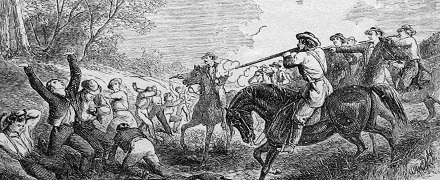
The Marais des Cygnes massacre was one of the last major horrors of that conflict: a party of 30 or so pro-slavery men led by Charles Hamilton seized 11 Free-Staters. They were mostly people who knew Hamilton personally, and seem to have gone along without resistance not anticipating what he had in store for them.

But Hamilton had told his men that on this campaign, “we are coming up there to kill snakes, and will treat all we find there as snakes.” (Source)

Much to their chagrin, these “snakes” were driven into a narrow ravine and lined up before Hamilton’s men’s guns. The volleys they delivered before fleeing back over the porous border into equally restive Missouri “only” killed five of their hostages: the other six survived by playing dead.


(Via)

Five years later, one of those survivors, William Hairgrove, supplied the identification that damned William Griffith — whose claim that he only helped capture the Marais des Cygnes victims, and didn’t help shoot them was an especially lame offering at the height of the Civil War.

According to Legal Executions in Nebraska, Kansas and Oklahoma Including the Indian Territory: A Comprehensive History, Griffith paid the forfeit for his role in the massacre “in a wood west of [Mound City, Mo.] on the opposite bank of Little Sugar Creek” before a crowd of thousands. There,

[a] little after noon Griffith was conveyed to the wood where he stepped onto the wooden platform a few inches above the ground. His wrists, knees and ankles were bound and the noose was adjusted. The black cap was pulled over his face at 1:07 p.m., and in but a moment William Hairgrove, one of the survivors of the massacre, cut the restraining rope with a hatchet; the four hundred pound weight dropped, jerking Griffith upward. The body rebounded and hung motionless while the attending physicians monitored his vital signs, and in twenty-five minutes they pronounced him dead.

Today, the site of the massacre is a U.S. National Historic Landmark. Quaker abolitionist poet John Greenleaf Whittier also memorialized the blood that was shed there in a poem titled “Le Marais du Cygne”:

A blush as of roses
Where rose never grew!
Great drops on the bunch-grass,
But not of the dew!
A taint in the sweet air
For wild bees to shun!
A stain that shall never
Bleach out in the sun!

Back, steed of the prairies!
Sweet song-bird, fly back!
Wheel hither, bald vulture!
Gray wolf, call thy pack!
The foul human vultures
Have feasted and fled;
The wolves of the Border
Have crept from the dead.

From the hearths of their cabins,
The fields of their corn,
Unwarned and unweaponed,
The victims were torn,—
By the whirlwind of murder
Swooped up and swept on
To the low, reedy fen-lands,
The Marsh of the Swan.

With a vain plea for mercy
No stout knee was crooked;
In the mouths of the rifles
Right manly they looked.
How paled the May sunshine,
O Marais du Cygne!
On death for the strong life,
On red grass for green!

In the homes of their rearing,
Yet warm with their lives,
Ye wait the dead only,
Poor children and wives!
Put out the red forge-fire,
The smith shall not come;
Unyoke the brown oxen,
The ploughman lies dumb.

Wind slow from the Swan’s Marsh,
O dreary death-train,
With pressed lips as bloodless
As lips of the slain!
Kiss down the young eyelids,
Smooth down the gray hairs;
Let tears quench the curses
That burn through your prayers.

Strong man of the prairies,
Mourn bitter and wild!
Wail, desolate woman!
Weep, fatherless child!
But the grain of God springs up
From ashes beneath,
And the crown of his harvest
Is life out of death.

Not in vain on the dial
The shade moves along,
To point the great contrasts
Of right and of wrong:
Free homes and free altars,
Free prairie and flood,—
The reeds of the Swan’s Marsh,
Whose bloom is of blood!

On the lintels of Kansas
That blood shall not dry;
Henceforth the Bad Angel
Shall harmless go by;
Henceforth to the sunset,
Unchecked on her way,
Shall Liberty follow
The march of the day.

On this day..

1936: Ramiro Ledesma Ramos, Falangist

Falangist politician Ramiro Ledesma Ramos was executed on this date in 1936, during the Spanish Civil War.

Ledesma (English Wikipedia entry | Spanish) launched the first fascist publication in Spain as a perspicacious 25-year-old admirer of Mussolini and Hitler.*

La Conquista del Estado — the expressive title was cloned from Curzio Malaparte‘s Italian fascist magazine — positioned Ramos as one of the leading apostles of the right in early 1930s Spain. Despite his youth, he’s been credited by later observers as one of the clearest, earliest intellectual exponents of fascism in Spain. Ledesma affiliated from the start with the Falangist movement Jose Primo de Rivera, and personally signed off on the party’s yoke-and-arrows logo and its motto “¡Arriba España!”

Spain’s Republican government had him detained in Madrid with the outbreak of the Spanish Civil War in July 1936. With the fascist armies closing in on Madrid in late October, Ledesma was among dozens of political prisoners taken out and shot without trial at the cemetery of Aravaca.

* His philo-Hitlerism allegedly led Ledesma to imitate the Fuhrer’s flopover coiffure.

On this day..

1859: Thomas Ferguson, but not on a Sunday

The first judicial execution of a white man* in the history of the Utah Territory took place on this date in 1859.

One Thomas Ferguson earned the distinction by getting roaring drunk and shooting dead the shopkeeper who employed and boarded him. Allegedly, Alexander Carpenter’s provocation had been to accuse Ferguson of being party to the unknown burglars who had lately raided his Salt Lake City shop, which obviously got way under Ferguson’s skin.

This was frontier America, being newly-settled by Brigham Young‘s upstart Latter-Day Saints sect, though not only by them. The capital’s population was perhaps 14,000 — the kind of place where dubious refugees could wash up from parts unknown, trusting their fortunes to their native wit and Colt’s Manufacturing Company.

“Crime has run riot in this city since the assassination of McNeill and Sergeant Pike” a hostile, non-Mormon correspondent wrote to the San Francisco Bulletin (letter dated Oct. 5, 1859, and published Oct. 27).

Till lately, no one has been arrested. Ferguson, a “Gentile,” murdered Carpenter, a Mormon, and for such an outrage “this people” will permit the sentence of death to be carried into effect; but the murderers of McNeill, of Pike, of Drown, of Arnold — the first two “Gentiles,” the last “apostates” — run at large to hold the community in terror and carry out other sentences.* An apostate committed suicide a few nights since by shooting himself twice in the back of the head!

Carpenter murdered his partner named Turner near Fort Laramie, Nebraska, brought their goods to this city, where, he said, (and convinced his associates,) he was tried and acquitted. Tried and acquitted in Utah for murder in Nebraska!

Both men were New Yorkers — and per a less strident observer writing to the New York Herald (datelined Oct. 7; published Nov. 7) neither of the two was Mormon. They had been allured to the West by the usual siren songs: wealth, fortune, fame. As young men do, these may have pictured themselves forever getting the drop on their enemies and never the other way around … and always with a dashing jailbreak at the ready if it came to that.

Unfortunately for Ferguson, he wasn’t the only Old West stock character in this tableau; a hanging-judge of dubious character named Charles Sinclair officiated the trial, so deep into his cups that he initially set Ferguson’s execution date for a Sunday. (It was changed to a Friday.) Ferguson himself gave the judge a right scorching from his scaffold rostrum on his way off this mortal coil:

I was tried by the statutes of Utah Territory, which give a man the privilege of being shot, beheaded or hanged. But was it given to me? No, it was not. All Judge Sinclair wanted was to sentence some one to be hanged, then he was willing to leave the Territory; and he had too much whiskey in his head to know the day he sentenced me to be executed on, and would not have known, if it had not been for the people of Utah laughing at him … A nice Judge to send to any country! (Source)

* The Espy file credits earlier executions of Native Americans, two Goshutes named Longhair and Antelope who hanged for slaying two whites during settler bush wars. (I would not venture to assert the judicial propriety, even by antebellum standards, of these proceedings.) And of course, Ferguson’s distinction excludes extrajudicial killings like the Mountain Meadows Massacre.

** The unpunished killings the correspondent names in this piece took place in the immediate aftermath of the 1857-1858 war between Mormon settlers in Utah and the federal government asserting its jurisdiction — a period when Brigham Young’s martial law had just been rescinded. Utah Gentiles inclined to read these incidents as emblematic of a lawless atmosphere in which reluctance to prosecute gave Mormons virtual impunity in their conduct towards the rest of the population.

On this day..

1821: Elizabeth Warriner, Lincoln poisoner

For this just-in-time-for-Halloween wicked stepmother, we are indebted to the highly browsable The Word On The Street, a collection of highlight broadsides held by the National Library of Scotland.

The Last Dying Words, Speech, & Confession of Elizabeth Warriner. Who was Convicted at the last Lincoln Assizes, for the Horrid Murder of her Step-Son, J. Warriner, by poison, and who was Executed at the City of Linclon [sic], on Saturday the 27th of Oct. 1821.

ELIZABETH WARRINER was indicted for the Murder of J. Warriner, her Step-Son, at Surfleet, by administering poison to him. The prisoner was the second wife of a Farmer. The deceased was his Son by a former marriage, about 12 years of age. From the period of her marriage, the prisoner treated the child with great cruelty. On various occasions she was heard to say she would be the death of him. At length on the morning stated in the indictment, the boy, immediately after breakfast, which consisted of bread and milk, was taken ill. Medical aid was called in, but he breathed his last in the course of the day. After she had poisoned the unfortunate boy, she dragged him out of the house, and put him in the stable, and hanged him up, with a rope round his neck, to make people believe he had hung himself, as there was no marks of violence round the neck. The body was opened by a surgeon, when the stomach and intestines were found to exhibit all the appearance of arsenic having been administered. It was afterwards ascertained that a quantity of arsenic was in the possession of the father, who used it for some husbandry purpose, [and to] which the prisoner had access. It further turned out, that a small quantity was found [in t]he basin from which he had eaten his breakfast: and that the prisoner had given him his breakfast in that basin. This circumstance, added to a variety of others, which in the [cou]rse of the examination of the witnesses, seven in numher, came out, led to to the conclu[sion], that the prisoner administered the poison.

Mr. Justice Holroyd summed up tne evidence, and the Jury found her gulity, The [judge] in passing sentence, obserted to the prisoner, that the crime of murder in all cases [was] an heinous one, and in all countries was punished with death; but there were gradations e[ven] in this crime, and her’s [sic] was of the worst nature. She had destroyed her Step-Son; and no other motive could be assigned than that arising from a cruel, hardened, and vicious disposition — her crime was that of muder, the most heinous and cruel. — He hoped she would sincerely repent of her crime, and take all possible care of her soul during the few hours she had to live, so to be reconciled to her offended Maker; he feared she was not so convinced of the necessity of this as she ought to be, but trusted she would seek for that advice which would satisfy her of that necessity, and enable her to meet her future Judge, with a well-rounded hope in his mercy from the sincerity of her contrition; all that remained for him to do was to pass sentence upon her which the law required, which was, that she should be taken from whence she came, and on Saturday the 27th October, 1821, to be taken from thence, to the place of execution, there to be hanged by the neck till she was dead, and that her body should be delivered to the surgeons for dissection — concluding with — “and may the Lord have mercy on your soul.”

The moment she heard that her life was to be forfeited for the barbarous murder, and her cruel treatment to her Step-Son, she jumped up from the floor in the greatest agony, wringing her hands, and other symptoms of distraction.

About ten o’clock on Saturday morning, she ascended the fatal scaffold with a greater degree of fortitude and resignation than could have been expected; and addressed the numerous spectators around her in nearly the following words: “Good people, you see now before you an unfortunate woman, cut off just in the prime of life, and for the most dreadful of al [sic] crimes, Murder! let my dreadful fate be a warning to you not to suffer your passion to work forcibly on your minds, which has been the cause of the melancholy situation in which I am now placed; let me beg your prayers — good people pray for me; O pray for me.”

On the morning of her awful execution, she was dressed all in white, with a child suckling at her breast, which was taken from her by the executioner and her melancholy cries was heard at a great distance. It was shocking to the surrounding multitude.

She then dropped a handkerchief she held in her hand, as a signal, crying, O my Child! my Child! and was immediately launched into a dreadful eternity.

Printed by John Muir, Glasgow.

On this day..

1761: Richard Parrott

(Thanks to Meaghan Good of the Charley Project for the guest post. -ed.)

On this date in 1761, Richard Parrott, a middle-aged man from Harmondsworth, was hanged for the murder of his wife.

According to witness accounts, it all started over “a trifling dispute first arose between the prisoner and the deceased, whether their son or daughter, should go to the field for a cow.”

Parrott later claimed his wife, Anne, had “told a great many lies of him.” The end result was that he beat her and then cut off a large chunk of her tongue. The policeman who responded to the scene later described what he saw in graphic terms:

She lay on the bed, leaning over one side, spitting blood, but could not speak. Her mouth was swelled, and battered in such a manner, there was no such thing as seeing her tongue, She was so swelled and black, she looked like a blackamoor; I should not have known her, though I had known her from a little girl, being born in the same parish.

The assault had knocked out several of Anne’s teeth and badly bruised her. The swelling in her mouth was such that she could eat only broth, and that with great difficulty.

She died a few weeks later.

Before the tragic incident Richard had claimed his wife put “brimstone” in his clothes in an attempt to kill him. To save himself from the supposed brimstone he’d torn off the garments, cut them into pieces and buried them. Witnesses reported he had been “barbarous cruel” to his wife. Anne had told their son he was paranoid and “out of his mind,” and said she was afraid of him.

Nothing was done about it, however, until it was too late.

As the Newgate Ordinary’s account opined,

Nothing but the defence made for the prisoner, viz. Insanity, (supposing it to have a real foundation) can extenuate this horrid and most inhuman fact: nothing but the supposed madness of the perpetrator, can rescue it from being ranked among the most cruel deeds, that ever was perpetrated …

But these circumstances put together don’t remove the probability of the prisoner’s being insane when the fact was done. Subtilty and craft are known to attend this unaccountable distemper, in carrying on any mischief or outrage. The affections are generally inverted; love is turned into hatred, suspicion, jealousy, and rage; and the dearest object of love, is doomed to be the first victim of the perverted passions. The excuse he made when apprehended for this outrage, shews something like this, viz. That she had told lies of him, and he would prevent her doing the like again. Probably he resented her representing and declaring him to be out of his mind, as it appears on the trial she did, when she sent one of her sons for another of them twelve miles, to come and take care of his father, as being in that case. Nothing can provoke a madman more than to be thought or called mad; they are the last, generally speaking, who are sensible of it; and it is the last thing they will acknowledge. Happy had it been for his family, his friends, his neighbours, and parishioners, had they secured and put him under care for this fatal malady; they might have prevented this sad event to the deceased, this reproach to the survivors, who are in any degree blameable for this gross and dangerous neglect.

Found competent to hang by his jury, Parrott “seemed calm, sensible, and resigned” at the Tyburn gallows, where he hanged with three other people: thief Edward Garnet; infanticide Esther Rowden; and a grossly incompetent forger named Donald Campbell who was detected in his craft “by misspelling the names, and the inconsistency of placing 200l. at the top, and writing one hundred pounds in the body of the bill.”

On this day..

1781: Gaspard de Besse, social bandit

The French robber Gaspard de Besse was broken on the wheel in Aix-en-Provence on this date in 1781.

From a cave in the Esterel Mountains looming over the French Riviera, Gaspard raided the ample traffic wealthy merchants sent to and from the Mediterranean and Italy. He established a Robin Hood-esque “social bandit” profile by dint of his targets and populist provocations like, “the two scourges of Provence are the mistral and the parliament!”

Legend holds that he was unfailingly courteous in his raids and never killed those he preyed upon.

No surprise, he did not enjoy a like deference once one of his gang betrayed him. Hopefully amid the limb-shattering blows of the executioner he could console himself with the prospect of posterity’s renown.

On this day..

1849: Zsigmond Perenyi, by the Hangman of Arad

In the weeks following his defeat of Hungary’s 1848-49 revolution, the Austrian general Julius Jacob von Haynau consolidated his victory with enough cruelty to merit the title “Hangman of Arad.” On this date in 1849, he advanced Zsigmond Perényi, of late the speaker of revolutionary Hungary’s House of Magnates, to the ranks of Magyar martyrs.

A career politician and judge, Perenyi (English Wikipedia entry | the more detailed Hungarian) was a stately 74 years of age when the barricades went up. He was a baron, but a member of the reform-minded faction of that class who in the 19th century came more and more to see themselves in a national, Hungarian context. This historical thrust would lead, 18 years after the events of this post, to the official arrangement of an Austro-Hungarian Empire, the promotion of Hungary to titular imperial partnership but never to a fully satisfactory settlement of the tensions between Hungarian patriotic aspiration and Habsburg imperial prerogatives.

Perenyi signed the April 14, 1849 Hungarian Declaration of Independence; he and others who had set their hand to this treasonable document and played a role in the national government — they were just the sort of people to invite the attention of the hangman of Arad.

“Many government commissioners who had supported Kossuth were summarily court-martialled and led to the gallows,” Alan Walker notes in Franz Liszt: The Weimar Years, 1848-1861, Volume 2.

Baron Jeszenak, lord-lieutenant of the county of Nyitra; Szacsvay, the young secretary of the Diet; and Csernus of the treasury board all swung from the end of a rope. Baron Zsigmond Perenyi, of the court of justice, listened carefully to the charges against him and replied: “I have to complain that the accusation is incomplete. I request to add that I was the first to press the resolution that the House of Habsburg-Lorraine should be declared to have forfeited the throne of Hungary.”


By Hungary’s own Franz Liszt.

On this day..