1531: Sikke Freriks, Menno Simons inspiration

Dutch artisan Sikke Freriks, beheaded on this date in 1531 in Leeuwarden‘s market, was the first Anabaptist put to death in that Friesland city.

While a minor milestone in the crowded history of Reformation martyrdoms, Freriks had a noteworthy posthumous effect: word of his heresy — adherence to adult, rather than infant, baptism — came to the ears of a Catholic priest, who later wrote that a man’s dying for this illicit doctrine led him to investigate it further.

To his amazement, the priest found no scriptural support for the established church’s practice of baptizing infants before they developed the maturity and volition to embrace Christ from the will of their own hearts. Christians are “cheated” by the loss of that opportunity of freely giving oneself in baptism, he later wrote.

This man, Menno Simons, would follow his discomfiting scrutiny of holy writ all the way out of the priesthood and into that same forbidden sect. His preeminence in the Anabaptist movement after its disastrous Münster rebellion — and particularly his pacifistic orientation — eventually ennobled him as the founder as well as the namesake of the Mennonites, a term that in Menno Simons’s own lifetime became all but synonymous for Dutch Anabaptism.

On this day..

2015: Four more in Pakistan, but not Shafqat Hussain

In what by this week’s measure constitutes a slackening pace, Pakistan hanged four more prisoners today, all for murder: Gulistan Zaman, Abdul Sattar, and brothers Mohammad Asghar and Ghulam Mohammad.

Meanwhile, the controversial scheduled Thursday hanging of Shafqat Hussain was postponed for further investigation by the Interior Minister at the very last moment.

“They dressed him up in white uniform for the execution,” Hussain’s brother* told the press. “Then they asked him to write his last will. He wrote: ‘I am innocent. They want to hang me for a crime I have not committed, to save others who have been freed.'”

Shafqat Hussain’s family reportedly produced a birth certificate supporting its contention that Hussain was 14 when arrested. Pakistan has contended that he was 23.


Shafqat Hussain

* Some news stories are naming that brother as “Gul Zaman” which is also the name reported for one of the killers hanged today. I’m not sure if this is media sloppiness, or if there are two distinct people involved in the day’s drama who happen to share a name.

On this day..

2015: Nine more in Pakistan

Today, one day after hanging 12 of its 8,000 condemned prisoners, Pakistan extended its newfound mass-execution campaign. Nine more men went to the gallows at various jails in several Punjab cities.

On the heels of Tuesday’s executions, this binge surely portends a return for Pakistan to the ranks of the world’s most active executioners, sub-China division. Human rights organizations are predictably horrified.

Dawn.com reported the identities of the hanged men — all murderers — as:

  • Lahore (1) — Tahir Shabir
  • Jhang (2) — Ghulam Muhammad and Zakir Hussain
  • Faisalabad (2) — Shafqat and Saeed
  • Rawalpindi (2) — Shaukat Ali and Muhammad Shabir
  • Mianwali (1) — Ahmed Nawaz
  • Attock (1) — Asad Mehmood Khan

More hangings are planned for Thursday, including the controversial execution of Shafqat Hussain, whom advocates say was condemned as a juvenile based on a torture-adduced confession. The shadow of the noose also appears to have triggered a scramble among at least some of those due to be executed to reach private settlements with their victims’ families. Dawn.com reported that Qadeer Ahmed in Rawalpindi and Azhar Mahmood and Muhammad Zaman in Gujrat were both reprieved from Wednesday executions by producing such arrangements at the eleventh hour.

On this day..

2015: Twelve in Pakistan

Repudiating its former death penalty moratorium with bombast, the government of Pakistan hanged 12 men today.

From 2008 to 2014, Pakistan while continuing to hand down death sentences had suspended their completion; a soldier condemned by court-martial and hanged in 2012 was the sole execution during that period.

As these pages have recently noted, the December 16 Peshawar school massacre abruptly ended that moratorium.

Islamabad resumed executions almost immediately thereafter, explicitly as a response to that atrocity. Those were, at first, hangings of prisoners convicted of terrorism-related offenses — not connected to Peshawar per se but tit-for-tat in at least a thematic fashion.

Approximately 27 terrorists with pre-existing death sentences hanged over the ensuing weeks.

But in keeping with the tradition of our age, “just terrorists” was just the camel’s nose under the tent.

Earlier this very month, the Interior Ministry announced an end to the death penalty moratorium for all crimes — casting many more people under the pall of potentially imminent execution.

The execution of death sentences may be carried out strictly as per the law and only where all legal options and avenues have been exhausted and mercy petitions under Article 45 of the Constitution of Islamic Republic of Pakistan have been rejected by the president.

Pakistan has continued even during the moratorium to be one of the most active death-sentencing countries in the world, and has an estimated 8,000 “ordinary” condemned criminals. Because many — up to 1,000 — of those prisoners’ judicial processes and clemency appeals ran their course during the time of the moratorium, and because President Nawaz Sharif has shown an avidity in the three months since Peshawar for the hangman’s services, it has been feared that Pakistan’s execution toll this year could easily vault straight into the triple digits.

That prospective hecatomb is yet to be determined — but today’s start will not reassure human rights advocates.

Different media outlets are giving slightly different rosters of the executed this morning, and Zafar Iqbal confusingly appears to be a name shared by two different prisoners — so this list (via the Pakistan Tribune) is offered only tentatively pending more definitive revisions. It appears to me that all or nearly all committed murder, often in the course of some other crime such as robbery or rape.

  • Multan (1) — Zafar Iqbal (another man there named Wazar Nazir was reportedly reprieved at the last moment)
  • Karchi (2) — Muhammad Faisal and Muhammad Afzal
  • Faisalabad (1) — Muhammad Nawaz
  • Rawalpindi (2) — Malik Muhammad Nadeem Zaman and Muhammad Jawed
  • Gujranwala (1) — Muhammad Iqbal
  • Jhang (3) – Muhammad Riaz, Muhammad Sharif, and Mubashir Ali (or Abbas?)
  • Mianwali (2) — Rab Nawaz and Zafar Iqbal

The hanged Muhammad Afzal’s shrouded body is received by his brother in Karachi.

A second man in Multan, named Wazar Nazir, was reported reprieved at the last moment, as was an Asghar Ali in Dera Ghazi Khan.

According to Dawn.com, these executions bring the count of those executed since Peshawar to 39.

At least one more hanging is scheduled for this week: Shafqat Hussain, allegedly tortured into confessing to a murder at the age of just 14 or 15.

On this day..

1773: Lewis Hutchinson, “the most detestable and abandoned villain”

Two inconsistent versions of a mass-murderer’s moniker in this American colonial news dispatch* can hardly detract from the horror of Jamaica’s first serial killer. The Scots emigre Lewis Hutchinson owned an isolated estate along the only byway connecting the north and south sides of Jamaica.

“The Mad Master of Edinburgh Castle” sought the most dangerous game in this creepy defile, and as many as 40 or 50 passing travelers might have become his prey when they came calling in need of a bed for the night at his sinister donjon.

Extract of a letter from Kingston, in Jamaica, April 1.

The 16th of last month was hanged at Spanish Town, one James [sic] Hutchinson, the most detestable and abandoned villain, that ever disgraced the human species.

He was a naive of North-Britain, and had a pen in Pedro Valley, in St. Ann’s parish: when any of his neighbours cattle strayed on his lands, he always secured them as his own, and by that means had acquired a little fortune, and it is imagined that many people had been murdered by him for demanding their property, and this conjectue seems but too well founded as you’ll observe in the sequel.

A Mr. Callender (whose land joined Hutchinson’s) had lost a Jack-ass, and seeing him in this wretch’s pasture, went to him and requested that the Ass might be turned in the highway, when he would take care he should trespass upon him no more.

Hutchinson told him this command should be immediately complied with, and when Callender had turned his back and was going away, the villain took a gun, and killed him on the spot. A man then lying sick at Hutchinson’s hearing the report of a gun, crept out of his bed, asked what firing that was, and said, I believe you have shot the man that I heard enquiring about the Ass.

The villain replied, go instantly to your bed, or I’ll serve you the same sauce.

The sick man however in the evening, found means to get privately out of the house, and immediately lodged a complaint, upon which Hutchinson, was apprehended, and by the information of one of his negroes, the place was discovered where he had conveyed the head of Callender, and where near 20 other human skulls were found, the body was thrown into a cockpit (as is here called) a place deemed inaccessible, being down a perpendicular rock, that had been split by an earthquake, or so formed by nature, the bottom of which could not be discerned, hanging however upon a point of the rock which jetted out, the unfortunate man’s body was seen, and well known by his cloaths; by some daring contrivance, a person went down a considerable length, and discovered a great number of human bones, but no skulls, so that it is to be supposed, this merciless villain had always taken off the heads of those he had murdered, in the same manner he did with poor Callender.

At his trial, he had several of our most eminent council to plead for him, and during the whole time for his commitment to his execution, he behaved with the greatest insolence, he employed the whole day before he died, in writing, and told the people he had made his own epitaph, and left a 100l. to have it engraved on his tomb stone. It is long and ill wrote, but he concludes it in these words, speaking of the Courts and Jury,

Their sentence, pride, and malice I defy,
Despise their power and like a Roman die.

Lewis Hutchinson, hanged at Spanish Town the 16th of March, 1773, aged forty years. — Thus was the world rid of this detestable and most execrable monster.

* It was printed many places; the Salem, Mass. Essex Gazette of May 25, 1773 is the specific one I’ve transcribed from.

On this day..

1745: Martha Stracey, whore and reprobate-creature

Martha Stracey or Tracey hanged at Tyburn on this date in 1745 for assaulting a man named Will Humphreys and robbing him of one single guinea a few months before.

Stracey, about 18 or 20 years old, was a prostitute and pickpocket — “a perverse, vicious Girl, void of all good Dispositions, and wholly untractable and unadviseable, giving herself up to the vilest Company on Earth, both of Men and Women,” the Newgate Ordinary judged. The Ordinary’s accounts are a reliable feast of purple prose and do not disappoint in discoursing on the young bawd and her fall.

Having no interest in honest work and “renounc[ing] every thing resembling Goodness or Virtue,” she “went idling her Time away on the Streets with her hellish wicked Companions, who induc’d her to commence Whore, upon which she turn’d a meer reprobate-Creature” and “became known to all the Constables, and inferior Officers of Justice in that End of the Town.” Stracey, says the Ordinary, “own’d she was naturally inclined, and not over-persuaded by others, as some of them may or do alledge in Extenuation of their Guilt.”

During the night of Dec. 22-23, Humphreys testified, Stracey and Humphreys met on the Strand. According to Humphreys, she approached him unbidden, and when Humphreys insulted her, two men clobbered him as Stracey skillfully went through his pockets in a few seconds and plucked out the gold coin.

Stracey claimed the affair began when Humphreys “pulled me into an alley, and wanted to be concerned with me.”

No other eyewitnesses could testify to the substance of their rendezvous, but Humphreys’s story about the mysterious male accomplices who after thumping him went on their own way and left Stracey alone with him mid-robbery has the definite whiff of a cover story. The jury — perhaps searching for some grounds to avoid sending the woman to the gallows* — even asked the arresting constable, William Dunn, whether Humphreys’s clothes were really dirty, since he claimed to have been knocked down in the scuffle. (The constable didn’t know.)

But the simple fact was that Stracey did have Humphreys’s gold guinea, whether she achieved by main force or plucked it during a roadside assignation. With the convenient disappearance of her supposed goon squad, Humphreys was now able to seize the hustler on the spot and drag her to the watch. Constable Dunn had someone “search her behind and before (I ask pardon, my Lord)” and finally found the guinea under Martha’s profane tongue.

Before her execution, Stracey did confess that she had stolen the gold piece, under the circumstances that Humphreys’s shady account might lead one to infer:

Martha own’d the Fact she died for, that meeting a Man in the Street in the Evening, about Nine or Ten o’Clock, they speedily came to speak of an Agreement about a certain Affair; and as they were adjusting Matters, Martha thought fit to examine the Gentlemen’s Pockets, and amongst other Things, finding a Guinea, she robb’d him of it, as he Swore against her, and upon this she was convicted of a Street-robbery, one of the greatest Crimes in the Eye of the Law. She did not well remember the Circumstances of this robbery, as being very Drunk, which all of them generally are, when attempting to perpetrate so soul and black Crimes in an audacious manner.

Martha owned her committing of several robberies of this Kind before, she being a constant Street-walker , but did not well remember the Circumstances of the Robbery, she died for, nor the others which were conceal’d, it being impossible to recollect them, for the was always dead Drunk when they were committed. She was very ignorant of Religion, and what Things pertained to the state of her Soul; I endeavoured to instruct her, as the Brevity of Time allow’d, but she was of a mean Capacity and slow of Understanding, and had been so accustomed to do Evil, that she could scarce do any Thing that was good.

* The denomination of the stolen coin made “pious perjury” impossible.

On this day..

1569: Louis de Bourbon, Prince of Conde, at the Battle of Jarnac

In an admittedly borderline “execution”, Louis de Bourbon, the Hugueunot Prince of Conde, was killed summarily at the end of the Battle of Jarnac on this date in 1569.

This nobleman’s conversion to Protestantism had been attended with the zeal so usual to that period. In the case of Conde (English Wikipedia link | French), that meant dipping his beak into some dramatic plotting.

Though nothing could be proved about him, the Catholic faction suspected him of being a leading spirit in the 1560 Amboise Conspiracy, a plot to kidnap King Francis II.

Nothing daunted by its failure, he spearheaded the even riskier Surprise de Meaux, a design to seize not only King Charles IX but the rest of the royal family in 1567. This time, failure triggered a whole new installment of the on-again, off-again Wars of Religion.

The Year of Our Lord 1569 found Conde at the head of the principal Huguenot army in an extremely tense country. On March 13, that army met the Catholic force of Marshal Gaspard de Saulx at the Battle of Jarnac.*

The result was a smashing victory for the Catholics. As the disaster unfolded, Conde, wounded and alone, tried to offer his surrender to an enemy guardsman. He was instead shot on the spot — and his body borne back to Catholic lines for jeering.

This crippling defeat set the stage for the uneasy truce that quelled religious bloodshed in 1570 — the truce that would be shattered by the 1572 St. Bartholomew’s Day Massacre.

* The teenage Walter Raleigh fought at this battle on the Huguenot side.

On this day..

1943: David Cobb, the first U.S. serviceman hanged in World War II Britain

David Cobb, Private, Company C, 827th Engineer Battalion (Aviation), on March 12, 1943 achieved the milestone distinction of becoming the first U.S. soldier executed in Great Britain.

On December 27, 1942 — a mere 11 days after arriving in Britain — Cobb was ordered by a Lt. Robert Cobner to surrender his weapon when the private popped off to him during a routine inspection. Instead, Cobb shot Cobner dead.

He was hanged by the British executioner Thomas Pierrepoint at Shepton Mallet prison — a fortress dating to 1610 and still in use to the present day. The U.S. Army employed part of the prison during World War II to carry out 18 military executions; over half of these men were, like Cobb, black.

On this day..

1941: Twenty-one hostages for Igo Sym


Igo Sym tickles the ivories in Zona i nie zona (Wife and No Wife) … his last role.

On this date in 1941, the Germans occupying Poland took revenge for the loss of an artist.

Handsome Austrian-born silver screen luminary Igo Sym, whose silent film credits included roles opposite Marlene Dietrich and Lillian Harvey, had become a prominent fixture of the Warsaw stage when the Germans overran Poland in 1939.

Sym (English Wikipedia entry | Polish) collaborated with the German occupation: he worked manicured hand in glove with the Gestapo, even helping to entrap a former co-star.

This attracted the hostility of the Polish underground, which secretly condemned him to death — and executed that sentence on the morning of March 7, 1941, with a knock at Sym’s apartment door and a sudden 9 mm pistol.

In punishment for this gesture of national defiance, all of Warsaw was clapped under a harsh curfew and dozens of hostages seized as surety for the public’s promptly rendering the actor’s murderers for punishment. But the assassins were not so delivered: in revenge, the Germans executed 21 hostages at the nearby village of Palmiry.* Two University of Warsaw professors were among those hostages, biologist Stefan Kopec and historian Kazimierz Zakrzewski.

* Palmiry had the sorrow to host numerous similar mass-executions during the German occupation of Warsaw. Over 2,000 bodies have been recovered from the site.


Polish hostages (not necessarily those of March 11, 1941) being readied for execution at Palmiry. This photo (and others) via the Polish Wikipedia page on war crimes in Palmiry.

On this day..

1899: Cordelia Poirier and Samuel Parslow

On this date in 1899, Cordelia Poirier was hanged in Ste. Scholastique, Quebec with her lover Samuel Parslow.*

Cordelia Viau by her maiden name, the femme fatale in this transaction found that in her marriage to one Isidore Poirier she was much the sturdier spirit.
“She was a masterful woman,” this old public-domain text on insurance crimes muses, “and Poirier seems to have been a man of very common mould. He was not great or strong enough to make his wife admire or respect him, yet was too obstinate to yield to her domination.”

Cordelia soon turned this gap in magnetism to good effect on Mr. Parslow, a local carpenter, to the considerable scandal of their village, Saint-Canut.

An intolerable domestic situation drove Isidore Poirier to the bottle, and Cordelia Poirier to the insurance underwriters — from whom she obtained two separate $1,000 policies on the life of her spouse. Much to the discredit of her agents (and, one must suspect, to the commission wage model), the wife’s blunt inquiries as to whether a death by assassination woud void the policies were met with simple affirmations rather than a summons to the constable.

Sure enough, Isidore Poirier suffered just such a death on November 21, 1897: after vespers (Cordelia was an organist at the church), she and Parslow barged in on the intoxicated Isidore at his home and Parslow slashed him to death with a butcher knife. The body was discovered the next day, and it wasn’t hard to put means to motive and clap the adulterers in gaol.

Having perhaps not thought this venture through, Samuel Parslow and Cordelia Poirier promptly began informing on one another in hopes of avoiding the rope. Their confessions would only cinch one another’s fates. By the time of trial, Parslow had to feebly accuse Mrs. Poirier of hypnotizing him.**

Her cynical domestic crime and vampish reputation earned her an extreme level of disapprobation: her behavior obviously inverted and betrayed the model of domestic virtue whose penumbra of sentimentality has often been counted on to save female murderers from the gallows. Cordelia Poirier was actively hated.

“The crowd inside the jail jeered [Cordelia Poirier],” it was reported — “but even then her nerve did not desert her, and at the suggestion of the executioner she turned and faced the Jeerers, and stood erect and prayed to the last.”

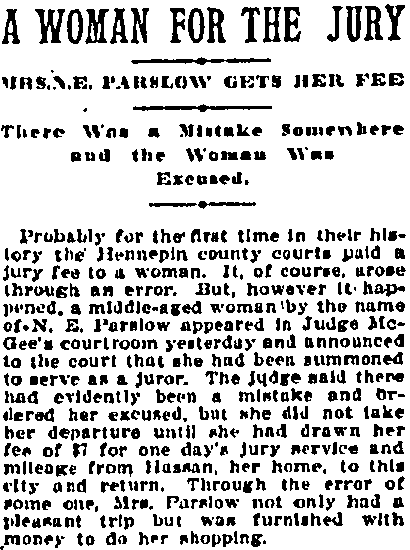
* Thanks to the wonders of database searches, research for this post also revealed a completely different legal drama off the same era related to a competely different Parslow. This story is from the Feb. 4, 1898 Minneapolis Journal.

** All reports do paint Cordelia Poirier as the stronger will in her adulterous relationship, as well as her marital one, and the instigator of the murder.

On this day..