1849: Friedrich Neff, 1848 Revolutions radical

On this date in 1849, the German revolutionary Friedrich Neff was shot at Freiburg.

A law and philosophy student, Neff had been one of the firebrands of the Baden incarnation of Germany’s 1848 Revolutions.

These stirrings for political liberalization and national unification in the loose 19th century German Confederation, which comprised dozens of duchies and principalities left over from the dissolved Holy Roman Empire, were just the sort of thing to inspire student radicals like Neff.

Neff‘s Heidelberg was an initial center of the movement, led by Friedrich Hecker* and Gustav Struve. (All links in this sentence are German Wikipedia pages.) Though Hecker and Struve were established lawyers who most certainly had something to lose, they led rebel guerrillas into the field against the troops dispatched to crush the republican stirrings. They didn’t have much success, but it’s the thought that counts.

On September 21, 1848, Struve unavailingly proclaimed a German Republic in Baden, an event that is known as the Struve-Putsch and whose defeat four days later closes the first chapter of the 1848 revolutions (at least in Baden).

As a Struve-Putsch supporter (and an open advocate of political violence even before that), Neff had been obliged to flee to Switzerland and onward to Paris. That positioned him perfectly when the 1848 revolution scheduled an 1849 comeback to be the man to muster a legion of Baden exiles who would attempt to topple the duchy.

“This legion was the wildest band which the revolution brought forth,” this history of the revolution recounts. “It was commonly called the Legion of Fugitives, because composed largely of political refugees from Baden, who had fought under Hecker and Struve … There were also in the Legion many daring adventurers, some of whom were still wearing the red trousers of the Algerian Foreign Legion of France.” But these, too, were easily crushed, and Neff was arrested fleeing into exile. His last letter urged his mother to “remain firm and steadfast. I will go to death tomorrow as calmly as I once strolled in our garden — would that I had ten lives to give for the cause.”

Neff is a hero to social democrat types in present-day Germany, and there are public monuments him — like this plaque marking his birthplace in Rümmingen.


(cc) image from Erik Vogelpohl.

* Haberdashers might be familiar with the Heckerhut, a wide-brimmed, high-peaked hat popularized by Friedrich Hecker.

On this day..

1570: John Felton, papal bull promulgator

On this date in 1570, the English Catholic martyr John Felton suffered hanging, disemboweling, and quartering at St. Paul’s Churchyard in London for the Old Faith.

Not to be confused with the 17th century assassin of the same name, our John Felton was reported by the biography from his daughter’s hand to be a wealthy Southwark gentleman whose wife had gamboled in her own childhood with the future Queen Elizabeth.

John’s crime was to hang up publicly in the dark of night before Corpus Christi the papal bull excommunicating Queen Elizabeth — an act not merely of religious dissidence but of overt political rebellion, inasmuch as the bull released English subjects from their obedience to “the pretended Queen of England” and exhorted them on pain of damnation to ignore her edicts. This directive from Rome was to prove so taxing for Catholics that it was soon modified to permit outward obedience in civil matters, pending the overthrow of the heresiarchess.

Following a decade of uneasy religious tolerance — in which, not coincidentally, Elizabeth entertained the suits of assorted continental royalty, some of them Catholic — Regnans in Excelsis marked the onset of open hostilities. The Catholic “Ridolfi plot” would be hatched this very year, for instance, and lead the Duke of Norfolk to the scaffold by 1572.

And then he said, O Lord, into thy hands I commend my spirit, in English; and as he was saying it in Latin, In munus tuas Domine, he was turned off the ladder; and hanging there six turns, he was cut down, and carried to the block, and there his head was smitten off, and held up, that the people might see it: whereat the people gave a shout, wishing that all Traitors were so served. Then he was quartered, and carried to Newgate to be parboiled, and so set up as the other rebels were. — God save the Queen.

John Felton’s son Thomas Felton was also martyred, in 1588. Both have since been beatified.

On this day..

2009: Li Peiying, corrupt aviation kingpin

On this date in 2009, China executed Li Peiying, the former chairman of a vast airport conglomerate that managed, among many others, Beijing Capital International Airport.

Li was convicted on corruption charges that netted £11 million in bribes and embezzled public funds from 1995 to 2003. Li’s case for leniency was that he gave it all back; the court’s case for aggravation was that Li had solicited (and not merely accepted) the bribes, an “extremely serious crime” resulting in “large economic losses.” For instance, nightclub mogul Qin Hui* was able to secure through Li $90 million in loans and guarantees

The state-owned Capital Airports Holding Co. that Li managed was reported at the time of his execution to employ 38,000 people and handle 30% of China’s air traffic.

In 2011, the successor to the corporate titancy Li was deposed from, Zhang Zhizhong, was himself convicted of wholesale corruption.** Perhaps in deference to China’s ongoing gradual de-escalation of penalties imposed for white-collar economic crimes, Zhang received only a 12-year prison sentence.

* Qin Hui shares a name with a villain in the classical story of Yue Fei. Our Qin Hui just owned the Paradise club in the Great Wall Sheraton.

** China’s aviation industry as a whole is notorious for corruption.

On this day..

1788: John and Robert Winter, father and son

On August 6, 1788, “John and Robert Winter, the father and son, were executed at Morpeth, pursuant to their sentence, for breaking open the house of William Charlton, esq., of Hesleyside. As they had lived for many years in a course of the most daring and shameless villainy, at their death, they testified the most brutal want of feeling, fear, or compunction.”

On this day..

1943: Red Orchestra members, in the Nazi Paradise

From 7 to 8 p.m. on the evening of August 5, 1943 the Fallbeil at Plotzensee Prison destroyed 17 members of the Berlin Red Orchestra resistance circle.

We have touched previously on Die Rote Kapelle in the context of the first 11 executions that claimed its leadership on December 22, 1942.

But the Gestapo had a much wider network than that to break up; ultimately, there would be nearly 50 death sentences associated with Red Orchestra, for activities ranging from outright espionage to merely dissident leafletting, and other rounds of executions had taken place over the preceding months.

The executions this date were more of the sad same, and noteworthy for some sincere and ordinary citizens so sympathetic that even the Reich Military Court recommended mercy for some. Adolf Hitler refused it across the board. The victims, predominantly women who had been moved to Plotzensee for execution that very morning, included

  • Cato Bontjes van Beek, an idealistic 22-year-old ceramicist.
  • Liane Berkowitz. Two days short of her 20th birthday when she was beheaded, Berkowitz had given birth to a child while awaiting execution.
  • Eva-Maria Buch, who translated propaganda leaflets destined for illicit distribution to the forced laborers employed in German munitions factories.
  • Else Imme, an anti-fascist whose sister had emigrated to the Soviet Union.
  • Ingeborg Kummerow.
  • Anna Krauss, a 58-year-old businesswoman.
  • Klara Schabbel, a Comintern agent who in her youth had fought against the French occupation of the Ruhr after World War I.
  • Rose Schlosinger.
  • Oda Schottmuller, a dancer and sculptor who used her arts-related trips to act as a courier.
  • Writer Adam Kuckhoff. His widow Greta would go on to head the East German central bank.
  • Emil Hubner, an 81-year-old retiree, along with his daughter Frida Wesolek and her husband Stanislaus.

Besides the above, at least three others among the condemned in this group paid with their lives for an arts activism attack on Das Sowjetparadies (The Soviet Paradise), a Reich exhibition in May-June 1942 that used photographs and captured artifacts from the war’s eastern front to depict “poverty, squalor and misery” in the USSR. This associated propaganda film gives a taste of the vibe:

The Orchestra orchestrated an “attack” littering the exhibition with counter-propaganda


“Permanent Exhibition
The NAZI PARADISE
War Hunger Lies Gestapo
How much longer?”

This act of wehrkraftzersetzung was a factor in the sentences of —

  • Hilde Coppi, one of the circle’s principal members and the wife of the previously executed Hans Coppi. Like Liane Berkowitz, she was spared the first rounds of executions to bear and nurse her child.
  • Maria Terwiel, a Catholic barrister with a Jewish mother.
  • Ursula Goetze.

On this day..

1743: Gen. Charles Emil Lewenhaupt, scapegoat

There’s a good chance that you experience an unpleasant degree of performance pressure from time to time in your environs, whatever they might be. Lord knows even the executioner is not immune to it.

But it’s doubtful very many are under the sort of professional pressure that Swedish general Charles Emil Lewenhaupt succumbed to on this date in 1743, when he was beheaded for command incompetence thanks to his country’s defeat in the 1741-1743 Russo-Swedish War.

An aggressive political faction of “Young Turks” — er, Young Swedes — known as the Hats had kicked the country’s cautious former president to the curb and aimed to restore the great power status Sweden had coughed up to Russia decades prior. In Sweden, their engagement with Russia would become known as the Hats’ War.

Lewenhaupt himself was elevated to command of Sweden’s Finland forces — for Finland was Swedish territory at this point, although it had been brutally occupied by Russia from 1714 to 1721 and only returned when Sweden ceded its Baltic possessions to Peter the Great — over a general who opposed the adventurous scheme. Ironically, the whole thing would ultimately redound to the benefit of Peter the Great’s daughter.

In 1741 as the War of Austrian Succession consumed the rest of Europe, Lewenhaupt was placed in charge of the opening gambit, an invasion of Karelia. Russia’s autocratic Empress Anna had just died in 1740, leaving her niece Anna Leopoldovna in charge as regent for the the infant Ivan VI. The idea from the Swedish side was to pair the invasion (with a short line to St. Petersburg, then the capital) with an internal coup against the shaky monarch; further to that latter end, Swedish diplomats* maneuvered behind the scenes to position Peter the Great’s popular daughter Elizaveta to seize power, whereupon she would cede back to Sweden (either out of gratitude or by compulsion of the arriving Swedish armies) the Baltic lands recently torn from Stockholm’s hands.

Make sense?

The entire project was a fiasco for Sweden.

Sweden’s Hats-dominated Riksdag declared war on Russia in July of 1741, but the joint land and naval attack that was supposed to ensue completely failed to materialize: the Swedish fleet had been ravaged by an epidemic while awaiting the action, and the Swedish army massing at Villmanstrand had not yet finished assembling. So having thrown down the gauntlet, the Swedes just stood flat-footed, and it was the Russians who launched the invasion by routing the army at Villmanstrand. Our Gen. Lewenhaupt only arrived at that army two weeks after the battle.

Things went pear-shaped from that point for Sweden, but back in St. Petersburg the invasion’s prospective beneficiary was doing just fine.

Elizaveta had cagily accepted the aid of her French and Swedish “benefactors” but without committing any reciprocal promise to paper. Far from being a catspaw of foreign interests, this daughter of Russia’s conquering tsar was a popular figure in her own right, especially with the elite Preobrazhensky Regiment; on the evening of November 24, 1741, Elizaveta displayed herself at the regimental barracks dramatically clad in a breastplate and wielding a silver cross, summoning her supporters to mount a coup that the guards themselves had long sought. It was achieved (by Elizaveta’s own insistence) without bloodshed** that very night.

Duly installed, Elizaveta simply continued prosecuting a war that was going quite nicely for her side thank you very much, eventually forcing Sweden to conclude the war with a treaty ceding yet more territory to Russia.

The tribulations of this embarrassing (and costly) war led for Sweden to an internal rebellion — but the Hats were able to crush it and hold onto power by farming out blame for their failed war of choice onto the generals in the field. In 1743, Gen. Lewenhaupt and Gen. Henrik Magnus von Buddenbrock were sentenced to death for command negligence. Buddenrock was executed on schedule on July 27, but Lewenhaupt managed to escape — briefly. He was recaptured aboard a ship fleeing for Gdansk and beheaded on August 4.

Needless to say the great classical tradition of “with your shield or on it” did not extend to the Hats’ civilian leadership. These fellows maintained their hold in the Riksdag long enough to fling Sweden into yet another costly war of choice with Prussia in 1757, where they got their ass kicked again by Frederick the Great.

* Joined by French diplomats, whose interest in Elizaveta’s takeover was to abort Russia’s alliance with Austria and England in the continental war. The Hats had aligned Sweden with France; the latter helpfully supplied the cash Elizaveta needed as the intrigue unfolded over 1741.

** Never the violent type, Elizaveta is especially notable in these pages for her pledge never to approve a death warrant under her reign. Russia would not see another execution until 1764, under Catherine the Great.

On this day..

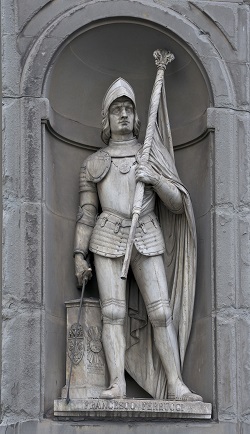
1530: Francesco Ferruccio, victim of Maramaldo

On this date in 1530, Francesco Ferruccio (or just Ferrucci) and his executioner Fabrizio Maramaldo clinched their immortality at the Battle of Gavinana.

The battle was the tragic final scene of the War of the League of Cognac, in which an alliance of Italian city-states tried to expel the Habsburg Holy Roman Emperor Charles V from the peninsula. Charles had already in effect decided matters by forcing the French out of the fight, which also brought about the capitulation of the Vatican.

Left alone in the fray, doughty Florence — ever so briefly at this moment restored as a Republic, having given the Medici the boot — continued to hold out against impossible odds. A vast imperial army swollen by landsknechts whose mercenary arms were now unnecessary elsewhere in Italy besieged Florence on October 24, 1529.


The Siege of Florence, by Tuscan Renaissance Man Giorgio Vasari.

The intrepid Florentine commander Francesco Ferruccio (English Wikipedia entry | Italian) strove to take his hopeless fight to the enemy. After a plan to coerce papal support by striking Rome was vetoed, Ferruccio mounted a march through the Apennines to threaten the Imperials’ rear.

He was intercepted at Gavinana, a battle decided by the arrival of landsknecht reinforcements under the command of the notoriously cruel condottiere Fabrizio Maramaldo.

Maramaldo would elevate himself for posterity out of the ranks of his merely brutal brethren by finding Ferruccio, badly wounded, his prisoner, and putting him to immediate death by his own hand — an execution that resulted in Florentine capitulation one week later, and the installation of Alessandro de’ Medici as Duke of the now ex-Republic.*

While admittedly borderline as an “execution” suitable for this here site, Ferruccio’s defiance in the face of his killer and his last denunciation of Maramaldo — “Coward, you kill a dead man!” — became the stuff of legend in a later Italy. (It also helped Ferruccio’s case for the nationalist pantheon that he died fighting against the Germans, not against the next city-state over.)

The romantic novelist Francesco Domenico Guerrazzi** made Ferruccio the subject of his magnum opus L’Assedio di Firenze, and before you knew it the name was on the lips of every risorgimento Tom, Dick and Francesco. Garibaldi invoked him in speech; Goffredo Mameli wrote him into the national anthem.


Every man has the heart
and hand of Ferruccio …

Under the Italian state those men helped to make, Ferruccio was appropriated as the name of a battleship; fascist Italy especially found Ferruccio congenial to the national-pride project and valorized the martyr relentlessly.


1930 Fascist Italy stamp depicting — for the 400th anniversary of the occasion — Fabrizio Maramaldo murdering his prisoner Francesco Ferruccio. Other Februccio stamps from the same period can be found on the man’s Italian Wikipedia page.

For Maramaldo, a less flattering but possibly more durable legacy: Italian gained the noun maramaldo, the adjective maramaldesco, and the verb maramaldeggiare to signify bullying or cruel domineering.

* Alessandro had a reputation for despotism, and was assassinated a few years later by his cousin Lorenzino de’ Medici in a tyrannicide that was Brutus-like in both its motivation and effect. That later affair is the subject of the 19th century play Lorenzaccio.

** Guerrazzi also did his bit for the legend of Beatrice Cenci.

On this day..

1548: Seraphin d’Argences

On this date in 1548, the Calvinist evangelist Robert de Lievre — better known by his nom de prosélytisme Seraphin d’Argences, or as Antoine Deschamps — was burned at Paris’s Place Maubert.

According to their hagiographies, the martyrs’ steadiness caused their assigned Catholic hector Francois Le Picart to lay off the browbeating and comfort them in their last pains.

This neat trick was achieved by the dread Chambre Ardente, really earning its name in this instance, which wanted the example made of this itinerant preacher to match the scope of his roving heresy. Seraphin d’Argences had even had the temerity to administer reformed Lord’s Suppers, leading the judgment against them to cite not only the obvious heresy stuff but “acts repugnant to the holy Catholic faith and the sight of the Holy Church, outraging the Blessed Sacrament of the altar.”

The show began with the minister’s collaborators, Jean Thuillier, Michel Mareschal and Jean Camus, piled into a cart for the ride to the stakes. Seraphin d’Argences trailed right behind them, drug on a sledge pulled by the tumbril.

At the Place Maubert, they all burned the same, but the heresiarch’s stake was consciously elevated above the other three — a sure nod to the developing age of spectacular capital punishment.

Following his bodily execution, Seraphin d’Argences was re-executed in effigy in various towns where he had been active: Langres, Sens, Blois, Bourges, Angers, and others all hosted ceremonial “executions” of lifelike likenesses of the lifeless schismatic.

On this day..

1868: Stefan Karadzha, Bulgarian national hero

On this date in 1868, the Ottoman Turks executed Bulgarian revolutionary Stefan Karadzha.

Karadzha was one of several nationalist cheta (guerrilla) leaders aspiring to father the future sovereign Bulgaria.

Operating from adjacent, and conveniently independent, Romania, around 1866-1867, Karadzha and others of his ilk — Hadzhi Dimitur Nikolov, Filip Totyu, and the dramatically mustachioed Panayot Hitov — slipped over the mountainous border to organize revolutionary cells and foment ill-feeling towards the Sublime Porte.

In Bulgaria’s late 19th century progress towards independence, these figures are transitional characters between the vanguard leadership of Georgi Rakovski, and the ensuing primacy of Vasil Levski.

Levski himself was a guerrilla in this period; after the cheta legions suffered some backbreaking defeats in the field — one of which saw our man Karadzha captured so badly wounded that he was “half-dead before the emergency Turkish court”* when condemned to hang — Levski set about honeycombing his country with the revolutionary network that would shape the future revolutionary struggle.

A national hero of lesser stature than Levski, which is sure no disgrace, Karadzha has a village named after him.

* The quote is from the unimpeachable source of Karadzha’s Wikipedia page.

On this day..

1746: Francis Towneley, of the Forty-Five

On this date in 1746,* the English Jacobite Francis Towneley was hanged, drawn and quartered at London’s Kennington Park.

This Lancashire Catholic had relocated residence and loyalty to France at age 19 in 1728, and fought in that country’s army. He was right at the sweet spot of veteran seasoning and youthful enterprise by the time “the Forty-Five” rolled around: the last great Jacobite rising to reverse the Glorious Revolution and re-enthrone the dispossessed heirs of King James.

With British armies deployed around Europe and the colonies in the 1740s during the War of Austrian Succession, the French decided to back a Jacobite bid to restore the exiled Stuart pretender, using the customary geopolitical strategem of teaming up with the Scottish. Being a Lancashire local, Towneley was commissioned a colonel and dispatched as an advance party to Manchester to scare up a regiment of Stuart loyalists there who would join up with Highlanders on the march from points north.

Towneley’s Manchester Regiment turned out to number just 300 hardscrabble souls. Discouraged by the thin show of public support — and by reports of a large loyalist army that turned out to be pure bluff — the Jacobites retreated, dropping off Col. Towneley’s regiment on the way to garrison Carlisle. Just days later, this small rearguard was overrun and forced into unconditional surrender by a guy named William the Butcher. This wasn’t destined to end well.

Towneley’s legal defense made the case that he was a commissioned officer of France, and not of the Stuarts themselves, which made him a prisoner of war rather than a traitor, an interesting debating point for barstool barristers but the sort of jurisprudence that will inevitably be determined in the breach by policy instead of principle. Policy in this instance was not to go easy on the Jacobites.

After he had hung for six minutes, he was cut down, and, having life in him, as he lay on the block to be quartered, the executioner gave him several blows on the breast, which not having the effect designed, he immediately cut his throat: after which he took his head off then ripped him open, and took out his bowels and threw them into the fire which consumed them, then he slashed his four quarters, put them with the head into a coffin, and they were deposited till Saturday, August 2nd, when his head was put on Temple Bar, and his body and limbs suffered to be buried.

Towneley’s family still had his severed, spike-holed head into the 20th century, when they finally interred the macabre mememto.

* We’re sticking with the local date in England here. England was still on the Julian calendar at this point (though for just a few years more). You’ll also see August 10 cites out there: that’s the equivalent date on the Gregorian calendar, which was current in France and throughout Europe’s Catholic realms.

On this day..