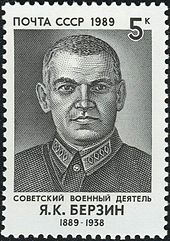
1938: Janis Berzins, Soviet military intelligence chief

On this date in 1938, the Soviet intelligence agent Janis Berzin(s) was shot in the basement of Moscow’s Lubyanka Prison.

A Latvian radical back to Riga’s chapter of the 1905 revolution,* Berzins became a trusted associate of Lenin in exile, and transitioned with the 1917 Revolution into a variety of political-security-military leadership positions in the new Soviet state.

For most of the 1924-1937 period, Berzins directed — indeed, practically createdSoviet military intelligence. He’s credited with personally recruiting the legendary World War II spy Richard Sorge; in 1936-1937 he was the chief Soviet military advisor in the Spanish Civil War under the nom de guerre “Grishin”. Russians fighting in Spain just referred to him as “the old man.” (Source)

Of course, no degree of seniority was sufficient safety during the frightful purging years of the Yezhovshchina. Once back in Moscow, Berzins fell instantly, almost randomly, over a spurious accusation of internal espionage.

His conviction was reversed after Stalin died.

* But not one of the Latvian revolutionaries who ended up in a shootout with London police.

On this day..

1938: Vladimir Kirshon, Bulgakov antagonist

On this date in 1938, Soviet playwright Vladimir Kirshon was shot at the Kommunarka “special object” shooting range outside Moscow.

Kirshon (English Wikipedia entry | Russian), purged as a “Trotskyist counter-revolutionary” as one might assume from the date and place. And like many peers in those terrible years, it was Kirshon’s to suffer the martyr’s fate without the merit of the martyr’s service.

In his day — which ran up to the spring 1937 fall of his patron, NKVD chief Genrikh Yagoda — Kirshon had distinguished himself with servility.

In his capacity as a Soviet writer’s guild bigwig, the ideologically rigorous Kirshon had been a point man in the depressing 1929-1932 campaign against the early Soviet Union’s rich literary heterodoxy. (Sample slogan: “For the hegemony of Proletarian literature! Liquidate backwardness!”)

This chilly period drove dystopian novelist Yevgeny Zamyatin to exile, and futurist poet Vladimir Mayakovsky to suicide.* The novelist and playwright Mikhail Bulgakov, a writer whose manuscripts from the furnace of Stalinism were forged for immortality, was also long harried by Kirshon. Kirshon’s pull nearly ruined Bulgakov’s career at what should have been its peak.

Bulgakov returned the contempt of his persecutor from a position of considerable literary superiority. Kirshon’s own work tended to the glorification of doctrinaire communism — he produced a verse celebrating the Civil War’s martyred 26 Baku commissars; Bulgakov has on his c.v. perhaps the signal achievement of 20th century Russian letters, The Master and Margarita. Little wonder to find Bulgakov complaining in private correspondence of the waste Kirshon has made of a trip to Europe, churning out the sort of tendentious and formulaic Soviet-man-abroad literature that any loyal commissar could have written without setting foot from Moscow. But despite the very real injuries Kirshon had done to him, Bulgakov found the baying denunciation theater so distasteful that he declined to say a public word against Kirshon when the latter fell.

The diary of Bulgakov’s wife Elena is not quite so diplomatic.

21 April 1937

A rumour that Kirshon and [Alexander] Afinogenov are in trouble. They say that [Leopold] Averbakh has been arrested. Is it possible that Nemesis has been visited upon Kirshon?

23 April 1937

Yes, Nemesis has come. There are very bad stories in the press about Kirshon and Afinogenov.

(These entries, quoted via J.A.E. Curtis’s Manuscripts Don’t Burn: Michael Bulgakov: a Life in Letters and Diaries, refer only to Kirshon’s professional fall. He was not arrested until that August.)

Kirshon was posthumously rehabilitated in the Khrushchev era and some of his work has even been performed in post-Communist Russia. But according to this Russian-language Bulgakov trove, that old foe made perhaps Kirshon’s lasting literary monument by using him as the model for the character Polievkt Eduardovich in Bulgakov’s short story “It Was May” (Russian link): it’s a story about a foppish critic who returns from abroad with specious critiques that force the narrator to ruin his own play by diverting the story to the arrest and purging of its principal character.

Thanks to friend of the blog Sonechka for translation and background.

* Mayakovsky shot himself at age 37; there’s also a popular hypothesis that he did this to check out at the same age as Pushkin.

On this day..

1973: Mimi Wong Weng Siu, jealous hostess

On this date in 1973, former cabaret star Mimi Wong Weng Siu and her husband Sim Woh Kum were hanged for the murder of Wong’s Japanese lover’s wife.

“Overwhelmed by a consuming jealousy” (her prosecutor’s words) for Hiroshi Watanabe, a land reclamation engineer from Osaka who was in Singapore working to prepare Bedok for development, Wong recruited her estranged husband to help her get rid of the competition. (Sim was just in it for the payment Wong promised him.)

On the evening of January 6, 1968, the two broke into the home when Ayako Watanabe was alone there. Sim threw bleach in the victim’s eyes to incapacitate her, as Wong fatally gashed her neck and abdomen with a small knife.

The resulting 26-day trial riveted Singapore with the risque details of the dance hostess’s adulterous trysts. (And said dance hostess’s two courtroom fainting episodes.) But their manifest guilt plus their confessions — each vainly attempting to blame the other — assured their convictions.

While Sim situates as a side character of little lasting interest, Mimi Wong’s hanging was among the few that would really stick with long-tenured Singapore hangman Darshan Singh.

The title character, if you like, of Alan Shadrake’s Singapore death row critique Once a Jolly Hangman, Singh executed more than 850 people in more than four decades on the job and never wavered in his support for the policies that kept him occupied. Even so, Singh felt compassion for the individual humans he was called upon to kill; he was known to go out of his way to get to know condemned prisoners and to comfort them in their distressing situation.

According to an October 2013 AsiaOne profile, Singh had an unusually close pre-execution relationship with the first woman hanged in the only recently (since 1965) independent Singapore.

In prison, she was a difficult inmate who would at times strip naked and refuse to put on her clothes even when ordered by prison guards. She even threw urine at the wardens, said Madam Jeleha.

“Darshan was the only one who could control her. He would say ‘Mimi, wear the blanket and cover yourself. Don’t do this or you won’t be beautiful any more’, and she would listen to him,” Madam Jeleha said.

The two forged an unlikely friendship and other prison officers even joked that Wong was his girlfriend. Mr Singh never minded.

Before her execution, Wong told Mr Singh they should be lovers in the next life and she wanted to take him with her.

“After he hanged Mimi Wong, he fell very sick for a month. He was in Toa Payoh Hospital for more than two weeks,” his wife said.

Even when probed, he refused to tell his wife about Wong’s final moments.

On this day..

1847: Manuel Antonio Ay, Caste War harbinger

On this date in 1847, the execution of Maya leader Manuel Antonio Ay in Valladolid kicked off the Yucatan’s decades-long Caste War.

Under Spanish administration, Mexico had a dizzying 16-tiered racial caste hierarchy.

The casta system was officially abolished when Mexico attained independence in 1821, but for Amerindians the newfound equality was more aspirational than real. It’s just that now they were looking up at Mexican-born criollo elites instead of Iberia-born peninsulares.

Either caste’s powers that be had long found found the Maya especially contumacious subjects; a Yucatan Mayan stronghold had, indeed, been the very last unconquered indigenous realm of the Americas to fall to Europeans — as late as 1697.

In 1846, a heavily Maya Yucatecan peasantry, strained by the economic extractions the Mexican state was imposing for its disastrous war with the United States, began rising against the overweening local gentry.

The progress and organization of these disturbances varied, but it’s the execution of our man, the 27-year-old chief of the village Chichimila, that traditionally marks turning-point galvanizing a full-scale rebellion. On July 18, as armed Maya regiments gathered in nearby Tihosuco, Valladolid’s authorities seized Miguel Antonio Ay for planning a rebellion. He had in his possession a letter from Bonifacio Novelo, a major Maya chief who would become one of the Caste War’s leading figures in the years to come — indeed, Terry Rugeley says in Yucatan’s Maya Peasantry and the Origins of the Caste War that Ay served for his persecutors as “a temporary substitute for Novelo, whom officials feared and hated more than any Maya.”

They’d never lay hands on Novelo, but his substitute was executed in the town square of Valladolid, and the body returned to exhibit in Chichimila in a futile attempt to cow resistance: Ay had, instead, become the first martyr of the coming war. Three days later, the gathering Maya army sacked the village of Tepich, beheading the colonel who commanded its defenses — the onset of generations of general war that persisted into the 20th century.

On this day..

1785: John Winship, family planner

On this date in 1785, a Sunderland-area farmer named John Winship was hanged for killing his maidservant Grace Smith with a poisonous draught of corrosive mercury sublimate which Winship had intended to induce an abortion.

His body was delivered to a local surgeon, who autopsied it and “in the presence of many gentlemen of the faculty” lectured on Winship’s organs as he dug them out (and extracted two intestinal worms).

the doctrine of the late Mr. Hewson, F.R.S. was demonstrated, that, in executions of this kind, death is not produced, as has been generally supposed, by an extravation of blood, occasioned by the rupture of the vessels of the brain, but by suffocation: as in the case of drowning, etc. (Newcastle Courant, July 30, 1785, quoted in this anti-abortion tract)

Grace Smith, who died four agonizing days after she ingested the toxin, perhaps did not sympathize overmuch with her killer’s unpleasant strangulation.

On this day..

2008: Christopher Scott Emmett, jocund

(Thanks to Robert Elder of Last Words of the Executed — the blog, and the book — for the guest post. This post originally appeared on the Last Words blog. Fans of this here site are highly likely to enjoy following Elder’s own pithy, almanac-style collection of last words on the scaffold. -ed.)

“Tell my family and friends I love them, tell the governor he just lost my vote. Y’all hurry this along, I’m dying to get out of here.”

— Christopher Scott Emmett, convicted of murder, lethal injection, Virginia.
Executed July 24, 2008

The Washington Post reported: “Emmett fatally beat his roofing company co-worker, John F. Langley, with a brass lamp in a Danville, Va., motel room in 2001. He then stole Langley’s money to buy crack.” He later lost an appeal in Virginia claiming that the state’s lethal injection protocol constituted “cruel and unusual” punishment.

On this day..

1896: John Pryde, Brainerd murderer

On this date in 1896, John Pryde hanged in Crow Wing County jail for a Brainerd murder over a little bit of money.

Pryde had worked all the preceding winter in a lumber camp but closed his engagement (so he said) with a Valentine‘s Day jaunt to Lothrop — abandoned in the present day but then the terminal stop on the Brainerd & Northern Minnesota Railway, where the lumber he’d been hewing would be loaded up for the Brainerd sawmill. According to this site about Minnesota ghost towns, Lothrop “was a typical hell-raising, end-of-tracks town.”

Some of the hell so raised consisted in the timeless pastime of wagering on small cardboard rectangles, and to hear Pryde’s (possibly suspect) account of it he got sharked at the poker table: ” I knew nothing about cards, only what I had found out by looking on. I tried the game and won, at one time being $100 ahead, and if I had known enough to quit then I would not be where I am today. But I was flush and my companions urged me to keep right on, saying that luck was with me and I could win everything in sight. I did so, to my regret, and lost all my winnings and also my winter’s wages, having but a few dollars in my pocket when I reached Brainerd, and I was all broke up.”

Back in Brainerd so penniless and broke up, Pryde decided a buddy from the logging camp could supply him and sent Andrew Peterson a letter urging him to hie to Brainerd immediately for a job that was waiting him. Peterson did so; Pryde met him on his return on Feb. 24 and escorted his victim around the outskirts of the city to a spot sufficiently remote to shoot him in the back of the head and rummage through his possessions.

Pryde found one dollar.

Unfortunately for Pryde, Peterson survived — not for good, just long enough to be found and identify his killer before he succumbed and made it a murder charge.

By the time authorities took Pryde into custody on this intelligence, he had already made arrangements for another logger to come on down for another “job”, with the same object in mind. (But hopefully more than a dollar in his pockets.)

With that pleasing want of artifice that can characterize the Upper Midwest at its finest, Pryde admitted everything and lodged a guilty plea just days after Peterson’s March 3 death. He did add that he regretted the mistake he made in not slashing Peterson’s throat to finish him for sure, and then burning the body to hide the crime.

Pryde’s fall — from an employed and relatively flush young man on the make to a condemned murderer — took all of three weeks.

There were suggestions that Pryde might have pulled the same trick on a different fellow who had disappeared from the work camp. He rejected that quite indignantly.

This story from his last days, and including his gallows address (blaming gambling) and his written last statement (blaming gambling) shows a man really locking in a narrative.

What we know about John Pryde is that he killed in cold calculation someone who was in no way connected to his gambling woes, and he was preparing to do the same a second time. There’s really only so much misbehavior one gets to write off to tilt. But Pryde was a young man and we might allow that a sense of guilt (however belated) and a wish to reconcile himself to his loved ones (however hypocritically) are not of themselves discreditable qualities. There were no protracted appeals or dramatic stays of execution to grow him into any other person but the one who shot his work chum dead for a buck. He had a bare five months to make sense of it all: one wonders if his parents in Chicago, who received this last missive from him, ever did.

I received your letter and was glad to hear from you, but I know that it was a hard thing for you to hear what I have done. Well, mother, I have thrown my whole life away, and not only that, how I have disgraced you and pa, and my only sister for the rest of your life; it is true that I made an awful mistake in life. Dear mother, my life was thrown away by the gambling hell hole, there is nothing in the world but that, and it would break most anyone up. It was my first time to gamble, and I was led away by one of my companions and was led into an eternal destruction, that is what put me in the place I am in now. Now my lot is a hard one, but I have made my peace with the Lord, and am prepared to meet my father in Heaven. God will forgive the most sinful if we only believe in Him. The Bible says that God has forgiven the greatest of sins.

I am very sorry over this matter, but it can’t be helped now. There is one thing, that I hope this will warn other young men and will put them on the straight road and show them what gambling will lead a young man to do, first from one thing and then to another.

Dear mother, now I have given you all the news that I have. Oh, dear mother, I cannot reward you for your kindness. You always stuck up for me, and if I had only taken your advice, I don’t think I would be where I am today. It is true what you said. I had a good home, and did not realize what a home was. I know I ought not to have left home but we young men do not pay enough attention to our mother and father. Now, father and mother, don’t take this matter too hard, as it won’t help it in the least. We all have go to go some time, sooner or later. There is a home prepared for us all and there we will have peace and joy. Now I will bring this letter to a close, hoping it will find you all well, as I remain, your most loving son,

JOHN PRYDE.

Now, I will bid you good bye, good bye. Father, forget me not, keep this letter to remember me.

On this day..

1995: 43 armed robbers

On this date in 1995, Nigeria’s military dictatorship struck a bloody blow against the country’s surging crime waves with a mass execution of 43 prisoners at Kirikiri prison in Lagos.

Soldiers dressed in camouflage and with black shoe polish on their faces fired semi-automatic weapons to execute the convicts who were tied to stakes in three groups of 12 and one of seven.

The executions, which lasted 90 minutes, were witnessed by three doctors, who certified the deaths, an Irish Roman Catholic priest and a Muslim imam. (Reuters report, in the July 23, 1995 Los Angeles Times)

Armed robbery had since the 1970s been the most feared and high-profile genre of a crime surge that seemed all but impervious to remedies. Organized into aggressive syndicates stealing on an industrial scale, robbers grew so numerous and brazen that they plundered the personal home of the Vice President in 1983; another band raided currency exchange offices at the Lagos airport in 1993. For everyday citizens, the terror of home invasion, often accompanied by rape or gratuitous murder, horribly taxed material and psychological resources. A 1985 Nigerian Herald article (via) reported that

Lagosians now live behind bars, in houses caged with tough iron rods. In such homes, it takes occupants 20 to 30 minutes to get through the barricades each time they want to go out or get in. Driving in Lagos as well is done in a style intended to avoid interception by armed robbers. The basic rule is that no driver allows the vehicle behind him to catch up with his and overtaking at the wrong side of the lane by another motorist is avoided at the risk of death. In Lagos, people live in such terrible fear of armed robbers that those who are not attacked as each day passes regard themselves as fortunate.

The death penalty was decreed for armed robbery in 1970, revoked in 1980, re-introduced in 1983. In the late 1980s, Nigeria tried check points, road blocks, increased police patrols — nothing stemmed the tide.

This date’s demonstrative mass execution made the news, for sure. But it didn’t exactly do the trick either.

On this day..

1683: Lord Russell, Whig martyr

On this date in 1683 at Lincoln’s Inn Fields in London the great Whig parliamentarian William, Lord Russell was beheaded with a legendary want of dexterity by Jack Ketch.

The third son of the Earl (later Duke) of Bedford, Lord Russell emerged from a decade of comfortable obscurity in the Parliament’s back benches to become a leading exponent of the nascent Whigs* opposed to royal absolutism and to Catholicism — two heads of the same coin, for the Whigs, given that the heir presumptive James had controversially converted to Catholicism.

The national freakout from 1678 over an alleged “Popish Plot” to undo Old Blighty gave Russell his cause; his leadership of the resulting parliamentary bid to exclude James from royal succession made the gregarious Russell “the governing man in the House of Commons”.

Lord Russell was a man of great candour, and of general reputation; universally beloved and trusted; of a generous and obliging temper,” his friend Gilbert Burnet recorded of our man. “He had given such proofs of an undaunted courage and of an unshaken firmness, that I never knew any man have so entire a credit in the nation as he had.”

Russell was, Burnet allowed, “a slow man, and of little discourse, but he had a true judgment, when he considered things at his own leisure: his understanding was not defective; but his virtues were so eminent, that they would have more than balanced real defects, if any had been found in the other.”

Chief among those virtues was his wholehearted sincerity for his cause — a passion the source of both his renown, and his destruction. Russell was heard to espouse the view that James ought not merely be excluded from succession, but executed like his father.

Matters never quite approached that point, but the crisis provoked by the Exclusion Bill firebrands led King Charles II to dissolve parliament in 1681, depriving the Whigs of their legal perch. In the ensuing years politics played out not as legislation but conspiracy, and the crown’s rather more successful harassment of same: many of the chief Whig actors were driven offstage to scaffolds, dungeons, or continental exile.

The half-dozen most eminent Whigs remaining — to whom, besides Lord Russell, we number the king’s illegitimate son Monmouth, the Earl of Essex, Baron Howard of Escrick,** Algernon Sidney, and John Hampden† — formed a sort of informal Council of Six who met secretly to consider the bad options available to the fractured Whig movement. Some section of the wider Whig network in which this Council operated turned eventually to considering the most desperate of measures.

Their Rye House Plot schemed to waylay and assassinate the royal person near a fortified manor handily on the king’s route back to London from the Newmarket races. It was owned then by a radical former soldier of Cromwell‘s New Model Army.

It has been long debated to what extent any of the top Whigs knew of or actively participated in this Guy Fawkesian plot, or its complement, a projected armed rising of the sort that Monmouth would indeed mount in 1685. One school of thought is that the Tories seized it as an expedient to eviscerate the remaining Whig leadership by conflating the entire movement with a regicidal scheme; another is that the Whig insistence upon its martyrs’ innocence — and Lord Russell is the chief man in this pantheon — has amounted to a fantastic propaganda coup.‡

In June 1683, a salter who was in on the Rye House planning got a cold sweat and informed on the Whigs. This backstab earned a royal pardon for himself, and started a familiar policing sequence of incriminated conspirators turning crown’s evidence and informing in their turn on the next part of the network.

Many of the Whigs fled to the Netherlands, received there by the House of Orange which would seat itself on the English throne inside of six years.

Lord Russell, however, refused to fly. He landed in the Tower of London by the end of the month, to face trial as a traitor on the evidence of his association with other Whigs and his entertaining the plan of raising an armed revolt. (He would have been joined in the dock by Essex, but that worthy cut his own throat in the Tower.) The judge’s summation to the jury even underscored that “You have not Evidence in the Case as there was [in other Rye House cases] against the Conspirators to kill the King at the Rye. There was a direct Evidence of a Consult to kill the King, that is not given you in this Case: This is an Act of contriving Rebellion, and an Insurrection within the Kingdom, and to seize his Guards, which is urged an Evidence, and surely is in itself an Evidence, to seize and destroy the King.”

Lord Russell’s case shifted around the fringes of actual innocence — those plans for Insurrection within the Kingdom, he said, occurred sometimes at meetings he happened to attend but only off on the side, or without Lord Russell’s own involvement or support. (Speaking from the scaffold, he would several times insist that his acts were at worst misprision of treason, which was no longer a capital crime at this point.)

Against this the crown produced Lord Howard, a cravenly interested party to be sure, who saved his own skin by testifying that the six-headed cabal was down to planning the specifics of the places where a rebellion might best be stirred up, the procurements of arms and bankroll that would be necessary to same, and how to draw Scotland into the fray as an ally. “Every one knows my Lord Russell is a Person of great Judgment, and not very lavish in Discourse,” Howard allowed on the point of Russell’s active assent to the plans. “We did not put it to the Vote, but it went without Contradiction, and I took it that all there gave their Consent.”

David Hume would observe in his History of Great Britain that Russell’s “present but not part of it” parsing didn’t make for a very compelling story. “Russell’s crime fell plainly under the statute … his defence was very feeble.”


Detail view (click for the full image) of an 1825 painting of Lord Russell’s trial, commissioned of George Hayter by Lord Russell’s admiring kinsman John Russell, Duke of Bedford. John Russell also wrote a biography of his famous ancestor. The unbroken succession of Dukes of Bedford from William Russell’s father continues to the present day; the current Duke of Bedford, 15th of that line, is one of Britain’s richest men.

Conscious of the great pulpit his scaffold would offer, Lord Russell drafted with the aid of his wife a last statement vindicating his own person and the Whig cause that flew into print before the onlookers at Lincoln’s Inn Fields were dipping their handkerchiefs into his martyrs’ blood.

Nor did I ever pretend to a great readiness in speaking: I wish those gentlemen of the law who have it, would make more conscience int he use of it, and not run men down by strains and fetches, impose on easy and willing juries, to the ruin of innocent men: For to kill by forms and subtilties of law, is the worst sort of murder …

I never had any design against the king’s life, or the life of any man whatsoever; so I never was in any contrivance of altering the government. What the heats, wickedness, passions, and vanities of other men have occasioned, I ought not to be answerable for; nor could I repress them, though I now suffer for them.

These notices drew furious confutations from Tory pamphleteers aghast at the face these traitors had to forswear their malice against King Charles; a battle of broadsides to control the historical narrative ensued, and was resolved in the Whigs’ favor by the imminent conquest of power by the aforementioned House of Orange. The Whig-aligned William and Mary reversed Lord Russell’s attainder in 1689 — but that’s never stood in the way of historians’ debates.

In a much lower historical register, Lord Russell’s execution was egregiously bungled by the London headsman Jack Ketch, who had to bash repeatedly at the man’s neck before he could remove it from the shoulders. It is largely from this event that Ketch derives his lasting reputation as an incompetent and/or sadistic butcher, mutually reinforcing with Russell’s martyr status.

Ketch would later claim in a published “Apologie” issued against “those grievous Obloquies and Invectives that have been thrown upon me for not Severing my Lords Head from his Body at one blow” that his prey

died with more Galantry than Discresion, and did not dispose him for receiving of the fatal Stroke in such a posture as was most suitable, for whereas he should have put his hands before his Breast, or else behind him, he spread them out before him, nor would he be persuaded to give any Signal or pull his Cap over his eyes, which might possibly be the Occasion that discovering the Blow, he somewhat heav’d his Body

and besides that Ketch “receav’d some Interruption just as I was taking Aim, and going to give the Blow.” How would you like it if someone came to your workplace and did that?

The damage to Ketch’s reputation was already done. Two years later, en route to the block for a subsequent failed bid to topple the Stuarts, the Duke of Monmouth tipped Ketch with the scornful charge not to “hack me as you did my Lord Russell.” When Ketch botched that execution too, he was nearly lynched — but escaped the scaffold to live on in Punch and Judy and in the English tongue as the definitive lowlife executioner.

* Short for “Whiggamores”, who were Covenanter rebels in the 1640s. “Tories”, by contrast, took their name from Irish Catholic outlaws: each party became known by the slur its foes attached to it.

** Yes, another one of those Howards: this Howard’s great-grandfather lost his head for the Ridolfi intrigue.

† Hampden survived the suppression of Whig intrigues long enough to coin the term “Glorious Revolution” when the Stuarts were finally overthrownJournal of British Studies, January 1985 for a skeptical-of-Russell reading of the evidence. “The government did not concoct the plot; it was frightened by the revelations, whatever use it made of them. There is no doubt that proposals for an insurrection of some kind were discussed; Russell’s impetuosity and extremism make it more likely than not that he was an active party to these discussions. What is in doubt, since nothing came of the discussions, is how far the parties had gone in developing a concrete plan for a rising.”

On this day..

1476: Hans Bohm, the Drummer of Niklashausen

On this date in 1476, a peasant preacher who nearly stirred a revolution was consigned to the flames in Wurzburg.

Hans Behem (or similar variations on that surname, e.g. Bohm or Boheim) is known to posterity as the Drummer of Niklashausen, for when he descended into that Tauber River town for Carnival he performed with this instrument.

His vocation — his peasant’s lot in life — was sheep-herding.

One frigid Lent night in 1476, a year when the protracted winter freeze promised gaunt months ahead for the peasantry, Hans was wrapped in his heavy cloak watching his flock when he had an unexpected visitor:

Book CoverThe Virgin Mary appeared to him.

Richard Wunderli’s very appealing Peasant Fires: The Drummer of Niklashausen situates this queer episode in the foreign world of the early modern peasantry, when the supernatural suffused everyday life and the seasons of the year elapsed in “ritualized joy, laughter, deprivation, and seriousness.”

Carnival, just ended, was “liminal time”: time for inversion of natural orders, time for foolishness, time for liberation. If the rite confined and discharged potential social pressures, “liminal time” also held a latent threat to the ordered world of lords and bishops. What happened if sublime religious revelation burst the calendar’s boundaries and flooded ordinary time with the liminal?

[The Virgin] told him that both God and her Son were angry with mankind and were chastising all peoples with the dreadful cold and snow. People were consumed by their vanities, she said, and did not worship the Heavenly Family as was their due … Hans was ordered to go to the portal of the village church of Niklashausen, the Frauen kirche, the church dedicated to the Virgin, and there publicly he was to burn his drum and his shepherd’s pipe. Then he was to preach in Niklashausen, and the Mother of God would instruct him what to say. (Wunderli)

Thanks to this vision, 1476 would be a year out of time.

Hans apparently knew a Beghard mystic who dwelled in the hills where he pastured sheep. In the fullness of time, this anonymous man would die with the drummer; the precise nature of their association is a matter for speculation, though some would later charge (the better to derogate the illiterate boy’s supposed divine revelation) that the Beghard orchestrated the whole thing.

Nevertheless, the proximity to the Drummer of Niklashausen of an adherent of the suppressed Beghard movement underscores the link between Hans’s subsequent preaching and the centuries-old tradition of radical poverty. Elites long viewed these movements as seditious, and why not? Poverty was the material lot of most people just as it had been for Christ himself, but it was self-evidently not the lot of Christ’s vicars, who in fashionable attire bought with forced tithes and the sale of get-out-of-purgatory indulgences breezed obnoxiously past the everyday tolls and levies that crushed their flocks. Arrogant, predatory lords made out even better than that.

Sacralized poverty ever sat next door to levelling — next door to revolution.

The German abbot Johann Trithemius would complain of the “rustic, ignorant people [who] gathered together daily in Niklashausen,” and their terrifying-to-him vision “that peasants would become free and the clergy placed in servitude.”

What could peasants find more agreeable than that they had been freed from all payments of rents and tenant services, and that thereafter they would hold everything in common with the clergy and princes? Truly, what could a layman find more desirable than that he should see the clergy and priests immediately stripped of all privileges and liberties, and denied their collection of tithes, rents, and the proceeds of the holy altar?

Madness … or divinest sense.

Hans Behem preaching from a window, with his sinister adviser at his side. Detail (click for the full image) of a 1493 Nuremberg Chronicle illustration. (via Wikipedia)

Hans, of course, obeyed the Virgin’s charge to him.

Just after Easter, he publicly burned his drum — his own little vanity — and began preaching in Niklashausen.

Maybe the words came from the Beghard, or from the alleged mendicant friar who was rumored to whisper to Hans. Maybe the young man had a natural gift for oratory and a few lucky breaks.

But to tens of thousands of German peasants who soon began arriving, he was a holy youth, the vessel for heaven. Hans’s prayers lifted the interminable frost, sparing at least some portion of the year’s crop. Peasants from all around the region caught wind of the supernatural event and began up and disappearing from their places without notice or excuse, leaving work half-done to join troops of their fellows making pilgrims’ tracks to Niklashausen.

There, they too were summoned to cast aside all their own vanities as well,* and into the flames went stylish clothes, sinful dice and cards.

“They cut the long points off their shoes,” wrote a disdainful chronicler Georg Widman. “And trimmed their hair, and it seemed as though a dozen carts would not suffice to haul away the hair and shoes being discarded that day, to say nothing of embroidered kerchiefs, robes, doublets.”

The drummer’s preaching veered apocalyptic. Medieval people would have believed of a course that God’s pleasure or disfavor went abroad in the world; the awful winter (only the latest in a series) and, for peasants, a generation of deteriorating material conditions and multiplying taxes, would have stood witness to the Lord’s dissatisfaction. The miracles attributed to Hans — healing the lame, the blind, and the mute; even raising a drowned child from the dead — were of a piece with his words, with the bonfires, with the favor of the Virgin Mary.

Hans’s call to renewal was not a summons to save individual souls but a charge to right the evils in the world that had laid divine afflictions upon all: “If they do not forthwith mend their lives, the whole world will be made to suffer affliction for their sins.” (Source)

The Emperor is a miscreant, and the Pope a nonentity. It is the Emperor who gives to princes, counts, and knights authority to tax and burden the common people. Alas! for you, poor devils!” Spies in the crowds, no doubt paraphrasing prejudicially, captured for the alarmed archbishop and lords the dangerous sentiments being preached in Niklashausen to crowds swollen into the tens of thousands who might not easily be controlled.

Princes, civil and ecclesiastical, ought to possess no more than common folk, and then all would have plenty. The time would come when princes and nobles would have to labour for a day’s wage. The fish in the water, and the game upon the land, ought to be common. Tolls, road-money, servitudes, rents, taxes, and tithes to spiritual or temporal superiors were to be wholly done away with.

Most frightful of all was the open threat to slay worthless priests, that soon clerics would cover their head with their hand for fear of being caught out with a tonsure. Hans Behem’s crowds rejoiced at the prospect; a clergyman would write later that summer of the pilgrims’ “hateful song”: “O God in Heaven, on you we call / Help us seize our priests and kill them all.”**

On the night of July 12, 1476 — the eve before the Drummer was to preach a sermon for which he had asked his followers to arrive armed — 34 mounted knights burst into the farmhouse where he was staying and hustled the firebrand into custody before anyone could resist.

The movement was beheaded and it fractured quickly: after a day of confusion, some of them set off on a march to nearby Wurzburg, where the Drummer languished in the Archbishop’s fortress, a position that the rabble was in no position to take by main force. Many gave up the enterprise, but dozens, maybe a hundred or more, were captured and filled Wurzburg’s dungeons to overflowing.

Almost all were ultimately released. Only three were put to trial: Hans himself, the mysterious Beghard, and a peasant who had risen up after Hans’s arrest to incite the crowd to kill the Wurzburg clergy. Hans was tortured by the rope, hoisted into the air by his pinioned hands then dropped with all the weight of his body tearing at his shoulders. They did this to him over and over, until he said that he was a fraud, that Mary never came to him, that he never worked a miracle, that the “wandering, cunning mendicant friar contrived everything.”

Hans was burnt flesh either way: this is the fate of martyrs. It was essential that he also be discredited, though the effect was scarcely immediate.

Certainly, there were those who with imprudent faith believed that his whole affair originated in heaven … they hoped that God would preserve him from being killed; or if God allowed him to die, then He would take immediate vengeance on the courts that condemned the Youth.

Others, who were more sane, among whom were the bishop and his clergy, did not fear the vengeance of God for the death of this wicked man; rather, they earnestly, sensibly, and rationally feared that spiteful, evil spirits — who take delight in possessing superstitious people — would scheme some plot of guile and deceit at the execution. For they judged that little Hans was not a man of God but was possessed by the devil.

At last the judgment of death to little Hans was to be carried out … After he had been led to a level piece of ground, which is behind my monastery near the house of the lepers, he was seated and bound with ropes. Nearly all the citizens of the town stood by armed, waiting for him to be delivered to the fires. In the meantime, two evildoers who were with him received a sentence to have their heads cut off.

After they were beheaded, little Hans asked the magistrate: “Are you going to hurt me?” The magistrate replied: “No, but someone has prepared a bath for you” — for the Youth had not yet seen the pile of wood for the fire, or if he had seen it, he perhaps did not know what it was.

When he was tied to the stake for burning, however, he sang certain songs or verses in a high voice about Our Lady, which he had composed in the German language. Among the bystanders were many who believed that the man could not be burned because of the merit of his holiness, by which they thought he would be preserved by the Mother of God. Hence, they were afraid to stand near him. They were terrified that perhaps the fire would be scattered about by divine fury and would consume those observing the execution. Others feared that the Youth could not be burned because of the protection of demons or of some other sorcery. Therefore, the executioner — who also feared this — caused all the Youth’s hairs to be shaved, so that no evil spirit or demon would be able to hide in them.

Bound to the post, the Youth shouted his songs. But as soon as the fire was set below him and he felt the flames, he cried out three times with a weeping voice: “Ow, ow, ow.” He was then engulfed by the flames. His voice uttered nothing again. Consumed by the voracious fire, he was reduced to ashes. No miracles happened, nothing that demonstrated that Innocence had been consumed by fire. Nevertheless, so that the frivolous devotion and fear of stupid people not fashion him into a martyr, the executioner ordered that all his ashes be thrown into the river. After this was done, the gathering of the people at Niklashausen came to an end.

The “gathering” did not quite blow away with the Drummer’s ashes, not just like that.

Despite edicts from nearby cities against the practice, pilgrims continued journeying to Niklashausen over the following months: not with the number and character sufficient to threaten revolution, but more than enough to make the authorities jumpy. The Archbishop was so desperate to quash these pilgrimages that in 1477 he had the church at Niklashausen razed.

In those years and long after, chroniclers as one scorned the Drummer and his flock; Sebastian Brant’s 1494 satire Ship of Fools also singles out des sackpfeifers von Nickelshusen (the bagpiper of Niklashausen) and those who followed him.† Hans’s people, illiterate commoners, don’t have a voice in the histories.

The grievances were never really answered. It was not until 1518 that authorities finally deemed it safe enough to rebuild the Niklashausen church … but even then, Germany had not heard the last of peasant revolution.

* Bonfires of the vanities were all the rage

** Wunderli notes the movement’s apparent indifference to Jews, despite its falling in the immediate wake of one of Europe’s most inflammatory blood libel cases. These peasants were not assembled for a pogrom; it was their Christian oppressors whom they hated.

† See the German version Das Narrenschiff, under “verachtung der gschrift”, “contempt of scripture”.

On this day..