1388: Nicholas Brembre, Mayor of London

One day after Nicholas Brembre’s treason trial was interrupted for the sudden capture and summary execution of his political ally Robert Tresilian, the former Mayor of London was back in the dock of the Merciless Parliament this day to receive (and immediately suffer) the Lords’ judgment that he be hanged.

Like Robert Tresilian, Brembre had backed the young Richard II’s bid to throw off the influence of a circle of advisors during the dangerous 1380s.

Brembre spent the early part of the decade bursting his ample coffers with a plum customs-collection gig (in which capacity he employed Geoffrey Chaucer), with a couple of stints as London mayor mixed in.

He earned a reputation for corruption and election-rigging (“on the day of the election … Sir Nicholas and others of his faction ordered to the Guildhall of London certain persons, ‘foreigns’ and others in great numbers, who were armed, to make the election”).

A wiser fellow than myself once said, sometimes you eat the bear and sometimes the bear, well, he eats you.

A rough customer to the last, Brembre tried (pdf) to mount a defense by right of single combat. It was not taken up.

He was drawn from the Tower through the city on a hurdle to Tyburn, resting at furlong intervals he gave great penance, beseeching mercy from God and men against whom he had sinned in past times, and many commiserating prayed for him. And when the noose was put on him so that he might be hanged, the son of Northampton* asked him whether the aforesaid things done elsewhere to his father by Brembre were legally done. For Northampton was formerly a mayor of the city of London, a richer and more powerful citizen among all those who were in the city, and through certain ones, associates who were death-bearing plagues, namely Brembre, Tresilian and others, was enormously vexed by certain nefarious conspiracies and confederacies then condemned to death, and with all his goods stripped hardly escaped alive. And concerning those things Brembre confessed that neither piously nor justly but with a violent heart for the sake of destroying Northampton he had infelicitously committed those things. And seeking forgiveness, hanging by the rope, he died when his throat was cut. Behold how good and pleasant it is to be raised up to honors! It seems to me better to carry out business at home among paupers than be thus lordly among kings, and at the end climb the ladder among thieves; since it is more a matter of onerousness than honor to assume the name of honor. You who are reading, look down to regard him, and you might be able to consider by their ends how their works receive results. For in every work be mindful of the end. (Source)

Richard II subsequently outmaneuvered the foes whose ascendance in 1388 forced Brembre’s execution; in 1399, the attainder was posthumously reversed … just before his royal patron Richard II was overthrown by Henry IV.

* “Northampton” here refers to former London Mayor John of Northampton, not to be confused with the ennobled Earl of Northampton — which latter title was actually held at this time by Henry Bolingbroke, the future King Henry IV and a member of the anti-Ricardian Lords Appellant party that engineered Brembre’s downfall. (Got all that?)

Part of the Daily Double: The Merciless Parliament.

On this day..

1388: Robert Tresilian, former Chief Justice

On this date in 1388, England’s former Chief Justice was executed for his executive-friendly jurisprudence.

For some reason, this illustration of Tresilian’s execution from Froissart‘s chronicles shows him receiving a dignified beheading, rather than a nude hanging.

The ambitious Robert Tresilian (or Tresillian) had shimmied his way up the 14th century legal ranks for his dutiful service to the monarch, including presiding over a “bloody assize” after Wat Tyler’s revolt.

Despite stringing up 500 rebels, Tresilian couldn’t have been too upset about the disturbance: it also killed off the sitting Chief Justice and opened the seat for a man of Tresilian’s talents and loyalty.

A few years later, Richard would require of this position a legal opinion vindicating his personal authority as against the council his rivals had foisted upon him. Tresilian duly produced a writ affirming the unitary executive authority.

The upshot of this opinion was to put that council at risk of life and limb. It turned out to be more dangerous to its author.

When the Lords Appellant defeated the Ricardian party, Tresilian was among the royal retainers attainted for treason by the vengeful “Merciless Parliament”.

The lords thereupon announced that in matters of such high concern the rules of civil law oculd not be observed; the parliament was itself the supreme judge; it was not to be bound by the forms which guided inferior courts, that were merely the executors of the ancient laws and customs of the realm, and of the ordinances and establishments of parliament.

In a characteristically judge-like juxtaposition of wit, naivete and arrogance, Tresilian was somehow smart enough to go into hiding but dumb enough to hide by disguising himself and hanging around the parliament where his associate, London Mayor Nicholas Brembre, was putting on a theatrically futile defense. Since Tresilian had absconded, he was already judged guilty in absentia and liable to suffer execution immediately upon capture.

This date in 1388, that’s exactly what happened: capture, and summary hanging.

Before they had argued to the finish the end of the trial against Nicholas Brembre, the hapless Tresilian occupied their attention. He had been located above the gutter of a certain house annexed to the wall of the palace, hiding among the roofs the sake of watching the lords coming and going from parliament. However, when resolute soldiers had entered that house and looking around found no one, a certain knight with intent expression strode to the father of the house and pulled his head up by the hair, drawing his dagger, saying, “Show us where Tresilian is or your days are numbered.” Immediately, the terrified father of the household said, “Behold the place where that man is positioned at this moment,” and under a certain round table which was covered for deception with a tablecloth, the unfortunate Tresilian, disguised as usual, was miraculously discovered. His tunic was made out of old russet, extending down to mid-shin, as if he were an old man, and he had a wiry and thick beard, and wore red boots with the soles of Joseph, looking more like a pilgrim or beggar than a king’s justice. This event was immediately made clear to the lords’ ears, and when, quicker than a word, the aforesaid five appellants under a hasty pretext left the parliament without explaining the reason for their departure, all who remain in parliament were stunned, and many others followed them with passionate zeal. And when at the palace gate they had seized Tresilian, leading him toward the parliament, they proclaimed in a universal voice, “We havet hym! We havet hym!” Meanwhile, interrogated in the parliament how he would excuse himself concerning the false treachery of this kind and other things done by him, he remained nonetheless stock-still and mute, his heart hardened even in the face of death, and he would not confess to the things committed. Immediately parliament was broken for the sake of this matter, and on the grounds of dealing with Tresilian they sent away for the day Brembre, who had remained present. And at once Tresilian was led to the Tower of London so that execution of his sentence might be carried out on his person. His wife and daughters, moaning and imploring weepingly, were present at hand there in that place, and with voiceless requests, kissing him first from one side then the other, they forgave him for one or another of the crimes he had committed. But she, overwhelmed with sorrow in her heart, fell to the ground as if dead. At length Tresilian was bound hand and foot to a hurdle, and along with a vast multitude of lords and commoners, horsemen and pedestrians, he was dragged from the back of horses through the city squares, resting at intervals of about the length of a furlong out of considerations of charity, to see if he wanted to repent anything. But alas, he did not publicly confess, and indeed it is not known what he would say to his friar confessor, nor has it been ours to discover: the friars well treated Tresilian, preserving him from his transgression. And when he had come to the place of Calvary that he might be made defunct, he did not want to climb the stairs but goaded by sticks and whips that he might ascend, he said, “While I carry a certain something around me, I am not able to die.” Immediately they stripped him and found particular instructions with particular signs depicted in them, in the manner of astronomical characters; and one depicted a demon’s head, many others were inscribed with demons’ names. With these taken away, he was hanged nude, and for greater certainty of his death his throat was cut.

“His fate,” wrote Baron John Campbell, “seems to have excited little compassion, for he had shown himself ready to mete out like injustice to others, and he had extra-judicially pronounced opinions which, if acted upon, would have been for ever fatal to public liberty.”

Part of the Daily Double: The Merciless Parliament.

On this day..

1952: Liu Qingshan and Zhang Zishan, the first corruption executions in Red China

China has been clamping down on official malfeasance lately, but corruption trials have a long and storied vintage in the realm.

The very oldest casket in the cellar has stamped upon it this date in 1952, when Maoist China carried out its first corruption executions.


The public trial of Liu Qingshan and Zhang Zishan. (Source.)

“Faithful and unyielding” during wartime, Liu Qingshan and Zhang Zishan exploited their resulting positions of authority to plunder economic development money.

Theirs was the signal case in an anti-corruption “campaign against three evils” that ended late in 1952, with the announcement that 196,000 party members and cadres had been convicted of something. (Cited here.)

One then-youthful man remembered that

in the winter of 1951, Mao launched a national campaign against what he called the three evils — corruption, waste, and bureaucracy. Taking advantage of the winter holidays, students were sent to various places as members of so called Tiger Hunting Teams. With six other students I was sent to the Art Supply Service then attached to our school. It was housed two miles from the campus. I worked there under the office of the Campaign Against the Three Evils. The entire staff and all the workers were organized to study Party policies attached to this campaign. The staff was then called upon to make a clean breast of their crimes and accuse others they knew to be criminals as well. These crimes included embezzling, forgery, theft, bribery and other white collar crimes. Some suspects were already being locked up in isolated rooms within the offices. Most of those locked up were directors on various levels. Some were even old Party members from the early Yanan days. We had no mercy on those we saw to be “criminals.”

I learned from the newspaper that corruption and waste had become very serious problems indeed. It also revealed how Party cadres had degenerated from revolutionary heroes into grafters. The best example we were told of was two senior cadres, the secretaries of the Tianjin Prefectural Party Committee, Liu Qing-san and Zhang Zi-shan, who were even sentenced to death for their crimes. The Party wanted to show that its own members were not exempt from justice. In showing this, they concurred with the old Chinese belief that it was best to execute one as a warning to a hundred.

Took the words right out of Mao’s mouth.

Only if we execute the two of them, can we prevent 20, 200, 2,000 or 20,000 corrupt officials from committing various crimes.

… although of course, that was a primitive age; one could hardly expect that sort of startling yield on investment in today’s on-the-go China. “[T]he effect would not be so great. To show our determination, we would have to execute several more than two.”

On this day..

1677: William Drummond, for Bacon’s Rebellion

“Mr. Drummond, I am more glad to see you than any man in Virginia; you shall hang in half an hour.”

Virginia Governor William Berkeley didn’t deliver gallows justice as rapidly as promised, but the outcome was just as certain.

Scotsman William Drummond, the former colonial governor of Abermarle and therefore the first governor of North Carolina,

was made to walk to Middle Plantation, about eight miles distant, and tried before a drum-head court-martial, the next day, at the house of James Bray, Esq., under circumstances of great brutality. He was not permitted to answer for himself; his wife’s ring was torn from his finger; he was stripped before conviction, was sentenced at one o’clock and hanged at four. (Source)

There’s nothing worse than a poor winner.

Drummond caught Berkeley’s considerable wrath for associating himself with Nathaniel Bacon’s Rebellion of frontier settlers demanding lower taxes and more energetic genocide against their Indian neighbors. When Berkeley balked, the movement metastasized into a republican revolution which declared the agent of royal authority in Virginia to have abdicated and proposed to reconstitute it by popular convocation.

It was very much short of an actual attempt to separate from England, but in its form and complaints one easily perceives the germ of the American Revolution a century hence. Sarah Drummond was reported to have been at least as vehement as her hanged spouse, and she is credited with prophesying “the child that is unborn shall have cause to rejoice for the good that will come by the rising of the country.”

Armed struggle between two desperate factions was truncated by the fatal case of dysentery* contracted by the namesake insurrectionary. His unpleasant and untimely demise crippled the rising rising, and left Drummond as about the most prominent target available for the victorious Berkeley’s fury.

Not that there wasn’t much more to go around — even when the British navy finally landed in late January with reinforcements too late to do any good, a general amnesty Berkeley had not clemency enough to use, and a successor to Berkeley the aging governor did not like one bit. Nineteenth-century historian George Bancroft in his History of the Colonization of the United States writes of the crackdown,

In defiance of remonstrances, executions continued till twenty-two had been hanged.** Three others had died of cruelty in prison; three more had fled before trial; two had escaped after conviction. More blood was shed than, on the action of our present system [i.e., the constitutional government of the United States], would be shed for political offences in a thousand years. Nor is it certain when the carnage would have ended, had not the assembly convened in February, 1677, voted an address “that the governor would spill no more blood.”

Finally the new guy managed to get Drummond on a boat back to the mother country with an unflattering report of his conduct. The crotchety septuagenarian, who had been a spry mid-30’s courtier when first appointed Virginia governor by Charles I, was coldly received by Charles II. “The old fool,” remarked the sovereign, “has taken more lives in that naked country than I have taken for the murder of my father.”

* “The bloodie flux” was an unsatisfying avenger for his foes, as indicated by the doggerel

“Bacon is Dead, I am sorry at my hart
That lice and flux should take the hangman’s part”

** Some sources put the total number executed at 23, not 22; I have been unable to locate the source of this discrepancy.

Part of the Themed Set: Resistance and Rebellion in the Restoration.

On this day..

1645: John Hotham the Elder

On this date in 1645 — one day after the same fate befell his son — Sir John Hotham was beheaded by the English Parliamentarians for attempting to betray Hull to the Cavaliers in the English Civil War.

Part of the Daily Double: John Hothams.

On this day..

1645: John Hotham the Younger

On this date in 1645, John Hotham the Younger — former M.P., and (too) briefly an adherent of Parliament in the English Civil War, was beheaded as a traitor.

Part of the Daily Double: John Hothams.

On this day..

104 B.C.E.: Jugurtha

(Thanks to Daily Kos diarist “emperorhadrian” for licensing this guest post, originally published on that site June 24, 2007. -ed.)

The Jugurthine War was a key war in the final century of the Roman Republic.

Like the Americans in Iraq, Rome assumed that their war against Jugurtha, King of Numidia (a nation in north Africa), would be a cakewalk. They believed that Numidia was a nation of savages with a bizarre religion. They assumed that their own “shock and awe” attacks by the superior legions would decapitate and destroy the “evil doer” Jugurtha. They believed that in order to liberate the Numidians of their primitive ways, they had to impose the civilized will of the Roman state on this backward nation. Rome never expected that the Numidians would wage an insurgent war against their Roman occupiers. This war ended up dragging on for almost a decade. And in the end, it showed the depravity of the ruling party (the ultra-conservative republican Optimate party), which was sending the Roman Republic on its way to tyranny, empire and ruin.

In 148 BC, the King of Numidia, Masinissa, died. The Roman proconsul, Publius Cornelius Scipio Aemilianus, had been given authority by Masinissa to divide Masinissa’s estate. He divided it between Masinissa’s three sons, Micipsa, Gulussa, and Mastarnable. Soon after, Gulussa and Mastarnable died, leaving Micipsa as the sole King of Numidia. Around the year 134 BC, Micipsa sent Jugurtha (who was Masinissa’s grandson, but the son of another Numidian) to Spain with Scipio Aemilianius. Scipio was fighting the Celtiberians, who lived in a part of what is now Spain. Jugurtha was able to raise an army to help Scipio. Because of the valor of Jugurtha and his army at the Siege of Numantia, Scipio was able to win his war against the Celtiberians.

While fighting for Rome, Jugurtha worked alongside his future enemy, Gaius Marius. Jugurtha not only learned the superior Roman style of fighting, but he also learned of Rome’s weakness for money and thus bribery. Jugurtha described Rome as “urbem venalem et mature perituram, si emptorem invenerit” (“a city for sale and doomed to quick destruction, if it should ever find a buyer”). When Jugurtha returned to Numidia, Micipsa adopted Jugurtha, and decided to include Jugurtha in his will.

After the fall of Numantia, Jugurtha returned home with a letter from Scipio addressed to his uncle; in it, the commander praised Jugurtha’s exploits and congratulated Micipsa for having “a kinsman worthy of yourself, and of his grandfather Masinissa” (Sallust Iug. 9). On this recommendation the king formally adopted Jugurtha and made him co-heir with his own children

In 118, Micipsa died. He left his kingdom to Jugurtha and his two natural sons, Hiempsal and Adherbal. Shortly after Micipsa’s death, Jugurtha had Hiempsal killed. Adherbal fled to Rome. The Roman Senate sent a commission to Numidia to make peace. Jugurtha bribed the Romans on the commission, and thus the commission gave the better regions of the kingdom to Jugurtha.

In 113 BC, Jugurtha took his army and cornered Adherbal in his capital city of Citra. According to Sallust, Adherbal had the support of the people, but Jugurtha had the support of the best soldiers. A Roman Commission was sent to Numidia to forge a new peace. Jugurtha then bribed the Romans on this commission. The Romans thus allowed Jugurtha to storm Citra, and slaughter Adherbal and his supporters. Because Jugurtha slaughtered a number of Italian business people (including Roman Equites, or “Knights“), the Roman senate declared war on Jugurtha.

The Roman Senate sent an army under the command of the consul Lucius Calpurnius Bestia to fight Jugurtha. Bestia decisively defeated Jugurtha. But Jugurtha bribed Bestia, and thus was given unusually favorable terms. The Roman Senate viewed the favorable terms with suspicion, so it summoned Jugurtha to Rome. When Jugurtha arrived in Rome, he bribed two Tribunes, who thus prevented him from testifying. While in Rome, Jugurtha attempted to have his cousin and rival Massiva assassinated. Because of this, he was expelled from the city and returned to Numidia.

In 110 BC, the Roman Senate sent the praetor Aulus Postumus Albinus (who was the cousin of a consul for that year) to defeat Jugurtha. Because Jugurtha bribed key Romans involved in Albinus’ army (who then betrayed Albinus), Albinus was defeated.

The Roman Senate then sent the consul Quintus Caecilius Metellus to fight Jugurtha. At the Battle of the Muthul, a young Roman officer named Gaius Marius helped to reorganize Metellus’ legions, which then defeated Jugurtha. But Jugurtha was defeated because he forced his army to retreat before it could suffer heavy losses. The Romans did suffer their own heavy losses. Jugurtha disbanded his army, and had his soliders mount an insurgency to fight the Roman occupiers.

Marius returned to Rome. Dissatisfied with the slow pace of the war under Metellus, the Roman Military Assembly (one of the two Roman legislative assemblies, similar to the US Senate) appointed Marius consul (the Military Assembly, not the senate, appointed consuls). The Roman consuls had similar powers as the US President. The consulship was the highest constitutional office, and the consuls had imperium powers, which allowed them to command armies and conduct wars. The senate didn’t want Marius to be consul, because at this time it was dominated by an ultra-conservative republican party of aristocratic elites known as the Optimates. Marius belonged to the party that opposed the Optimates, the Populares. Partly because the senate didn’t like Marius, and partly because of the increasing difficulty Rome was having in recruiting armies, Marius was forced to raise his own army.

The capture of Jugurtha, from this French history of the Jugurthine War.

Marius took his army to Numidia to fight Jugurtha. But while Marius had been raising his army, Jugurtha allied with his father-in-law, Bocchus, the King of Mauretania. Marius defeated Jugurtha and Bocchus in several key battles. But much like with the American occupation in Iraq, Jugurtha’s strategy of insurgency warfare against the occupiers rendered all conventional victories irrelevant. Marius was playing a game of whack-a-mole. No matter how many times the Numidians were defeated, Jugurtha’s insurgents would regroup and keep fighting. It became clear that because of this, Rome could not defeat Jugurtha.

Marius sent his young Quaestor, Lucius Cornelius Sulla, to Bocchus. Sulla bribed Bocchus, and told him that Bocchus would be given a part of Numidia if he would betray Jugurtha. Bocchus then decided to give Jugurtha to Sulla. Sulla took Jugurtha to Rome, where Jugurtha was strangled in the Tullianum in Rome after marching in Marius’ January 1, 104 B.C. Triumph.


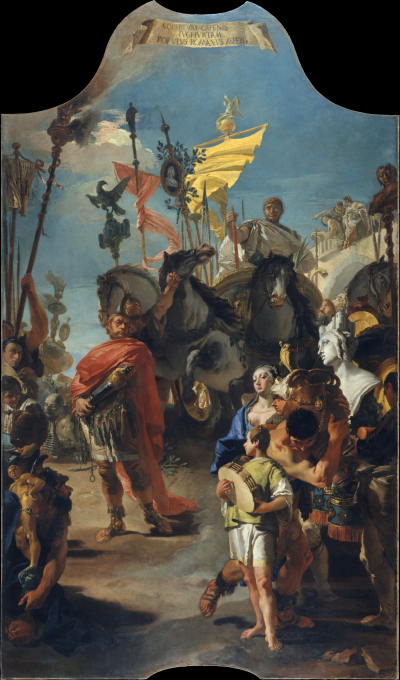
The Triumph of Marius (1729) by Giovanni Battista Tiepolo. The inscription in Latin reads “The Roman people behold Jugurtha laden with chains”.

The Jugurthine War was over. But in the process, several problems were exposed that would cause Rome serious pain in the future. Republicans in this country love to tell us that money in politics is harmless free speech. But as we saw in the Roman Republic during the Jugurthine War, money can be very corrupting. Rome almost lost the war because of money in politics, and the susceptibility of public officials to bribery.

In addition, this war saw the rise of two Romans who would play a key role in the events that directly preceded the fall of the Roman Republic. The first Roman made famous through this war was Gaius Marius. Gaius Marius would later hold the Roman Consulship an unconstitutional 7 times in 21 years (constitutionally, a Roman had to wait 10 years before being reelected consul).

The second Roman made famous through this war was Lucius Cornelius Sulla. Sulla and Marius would fight an unconstitutional civil war with each other several years after this war had ended. Sulla would illegally march his troops on Rome, and unconstitutionally legalize the mass killing of Marius’ supporters. Marius’ supporters in the senate would unconstitutionally prevent Sulla from fighting a war during one of Sulla’s consulships. Sulla would eventually seize absolute power for himself. Sulla would be the first Roman to be Dictator in almost 150 years. He would also be the first Roman in history to hold the dictatorship without the traditional six month term limit.

As dictator, Sulla would illegally change the Roman constitution to make himself and his party (the ultra-conservative republican Optimates) even more powerful. And most importantly, Sulla would set the example (of civil war on Romans, and then the seizing of absolute power) that the future tyrant Gaius Julius Caesar would follow.

In the end, the actions taken by key players in the war against Jugurtha would be repeated in the final destruction of the Roman Republic. The future triumvir Pompey would unconstitutionally hold multiple consulships in a short period of time. Crassus, another future triumvir, would illegally bribe politicians to get his way. And the future tyrant Julius Caesar would bribe, unconstitutionally hold the consulship, and become dictator for life (as Sulla had done). It was Caesar’s actions in this regard, as well as the similar actions of his adopted son and heir, Gaius Octavius (later Gaius Julius Caesar Octavianus, the Emperor Augustus) that would once and for all destroy the Roman Republic, and create the Roman Empire.

1. When when, and whenever death closes our eyelids,
2. Moving naked over Acheron
3. Upon the one raft, victor and conquered together,
4. Marius and Jugurtha together,
5. one tangle of shadows.

6. Caesar plots against India,
7. Tigris and Euphrates shall, from now on, flow at his bidding,
8. Tibet shall be full of Roman policemen,
9. And the Parthians shall get used to our statuary
10. and acquire a Roman religion;

11. One raft on the veiled flood of Acheron,
12. Marius and Jagurtha together.
13. Nor at my funeral either will there be any long trail,
14. bearing ancestral lares and images;
15. No trumpets filled with my emptiness,
16. Nor shall it be on an Atalic bed;
17. The perfumed cloths shall be absent.
18. A small plebeian procession.
19. Enough, enough and in plenty
20. There will be three books at my obsequies
21. Which I take, my not unworthy gift, to Persephone.

From Homage to Sextus Propertius, Canto VI by Ezra Pound

On this day..

1683: Merzifonlu Kara Mustafa Pasha, for the Battle of Vienna

On this date in 1683, the commander who just months before had brought the Turkish army to the gates of Vienna was executed in Belgrade for losing one of the pivotal battles in European history.

The Battle of Vienna saw the Ottoman Empire’s high tide and its last great bid to capture control of the strategic Danube city.

Despite an army of well over 100,000 that had besieged a frightened garrison numbering fewer than 20,000 soldiers and civilians, Kara Mustafa Pasha had been unable to reduce the city, and then decisively beaten after the timely arrival of a 70,000-strong relief force under the command of the Polish monarch Jan Sobieski. Here’s a great Italian map of the battle, with Mustafa himself hanging out in the lower corner; apparently, you can buy the original.

For both contemporaries and posterity, the “miraculous” defeat of an overwhelming Turkish threat by a coalition of Christian forces — a sort of earthbound equivalent to the previous century’s Battle of Lepanto — has appeared as a signal clash-of-civilizations event. In the right audience, a knowing 1683 reference is a sort of dominionist gang handshake.

So, anyway: big win.

If the blame for the defeat — Sobieski’s intervention apart — lay at Kara Mustafa’s door, it was due less to his decision to march straight for Vienna than to a number of technical miscalculations on his part, such as failing to bring heavy artillery to the siege but relying instead on light guns … inadequate to breach Vienna’s strongly fortified walls …

Merzifonlu Kara Mustafa Pasha had long been a close adviser of the Sultan, but any doubts Mehmed IV might have harboured about him were given substance during his absence on campaign as plotters fabricated reports of disorder in the empire. On hearing of the defeat at Vienna, one of the plotters … announced, in the words of Silahdar Findiklih Mehmed Agha, that ‘our enemy is finished with; the time is ripe for revenge’ …

Mehmed succumbed to the pressure from Kara Mustafa’s detractors, and the Grand Vezir was executed in Belgrade on Christmas Day 1683 while engaged in planning a new advance for the following spring … a skull in Vienna’s city museum is commonly believed to be his.

The Austrian victory at Vienna cost the Turks more than Mustafa’s service, which was quite a lot in itself. (Twelve different viziers held the post in the two decades after Kara Mustafa Pasha was strangled.)

The empire’s longstanding (and to Christendom, terrifying) expansionist posture towards Europe was at an end; in the future, the Musulman would have to ward off the Christian.

Ensuing Holy League victories wrested central Europe away from Constantinople, inaugurating a long Ottoman stagnation that would culminate in the empire’s destruction after World War I.

The Hapsburgs — though likewise marked for calamity in the War to End All Wars — for their part won hegemony in central Europe … and, it is said, the literal coffee beans captured as war booty with which to brew the famous Viennese cafe scene.

On this day..

1953: Lavrenty Beria, Stalin henchman

On this date in 1953, Stalin’s feared minister Lavrenty Beria was shot — finally on the receiving end of the cruelty he had administered to countless Soviet citizens.

Lavrenty Pavlovich was, like Stalin, a Georgian peasant, albeit one generation younger.

He won his way into Stalin’s confidence from the 1920’s, and in 1938 replaced Nikolai Yezhov as head of the KGB predecessor NKVD. Yezhov did much of the bloody work of the Great Purge, and was himself in turn purged. The cunning Beria must have taken note.

Though his initial project was to clean up the excesses of the Yezhovshchina — releasing thousands of innocent convicts, making the gulag camps less homicidal and more effective and keeping prisoners alive long enough to get some work out of them, that sort of thing — it wasn’t long before Beria cast a terrifying shadow of his own. (Beria was Yezhov’s deputy, so it’s not like he walked into the job without the requisite qualifications for mass murder.) He wrote the memo proposing the execution of Polish officers that led to the Katyn massacre.

To the more everyday repressive operations of the Soviet secret police, Beria added his notorious (perhaps propagandistically exaggerated?) personal peccadilloes: nothing to trouble the boss, just a little penchant for seducing, or raping, and at his pleasure murdering, comely young lasses.

Soviet author Sergei Dovlatov sketched his character in this imagined vignette (translated by Executed Today friend Sonechka from the Russian original here):

As is well known, winsome high school girls were delivered to Lavrenty Beria’s house. Then his chauffeur presented a bouquet of flowers to the next victim. And rendered her home. This was an established ceremony. Suddenly, one of the damsels became unruly. She began to struggle and scratch. In short, held her ground and did not succumb to the charms of the Internal Affairs minister. Beria told her:

-You can leave.

The young woman descended the stairs. The chauffeur, not expecting such a turn of events, handed her over the prepared bouquet. The girl, somewhat more composed now, addressed the minister who was standing on the balcony:

-You see, Lavrenty Pavlovich! Your chauffeur is more courteous than you are. He gave me a bouquet of flowers.

Beria sneered and dully uttered:

-You are mistaken. It is not a bouquet. It is a funeral wreath.

More consequential for his fate was his position among the handful of Stalin’s closest associates, in which capacity he maintained himself for a remarkably extended period of time. This made him one of the people with a shot at succeeding Stalin, which in turn put him in the middle of the furious political infighting Uncle Joe was pleased to subject his subordinates to.

And the natural enmity between sovereign and heir — the one whose interest is the other’s death — may have even led Beria to poison Stalin in March 1953 when he was on the verge of a falling-out himself. Foreign Minister Vyacheslav Molotov (he of the pact, and the cocktail) remembered in his memoir Beria boasting after Stalin’s sudden and mysterious death,

“I did him in! I saved all of you!”

Briefly the official #2 man in the post-Stalin state, he would again preside over a political liberalization that belied his monstrous personal reputation.

But this pallbearer of Stalin soon followed his former master to the grave. Outmaneuvered by rivals Nikita Khrushchev, Georgy Malenkov, and Molotov, Beria was purged as a traitor in the summer of 1953 and secretly executed Dec. 23, 1953 with six confederates after a summary trial before the Supreme Court. (One of the expedients laid at his feet in that affair was a set of executions he had ordered in a 1941 purge).

According to a chapter by Michael Ross and Anne E. Wilson in Memory, Brain and Belief, after Beria’s fall, subscribers to the Great Soviet Encyclopedia

were instructed to destroy the article on Beria and were provided additional information on the Bering Strait to fill the gap in the pages.

Beria’s heirs actually applied to the post-Soviet government for a reversal of the conviction under laws granting victims of politically motivated prosecutions right of redress. The Russian judiciary turned them down.

On this day..

1520: Hemming Gadh

On this date in 1520, Hemming Gadh was beheaded at Raseborg Castle, Finland for his support of Swedish independence from Denmark.

Gadh (English Wikipedia entry | Swedish | free Swedish biography), around 70 by this time, had had a colorful, opportunistic career in Swedish politics. And religion: he was once temporarily Bishop of Linkoping, but could not win papal approval for the post and got excommunicated a few years later.

A Gadh-fly to the Danish-run Kalmar Union, he was a longtime supporter of Swedish independence agitator Sten Sture the Elder — so much so that when Sten kicked the bucket in 1503, it was Gadh who spiked the story and sent a squire disguised as the late statesman running off to Stockholm to rally his successors before the opposition could capitalize on the situation. (Sweden: The Nation’s History, by Franklin D. Scott)

Gadh was a key figure holding the Swedish party together in a decade-long interregnum until Sten Sture the Younger was up to the task.

And young Sten’s arrival was just in time, because around 1518, Gadh got captured, went over to the Unionist party, and helped it capture Stockholm … precipitating an infamous bloodbath.

Danish King Christian II evidently didn’t trust this turncoat any further than he could throw him, however, which was quite a bit further when he was cut in two. The opportunism that had served Gadh so well for so long this time cost him his head. (Swedish link.)

When in Finland, you can still see the dramatic former island keep where it all went down:


Raseborg Castle (Finnish: Raaseporin linna, Swedish: Raseborgs slott) in Ekenas.

(More information here)

On this day..