2004: Benjamín Altamirano lynched

On this date in 2004, Bolivian Aymara peasants burned to death the mayor of Ayo Ayo.

Disgruntled residents of his fiefdom had accused Benjamin Altamirano (who was also Aymara) of corruption, and received no redress. Likewise had Altamirano complained to the central government of growing threats against him without receiving protection.

The situation came to a shocking head when Altamirano was kidnapped from the capital city of La Paz the night of June 14 and driven overnight to his home in Ayo Ayo. There, according to wire reports,*

[o]fficials said he was then burned to death inside his house, with his body later dragged through the streets and dumped in the town square. Witnesses said he was tied up, set aflame in the town square and hung upside down from a lamppost.

The Andean Altiplano region to which Ayo Ayo belonged was at this time being riven by the Bolivian gas war, a social conflict that would ultimately force the resignation of neoliberal President Carlos Mesa and lead to the election of leftist** indigenous leader Evo Morales.

From 2003 to 2005, the region (on both sides of the Peru-Bolivia border) was paralyzed with repeated peasant protests and the community expulsion of disagreeable state authorities (other government officials fled Ayo Ayo after Altamirano died).

In the words of one unrepentant Aymara quoted in this Guardian piece,

‘We Aymara carry rebellion in our blood,’ said Ramón Coba, who heads the leading Ayo Ayo peasant organisation. ‘Bolivia is totally corrupt, not just the mayor. All of them should be finished in the same way, if not burnt then drowned or strangled or pulled apart by four tractors… It’s the only way they are going to learn.’

* This one ran in the St. Louis Post-Dispatch on June 16, 2004.

** Morales, in 2009:

After more than 500 years, we, the Quechuas and Aymaras, are still the rightful owners of this land. We, the indigenous people, after 500 years of resistance, are retaking the power. This retaking of power is oriented towards the recovery of our own riches, our own natural resources such as the hydrocarbons. This affects the interests of the transnational corporations and the interests of the neoliberal system. Never the less, I am convinced that the power of the people is increasing and strengthening. This power is changing presidents, economic models and politics. We are convinced that capitalism is the enemy of the earth, of humanity and of culture.

Morales has floated elevating indigenous “communal justice” actions like Altamirano’s lynching into the stature of de jure law.

On this day..

1441: Corrado Trinci, Lord of Foligno

On this date in 1441, Corrado Trinci was executed in Foligno.

Once the hereditary lord of that venerable town,* Trinci (English Wikipedia page | Italian), had turned tetchy with his Guelph family’s onetime papal patrons and suffered the consequences.

As the proper captain of an Italian city-state in the 15th century, Trinci had taken a few spins around the wheel of fortune in battle with his neighbors. He kicked off his reign in operatically sanguinary style when a neighboring town‘s castellan murdered Trinci’s brothers, suspecting one of them of adultery with his wife. Trinci revenged himself by sacking Nocera Umbra, which still holds a civic relay race (Italian link) commemorating the occasion.

Trinci didn’t fare as well when it came to picking on someone his own size.

For the next generation, Trinci would do the Machiavellian dance characteristic of his time and station — by turns allied with, at war with, or plotting with the papacy, Condottiero Francesco Sforza, the archbishop of Florence, and miscellaneous other peninsular neighbors and rivals. He was down. He was back up. He was beaten. He fought back. Etc.

Trinci pushed the wheel of fortune one turn too far by rebelling (again) against papal authority in the mid-1430s. His march on the Vatican-controlled Duchy of Spoleto was an initial success —

Corrado brought to Foligno four hundred youths of Spoleto, the standard of Spoleto, the chains, the locks from the city gates, the seal, and the clapper from the great bell of the commune.

Durante Dorio, as quoted and translated by Sergio Bertelli

That was in 1436. By 1439, Foligno itself (with Trinci inside it) had capitulated to a papal siege. Spoleto really wanted its clapper back.

Trinci was imprisoned with his family, and after a couple years’ languishing, put to death on this date. While both the English and Italian Wikipedia entries currently assert that he was strangled, the principal source for this gentleman’s biography, the freely-available Istoria della Famiglia Trinci by Durante Dorio, flatly asserts that the washed-up brawler was dispatched by decapitato.

By whatever method Corrado laid down his life, he retired with it not only the fame of his family but its Lordship of Foligno. The title fell extinct: Foligno became part of the Papal States and remain so right up to Italy’s 19th century unification.

* When next in central Italy, be sure to visit the lovely Palazzo Trinci. Corrado commissioned the Ottaviano Nelli frescoes in the chapel.

On this day..

193: Didius Julianus, who bought the purple from the Praetorians

On this date in 193, Didius Julianus lost the rulership of Rome for which he had paid so dearly.

And his life.

Julianus‘s path to these doleful pages begins with the assassination of the notorious Emperor Commodus at the end of 192.

That man’s successor, Pertinax, was a notable bust with the Praetorian Guard, the elite imperial bodyguard whose status as the only military unit in Rome made it potential — and here, actual — kingmakers.

The Praetorians expected the payoff that had become customary for new executives, and when Pertinax proved less than liberal on that particular budget item, they turned right around and overthrew him.

To see that there would be no mistake the next time around, the Praetorians dispensed with the pretense and brazenly auctioned the purple.

Roman aristocrat and historian Cassius Dio was a witness to this hot mess.

Didius Julianus, at once an insatiate money-getter and a wanton spendthrift, who was always eager for revolution and hence had been exiled by Commodus to his native city of Mediolanum, now, when he heard of the death of Pertinax, hastily made his way to the camp, and, standing at the gates of the enclosure, made bids to the soldiers for the rule over the Romans. Then ensued a most disgraceful business and one unworthy of Rome. For, just as if it had been in some market or auction-room, both the City and its entire empire were auctioned off. The sellers were the ones who had slain their emperor, and the would-be buyers were Sulpicianus and Julianus, who vied to outbid each other, one from the inside, the other from the outside. They gradually raised their bids up to twenty thousand sesterces per soldier. Some of the soldiers would carry word to Julianus, “Sulpicianus offers so much; how much more do you make it?” And to Sulpicianus in turn, “Julianus promises so much; how much do you raise him?” Sulpicianus would have won the day, being inside and being prefect of the city and also the first to name the figure twenty thousand, had not Julianus raised his bid no longer by a small amount but by five thousand at one time, both shouting it in a loud voice and also indicating the amount with his fingers. So the soldiers, captivated by this excessive bid and at the same time fearing that Sulpicianus might avenge Pertinax (an idea that Julianus put into their heads), received Julianus inside and declared him emperor.

Cassius Dio, Book 74

The ignoble achievement is the only thing Didius Julianus is now remembered for.

While Julianus and the Praetorian guard were conducting their damnable business in the capital, three Roman generals in the provinces claimed the throne for themselves.

For centuries the Roman legions had been scattered beyond the Italian peninsula as a hedge against military coups. But after decades of relative stability at the top,* Rome was about to get a bracing reminder of what civil war looked like.

Praetorians — a few cohorts worth of men not in fighting trim — were fine for bullying Senators, but in an outright civil war, they were no match for the legions. The Praetorian Guard’s power to arbitrate the succession was contingent upon the beneficiary’s capacity to cement his own legitimacy by commanding the loyalty of (most of) the state apparatus.

And it turned out that buying the sceptre on spqrBay was not the way to get folks to bend their knees to it.

Septimius Severus, the imperial claimant nearest to the capital, commenced a relentless and virtually unresisted march on Rome, co-opting the troop garrisons and towns as he swept down the peninsula and spurning Julianus’s desperate diplomatic entreaties.

Cassius Dio’s record of Julianus scrambling to defend Rome against Severus is full of black humor.

Julianus … caused the senate to declare Severus a public enemy, and proceeded to prepare against him. In the suburbs he constructed a rampart, provided with gates, so that he might take up a position out there and fight from that base. The city during these days became nothing more nor less than a camp, in the enemy’s country, as it were. Great was the turmoil on the part of the various forces that were encamped and drilling, — men, horses, and elephants, — and great, also, was the fear inspired in the rest of the population by the armed troops, because the latter hated them. Yet at times we would be overcome by laughter; for the Praetorians did nothing worthy of their name and of their promise, for they had learned to live delicately;** the sailors summoned from the fleet stationed at Misenum did not even know how to drill; and the elephants found their towers burdensome and would not even carry their drivers any longer, but threw them off, too. But what caused us the greatest amusement was his fortifying of the palace with latticed gates and strong doors. For, inasmuch as it seemed probable that the soldiers would never have slain Pertinax so easily if the doors had been securely locked, Julianus believed that in case of defeat he would be able to shut himself up there and survive.

In the end, Severus took Rome without striking a blow: the Praetorians switched sides again, and the Eternal City delivered itself from the one usurper to the other. Cassius Dio, again, in media res

the soldiers, convinced by letters of Severus that if they surrendered the slayers of Pertinax and themselves kept the peace they would suffer no harm, arrested the men who had killed Pertinax … We [the Senate] thereupon sentenced Julianus to death, named Severus emperor, and bestowed divine honours on Pertinax. And so it came about that Julianus was slain as he was reclining in the palace itself; his only words were, “But what evil have I done? Whom have I killed?” He had lived sixty years, four months, and the same number of days, out of which he had reigned sixty-six days.

(Actually, Julianus had killed someone: foreseeing that the Praetorians were liable to turn coat yet again, Julianus had the Praetorian prefect who sold him this lemon of an empire put to death for trying to cut a deal with Severus. Despite this negative feedback, the transaction took place on a strict no-refunds, no-exchanges basis.)

A harsh deal for Didius Julianus was a pretty good one for the Roman Empire. Septimius Severus cleaned up his other rival claimants, and ran the empire capably for the next generation.

Kick back with this review of the the dreadful interlude of Didius Julianus with episodes 98 and 99 of the enjoyable History of Rome podcast.

* “The period in the history of the world during which the condition of the human race was most happy and prosperous,” in the judgment of Edward Gibbon.

** The Praetorians were also de-motivated because their promised donative had not been forthcoming.

On this day..

1797: Gracchus Babeuf, for the Conspiracy of Equals

If the “revolutionary extremist” exists at all as an identifiable type, he exists in purest incarnation in Gracchus Babeuf. No revolutionary better fits the description “narrowminded to the point of genius”; few have defined their heaven more clearly or crusaded so fanatically, ascetically, so religiously to bring it to earth.

Gracchus Babeuf: The First Revolutionary Communist

On this date in 1797, Francois-Noel Babeuf lost his head for the Conspiracy of Equals — the last Jacobin upheaval of the French Revolution, or the first Communist upheaval of post-Revolution modernity.

Francois-Noel — he styled himself “Gracchus” after the populist Roman tribunes — was a young man of Desmoulins‘ generation but from a considerably more hardscrabble background. Like the starry-eyed Dantonist scribbler, Babeuf discovered himself a brilliant journalist and pamphleteer with the onset of the Revolution; he did several prison stints during various revolutionary phases of the early 1790s for his too-radical-for-school opinions.

He did another in 1795 under the French Directory for his firebreathing rag Le Tribun du Peuple, which was particularly unfashionable stuff during the post-Robespierre Thermidorian regime.

Nothing daunted, Babeuf emerged from prison the leading apostle of the Parisian proletariat which had by then been decisively separated from power.

The order of the day was class consolidation with the spoils of the aristocracy apportioned among a new oligarchy of wealth. As France rushed headlong towards Bonaparte and Bourbon restoration, Babeuf was the man left to rally “the party which desires the reign of pure equality.”

The French Revolution was nothing but a precursor of another revolution, one that will be bigger, more solemn, and which will be the last.

The people marched over the bodies of kings and priests who were in league against it: it will do the same to the new tyrants, the new political Tartuffes seated in the place of the old.

Manifesto of the Equals, 1796

One can see why later revolutionaries — Marx included; Babeuf makes a cameo in the Communist Manifesto — would adopt this sort of thing as a harbinger of the next century’s revolutions.

And if the Directory had known who Nicholas II would be, it would have had no intention of going the way of his family.

Instead, it shut him down in February, 1796: Napoleon Bonaparte personally carried out the operation, just days before he wed Josephine.


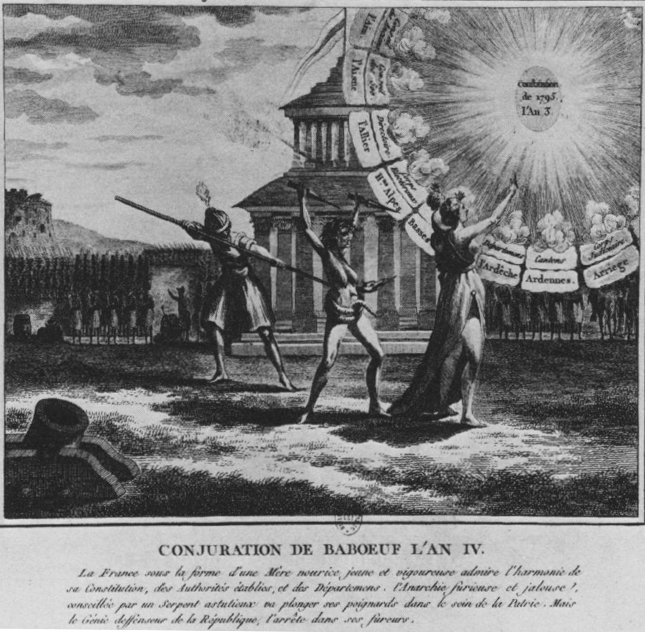
The Babeuf Conspiracy. Anonymous French print.

Babeuf’s party comes down to us as a “conspiracy,” under which word the state would charge him and which his follower Philippe Buonarroti would later rebrand the “Conspiracy of Equals”. It was not so much a grassy-knoll type of conspiracy as it was an underground organization.

When its adherents placarded Paris with the seditious “Analysis of the Doctrine of Babeuf” as the city endured a potentially dangerous economic crisis in April 1796, the government was put to a test of its strength.

It passed.

Having infiltrated Babeuf’s network, it arrested the principals on the eve of the Conspiracy’s intended insurrection. They were hailed out of Paris (a safeguard against sympathetic risings) to the commune of Vendome and there put on trial.* Babeuf and his associate Augustin Alexandre Darthe were condemned to death on May 26th and guillotined the very next day.

The last gasp of the French Revolution dropped with their heads into the basket.

Revolutionary Babeuvism, however, had scarcely just begun.

I don’t know what will become of the republicans, their families, and even the babies still at their mothers’ breasts, in the midst of the royalist fury that the counter-revolution will bring. O my friends! How heart-rending these thoughts are in my final moments! … To die for the fatherland, to leave a family, children, a beloved wife, all would be bearable if at the end of this I didn’t see liberty lost and all that belongs to sincere republicans wrapped in a horrible proscription.

-Babeuf’s last letter to his family

* The trial of Babeuf was itself a jurisprudential milestone: it was the first French trial to be transcribed verbatim.

What might look today like a nifty little advance for efficient judicature was bitterly controversial in 1797. The French Revolution had overturned an ancien regime practice of professional magistrates accepting legal testimony by written deposition and deciding matters behind closed doors. The liberte, egalite, fraternite way would instead demand that testimony be given live in the courtroom where citizen jurors could weigh its credibility.

Babeuf’s lawyer, Pierre-Francois Real, protested against the court stenographers, arguing that “The law insists that the system of written depositions not be restored in any way. That system will undoubtedly return if any means are used to save testimony given orally.”

There’s a fascinating disquisition on the curious and contradictory development of this issue and the way it “violates … common assumptions about the advance of textuality in the West” during the French Revolution in Laura Mason, “The ‘Bosom of Proof’: Criminal Justice and the Renewal of Oral Culture during the French Revolution” The Journal of Modern History, March 2004.

On this day..

2003: Guillermo Gaviria Correa and nine other FARC hostages

On this date in 2003, the Colombian military mounted a raid in an attempt to free 13 hostages of the narco-trafficking guerrilla organization FARC — causing the rebels to summarily execute their hostages. (Three survived.)

Most notable among the victims of what Colombian President Alvaro Uribe called “another massacre” in that country’s long-running civil war were two men:

Scion of a political family, Gaviria had become a notable exponent of nonviolence; he and Echeverri had been captured leading an unarmed, 1,000-person solidarity march in April of 2002.

It was part of the governor’s visionary (or quixotic) bid to transform his society.

As time passes, my confidence about the benefits of spreading and promoting nonviolence in Antioquia grows stronger. It is not about using nonviolence as a tool to try to transform FARC-EP attitudes. Before we can aim that high, it is absolutely necessary for the people of Antioquia to familiarize themselves with the concept of nonviolence and to adopt it, to the best of their abilities, as their own. We need nonviolence as a society to overcome our mistakes and transform the cruel reality suffered by so many in Antioquia. Here I have pondered about what kind of message I could offer as a leader. I came to the conclusion that the only message I want and can give is about the transforming power of nonviolence, its tremendous capacity to bring out the best in human beings, even in the worst of circumstances.

Peace activist Glenn D. Paige paid Gaviria the tribute of comparing him to Mahatma Gandhi and Martin Luther King, and nominated the governor for a posthumous Nobel Peace Prize.

The diary Gaviria kept during his year’s captivity, reflecting on his “journey toward nonviolent transformation,” has been published.

On this day..

1919: Mehmed Kemal, for the Armenian genocide

Ninety-one years ago today,* the tottering Ottoman Empire hanged one of its officials in Istanbul for his role in the mass slaughter of its Armenian minority during the First World War.

Kemal Bey’s hanging in Bayezid Square occurred in the immediate aftermath of the Great War. Here, on its last legs, the remains of a sultanate splintered apart in the war instituted tribunals for wartime offenses by the Young Turks who had run the government during the war — a sop to the British occupying forces making worrying noises about international trials for much bigger fish.

Much testimony at the trial pointed to the governor’s fervor for massacres; an Armenian priest who survived the slaughter later wrote that a Turkish officer had told him that Kemal “made a vow on the honor of the Prophet: I shall not leave a single Armenian alive in the sanjak of Yozgat.”

A response to the New York Timesreport of the hanging noted that “his part was that of an executioner. The originators of the plan to exterminate the Armenians were primarily Enver, Tallat, and Djemal.”

These “Three Pashas” who had driven Ottoman policy during the war had fled abroad. They would be condemned to death in absentia, and though none would hang, neither would they outlive Mehmed Kemal by as much as four years.

They were among the many unpunished perpetrators of the slaughter hunted down by Armenian assassins. The latter two were avenged by Operation Nemesis; Enver Pasha died in battle in Tajikistan during the Russian Civil War.

Though overshadowed in historical import by those three, our day’s principal is distinguished as the first person executed for “crimes against humanity.”

This novelty, combined with the trial’s victor’s-justice character, were immediately controversial, and remain so in the fraught politicking around the genocide. (This genocide-denialist paper describes, on page 13, the rowdy funeral scene that erupted the next day, also attested** by annoyed British officials.)

Events would soon outstrip these tribunals and lay waste to all parties’ plans for the Ottoman carcass, incidentally leaving the Armenian issue permanently unresolved.

The month after Mehmed Kemal swung, western allies went one dismemberment too far by backing the irredentist Greek state’s landing at Smyrna — an intervention that was to backfire catastrophically for the Greeks, and help birth the Turkish Republic.

* A few secondary sources say April 12 rather than April 10, but the earlier date appears much better attested.

** e.g., a diplomatic note cited in The Burning Tigris, p. 337: “Not one Turk in a thousand will think that any other Turk deserves to be hanged for massacring Christians.”

On this day..

1794: Jacques Hebert and his followers

On this date in 1794, firebrand revolutionary pamphleteer Jacques Hebert and his eponymous party of Convention radicals mounted the scaffold during the Paris Terror.

As a 32-year-old, Hebert started putting out his foul-mouthed blog radical newspaper Le Pere Duchesne in the Revolution’s early months.

In this increasingly vituperative rag, Hebert — incongruously writing in the voice of “Old Man Duchesne” — savaged first the royal couple, and then (after that pair lost their well-coiffed heads) whatever the retrograde element of the unfolding Revolution happened to be on any given day: the constitutional monarchist Lafayette; the bourgeois liberal Girondists. His paper valorized the Parisian working-class sans-culottes, and lustily demanded heads for the satisfaction of their various grievances.

Here, he literally channels Marat:

All of these thoughts trouble my brain, and the memory of Marat follows me without end. Last night I saw him in a dream: his wound was still bleeding, dammit. Upon seeing it I cried. Friend of the people, I shouted, is it you? Yes, good Père Duchesne, it’s Marat who comes from the dead to talk with you, because — dammit — the love of freedom pursues me even beyond the grave. Content to have lost my life for my republic, there only remains to me the regret of not having seen it delivered, before my death, from all the scoundrels who tear away at its breast. Père Duchesne, you must do what I couldn’t do. You closely followed me in the revolution; like me you consecrated you life to the defense of the rights of the people. You speak the language of the Sans Culottes, and your foul mouth, which makes little mistresses faint, sounds beautiful to free men, for free men shouldn’t be sought among the beautiful souls. Your joy and your anger have done more than all the dreams of statesmen. They know this well, the worthless fucks, and that’s why they’ve persecuted you like they did me. Courage, old man; don’t back off when you suffer the same trials as me, don’t be afraid: is there a more beautiful death than mine? But since you’re useful to your fellow citizens, try to avoid the daggers of statesmen. Live a while longer in order to denounce them and to complete, if you can, the task I’d undertaken.

Yes, Père Duchesne, you have to go after them hammer and tong, and not take it easy on anyone. When three months ago I proposed planting three hundred nooses on the terrace of the Tuileries in order to hang there the perfidious representatives of the people, some took me for a madman, and others as someone thirsty for blood. But nevertheless, if I’d been believed how much bloodshed would have been avoided! More than a million fewer men would have perished! So when I made that proposition I wasn’t speaking as a bloody monster, on the contrary I spoke as a friend of humanity. The moderates have buried more victims than those that fell before the steel of our enemies. Nothing is more harmful in a revolution than half measures. We have finally arrived at the era when we must pare things right down to the bone. … No more quarter for the defeated party, because, dammit, if the statesmen had the upper hand for one moment there wouldn’t exist a single patriot in six months.*

Late in his run, Hebert was on to venting dissatisfaction with the party of Danton, who had followed the monarchists and the liberals off the starboard of acceptable revolutionary opinion. Sensible centrist Maximilien Robespierre would indeed strike that faction down — just two weeks after he’d purged the radical Hebertist gaggle itself.**

Eleven days after Le Pere Duchesne last hit the streets, its author’s head hit the basket.

His printed editorials (like the one above) often assert a modish conviction in his own coming martyrdom, but as proof against a fatal political reversal, Hebert had trusted overmuch to his power base in the Paris commune. When he was carted out this morning, the mob whom his own paper once played to reveled in old Pere Duchesne’s fall just as readily as it had reveled in his enemies’.

some men carrying long sticks, at the end of which were suspended braziers of burning charcoal, symbolical of the “Charcoal-burners” of the “Pere Duchesne,” thrust them into the face of Hebert, insulting him with the same bitter railleries with which he tormented so many other victims (Alphonse de Lamartine)

Hebert was executed at the Place de la Revolution in a batch of 20 fellow-radicals, among whom we also find the eloquent “orator of mankind,” anticlerical† wordsmith Anacharsis Cloots. (Victor Hugo on his revolutionary leader in Les Miserables: “he had too much of Saint-Just about him, and not enough of Anacharsis Cloots.”)

The original La Pere Duchesne was dead, but just as the hot-selling mag had attracted ripoffs in its original run, the name lived on as a symbol of popular revolutionary menace — to be reclaimed by later generations in print and song.


La chanson du pere duchesne (live at RMZ)

* I know, right? Hebert was such a wild man, he thought ill of slavers.

Everywhere and at all times men of commerce have had neither heart nor soul: their cash-box is their God; they only know how to thieve and deceive; they would shave an egg, they would kidnap their own fathers; they traffic in all things, even human flesh; theirs are the ships which sail to the African coasts to capture negroes whom they then treat as worthless cattle.

** These rival factions linked as fellow-victims of Robespierre’s Terror are neatly symbolized by the spouses of their respective antipathetic scribblers: Jacques Hebert’s wife Marie, and Lucile Duplessis, wife of the Dantonist journalist Camille Desmoulins. Marie and Lucile were guillotined together that April, having forged a friendship while awaiting the chop.

† “The personal enemy of Jesus Christ,” Cloots called himself. He also remarked, “What is man’s chief enemy? Each man is his own.” A lot of enemies, this one had.

On this day..

1289: Ugolino della Gherardesca, ravenous

On an uncertain date in March 1289, fallen nobleman Ugolino della Gherardesca was immured in a Pisan tower with two sons and two grandsons — all doomed to starve to death and land in the Inferno.

Hungry? Ugolino with his starving whelps, as chiseled by Jean-Baptiste Carpeaux. (Ugolino was around 70 at his death, so his sons and grandsons were actually quite a bit older than these tots.) Auguste Rodin also sculpted Ugolino, more literally following Dante’s narrative.

In the dangerous Guelph vs. Ghibelline political landscape, Gherardesca had a knack for switching sides.

Originally a Ghibelline, he was banished once for plotting but returned with the support of Guelphs, and was made podesta to negotiate with Pisa’s Guelph enemies, Florence and Lucca.

Having made the unpopular but perhaps politically necessary decision to buy peace with Florence at the expense of territory and castles, Ugolino schemed to extend his own authority in Pisa, only to find himself hoisted on his own petard when onetime plotting-partner Archbishop Ruggieri Ubaldini had Ugolino and descendants seized for (wait for it) … treachery.

Months later, Archbishop Ruggieri ordered the keys to their dungeon thrown into the Arno and left them to starve to death.

Ugolino’s fate is mostly remembered by way of Dante, who places both Ugolino and Ruggieri deep in hell — where the treacherous noble has at least the satisfaction of gnawing vengefully on the treacherous cleric, but detaches his maw long enough to deliver himself the poem’s longest speech by any of the damned.

Here’s Dante’s Ugolino, from the tail end of Canto XXII through most of Canto XXIII.

I beheld two spirits by the ice
Pent in one hollow, that the head of one
Was cowl unto the other; and as bread
Is raven’d up through hunger, th’ uppermost
Did so apply his fangs to th’ other’s brain,
Where the spine joins it. Not more furiously
On Menalippus’ temples Tydeus gnaw’d,
Than on that skull and on its garbage he.

“O thou who show’st so beastly sign of hate
‘Gainst him thou prey’st on, let me hear,” said I
“The cause, on such condition, that if right
Warrant thy grievance, knowing who ye are,
And what the colour of his sinning was,
I may repay thee in the world above,
If that, wherewith I speak be moist so long.”

HIS jaws uplifting from their fell repast,
That sinner wip’d them on the hairs o’ th’ head,
Which he behind had mangled, then began:
“Thy will obeying, I call up afresh
Sorrow past cure, which but to think of wrings
My heart, or ere I tell on’t. But if words,
That I may utter, shall prove seed to bear
Fruit of eternal infamy to him,
The traitor whom I gnaw at, thou at once
Shalt see me speak and weep. Who thou mayst be
I know not, nor how here below art come:
But Florentine thou seemest of a truth,
When I do hear thee. Know I was on earth
Count Ugolino, and th’ Archbishop he
Ruggieri. Why I neighbour him so close,
Now list. That through effect of his ill thoughts
In him my trust reposing, I was ta’en
And after murder’d, need is not I tell.
What therefore thou canst not have heard, that is,
How cruel was the murder, shalt thou hear,
And know if he have wrong’d me. A small grate
Within that mew, which for my sake the name
Of famine bears, where others yet must pine,
Already through its opening sev’ral moons
Had shown me, when I slept the evil sleep,
That from the future tore the curtain off.
This one, methought, as master of the sport,
Rode forth to chase the gaunt wolf and his whelps
Unto the mountain, which forbids the sight
Of Lucca to the Pisan. With lean brachs
Inquisitive and keen, before him rang’d
Lanfranchi with Sismondi and Gualandi.
After short course the father and the sons
Seem’d tir’d and lagging, and methought I saw
The sharp tusks gore their sides. When I awoke
Before the dawn, amid their sleep I heard
My sons (for they were with me) weep and ask
For bread. Right cruel art thou, if no pang
Thou feel at thinking what my heart foretold;
And if not now, why use thy tears to flow?
Now had they waken’d; and the hour drew near
When they were wont to bring us food; the mind
Of each misgave him through his dream, and I
Heard, at its outlet underneath lock’d up
The’ horrible tower: whence uttering not a word
I look’d upon the visage of my sons.
I wept not: so all stone I felt within.
They wept: and one, my little Anslem, cried:
“Thou lookest so! Father what ails thee?” Yet
I shed no tear, nor answer’d all that day
Nor the next night, until another sun
Came out upon the world. When a faint beam
Had to our doleful prison made its way,
And in four countenances I descry’d
The image of my own, on either hand
Through agony I bit, and they who thought
I did it through desire of feeding, rose
O’ th’ sudden, and cried, ‘Father, we should grieve
Far less, if thou wouldst eat of us: thou gav’st
These weeds of miserable flesh we wear,

‘And do thou strip them off from us again.’
Then, not to make them sadder, I kept down
My spirit in stillness. That day and the next
We all were silent. Ah, obdurate earth!
Why open’dst not upon us? When we came
To the fourth day, then Geddo at my feet
Outstretch’d did fling him, crying, ‘Hast no help
For me, my father!’ There he died, and e’en
Plainly as thou seest me, saw I the three
Fall one by one ‘twixt the fifth day and sixth:

“Whence I betook me now grown blind to grope
Over them all, and for three days aloud
Call’d on them who were dead. Then fasting got
The mastery of grief.”
Thus having spoke,

Once more upon the wretched skull his teeth
He fasten’d, like a mastiff’s ‘gainst the bone
Firm and unyielding. Oh thou Pisa! shame
Of all the people, who their dwelling make
In that fair region, where th’ Italian voice
Is heard, since that thy neighbours are so slack
To punish, from their deep foundations rise
Capraia and Gorgona, and dam up
The mouth of Arno, that each soul in thee
May perish in the waters! What if fame
Reported that thy castles were betray’d
By Ugolino, yet no right hadst thou
To stretch his children on the rack. For them,
Brigata, Ugaccione, and the pair
Of gentle ones, of whom my song hath told,
Their tender years, thou modern Thebes! did make
Uncapable of guilt.

(According to Dante, the Wayfarer, Ugolino’s daughter married Guido Novello, and the couple actually hosted Dante at one point in his long exile.)

Dante’s quite understandable speculation that Ugolino might have been driven to cannibalize children has been recently disputed by scientists examining the apparent remains of this unfortunate bunch. But it hardly matters now … and Dante was sure right about the cannibalism scene’s dramatic potential.

On this day..

1623: Amboyna Massacre

On February 27,* 1623, the Dutch East India Company beheaded twenty who had been waterboarded into confessing to a terrorist plot.

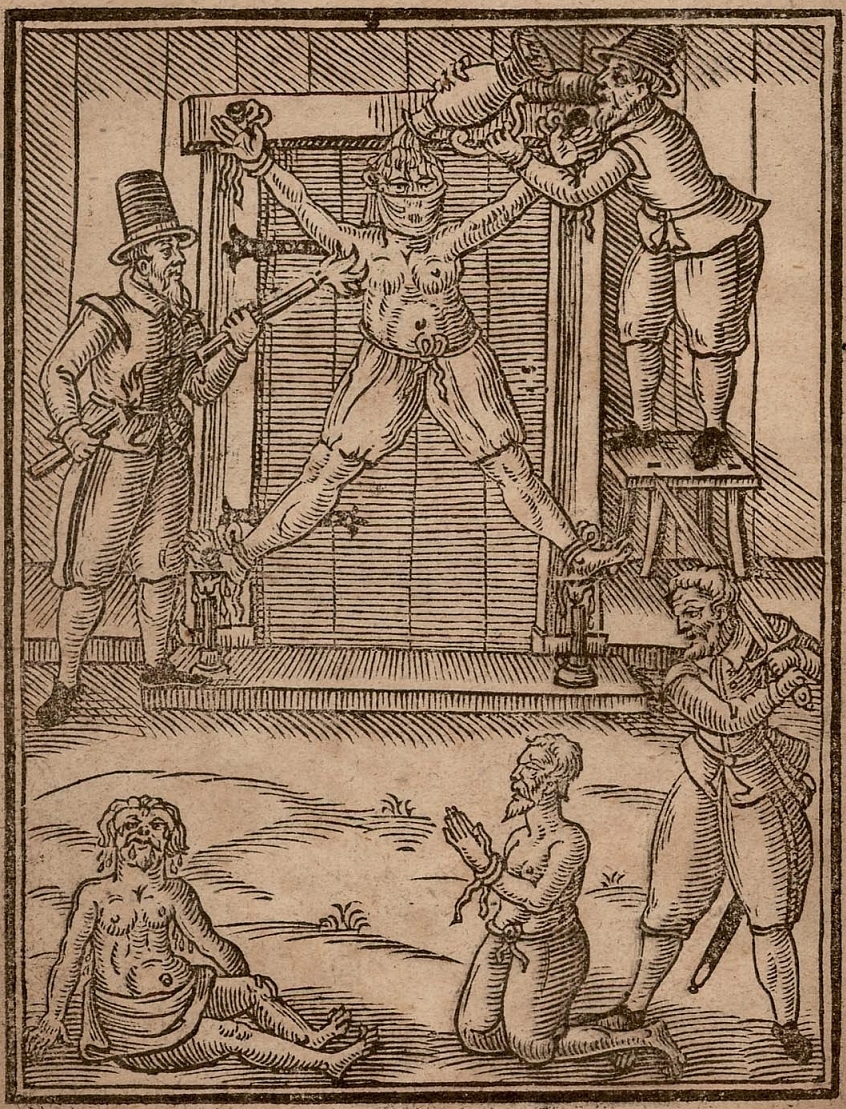
English prisoner suffering “waterboarding” faux-drowning torture, published under the name “A true relation of the unjust, cruell, and barbarous proceedings against the English at Amboyna in the East-Indies 1624”.

The torturers “poured the water softly upon his head until the cloth [wrapping his head] was full, up to the mouth and nostrils, and somewhat higher, so that he could not draw breath but he must suck in all the water.” More nasty description.

(cc) Image from Flickr | BiblioOdyssey

Posh Spice

As in modern times, this scenario originated with resource competition in the Muslim world … in this case, competition for spice, in Indonesia.

European colonialism had pitted the Dutch East India Company against its British counterpart on the archipelago, both scrabbling after the lucrative trade in cloves and pepper, with garnishes of nutmeg, cinnamon, mace, and ginger.

The two rival powers had, as we lay our story, recently come to a tense truce, dividing the commerce between them — and swapping mutual accusations of violating that pact. The arrangement basically gave the Dutch a bigger slice of the pie, so we’ll find them when the cloves hit the fan having the balance of power on their side.

Terrorists

We’re going to oversimplify to set the scene.

On Ambon Island, one of the very “Spice Islands” (i.e., the Moluccas) — at the Dutch-controlled fortification of a trading post also shared by the English — the Dutch merchant-governor Herman van Speult heard that a Japanese mercenary had asked about the Dutch fortifications.

The security-conscious van Speult ordered that unfortunate soldier interrogated under torture.

As tends to happen when the interrogators in such a case are convinced of a ticking time bomb situation, the torture uncovered a ticking time bomb situation.

The mercenary got the Dutch to stop burning and drowning him by “revealing” a highly implausible** English plot to seize the Dutch fort, with 20 guys or so and no prospect of imminent outside aid. Wouldn’t you know it: when the supposed confederates named by the mercenary were similarly tortured, they too admitted the plot. Van Speult’s English opposite number, Gabriel Towerson, was one of them.

The Amboyna Massacre followed anon, with Towerson and nine other British East India Company employees beheaded, along with nine Japanese mercenaries and one Portuguese. (The latter ten worked for the Dutch East India Company, not the British. A fifth column!)

They went to their deaths protesting their innocence, and many smuggled out written recantations to that same effect: “tortured … with that extream Torment of Fire and water, that Flesh and Blood could not endure it, and we take it upon our Salvation, that they have put us to Death Guiltless.”

Anger in the English Street

That last quote comes from Karen Chance, “The Amboyna Massacre in English Politics, 1624-1632,” in Albion: A Quarterly Journal Concerned with British Studies (Winter 1998).

As the title of that piece suggests, the Amboyna Massacre outraged Towerson’s countrymen and -women once word finally made it back to the mothership. (In addition to the torture/wrongful execution dimension, the legal authority of the Dutch trading concern to impose judicial punishment on their English counterparts was questionable at best.)

English demands for satisfaction against the perpetrators continued to complicate Dutch-English relations into the reign of Charles I and beyond. Even Oliver Cromwell required, as the price of peace for the First Anglo-Dutch War in the 1650s, punishment of any surviving offenders. (Which was apparently nobody at all.)

And still later, the burgeoning British Empire’s propaganda arm reached for the Amboyna narrative to justify seizing New Amsterdam on the grounds that the Dutch had attempted to spring a massacre on English settlers — “their Amboyna treacherous Cruelty extended itself from the East to the West Indies, and pursued thus the straight channel of Dutch blood”.

As for the trade-jockeying: the Netherlands’ commanding position in Indonesia ultimately squeezed the English out.** But don’t fret for Old Blighty: she turned attention to gobbling up India, and made a lot more bank than did the Dutch spice racket.

* February 27 was the date according to the Julian calendar in use at this time by the British. By the Gregorian calendar the Dutch were using, the massacre took place on March 9.

** For more on both the fanciful nature of the supposed plot, and the economics of the East Indies trade as it unfolded in the 17th century, see D.K. Bassett, “The ‘Amboyna Massacre’ of 1623”, Journal of Southeast Asian History, September 1960.

On this day..

1939: Stanislav Kosior, Vlas Chubar and Pavel Postyshev

On this date in 1939, a couple of “New Bolsheviks” recently flying high after helping purge the Old Bolsheviks had their own reversals of fate culminate with a bullet to the head.

Stanislav Kosior* (or Kossior), a Pole who ran the Ukrainian Communist Party for much of the 1930’s, and Vlas Chubar, a Ukrainian politburo member who had once served as Prime Minister, were shot this day along with Pavel Postyshev,** once Stalin’s personal representative to the Ukraine.

Left to right: Kosior, Chubar, and Postyshev — the first and last on post-rehabilitation Soviet stamps.

Though these obviously died because of parochial party politics under the terrifying reign of Stalin — and all were accordingly rehabilitated after Stalin’s death — posterity has another bone to pick with them: the Ukrainian famine known as the Holodomor.

Their portfolios included carrying out the forced collectivization to which the famine is generally attributed. Participation was strongly encouraged.

“Join the collective farm or else off to the Solovets Islands.”

Chubar

It was a grim time: starving peasnts dared not touch collectivized foodstuffs slated for use elsewhere on pain of execution themselves.† (Kosior won the Order of Lenin for his achievements in agriculture.) These Soviet VIPs themselves faced very similar pressure to implement Moscow policy and party line with exactitude … and very similar consequences for any perceived failure. (Kosior, too steely to succumb to torture, finally broke when his captors raped his teenage daughter in front of him.)

State organs adapted to the fall of these powerful men with Orwellian aplomb. “Radio Kosior” was renamed “Radio Kiev” overnight with its namesake’s arrest. Secret police chief Lavrenty Beria personally expropriated Chubar’s dacha. And

there is an account of a case in the Ukraine in which fifty students were charged with forming an organization to assassinate Kossior, who had been named as one of the senior intended victims in the great Moscow Trials. A year’s work on this case, which was a structure of great intricacy, had been performed by the interrogators. In 1938, however, it became known that Kossior himself had been arrested as a Trotskyite. Everyone thought that the students would be released. But a new interrogation immediately started, and they were beaten up for having lied to the NKVD. After a few days, the stool pigeons in the cells let them know what they were supposed to confess this time. It was to change their deposition, putting the name of Kaganovich for that of Kossior. The NKVD could not face the trouble of constructing a completely new fabrication. Finally everything was in order, and the students were sent off to labor camps.

A Ukrainian court recently named Kosior, Chubar and Postyshev among eight individuals personally responsible for the Holodomor.

* When Kosior was assigned to Moscow in 1938, he was replaced in the Ukraine by a good friend: future Soviet Premier Nikita Khrushchev. (According to Nikita’s son.) To judge by the ferocity and extent of the purges Khrushchev oversaw, he took to heart the lesson from his predecessors’ fall.

** But on the plus side, Russians’ and eastern Slavs’ (continuing) tradition of putting up New Year’s trees in at least partly attributable (Russian link) to a Postyshev epistle to Pravda in 1935 calling for same. (The New Year’s yolka was a religious/tsarist tradition that had been discontinued after the Russian Revolution, but like many such cultural artifacts proved amenable — with Postyshev’s nudging — to secular/Communist reappropriation.)

† The nature of the Holodomor is the subject of furious present-day wrangling: can the mass starvation accurately be classed as a “genocide”? Especially given that such a finding could expose Russia and/or Russians to legal liability, there’s something of a difference of opinion on the matter between Kiev and Moscow.

On this day..