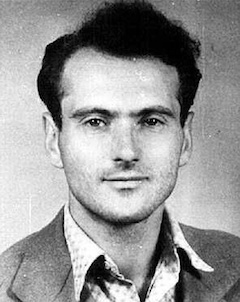
1831: Vicente Guerrero, former President of Mexico

Vicente Guerrero, late the president of Mexico, was executed on this date in 1831.

He was once a rebel soldier under Jose Maria Morelos in the Mexican War of Independence against Spain.

The Afro-Mestizo Guerrero (English Wikipedia entry | Spanish) cinched that conflict by successfully appealing to his royalist opposite number, Agustin de Iturbide, to switch sides. Their combined forces rode into Mexico City together in September 1821 but the conservative Iturbide and the liberal Guerrero soon parted ways.

Iturbide was elevated to emperor of Mexico; Guerrero by 1823 had returned to the field to rebel against the strongman. When Iturbide was deposed (and eventually executed), Guerrero became one of the ruling triumvirs and a national political figure. He contested the 19281828 presidential election which he lost at the ballot box but won in the ensuing street battles — an affair that featured the intervention on Guerrero’s side of Santa Anna.

He was quick about abolishing slavery and he had to be, for this mixed-race populist was deposed by his conservative vice president within months — beginning another round of civil conflict that was dishonorably resolved when an Italian sea captain arranged with the Mexico City government to lure him aboard and arrest him. For this gambit Judas received 50,000 pesos and Guerrero a summary court-martial and a firing squad at Cuilapam.

The cruel treatment of Guerrero requires an explanation. Bravo had been defeated in 1827 but was merely exiled and there were other similar cases. It is reasonable to ask, therefore, why in the case of Guerrero the government resorted to the ultimate penalty. The clue is provided by Zavala who, writing several years later, noted that Guerrero was of mixed blood and that the opposition to his presidency came from the great landowners, generals, clerics and Spaniards resident in Mexico. These people could not forget the war of independence with its threat of social and racial subversion. Despite his revolutionary past, the wealthy creole Bravo belonged to this “gentleman’s club’, as did the cultured creole, Zavala, even with his radicalism. Hence Guerrero’s execution was perhaps a warning to men considered as socially and ethnically inferior not to dare to dream of becoming president. (Source)

The southern Mexico state of Guerrero is named for him; its slogan, mi patria es primero (my fatherland is first) is the legendary reply that the young Vicente Guerrero made to his Spain-supporting father when asked to foreswear the independence movement.

On this day..

1886: The leadership of the Proletariat Party

A quartet of revolutionary socialists were executed by the tsarist authorities at Warsaw Citadel on this date in 1886.

Poland’s first socialist party of any consequence, the Proletariat was founded in 1882 by Ludwik Warynski.

“Small in number and very young in age,” were these founding socialists, “sons and daughters of a shattered class and a defeated nation.” But Moscow had long feared the diffusion of revolutionary ideologies in Poland, for as an 1873 Russian security brief observed, “of all the lands belonging to his Imperial Majesty the Kingdom of Poland more than any other constitutes a favorable ground for the Internationale.” (Both quotes from The Origins of Polish Socialism: The History and Ideas of the First Polish Socialist Party 1878-1886.)

The Proletariat Party went some way to vindicating the fears of the secret police by gaining several hundred members in its first years and conducting some successful protest campaigns in Warsaw. Naturally this invited state violence on the heads of the leadership; Warynski was in irons by the end of 1883, and would die in prison six years later.

This in turn brought new and more implacable men to the fore of the movement, like one of our day’s principals Stanislaw Kunicki (English Wikipedia entry | Polish) — who better inclined to ally the Proletariat Party with the anti-autocrat terrorist organization Narodnaya Volya (People’s Will). Eventually in the course of the 1880s crackdown

several hundred members of Proletariat were arrested, of whom twenty-nine from the industrial areas of Poland were selected as being principally responsible for the direction of the party. The trial of 23 November to 20 December 1885 produced its first socialist martyrs. In the end the Russian Piotr Bardovsky, Stanislaw Kunicki, the shoemaker Michal Ossowski and the weaver Jan Petrusinski were hanged on 28 January 1886.


A plaque at Warsaw Citadel commemorates the Proletariat martyrs ((cc) image by Mateusz Opasinski.

On this day..

1863: Antonio Locaso

On this date in 1863, the famed Italian bandit Antonio Locaso was shot in Castellaneta at the tender age of 22.

A former goatherd, Locaso supposedly embarked his career in brigandage in the classic style of the social bandit, impetuously intervening to fight off an agent of the law who was bent on ill-treating some penniless neighbors.

He thereafter was compelled to conceal himself in the wildernesses near Castellaneta,* down at the hinge of the Italic boot’s heel.

No mere highwayman, he fell in as a lieutenant of the ex-Bourbon officer turned outlaw/rebel Sergente Romano. This brought a violent crackdown by the Kingdom of Italy.

In a Christlike turn, he was betrayed by a comrade for the price on his head — and found slumbering amid his repast where “bread, cheese and salami there was also a bottle of narcotized wine.”

* Although it’s hardly a city on the front rank of the world’s conscience, it’s on the credit scroll of every episode of The Simpsons as it confers the municipal ancestry and the surname on Homer Simpson voice actor Dan Castellaneta.

On this day..

1934: Surya Sen

On this date in 1934 the great Bengal revolutionary Surya Sen was hanged by the British.

A schoolteacher affectionately known as “Master Da”, Sen put his name in the annals by leading the April 18, 1930 raid on the Chittagong police armory,* which yielded benefits more symbolic than practical: it was hoped that the raid would also surprise and massacre the local British officer corps and trigger a whole rising, but the prospective targets were absent, and then became forewarned, on account of the raid taking place on Good Friday.

Afterwards, the rebels melted away and the wanted Sen stayed underground for years. It’s no wonder he was hard to catch: the guy who finally betrayed him was beheaded in revenge. “Death is knocking at my door,” ran the man’s letter before he went to the Chittagong Central Jail along with another revolutionary named Tarakeswar Dastidar.

My mind is flying away towards eternity … At such a pleasant, at such a grave, at such a solemn moment, what shall I leave behind you? Only one thing, that is my dream, a golden dream-the dream of Free India … Never forget the 18th of April,1930, the day of the eastern Rebellion in Chittagong … Write in red letters in the core of your hearts the names of the patriots who have sacrificed their lives at the altar of India’s freedom.

* Armories, actually: two separate facilities, one for the police and one for the auxliaries, plus the European Club where they intended to seize hostages.

On this day..

1453: Stefano Porcari

(Thanks to the estimable historian Edward Gibbon for this guest post on the humanist Stefano Porcari, who aspired to follow the revolutionary trail of the previous century’s great tribune of the people Cola di Rienzi … and did follow Rienzi’s fate. Compare with the account of Machiavelli in History of Florence, who remarks that “though some may applaud his intentions, he must stand charged with deficiency of understanding; for such undertakings, though possessing some slight appearance of glory, are almost always attended with ruin.” -ed.)

It is an obvious truth, that the times must be suited to extraordinary characters, and that the genius of Cromwell or Retz might now expire in obscurity.

The political enthusiasm of Rienzi had exalted him to a throne; the same enthusiasm, in the next century, conducted his imitator to the gallows.

The birth of Stephen Porcaro was noble, his reputation spotless: his tongue was armed with eloquence, his mind was enlightened with learning; and he aspired, beyond the aim of vulgar ambition, to free his country and immortalize his name.

Spirto gentil, che quelle membra reggi

Gentle spirit, that rules those members
in which a pilgrim lives,
a brave lord, shrewd and wise,
now you have taken up the ivory sceptre
with which you punish Rome and her wrongdoers,
and recall her to her ancient ways,
I speak to you, because I see no other ray
of virtue that is quenched from the world,
nor do I find men ashamed of doing wrong.
I don’t know what Italy expects or hopes for,
she seems not to feel her trouble,
old, lazy, slow,
will she sleep forever, no one to wake her?
I should grasp her by the hair with my hand.

I’ve no hope she’ll ever move her head
in lazy slumber whatever noise men make,
so heavily is she oppressed and by such a sleep:
not without the destiny in your right hand,
that can shake her fiercely and waken her,
now the guide of our Rome.
Set your hand to her venerable locks
and scattered tresses with firmness,
so that this sluggard might escape the mire.
I who weep for her torment day and night,
place the greater part of my hopes in you:
for if the people of Mars
ever come to lift their eyes to true honour,
I think that grace will touch them in your days.

Those ancient walls the world still fears and loves
and trembles at, whenever it recalls
past times and looks around,
and those tombs that enclose the dust
of those who will never lack fame
until the universe itself first dissolves,
and all is involved in one great ruin,
trust in you to heal all their ills.
O famous Scipios, o loyal Brutus,
how pleased you must be, if the rumour has yet
reached you there, of this well-judged appointment!
I think indeed Fabricius
will be delighted to hear the news!
And will say: ‘My Rome will once more be beautiful!’

And if Heaven cares for anything down here,
the souls, that up there are citizens,
and have abandoned their bodies to earth,
pray you to put an end to civil hatred,
that means the people have no real safety:
so the way to their temples that once
were so frequented is blocked, and now
they have almost become thieves’ dens in this strife,
so that their doors are only closed against virtue,
and amongst the altars and the naked statues
they commit every savage act.
Ah what alien deeds!
And no assault begun without a peal of bells
that were hung on high in thanks to God.

Weeping women, the defenceless children
of tender years, and the wearied old
who hate themselves and their burdened life,
and the black friars, the grey and the white,
with a crowd of others troubled and infirm,
cry: ‘O Lord, help us, help us.’
And the poor citizens dismayed
show you their wounds, thousand on thousands,
that Hannibal, no less, would pity them.
And if you gaze at the mansion of God
that is all ablaze today, if you stamped out
a few sparks, the will would become calm,
that shows itself so inflamed,
then your work would be praised to the skies.

Bears, wolves, lions, eagles and serpents
commit atrocities against a great
marble column, and harm themselves by it.
Because this gentle lady grieves at it,
she calls to you that you may root out
those evil plants that will never flower.
For more than a thousand years now
she has lacked those gracious spirits
who had placed her where she was.
Ah, you new people, proud by any measure,
lacking in reverence for such and so great a mother!
You, be husband and father:
all help is looked for from your hands,
for the Holy Father attends to other things.

It rarely happens that injurious fortune
is not opposed to the highest enterprises,
when hostile fate is in tune with ill.
But now clearing the path you take,
she makes me pardon many other offences,
being out of sorts with herself:
so that in all the history of the world
the way was never so open to a mortal man
to achieve, as you can, immortal fame,
by helping a nobler monarchy, if I
am not mistaken, rise to its feet.
What glory will be yours, to hear:
‘Others helped her when she was young and strong:
this one saved her from death in her old age.’

On the Tarpeian Rock, my song, you’ll see
a knight, whom all Italy honours,
thinking of others more than of himself.
Say to him: ‘One who has not seen you close to,
and only loves you from your human fame,
tells you that all of Rome
with eyes wet and bathed with sorrow,
begs mercy of you from all her seven hills.’

-Verse no. 53 from this English translation of Petrarch

The dominion of priests is most odious to a liberal spirit: every scruple was removed by the recent knowledge of the fable and forgery of Constantine’s donation; Petrarch was now the oracle of the Italians; and as often as Porcaro revolved the ode which describes the patriot and hero of Rome, he applied to himself the visions of the prophetic bard.

His first trial of the popular feelings was at the funeral of Eugenius the Fourth: in an elaborate speech he called the Romans to liberty and arms; and they listened with apparent pleasure, till Porcaro was interrupted and answered by a grave advocate, who pleaded for the church and state.

By every law the seditious orator was guilty of treason; but the benevolence of the new pontiff [Pope Nicholas V -ed.], who viewed his character with pity and esteem, attempted by an honorable office to convert the patriot into a friend.

The inflexible Roman returned from Anagni with an increase of reputation and zeal; and, on the first opportunity, the games of the place Navona, he tried to inflame the casual dispute of some boys and mechanics into a general rising of the people.

Yet the humane Nicholas was still averse to accept the forfeit of his life; and the traitor was removed from the scene of temptation to Bologna, with a liberal allowance for his support, and the easy obligation of presenting himself each day before the governor of the city.

But Porcaro had learned from the younger Brutus, that with tyrants no faith or gratitude should be observed: the exile declaimed against the arbitrary sentence; a party and a conspiracy were gradually formed: his nephew, a daring youth, assembled a band of volunteers; and on the appointed evening a feast was prepared at his house for the friends of the republic. Their leader, who had escaped from Bologna, appeared among them in a robe of purple and gold: his voice, his countenance, his gestures, bespoke the man who had devoted his life or death to the glorious cause.

In a studied oration, he expiated on the motives and the means of their enterprise; the name and liberties of Rome; the sloth and pride of their ecclesiastical tyrants; the active or passive consent of their fellow-citizens; three hundred soldiers, and four hundred exiles, long exercised in arms or in wrongs; the license of revenge to edge their swords, and a million of ducats to reward their victory. It would be easy, (he said,) on the next day, the festival of the Epiphany, to seize the pope and his cardinals, before the doors, or at the altar, of St. Peter’s; to lead them in chains under the walls of St. Angelo; to extort by the threat of their instant death a surrender of the castle; to ascend the vacant Capitol; to ring the alarm bell; and to restore in a popular assembly the ancient republic of Rome.

While he triumphed, he was already betrayed.

The senator, with a strong guard, invested the house: the nephew of Porcaro cut his way through the crowd; but the unfortunate Stephen was drawn from a chest, lamenting that his enemies had anticipated by three hours the execution of his design.

After such manifest and repeated guilt, even the mercy of Nicholas was silent. Porcaro, and nine of his accomplices, were hanged without the benefit of the sacraments; and, amidst the fears and invectives of the papal court, the Romans pitied, and almost applauded, these martyrs of their country. But their applause was mute, their pity ineffectual, their liberty forever extinct; and, if they have since risen in a vacancy of the throne or a scarcity of bread, such accidental tumults may be found in the bosom of the most abject servitude.

On this day..

1795: Franz Hebenstreit, Wiener Jakobiner

Vienna utopian Franz Hebenstreit, the world’s first communist, was publicly hanged on this date in 1795.

Philosophy student turned cavalry officer and sometime poet, Hebenstreit along with Andreas von Riedel became in the wake of the French Revolution the foremost proponents of constitutional monarchy within the Habsburg empire.

As these visionaries trended, with France, ever more republican they became in like proportion ever more odious to Emperor Franz II. Finally in 1794 the “Wiener Jakobiner” types were arrested; Hebenstreit caught a death sentence for treason via a show trial designed to exaggerate the group’s threat. (Riedel would be imprisoned, and freed from his dungeons by Napoleon.)

On this day..

1328: Willem de Deken, Flemish merchant-rebel

On this date in 1328, Willem de Deken, burgomaster of Bruges, had his hands cut off and his neck strung up in Paris for treason.


Belgian illustrator Jean-Leon Heuns‘s 20th century depiction of Willem de Deken.

De Deken was among the leaders of the 1323-1328 Revolt of Coastal Flanders.

“As with most rebellions in Flanders, the revolt was not a straightforward clash of social classes,” notes Medieval Bruges: c. 850-1550.

At first, the protests of the rebels of the castellany of Bruges and other rural districts in coastal Flanders were aimed at the abuses in tax collection by the ruling elites — and more specifically members of the castellany’s noblemen who were thought to be exploiting the commoners to line their own pockets … However, the rising was soon joined by a Bruges coalition of artisans and some disgruntled members of the city’s commercial elite.

De Deken “led a rebellious coalition uniting various social groups though with the textile workers as its backbone”; at one point the rebels even captured Louis, Count of Flanders. (He escaped.)

The rising’s scale brought in the intervention Louis’s French allies,* and the French finally brought Flanders to heel at the Battle of Cassel on August 23, 1328.** De Deken did not have the good sense of his peasant rebel counterpart Nicolaas Zannekin to die at this battle.


The Battle of Cassel, by Hendrik Scheffer (1837).

This was all bad news for the men and women in rebellion in the 1320s but triumph on the Cassel battlefield could not resolve a fundamental contradiction in the Low Countries between Flemish merchants, whose booming wool trade pulled them ever closer to the English cloth industry, and the French-facing political alignment of Count Louis.

Just a few years later when English-French rivalries blossomed into the start of the Hundred Years’ War, a new merchant-rebel succeeded where De Deken had failed, expelling the Count and aligning the Low Countries with England. (Eventually these precincts would become part of the Burgundian patrimony, and those dukes’ running rivalries with the French crown.)

* Times being what they were, French intervention also entailed having the Avignon Pope John XXII pronounce a sacramental interdict against Flanders pending its submission.

** It’s one of several battles of Cassel in northern France, further muddled by several battles of the unrelated but homophonic Cassel/Kassel in Hesse.

On this day..

1787: John Bly and Charles Rose, Shaysites

On this date in 1787, the only two men to hang for the infant American republic’s seminal post-independence rebellion went to the gallows at Lenox, Massachusetts.

The newborn United States emerged from the American Revolution (1776-1783) in a parlous financial condition. Forever short of gold and credit, it had paid George Washington’s Continental Army in worthless scrip* and promises of goodwill. Instead, many a Cincinnatus returned from Yorktown to discover his debtor farm dunned by creditors and taxmen, as desperate as he for hard currency.

Come 1786, protests against unpayable taxes verged into an outright rural insurrection in western Massachusetts. Known for one of its principals, Daniel Shays — who like so many of his fellows was a Continental Army veteran turned penniless farmer — this rebellion continued for several months and took earnest aim at the hated Massachusetts merchant elites. Some 4,000 “Shaysites” would eventually admit to** taking the field as rebel guerrillas. They mounted an attack on a federal armory, and seized weapons where they could for their own use.

A few books about Shays’s Rebellion

It was this last act which occasions our men’s hangings.

The new American authorities, who had not so many years ago been beckoning this same populace to take up their muskets in revolution, exercised in this moment a brittle authority and they would calculate that the proper balance of due regard for their power without unnecessary resentment entailed only a circumscribed approach.

Instead of charging Shaysites wholesale, most were waved away with a free pardon. And instead of charging treason, the Bay State made its demonstration cases with regular criminal offenses — for burglary when our men John Bly and Charles Rose followed some Shaysite militiaman’s order to confiscate guns and powder from nearby houses. In 1787, that was still a potential hanging offense.

Of course, everyone understood well enough the real offense. On the eve of their executions, someone got the condemned men to sign onto a “Last Words & Dying Speeches” broadsheet with a lesson addressed “To the good People of Massachusetts, more especially to Daniel Shays, and other Officers of the Militia, and the Select men of Towns who have been instrumental in raising the Opposition to the Government of this Commonwealth:”

Our fate is a loud and solemn lesson to you who have excited the people to rise against the Government … Advert to those things — live peaceably with all men — be not too jealous of your Rulers — remember that Government is absolutely necessary to restrain the corrupt passions of men — obey your Honest Governors — be not allured by designing men — pay your honest debts and your reasonable taxes — use your utmost endeavours to give peace to your divided, distracted country …

There was another legacy: the outbreak of Shays’s Rebellion — and the federal government’s impotence to respond to it (it was haltingly suppressed by state militia, with the insurgents at points escaping into New York for breathing room) — helped catalyze the Constitutional Convention from May to September of 1787, and informed its creation of a stronger federal state and of the system of checks upon democratic action that a rebellious populace might wish to undertake.

There’s a podcast episode about Shays’s Rebellion here.

* So widely shunned was the depreciated paper Continental currency issued during the Revolution that the phrase “not worth a Continental” entered the parlance of the times; it was these notes that had been given to revolutionary soldiers by way of aspirational salary like so many stock options from a foundering Silicon Valley startup. In 1791, these Continentals were bought out by the new federal government at one cent on the dollar.

** This census arrives via applications for the free amnesty eventually offered to the Shaysite rank and file.

On this day..

1958: Istvan Angyal, Hungarian revolutionary

On this date in 1958, Angyal Istvan was hanged for the failed 1956 Hungarian revolution.

A working-class Jew who survived Auschwitz as a boy — his mother and sister were not so fortunate — Angyal was a convinced leftist who became disaffected with the Hungarian regime not because of its Communism but because of its failure to realize the democratic and egalitarian aspirations of that ideology.

A fixture on the youthful intellectual ferment in Budapest in the early 1950s, he was one of the leaders of street protests against Soviet domination during the doomed Hungarian Revolution of 1956, even conferring personally with Prime Minister Imre Nagy during its last days. In a gesture that not all of his comrades would have supprted, he set out the hammer and sickle along with the Hungarian national flag on November 7, the very eve of the revolution’s defeat, arguing to Soviet troops that they were fighting against true communism.

He’s commemorated today at an Angyal István Park in Budapest; it’s evidently “a modern social place with free Internet” and a nifty paper plane art installation.

On this day..

1989: Rohana Wijeweera

On this date in 1989, Sri Lankan Marxist revolutionary Rohana Wijeweera was — by at least some accounts, properly disputed by the authorities — summarily executed

Moscow-educated at Lumumba University, Wijeweera showed his leftist bona fides by forming a splinter party breaking with the Ceylon Communist Party.

Wijeweera wasn’t there to do the People’s Front of Judea thing; his still-extant Janatha Vimukthi Peramuna (JVP) party aimed straight at revolution.

An abortive 1971 rising landed Wijeweera a long prison sentence, but he was amnestied in time to run a distant third in Sri Lanka’s 1982 presidential election.

The JVP — which increasingly also verged towards Sinhalese nationalism — then proceeded to foment a second and much more vigorous rebellion that ran from 1987 to 1989 which was suppressed in the usual ways. There’d be no prison amnesty for Rohana Wijeweera this time.

Officially, Wijeweera’s death in captivity is attributed to crossfire during an ambush shootout with his partisans. Sure. Here’s what Sri Lankan General (and later M.P.) Sarath Munasinghe had to say about Wijeweera’s end:

The time was 11.30pm [on November 12, 1989]. We reached the premises of HQ ‘Operation Combine’. There were many officers of other services too. We were conducted to the conference table where Rohana Wijeweera was seated. I was given a chair just opposite Wijeweera across the table. I commenced having a conversation with him. Mr Ernie Wijesuriya, director, National Intelligence Bureau, his deputy and some others were present. I spoke to Rohana Wijeweera at length.

Whenever I questioned him in English, he answered in Sinhalese. In fact, he asked me whether I knew the Russian language. I replied in the negative. Rohana Wijeweera told me that his second language was Russian. He told me all about his personal life, initially at Bandarawela and later at Ulapane in Kandy. He was reluctant to talk about the activities of the JVP.

While this discussion was going on, the ‘Operation Combine’ commander was with his deputy in the adjoining room, which was his office. Just past midnight, the deputy Defense Minister General Ranjan Wijeratne walked in and sat at the head of the conference table. Gen Wijeratne asked few questions, but Rohana Wijeweera did not respond. Gen. Wijeratne joined the ‘Operation Combine’ commander in his office. We continued with our conversation. We had many cups of plain tea (dark tea), while talking. I made a request to Rohana Wijeweera to advise his membership to refrain from violence. He agreed after persuasion. So we managed to record his words and also his picture in still camera.

After some time, a well-known Superintendent of Police arrived at the HQ Operation Combine. As the police officer walked in, he held Rohana Wijeweera’s hair from the rear and gave two taps on Wijeweera’s cheek. Wijeweera looked back, and having identified the officer said, ‘I knew it had to be a person like you’. The police officer joined the Minister and Operation Combined Commander. We continued with our conversation. Wijeweera related a few interesting stories. One day, a group of JVP activists had visited the residence of Nimal Kirthisri Attanayake [Rohana Wijeweera] at Ulapane. They demanded money for their movement. Wijeweera responded quickly by giving Rs 100. The youngsters did not have a clue about their leader. Wijeweera was full of smiles when he divulged this story.

The time was around 3.45am on 13 November 1989. I was informed to conclude the questioning and to take Rohana Wijeweera downstairs. Together we walked downstairs and were close to each other. Wijeweera held my hand and said, ‘I am very happy I met you even at the last moment. I may not live any longer. Please convey my message to my wife’. Rohana Wijeweera’s message contained five important points. They were all very personal matters concerning his family.

Moments later, Wijeweera was blindfolded and helped into the rear seat of a green Pajero. Two people sat on either side of Wijeweera. There were others at the rear of the vehicle. Just then a senior police officer arrived near the vehicle. I politely rejected his invitation to join them. The Pajero took off. I joined Col Lionel Balagalle standing near the main entrance of the Operation Combine HQ building. We were having a brief chat when a senior officer came downstairs to get into his car. We greeted him. He was in a very good mood. But the atmosphere changed all of a sudden. A military police officer appeared in front of us. The senior officer blasted him for not accompanying Wijeweera and party. The military officer dashed towards his vehicle and sped away. The senior officer departed. We also went home thinking of a good sleep.

Late in the morning I was busy getting Wijeweera’s photograph printed. No one would recognise Wijeweera without his beard. So I had to seek help and add the beard to Wijeweera’s photograph. It was done very well. Late in the afternoon there was a press conference at the Joint Operation Command. Minister Ranjan Wijeratne briefed the press. ‘Wijeweera and HB Herath [another JVP leader] had been taken to a house just outside Colombo, where the JVP had hidden part of their treasure. While the search was in progress, Herath pulled out a pistol and shot Wijeweera dead’. The minister went on to give more details. Subsequent to the killing of Wijeweera, violence by the JVP ceased gradually and there was peace in the country, except in the north and east. [i.e., the zone of the entirely separate Tamil Tigers insurgency -ed.]

On this day..