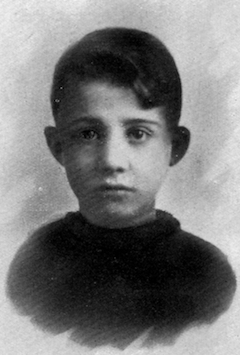
1907: Afanasi Matushenko

On this date in 1907,* revolutionary sailor Afanasi Mat(y)ushenko was executed for his part in tsarist Russia’s Potemkin mutiny.

The son of a liberated serf, the Ukrainian Matushenko (English Wikipedia entry | the more detailed Russian) absconded in his childhood to enter imperial Russia’s industrial economy. After spending the late 1890s — his mid teens to early twenties — on the railroads and the docks he was conscripted into the navy.

The revolutionary year of 1905 finds Matushenko a quartermaster aboard the soon-to-be-famous battleship Potemkin stationed at Sevastopol, already politically radicalized enough to have participated in a revolutionary barracks riot the previous November.

Eisenstein is mandatory where the Potemkin is concerned but the fact is that the mutiny was not spontaneously generated: it had been planned, and Matushenko was a part of the planning.

On the day of the rising, it was he who led brother-sailors in a protest against worm-ridden rations, and he who eventually crossed the rubicon into mutiny by calling them to arms. He personally killed several of the ship’s officers, and with the mutiny’s success he was elected the chair of the ship’s executive committee.

The Potemkin sailed for Odessa where her aspirations to catalyze a wider rebellion ran (metaphorically) aground, and eventually sailed for Romania. Matushenko lived abroad for two years as a political refugee, crossing paths with kindred souls but indistinct in his political outlook, nearly terroristic. The leftist writer Vladimir Posse met Matushenko in Geneva and found him

Matyushenko … did not go into theory. And his practice was to destroy — precisely the destruction, not the elimination, of all the chiefs, all the masters, and above all the officers. For him, the people were divided into masters and subordinates … the lower ranks can free themselves only when the officers are “simply” destroyed. He himself killed two or three of his superiors during a riot on the Potemkin. And it seemed to him that the essence of the revolution lay in such murders. In this spirit, he wrote bloodthirsty proclamations to sailors and soldiers, urging them to kill officers. He thought that with such a program it was easy to attract all the sailors and most of the soldiers to the side of the revolution …

He considered himself to be doomed to die in battle or on the scaffold … He considered living in an emigrant position to be dishonorable, something of a betrayal. In his view, a true revolutionary is one who not only kills, but also dies himself.

In June 1907 he acted on the latter beliefs and returned to Russia — where he was promptly arrested and condemned by a military court to fulfill his prophesied destiny.

Several cities in the Soviet Union, including Sevastopol itself, had streets named for Sailor Matyushenko, and a Black Sea minesweeper received that name in 1969.

* November 2, 1907 per the Gregorian calendar. Tsarist Russia was still hanging on to the Julian calendar at this time.

On this day..

1926: Anteo Zamboni, Mussolini near-assassin, lynched

Halloween of 1926 was a festival of triumph for the Italian fascists … and they crowned it in a festival of blood.

The occasion marked (not exactly to the day) the fourth anniversary of Benito Mussolini‘s bloodless coup via the October 1922 March on Rome. And as a gift for himself and his populace, Benito Mussolini on that date inaugurated Bologna’s Stadio Littoriale by riding a charger into the arena and delivering a harangue.


Fascist-built and still in service, it’s now known as the Stadio Renato Dall’Ara and it’s home to Bologna F.C. 1909. (cc) image by Udb.

After another address to a medical conference later that afternoon, Mussolini was motorcading down via Rizzoli in an Alfa Romeo when a gunshot whizzed through his collar.*

It had been fired by a 15-year-old anarchist named Anteo Zamboni, vainly and sacrificially hoping to turn history’s tide with a well-placed bullet.

Instead, his act would offer Il Duce a Reichstag Fire-like pretext — there was always bound to be one, sooner or later — for a raft of repressive legislation including the creation of a nasty secret police, the dissolution of political opposition, and (of interest to this here site) reintroduction of the death penalty.**

But Anteo Zamboni would see his penalty delivered summarily after the crowd seized him.†

Zamboni was done to death with blows and blades by Mussolini’s fascist admirers right on the spot. In a turn of heart, Bologna — by tradition a leftist stronghold — now has a street named for the young would-be assassin. (Here is the source for the ghastly Mature Content images below of Zamboni’s brutalized corpse.)

The incident is the subject of the 1978 film Gli Ultimi Tre Giorni.

* Zamboni’s was only one of three assassination attempts on Mussolini in 1926 alone.

** Just days afterwards during the post-Zamboni repressive pall, the great Marxist intellectual Antonio Gramsci was tossed into prison, never to emerge. Gramsci’s Prison Notebooks issued out of his dungeon, before his health succumbed in 1937 to the intentional neglect of his captors.

† It’s reportedly cavalry officer Carlo Alberto Pasolini who first detained the youth: the father of postwar film director Pier Paolo Pasolini.

On this day..

1949: Nicolae Dabija, anti-communist partisan

On this date in 1949, the Romanian anti-communist partisan Nicolae Dabija (English Wikipedia entry | Romanian) was shot at Sibiu, along with six other members* of that resistance.

Although cousin to Romania’s pre-Ceausescu Communist ruler Gheorghe Gheorghiu-Dej, Dabija — not to be confused with the 19th century general of that name nor with the latter-day Moldova M.P. of the same name — charted a distinctly separate ideological course.

He was decorated for his service on the Axis’s Eastern Front during World War II, but this same credential got him expelled from the army in the postwar Red takeover.

Nothing daunted, Dabija and some like-minded comrades** formed an armed anti-communist militia a few dozen strong in Transylvania’s Apuseni Mountains named the National Defense Front, Haiducian Corps — a nod to the Balkans’ historical outlaws/rebels. The Securitate reduced them over the course of 1948-1949 months, culminating in a March 3-4, 1949 forest battle that brought Dabija et al into custody.

* Ioan Scridon, Traian Mihaltan, Titus Onea, Augustin Ratiu, Gheorghe Oprita, Silvestru Bolfea. (Source)

** Brothers with the apt surname Macavei.

On this day..

1944: Werner Seelenbinder, communist grappler

Left-wing athlete Werner Seelenbinder was executed by the Third Reich on this date in 1944.

An Olympic Greco-Roman wrestler, Seelenbinder’s plan to scandalize patriots by refusing to make the Nazi salute from the podium at the 1936 Berlin games was scratched when he came in fourth in the event.

Nevertheless, Seelenbinder (English Wikipedia entry | German) had already by then given more material aid to Hitler’s foes by using his sportsman’s travel itinerary as cover to act the courier for the banned Communist party.

Arrested in 1942 during the smash-up of the Robert Uhrig resistance ring, Seelenbinder was tortured horrifically in prison but died with courage — as he had pledged in a last letter to his father.

The time has now come for me to say goodbye. In the time of my imprisonment I must have gone through every type of torture a man can possibly endure. Ill health and physical and mental agony, I have been spared nothing. I would have liked to have experienced the delights and comforts of life, which I now appreciate twice as much, with you all, with my friends and fellow sportsmen, after the war. The times I had with you were great, and I lived on them during my incarceration, and wished back that wonderful time. Sadly fate has now decided differently, after a long time of suffering. But I know that I have found a place in all your hearts and in the hearts of many sports followers, a place where I will always hold my ground. This knowledge makes me proud and strong and will not let me be weak in my last moments.

As a visible public person who died in resistance to fascism, Seelenbinder made for ready national-icon material in postwar Germany … but because of his red affiliations he was honored in this fashion mostly in East Germany. (Indeed, even a sports club that had been named for him weeks after the war’s end, in the American-occupied sector, stripped his name right off a few years later to keep with the times. The stadium was reverted to its Seelenbinder christening in 2004.)


East Berlin’s Werner-Seelenbinder-Halle was demolished in 1993 and replaced by the Velodrom.

On this day..

1871: Eugen Kvaternik, for the Rakovica revolt

On this date in 1871, Eugen Kvaternik and a number of companions were shot as rebels.

A patriot who had long aspired to detach Croatia from the Austro-Hungarian Empire, Kvaternik (English Wikipedia entry | Croatian) found enough traction to give it a go during the late 19th century’s rise of swirling nationalist rivalries.

His Rakovica Revolt, named after the village where Kvaternik announced the Croatian People’s Republic on October 7, 1871, was speedily crushed, however. Kvaternik’s rebels routed on the 10th with the appearance of a federal army and the arrests began forthwith.

On October 11, a military tribunal sentenced Kvaternik and various comrades to death — sentences that were implemented immediately by musketry. Today, there are streets and city squares in independent Croatia named to Kvaternik’s honor.


The Killings of Rakovica (Death of Eugen Kvaternik), by Oton Ivekovic.

On this day..

1796: Claude Javogues

French Revolutionary Claude Javogues was shot on this date in 1796.

The son of an ancien regime royal castellan, the barrister Javogues would have the opportunity in the revolutionary Convention to vote the death of the old man’s boss, and he did not miss his chance.

Pour préserver les âmes pusillanimes de l’amour de la tyrannie, je vote pour la mort dans les vingt-quatre heures. (“To preserve pusillanimous souls from the love of tyranny, I vote for death within twenty-four hours.”)

The guy wasn’t above getting his own hands dirty in the bloody work of revolution, either, and ran his own local revolutionary terror in his home town of Feurs. (A Chapel of the Martyrs in Feurs pays homage to the 80 victims of Javogues’s Terror.) Even so, he had his own brush with the Committee of Public Safety and stood in some danger for a time of being one of the children devoured by the revolution.

Instead, it was the subsequent Thermidorean Reaction that did for Javogues when he was suspected of complicity in the radicals’ Conspiracy of Equals.

He had the distinction in parting to be shot by a firing detail commanded by one Leopold Hugo — eventually (come 1802) the father of novelist Victor Hugo.

On this day..

1973: Jose Gregorio Liendo, “Comandante Pepe”

Comandante Pepe was shot on this date in 1973.

Jose Gregorio Liendo (English Wikipedia entry | Spanish), a onetime agronomy student, had quit his studies years before to join a Marxist guerrilla organization.

From the gorgeous inaccessibility of Chile’s mountainous border with Argentina, the Revolutionary Left Movement (MIR) launched pinprick-level attacks on the state in the late 1960s and took land reform by the barrel of the gun by seizing farms around Panguipulli for the use of workers.

The quixotic former student turned campesino revolutionary, Liendo became one of MIR’s most visible public faces under the nom de guerre of “Comandante Pepe”, even settling down in the mountains and marrying a local.

In the early 1970s this movement enjoyed the simpatico of the socialist Salvador Allende government. (One of MIR’s co-founders was President Allende’s nephew.)

That moment ended abruptly with the September 11, 1973 coup replacing a socialist administration with a far-right military dictatorship — and the latter immediately began slaughtering leftists.

The MIRistas themselves managed a few small attacks on the Pinochet regime in the weeks following the coup but were speedily overwhelmed. Captured after an attack on a carabineros station, “Pepe” with eleven comrades — a mixture of students and lumber workers — were condemned to immediate execution by a drumhead military tribunal in Valdivia.

“A week later, on October 9, the army executed seventeen more persons in the area,” according to Mark Ensalaco. “They were loggers, farmers, and peasant activists. The following day Helicopter Squadron 3 arrested sixteen employees of the same lumber and forestry complex where Comandante Pepe had worked and agitated. The prisoners were taken to a bridge over the Tolen River and executed.”

There’s a recent historical novel about this legendary character, Lo Llamaban Comandante Pepe (They Called Him Comandante Pepe).

On this day..

1972: Helenira Rezende, Brazil guerrilla

Brazilian Communist guerrilla Helenira Rezende was summarily executed in the field on this date in 1972.

“Preta” to her comrades, she was a silver-tongued student activist at the University of Sao Paulo who had been clapped in prison by the dictatorship.

Rezende was amnestied in December 1968 and went underground, eventually joining the guerrilla movement in the Araguaia River basin.

The 80 or so guerrillas operating in the eastern Amazon aspired to run that Che Guevara rural-insurgency playbook, as it announced in a May 1972 manifesto. It didn’t work: the Brazilian military successfully suppressed the revolution in a series of campaigns over the next two-plus years. Only about 20 of the guerrillas survived.

One of those lucky ones, Angelo Arroyo,* gave an account of her death:

On September 29, there was an ambush that resulted in the death of Helenira Resende. She, along with another companion, was on guard at a high point in the woods. On that occasion, troops came along the road. As they found the passage dangerous, they sent scouts to explore the side of the road, precisely where Helenira and the other companion were. The latter, when he saw the soldiers, fired the machine gun, which did not work. He ran and Helenira did not realize what was happening. When she saw the soldiers were already in front of her. Helenira fired a 16-round shotgun. The other soldier gave a blast of machine-gun fire that struck her. Injured, she pulled out the revolver and shot the soldier, who must have been hit. She was arrested and tortured to death.

Her bayoneted body was secretly buried by sympathetic campesinos and has never been recovered; officially, she’s still considered a fugitive. Her unit adopted the tributary name Destacamento Helenira Rezende; more recently, the University of Sao Paulo’s postgraduate association has been named in her honor.

* He wasn’t lucky for long: Arroyo was assassinated with a fellow Communist leader by military officials in Sao Paulo in 1976.

On this day..

1943: Mao Zemin, brother of Mao Zedong

Mao Zemin, younger brother of Communist leader Mao Zedong, was executed on this date in 1943.

A party cadre since 1921, the non-chairman Mao served a variety of economic leadership posts for the Red Army.

As of early 1941, Mao (English Wikipedia entry | the far more voluminous Chinese) was detailed to the western province of Xinjiang, where the warlord Sheng Shicai maintained friendly relations with the neighboring Soviet Union.

To Mao’s grief, this “King of Xinjiang” saw in the unfolding global war an opportunity to realign.

After the German invasion of the USSR in 1941, Sheng boldly flipped his affiliation from Moscow to the nationalist Kuomintang government with which he had theretofore maintained only the frostiest of relations. Crackdowns on Communists ensued too, and both Mao Zemin and Chen Tanqiu were both arrested, tortured, and executed as a result.

Needless to say this KMT-Xinjiang axis did not hold the Celestial Empire’s destiny and the whole decision to fade Moscow looks pretty dumb in retrospect. Sheng, however, surely did not much regret the gambit since he was able to follow the nationalists to Taiwan and spend a comfortable retirement writing memoirs like Sinkiang: Pawn or Pivot?

Mao’s son Mao Yuanxin, a still-living pensioner as of this writing, was a political figure in the 1970s who was jailed post-Gang of Four.

On this day..

1799: Ettore Carafa

On this date in 1799, a nobleman turned republican was turned into a martyr.

Fruit of the distinguished Carafa family, Ettore Carafa (English Wikipedia entry | Italian) was the Count of Ruvo but preferred the ennoblement of all mankind.

After a youthful trip to Paris on the verge of the French Revolution, Carafa returned to make himself the scandal of the Neapolitan aristocracy by such behaviors as translating the Declaration of the Rights of Man and of the Citizen and wearing the republican tricolor to the opera. Carafa was eventually obliged to break out of prison and take sanctuary in the Cisalpine Republic but he returned in glory (and no little satisfaction) with the 1799 Parthenopean Republic, when Naples briefly went republican, too. Commissioned an officer in revolutionary Naples’s army, he besieged his hometown of Andria.

Alas, this democratic interlude did not even live out the year, and many of its leading lights paid the forfeit to a violent reaction. Naples’s briefly-exiled queen was Marie Antoinette‘s sister and nowise forgiving when it came to Jacobin types and certainly not “such a man as Carafa, fit match as he was to Caracciolo, and held in almost equal terror by the Court.”

Carafa was one of its last holdouts, defending Pescara from siege well after Naples itself had fallen.

On September 4, 1799, Carafa mounted the guillotine with aplomb, his last words a command to the executioner Tommaso Paradiso, “You will tell your queen how a Carafa can die!” Then he slid himself under the knife on his back, boldly looking up at the instrument of death as it crashed through him.

On this day..