1849: Ugo Bassi, nationalist priest

Measure thy life by loss instead of gain;
Not by the wine drunk, but the wine poured forth
For love’s strength standeth in love’s sacrifice;
And whoso suffers most hath most to give.

-From Harriet King‘s poem “Ugo Bassi’s Sermon in the Hospital”

On this date in 1849, the Garibaldian priest Ugo Bassi was shot in Bologna along with fellow-nationalist Count Livraghi.


Statue of Ugo Bassi at Bologna’s via Ugo Bassi.(cc) image from Biblioteca Salaborsa.

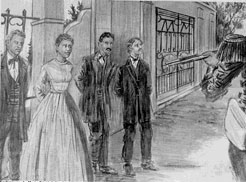
Detail view (click for full image) of Bassi and Livraghi being escorted to execution.

Bassi was a penniless Barnabite priest famous for his powerful oratory* and his national enthusiasms. He signed right up for Garibaldi‘s national movement in the heady liberal revolutions of 1848-49.

“Italy is here in our camp,” he would say of the Garibaldian forces readying their (ultimately unsuccessful) defense of the Roman Republic.** “Italy is Garibaldi; and so are we.”

Alas, in this engagement, Italy had a lot fewer guns than the French.

The new French ruler Napoleon III, who had himself been in youth a revolutionary carbonaro in Rome, saw foreign policy advantage in backing the exiled Papacy and overthrew the Republic.†

Garibaldi escaped to exile, but many of his subalterns did not. Bassi was captured unarmed — he didn’t even bear arms in battle — and Pius IX, once thought a fellow-traveler by the liberals, did not hesitate to hand him to the Austrians for punishment. The Habsburgs stood equally to lose from any gains of the Risorgimento, and accordingly gave Bassi a perfunctory military trial, then had him shot immediately in Bologna.

For crowning his open-hearted life with this sacrifice, Ugo Bassi instantly became, from that day to this, one of the best-honored Italian patriots.

He possessed at once the simplicity of a child, the faith of a martyr, the knowledge of a scholar, and the calm courage of a hero … If ever Italy comes to be united may God restore her the Voice of Ugo Bassi … The name of Ugo Bassi will be the watchword of the Italians on the day of vengeance!

Garibaldi

* Anecdote associated with Bassi once he came to firing up the Bolognese for Garibaldi: a poor girl who could give nothing to the cause spontaneously chopped off her own hair and handed it to him. This is the event depicted by Bassi’s fellow-Bolognese Napoleone Angiolini, Ugo Bassi sui gradini di San Petronio.

** Topical incidental: the Roman Republic lasted only a few months, but its constitution abolished the death penalty … so it can count as the first nation to abolish capital punishment in constitutional law.

† Earning Napoleon III the permanent wrath of Italian nationalists.

On this day..

1956: Andreas Dimitriou and Michalis Karaolis, the first EOKA men hanged

On this date in 1956, the British hanged two members of Cyprus’s nationalist resistance underground, the EOKA


Andreas Dimitriou (left) and Michalis Karaolis.

Michalis Karaolis murdered a local constable; Andreas Dimitriou (or Demetriou) hadn’t managed to kill his target, and only injured the British intelligence agent he shot. This, however, occurred two days after the enactment of draconian emergency regulations to counteract EOKA terrorism, under which merely possessing a firearm could be a hanging offense, never mind discharging it into someone.

The two of them weren’t connected to one another save in their common support for expelling the British from the Mediterranean island and reuniting it to the Greek mainland. It was a longtime, long-frustrated Hellenic dream.

Great Britain, even while the death penalty was eroding domestically, spurned international appeals for clemency — the Greek government made history by filing the first state-vs.-state petition to the European Commission of Human Rights a few days before the execution — reckoning that its credibility as a hard line against terrorism was at stake.

In Nicosia, where the hangings took place, schools were shuttered, armed paratroopers patrolled streets barred to traffic, and newspapers operated under a censor’s requirement not to inflame the populace.

In Athens, beyond the reach of the crown, the soundness of this policy was unpleasantly confirmed. Seven deaths and hundreds of injuries resulted from the ensuing brickbats with police. (The mayor of Athens personally smashed up a tributary plaque to Queen Elizabeth II.) And in retaliation, the EOKA subsequently executed two British soldiers it had captured, Gordon Hill and Ronnie Shilton … although British skepticism over this claim required an additional statement clarifying the matter.

On this day..

1916: Joseph Hani, abandoned

“Mr Joseph Hani was hanged for treason in the Burj at 5 a.m. At 8 a.m. 40 families deported.

-Diary of Mrs. Harry Dorman, April 5, 1916*

The unfortunate Joseph Hani — Yusuf al-Hani — was among the worthies of Beirut’s Maronite Christian community to petition the French consulate for western aid in detaching Lebanon from the Ottoman Empire.

With the development of World War I, the French ambassador Francois Georges-Picot abandoned the embassy … without removing or destroying this sort of incriminating correspondence. As a result, the Turks ransacked the embassy and identified several dozen of reproachable loyalty to the Porte to put to death.

May 6 — Martyrs’ Day — honors these victims, but Hani was among the very first of them.

While most of the other Maronite signers were able to fly, Hani stuck around to face the music. A British agent was able to contact the implicated characters in Aley Prison, and received the plaintive answer,

‘Where are the English? Where are the French? Why are we left like this?’

* I believe an ancestor of the current president of the American University of Beirut, Peter Dorman. The source of the diary citation is Nicholas Z. Ajay Jr.’s “Political Intrigue and Suppression in Lebanon during World War I” in International Journal of Middle East Studies, Apr., 1974.

On this day..

1865: Marcellus Jerome Clarke, “Sue Mundy”

On this date in 1865, Marcellus Jerome Clarke rode a carriage to a scaffold on Broadway Ave. in Louisville, Ky., where he addressed the multitude thus:

I am a regular Confederate soldier, and have served in the Confederate army four years … I could prove that I am a regular Confederate soldier, and I hope to die for the Confederate cause.

And then he did.

Clarke‘s last remarks were a protest against Kentucky’s military government. Having captured Clarke just three days before, it refused him prisoner-of-war status; regarding him rather as a franc-tireur, it gave him a pro forma secret trial even while throwing up the gallows for the preordained hanging.

This border region between North and South had seen bitter guerrilla war. As one indicator: the Northern effort in the Bluegrass State to suppress Confederate irregulars had been led by a general who earned the nickname “Butcher of Kentucky” for his ruthless exertions.

Stubbornly eluding those exertions (the Butcher was gone by March 1865) was Clarke, an elfin captain of 20 years with a band of cavalry raiders (in)famous for its hit-and run raids on Union men and supplies. (And on one infamous occasion, 30 African-American cattle-drivers.)

It was during this time that stories began circulating of a daring female commando, a “she-devil in pantaloons,” and the picturesque character — perfectly calibrated to twist the Butcher’s tail — seized popular imagination and moved newspapers.

While the honor is disputed by another Kentucky irregular hanged later in 1865, this “Sue Mundy” (or Munday) character soon came to be identified with the androgynous, just-old-enough-for-his-riding-license Clarke.

The Louisville Journal fantastically embroidered the Mundy legend and its alleged connection to Clarke — editorializing, for instance, that Clarke cross-dressed for amusement and advantage and could pull off his female alter ego thanks to his

“fair [complexion], long dark hair, which touched his shoulders, and a beautifully shaped mouth” (Mar. 16, 1865)

and his

“medium female statue, small feet and hands, face beardless and quite handsome, voice soft and feminine — all together making a counterfeit so perfect that even John Morgan, on a certain occasion, mistook him for a female.” (Jan. 14, 1865)


Right?

A captured Clarke would eventually complain that “he was not guilty for one-tenth of the outrages that he had been charged with and that the Louisville Journal had done him a great injustice.” Maybe he’d never heard that there’s no such thing as bad publicity.

The publicity this afternoon, of course, was of the very worst variety, albeit not exactly inimical to the celebrity racket.

“The fall was not more than three feet, and did not break his neck; he choked to death. We have seen a great many persons hung, but never before did we witness such hard struggles and convulsions. It was feared for a time that he would break the lashings. His sufferings, however, were of short duration. Thus ended the career of the notorious Sue Mundy.”

Several historical markers in Kentucky still commemorate that notorious career.

On this day..

1845: Maria Trinidad Sanchez, Dominican Republic heroine

We’ve previously noted in these pages Francisco del Rosario Sanchez, one of the Dominican Republic’s founding heroes, who in 1861 was shot for propounding independence.

Martyrdom was the family business.

On February 27, 1845, his sister Maria Trinidad Sanchez (Spanish link) had been, well, shot for propounding independence. (More Spanish)

That date, February 27, also happens to be the Dominican Republic’s Independence Day celebration — because a year to the date before her death, Maria Sanchez, her brother, and others of the anti-colonial La Trinitaria proclaimed independence from a bloody 22-year Haitian occupation.

Maria Sanchez, together with another woman named Concepcion Bona, made the first Dominican Republic flag.


Sanchez and Bona’s original flag for the Dominican Republic.

This was all well and good, until the resulting head of state steered the Dominican Republic towards recolonization by Spain, as a hedge against reconquest by Haiti. La Trinitaria types took an understandably dim view of this gambit, so busting them up was part of the deal.

Many of the country’s founding heroes, including brother Francisco, were chased into exile; Maria was rounded up by the new government and tortured for information about the Trinitarian “plots” against the new regime. She refused to name any names, and was shot on the country’s first independence anniversary.

On this day..

1902: Gideon Scheepers, Boer guerrilla

Scheepers lives because they shot him.”

-Hermi Baartman, Graaf-Reinet Museum

On this date in 1902, Kommandant Gideon Jacobus Scheepers was shot by the British for his exploits in the Boer War.

The young Dutch-descended Scheepers (here’s his Afrikaans Wikipedia page) was a soldier from the still-independent Boer states which were being reduced in this war to British dependencies.

In 1901, late in the proceedings, Scheepers took a column of irregulars into the British Eastern Cape Province and wrought havoc behind the lines. Some exploits are the stuff of legend, like the time he rode into a town, released all the Boer prisoners, locked up the British magistrate, and hauled down the Union Jack — to the delight of the Boer locals.

He would spend that year giving the British much better than he got, but the war was also infamously dirty.

According to David Harrison’s The White Tribe of Africa: South Africa in Perspective, “Scheeepers’ men also flogged and shot natives who helped the British, looted as well as burned farms, and executed Boer ‘traitors’.”

Was any of that criminal?

Since Scheepers was over enemy lines, the Boers who joined him could be held liable for treason … but that didn’t hold for Scheepers himself. His execution turned on holding these unsavory acts as war crimes: his 30-count charge sheet included seven arsons, seven murders, and various and sundry abuses of prisoners and blacks. Scheepers was really sore about the last; natives were supposed to be kept out of the fighting, but the prisoner very credibly insisted that the ones he “murdered” were under arms as scouts for the British.

“We Afrikaners will never find justice under the English,” Scheepers wrote as a prisoner. “Everything is for the kaffirs.”

(There’s a vociferous defense of Scheepers from a pro-Boer history here, and a more sober one by a London press correspondent here.)


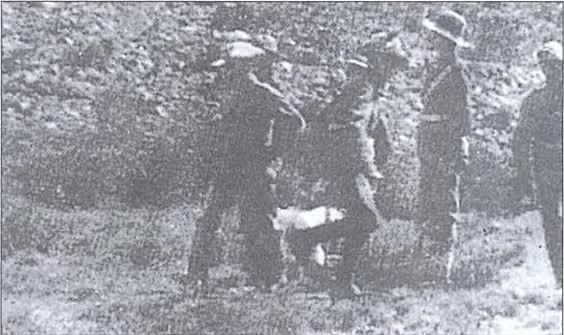
Scheepers is read the death warrant on January 17, 1902 — before Graaf-Reinet townspeople assembled by British orders.

For non-Loyalist Boers and for many throughout the world — the U.S. House of Representatives even moved a resolution calling for Scheepers to be accorded POW status according to the Geneva Convention — it smacked of a setup.


Gideon Scheepers (mostly obscured by his guards) tied to a chair for execution.


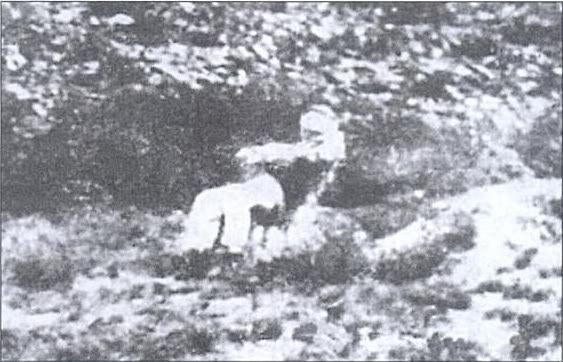
Just shot, Gideon Scheepers slumps backward in his chair.

While martyrdom guaranteed Scheepers a lasting legacy, bizarre posthumous turns helped elevate it into legend. When the dead man’s family turned up after hostilities to retrieve his bones, the grave turned out empty, leading to a years-long saga with colorful frauds presenting bogus remains, a mentally ill man doing the Grand Duchess Anastasia act and claiming to be Scheepers, and the actual corpse remaining stubbornly elusive.

The bereaved mother’s ultimately fruitless search for her son’s final resting place inspired the poem “Gebed om die Gebeente”(“Prayer for the Bones”), by D.J. Opperman. (Here’s a translated version.) That verse was recently set to music as a cantata by composer Hendrik Hofmeyr.

Scheepers’ allies, however, had simply been beaten in the field. On May 31, 1902 they capitulated to the British.

If we are asked why in 1978 a memorial should be erected for a man who died in 1902, then the answer is simple. The life and work of this man was such that history placed him in the heroes’ gallery and nothing and no one can deprive him of that place.

-Nationalist Prime Minister John Vorster upon the unveiling of a Scheepers monument

This interesting “On the Trail of Gideon Scheepers” series has a detailed and richly illustrated narrative of the man’s final year.

On this day..

1872: Du Wenxiu, Panthay rebellion leader

On this date in 1872, China’s Panthay Rebellion came to an end with the surrender, suicide, and execution — in that order — of Du Wenxiu.

The Panthay Rebellion (also known as the Du Wenxiu Rebellion) was one of several cataclysmic revolts to shake foundering imperial China in the 19th century.

This one was centered in the city of Dali (also known as Talifoo) in the southeastern Yunnan Province, near the Burmese border.* The rebels in question were the Hui people, a predominantly Muslim ethnic group who had been pushed around for years by Qing officials and by the ethnic Han.

The backstory of Han-on-Hui ethnic cleansing in the 1840s makes for harrowing reading, lowlighted by the 1845 massacre of 8,000 Hui in Baoshan.

An even more ambitious operation in May 1856 went down in Kunming, where a massacre — Qing officials publicly posted a directive to “kill [the Hui] one and all”** — claimed several thousand more and razed the city’s mosques. This outburst spawned an attempt at wholesale ethnic cleansing throughout the province … but that attempt blew back on its perpetrators by triggering a rebellion that would require a generation to tame.

The unexpected tenacity of Hui resistance was multiplied by the disadvantages for the Chinese state of operating in a distant and mountainous territory, and its preoccupation with the much larger simultaneous Taiping Rebellion. Though these considerations were not sufficient to dissuade local officials from picking the fight in the first place, they would help them come to regret it.

Hui resistance quickly coalesced into an organized rebellion, and that rebellion overran Dali by the end of the year, establishing itself as the seat of an independent kingdom called Pingnan Guo. Meanwhile, the onset of the Second Opium War left China incapable of contemplating a reconquest.

Du Wenxiu, the half-Han Islamic convert rebel leader acclaimed Sultan Sulaiman of Dali, was therefore left with some operating room to establish a Hui state. He led a pluralistic nation (for the Hui themselves were and are a pluralistic identity) in the western half of Yunnan, stretching from the Tibetan frontier almost to Kunming. (They came close but never quite managed to take this city).

Alas, in due time and with sufficient stability elsewhere in China the Pingnan state came under withering attack from the late 1860s. It sought help from the British as a potential foil against Chinese power, but the aid was not forthcoming and probably would have been too little and much too late. The Pingnan / Panthay / Hui state

ended much as it had begun — in a bloody massacre of the Hui populace. On 26 December 1872, imperial troops surrounded Dali, the Pingnan capital. Du Wenxiu, in a move that he hoped would spare the lives of the city’s residents, made the decision to hand himself over to the Qing general. Swallowing a fatal dose of opium as his palanquin carried him to the Qing encampment, Du was already dead by the time that he was delivered to the Qing commander. Not to be robbed of the gratification of killing him themselves, Qing officials hastily dragged Du before the Qing troops to be decapitated.† According to Emile Rocher, a French adviser to the provincial officials in Yunnan at the time, Du’s head was encased in honey and sent to the emperor.

Du’s sacrifice, however, was in vain. Three days later, imperial troops began a massacre that, according to the government’s own conservative estimates, took ten thousand lives by the time it was concluded — four thousand of the victims were women, children, and the elderly. Hundreds drowned trying to escape from Dali by swimming across Erhai Lake. Others attempted to flee through the narrow passes at either end of the valley. All were chased down and slain by the Qing troops. The imperial soldiers were ordered to cut an ear from each of the dead. These grisly trophies filled twenty-four massive baskets and, together with Du’s severed head, were sent to Beijing, where they served as a silent and unequivocal corroboration of the Pingnan regime’s bloody demise.**

Du Wenxiu was within living memory when the Qing themselves fell; shortly after that happened, an honorary tomb was constructed for the martyred rebel outside Dali.

* “Panthay” is a Burmese word for Chinese Muslims.

** David Atwill, “Blinkered Visions: Islamic Identity, Hui Ethnicity, and the Panthay Rebellion in Southwest China, 1856-1873,” The Journal of Asian Studies, Nov. 2003. This article and/or Atwill’s book (review) on the same subject appear to be the ultimate source of nearly every accessible English resource on the Panthay Rebellion.

† According to the London Times (Aug. 27, 1873) the aides and litter-bearers who accompanied the dying Du to the Qin camp were also beheaded for their troubles. It ballparks the ensuing butchery at 40,000 to 50,000 souls.

On this day..

1838: The first hangings of the Lower Canada Rebellion

On this date in 1838, Joseph-Narcisse Cardinal and Joseph Duquet were hanged for a rebellion.

As the names suggest, these weren’t rosbifs themselves: they were French, born under crown jurisdiction by grace of their forbears’ thrashing at British hands in the Seven Years’ War.

In 1837, French Lower Canada rose in rebellion — la Guerre des patriotes, to the Quebecois. The British dispatched it.

Cardinal and Duquet were young notaries of radical sympathies who organized a sort of aftershock insurrection (French link) in 1838 at their native Chateauguay. It was instantly suppressed, its authors court-martialed for treason.

Those patriotes spared the pains of the gallows were condemned instead to a different kind of suffering — exile. The folk song “Un Canadien Errant” (“The Wandering Canadian”) eulogizes the land lost to these unfortunates.

“If you see my country,
my unhappy country,
Go, say to my friends
That I remember them.”

A monument pays tribute to all those executed or exiled for the rebellion.

On this day..

1932: Yoon Bong-Gil, nationalist assassin

On this date in 1932, the Japanese shot Korean Yoon (or Yun) Bong-Gil for bombing a parade dais in Shanghai.

A parade to celebrate the emperor’s birthday may be standard enough fare on the home front, but in a China being swallowed by said emperor’s empire it was a provocative act.

In the first months of 1932, Japan had merrily exploited — or incited — anti-Japanese incidents in Shanghai as pretext for an imperialist mini-war, won handily by Japan.

When the aggressors presented their celebratory pageant of arms in the city’s Hongkou Park (today, Lu Xun Park), our young Korean terrorist* “threw a narrow tin box high in the air. In an ear-splitting roar, the grandstand flew apart like a mechanical toy.” (Time magazine, excerpted in this useful Axis History Forum thread.) All seven of the Japanese VIPs on the dais were casualties, and two of them died: one instantly and another succumbing to his injuries a month later.

“A young Korean patriot has accomplished something tens of thousands of Chinese soldiers could not do,” remarked an admiring Chiang Kai-shek. Coming just months after another Korean activist had taken a whack at Hirohito in Tokyo, the generalissimo couldn’t help but appreciate his brothers in resisting colonization.

For this accomplishment Chiang would later go to bat for postwar Korean independence. But for his part, the patriotic Yoon got only a free trip to Japan for military trial and execution.

When calling in Seoul, drop by a well-appointed memorial hall dedicated to Yoon’s memory … or, at the national cemetery where Yoon’s remains were repatriated in 1946.

You’ll find another subtle memorial to this incident in pictures from the decks of the USS Missouri, where a Japanese delegation surrendered to end World War II on September 2, 1945. Leading the delegation is a distinguished gentleman with a top hat and a cane: it is Mamoru Shigemitsu, walking with an artificial leg thanks to Yoon Bong-Gil’s bomb 13 years before.**


Mamoru Shigemitsu aboard the USS Missouri.

* Note: calling Yoon Bong-Gil a “terrorist” is controversial in Korea. We use the word without moral censure.

** Mamoru Shigemitsu had been Japan’s ambassador to China at the time of the assassination bid.

On this day..

1715: Four Jacobites including George Lockhart’s brother

On this date in 1715, four Jacobites who had participated in the 1715 Jacobite rising were shot together at Preston.

These executions came in the aftermath of the Battle of Preston, with the Jacobite cause in full collapse. It was an affecting scene, the first of many among the Preston captives.

After [Major John Nairn] was shot, Captain Lockhart would not suffer any of the common soldiers to touch his friend’s body, but, with his own hands and the help of the other two gentlemen [about to be executed], laid Major Nairn in his coffin, and, with the greatest composure of mind, performed the last offices to his dear companion: After which, he was shot, and the other two performed the like to his body.

Then the others [John Shaftoe and John Erskine] were shot, and laid together, without a coffin, in a pit digged for that purpose. Which tragical scene being thus finished, Mr. Nairn and Mr. Lockhart were decently buried. (Source)

False Equivalent

The “Captain Lockhart” named here was Philip Lockhart, brother to anti-unionist politician George Lockhart.* George Lockhart, years before, somehow ended up on the committee whose job it was to hammer out the terms on which that union would take place.

As a result, Lockhart’s memoirs record an inside look at the tawdry payoffs that roped Scottish elites into the union arrangement — beginning first of all with “the Equivalent”, a massive British inducement to Scottish lords who had lately gone comprehensively bust gambling on the dot-com scam of New World colonization, the Darien scheme.

the Equivalent was the mighty Bait; here was the Sum of 398,085 Pound Sterling to be remitted in Cash to Scotland (tho’ the Scots were to pay it and much more back again in a few Years, by engaging to bear a Share of the Burthens impos’d on England, and appropriated for Paymnt of England’s Debts.) … here was a swinging Bribe to buy off the Scots Members of Parliament from their Duty to their Country, as it accordingly prov’d: For to it we may chiefly ascribe, that so many of them agreed to this Union. The Hopes of recovering what they had expended on the African Company, and obtaining Payment of Debts and Arrears due to them by the Scots Government (it being articled in the Treaty, that it should be expended this Way) prevail’d upon many to overlook the general Interest of their Country.

Just Deserts

This, however, was not the reason that Philip et al were first in line for punishment after Preston. Instead, they were in trouble because they were British officers who had deserted.

At least, that was the crown’s position. As a legal matter, it wasn’t quite that simple: the “deserters” weren’t on active duty, but rather, were half-pay officers.

This ambiguous category had been introduced as a sort of reserve system to keep idled officers available to the army, but developed into a general dumping-ground of incompetents, invalids, and retirees (half-pay could be used as an ad hoc pension) in an army still only semi-professionalized. Moreover, according to Margaret Sankey, the system

was thoroughly corrupt by 1715. Much of the half-pay list was made up of men who were unfit to be called back into active service, while many of the commissions had been sold to brokers for an immediate cash settlement … [some officers] saw half-pay as a well-deserved personal gift from Queen Anne for … service under Marlborough, and one that carried no obligations to the current monarch whatsoever ‘as no more than a gratuity and a reward for the hazards they had run and the fidelity they had shewn their late mistress.’

It was also a period of dynastic turnover: six different monarchs representing three different houses had ruled England/Great Britain in the preceding 30 years, each man or woman coming to the throne under contestable circumstances. Various gentlemen-officers had sworn various oaths to various entities and they in good faith did not necessarily consider those blanket oaths transferable to the new “British” state and to every Tom, Dick, and German elector who styled himself king of it.

Martial Prowess

These neither-fish-nor-fowl soldiers, then, presented a delicate jurisprudential question. No less a personage than the Lord High Chancellor suggested back in Privy Council that, since half-pay officers would not be eligible to sit on a court-martial jury, they must likewise not be eligible to be court-martialed.

The plurality of the government, and certainly the military, saw it otherwise.

Nevertheless, all concerned were constrained not to be entirely indiscriminate. Of six men prosecuted, the one who was able to prove that he had “thrown up” his half-pay commission walked altogether: he’d been in rebellion, but he hadn’t deserted to do it. Another defendant, who threw himself on the court’s mercy rather than trying to parse a half-reason why half-pay licensed his revolt, received that mercy. (It didn’t hurt that that one was also the child of a (loyal) duke.)

The rest of the lot was abandoned to its fate, leading the correspondent who recorded the particulars of their execution concluded to conclude,

this is a swatch of the usage people may expect that fall into some men’s clutches, from whom all good Christians and true Scotsmen should fervently pray, that God, out of his infinite goodness and mercy, would deliver every honest man!

* These Lockharts were sons of the Scottish judge George Lockhart whose senseless 1689 murder we have previously noticed.

On this day..