On this date in 1635,* the German aristocrat and general Hans Ulrich [von] Schaffgotsch lost his head in Regensburg.
Schaffgotsch (German Wikipedia entry: most information about him online is in German) would have appeared to have won the birthright lottery. Sure, he was no king, but being born to a hereditary Silesian baron of distinguished blue-blood lineage, and being dynastically married to a princess, put him squarely within the 1 percent’s 1 percent.**
Schaffgotsch caught one very bad break: he was born to come of age during the Thirty Years’ War.
The Schaffgotsch family had different branches going, but Hans Ulrich’s was Protestant — and this was also the predominant faith in early 17th century Silesia. (It adhered to the unsuccessfulBohemian Revolt.)
Doctrinal differences aside, Schaffgotsch had favorable terms from the Catholic emperor. He also made himself good friends with a fantastically wealthy duke named Albrecht von Wallenstein. Wallenstein was a little shaky on the religion question himself; he’d been raised Protestant and converted to Catholicism for unknown reasons.
When the Thirty Years’ War came calling again late in the 1620s, Wallenstein used his capacious wealth to field a large army in service of Ferdinand, and Schaffgotsch went right along as the generalissimo’s able adjutant. But Ferdinand, who was short on both cash and troops to call his own, soon came to fear this capable general upon whom he overmuch depended. When the opportunity arose, the sovereign abruptly relieved Wallenstein of command in 1630 — only to have to reinstate him in 1632† when his replacement got killed.
It turns out Ferdinand did have good cause for suspicion. Wallenstein was dissatisfied with the emperor’s treatment as well, and covertly treated with the Protestant league to switch sides or overthrow the emperor and rule in Bohemia. The detection of these plans in Vienna led Ferdinand to have Wallenstein judged by a secret court, then assassinated in 1634.‡
As his aide, Schaffgotsch too was soon dealt with. Unlike the dangerous Wallenstein, Schaffgotsch was a small enough target to arrest and prosecute in the conventional way — which happened in 1635. Schaffgotsch obstinately refused under torture to admit any involvement in treason, but he was condemned to death all the same.
The Silesian aristocrat might have felt hard done by, but he relieved some annoyance with an old-fashioned shopping spree. Schaffgotsch went out in style (German link) by plumping for black drapings for the scaffold, ordering a custom coffin, doing up all his servants in black mourning garb, and bribing the executioner of Regensburg to behead him seated in a chair. (The lord rooted himself so firmly in his seat that his head flew off at the sword’s stroke without his body toppling over.)
Afterwards, Schaffgotsch’s body was laid out for last respects for two days in Regensburg Blauen Krebs inn, which still exists to this day. (And has the story on its website.)
* Gregorian date. With Catholic and Protestant powers both going at it, dating gets confusing in this period; it would have been July 13 per the Julian calendar still in use by most Protestants, and this date is also sometimes attributed.
** Click here for some appealing views of Kynast (Chojnik), one of Schaffgotsch’s castles.
† Wallenstein commanded Habsburg forces at the Battle of Lutzen in November 1632, where Sweden’s King Gustavus Adolphus was killed.
‡ Wallenstein’s treachery and death are the topic of Schiller’s play Wallenstein.
Cherkess Mehmet Pasha, popularly known as Kaba Sakal — i.e., “twisted beard,” the torturer and former aide-de-camp of [Sultan] Abdul Hamid, Yusuf Pasha, Commandant of Erzerum, the Dervish Vahdeti, chief of the Jemiyeti Mohammadeieh, Hakki Bey, the notorious spy, and eight officers and soldiers who took part in the recent mutiny, were publicly executed at dawn.
–London Times, July 20, 1909
The Ottoman Empire in 1908 experienced the Young Turk Revolution, curbing the power of the sultan in a brief constitutional-monarchy era that would take the foundering state through the First World War.
Unsurprisingly, the reigning, formerly-supreme monarch was nonplussed at this brake on executive authority.
He backed the 31 Mart Vakasi, or 31 March Incident,* a counter-coup by conservative and Islamist elements in Istanbul to overthrow the Young Turks and re-establish the sultan’s power. Already the Porte was resorting to an assertion of Islamic political identity to hold the “sick man of Europe” together — and already that had resulted in some appalling atrocities.
For a few days the rightists, incited by Dervish Vahdeti, had Istanbul in hand. Vahdeti was a 40-year-old Cypriot who published Volkan, an Islamist newspaper in Istanbul; the 31 March Incident is sometimes also known as the Revolt of Dervish Vahdeti. (Biographical details source)
Once again, Armenian blood flowed. News of the revolt triggered an attack by Turks in the Anatolian city of Adana upon that city’s Armenian Christians. The resulting Adana Massacre claimed 15,000 to 30,000 lives throughout the Adana province.
Indeed, the Adana massacre quite outlasted the counter-coup, resulting in going debate over the extent to which the Young Turks themselves blessed the pogroms. These guys had their own fraught relations with Turkey’s Armenians; of course, they’d eventually have the Armenian genocide to answer for.
As for the event at hand, Second Army Corps and Third Army Corps dispatched Dervish Vahdeti’s revolt with ease. These units still loyal to the Young Turks reached Istanbul from Salonika within days of the uprising. (Among their number was the 27-year-old Mustafa Kemal — later known as Ataturk, the founding statesman of modern, post-Ottoman Turkey.)
The mutiny collapsed with little effective resistance upon this Macedonian intervention, and the military had the run of the place — not for sack but for a severe clamp-down on the Islamic party. According to Nader Sohrabi, “some two hundred movement participants were hanged en masse, on row after row of scaffolds erected in public space by the order of military courts” in the crackdown.
The 74 constitutionalist soldiers who died to put down the 31 March Incident are honored at a Monument of Liberty in Istanbul.
* The Ottomans were on the Julian calendar-based Rumi calendar, so March 31 in Istanbul corresponded to April 13 in western Europe. Similarly, this date’s hangings took place on July 6, not July 19, per the local Turkish date.
Prado’s father, Manuel Ignacio Prado, was twice the president of Peru (1865-1868,* 1876-1879).
As a military man (Prado’s first presidency was as outright dictator), the old man naturally had his son on a soldierly track as well. Leoncio was all of 12 years old when he took part in the Battle of Callao in 1866, defending that city against a Spanish bombardment during the Chincha Islands War.
That war saw Peru and Chile cooperating against Spain, after the latter seized a lucrative cluster of guano islands.
But different resource rivalries put the two former allies at loggerheads in 1879. When Peru nationalized saltpeter mining in the border province of Tarapaca — dispossessing Chilean interests — and Bolivia took similar measures, the countries fought the three-way War of the Pacific, also known as the Saltpeter War.
Chile would win the war decisively, dramatically reshaping Latin America in the process. Peru lost most of Tarapaca to Chile, devastating Peru’s saltpeter industry and provoking a generation of instability and social crisis. Bolivia fared even worse, losing its only littoral province to Chile: Bolivia remains landlocked to this day.
So it’s safe to say that there was something at stake worth fighting for as hostilities commenced.
As the Saltpeter War got underway, Prado returned from the United States where he was preparing an expedition to help Philippines separatists, and formed a guerrilla force. Though this corps had its highlight moments, it was overwhelmed in a scrap with Chilean regulars in July 1880 and Prado taken prisoner.
Considering his lineage and his exploits, he was an honored captive for the Chileans who repeatedly offered to release him on his honor not to take up arms again.
Prado refused these offers for some time, but he finally accepted his parole at the start of 1882 — a low ebb for Peruvian fortunes, for his father had been deposed by a coup and 1881-82 saw leadership of the country violently contested. Prado’s only thought, notwithstanding his pledge to Chile, was for the defense of his country and he rallied another party of guerrillas to his banner. “The enemy’s bullets do not kill,” he cried. “For to die for the fatherland is to live in immortal glory!”
That has proved to be the case for Prado, who certainly stood out from the politicians of his time for his patriotic heroism.
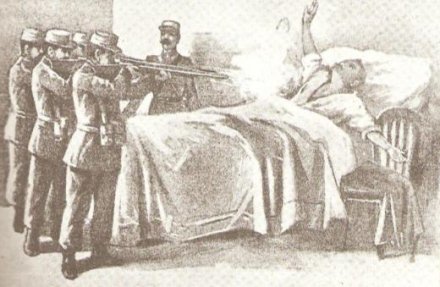
Captured during the decisive Chilean victory at the Battle of Huamachuco where a grenade shattered his thigh, the crippled Prado was regretfully executed in his bed for having broken his previous parole by resuming arms in the fight.
“We were all crying — all but Pradito,” recalled the Chilean captain tasked with overseeing the nasty business.
In the earliest years, people sluiced over the long border just anywhere. By Smolka’s time, that perimeter was buffered by an “internal border” that made it difficult for ordinary people to approach near enough to West Germany to escape. Consequently, most emigration by the the late 1950s occurred in the divided city of Berlin — a flow that East Germany would finally stanch in 1961 with the ultimate in immigration reform, the Berlin Wall.
One of the Cold War’s iconic photographs: East Berlin border guard Conrad Schumann leaps over the barbed-wire barrier into West Berlin on Aug. 15, 1961, just days after construction of the Berlin Wall began.
Like that more famous later escapee, Manfred Smolka (German link, as are most that follow) was a border guard; indeed, he was an officer. That gave him the ability, in 1958, to be far enough within the “internal border” to defect into West Germany
The very next year, he arranged to meet his abandoned wife and daughter on the Bavaria-Thuringia frontier to smuggle them over, too. Alas, it was a trap (pdf) laid by the feared East German secret police, the Stasi.
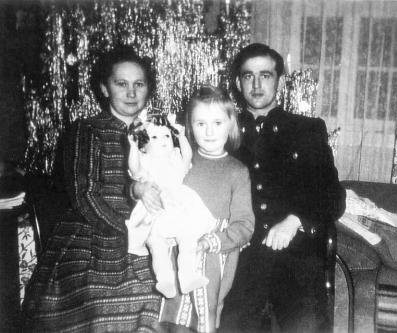
Happier times: Manfred Smolka with his wife and child.
According to press reports, Smolka was actually on West German soil when the Stasi men captured him.* (The Stasi were often up for a bit of kidnapping.)
West Germans were outraged by Smolka’s capture and subsequent death sentence for “military espionage,” but the case was deemed an apt one for the education of East Germany’s border security agents.
Only with post-Cold War German reunification could his family examine his file. “I am innocent, I can prove it a hundred times,” they read in the last letter the onetime defector wrote to his family — a letter which had never been delivered. “You need not be ashamed of me.” In 1993, a reunified, post-Cold War Germany officially agreed and posthumously rehabilitated Manfred Smolka.
There’s a few minutes of documentary video about him, in German, here.
* By a July 5, 1960 account in the London Times, Smolka was shot at and wounded as he crossed into East Germany but still managed to “crawl” back to West Germany — where his pursuers did not fear to follow him.
The Aug. 28, 1955 lynching of Emmett Till and the subsequent acquittal of his murderers by an all-white Mississippi jury were among the American civil rights movement’s pivotal events.
For a certain indecent number of people, however, the passion of the 14-year-old youth — alleged to have flirted with a white woman — was to be mourned only insofar as it confirmed the menace that insatiable Negro libidos posed to southern way of life.
Further to that end, the months following Emmett Till’s death brought to the headlines the formerly obscure* July 2, 1945 hanging of an American G.I. in Italy: Emmett’s father, Louis Till.
The violent Louis Till ruined his marriage to Emmett’s mother Mamie shortly after his son’s birth. Repeatedly violating her restraining order eventually landed Till pere before a judge, who gave him a choice between hard time and enlistment. Till joined the U.S. Army.
In 1945, he was court-martialed for murdering an Italian woman and raping two others. His execution near Pisa — he’s buried in Europe in the Oise-Aisne American Cemetery, the same final resting place as Eddie Slovik — was the no-account end of a no-account man for many years thereafter. Mamie Till said that she wasn’t even told what happened to her ex-husband, and was stonewalled when she sought information.
By the end of 1955, everyone knew.
In Jim Crow’s backlash against nationwide condemnation of the Till lynching, Louis Till came back to life in newsprint all that autumn to visit the sins of the father upon his late son: here was the mirror of the young predator all grown up, violating Italian women. Mississippi’s white supremacistsenators used their rank to obtain his army file, and leaked it to reporters.
According to Davis Houck and Matthew Grindy’s study of the Mississippi media’s conflicting reactions to the events of 1955, “Louis Till became a most important rhetorical pawn in the high-stakes game of north versus south, black versus white, NAACP versus White Citizens’ Councils.”
The pawn’s sacrifice did not figure in the endgame.
Crude attempts to impose blood guilt for Louis Till’s crimes aside, Clenora Hudson-Weems argues in her Emmett Till: The Sacrificial Lamb of the Civil Rights Movement that it was Emmett Till’s shocking death that catalyzed the civil rights movement — that the horrifyingly mutilated face at his open-casket funeral and the insouciant confession of his killers once they had been acquitted shook southern blacks and northern whites alike so profoundly as to dispel any confidence that legal briefs or political incrementalism could grapple with America’s race problem. Civil rights lion Joyce Ladner was an 11-year-old Mississippi girl when Emmett Till was lynched; she would tell Hudson-Weems of the shock it delivered in her world coming on the heels of the Brown v. Board of Education ruling desegregating schools.
A very important thing is that it followed the Supreme Court decision in 1954. It’s like the Whites said that they don’t care what rights we were given … So when the spark came in Mississippi to sit in the public library, for example, people who participated had been incensed by the Till incident and were just waiting for the spark to come. The Till incident was the catalyst.
Emmett Till’s body was exhumed for autopsy and DNA testing in 2005, in part to dispel the old story first promulgated by the attorneys who defended Till’s murderers — that the body wasn’t Emmett Till’s at all. On the corpse’s finger was a ring inscribed with the initials of his father: L.T.
* Louis Till did have one small claim to fame prior to his son’s murder: the fascist poet Ezra Pound chanced to be imprisoned with Till; he mentions the later-famous execution in his Pisan Cantos:
Till was hung yesterday
for murder and rape with trimmings
June 29, 1944, saw several noteworthy mass executions around Axis western Europe.
France: Seven Jewish hostages for the assassination of Philippe Henriot
Poet and journalist Philippe Henriot (English Wikipedia entry | French), the “French Goebbels”, was the Vichy government’s able chief propagandist.
On June 28, 1944, Henriot was assassinated by Maquis operatives disguised as milice paramlitaries.
Incensed, the real milice this morning gathered seven Jews already held in prison as hostages at Rillieux, drove them to the cemetery, and shot them one by one.
(Paul Touvier, who orchestrated this retaliatory execution, managed to stay underground until 1989. At his 1994 war crimes trial, he claimed that the Germans wanted 30 hostages killed, and therefore what he actually did was “save 23 human lives.” Touvier was convicted on the charge of crimes against humanity.)
Italy: Massacres in San Pancrazio, Cornia, and Civitella
As dawn broke this date, German soldiers retreating from liberated Rome fell upon several Tuscan villages.
German columns had been beset by partisans on the way, and standard operating procedure was to retaliate against partisans indirectly, by killing civilians — as in the notorious massacre in the Ardeatine caves. This vengeance was visited on the three towns: over 200 civilians were summarily executed on June 29, 1944.
“My mother later said she went to speak to my father,” remembered one San Pancrazio man. “A soldier turned her back and told her they were taking him to be tortured. She and my father both cried.” The father and those taken with him were shot in the basement of a farmhouse.
Caution: Graphic video.
The towns themselves have kept this date in remembrance, but the massacres were swept under the rug in the postwar settlement as Italy, Germany, and their former western enemies realigned for the Cold War. Only in the 21st century have they come to wider attention, when the discovery of secret archives documenting the atrocities enabled an Italian court to convict an aged German soldier in absentia.
There’s a CNN documentary on these events focusing particularly on San Pancrazio. Called “Terror in Tuscany”, it may be viewable here or here, depending on your location.
“A most infernal plot has lately been discovered here, which, had it been put into execution, would have made America tremble, and been as fatal a stroke to us, this Country, as Gun Powder Treason would to England, had it succeeded.”
On this date in 1776, Continental Army soldier Thomas Hickey was hanged before “a vast concourse of people” for a plot that might have strangled the American Revolution in its crib.
That revolution was a highly uncertain venture at this moment, and in a different timeline Thomas Hickey might have been a British hero for squelching it. “These are the times that try men’s souls,” revolutionary firebrand Thomas Painewrote late in 1776. Hickey had to face his trial in the flesh.
George Washington had holed up in New York City in the spring to fortify it against an expected British invasion — an invasion that did indeed arrive and eventually drove the Continental Army all the way to Philadelphia.* As Paine beheld, the wrong turn of events here could have been decisive. The Continental Army was badly outnumbered and afflicted by desertion. The Continental Congress itself had to abandon Philadelphia not long after boldly declaring independence on July 4.
Whatever one might say of the great-man historiographical mood, you’d have to think that knocking out the rebel army’s top general at this juncture would have been a coup for the British.
In June of 1776, New York was tense ahead of the fighting. A British ship of the line sat forebodingly in the harbor, and even as she awaited the coming British force, her crew members rowed freely ashore for provisions. Plots went abroad among the mixed population of “Patriot” and “Loyalist” citizens. Nathan Hale would soon earn his martyr’s laurels in New York, trying to reconnoiter behind enemy lines as Washington staged a series of losing battles and a gradual retreat.
Somewhat below this plane of world-shaping combat and statecraft, a guy named Isaac Ketcham (or Ketchum) found himself clapped in gaol for counterfeiting the easily-counterfeited colonial paper currency. There, Ketcham caught jailhouse scuttlebutt of Loyalist plots afoot in New York. Realizing this could be his ticket out of prison, Ketcham wrote New York’s Provincial Congress informing on the schemes.
Sadly, Ketcham’s full memorandum has been lost, and as the ensuing trial records are circumspect the “plot” or “plots” in question are a bit of a historical muddle. Roughly, there are two discernible thrusts:
A fifth-column plot against the patriot position in New York, with Loyalist-inclined soldiers set to desert back to the arriving British army.
A plot against the person of George Washington himself.
Ketcham was eagerly interrogated by the Provincial Congress on these matters, and returned to his dungeon in the capacity of an informant. There, he made the acquaintance of the Irish-born Thomas Hickey, a member of George Washington‘s personal guards who had on June 15th been committed for doing his own bit of private currency-printing.
Representing himself as a Tory loyalist, Ketcham apparently induced Hickey to boast about something quite a bit more serious than counterfeiting.
“In different conversations he informed me that the Army was become damnably corrupted,” Ketcham told the court-martial that tried Hickey. “That the fleet was soon expected; and that he and a number of others were in a band to turn against the American Army when the King’s troops should arrive.”
The whole scheme went under the pay of Loyalist New York mayor David Mathews, who was also arrested by patriot troops — although Mathews, whose execution might have turned the British very nasty in the various diplomatic conferences ongoing during the New York campaign, was never even tried.** He escaped to British protection shortly after capture.
No kid gloves were available to the treacherous Irishman Hickey, however. Word of the conspiracy against the patriots had also been obtained from a businessman, William Leary, who reported the attempt of his former employee to recruit him into it. The sheer quantity of highly indiscreet men blabbing about it in taverns and jails and the like makes the whole thing seem crazy in retrospect, but if it had succeeded in, say, destroying Kingsbridge, it might have trapped the Continental Army on Manhattan where they would have been easy pickings for the vastly superior British. Someone surely had to pay for this.
Several of Hickey’s accomplices provided evidence against him, and the speedy conclusion of the military commission that tried him was that Hickey should hang in order to, as Washington wrote the Continental Congress, “produce many salutary consequences, and deter others from entering into like traitorous practices.” So far as is known, however, Hickey was the only person to suffer this extremity.
The unhappy fate of Thomas Hickey, executed this day for mutiny, sedition, and treachery, the General hopes will be a warning to every soldier in the Army to avoid those crimes, and all others, so disgraceful to the character of a soldier, and pernicious to his country, whose pay he receives and bread he eats. And in order to avoid those crimes, the most certain method is to keep out of the temptation of them, and particularly to avoid lewd women, who, by the dying confession of this poor criminal, first led him into practices which ended in an untimely and ignominious death.
Physician William Eustis (eventually the U.S. Secretary of War), who was among the 20,000 to see Hickey hanged, wrote a friend that afternoon of the execution.
Their design was, upon the first engagement which took place, to have murdered (with trembling I say it) the best man on earth: Genl Washington was to have been the first subject of their unheard of Sacricide: our magazines which, as you know, are very capacious, were to have been blown up: every General Officer and every other who was active in serving his country in the field was to have been assassinated: our cannon were to be spiked up: and in short every the most accursed scheme was laid to give us into the hands of the enemy, and to ruin us. (Source)
The scarcity of original documentation makes it very difficult to say with confidence just how impressive this accursed scheme really was. One can see from Eustis’s letter that it was understood immediately to have compassed the murder of George Washington. This prospective “Sacricide” of America’s founding father par excellence has been worth a good bit of embellishment; one bit of utterly insupportable folklore congenial to vegetable-hating schoolchildren is that Hickey arranged to have General Washington’s peas poisoned with arsenic, but the faithful housekeeper exposed the scheme in the nick of time.
Only a bit more fantastical is the video game Assassins Creed III, whose representation of the death of Thomas Hickey — this version of Hickey is a Templar agent — uses a wacky sequence that begins with the public execution of the game player’s own assassin character, complete with first-person, inside-the-hood perspective.
It might well be that Hickey had been engaged in a plot not to murder but to kidnap the rebel general. David Mathews, the New York mayor, would later tell a royal commission in London autopsying Britain’s Revolutionary War defeat, “I formed a plan for the taking of Mr. Washington and his Guard prisoners but which was not effected.” It’s been speculated that the Continental Army itself chose to play up the “murder” angle for public consumption in preference to “kidnap” — perhaps because the notion that the Tories had the strength to contemplate the more complex objective of snatching Washington away from his own army, and were in a position to use his very own guards to accomplish it, implied a weakness in the revolutionary cause far too grave to acknowledge openly.
* It’s from this position that Washington would [re-]cross the Delaware amid December ice floes to conduct a morale-salvaging raid on Hessian troops in New Jersey after many long months of reversals. The British, for their part, held New York for the balance of the war, and this helped make adjacent New Jersey a battleground between pro-British and pro-American militias.
** Mathews administered New York until 1783, when the British ceded it to the victorious colonists.
June 17 is an honored day in Vietnam for the sacrifice under the French guillotine this date of 13 early martyrs for national independence.
These were members of the nationalist Viet Nam Quoc Dan Dang (VNQDD, or Viet Quoc). Not averse to the propaganda of the deed, these revolutionaries labored secretly under onerous French pressure following the previous year’s assassination of a labor recruiter.*
A year later (almost to the hour), with the movement crippled by arrests, the VNQDD tried an audacious gambit to revive its fortunes and trigger a general rising against the French.
The Yen Bai mutiny — named for the Tonkincity where it transpired** — saw 40 or 50 Vietnamese riflemen of the Fourth Régiment de Tirailleurs Tonkinois† and a like number of civilian sympathizers attacked the regiment’s officers in concert.
Alas, most of the other Vietnamese tirailleurs declined to join the rising, and it was suppressed within a few hours.
Over 1,000 accused revolutionaries stood trial for the Yen Bai mutiny, and the top leadership paid the top penalty this date — but as quietly as the French could manage. They were whisked out of their cells on the preceding evening and taken by secret convoy on a four-hour ride to the Yen Bai execution grounds, where a guillotine had been covertly erected.
We are going to go to pay our debt for the country. The flag of independence must be dyed with blood. The flower of freedom must be sown with blood. The country needs more and more sacrifices of its people. The revolution would meet success finally. We want to say goodbye to all of you with our respects.
-Nguyen Thai Hoc, taking his final leave of imprisoned VNQDD comrades
From 4:55 a.m. at Yen Bai, the thirteen men one by one were each lashed to the plank. One by one, each of their necks were fixed by the lunette under the blade. One by one, each cried out “Vietnam!” as the blade fell.
Bui Tu Toan
Bui Van Chuan
Nguyen An
Ha Van Lao
Dao Van Nhit
Ngo Van Du
Nguyen Duc Thinh
Nguyen Van Tiem
Do Van Su
Bui Van Cuu
Nguyen Nhu Lien
Pho Duc Chinh, who allegedly asked (it’s unclear to me whether it was granted) to be guillotined face-up — perhaps a show of bravado
The founder of the VNQDD Nguyen Thai Hoc, whose name now graces a major street in the heart of Hanoi
The VNQDD at this point was organizationally shattered, and many of its un-arrested cadres fled to China — whose sponsorship would revive it and return it to Vietnam in the 1940s.
* The labor recruiter is only tangential to the Yen Bai story, but their function, to dragoon Vietnamese peasants into brutal plantation work on terms next door to slavery, made them particularly hated characters. More about that racket in this 1930 text (pdf) by an outraged Frenchman.
** A few other minor secondary incidents occurred elsewhere in the area, but the epicenter of the rising was always Yen Bai.
† After the mutiny, the French army tried to reduce its dependence on Vietnamese recruits.
This dispatch to the New York Herald was published on June 16, 1863.
Mr. W. Young’s Letter.
Near Beallton Station, Va., June 14, 1863.
THE DESERTER J.P. WOOD.
John P. Wood, of Company F, Nineteenth Indiana, who had deserted once or twice before, again deserted on the 28th of May, and was subsequently arrsted at Aquia Creek, tried by court martial, and sentenced to be shot on Friday last.
Wood was about nineteen years old, quite intelligent, and when arrested was dressed in rebel uniform and represented himself as belonging to the Nineteenth Tennessee.
He alleged that he deserted because he had come to the conclusion that the war was not right, and he could not therefore go into action. He admitted that when he volunteered his views were somewhat different, and that he enlisted because he did not wish to see the Union dissolved.
He regarded his sentence as just, and expressed the belief that his execution for desertion would be of more service to the army than he could render it in any other manner.
THE EXECUTION, AND THE EFFECT UPON THE ARMY.
As this is the first instance of an execution for desertion in the Army of the Potomac, it created considerable sensation.
The sentence was executed upon the prisoner on Friday, near Berea church. About two P.M., near Berea church, the corps was halted. The First brigade was ordered out, with the balance of the division to which the prisoner belonged, the First brigade in advance.
Two ambulances, in the first of which was seated the prisoner, and the other containing his coffin, at the head of the division, advanced about half a mile, when the division was drawn up, occupying three sides of an oblong parallelogram. On the fourth side were placed the coffin, the criminal and the guard. The men were selected to do the firing, and received their muskets from the guard properly loaded.
HIS LAST MOMENTS.
A clergyman —- was with the prisoner, who displayed no emotion. General Wadsworth then went to the men who were to perform the duty of execution, and spoke to them in regard to the disagreeable nature of the duty to be performed — the shooting of a comrade — and urged them, as a matter of humanity, to take good aim.
The General then returned to the right, Colonel Morrow to the left. The guard was then withdrawn, and the Provost Marshall, Lieutenant Rogers, took the prisoner to the coffin, upon which he was seated, his eyes blindfolded, his hands tied behind him, his knees tied together and his breast bared.
All having retired, except the executions and the Provost Marshal, the order to take aim was given. Before the order to fire was given two pieces were discharged, but without effect.
At the order to fire, the remainder of the men — ten in number — fired. The prisoner fell backward, and the Provost Marshal went up to him. He struggled for an instant, and then all was over.
An additional detail from the Pioneer corps were called up and began to dig the grave, and the division marched off in perfect order, much impressed by the solemn scene which they had witnessed.
On this date in 1921, Great Britain hanged one of its own paramilitaries in Ireland. William Mitchell was, in fact, the only member of the reviled Black and Tans executed during the Irish War of Independence.*
Was Mitchell hanged for political expediency? Did he even commit the murder for which he stood condemned?
Kelly was kind enough to talk with Executed Today about exhuming a dead soul.
ET: What led you to take an interest in this hanging?
DJK: A third cousin of mine, who shares my interest in family history research, asked me to help her verify her late father’s claim that they were related to a Black and Tan who had been hanged for murder.
I knew that the ‘Tans’ were temporary policemen recruited in England from ex-combatants of The Great War and sent to Ireland to bolster the ranks of the beleaguered Royal Irish Constabulary during the Irish War of Independence. It took me no time at all to discovered that only one Black and Tan — indeed only one member of the entire British Crown Forces — had been executed during that conflict, and that indeed he shared a surname with my cousin.
However, I could find only the briefest of mentions of him in any accounts of that bitter struggle for Ireland’s freedom. It took me and my cousin two years to track down the elusive official case papers, to establish exactly who Mitchell was, and to tell his hitherto untold story. To date however, we still have not established a firm link with my cousin’s family.
The Black and Tans are of course still notorious in Ireland and elsewhere. In this book you’re complicating their story quite a bit, making at least this one Tan a sympathetic character. What sort of audience reception has Running with Crows had? Do you find there’s a lot of resistance to the story you have to tell? For that matter, did you have any misgivings to overcome in writing it?
You are right about their notoriety. The ‘Tans’ were bored, drunk and indisciplined during the short period of their service in Ireland. They were also poorly managed and allowed to run amok, robbing and assaulting the Irish population. There is no evidence however to support the popular myth that they included a greater number of criminals than has any police force before or since. They were disillusioned and battle-hardened men who were unable to find employment back in the ‘land fit for heroes’.
Ironically, one lone reviewer of my book has accused me of not making Mitchell sympathetic enough. It was not my intention though to create sympathy for this flawed and tragic man or to turn him into a folk hero. However, whilst I do not think he was the most honourable of men, I am not persuaded he deserved to hang.
I was indeed wary of uncovering this controversial case, especially as folks in Ireland, my own relatives included, are still sensitive and emotional about the events of the 1920s. The accepted view is that the old IRA were the heroes and the ‘Tans’ were the baddies. Few people realise however that at least a quarter of the Black and Tans were Irishmen, as indeed was Mitchell. However, I am delighted to have received highly positive reviews, from ‘both sides of the divide’, that is from an IRA re-enactment group as well as from supporters and historians of the Royal Irish Constabulary. Moreover, a theatrical production company, based in the town where the murder took place, and where people still remember and sympathise with the murdered magistrate’s family, has adapted my book to a stage play, which will debut there on 15 June at the Dunlavin Arts Festival. They have also kindly invited me to hold an author talk at the festival on the 16th June.
William Mitchell was hanged for killing a magistrate named Robert Dixon. Who was Robert Dixon and why was he a target during the war?
Robert Gilbert Dixon was an Anglo-Irish gentleman; a gentleman farmer who acted as an auctioneer at the local livestock auctions and who served as a district magistrate on the local circuit. He and his wife were descended from noble and philanthropic English forebears, and indeed Robert Dixon was respected in his community for his generosity shown both to his neighbours and to the police.
During the conflict though, both magistrates and police were viewed by the Nationalists as instruments of the occupying power (the British) and as such were prime targets for assassination by the IRA. Dixon’s murder was not a political killing however. He was shot dead, and his war hero son seriously wounded, during the course of a robbery at his home.
This post-war era saw the erosion of the class system and marked the beginning of the end for ‘the old order’. Socialism was gaining popularity and the working classes were shrugging off the idea that they should ‘know their place’. The awful loss of life, mainly through mis-management of the war, meant that many had lost respect for, and indeed were resentful of, the privileged classes. A truce was now imminent in Ireland and so the ‘Tans’, who were being paid per day what the regular Irish constables earned in a week, saw their lucrative employment coming to an end, and meanwhile, in Dunlavin, the Dixon family were conspicuously wealthy …
Coming at last to the main character here, who was William Mitchell? Why was he serving in the Black and Tans, and why did he end up at the end of a noose?
Contrary to what some commentators on the conflict have written, Mitchell was not English but Irish. He was a Dublin-born former professional soldier, who had served King and Empire, both in India and in the trenches of the Western Front. He was the son of Joseph Mitchell, a London-born soldier; a respectable man who had fought in the Boer War and who had married a Dublin Protestant girl.
Another myth, that of the privileged position of those in the ‘Protestant ascendancy’ in Ireland, is dispelled by William Mitchell’s impoverished upbringing in Dublin’s Monto district, which was not only Ireland’s, but indeed Europe’s, biggest slum and red-light district. William Mitchell was a man who did not respect authority — some might say, with good reason. When two masked intruders forced their way into the Dixon household and killed the magistrate during a bungled robbery, and when one of the ‘Tans’ shot himself dead at the local barracks the following day, it was believed the dead ‘Tan’ was the shooter, and so Mitchell was then arrested as his accomplice.
This hanging occurred just as London was determining to wind things down in Ireland; later that June, Prime Minister Lloyd George proposed peace talks. As a political sop, how important domestically within Ireland was William Mitchell’s execution in June 1921? Did it even register? Had he been spared, would that have affected at all the progress towards a truce?
Ah, you have put your finger on the nub of the issue.
As ill-disciplined and unruly as the temporary constables were, there was another arm of the Black and Tans which was far more undisciplined. The Auxiliaries were demobilised officers who had been engaged ostensibly to act as an officer cadre for the temporary constables but who had instead formed themselves into hit squads and set about abducting, torturing and killing suspects without due process of law. It was the Auxiliaries who were identified with some of the worst atrocities of the conflict, including the destruction of whole villages and towns and even of the murder of the mayor of Cork.
Several Auxiliaries had been tried for murder but acquitted, usually because crucial prosecution witnesses had ‘disappeared’. One indicted auxiliary, who was a decorated war hero, but most likely also a psychopath, and was head of the self-designated ‘murder squad’ based in Dublin Castle, was facing his second murder trial. By April 1921, the world’s press were united in condemning the British administration in Ireland for letting loose this uncontrolled ‘pseudo gendarmerie’ upon the Irish population. The number of Republicans who would be executed would run to two dozen, yet thus far, no member of the British Crown Forces had been convicted for any atrocity.
The Americans and the heads of the Commonwealth nations were demanding fair play. The British public were revolted by the way the conflict was being managed and now no less a personage than King George V stepped into the arena and demanded that Lloyd George‘s government show even handedness in the way it dealt with both rebel and law enforcer. Another acquittal was fully expected in the trial of the twice-tried Auxiliary, who had carried out his grisly and murderous duty on behalf of his government, but then along came the hapless Constable Mitchell, a ‘difficult’ Irishman who had allegedly killed, not an Irish rebel, but a magistrate; an Englishman and a representative of the establishment.
The outcome in the April trial of the Auxiliary, whose defence costs (equating in today’s values to £17,600) were met from the personal funds of Hamar Greenwood, Chief Secretary for Ireland, was an acquittal, as expected.
Mitchell’s swift trial a couple of days later, by court martial (so no right of appeal) attracted little publicity. He went stoically to the scaffold, leaving behind him a 23-year-old widow and a seven-week-old baby daughter.
Political events moved fairly swiftly thereafter, so it is hard to judge whether his execution had much effect on the progress of Ireland’s achieving independence. The focus of public attention was taken up next with the internal struggles leading up to the Civil War. It seems Mitchell’s execution had little effect in the grand scheme of things.
So, did Mitchell kill the magistrate? Was he even present at the crime scene or was he a sacrificial lamb, slaughtered to offset criticism of Lloyd George’s administration in Ireland? I have presented all there is to know of this man’s life and death, as found in his military and police records, trial transcripts etcetera, and whether or not he killed the magistrate for whose murder he was hanged, or whether this was an awful miscarriage of justice, I leave for the reader to judge.
What happened to Mitchell’s family afterwards? And all these years later, what do the descendants think about their ancestor’s execution, and about the work you did with it?
I felt I could not let Mitchell’s story end with his execution. Since this is a novel closely based on a true and tragic story, I felt the reader would want to know what happened next. I know I certainly did, so I continued my research, and my narrative, to recount what had happened to many of the players in the story, and this may be found in the book’s epilogue.
Mitchell’s baby daughter lived into her nineties, always believing her father had died a hero in the course of his police service. Her respectable and courageous widowed mother did not want her little girl to grow up with any sort of stigma. Other family members knew of Mitchell’s fate however. When I tracked down his living descendants, I was cautious of the sensitivities surrounding my exposing Mitchell’s history. However, the family were keen for the full story to come out, and moreover they provided me with photographs of Mitchell, for which I am most grateful, as they enabled me to put a face to a man who hitherto had been simply a statistic.
This is not the end of the Mitchell story, however. His mortal remains (which are amongst the few still buried within the precincts of Dublin’s Mountjoy Gaol) will one day be exhumed when planned re-development of the gaol is commenced. When that day comes, my cousin and I will press for his re-interment in a local cemetery. Mitchell may not warrant the hero’s funeral accorded the Republicans who have all be disinterred from Mountjoy, but I believe he deserves at least a Christian burial.


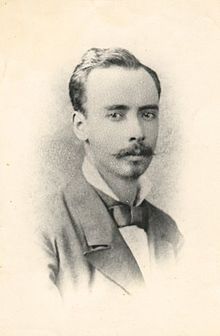 Prado’s father,