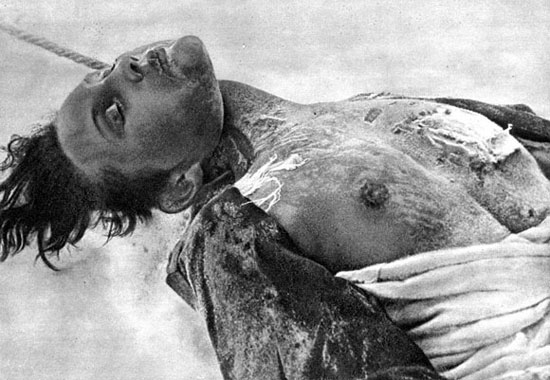
1884: Charles Henry, iced in the Arctic

On this date in 1884, U.S. Army Private Charles B. Henry of the Lady Franklin Bay Expedition (LFBE) was summarily executed in the distant northern reaches* of present-day Nunavut.


It’s waaaaaay up there. Click to view larger map, but don’t expect details.

The “Greely expedition” — so called after its commander, Adolphus Greely — was dispatched from Washington in the enthusiasm of the First International Polar Year. This was a multinational collaborative to gather scientific data about the globe’s frigid polar reaches; technically, this first IPY spanned 1882 to 1883, but the ill-starred Greely mission set out in 1881.

The LFBE was headed for a narrow icebound inlet named for a woman who lost her explorer husband on an Arctic voyage. That bay juts like a dead tree limb out of the Robeson Channel into the remote northern wildernesses of Ellesmere Island.

The mission laid down for the 25 men of the Lady Franklin Bay Expedition in 1881 was to establish a weather station, and to collect astronomical and geomagnetic data.

But long before the starving remnants of that crew put Private Henry to sudden death, they had supplanted that noble endeavor with the classic objective of polar adventure: mere survival.

Matters started promisingly enough: the ship that ferried these men to their ordeal dropped them without incident at a natural harbor in Lady Franklin Bay, where the intrepid men built Fort Conger — a sturdy frame house 65′ x 21′ x 14′. They would spend the next two years making scientific measurements, exploring, and awaiting planned resupply ships in the summers.

Ice-choked waters, however, do not open reliably to this location. The resupply missions in both 1882 and 1883 failed — and left the mission with a life-or-death choice.

Per prearranged contingency, the supply ships, should they not be able to reach Camp Conger, were to drop their provisions at a backup location. Much against his men’s will, Greely gave up Camp Conger to chase this hypothetical cache. Camp Conger was more difficult for any future ships to reach but was secure, warm enough, and blessed with seal-hunting enough to keep the team in good health.

Camp Sabine was reached only after a terrifying and near-fatal float down the coast in an ice floe (!) and it proved when they reached it a much less congenial spot for wilderness survival. The resupply missions that hadn’t reached Camp Conger had failed so thoroughly that only a very small drop had even made it to Camp Sabine. Conditions prevented the party from returning to Camp Conger or from crossing the water to another inhabited Arctic station: instead, they wintered in the mouth of hell; seal-hunting here was not favorable, and most days they were only able to supplement their dwindling cache of life-giving calories with a few shrimp and scraps of lichen peeled off the frozen rocks.

Not only ravenous hunger afflicted the party, but scurvy too, and still worse a morale collapse among party members who regarded Lieutenant Greely’s leadership very lightly. Huddled in a makeshift stone hut, three years gone from hearth and home, bored and helpless and stretching out less-than-subsistence rations as far as possible and farther, nerves began to fray … and party members began to succumb to conditions.

Charles Buck Henry did not wear well on this desperate party.

“Henry” was actually the new alias of a German immigrant formerly known as Charles Henry Buck. Buck had served time for embezzling whiskey money from a frontier cavalry company, then escaped and slew a Chinese man in a Deadwood, S.D. brawl. Henry stole from the expedition’s small store of food: he was not the only one, but he was perhaps the baldest thief and the one with the fewest redeeming features that would balance this behavior. He’d been confined in March to his sleeping bag as the closest thing to punishment that Greely could visit on him. Still, Henry stole more. Resentful comrades ostracized him, while silently sizing up the discomfiting likelihood that the hulking German would be odds-on to kill any man among them in a fair scrap.

This day, Greely finally caught him stealing once too often.

Notwithstanding promises given by Pvt C.B. Henry yesterday [to stop stealing] he has since as acknowledged to me tampered with seal thongs if not other food … This pertinacity and audacity is the destruction of this party if not at once ended. Pvt Henry will be Shot today all care being taken to prevent his injuring any one as his physical strength is greater than that of any two men. Decide the manner of death by two ball and one blank cartridge. This order is imperative & absolutely necessary for any chance of life.

A.W. Greely
1 Lt. 5 Cav. ASO & Asst
Cmdg. L.F.B. Expd

That order Greely issued to his able assistant, Sgt. David L. Brainard. Brainard proceeded to gather two other men who contrived to “execute” Henry by a stratagem of approaching Henry armed, but casual, and distracting the unrestrained condemned man long enough to get the drop on him. They shot him dead just as Henry recognized his danger and started to lunge for a nearby axe — an incredibly chancy engagement that could easily have turned the whole expedition into a hyperboreal edition of “The Most Dangerous Game” had the mountainous Henry avoided or survived that gunshot.

Instead, his body with its fatal bullet wound was discovered by accident when the Greely party was at long last rescued later that June, and returned along with just seven** (barely) living souls out of the 25 who set sail in 1881. Those fortunate survivors — the relief mission’s commander reported them “crying like children, hugging each other, frantic with joy”† as their rescue vessel pulled into view — would be forever defined by their participation in the LFBE: toasted for their survival story while also dogged by dark rumors of cannibalism.

According to polar and maritime historian Glenn Stein, FRGS, who spent several years researching this jaw-dropping case,‡ they also closely husbanded the story of their one-time mate’s execution. Mr. Stein is also U.S. Liaison a present-day polar journey, the South 2014 Expedition, and he was gracious enough to speak with Executed Today about the LFBE’s execution.


ET: The Lady Franklin Bay Expedition was a U.S. expedition launched as part of the first International Polar Year. Could you situate the LFBE in the context of polar expeditions at this time?

GS: In the years following the 1875-76 British Arctic Expedition, it was suggested that nations should stop competing for geographical discoveries and instead dispatch a series of coordinated expeditions dedicated to scientific research. Eleven nations took part in the first International Polar Year (IPY) 1882-83, and the United States contributed two components to its first participation in an international scientific effort. In 1881, it was decided that the U.S. Army Signal Corps would establish one scientific station 500 miles from the North Pole, at Lady Franklin Bay, Grinnell Land. The other station was at Point Barrow, Alaska.

The executed man in this instance is Charles Henry, formerly known as Charles Buck. This man had a pretty disreputable history. How was he able to get on this expedition? – And, how did he become the Chicago Times correspondent for this journey? Did he actually file any stories?

Buck enlisted in the Fifth Cavalry under the alias Charles B. Henry, and wrote to Lieutenant Greely from Fort Sidney, Nebraska, in April 1881, volunteering for the expedition. Henry had the strong recommendation of his company commander, Captain George T. Price, to back him up. Greely and Price were friends, so Greely leaned toward taking Henry (who repeatedly telegraphed Greely with reminders of his availability). Another story is that Henry joined from Fort Sidney when one of the original expedition members deserted just before it was to leave. However, as far as I’m aware, there was only one desertion from the LFBE, and that person was replaced by Private Roderick R. Schneider, First Artillery.

Supposedly, since Henry was the only volunteer from the Fifth Cavalry, with a strong recommendation from post commander Lieutenant Colonel Compton, Greely decided to take him.

According to A.L. Todd’s Abandoned (1961), before joining the expedition back East, Henry “got permission to stop off in Chicago to visit relatives, and managed to make an arrangement with the Chicago Times to act as that paper’s special correspondent with the Lady Franklin Bay Expedition.” In his Ghosts of Cape Sabine, Len Guttridge (2000) made references to Henry’s newspaper articles: “One or two eventually published in the Chicago Times attested to an effective if florid command of the English language.”

This expedition lasted three years, 1881-1884, and it came to a considerable amount of grief. Could you sketch out what happened to the LFBE, and how it found itself in such a perilous situation in its last months?

By the end of August 1881, a frame house was constructed at Lady Franklin Bay and named Fort Conger. Over the next two years scientific data was collected and sledging parties were sent out, discovering many new geographic features, and setting north, east, and west “farthest” records. Because of the mismanagement of resupply expeditions from the United States, expedition members initiated a planned retreat by boat to Cape Sabine in August 1883 — but the journey turned into a nightmare. The party eventually ended up at Cape Sabine, where the men constructed a stone house for the winter, with an upturned boat for a roof. It was christened Camp Clay. Throughout the following months, the men’s spirits and energy dwindled, and constant hunger was now their companion. Worse, food was being stolen from the commissary storehouse. More than once, angry accusations flew back and forth within the party. The daily ration for each type of food was measured out to hundredths of an ounce.

The first death occurred on Jan. 18, 1884, when Sergeant William H. Cross died of starvation. In spite of the privations, only one man died that winter, even though scurvy was also present. In the spring Death returned with a vengeance.

So by the end, there’s a party near to starvation, just scraping by on a starvation diet. Naturally there’s a temptation for people to steal from the camp rations.

Henry wasn’t the only person to have stolen, but it seems from your description like he was the most distinctly resented by the rest of the party. Why was that?

During his time at Fort Conger, Henry was the originator of many profane remarks, misdeeds, and lies, so Greely and others had learned not to trust him.

Until the publication of my article, “An Arctic Execution,” LFBE historians consistently wrote that no one on the expedition knew of Henry’s criminal history as a forger, thief and accused murderer. However, I discovered within Sergeant Brainard’s unpublished daily notes that he definitely knew of Henry’s past — so who else knew as well? In consequence, although others also stole food, Henry would have been treated with less tolerance.

The specific details of the execution, and the variations on the story that are given later, are quite fascinating. The execution was ordered by the camp commander, but Henry was not confined and had no idea what was coming, because the shooting party could have been in some danger as well. Given the rough and ready circumstances, why then, does the execution party go to such elaborate ends to anonymize the shooter? There’s the “three guns, two balls” order, and then they can’t comply with that since there’s only one usable rifle, so they swear an oath among themselves never to tell.

Firing squad duty obviously preys upon the conscious and subconscious mind. It’s possible that passing the rifle around and swearing an oath replaced the anonymity provided by the “three guns, two balls” order. Keep in mind that, if the three men survived their Arctic ordeal, their participation could impact them for the rest of their lives — in and out of the Army.

This was particularly true of Sergeant Brainard, who was promised a commission by Greely. Decades after the execution, Brainard declared that “no matter what the provocation, the family of a man doesn’t want to think of him as an executioner.”

As a factual matter, it was either Brainard or Francis Long who pulled the trigger, since Frederick distracted Henry and lured Henry into the trap.


Charles Henry (left), and his two potential executioners: David Brainard (center) and Francis Long (right).

What’s left of Henry is buried in New York. If you really wanted to find out what happened, you would have to exhume the remains. Henry’s sister, Dora Buck, did request the exhumation and autopsy of his body, but these were never allowed to take place. Officially, as my article notes, Henry’s remains were buried with full military honors. What we are left with today are cemetery records, which state that Charles Henry “Died of Starvation.”

And you think Brainard carefully managed the way the dangerous execution story got out.

Brainard is like a historian’s dream. Not only was he there, not only was he a very intelligent individual — but he made a record of many things, keeping daily notes that go from start to finish.

I hand-copied each page, three years of field notes, and I referenced these in my article. Those notes represent his impressions at the time they were written, not edited versions. One crucial thing Brainard recorded about Henry was that he “is a born thief as his 7th Cavalry name will show — a perfect fiend.” That’s significant, because it doesn’t appear in Brainard’s published writings. Why omit that piece of information? There’s one reason: Brainard knew beforehand that Henry was a criminal, and if it was known Brainard possessed this information, then he may appear prejudicial regarding the decision to shoot Henry.

It starts to add up, because who had control of the expedition members’ journals on the passage home? Brainard.

Who wrote up an incomplete journal on the way home — and then, many months later, turned in writings covering several more months — but ending in March 1884? Brainard.

I’ve examined the three volumes of his original journal. Everything was very carefully written, and Brainard made sure the story he wanted told got into these journals.

And what transpired afterward?

Sgt. Brainard had been promised a commission by Greely for his leadership on the LFBE. That’s a huge deal — to get commissioned from the ranks for gallant and meritorious service, and not even in wartime, but peacetime. At that time, and for many years thereafter, he was the only living officer of the Army, active or retired, holding a commission awarded for specific distinguished services. I believe Brainard was a “good guy” and a stand-up guy, but at the same time, would he really chance ruining his opportunity to get that commission? The whole execution business could have made things really difficult for him.

When they evacuated Fort Conger, and later on were literally floating south on a piece of ice, there was almost a mutiny. The mutineers went to Brainard, saying Greely had to be relieved of command, that he was going to get everyone killed. But Brainard wouldn’t go along with it — in part, he probably realized it would destroy his future.

You have to start looking at these motivations; and it’s not an entirely unsympathetic view, because people in these positions had jobs to do.

It took a lot of pushing to get Brainard’s commission to Second Lieutenant approved, and this didn’t happen until October 1886. In 1917, when he was near the end of his career, he was actually appointed Brigadier General. Brainard went from buck private to Brigadier General!

After the LFBE’s rescue later in 1884, how was the matter of the execution handled? I’m reading between the lines here, but it seems to me that, while it was not a secret, it was also downplayed as a public matter in the immediate aftermath — Henry buried with full military honors, that sort of thing. As it emerged more publicly thereafter, was there ever any controversy or a significant sentiment that Greely had handled the situation improperly? Was there ever a question about the legality of his order?

Greely made a verbal report regarding the execution to his departmental superiors several days before Henry’s burial. He then wrote to Adjutant General of the Army R.C. Drum in August 1884, to report Henry’s execution and request that a court of inquiry be ordered or a court martial convened regarding the matter. Drum responded in November 1884 that after examining the expedition’s records, “the Secretary of War entertains no doubt of the necessity, and the entire propriety of your action in ordering the execution of Private Henry, under the circumstances and in the manner set forth in your report.”

It was understood that any military officer operating in the field possesses a fair degree of discretion in carrying out orders, and Greely had Henry executed in order to preserve lives.

Newspaper articles certainly featured Henry’s execution, but stories of cannibalism (including the condition of Henry’s remains) and the political scandal related to the mishandling of the attempted relief of Greely prior to his rescue were much more high profile stories.

You have a professional interest in polar exploration, and obviously starvation risks are endemic to these situations when matters go awry. Have you encountered any similar instances of a polar party executing one of its members for the sake of maintaining discipline?

A somewhat similar execution scenario, also an attempt to preserve the lives of starving men, had played out during Sir John Franklin’s 1819-22 Arctic Land Expedition. A detachment of four men from the expedition, including Surgeon John Richardson, discovered that their comrade, Midshipman Robert Hood, had been murdered by an Iroquois voyageur named Michel Teroahauté (also known as Ferohaite).

Under the circumstances, Richardson shot Michel to save their own lives.

How did you come to find out about this story and why did you decide to research it in such depth? Over a century on from the events themselves, what does the fate of Charles Henry have to tell us today?

I can trace back my knowledge of the execution to at least September 1988, when I bought a copy of The Polar Passion, by Farley Mowat (1967). Several years later, I acquired a large collection of items once belonging to General Brainard, which included most of his medals and orders, photographs, books, and a bone knife he brought back from the Arctic. Brainard is a fascinating historical figure and human being (I like to call him the quintessential American), and I spent a good deal of time researching and writing about his life. In the process I discovered there were many contradictory details about the execution.

On July 13, 2005, I was sitting at an outside bar in Jamaica, when it dawned on me that if I dug deep enough, I just might be able to figure out what really happened during the execution of Private Henry.

So, I began jotting down notes on three 4″ x 5″ pieces of paper — “1. Primary Question: Who was the shooter?” Of the three men involved, the evidence dictates the trigger man must have been either Brainard or Long — but in the absence of conclusive evidence we’ll probably never know which one. And I ultimately decided that’s okay, because it’s the way the three wretched souls wanted it to be on that fateful summer day in 1884, and I needed to respect their wishes.

The events during the Lady Franklin Bay Expedition, especially Charles Henry’s fate, are reminders of how crises bring out the best — and worst — in human nature. At various times in our lives we’re all confronted with personal crises: how we deal with them is what counts. Writing “An Arctic Execution” forced me to stretch my mind beyond what I thought were its limits to attempt to understand defining moments in the lives of human beings who were at the brink of oblivion.

A few books about the Greely expedition

* This expedition established a “farthest north” record: it was for the next several years the most northerly latitude that any explorer could document ever attaining.

** One of the seven retrieved by the Thetis, Sgt. Joseph Elison, was at death’s door. Wasted to 78 pounds and stricken with frostbite and gangrene that required his rescuers to amputate both hands and both legs, Elison died at sea — leaving just six survivors of the Lady Franklin Bay Expedition who would ever again set foot on American soil.

† San Francisco Bulletin, July 18, 1884, quoting Winfield Scott Schley — later famous as a Spanish-American War hero.

‡ Glenn M. Stein, “An Arctic Execution: Private Charles B. Henry of the United States Lady Franklin Bay Expedition 1881-84,” Arctic, Vol. 64, No. 4 (December 2011). Read it here (pdf).

On this day..

1942: Stjepan Filipovic, “death to fascism, freedom to the people!”

On this date in 1942, this happened:

The young man striking the dramatic pose is Stjepan Filipovic, an anti-fascist partisan hanged in the city of Valjevo by the Serbian State Guard, a collaborationist force working with the Axis occupation of Yugoslavia.

Filipovic is shouting “Death to fascism, freedom to the people!” — a pre-existing Communist slogan that Filipovic’s martyrdom would help to popularize. Smrt fašizmu, sloboda narodu! … or you can just abbreviate it SFSN!

In the city where Filipovic died, which is in present-day Serbia, there’s a monumental statue in his honor replicating that Y-shaped pose — an artistically classic look just like our favorite Goya painting, poised between death and victory.


(cc) image from Maduixa.

Filipovic was a Communist so we’re guessing that he would not have had a lot of truck with the ethnic particularism that’s latterly consumed the Balkans. Times being what they are, however, the national hero to Tito’s Yugoslavia has become a post-Communist nationalist football.

That Valjevo monument — it’s in Serbia, remember — calls him Stevan Filipovic, which is the Serbian variant of his given name. But as Serbia is the heir to Yugoslavia, he at least remains there a legitimate subject for a public memorial. Filipovic himself was Croatian, but his legacy in that present-day state is a bit more problematic: in his native town outside Dubrovnik, a statue that once commemorated Filipovic was torn down in 1991 by Croat nationalists; its vacant plinth still stands sadly in Opuzen. (Opuzen’s film festival, however, awards its honorees a statuette replicating the destroyed monument.)

On this day..

1863: William Francis Corbin and Thomas Jefferson McGraw

On this date in 1863, two men were shot* on the beach at Johnson’s Island in Lake Erie, site of a Civil War prison. Their crime: recruiting for the Confederate army behind Union lines.

After a short-lived attempt to maintain a posture of “armed neutrality” vis-a-vis the Civil War combatants, Kentucky became the uncertain and bloodily contested frontier march between the rival governments.

With the 1862 invasions of Kentucky by armies North and South, sides had to be chosen. Corbin enlisted with some local militia mates in the Confederate army; after wintering in Virginia, he was dispatched back to his native Campbell County, Ky. — now under Union control — to beat the bushes for more Confederate enlistees. With him was another Campbell County native son now serving in the Southern army, Jefferson McGraw.

In April 1863, a Union patrol out hunting Confederate guerrillas accidentally caught wind of the recruiters’ activities and followed McGraw to the Rouse’s Mill safe house where he was to rendezvous with the waiting Corbin.

Several days after the recruiters’ capture, Union Gen. Ambrose Burnside issued General Order 38, threatening the death penalty for “all persons found within our lines who commit acts for the benefit of the enemies of our country.” This order explicitly compassed “Secret recruiting officers within our lines.”


Not to be confused with Order 66.

This book has a chapter about the Corbin-McGraw case.

General Order 38 was viewed as targeting “Copperheads” and other anti-war northern agitators — and it almost immediately resulted in the arrest of Ohio Democrat Clement Vallandigham** — but it was the less august Corbin and McGraw who paid the heavier penalty.†

Again, General Order 38 postdated Corbin and McGraw’s arrest. They had expected, and perhaps were even directly assured by their captors, to be treated as regular prisoners of war. On the other hand, Order 38 aside, these men were undoubtedly working covertly behind Union lines, and risked harsher treatment on that basis alone.

At any rate, the two were condemned to die by a military commission in Cincinnati for violating Order 38 by recruiting behind Union lines. Neither Gen. Burnside nor Abraham Lincoln himself — who were both besieged by petitions for clemency — would consent to spare them.

Corbin, who was a church elder in his home environs, led a prayer service for guards and inmates alike at the prison chapel on the morning of his execution. Writing 34 years later, a witness recalled the moment:

That scene, and the words which fell from his lips on that occasion, are indelibly stamped on my memory …

After reading and prayer by Captain Corbin, he said, in part, speaking of himself, that “life was just as sweet to him as any man, but if necessary for him to die in order to vindicate the law of the country, he was ready to die, he did not fear death; he had done nothing he was ashamed of; he had acted on his own convictions and was not sorry for what he had done; he was fighting for a principle, which in the sight of God and man, and in the view of death which awaited him, he believed was right, and feeling this he had nothing to fear in the future.” He closed his talk by expressing his faith in the promises of Christ and his religion.

To see this man, standing in the presence of an audience composed of officers, privates, and prisoners of all grades, chained to and bearing his ball, and bearing it alone, presenting the religion of Christ to others while exemplifying it himself, was a scene which would melt the strongest heart, and when he took his seat every heart in that audience was softened and every eye bathed in tears.

After Corbin and McGraw were shot, two Union prisoners of war in Confederate custody were selected by lot for a retaliatory execution. With some diplomatic maneuvering (and a Union threat to retaliate for the retaliation by executing Robert E. Lee’s captured son), they managed to avoid that fate. (One of these men almost executed in retaliation, Henry Washington Sawyer, went on after the war to build the still-extant Chalfonte Hotel in his hometown of Cape May, N.J.)

There is a weathered but still-visible monument to Thomas J. McGraw erected in 1914 by the Daughters of the Confederacy at the Flagg Springs Baptist Church cemetery where his remains were interred. (Corbin’s remains are at a family cemetery in Carthage.)

* Corbin and McGraw were set up for execution seated on the edges of their own coffins, so that the force of the firing detail’s barrage would knock them conveniently back in. That’s efficiency.

** General Order 38 also resulted in the arrest of an Indiana legislator named Alexander Douglas. Douglas beat these charges thanks to the energetic defense mounted at the tribunal by his neighbor, attorney Lambdin P. Milligan … and the fame thereby falling to the latter man would eventually help to fix his own name into the jurisprudential firmament as the subject of the landmark Supreme Court ruling Ex parte Milligan. For more background, see this pdf.

† Nobody else was ever executed under General Order 38.

On this day..

1945: Bruno Dorfer and Rainer Beck, Wehrmacht deserters

On this date in 1945, five days after the Germans had surrendered to the Allies in World War II, two deserting sailors were shot at Amsterdam.


Dorfer (top) and Beck.

The strangest thing: Bruno Dorfer and Rainer Beck were deserters of the Wehrmacht’s Kriegsmarine … and they were shot by a court-martial conducted by the Wehrmacht itself.

This surprising and shameful story is told in full by Chris Madsen in “Victims of Circumstance: The Execution of German Deserters by Surrendered German Troops Under Canadian Control in Amsterdam, May 1945,” a 1993 Canadian Military History journal article available online in pdf form.

Basically, a pocket of fortified German resistance remained hunkered down in the Netherlands as the war approached its close. That force of 150,000 surrendered to a much smaller number of Canadians on May 5 on terms that maintained German responsibility for administering its armed forces and the civilian areas under its control — a highly anomalous situation in an occupied country as the Third Reich winked out of existence altogether.

Canadians and Germans, according to Madsen, enjoyed a collegial relationship as the Canadians gradually took German forces into custody … or received German forces who helpfully marched themselves into custody. But even under guard, these “imprisoned” Germans still retained significant autonomy and a German command structure that Canadians were loath to interfere with — an arrangement so expedient that it severely tested the bounds of propriety. So invested were the Canadians in maintaining their opposite numbers’ unit cohesion* that they handed some deserters (and plenty of men were deserting the German army) back over to the nominal prisoners!

Rainer Beck had been deserted for the best part of a year: the son of a Social Democratic father and a Jewish mother, he’d ditched harbor defense the previous September and had been laying low with his sister in Amsterdam. Bruno Dorfer was a more recent deserter. They naturally assumed that with the Canadian takeover, they’d be good to go: they turned themselves in to Canadian soldiers with an eye towards regularizing their status.

They were in for quite a surprise, as Madsen relates:

Major Oliver Mace, acting commanding officer of the Canadian regiment, ordered Major J. Dennis Pierce, the company commander in charge of the former factory [where the German prisoners were being held], to place the two deserters inside the compound because “they were certainly Germans and we had no other place to put them.” …

At 1005 hours on 13 May 1945, Pierce informed 2 Canadian Infantry Brigade of the intended German course of action: “German Marine deserters being tried this morning. German Commander intends [to] shoot them.” The German camp leadership established a Standgericht or a court martial within the camp … [and] brought Dorfer and Beck before three officers, a team of military lawyers “whom Pierce himself had ‘put in the bag’ in the streets of Amsterdam earlier in the week.” [Fregattenkapitan Alexander] Stein regarded the proceedings as a show trial for his authority. At the insistence of the German naval commander, the entire camp population witnessed the event. A parade state, taken earlier that morning, counted 1,817 German marines inside the camp. The two accused, represented by a German military lawyer, underwent rigorous cross-examination before this large staring crowd … Oberleutnantnginieur Frank Trmal, a young German officer present at the fifteen-minute trial, remembered Beck’s defense:

For some reason Beck, who was older, decided to defend himself and told the court that we (the Germans) all knew several weeks ago the war was all over for us and that it was a matter of time before we surrendered. He told the captain and the court that any further fighting by us against the Canadians would be senseless bloodshed. With this the captain jumped to his feet in a rage, screaming at Beck that he was calling all of us, his comrades, and his officers, murderers. It is something that I will never forget.

After the inevitable-yet-incredible conviction, Stein appealed to his Canadian guards for a bit of comradely assistance in carrying out the court-martial’s order.

The Seaforth Highlanders obligingly delivered up eight captured German rifles with ammunition, plus a heavy truck to help their “prisoners” execute their deserters. A Canadian military cable testifies in its clipped and plaintive language to the egregious moral vacuum afflicting the chummy occupation: “German marines in Amsterdam have picked up some of their own deserters. They have been tried by military law and sentenced to be shot. May they do this.”

The answer was determined not by any senior Canadian officer, but by the German high commander who had surrendered the Dutch pocket the week before, Johannes Blaskowitz. It was on his approval that Dorfer and Beck were shot against an air raid shelter wall at 1740, not eight hours after their bizarre public trial.

When the story surfaced publicly in 1966 as a result of Der Spiegel investigations, Stein was unrepentant. “Beck would never have been a credit to Germany anyway,” he told the Globe and Mail (Oct. 28, 1966). “Deserters only turn into criminals in civil life too.”

This execution is dramatized in the 1969 Italian-Yugoslav film Dio è con noi (The Fifth Day of Peace, also released as Gott mit Uns and The Firing Squad).

* Conceivably as part of a policy to have Wehrmacht troops in readiness in case the western allies segued directly into war with the Soviet Union. Jacques Pauwels writes in The Myth of the Good War: America in the Second World War:

it is a fact that many captured German units were secretly kept in readiness for possible use against the Red Army. Churchill, who not without reason had a high opinion of the fighting quality of the German soldiers, gave Field Marshall Montgomery an order to that effect during the last days of the war, as he was to acknowledge publicly much later in November 1954. He arranged for Wehrmacht troops who had surrendered in northwest Germany and in Norway to retain their uniforms and even their weapons, and to remain under the command of their own officers, because he thought of their potential use in hostilities against the Soviets. In the Netherlands, German units that had surrendered to the Canadians were even allowed to use their own weapons on May 13, 1945, to execute two of their own deserters!

On this day..

1979: Twenty-one by revolutionary courts of the Iranian Revolution

At 5 a.m. today, 21 people were shot in Tehran by sentence of the previous day’s revolutionary court — the largest mass-execution since the Iranian Revolution three months prior. “Revolutionary courts consolidate the gains of the revolution,” exulted an official newspaper.

While the bulk of this morning’s condemned were lower-ranking Savak personnel or former policemen, several distinct VIPs were also shot along with them.

The names of all 21 people executed this date can be perused by date-searching the Iran Human Rights Memorial database.

On this day..

998: Crescentius the Younger

On this date in 998, Crescentius the Younger was beheaded in Rome.

In the abject Eternal City, sacked and scattered and plucked of its glories, even the title of Roman Emperor now belonged to a line of absentee Germans — “neither holy, nor Roman, nor an Empire,” as Voltaire would later put it. But empire enough to push around the likes of Rome.

Rivalry between imperial and anti-imperial factions will write the city’s history for centuries to come. In the late 10th century, the 28-year-old emperor Otto II died unexpectedly, elevating his three-year-old son Otto III.

Anti-imperial Romans moved to capitalize on the turmoil, and Crescentius the Younger (his dad had the same name) raised himself up as the master of the city.

He was fruit of the the Crescentii family,* who attained their first rank in Roman politics a century before thanks to the propitious concubinage of a woman named Theodora and “her equally infamous daughters Marozia and Theodora, [who] filled the See of Peter with their paramours, their sons, and grandsons, who surpassed each other in vileness and wickedness of every kind.” (Johann Heinrich Kurtz) The fulminations of scribes against these libidinous, Machiavellian women** would eventually suggest to the history discipline one of its all-time best periodizations, the pornocracy. Sticks and stones, love: their lineage cast a long shadow on the Tiber throughout the 10th century.

Our guy Crescentius took the title Patricius Romanorum and bossed the town for a number of years in the late 980s and early 990s. There wasn’t much the Holy Romans and their boy-emperor could do about the scion of pornocrats.

But by 996, Otto III was all grown up to age 16, and marched down the Italic boot to set things straight in the Caput Mundi.

Temporarily cowed, Crescentius had to accept the appointment of Otto’s guy, Pope Gregory V, who then generously begged off an intended sentence of banishment for Crescentius, in the interests of comity.

Crescentius thanked the new pope, once Otto left town, by running Gregory out of Rome and setting up his own antipope and himself once more as big man on Campo Vecchio. Rome could not hope to match blows with the Germans, so the big idea here for Crescentius was to deliver his city to Byzantine protection; to this end, his antipope was Greek. Constantinople, however, was by this time much too weak in Italy for Crescentius to entertain realistic hope of success.

This in turn led Otto to re-invade in 997-998, and re-depose Crescentius, who retreated to the Castel Sant’Angelo. While Crescentius holed up there, his antipope was blinded, mutilated, and degraded out of the clergy, driven backward on an ass (literally ass-backward!) through the streets to the derision of the mob.† Certain of his control, the emperor set about restoring his authority while the friendless Patricius Romanorum and his followers cooled their heels in their dead-end fortress for two months.

Exactly how Crescentius came to die is sunken into the Tiber’s murky waters: was he lured from his redoubt by promise of royal clemency, or did he crawl to Otto to beg it? More probable is that the nigh-impregnable edifice was simply reduced over time until the Germans nigh-impregnated it; one version of the upstart’s end has him summarily executed on the battlements, his body thrown down into the moat below only to be dredged up and hung upside down on Monte Mario.

* Here’s an attempted family tree (pdf). They would evolve into the Crescenzi.

** Gibbon speculated that this period of female domination of the papacy might have lived on in popular memory as the medieval legend of Pope Joan.

† But not executed, more’s the pity for me.

On this day..

1705: The Camisards Catinat and Ravanel

On this date in 1705, two men were burned at the stake and two others broken on the wheel — Camisards all, put to death in Nimes, France.

The Camisards* were French Protestants of the mountainous southern Cevennes region who make their entry into these pages because the crown in 1685 revoked the Edict of Nantes, France’s guarantee of multiconfessional toleration.

Protestants were going to be bullied into conversion — or, in many cases, flight. (London’s Spitalfields textile industry, for instance, got a welcome shot in the arm from refugee Huguenot weavers.)

In 1702, the Cevennes Protestants pushed back.

“A persecution unsurpassed in violence had lasted near a score of years,” Robert Louis Stevenson wrote in his 19th century travelogue of the region. “This was the result upon the persecuted; hanging, burning, breaking on the wheel, had been in vain; the dragoons had left their hoof-marks over all the countryside; there were men rowing in the galleys, and women pining in the prisons of the Church; and not a thought was changed in the heart of any upright Protestant.”

On July 24, 1702, the Catholic torturer-priest running this show was assassinated, and the Camisard revolt was on.

Two years of dirty neighbor-on-neighbor violence mostly petered out in 1704 with the loss of the Camisards’ two main leaders — Jean Cavalier, the brilliant peasant-turned-commander who was bought off by an army commission and a royal pension, and Roland Laporte, who was betrayed as by Judas for 200 pieces of gold.

Catinat and Ravanel were Cavalier’s lieutenants; according to Alexandre Dumas, Catinat was a peasant named Abdias Maurel who picked up his nickname after serving under Marshal Catinat in the War of Spanish Succession.

The prospect of a renewed rising drew them back — a bold and terrible stroke to mount a surprise massacre and kidnap the exiled English Duke of Berwick. Catinat returned from his hidey-hole in Geneva; Ravanel came the bush where he was the last notable Camisard commander in the field.

An informer spilled the secret and the conspirators were busted in Nimes before they could spring their trap.

They faced immediate trial and condemnation — Catinat and Ravanel, along with two younger fighters named Jonquet and Villas.

After a long bout of pre-execution torture on April 21 to reveal their conspirators,**

The next day, the 22nd April, 1705, they were taken from the prison and drawn to the place of execution in two carts, being unable to walk, on account of the severe torture to which they had been subjected, and which had crushed the bones of their legs. A single pile of wood had been prepared for Catinat and Ravanel, who were to be burnt together; they were in one cart, and Villas and Jonquet, for whom two wheels had been prepared, were in the other.

The first operation was to bind Catinat and Ravanel back to back to the same stake, care being taken to place Catinat with his face to windward, so that his agony might last longer, and then the pile was lit under Ravanel.

As had been foreseen, this precaution gave great pleasure to those people who took delight in witnessing executions. The wind being rather high, blew the flames away from Catinat, so that at first the fire burnt his legs only — a circumstance which, the author of the History of the Camisards tells us, aroused Catinat’s impatience. Ravanel, however, bore everything to the end with the greatest heroism, only pausing in his singing to address words of encouragement to his companion in suffering, whom he could not see, but whose groans and curses he could hear; he would then return to his psalms, which he continued to sing until his voice was stifled in the flames. Just as he expired, Jonquet was removed from the wheel, and carried, his broken limbs dangling, to the burning pile, on which he was thrown. From the midst of the flames his voice was heard saying, “Courage, Catinat; we shall soon meet in heaven.” A few moments later, the stake, being burnt through at the base, broke, and Catinat falling into the flames, was quickly suffocated. That this accident had not been forseen and prevented by proper precautions caused great displeasure to spectators who found that the three-quarter of an hour which the spectacle had lasted was much too brief a time.

Villas lived three hours longer on his wheel, and expired without having uttered a single complaint.

A hecatomb of Camisard executions followed, fed by the denunciations of frightened or avaricious people; still others were “merely” condemned to the galleys … bringing at last a sullen peace of arms to the turbulent province.

* Here’s a 19th century public domain novel about the whole Camisard business.

** While three bore the torture quietly, Villas coughed up the name Boeton de Saint-Laurent-d’Aigozre. This man, too, was arrested and executed.

On this day..

1945: The children of Bullenhuser Damm

On this date in 1945, as Adolf Hitler celebrated his 56th birthday within a Red Army cordon, one of the Second World War’s more tear-jerking little crimes against humanity happened in Hamburg.

Bullenhuser Damm — still to be found today — was a former Hamburg school which fell out of use as World War II progressed, owing to the devastation Allied bombings wrought on the surrounding area.

The school itself sustained little damage, however, which eventually facilitated its appropriation as a satellite building for the nearby Neuengamme concentration camp.

Over at Neuengamme, the SS doctor Kurt Heissmeyer had been conducting a litany of horror medical experiments on 20 Jewish children — mostly from Poland — culled from the concentration camps, seeking medical evidence for Nazi racial theories further to a cushy professorship. But as April 1945 was obviously endgame for the Third Reich, thoughts naturally turned to disposing of evidence of indictable offenses.


Photos of the eventual Bullenhuser Damm victims showing their surgical scars after Heissmeyer injected them with tuberculosis.

Bullenhuser Damm was just the place for disposal.

On April 20, the 20 kids were loaded up on trucks with their four adult caretakers — two French, two Dutch — plus six Soviet prisoners of war.

At Bullenhuser Damm, the kids were parked in a room and hung out, blissfully ignorant of their danger. “They had all their things with them — some food, some toys they had made themselves, etc,” physician Alfred Trzebinski later recalled at his own trial. “They sat on the benches and were happy that they had gotten out. They didn’t suspect a thing.”

In the next room, the 10 adults were being hanged.

According to Admitting the Holocaust, Trzebinski was impressed with his own compassionate use of this bit of down time: he generously gave the children morphine shots to sedate them before their own executions. Or rather, their murders … since the doctor could not but agree that “you cannot execute children, you can only murder them.”

I must say that in general the children’s condition was very good, except for one twelve-year-old boy who was in bad shape; he therefore fell asleep very quickly. Six or eight of the children were still awake — the others were already sleeping … Frahm [an orderly] lifted the twelve-year-old boy and said to the others that he was taking him to bed. He took him to a room that was maybe six or eight yards away, and there I saw a rope already attached to a hook. Frahm put the sleeping boy into the noose and with all his weight pulled down on the body of the boy so that the noose would tighten. (Trzebinski, again)

The other 19 children were disposed of in like manner, and then all 30 corpses cremated overnight … just in time for what must have been a much-needed 5 a.m. coffee.

After the war, the facility went back to use as an actual (creepy!) school, but it was eventually renamed Janusz Korczak School, for a Polish-Jewish educator gassed with his young charges at Treblinka. There’s a permanent exhibition (German) at the site, as well as a memorial rose garden with a variety of plaques commemorating the victims of Bullenhuser Damm.

Trzebinski’s take on his conduct this horrible night might have been good enough for his conscience, but it didn’t pass muster with his judges: he was hanged on a war crimes rap prominently including Bullenhuser Damm on October 8, 1946. Kurt Heissmeyer, however, avoided detection until 1959 and only received a long prison sentence in 1966, shortly before his death.

On this day..

1567: Wilhelm von Grumbach, Landfrieden-breaker

On this date in 1567, Wilhelm von Grumbach was dismembered along with two of his followers in the marketplace of Gotha.

Grumbach (English Wikipedia entry | German) was the cantankerous German instigator of the aptly-named Grumbachsche Handel, a messy clash of rights and prerogatives at the hinge of the old feudal order and centralized princely authority.

Grumbach was a knight who’s invariably described as an “adventurer”. As a young man he fought in the Peasants War, but as he headed into middle age he became your basic penniless minor nobleman chafing at the failures and obstructed opportunities life threw at him.

The thing he could not abide losing was the disappearing right of the nobility to enter into a feud or vendetta. This scans to the modern like rank anarchy, but feuds were part of the tapestry of medieval German society, long codified in law — an obvious descendant of clan and tribal obligations out of which the muddle of feudal vassalage had formed. “The passion for liberty and rights,” says this volume, “ran amok in Germany. Churchmen, princes, burghers, and peasants all wanted their independence and readily resorted to declarations of feud to secure and defend their rights.”

The standing right for miscellaneous minor lords to start miscellaneous private wars was quite naturally one that princes were ever keen to restrict. After centuries of two-steps-forward, one-step-back efforts to deal with the feud, the 1495 Imperial Diet formally codified a ban on feuding known as the Ewiger Landfriede, or “perpetual peace”. In Poli Sci 101 terms, this is the state finally monopolizing legitimate violence.

As with dueling, however, official proscription did not end the practice. It was, indeed, Grumbach’s defeat and execution that would eventually be remembered as the decisive nail in the coffin for knightly feuds.

And so in Franconia where we lay our scene will civil blood make civil hands unclean …

Grumbach’s liege was Melchior Zobel von Giebelstadt, the Prince-Bishop of Wurzburg. (Still another confusing dimension of the political map, some princes of Germany’s many statelets were simultaneously ecclesiastical authorities. For purposes of this post, the “-Bishop” part doesn’t enter into it.)

Knights’ basic problem — the reason they were vulnerable to losing their wacky old-time rights — was poverty, and it was in money that Grumbach’s feud was rooted. Grumbach’s personal twist on this was being the sort of irascible coot who could carry a grudge so far as to get himself sawed into pieces over it.

Immediately upon assuming the Prince-Bishopric in 1544, Melchior Zobel von Giebelstadt forced Grumbach to return an unauthorized cash gift his predecessor had paid to the knight, and then stiffed said knight out of six villages whose revenues Grumbach sought by way of compensation.

He had to deal with Grumbach’s feud for the remainder of his term, which was also the remainder of his life … right up until Grumbach murdered him.

The disaffected knight hooked up with the margrave* Albert Alcibiades and started making a right mess in the middle of Europe with a 1552-54 mini-war. When Albert got thumped, Grumbach had to evacuate to France, and his holdings outside Wurzburg were plundered and/or destroyed by his foes.

So now the guy was even more aggrieved, and even more pfennigless.

He was downright vengeful about his feud at this point, although it’s noteworthy relative to that monopolization-of-violence trend that he was still the only one: in days of yore, intra-elite wars might have spawned multiple self-reproducing vendettas.

The grumpy Grumbach now gravitated to another patron,** the deposed elector of Saxony Johann Friedrich II — another dude who felt hard done by in the Holy Roman Empire.

Grumbach evened his score with Melchior von Zobel by having the Prince-Bishop killed in Wurzburg in April 1558. (In present-day Wurzburg, three Zobelsaulen markers commemorate the Prince-Bishop’s assassination, one on the very spot of the murder.)

But that still left the money, and we know Grumbach wasn’t the type to write off a debt. In 1563, he successfully invaded Wurzburg with 1,300 soldiers and at swordpoint forced from the city a concession restoring his property.

For Grumbach, it was to prove a Pyrrhic victory.

In principle, he had achieved a great vindication of the ancient right of the feud, and for the hard-pressed nobility against the realms’ many princes. If others of his station had rallied to that banner, what a whirlwind Germany would have reaped.

According to Hillay Zmora’s State and Nobility in Early Modern Germany: The Knightly Feud in Franconia, 1440-1567, however, Grumbach’s fellow-knights looked into this particular abyss and said “nein, danke.”

Grumbach was in fact hatching an extravagant scheme† to liberate the entire German nobility … from the yoke of the princes. It was a radical aristocratic utopia … nobles were not only to be protected by the [Holy Roman] emperor from the princes, but to help him subdue them once and for all and to establish an hereditary monarchy in Germany. But despite Grumbach’s best efforts to incite the Franconian nobility, they did not line up behind him. Guidied by the captain of the Franconian Circle (Kreis), Georg Ludwig von Seinsheim, who denounced Grumbach’s undertaking as ‘against God, law and the emperor’, they formally turned away from him in 1564. In the view of the majority of them, the Knighthood was to maintain its autonomy by respecting the equilibrium between emperor and princes, not by irresponsibly challenging the latter. And it was this view, reassuringly transmitted to the princes, which carried the day.

Grumbach was outlawed by the empire and in 1566-67 was overcome with his protector Johann Friedrich at Gotha. Both men spent he remainder of their lives as imperial prisoners, with the notable difference that Johann Friedrich had the pull to live out his natural ration of days while Grumbach went straight to the dungeon for torture and thence to the scaffold in the town that had lately been his last redoubt. There, Grumbach was ripped apart — his dying eyes beheld the executioner wrench the heart out of his very chest and taunt him: “Behold, Grumbach, thy false heart!” The late knight’s rotting quartered remains got nailed up around town to broadcast the unmistakable message:

The noble right to feud was dead.

* Hereditary military commander.

** Among their other capers, Grumbach and his patron Johann Friedrich conspired with Torben Oxe‘s nephew Peder Oxe to depose the Danish king Frederick II in favor of the king’s grand-niece, Christina. (Christina will be known to Tudor-philes as the young woman who scuttled Henry VIII’s post-Anne Boleyn suit with the sharp remark, “If I had two heads, one should be at the King of England’s disposal.”) Nothing came of the plot. (Source)

† Christian Wieland writes that Grumbach deployed — unsuccessfully but still impressively — a 16th century multimedia propaganda campaign to state his case to the “common nobleman”: woodblock-illustrated printed leaflets, songs valorizing the attack on Wurzburg (sample verse: “Violence may be averted by violence / According to natural law”).

On this day..

1942: Vasily Klubkov, Zoya Kosmodemyanskaya’s betrayer

We’ve touched in these pages — one of our earliest posts, in fact — on Soviet war heroine Zoya Kosmodemyanskaya, a teenager executed by the advancing German army in November 1941 for conducting partisan attacks behind enemy lines.

Zoya’s story became known after the Red Army recaptured village of Petrishchevo, where she was hanged. A January 27, 1942 Pravda article recounted the gallows defiance of the young guerrilla, whom villagers knew only by her nom de guerre, “Tanya”. She had withstood German torture, refused to give them any information, and at her hanging incited her countrymen and -women to resist the invaders. She’s still to this day a beloved national martyr in Russia, which is why she’s also an Ace in our execution playing cards.

The young woman on the gallows, and in the ghastly post-mortem pictures with her left breast mutilated swiftly became propaganda grist for Moscow.

Zoya’s instant Joan of Arc-like legend invited investigation of the precise circumstances of her capture and death … and this in turn meant extremely dangerous scrutiny for any Soviet citizen in her environs whose behavior in those last days could be held to be in any way sub-heroic.

This brings us to today’s unfortunate entry, Vasily Klubkov, a humble mail-sorter before the war whose picture belongs in the dictionary next to “poor luckless sod.” Just him, Zoya, and everyone else on the terrible Eastern Front.

It was on this date* in 1942 that Klubkov paid the penalty for Zoya’s sacrifice.

Vasily Klubkov and Boris Krainov were other partisans who had been detailed along with Zoya Kosmodemyanskaya to torch some enemy assets on the same mission around Petrishchevo. Practically children all, they each acted independently from the others; long story short, Zoya and Vasily Klubkov were both captured.

Zoya fiercely endured every torture the Germans could throw at her, but Klubkov was made of softer stuff. When an officer pointed a gun at his head and demanded some answers, Klubkov started talking.

“I was a coward,” he later admitted. “I was scared I would be shot.”

Now, this admission very much against his own safety was made to the NKVD in March 1942, and since we already know that Vasily Klubkov was the sort to fold under torture, we can well imagine that the NKVD also got whatever it wanted out of the misfortunate young man. Considering the politicized quality of the trial and the circumstances of the “confession,” it has to be treated with caveats.

Under NKVD pressure, Klubkov signed off on a version of events that just so happened to mesh beautifully with the iconography already forming around the hanged “Tanya”: namely, that he was brought face-to-face with his fellow-prisoner and confirmed her identity, whereas she refused to breathe a word to her captors; that he saw her stripped naked and bashed with truncheons for hours and still summon the fortitude to refuse her interrogators the least satisfaction. Pavel Klubkov gave posterity firsthand evidence of Zoya Kosmodemyanskaya’s heroism in captivity.

“Klubkov may have been telling the truth, since it’s easy to imagine a terrified teenager on his first mission agreeing to his German captors’ demands,” notes Andrew Nagorski in The Greatest Battle: Stalin, Hitler, and the Desperate Struggle for Moscow That Changed the Course of World War II. “But there’s no way of knowing for sure how he really behaved, since he surely was just as terrified when he was interrogated by the NKVD. Or how much of what he said about Zoya was accurate, since the NKVD may already have been preparing the transcript with the idea of her elevation to mythic status.”

Heck, the reason the NKVD even had Klubkov to interrogate was that he escaped German custody, another big character red flag as far as the Soviets were concerned. That he escaped from the same custody that martyred Zoya Kosmodemyanskaya probably sealed his fate before he received his first pistol-whipping. NKVD records paint a kid who has already given up.

Well he might have. The verdict of the court was surely ordained from the start, but it was formally delivered on April 3: “Execution by shooting, without confiscation of property due to its absence.”

* Though there are some cites for April 3 out there, it appears that April 3 was the date of his conviction by a military tribunal and April 16 his execution date. This is a bit of a protracted delay by wartime Soviet tribunal standards, but then, Klubkov would have been a person of relevance to the state itself. The highest-ranking official who thought he could approve Klubkov’s execution without asking anyone else might have been a little further up the food chain than for your run-of-the-mill deserter.

On this day..