1981: Mustapha Danso

On this date in 1981, Mustapha Danso was executed for an attempted coup in Gambia.

Gambia (or “The Gambia”: we’re going to dispense with the article here) is a sliver of a country hugging the Gambia River, entirely surrounded (save the coast) by Senegal.

It became independent of Great Britain in 1970 under the leadership of Dawda Jawara, who held the Gambian presidency democratically from that time until 1994. Mustapha Danso, our date’s principal, was one of a coterie of disaffected Gambian junior officers who were scheming a coup against Jawara as the 1980s got underway.

In October 1980, Danso walked up to the deputy commander of the Gambia Field Force, Eku Mahoney, and coolly shot him dead. “Although the first speculations blamed the constable’s action on possible illicit drug influence,” notes a book about Gambia’s subsequent, and successful, 1994 junior officers’ coup, “Mustapha Danso’s unresentful attitude after the incident convinced many people that there was more to it than what met the eye.” Mahoney may have been killed because he was viewed by the prospective coupists as an obstacle.

Danso caught a death sentence, but since Gambia never actually executed anyone, it was essentially symbolic.

That is, until July 1981, when Jawara was in London to attend the wedding of Prince Charles and Lady Diana. Danso’s former comrades in the Field Force seized the opportunity to join a coup mounted by leftist politician Kukoi Samba Sanyang against the “corrupt, tribalistic, and despotic” Jawara in favor of “the dictatorship of the proletariat.”

From London, Jawara summoned Senegalese aid: Gambia’s neighbor and sometime rival dispatched troops who successfully crushed the rebellion within a week. Some 500 people lost their lives during the turmoil, and its leaders fled abroad. (Kukoi Sanyang died a few months ago as of this writing, but his version of the “people’s revolution under my able leadership” can be perused here.)

While the coup itself was suppressed, Jawara went pretty easy (as these things go) on his actual or perceived enemies. Danso was the only party to the plot who was executed, and Jawara went out of his way to declare normalcy instead of using a national security emergency to smash up everything.

“In the aftermath of this threat to our internal security some have asked whether it would be appropriate at the time to consolidate both the power of the State and the power of the executive. Let me state categorically and unequivocally that the system of democracy that has always existed will prevail. There will be no dictatorship in The Gambia — neither by the President, nor by the Government, nor by the proletariat.” (Source)

Danso was the first and, for 30 years the only, person executed in Gambia; the country has retained the death penalty in law, but was long considered de facto abolitionist. That changed suddenly in August 2012 when current president Yahya Jammeh unexpectedly ordered nine condemned prisoners put to death on a single day.

On this day..

1931: Omar Mukhtar, Libyan revolutionary

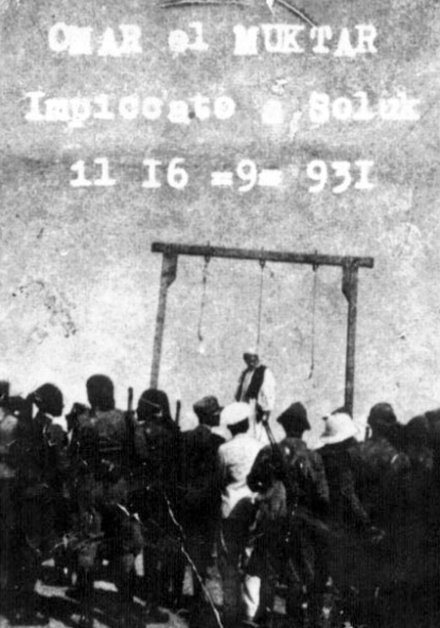
On this date in 1931, Libyan independence martyr Omar [al-]Mukhtar was publicly hanged by the Italians at their concentration camp in Suluq.

Mukhtar (English Wikipedia entry | Italian) was born an Ottoman subject back in 1858 and had lived long enough to see his native Libya seized in the 1911-12 Italo-Turkish War.

Mukhtar, a religious teacher and follower of the Senussi movement, became the leader of the Libyan resistance that dogged the Italian occupation. Mukhtar proved an energetic and successful desert guerrilla fighter, and he had to be given the Italians’ mechanized military.

The Italians executed an estimated 4,000 Libyans in the 1920s, and drove hundreds of thousands into concentration camps, and gradually, only gradually, gained the upper hand on their adversaries.

Captured in battle after he abandoned a 1929 truce, Mukhtar was denied prisoner-of-war status and subjected to a snap military tribunal in one of the small coastal enclaves actually controlled by Italy — “a regular trial and consequent sentence, which will surely be death,” as the Italian general directed. It surely was.

He’s played by Anthony Quinn in the 1981 film Lion of the Desert — a better movie than you might think given that it was bankrolled by Muammar Gaddafi.

A national hero for contemporary Libyans across any social divide you’d care to name, Omar Mukhtar was valorized by the rebels who recently overthrew the aforementioned Gaddafi (here’s Mukhtar on a billboard in rebel-held Benghazi). “The whole world knows what Omar al-Mukhtar did,” Mukhtar’s 90-year-old son told media during the civil war. “That’s where they get their energy from. Ask the youth, they’ll tell you they are all the grandsons of Omar al-Mukhtar.”

His steely profile can be seen on Libya’s 10 10 dinar note.

On this day..

1896: Chief Uwini of the Maholi

This date in 1896 during the Second Matabele War saw the execution by field court-martial of the rebellious Chief Uwini.

This war, in present-day Zimbabwe, featured a revolt of the Matabele (Ndebele) people against Cecil Rhodes’s* British South African Company.

In the field, it was a short-lived affair.

Ndebele rebels slew over 200 white settlers in Matabeleland and Mashonaland during the first week of the surprising rising in March 1896. But most settlers were able to hunker down in he town of Bulawayo behind makeshift breastworks.

Up to 15,000 Ndebele warriors menaced this little citadel, but were deterred from storming it by the settlers’ modern weapons — artillery and the legendary Maxim gun** — until relieved in May. (Rhodes himself led one of the relief columns.) At that point, the rebels retreated to their strongholds, fragmented from one another, and generally got picked off or bought off group by group over the ensuing months.

One of the men arriving with Rhodes’s relief column was Robert Baden-Powell, an army scout who will bring us to this date’s feature execution.

Baden-Powell was dispatched with a squadron of cavalry to pacify the area northeast of Bulwayo. When he arrived there, one of the main rebel chiefs in the Somabula Forest, Chief Uwini, had just been taken prisoner.

“He was badly wounded in the shoulder, but, enraged at being a prisoner, he would allow nothing to be done for him; no sooner had the surgeon bandaged hi than he tore the dressings off again. He was a fine, truculent-looking savage, and boasted that he had always been able to hold his own against any enemies in this stronghold of his, but now that he was captured he only wished to die.”

-Baden-Powell (Source)

This prisoner put Baden-Powell in a conundrum. He had written orders to turn prisoners over to the Native Commission for civil handling (whether trial or otherwise).

Uwini had been induced to surrender by another officer’s promise to spare his life. However, this wounded chief could not be escorted five days back to Bulawayo by a force large enough to protect against the likely rescue attempt by his followers without abandoning his mission. Neither could Uwini be brought along on the patrol.

Something had to give.

Baden-Powell decided it would be the safe-conduct promise.

“I have taken another step, which I hope you will not disapprove of — viz. — trying Uweena by Court Martial,” Baden-Powell wrote his superiors on September 13. “He is the big chief of this part, we have lots of evidence that he instigated rebellion and murders of whites, he is badly wounded, we cannot send him to Buluwayo, and I must be leaving this with some of the senior officers tonight. So if the court find him guilty and sentence him to be shot I shall take on myself the responsibility of confirming it. The effect too should be very good for being carried out promptly and at his own stronghold — and we have a good number of rebels, prisoners and refugees, here to witness it & report it to the remainder.”

Another letter dated later that same day confirmed that the expected sentence had indeed been rendered, and Uwini had been ceremoniously shot that evening at sunset before the walls of the enemy fortress, in the presence of as many witnesses as Baden-Powell could find.

This quasi-juridical field execution put Baden-Powell in front of a court of inquiry after the fact. The court exonerated him, citing the circumstances and the purported effect of the execution in cowing the local insurgents.

Despite leaving the court of inquiry “without a stain on my character,” in Baden-Powell’s own words, this incident can’t help but throw a morally questionable shade for later observers. And this agent of empire does have later observers — because Lord Baden-Powell (as he eventually became styled) would go on to found the Scout Movement.† His 1907 boys scouting camp and subsequent book laid the foundation for the ensuing decades’ Anglo scouting tradition.

And this very Matabele War contributed crucial parts of the scouting backstory. It was in the course of this campaign that Baden-Powell became acquainted with the American scout and adventurer Frederick Russell Burnham. The two struck up a lifelong friendship, and Baden-Powell cribbed notes from the ranger’s guile (like wood “scoutcraft”) his counterpart had picked up on the dwindling American frontier. It was also in Rhodesia that Baden-Powell first wore the Stetson hat and neckerchief combination that would become a distinctive look both for Baden-Powell himself, and for the scout movement he launched.

* As of this story’s setting, the place in question had just begun to be called Rhodesia.

** It is in the context of Great Britain’s colonial adventures in Africa in this period (though not specifically just those of Matabeleland) that Hilaire Belloc published his 1898 poem “The Modern Traveller”. In it, a character named “Blood” gave this early machine gun its definitive literary tribute: it’s the couplet highlighted below, but the larger excerpt may be illuminating.

Blood understood the Native mind.
He said: “We must be firm but kind.”

A Mutiny resulted.
I never shall forget the way
That Blood upon this awful day
Preserved us all from death.
He stood upon a little mound,
Cast his lethargic eyes around,
And said beneath his breath:

“Whatever happens we have got
The Maxim Gun, and they have not.”

He marked them in their rude advance,
He hushed their rebel cheers ;
With one extremely vulgar glance
He broke the Mutineers.
(I have a picture in my book
Of how he quelled them with a look.)
We shot and hanged a few, and then
The rest became devoted men.

And here I wish to say a word
Upon the way my heart was stirred
By those pathetic faces.
Surely our simple duty here
Is both imperative and clear;
While they support us, we should lend
Our every effort to defend,
And from a higher point of view
To give the full direction due
To all the native races.
And I, throughout the expedition,
Insisted upon this position.

† Baden-Powell also counseled scouts to be unflinching should the “duty” arise to hang a man.

On this day..

1864: George Nelson, Indiana Jones rapist

(Thanks to Meaghan Good of the Charley Project for the guest post. -ed.)

On this day in 1864, Private George Nelson of Company F of the 13th United States Colored Troops was hanged for rape in Nashville, Tennessee.

He committed his crime on November 13, 1863. Nelson and two other men were on Nashville Pike outside of the town of Dickson when they encountered an unmarried white woman named, no lie, Indiana Jones.

They asked her where she lived and she said her house was about a mile away. The men claimed they’d been fighting with some rebels near her house and said she must go with them.

Miss Jones refused, and Nelson threatened to shoot her if she did not comply. She went with him for about 250 yards, begging him to release her. Private Nelson put a bayonet to her side and told her to come into the woods with him or he would run her through. Miss Jones started crying then, and he threatened to strangle her with a rope if she did not shut up. They went into the woods together while the other two men held the horse.

As Miss Jones later testified, “I again begged of him to let me go, when he cocked his gun and said if I did not be still he would blow my brains out. He then took hold of me, threw me down, and committed a rape on my person.”

When he was done he robbed her of $1.50, but the other soldiers made him give the money back. Then they let her go.

George Nelson’s accomplices were tried separately, and on cross-examination the victim was asked, “Did you use your utmost endeavors to prevent him from executing his desires, or did you simply cry out, thus yielding a tacit consent?”

As if she could have done anything else with a gun trained on her!

The three defendants were all court-martialed. President Lincoln approved the death sentence for Nelson in August 1864 and he hanged the following month. His partners-in-crime got twelve and ten years in prison respectively.

On this day..

1874: Private Joseph Michaud, the first in Manitoba

The Canadian province of Manitoba logged its first judicial hanging on this date in 1874.

Private Joseph Michaud, an artillery gunner, earned the distinction with one of the classic criminal archetypes, the ill-advised bender. Having snuck out on the town — Winnipeg, in this case — a progressively more belligerent Michaud found himself by the wee hours slashing with his knife one of his fellow duty-derelicters.

That other soldier wasn’t the murder victim: it was, instead, a passerby who saw Michaud brandishing his weapon and attempted to intervene. The boozy artillerist chased that poor man down and left the Good Samaritan a bloodied corpse in the street, pocked with thirty or more knife wounds.

Once he sobered up, Michaud was as appalled as anyone. At his trial, his plea was “coupable dans mon coeur et je merite la morte.” (“Guilty in my heart and I deserve to die.”) In a similar vein, Canada’s temperance movement seized on the case of the remorseful young man driven to an act of madness by drink. “The miserable end of this young man Michaud ought to be a lesson to our young men to keep away form the temptation of strong drink.” (That quote and a longer summation of the trial are here.)

On this day..

1916: Benjamin De Fehr, fragging driver

On this date in 1916, Canadian World War I enlistee Benjamin De Fehr was shot for murder.

De Fehr was one of 25 Canadians to go to the stake for military offenses during the Great War. Twenty-two of those were condemned as deserters; another for cowardice when he refused to advance.

De Fehr, by contrast, picked up his rifle inexplicably on August 19, 1916, and shot his Regimental Sergeant-Major James R. Scott in the back. He was tried three days later, and executed three days after that. His best defense was a disputed claim that he was drunk, probably not a winner under the circumstances even if true.

“Shot at dawn” soldiers have earned a good deal of latter-day sympathy, but suffering from shellshock and fragging your RSM are two different things. De Fehr wasn’t even a front-line soldier himself; he was a driver behind the lines. He was excluded from the 2006 posthumous pardon of 306 British Commonwealth soldiers executed during World War I.

He’s buried in Nord-Pas-de-Calais, France, just three plots away from his victim.

On this day..

1997: Chiang Kuo-ching, Taiwan wrongful conviction

On this date in 1997, Taiwanese airman Chiang Kuo-ching was shot for the rape-murder of a five-year-old girl the previous September.

Chiang was nominated as a suspect by a fellow enlistee just a day after the little girl’s body was found in a privy gutter.

So, he and three other early suspects were given “lie detector” tests. Because Chiang was the only one of these who “failed” to acquit himself by this ludicrous mummery, he became the subject of implacable official tunnel vision.

The case was referred — illegally and arbitrarily — to the country’s intelligence services, who subjected Chiang to 37 hours of torture in order to extract a confession: beatings, threats, sleep deprivation, and private screenings of “his victim’s” autopsy.

Chiang broke, and admitted to the crime.

That admission was the star witness against him in his ensuing military trial. Chiang had retracted it by then — but that was much too late to help himself, especially since potentially exculpatory forensic evidence was intentionally withheld from his defense.

As it turned out, the bloody handprint and the DNA trace recovered from the scene didn’t match Chiang at all. No evidence connected him to the crime, except the evidence of truncheons.

Another airman, Hsu Rong-chou, eventually admitted to the killing. (He’d already been convicted in two other child molestation cases, in 1997 and 2003.) In 2011, Hsu received an 18-year prison sentence for the crime that took Chiang Kuo-ching’s life. Chiang was posthumously acquitted that same year.

The latter-day reversal of the sentence was so sensational that Taiwan’s legislature enacted a special law to increase the compensation Chiang’s family received. The family also got an extraordinary televised apology from President Ma Ying-jeou, who bowed three times before an image of the wrongfully executed man.

On this day..

1936: Manuel Goded Llopis

On this date in 1936, the Spanish Republic executed Gen. Manuel Goded Llopis, who mounted an unsuccessful nationalist attack in the heart of Republican Spain, Barcelona.

Goded (English Wikipedia entry | Spanish) was born of Catalan ancestry in Puerto Rico. His family moved back to the mother country when the United States stripped that territory away in the Spanish-American War.

Goded advanced rapidly through the armed forces, becoming dictator Miguel Primo de Rivera‘s chief of staff by 1927. He was dismissed from this post for intriguing against the government, but soon found his way back to command and became (Spanish link) one of the circle of officers conspiring to check the advance of the left.

When the anti-Republican military mounted the revolt that became the Spanish Civil War, Goded was in Catalonia — freshly arrived on a mission to snatch Barcelona for the fascists at the revolt’s outset. Forces loyal to the Republican government, however, defeated Goded in the streets of Barcelona on 19 July. The general himself was captured on 11 August. A Republican court had him shot at Montjuic the very next day, along with another officer, Alvaro Fernandez Burriel.

His defeat, in the long run, might have been a gift by the Republicans to their conquerors: Goded was a partner but also a rival of Francisco Franco’s, and Goded’s presence in the postwar settlement among the nationalist victors might have introduced a fault line into the Franco regime.

On this day..

1864: Li Xiucheng, Taiping Rebellion general

On this date in 1864, Qing commander Zeng Guofan had executed his opposite number in the destructive Taiping Rebellion, previously surveyed in these pages.

Stephen Platt‘s acclaimed 2012 history Autumn in the Heavenly Kingdom: China, the West, and the Epic Story of the Taiping Civil War depicts this war along with Li, the illiterate peasant farmer whose brilliance in command flowered as the Taiping undid ossified class hierarchies.

Li’s generalship kept the Taiping in the fight for a long, long time: the war spanned 14 years, with some 20 million estimated killed. In July of 1864 the central government finally overran the rebel capital of Nanking/Nanjing and put that city to a frightful sack. Here’s Platt on Li’s fate:

Zeng Guofan seeded his reports on the fall of Nanjing with fabrications, claiming that a hundred thousand rebel soldiers had been killed in the fighting, inflating the glory of his family and his arm, masking their looting and atrocities against cvilians. He kept careful control over what the cout would know. To that end, from the day he arrived in Nanjing he took over the interrogation of Li Xiucheng for himself. The Hunan Army commanders had already secured a long confession from Li Xiucheng in the weeks since he had been captured — pages upon pages detailing his origins and the history of the war and explaining the tactical decisions he had made, many of which they still did not understand. The honor of beginning the questioning had fallen to Guoquan, who had taken to the job with undisguised relish; his primary tools were an awl and a knife, and he managed to cut a piece out of Li Xiucheng’s arm before the others made him slow down.

When Zeng Guofan took over the interrogations on July 28, at last the two hoary, weatherbeaten commanders in chief of the civil war faced each other in person for the first time: square-shouldered Zeng Guofan on the one side, the weary-eyed scholar, his long beard turning gray;wiry, bespectacled Li Xiucheng on the other, the charcoal maker who had risen to command the armies of a nation. It would be no Appomattox moment, however. There was no wistful air of regret and respect between equals. For the defeated, it was no prelude to reconciliation, to twilight years on a rolling plantation. This war ended not in surrender but in annihilation. Zeng Guofan would spend long hours of the following evenings editing his counterpart’s fifty-thousand-word confession, striking out passages that didn’t paint his own army in a good light and having it copied and bound with thread for submission to the imperial government, before casually ordering Li Xiuceng’s execution — in spite of orders he knew were coming from Beijing, that the rebel general be sent to the Qing capital alive.

On this day..

1471: Dmitry Isakevich Boretsky, son of Marfa Boretskaya

Muscovy’s long march to supremacy among the early Russian polities reached a decisive turn on 14 July 1471 when it defeated longtime rival Novgorod at the Battle of Shelon.

Ten days after that defeat, Novgorod’s commander Dmitry Isakevich Boretsky was put to death by the will of Ivan III.

Novgorod the Great had been losing ground to its neighbor for generations. Matters came in the end to the “Mayoress” Marfa Boretskaya, the widow of Novgorod’s former mayor (posadnik) Isaac Boretsky; she emerged in the 1460s as the charismatic leader of the hardline anti-Muscovite types.

Struggling to find a political foothold upon which to resist burgeoning Moscow, Marfa Boretskaya intrigued with the friendly — and similarly Muscophobic — Polish-Lithuanian Commonwealth. This drew Ivan III into what would prove to be the decisive military showdown between these venerable cities.

Marfa’s son Dmitry, our date’s unfortunate executed, would have stood to garner the glory of it had he prevailed.

He didn’t.


Bummer: Klavdy Lebedev‘s 1889 panorama of Marfa Boretskaya surveying the destruction of Novgorod.

Marfa Boretskaya was not put to death herself, but taken prisoner to Moscow upon Novgorod’s formal annexation in 1478 and socked away in a convent.

On this day..