1645: John Hotham the Younger

On this date in 1645, John Hotham the Younger — former M.P., and (too) briefly an adherent of Parliament in the English Civil War, was beheaded as a traitor.

Part of the Daily Double: John Hothams.

On this day..

1960: The assassins of Hazza Majali

On this date in 1960 — just two days after they had been sentenced — Saleh Safadi, Mohammed Hindawi, Lt. Husham Dabbas, and Karim Shaqra were hanged in Amman’s Hussein Mosque Square for assassinating Jordan’s prime minister earlier that year.

The marquee casualty of Jordan’s standoff against Nasserite Egypt, Hazza Majali might have just been a footnote to the story. According to King Hussein of Jordan: A Political Life,

[i]t may be that the bomb plot which cost Hazza Majali his life was also aimed at the King himself. The first bomb, which killed the prime minister, was followed by a second explosion at the scene less than forty minutes later. Had the King followed through on his initial intention to visit the bomb site, he might well have been caught in the second blast.

Though the bombings didn’t get King Hussein, they claimed 11 other lives besides Majali’s.

The assassins’ conspiracy traced back to neighboring Syria, which at that time was (briefly) unified with Egypt as the United Arab Republic. Syria and Jordan have found plenty of reasons to bicker over the years, and the former’s alliance here with Nasser‘s pan-Arabism added a pointed ideological critique of Jordan’s throwback Hashemite dynasty.*

Syria and the UAR were busily subverting U.S.-backed Jordan, and in this venture they enjoyed dangerously considerable popular support within Jordan; Majali in particular was “regarded by some Jordanians — and particularly Palestine refugees — as a virtual tool of the Western powers.” (New York Times, Aug. 30, 1960)

So it was a dangerous situation, and King Hussein did well to escape those years un-blown-up himself.

Several weeks of brinksmanship followed Majali’s assassination, with Jordanian troops massed on the Syrian border. Matters stopped short of outright war, but Nasser, Syria, and the UAR were all explicitly accused of this operation and others at the resulting trial of the assassins in December: the plot was supposed to have originated in Damascus, been paid for in Damascus, and used bombs shipped from Damascus.

Eleven in all were condemned to death, but seven of those sentences were given in absentia to suspects who had absconded to Nasser’s dominions.

* In response to the Egypt-Syria union, the kindred Hashemite rulers of Jordan and Iraq had formed the Arab Federation of Iraq and Jordan. That arrangement was even shorter-lived than the UAR, because the Iraqi Hashemites were almost immediately overthrown. You can get Jordan’s official take on those perilous years here.

On this day..

1862: An unknown Confederate deserter

From a letter written by one Private Thomas Warrick of Alabama, cited in The Life of Johnny Reb: The Common Soldier of the Confederacy by Bell Irvin Wiley:

I saw a site today that made me feel mity Bad I saw a man shot for deserting there was twenty fore Guns shot at him thay shot him all to pease … he went home and thay Brote him Back and then he went home again and so they shot him for that Martha it was one site that I did hate to see it But I could not helpe my self I had to do Jest as thay sed for me to doo.

This unknown soldier shot “all to pease” had just run afoul of Gen. Braxton Bragg‘s draconian anti-desertion policy meant to crack down on soldiers going AWOL for casual leave, often to help the families they had left behind keep up the farm.

As Wiley points out, our letter-writer Private Warrick was himself planning to do just that.

Bragg’s little salutary bloodbath evidently had its effect, because he didn’t go AWOL. Wiley quotes Warrick, now in a more Joe Friday mode than when he had promised to “come home Eny how”, writing his parents in 1864,

I would be glad to see you all now but I recon that I have bin home my last time till this war closes.

On this day..

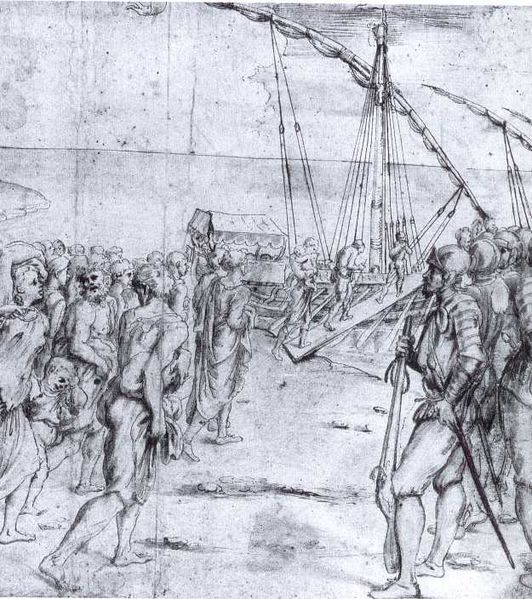
1609: Vicente Turixi, King of the Moriscos

La Expulsión de los Moriscos, by Vincenzo Carducci (Vicente Carducho).

Having taken the trouble over the preceding century to eliminate (or force underground) its substantial Muslim population by forcibly converting it to Christianity, Spain in the early 1600s bethought itself to complete the operation upon its recently minted fellow-Christians by ejecting these Moriscos from Spain altogether.

When the edict for this radical act of expulsion first came down in the heavily Morisco area of Valencia, some of its victims reportedly embraced the prospect of deportation to a land where their dress, language, and religion were no longer forbidden.

Others were less sanguine.

Armed resistance broke out in two wilderness fastnesses, the mountainous Vall de Laguar (Spanish link) and — as narrated by Henry Charles Lea in his freely available The Moriscos of Spain; their conversion and expulsion —

the Muela de Cortes (Spanish link), an almost inexpugnable spot, being a deep valley surrounded by precipitous heights, of which the passes were easily defensible. The Moriscoes of that region … were in a state of excitement and were readily persuaded to rise by an outlaw named Pablillo Ubcar. They elected as king Vicente Turixi, who sent a proclamation through the sierra for all to join him under pain of treason. From their strongholds they made raids on the surrounding country, gathering cattle and provisions, burning villages, and desecrating churches.

[Ethnic cleansing coordinator Don Agustin] Mexia, absorbed in the work of embarkation and fearing to interrupt it, for awhile paid no attention to these movements … who could readily be reduced when the time came.

His provisions were justified … those of the Muela de Cortes … lost heart when they heard of the defeat of those of Aguar, and were disappointed as to the appearance of the Moor Alfatami on his green horse, whom tradition reported to be concealed under the mountain since the days of King Jayme … It was agreed that they [the rebels, surrendering] should be safe in person and property, provided they would go to embark within three days.

The rapacious soldiery, who had promised themselves abundant plunder, in their disappointment threw off all discipline; they sacked the village of Royaya, outraged the women and seized numbers of children as slaves. Only three thousand Moriscoes were brought to the port of embarkation, the rest having scattered and taken to the mountains to escape the fury of the soldiers.

These, estimated at two thousand in number, for several years gave infinite trouble, killing all the Christians they met and committing constant depredations. At one time the Governor of Jativa induced many of them to come down, but finding that they were to be enslaved they fled back to the mountains.

A reward was offered for King Turixi, dead or alive; he was tracked to a cave, captured, and brought to the city, when he was sentenced to have hands and ears cut off, to be drawn, torn with pincers, hanged and quartered; but at the execution, December 18th, the cutting of hands and ears was omitted. He had been confessed twice and reconciled twice, and died as a good Christian, making a most edifying end, for we are told that he had been a liberal almsgiver and devoted to the Virgin and the religious Orders.

The miserable remnants were hunted down gradually, the viceroy paying twenty ducats a head for them as galley-slaves.

The armed resistance in Valencia — where Moriscos were most numerous, and the expulsion was first decreed — was actually much less than had been feared, which gave the Spanish authorities all the encouragement they would need to enforce it elsewhere, too.

“Seeing that the whole body of our nation is tainted and corrupt, he applies to it the cautery that burns rather than the salve that soothes; and thus, by prudence, sagacity, care and the fear he inspires, he has borne on his mighty shoulders the weight of this great policy and carried it into effect, all our schemes and plots, importunities and wiles, being ineffectual to blind his Argus eyes, ever on the watch lest one of us should remain behind in concealment, and like a hidden root come in course of time to sprout and bear poisonous fruit in Spain, now cleansed, and relieved of the fear in which our vast numbers kept it.”

-Cervantes, Don Quixote

On this day..

1818: Abdullah ibn Saud, last ruler of the first Saudi state

On this date in 1818, the last ruler of the first state established by the Al Saud who rule the modern state of Saudi Arabia lost his head to the Ottoman Sultan.

The Ottoman state and its (largely independent) vassal Egypt begged to dispute the Wahhabi tribe’s authority in the Arabian peninsula (and its proclivity for raiding Ottoman caravans) and made war on the House of Saud throughout the 1810’s.

The Battle of ad-Dir’iyah in 1818 settled the matter, with our day’s principal Abdullah I surrendering to the Egyptian general Ibrahim Pasha.

We pick up the action from the third-hand, well-after-the-fact reports of the London Times. This, printed on Jan. 16 1819 under the “German Papers” heading:

FROM THE TURKISH FRONTIERS, DEC. 16.

The last victory over the Wechabites puts an end to the war at once. Ibrahim Pacha, who commanded the Turkish army, sends the captive Abdallah to Constantinople, but he first had his head shaved, and all his teeth pulled out.

On Feb. 6, the Times channeled the Dutch and Flanders mail:

Intelligence from Constantinople, dated the 24th December, states, that the Chief of the Wechabites, Abdallah, and his Iman, were brought prisoners into that capital on the 16th of the same month. After being led, in chains, through the principal streets, they were taken to prison and put to the torture. On the following morning, they were brought before the Sultan and beheaded. Their naked bodies were exposed during three days, and then delivered to the populace.

In addition to Abdullah himself, this affair finished off the city of Diriyah as a Saudi capital.

But of course, the Saud and their state were just getting started.

On this day..

1831: Gen. Jose Maria Torrijos y Uriarte and his liberal followers

On this date in 1831, one of the great Spanish liberal officers was shot along with dozens of comrades attempting to spark a revolution.

It was a dark time for Spanish liberals under the autocratic rule of Ferdinand VII.

Jose Maria Torrijos y Uriarte (Spanish Wikipedia page) was one of the heroes of that downtrodden cause from way back, a noble-born officer who had been made a captain at the precocious age of 13 and been around for all of Spanish liberalism’s greatest early 19th century tragedies.

He was in Madrid for the ill-fated uprising against its French occupiers in 1808, and was captured en route to aid Pedro Velarde‘s last stand.

Lucky for Torrijos, and luckier still: as a prisoner, he might have been in line for the ensuing mass execution, but an aide-de-camp of General Murat let him go in gratitude for chivalrously preserving a French officer from the Spanish mob.

A few years after the Peninsular War, with independent Spain yoked to a reactionary Bourbon-backed monarchy, Torrijos’ dangerous opinions made him a prisoner once more.

This time, he was liberated by the brief ascendancy of fellow-traveler Rafael del Riego. This effusion, too, was destined for grief upon the scaffold; once more, Torrijos escaped, this time to exile.


The execution of Rafael del Riego

Pushing forty and a bit emptyhanded for all his strivings, Torrijos’ restless soul was not satisfied knocking about the shores of England. He soon assembled a company of like-minded folk (such as Robert Boyd) to make another bid at liberating Iberia. But he was induced to put ashore under the misapprehension of support, and promptly rounded up.

The Malaga governor’s message to Madrid requesting instruction returned the simple order: shoot them all.* (Spanish link)


El fusilamiento de Torrijos y sus compañeros en la playa de Málaga, by Antonio Gisbert

“A la muerte de Torrijos y sus compañeros”
by José de Espronceda (from here (pdf))

Helos allí: junto a la mar bravía
cadáveres están ¡ay! los que fueron
honra del libre, y con su muerte dieron
almas al cielo, a España nombradía.

Ansia de patria y libertad henchía
sus nobles pechos que jamás temieron,
y las costas de Málaga los vieron
cual sol de gloria en desdichado día.

Españoles, llorad; mas vuestro llanto
lágrimas de dolor y sangre sean,
sangre que ahogue a siervos y opresores,

y los viles tiranos con espanto
siempre delante amenazando vean
alzarse sus espectros vengadores.


Monument to Torrijos at Malaga’s Plaza de la Merced.

* Around 50 or so were shot. The exact figure is differently accounted by various sources; I have been unable to determine if any among them are authoritative.

On this day..

1982: Suriname’s “December murders”

This was the date in 1982 of the “December murders” (“Decembermoorden”), when 15 opponents of Suriname’s military dictatorship were shot at Fort Zeelandia.

(The 15 people shot each have an entry on the Dutch Wikipedia, accessible through its Decembermoorden entry.)

Though the killings weren’t secret at the time, their circumstances have always been murky, beyond the plain fact of being murders of political dissidents — “counterrevolutionaries,” in the parlance of the “Socialist Republic”.

President Desi Bouterse had seized power in a coup in early 1980, and some of the casualties this day might have been suspected of plotting to pull the same trick on him: at least, several were made to read statements to that effect. Others were regime opponents of a less existential menace: dissident university professors; critical journalists; a prominent former footballer. (When in Paramaribo, take in a match at Andre Kamperveen Stadion, which is named for him.)

Bouterse took political responsibility for the slaughter while claiming not to have ordered it. But it’s long been said that Bouterse was actually present for the shootings, personally interviewing/interrogating/”judging” the prisoners. (That’s what the massacre’s lone survivor, the since-deceased Fred Derby, said. (Dutch link))

Decades later, Bouterse — now an ex-dictator — is finally facing trial for the December murders, including fresh evidence of his involvement in the day’s notorious affair.

On this day..

1689: Karposh, Macedonian rebel

On an uncertain date in early December (or possibly late November), the Macedonian* rebel Karposh was executed at Skopje.

The Great Turkish War had seen the Ottomans advance to the gates of Vienna, but an alliance of European powers pushed the Mohammedan back.

Their crisscrossing armies roiled the Balkans, creating the opportunity for a bit of ill-fated separatism.

Arambasha [a title, not a name] Karposh raised a native Macedonian rebellion (detailed account of it here) that waxed and waned with the fortunes of the Austrian army. In his brief heyday, he was acclaimed “Prince of Kumanovo“.

But a November 1689 counteroffensive seriously harshed that vibe; the Turks overran his force and drug Karposh back to Skopje where he and a couple hundred fellow Macedonian captives are said to have been put to death by impalement on the lovely Stone Bridge over the Vardar. (Other versions of this story cite, less picturesquely, hanging.)

You can still see this landmark today in Skopje … capital of the now-independent Macedonia.

* Lest I wade carelessly into the Balkan ethnic crossfire, I hasten to declaim that “Macedonian” here refers to the geographic environs roughly coincident with the present-day Republic of Macedonia. No representation as to the man’s ethnicity or his project is intended, or attempted.

On this day..

1876: The samurai leaders of the Hagi and Akizuki rebellions

Unless you’re a Jedi knight, feudal warrior castes and industrial civilization go together like sashimi and fries. So, when the Meiji Restoration made its choice for Japanese modernization, it gained the enmity of the samurai it necessarily dispossessed.

A news nishiki-e woodblock depicting the defeat of the Hagi Rebellion, with the conquering Miura Goro on horseback. (Click for a wider, three-panel image.) From here.

In many cases, said samurai were especially burned at having initially backed the restoration’s restoration of the emperor and attendant jingoistic sloganeering, only to find themselves on the outs as soon as the new government got its feet under it.

Over the 1870’s, the samurai caste was essentially abolished, and it lost its sword-toting privileges along with (come the advent of a new conscript army) its military import.

Small wonder that once-haughty military folk fought this unwelcome progress katana and wakizashi.

In 1876, the Shimpuren Rebellion helped spark sympathetic retrograde uprisings both named for their locations, Akizuki and Hagi. In all of these, the aggrieved samurai made desperate bids to reassert their lost position and reverse Japan’s westernization.

In all of these, they failed.

Leaders of both the Akizuki and Hagi Rebellions — Wikipedia gives it as two from the former (Masuda Shizukata and Imamura Hyakuhachiro) and seven from the latter (notably Maebara Issei) — were beheaded together this date in Fukuoka.

On this day..

1945: Anton Dostler, gone commando

On December 1, 1945, German General Anton Dostler was shot by the American military at Aversa, Italy, for war crimes.

Gen. Dostler readied for execution, from the U.S. National Archives. Click for larger image, or click here for the post-execution photo.

Specifically, General Dostler was condemned for having ordered the summary execution of American saboteurs who had been taken behind enemy lines.* Dostler was the first German general tried by an American military commission, and the first put to death for war crimes.

And his sentence did not sit well with all.

There had been a group of German saboteurs captured in the United States during the war who had themselves been executed (after becoming the subject of Supreme Court landmark Ex parte Quirin). Here, a mirroring act on the German side brought a death sentence for its (supposed) author.

Dostler’s scenario therefore raised interesting questions of war crimes law, jurisdiction … and politics.

The essential legal difference between the German saboteurs and the OSS men shot at La Spezia was that the latter were found to have been taken in uniform. If uniformed, they were entitled to prisoner of war status; if not, then a summary execution might have been (however repugnant) permissible.

It seems to be generally agreed, and even conceded by Dostler’s defense, that the saboteurs were indeed in uniform, though the notes of the trial are rather vague on the point; there’s an intriguing indication that the defense disputed the notion that the captive saboteurs’ uniform had the necessary “fixed distinctive sign recognizable at a distance.” (Time said that “they wore no insignia, had turned their field jackets inside out.”)

In a do-over, Dostler’s defense might have dug very deep into what met the Geneva Convention’s definition of a uniform.**

For the Germans, however, the saboteurs’ fate was decided by Hitler’s notorious Commando Order, inflicting immediate death on any enemy personnel (uniformed or not) captured behind German lines.†

Understandably, then, Dostler’s counsel seems to have been much more interested in pursuing the “superior orders” defense, and did so with gusto: in this early landmark trial, it was an as-yet untested strategem even though the Allied Powers had decided as a matter of policy not to protect potential war criminals on that basis. Not only was the Führerbefehl at work in general, but Dostler had kicked this specific decision upstairs to the office of Gen. Albert Kesselring, which had insisted upon the executions (to the point of directly phoning the fortress which held the Americans to ask why they weren’t dead yet).

Dostler defense attorney Col. Claudius Wolfe appeared to strike a chord with the tribunal’s career military officers in his closing summation, impressing upon them the danger to military order or to their own persons of establishing a precedent that subordinates can be held accountable for illegal orders from above.‡

We won the war this time, but no one knows who will win the next time. We might lose and then you gentlemen might find yourselves sitting where this man is now sitting…

If we find this man guilty because of political pressure or because he lost the war and is in our power, we might as well not have won the war. (New York Times, Oct. 12, 1945)

But a more immediate precedent was at stake: the many imminent war crimes trials including the Nuremberg proceedings. Many of those would never get off the ground if a “superior orders” plea could work for someone as high-ranking as a general — or if the first war crimes trial out of the gate resulted in an acquittal.

A son of one of Dostler’s defense team makes a hotly-stated case for the general here; some factual errors (e.g., the “Roosevelt administration”) detract from the piece, but his recollection of the backstage machinations as related by his father are fascinating if true.

Video of Dostler’s execution is available, in its original silent cut.

* A description of the attempted operation, with helpful maps, is here (pdf). Coincidental — but perhaps informative for the Third Reich’s decision-making apparatus — was the fact that the La Spezia saboteurs were captured on March 24, 1944, the very same date as a reprisal mass execution in Rome for a partisan attack the day before that had claimed 33 Germans.

** Here (pdf) is a review of the current legal terrain around the “uniform” issue, significantly shaped by World War II. Executive summary: commanders should give awfully wide latitude to hostiles wearing less-than-standard uniform unless said hostiles are clearly using their wardrobe as a ploy to get the drop on your guys.

† Actually, the text of the Commando order directed that enemy “commandos” should without quarter “be exterminated to the last man, either in combat or in pursuit” (a “no quarter” order being illegal itself, but not relevant here); but, that those who somehow managed to be captured should be handed over to the SS. German officers seem to have understood, probably accurately, that the high command simply wanted them dead and wasn’t fussy about distinguishing the circumstances. Dostler’s guys (per the Oct. 13, 1945 London Times) contended that Hitler’s citation in the Führerbefehl of Allied atrocities made the German policy in reality a Geneva Convention-legal reprisal order.

‡ A German officer down the chain of command, Alexander zu Dohna-Schlobitten, actually refused to sign the execution order for the Americans because — yes — the order violated the Geneva Conventions. The Wehrmacht sacked him, but did not prosecute him, for his scruples.

Part of the Daily Double: Lesser War Criminals.

On this day..