1945: Heinz Eck, U-Boat commander

On this date in 1945, Heinz-Wilhelm Eck and two of his former subordinates on the Unterseeboot U-852 were shot in Hamburg for killing the survivors of a sunk target.


The defendants in the U-852 trial. From left to right: Eck, August Hoffmann, Walter Weisspfennig, Hans Lenz, Wolfgang Schwender. The leftmost three were executed.

On March 13, 1944, in the South Atlantic en route to the Indian Ocean, U-852 torpedoed the Greek-flagged Peleus.

The submarine commander Eck feared the steamer’s debris would be observed by a passing airplane, and give enough information to Allied reconnaissance to enable it to find his ship. He therefore surfaced and attempted to have the debris field eliminated by machine-gunning and grenading it into the watery deep.

This seems a rather curious expedient, but evidently it was a common one.

U-Boat ace Adalbert Schnee was called (German link) to testify that blasting away at ship wreckage actually was an effective practice. But on prosecution’s cross-examination, Schnee was deftly trapped — lest he incriminate himself in a potential war crime — into disavowing (pdf) the killing of survivors who happened to be clinging to that debris.*

Q. What would you have done if you had been in Eck’s position?

A. I would under all circumstances have tried my best to save lives, as that is a measure which was taken by all U-boat commanders; but when I hear of this case, then I can only explain it as this, that Captain Eck, through the terrific experience he had been through, lost his nerve.

Q. Does that mean that you would not have done what Captain Eck did if you had kept your nerve?

A. I would not have done it.

Survivors of torpedo attacks usually had problems enough without the sub crew taking pains to attack them. Eck claimed that he worried that the survivors’ rafts might have communications equipment that would call out the sub-hunters tout de suite, but a standing German directive forbade U-boat captains assisting their prey.

No attempt of any kind should be made at rescuing members of ships sunk, and this includes picking up persons in the water and putting them in lifeboats, righting capsized lifeboats and handing over food and water. Rescue runs counter to the rudimentary demands of warfare for the destruction of enemy ships and crews … Be harsh, having in mind that the enemy takes no regard of women and children in his bombing attacks of German cities.

An unpleasant reality of sub warfare, as depicted in the classic submarine film Das Boot:

But in this case, some of the Peleus crew managed to survive the mop-up operation, and then the open ocean, long enough to tell their tale.

The British military tribunal sentenced Eck to death, his plea of “operational necessity” (i.e., “I had to shoot the survivors to sink the debris to save my ship”) rejected; also condemned were the ship’s doctor Walter Weisspfennig, who wasn’t supposed to be involved in gunplay at all, and August Hoffmann. Both of them had taken the “only following [Eck’s] orders” line.

Hans Lenz, who had opposed Eck’s order but ultimately complied with it, drew a life sentence. Wolfgang Schwender, who seems to have shot generally at debris but not (he said) at human beings, and then got bumped off his gun by the reluctant Lenz, got off the easiest at 15 years.

Despite the predictable “victor’s justice” dynamic — American and British sub personnel, and even Japanese I-boat officers, evidently skated on similar conduct — Eck was the only U-boat commander in World War II to draw a war crimes conviction. That was surely due in part to the overwhelming majority of them having simply failed to survive the perilous undersea campaign long enough to see the inside of a war crimes court.

* Part of the past-is-prologue contest for this case was the World War I sinking of the Llandovery Castle by a German submarine, which had then proceeded to hunt down the lifeboats. It resulted in (non-death penalty) war crimes convictions for some of the U-boat officers involved. The existence of this precedent helped to defeat the “superior orders” defense of the junior officers, since they could be held to have known that Eck’s command was illegal.

Part of the Daily Double: Lesser War Criminals.

On this day..

1871: Louis Rossel, Théophile Ferré, and Sergeant Bourgeois, Communards

On this date in 1871, three very disparate men of the recently quashed Paris Commune were shot together at Satory.


Louis Rossel (top) and Theophile Ferre. The mysterious Bourgeois will have to be imagined.

Louis Rossel (French Wikipedia link | English) got the press — the public sighs, the clemency campaign, the big show by Adolphe Thiers of considering mercy. “Rossel,” French scribbler Jules Barthelemy-Saint-Hilaire wrote, “is a man whose hand we grasp even when we shoot him.”

Rossel, to the elites of the Third Republic, was one of them. (Here’s a very sympathetic extended biography via Google books.)

The highest-ranking officer (a colonel) to serve the Commune, a writer of books and thinker of thoughts, the fuzzily lefty Rossel had gone to Paris to serve “the people” when France’s capitulation during the Franco-Prussian War put the capital at the mercy of the Germans.

Rossel was briefly Minister of War for the Commune, but he broke with its leadership’s fire-eating ways and then hung about the city while events played out around him. For his adherents, he was the loyal patriot who had renounced the rebellion. For the rebels … pretty much the same (Rossel resigned/was forced from power three weeks before the Commune fell).

But for the brass, the youngster’s March resignation letter abandoning the Thiers government for the Parisian masses was a little more dangerous than your garden-variety liberalism.

Having learned … that two parties are struggling for mastery of the country, I do not hesitate in joining the side which has not concluded peace [with the Germans], and which has not included in its ranks generals guilty of capitulation. (Source)

Without doubt, Theophile Ferre (French Wikipedia link | English) was a true believer, a radical agitator from way back. Ferre was part of the Commune leadership, and directly involved in the execution of hostages during its desperate last week.*

As such, his sympathy from the bourgeois public was zero, and his prospects of commutation were even worse than that. Ferre took his solace from his faith in the cause.

Joining these two in a sort of literary triad was one “Sergeant Bourgeois” (seriously), a straight-from-central-casting grunt “condemned to death for having struck one of his officers, and for having afterwards taken part in the Commune.”** His role in the story is to be the virtuous avatar of The People, understood to have died in a manner confirming the interlocutor’s take on the Commune, whatever that take might be.

Thus, Lissagaray (French link), eloquently reviling that milquetoast fop Rossel:

For twelve weeks death remained suspended above the heads of the condemned. At last, on the 28th November, at six o’clock in the morning, they were told that they must die. Ferré jumped out of bed without showing the slightest emotion, declined the visit of the chaplain, wrote to ask the military tribunals for the release of his father [also imprisoned -ed.], and to his sister that she should have him buried so that his friends would be able to find him again. Rossel, rather surprised at first, afterwards conversed with his clergyman. He wrote a letter demanding that his death should not be avenged — a very useless precaution — and addressed a few thanks to Jesus Christ. For comrade in death they had a sergeant of the 45th line, Bourgeois, who had gone over to the Commune, and who showed the same calm as Ferré. Rossel was indignant when they put on the handcuffs; Ferré and Bourgeois disdained to protest.

The day was hardly dawning; it was bitterly cold. Before the Butte of Satory 5,000 men under arms surrounded three white stakes, each one guarded by twelve executioners. Colonel Merlin commanded, thus uniting the three functions of conqueror, judge, and hangman.

Some curious lookers-on, officers and journalists, composed the whole public.

At seven o’clock the carts of the condemned appeared; the drums beat a salute, the trumpets sounded. The prisoners descended, escorted by gendarmes. Rossel, on passing before a group of officers, saluted them. The brave Bourgeois, looking on at the whole drama with an indifferent air, leant against the middle stake. Ferré came last, dressed in black and smoking a cigar, not a muscle of his face moving. With a firm and even step he walked up and leant against the third stake.

Rossel, attended by his lawyer and his clergyman, asked to be allowed to command the fire. Merlin refused. Rossel wished to shake hands with him, in order to do homage to his sentence. This was refused. During these negotiations Ferré and Bourgeois remained motionless, silent. In order to put a stop to Rossel’s effusions an officer was obliged to tell him that he was prolonging the torture of the two others. At last they blindfolded him. Ferré pushed back the bandage, and, fixing his eyeglass, looked the soldiers straight in the face.

The sentence read, the adjutants lowered their sabres, the guns were discharged. Rossel and Bourgeois fell back. Ferré remained standing; he was only hit in the side. He was again fired at and fell. A soldier placing his chassepôt at his ear blew out his brains.

By unsurprising contrast, the New York Times reporter found Rossel’s act more convincing than Ferre’s.

Throughout this trying morning ROSSEL was calm and resigned to his fate, and all of his remarks are manly and touching …

It was a cold, dark, November morning, a heavy fog obscuring everything at 6 &frac12, and the street lamps were still lighted. During this time FERRE had dressed himself with unusual care, putting pommade upon his hair, and spending a long time in brushing his clothes … BOURGEOIS rose jauntily from his bed, made his ablutions like a soldier, then listened to the consolation of the priest. After this he lighted a cigar, and went out jauntily, with light military tread, and with his kepi cocked upon one ear. He was cool, but there was no bravado about him, while FERRE seemed to be constantly searching for effect …

ROSSEL … stood calmly before the platoon awaiting the signal to fire.

Meantime Bourgeois had marched gaily to his post, saluting the troops as he passed, and in a business-like way threw down his cigar, threw open his coat, and stood in an easy position, awaiting the word. FERRE was a poseur to the last. A number of times he changed his position, looking at his legs and then at the few spectators, but no position seemed to satisfy him. He then cast a rapid glance toward BOURGEOIS, and immediately struck the soldier’s attitude.

Seeing these archetypes reduced to corpses, the London Times‘ correspondent could hardly resist.

As I cast a last look at them, I could not but feel how different was the spirit which had animated each at the last moment. Rossel had died commending his soul to God; Borugeois had gone through the form of confession, and died probably in the ignorance of a superstitious soldier, while Ferre died, caring as little for his own life as he had for those of others … a Materialist.

* Ferre is supposed to have personally announced the death sentence to Archbishop Georges Darboy, the marquee martyr to the Commune.

** London Times, Nov. 30, 1871.

On this day..

1974: Black Saturday in Ethiopia

November 23, 1974 was “Bloody Saturday” in Ethiopia for that day’s* surprise purge of some threescore politicians and soldiers by the ruling Derg.

It was barely ten weeks since the Derg — an Amharic word meaning “committee”, in this case a leftist military junta — had formally overthrown Emperor Haile Selassie, so ancient that he was already middle-aged back when he’d been leading Ethiopia’s resistance against Mussolini.

It’s strange to say in retrospect, but having spent the best part of a year systematically supplanting the political authority of the decrepit ancien regime with widespread public support, the Derg had engendered hope that its revolution would be accomplished without slaughter.

“Ityopiya tikdem/yala mimin dem” — “Let Ethiopia progress/Without any bloodshed” — became the popular slogan of that heady time. (pdf source)

Black Saturday turned the leaf on all that, and opened the sanguinary chapter of Ethiopian history today evoked by the name of the Derg.

What went wrong with Ethiopia's bloodless revolution?
“The prospect,” concluded the analysis that appeared under this headline in the Nov. 29, 1974 London Times, “is that the mass executions will be followed by further drastic action aimed at consolidating the control of the new military rulers.” The same author, Michael Knipe, had written on Nov. 16 that “the firmness of [the military’s] control appears to be matched by an overall moderation of approach, which holds promise for Ethiopia’s future.”

The Derg long remained a shadowy body, its members largely unknown and its internecine factional politics only guessed-at. The executions this date are generally read as the consolidation of the coup’s “radical” elements as against its “moderates” and the first signal event in Derg member Mengistu Haile Mariam‘s eventual conquest of supreme authority.

The crucial issue that separated radicals from moderates at the revolution’s early stage appears to be their approach to the ongoing struggle of coastal Eritrea — then still a province of Ethiopia.

Ethnically Eritrean officer Aman Michael Andom, the first titular head of the Derg who had been deposed from his position only a week ago, was a noteworthy advocate of negotiating a peacable settlement with Eritrean agitators. He was among the casualties of Black Saturday. (Aman was later reported to have been killed resisting arrest, rather than actually executed; many of the available accounts of this massacre have slightly varying numbers and particulars.) Henceforth, military force would be Addis Ababa’s only approach to the Eritrean problem.

A few other Aman supporters in the Derg shared his fate in a political wipeout. But more numerous among the 29 civilian and 31 military men announced as casualties the next morning — and there had been no prior warning that executions were imminent — were aristocrats and officials of the Haile Selassie government, including:

  • Two former Prime Ministers, Endelkachew Makonnen and Aklilu Habte-Wold (or Aklilou Wold), both of whom had been slated for trial for the recent famine in Wollo (London Times, Nov. 14, 1974);**
  • Solomon Abrahami, the former governor of Wollo;
  • Selassie’s own grandsom, Rear Adm. Iskender (Alexander) Desta;
  • 16 generals, including Selassie’s son-in-law (and former Defense Minister) Abiye Abebe.

(This Nov. 25, 1974 New York Times article — behind the paper’s pay wall — lists all 60 vicitms.)

These were a selection of some 200 political prisoners held by the Derg; how hard to come down on these officials was another point of contention between radicals and moderates. It emerged later that the Derg had met earlier on the 23rd to vote, name by name, which among its prisoners deserved execution.

So if you look at it right, summarily machine-gunning only 30% of your political prisoners is a moderate policy. Alas: these would hardly be the last.

After the Derg government was itself finally overthrown in 1991 — and the troubled province of Eritrea finally won its independence from Ethiopia — some of the perpetrators of its genocidal atrocities were themselves put on trial.

* It’s obscure — perhaps permanently so — whether the nighttime killings transpired before or after the end of the day, and both the 23rd and 24th are variously cited as the date of death. “Reliable sources said the executions were by machine gun at midnight,” the unhelpfully breezy New York Times reported on Nov. 25. This account (pdf) has the shootings occupying several batches with midnight passing during the process. We give precedence to Saturday the 23rd here because that’s the day that earned the “Bloody” appellation.

** According to Marxist Modern: An Ethnographic History of the Ethiopian Revolution, Mengistu was rumored to have disposed of Aklilu personally.

On this day..

1909: Leonard Groce and Lee Roy Cannon, American mercenaries in Nicaragua

In few countries is it possible to trace the development of anti-American sentiment as clearly as in Nicaragua. A century of trouble between the two nations, which led to the death of thousands and great suffering for generations of Nicaraguans, began when the United States deposed President Zelaya in 1909. Benjamin Zeledon [Spanish link -ed.] took up arms to avenge him. Zeledon’s death inspired the young Sandino, who, in turn, inspired the modern Sandinista Front.

For all his faults, Zelaya was the greatest statesman Nicaragua ever produced. If the United States had found a way to deal with him, it might have avoided the disasters that followed. Instead, it crushed a leader who embraced capitalist principles more fully than any other Central American of his era.

-Steven Kinzer, Overthrow: America’s Century of Regime Change from Hawaii to Iraq

It was a century ago today* that the execution of two American soldiers of fortune set all that strife in motion.

Leonard Groce, a mining supervisor, and Lee Roy Cannon, a rubber planter, were among those hired out by the U.S.-backed rebellion of Juan Jose Estrada. Dictatorial Nicaraguan President Jose Santos Zelaya — no known relationship to his namesake bookend at the other end of that century, the recently deposed leftist Honduran President Manuel Zelaya — had earned Washington’s ire by attempting to carve out an excessively independent sphere of action for his country. Most notably, he courted European investment, and mooted funding a possible Nicaraguan competitor to the U.S.-controlled Panama Canal.

Though the Estrada insurrection was spinning its wheels militarily, Groce and Cannon would give it legs diplomatically, and afford the Yankees sufficient pretext to overthrow Zelaya directly.

These two U.S. nationals were caught mining the San Juan River in an admitted attempt to sink a Nicaraguan troop transport, and shot in El Castillo a few days later. (Here‘s Groce’s final letter to his mum — a Spanish translation; I have not been able to find the English original.)

When word reached U.S. Secretary of State Philander Knox about the shootings, he “saw an opportunity to intervene directly.”**

Knox dashed off a bellicose note to the Nicaraguan charge d’affaires calling his

regime … a blot upon the history of Nicaragua …

From every point of view it has evidently become difficult for the United States further to delay more active response to the appeals so long made, to its duty to its citizens, to its dignity, to Central America, and to civilization.

The Government of the United States is convinced that the revolution represents the ideals and the will of a majority of the Nicaraguan people more faithfully than does the Government of President Zelaya.

“Then,” says Steven Kinzer, “he issued an official legal opinion holding that because Estrada’s rebellion had given his men the ‘stature’ of belligerents, Cannon and Groce had been entitled to prisoner-of-war status. That made Zelaya a war criminal.”

Maybe Zelaya mistook the foreign bombers for “unlawful combatants.”


Groce and Cannon temporarily became a media cause celebre in the U.S. This article is from the Nov. 21, 1909 edition of the Salt Lake Herald-Republican.

By late December, with marines† landing, Zelaya bowed to the inevitable and resigned, and Nicaragua began a generation under more-or-less overt U.S. control.

That terrible miscalculation drew the United States into a century of interventions in Nicaragua. They took a heavy toll in blood and treasure, profoundly damaged America’s image in the world, and helped keep generations of Nicaraguans in misery. Nicaragua still competes with Haiti to lead the Western Hemisphere in much that is undesirable, including rates of poverty, unemployment, infant mortality, and deaths from curable diseases.

– Kinzer

There’s more coverage of this episode and America’s early 20th century Nicaraguan policy in The Banana Men: American Mercenaries and Entrepreneurs in Central America, 1880-1930 and Beneath the United States: A History of U.S. Policy toward Latin America.

* A few sources give the date as the 16th, and the situation was confused and uncertain enough on the ground that early press reports elide the execution date altogether. The 17th tracks with The Banana Men, Overthrow, and the U.S. diplomatic correspondence.

** Knox, a plutocrats’ attorney from Pennsylvania and certifiable bastard, was also personally connected with Pittsburgh-based mining interests Zelaya was threatening to expropriate. Groce worked for the firm.

† Marine Corps Major (later General) Smedley Butler mounted three different expeditions to Nicaragua during the civil war following Zelaya’s departure. He would later remember of his service in America’s southerly “Banana Wars” interventions, “I spent most of my time being a high class muscle-man for Big Business, for Wall Street and for the Bankers. In short, I was a racketeer, a gangster for capitalism.”

On this day..

1941: Masha Bruskina, Kiril Trus, and Volodia Shcherbatsevich, partisans

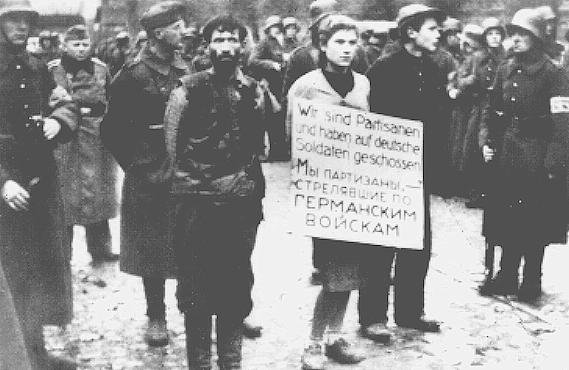
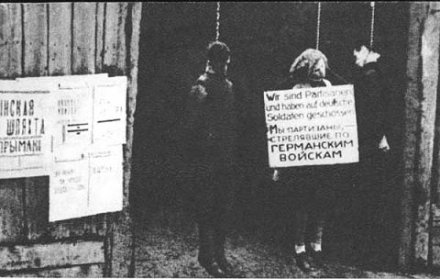
On this date in 1941, the German occupiers of Minsk conducted an infamous public hanging of partisans — perhaps the first such salutary public execution of resistance members of the war.

Jewish* 17-year-old Maria (Masha) Bruskina was the central figure of the grim tableau, and wore the placard announcing “We are partisans and have shot at German soldiers.” Evidently, she also attracted the most attention** from the onlookers to whom the scene was addressed.

Before noon, I saw the armed German and Lithuanian soldiers appear on the street. From over the bridge they escorted three people with their arms tied behind their backs. In the middle there was a girl with a sign-board on her chest. They were led up to the yeast factory gate. I noticed how calmly these people walked. The girl did not look around … The first one led to the gallows was the girl.

She was hanged with bewhiskered World War I vet Kiril Trus and the 16-year-old Volodia Shcherbatsevich. The men were members of a partisan cell organizing anti-fascist resistance; Masha Bruskina was a nurse who had been caught aiding the partisans by providing civilian clothes and papers for wounded Red Army soldiers under her care to smuggle them back to the resistance.

The scene of their deaths was captured in a series of powerful photographs taken by one of the Lithuanian Wehrmacht collaborators.

(More images here and here.)

* Phototextualities: Intersections of Photography and Narrative claims that Bruskina lightened her hair and changed her name to prevent her Jewishness affecting her resistance work; even though she was a Minsk native, her initial identification didn’t happen until 1968. The men who suffered with her were named almost immediately after the war.

** Despite the eye-catching place of the girl, she was officially unidentified for decades even after the name Masha Bruskina surfaced. In “A Historical Injustice: The Case of Masha Bruskina,” (Holocaust Genocide Studies 1997, 11:3) Nechama Tec and Daniel Weiss argued that Soviet authorities, and later Belarusian ones, found her Jewishness problematic and resisted identifying her because of it — while an ethnically Russian female partisan like Zoya Kosmodemyanskaya could be more conveniently accepted as a heroine. Maybe, but bureaucratic inertia and simple precedence (since Zoya Kosmodemyanskaya was known immediately while Masha Bruskina was not) are also plausible contributing factors.

A plaque unveiled at the Minsk yeast factory in 2009 finally called her Maria Bruskina.

On this day..

1415: French prisoners at the Battle of Agincourt

This day is called the feast of Crispian.
He that outlives this day and comes safe home,
Will stand o’ tiptoe when the day is named
And rouse him at the name of Crispian.
He that shall see this day, and live old age,
Will yearly on the vigil feast his neighbors
And say, “Tomorrow is Saint Crispian.”
Then will he strip his sleeve and show his scars,
And say, “These wounds I had on Crispin’s day.”

…And Crispin Crispian shall ne’er go by,
From this day to the ending of the world,
But we in it shall be remembered-
We few, we happy few, we band of brothers.

–Henry V, Act 4, Scene 3

In the world of Henry V, the Battle of Agincourt is a source of bursting pride for the English, a wellspring of superiority over the French and proof of the soul of those from the Isle. In spite of the inspiring speeches, the battle has passed into history as one of the enduring examples of a well-positioned army besting a much larger force.

Were it not for the story of the triumphant underdog, Agincourt would have fallen into international obscurity with much of the Hundred Years’ War, a simmering conflict for the French throne that spanned from 1337 to 1453. The notoriety of the Hundred Years’ War comes not from its intensity but from its longevity and breadth: an international conflict that swept up hundreds of wealthy European houses, it featured the first significant post-Roman standing armies, organized cavalry, and formative nationalism in both France and England.

The interminable war centered around the English crown’s claim to succession of the French throne — a claim events had overtaken by the end of the conflict in 1453 — and had already been going off and on for nearly eighty years as we lay our scene in 1415, with King Henry V of England initiating what would be known as the Lancastrian War.

Henry’s English and Welsh forces battered the French port of Harfleur starting in August 1415, which was the first holding to fall to the invading army. Almost immediately after taking control in late September of that year, the English king made a curious decision to march across Northern France from Harfleur to Calais, approximately 100 miles away.

As he tromped northeast, French troops shadowed his movements, and Henry made several attempts to shake them. After passing through Frévent, Henry turned his men north. He crossed the last major tributary of the Canche River south of Maisoncelle, hopeful that the exhausting trip was nearly through. His scouts, however, had hairy news for their king: the French force had cut the corner and was amassing north of their position. The way was blocked.

Archer? I Hardly Knew Her!

Agincourt (now spelled Azincourt) lay across a ploughed field from Tramecourt, making for a narrow defile not suited to maximizing the French force’s advantage in numbers and heavy cavalry.

Nevertheless, that advantage was considerable, or at least has conventionally been thought so, and it was in the face of desperately dwindling supplies that Henry was forced to initiate battle. The opposing French forces, ostensibly commanded by Constable Charles d’Albret, Comte de Dreux, and Marshal Boucicaut, Jean Le Maingre, allegedly outnumbered the British by at least 2 to 1 (estimates range as high as 6 to 1*).

The English drew up longbowmen in a wedge along the woods adjacent the field (map), and it was these positions that provided the decisive turn.

When the Gallic banners advanced, the English archers moved into firing range and dug in palings they had hastily manufactured from the local forest; this made a direct assault problematic while the woods prevented a flanking maneuver. French cavalry attempted to dislodge them with a concerted assault, but the defensive postures held, and the cavalry was turned away. All the while, the hail of arrows mowed down the flower of French chivalry, whose lines crumbled in panic and disorder.

As one contemporaneous account states**:

Before, however, the general attack commenced, numbers of the French were slain and severely wounded by the English bowmen. At length the English gained on them so much, and were so close, that excepting the front line, and such as had shortened their lances, the enemy could not raise their hands against them. The division under sir Clugnet de Brabant, of eight hundred men-at-arms, who were intended to break through the English archers, were reduced to seven score, who vainly attempted it. True it is, that sir William de Saveuses, who had been also ordered on this service, quitted his troop, thinking they would follow him, to attack the English, but he was shot dead from off his horse. The others had their horses so severely handled by the archers, that, smarting from pain, they galloped on the van division and threw it into the utmost confusion, breaking the line in many places. The horses were become unmanageable, so that horses and riders were tumbling on the ground, and the whole army was thrown into disorder, and forced back on some lands that had been just sown with corn. Others, from fear of death, fled; and this caused so universal a panic in the army that great part followed the example.

A confused chain of command in the French camp (the English, of course, were personally commanded by their sovereign) facilitated the rout.

Despite their military status, d’Albret and Boucicaut were outranked by several of the nobles heading the lines behind them, said nobles being prone to glory-seeking freelance charges as chivalrous as they were tactically unavailing. The Constable led the front line, followed by the Duke of Bar and the Duke of d’Alençon.

After the disastrous first charge, what remained of the second line moved in to join the fray. The French peasantry was massacred during the fight, and Constable d’Albret and the Duke of d’Alençon, along with the Duke of Orleans and Duke of Barant, along with several other nobles, fell during the assault, further disorganizing the French. (The highest-ranking English casualty was the Duke of York.)

With thousands of French dead, the third line, headed by the Count of Merle and Count of Falconberg, fell away before they entered the battle. While England’s longbows dominated the field, France’s bowmen never even participated in the battle, squeezed to the back by too many bluebloods demanding the right to charge.

Only 100-200 English are thought to have died this day; the death toll for the French was in the thousands, with hundreds more taken prisoner.


Uh-oh.

It is a portion of this lot summarily executed during the battle who offer this blog an excuse to survey the battlefield.

After a successful raid on the English supply van — the signal French achievement in the battle, and one that briefly threatened to knock out the monarch himself and turn the tide — Henry got worried that his oversized contingent of French prisoners was liable to get loose and wreak havoc in his rear. He issued the expedient but decidedly unseemly order to put his captives to death.†

Parts 1, 2, 3 and 4 of this documentary, which among other things unpacks the longbow’s actual role in the victory, given that English arrows could not penetrate French knights’ plate armor.

The Battle of Agincourt has inspired innumerable interpreters, from Shakespeare to Star Trek.

Shakespeare’s classic Henry V is frequently staged, and has hit the silver screen multiply — here’s Laurence Olivier’s version of the stirring St. Crispin’s Day speech followed by the start of battle from the 1944 production addressed to the martial fervor of World War II.

There are plans to adapt Bernard Cornwell’s Agincourt to film as well.

In the nonfiction world, Lt. Col Alfred Burne’s The Agincourt War focuses on the military side of the battle while Juliet Barker’s Agincourt: The King, the Campaign, the Battle and Agincourt: Henry V and the Battle That Made England.

The year after Agincourt, Henry V claimed all of Normandy, and in subsequent years forced the French to sign the Treaty of Troyes in 1420, which established the line of succession for Henry’s heirs to unify the crowns of the adversaries. Henry’s grand plan was foiled by his untimely death just two months after the death of King Charles VI of France, which left Henry VI — then less than a year old — as the heir to both English and French thrones.

The Dauphin Charles of France, officially disinherited by Troyes but still widely supported in France, swooped in to claim power in France, but internal dissent made his rule difficult; 30 years later (and after the intervention of Joan of Arc), Charles finally expelled the English from Aquitaine, and brought all France together not under the House of Lancaster but under the House of Valois.

* Accounts are sketchy in this regard. Some modern analysis puts the values at 4:3 for the French. However, contemporaneous accounts suggest a much heavier French advantage. Of course, people are notoriously bad at crowd estimation.

** Translation by Thomas Johnes.

† Shakespeare covers this notorious massacre as well, in Act 4, Scene 6 (the next scene opens with Englishmen horrified at the order, but the matter drops as they realize they’ve won the battle)

Alarum
But, hark! what new alarum is this same?
The French have reinforced their scatter’d men:
Then every soldier kill his prisoners:
Give the word through.

Part of the Daily Double: Agincourt.

On this day..

1415: Bardolph, Hal’s friend

On this date in 1415, on the eve of the Battle of Agincourt, the young English King Henry V approved the execution of his onetime boon companion Bardolph in William Shakespeare’s Henry V.

The fictional Bardolph had been the ruddy-nosed friend of Henry’s in the Henry IV plays (Part 1, Part 2), where the hard-drinking, rabble-rousing young prince is a disappointment to the father who fears his heir will never merit the throne.

By Henry V, the boy has become the ruler, and launched an audacious incursion into France during the Hundred Years’ War.

Hal’s willingness to own the rough decisions of statecraft — in this case having his friend put to death further to his win-French-hearts-and-minds policy — is part of his coming of age as Henry V.

Whether that means Hal’s maturation into regal dignity or the corruption of his humanity by power is up to the reader.

KING

How now Fluellen, cam’st thou from the Bridge?

FLUELLEN

I, so please your Maiestie: The Duke of Exeter
ha’s very gallantly maintain’d the Pridge; the French is
gone off, looke you, and there is gallant and most praue
passages: marry, th’ athuersarie was haue possession of
the Pridge, but he is enforced to retyre, and the Duke of
Exeter is Master of the Pridge: I can tell your Maiestie,
the Duke is a praue man

KING

What men haue you lost, Fluellen?

FLUELLEN

The perdition of th’ athuersarie hath beene very
great, reasonnable great: marry for my part, I thinke the
Duke hath lost neuer a man, but one that is like to be executed
for robbing a Church, one Bardolph, if your Maiestie
know the man: his face is all bubukles and whelkes,
and knobs, and flames a fire, and his lippes blowes at his
nose, and it is like a coale of fire, sometimes plew, and
sometimes red, but his nose is executed, and his fire’s
out

KING

Wee would haue all such offendors so cut off:
and we giue expresse charge, that in our Marches through
the Countrey, there be nothing compell’d from the Villages;
nothing taken, but pay’d for: none of the French
vpbrayded or abused in disdainefull Language; for when
Leuitie and Crueltie play for a Kingdome, the gentler
Gamester is the soonest winner.

This is Laurence Olivier’s 1944 version of the scene, with the commoner Bardolph well off-camera:

… and Kenneth Branagh’s more pathos-laden 1989 interpretation, with the king wavering a moment as he locks eyes with his doomed subject, and flashing back to bygone scenes of conviviality before delivering his troop the stern lesson of his friend’s strangling:

Although Bardolph himself and his prior relationship with his sovereign are fiction, the action of the scene actually proceeds from reality. Shakespeare has (as is his wont) cribbed Holinshed, who relates that Henry’s army was under strict orders not to pillage the countryside, and observed that discipline to a man —

except one, which was, that a souldiour tooke a pix out of a church, for which he was apprehended, and the king not once remooved [i.e., he halted] till the box was restored, and the offendor strangled. The people of the countries thereabout, hearing of such zeale in him, to the maintenance of justice, ministered to his armie victuals, and other necessaries, although by open proclamation so to doo they were prohibited.*

* As quoted in the very apt 1992 “Shakespeare’s Henry the Fifth and the Law of War” by Theodor Meron, American Journal of International Law, vol. 86, no. 1.

Part of the Daily Double: Agincourt.

On this day..

1865: Mexican Republican officers, under the Black Decree

On this date in 1865, two Republican generals, four colonels, and various other officers captured earlier in the month were executed on the authority of Mexico’s notorious Bando Negro — the “Black Decree.”

Halfway into his ill-fated three-year reign as “Emperor,” Maximilian I was in a bad way against Mexican president-turned-guerrilla Benito Juarez.

On October 3, 1865, he authorized summary execution for captured Republicans … and for anyone else who ran afoul of a nearby military official without having speedy proof of his or her political bona fides.

All individuals forming a part of armed bands or bodies existing without legal authority, whether or not proclaiming a political pretext, whatever the number of those forming such band, or its organization, character, and denomination, shall be judged militarily by the courts martial. If found guilty, even though only of the fact of belonging to an armed band, they shall be condemned to capital punishment, and the sentence shall be executed within twenty-four hours.*

In signing the Black Decree, said Mexican essayist Carlos Fuentes, Maximilian “signed his own death warrant.”

But more immediately, of course, he signed a lot of other people’s death warrants.

Republican General José María Arteaga Magallanes (Spanish link), a man of famous chivalry (once, recovering the body of the Belgian Foreign Minister’s son, he returned the boy’s watch home to dad), and fellow General Carlos Salazar Ruiz (Spanish again) were the biggest fish; they and the others are honored today as the Martyrs of Uruapan. (Spanish yet again)


The square in Uruapan where this day’s victims were shot … now known as Plaza Mártires.

* The excerpted text is Article I of the Black Decree, whose entire (taken from here) follows:

THE BANDO NEGRO (BLACK DECREE) PROCLAMATION
OF EMPEROR MAXIMILIAN, OCTOBER 3, 1865

MEXICANS: The cause sustained by D. Benito Juarez with so much valor and constancy had already succumbed, not only before the national will, but before the very law invoked by him in support of his claims. To-day this cause, having degenerated into a faction, is abandoned by the fact of the removal of its leaders from the country’s territory.

The national government has long been indulgent, and has lavished its clemency in order that men led astray or ignorant of the true condition of things might still unite with the majority of the nation and return to the path of duty. The desired result has been obtained. Men of honor have rallied around the flag and have accepted the just and liberal principles which guide its policy. Disorder is now only kept up by a few leaders swayed by their unpatriotic passions, by demoralized individuals unable to rise to the height of political principle, and by an unruly soldiery such as ever remains the last and sad vestige of civil wars.

Henceforth the struggle must be between the honorable men of the nation and bands of brigands and evil-doers. The time for indulgence has gone by: it would only encourage the despotism of bands of incendiaries, of thieves, of highwaymen, and of murderers of old men and defenseless women.

The government, strong in its power, will henceforth be inflexible in meting ont punishment when the laws of civilization, humanity, or morality demand it.

Mexico, October 2, 1865.

Maximilian, Emperor Of Mexico : Our Council of Ministers and our Council of State having been heard, we decree:

Article I. All individuals forming a part of armed bands or bodies existing without legal authority, whether or not proclaiming a political pretext, whatever the number of those forming such band, or its organization, character, and denomination, shall be judged militarily by the courts martial. If found guilty, even though only of the fact of belonging to an armed band, they shall be condemned to capital punishment, and the sentence shall be executed within twenty-four hours.

Article II. Those who, forming part of the bands mentioned in the above article, shall have been taken prisoners in combat shall be judged by the officer commanding the force into the power of which they have fallen. It shall become the duty of said officer within the twenty-four hours following to institute an inquest, hearing the accused in his own behalf. Upon this inquest a report shall be drawn and sentence shall be passed. The pain of death shall be pronounced against offenders even if only found guilty of belonging to an armed band. The chief shall have the sentence carried into execution within twenty-four hours,—being careful to secure to the condemned spiritual aid,—after which he will address the report to the Minister of War.

Article III. Sentence of death shall not be imposed upon those who, although forming part of a band, can prove that they were coerced into its ranks, or upon those who, without belonging to a band, are accidentally found there.

Article IV. If from the inquest mentioned in Article II facts should appear calculated to induce the chief to believe that the accused has been enrolled by force, or that, although forming part of the band, he was there accidentally, he shall abstain from pronouncing a sentence, and will consign the prisoner, with the corresponding report, to the court martial, to be judged in accordance with Article I.

Article V. There shall be judged and sentenced under the terms of Article I of the present law:

I. All individuals who voluntarily have procured money or any other succor to guerrilleros.

II. Those who have given them advice, news, or counsel.

III. Those who voluntarily and with knowledge of the position of said guerrilleros have sold them or procured for them arms, horses, ammunition, provisions, or any other materials of war.

Article VI. There shall be judged and sentenced in accordance with Article I:

I. Those who have entertained with guerrilleros relations constituting the fact of connivance.

II. Those who of their own free will and knowingly have given them shelter in their houses or on their estate.

III. Those who have spread orally or in writing false or alarming news calculated to disturb order, or who have made any demonstration against the public peace.

IV. The owners or agents of rural property who have not at once given notice to the nearest authority of the passage of a band upon their estate.

The persons included in the first and second sections of this article shall be liable to an imprisonment of from six months to two years, or from one to three years’ hard labor, according to the gravity of the offense.

Those who, placed in the second category, are connected with the individual concealed by them by ties of relationship, whether as parents, consorts, or brothers, shall not be liable to the penalty above prescribed, but they shall be subject to surveillance by the authorities during such time as may be prescribed by the court martial.

Those included in the third category shall be sentenced to a fine of from twenty-five to one thousand piasters or to one year’s imprisonment, according to the gravity of the offense.

Article VII. When the authorities have not given notice to their immediate superior of the passage of an armed force in their locality, the superior authority shall inflict a fine of from two hundred to two thousand piasters or from three months’ to two years’ imprisonment.

Article VIII. Every inhabitant who, having knowledge of the passage of an armed band in a village or of its approach, has not notified the authorities shall be liable to a fine of from five to five hundred piasters.

Article IX. All inhabitants between the ages of eighteen and fifty-five years of age not physically incapacitated shall, when the locality inhabited by them is threatened by a band, take part in the defense of the place, under penalty of a fine of from five to two hundred piasters or of from fifteen days’ to four months’ imprisonment. If the authorities deem it proper to punish the village for nonresistance, they may impose a fine of from two hundred to two thousand piasters, which shall be payable by all those who have not taken part in the defense.

Article X. The owners or agents of country property who, being able to defend themselves, have not kept guerrillas and other evil-doers away from their estates or have not notified the nearest military authority of their presence, or who have received the tired or wounded horses of the guerrillas without advising the said authority, shall be punished by said authority by a fine of from one hundred to two thousand piasters, according to the gravity of the offense. In cases of extreme gravity they shall be arrested and brought before the court martial, to be judged in conformity with the rules laid down by the present law. The fine shall be paid to the principal administrator of the revenue of the district where the estate is situated. The provisions of the first part of the present article are applicable to the populations.

Article XI. All authorities, whether political, military, or municipal, who have not acted in accordance with the provisions of the present law against those who are suspected of or recognized as being guilty of the offenses with which it deals, shall be liable to a fine of from fifty to one thousand piasters; and when the omission implies acquaintance with the guilty, the delinquent shall be brought before the court martial, who shall judge him and inflict a penalty in proportion to the offense.

Article XTT. Plagiarios [kidnappers] shall be judged and sentenced under the provisions of Article I of the present law, without regard to the circumstances under which the abduction shall have been committed.

Article XIII. Sentence of death passed upon those guilty of the offenses enumerated by the present law shall be executed in the time fixed, and the benefit of appeal for mercy shall be refused to the condemned. When the accused has not been condemned to death, and is a stranger, the government, after he shall have undergone punishment, may make use with regard to him of its right to expel from its territory pernicious strangers.

i Kidnappers. The Minister of Foreign Affairs, intrusted with the Department

Article XIV. Amnesty is proclaimed in favor of all who, having belonged or still belonging to armed bands and having committed no other offense, shall present themselves to the authorities before the 15th of next November. The authorities shall take possession of the arms of those so surrendering themselves.

Akticle XV. The government reserves unto itself the right to fix the time when the provisions of the present law shall cease to be enforced. Each of our ministers is bound, as far as his department is concerned, to enforce the present law and to issue such orders as will secure its strict observance.

Issued in the Palace of Mexico, October 3, 1865.

Maximilian.

On this day..

1946: The Nuremberg Trial War Criminals

Victor’s justice was never better served than this date in 1946, when the brass of Third Reich hung for crimes against humanity during the late World War II.

[audio:http://www.stelzriede.com/ms/mus/nuremexe.mp3]

(From this page of original period audio files.)

The landmark legal proceeding* is covered well enough in many other sources for this humble venue to break new ground.

Apart from trailblazing international law, the trial was notable for the gut-punching film of German atrocities; this relatively novel piece of evidence is available for perusal thanks to the magic of the Internet. Caution: Strong stuff. An hour’s worth of Nazi atrocities.The climactic hangings in the predawn hours this day in Nuremberg were conducted by an American hangman who used the American standard drop rather than the British table calibrated for efficacious neck-snapping. As a result, at least some hangings were botched strangulation jobs, a circumstance which has occasionally attracted charges of intentional barbarism.

Media eyewitness Kingsbury Smith’s taut report of the night’s executions (well worth the full read) described just such an ugly end for propagandist Julius Streicher.

At that instant the trap opened with a loud bang. He went down kicking. When the rope snapped taut with the body swinging wildly, groans could be heard from within the concealed interior of the scaffold. Finally, the hangman, who had descended from the gallows platform, lifted the black canvas curtain and went inside. Something happened that put a stop to the groans and brought the rope to a standstill. After it was over I was not in the mood to ask what he did, but I assume that he grabbed the swinging body of and pulled down on it. We were all of the opinion that Streicher had strangled.

There were in all 12 condemned to death at Nuremberg; all hanged this day except Martin Bormann (condemned in absentia; it was only years later that his death during the Nazi regime’s 1945 Gotterdammerung was established) and Hermann Goering (who cheated the executioner with a cyanide capsule two hours before hanging). The ten to die this day were:

* Its resultant Nuremberg Principles comprise a lofty articulation of principles whose actual application, as Noam Chomsky has observed, would have meant that “every post-war American president would have been hanged.”

On this day..

1815: Joachim Murat, Napoleonic Marshal

On this date in 1815, French Marshal-cum-Neapolitan King Joachim Murat was shot in Pizzo, Italy, for a failed attempt to regain his throne.

The charismatic cavalryman cuts a snazzy figure in the Napoleonic era, from its very infancy: it was Murat who secured for the 26-year-old Bonaparte the cannon used to deliver the “whiff of grapeshot” whose odor set Napoleon on the path to becoming Emperor.

Murat knew a good thing when he had it, and thereafter zipped around with the peripatetic conqueror, finding time between dashing mounted charges to marry Napoleon’s sister Caroline.

Murat’s honors multiplied with his commander’s victories: “First Horseman of Europe” (whatever that means); Grand Duke of Berg and Cleves; at last, in 1808, he was appointed King of Naples and Sicily, beneficiary via Caroline of the Corsican’s policy of installing family members to helm his satellite kingdoms.

Still, that elevation didn’t mean Murat would just retire to his Mediterranean villa and his mistresses: he was on call when Bonaparte went to invade Russia.

Leo Tolstoy, undoubtedly a hostile witness in his epic War and Peace, renders Murat as something of an oblivious dunderhead:

Though it was quite incomprehensible why he should be King of Naples, he was called so, and was himself convinced that he was so, and therefore assumed a more solemn and important air than formerly. He was so sure that he really was the King of Naples that when, on the eve of his departure from that city, while walking through the streets with his wife, some Italians called out to him: “Viva il re!” he turned to his wife with a pensive smile and said: “Poor fellows, they don’t know that I am leaving them tomorrow!”

But though he firmly believed himself to be King of Naples and pitied the grief felt by the subjects he was abandoning, latterly, after he had been ordered to return to military service — and especially since his last interview with Napoleon in Danzig, when his august brother-in-law had told him: “I made you King that you should reign in my way, but not in yours!” — he had cheerfully taken up his familiar business, and — like a well-fed but not overfat horse that feels himself in harness and grows skittish between the shafts — he dressed up in clothes as variegated and expensive as possible, and gaily and contentedly galloped along the roads of Poland, without himself knowing why or whither.

Like his fellow-Marshal Michel Ney, Murat nevertheless had the realpolitik chops to get on after their thrust to Moscow had so calamitously reversed — in Murat’s case, by cutting a deal with the Austrian Empire to retain his kingship.

But also like Ney, he couldn’t resist joining Napoleon’s ill-fated 1815 reunion tour. Murat could have survived the consequent loss of his throne, but made a quixotic bid to invade with only a handful of men the former possession whose people he quite wrongly imagined would rally to his cause.

Not the realization of the day-dreams of the most dreaming youth, not the visible acting of the strangest visions which the dramatist and romance-writer have conceived, could strike us with more wonder than the simple narration of that which befel the son of the baker of Cahors in his passage from the ranks of the French army to the throne and sceptre of Naples; and, alas! one step farther, an unquiet and a mournful one, to that small court in the castle of Pizzo, where the hero of a hundred fights, — the Achilles of the chivalrous French, — gazed for a second, with uncovered eye and serene brow on the party drawn out to send the death-volley home to his heart.

Well, this depiction of Murat’s end is plainly of more sympathetic character than Tolstoy would have done.

… the disgraceful tribunal, after consultation, declared, “That Joachim Murat, having by the fate of arms returned to the private station whence he sprung, had rashly landed in the Neapolitan dominions with twenty-eight followers, no longer relying upon war, but upon tumults and rioting; that he had excited the people to rebellion; that he had offended the rightful King; that he had attempted to throw the kingdom of Naples and the whole of Italy into confusion; and that therefore, as a public enemy, he was condemned to die, by authority of the law of the Decennium, which was still in vigour.” This very law, by a strange caprice of fortune, was one which Joachim himself had passed seven years before. He had, however, humanely suspended its operations many times, at particular seasons of his rule; and yet this very law, so passed, and so suspended by him, was made the instrument of his death.

The prisoner listened to his sentence with coolness and contempt. He was then led into a little court of the castle, where he found a party of soldiers drawn up in two files. Upon these preparations he looked calmly, and refused to permit his eyes to be covered. Then advancing in front of the party, and, placing himself in an attitude to meet the bullets, he called out to the soldiers, “Spare my face — aim at the heart.” No sooner had he uttered these words than the party fired, and he, who had been so lately King of the Two Sicilies, fell dead, holding fast with his hands the portraits of his family …

* More evidence that blood is thicker than water, since Napoleon and Murat were not chummy. According to Memoirs of Napoleon, His Court and Family, by the wife of another Napoleonic general,

The Emperor did not cherish for Murat the sincere friendship which he entertained for the other officers of the army of Italy. He used frequently to make him the subject of derision; and many of us have heard him laugh at the King of Naples, whom he used to call a Franconi King.

On this day..