1711: Ifranj Ahmad, Janissary

On this date in 1711, a Janissary captain in Ottoman Egypt was beheaded in Cairo as the “Great Insurrection” gave way to the last gasp of Mamluk power in Egypt.

Mamluks (or Mameluks) — enslaved soldiers who had evolved into a military caste — had ruled Egypt from 1250 until absorbed by the Ottoman Empire in 1517. Now nominally under the power of the sultan, Mamluks remained as beys (district governors) and were drawn into a labyrinthine political environment that boiled down to a contest for rent collection from the lucrative country.

The relative power in Egypt of the Ottoman viceroy (wali) vis-a-vis Mamluk beys in shifting alliances waxed and waned through the 17th century, but the position of wali was always fundamentally undermined by his short-term appointment and the presence of imperial troops who did not answer to him and therefore became independent players Cairo. The most prominent of these were the Janissaries — elite troops whose original servile composition somewhat mirrored the Mamluks’ own and who had established themselves as the wealthiest (and most arrogant, and most resented) regiment by making profitable commercial partnership with the Cairo artisans.

Read all about the Qasimi and Faqari founding myths (and possible realities).

As we lay our scene in the early 18th century, the Ottoman walis have been thoroughly eclipsed; politically, Mamluk Egypt is independent in all but name. The Mamluks are themselves grouped into two great factions, the Qasimi and the Faqari.*

Each faction was composed of the personal mamluks of the leader, retainers who attached themselves to the leader, bedouin tribes, men of the garrison regiments [that is, the Janissaries and other Ottoman military corps], and private armies composed of free-born Ottoman mercenaries. (From the introduction to this translation of Al-Damurdashi’s Chronicle)

An accelerating cycle of revolts and disturbances culminated in the “Great Insurrection,” (or “Great Sedition”) several years of friction climaxing in three months of armed conflict in early 1711 — “to all intents and purposes, a civil war among the elite” over dividing up spoils, as Afaf Lutfi Sayyid-Marsot puts it.

Ifranj (or Ifrandj, or Afranj) Ahmad — “Ahmad the European,” a distinctive name since the Janissaries were mostly locally born by this point — was a lower officer, but a predecessor in his position had mounted a temporarily successful revolt against the Janissary brass in the 1690’s, and Ahmad (as events would prove) commanded the loyalty of his regiment. A dispute over an attempt to remove him helped precipitate the open fighting in 1711.

Ifranj Ahmad was just an excuse … The main reason was the resentment of the other regiments, primarily the ‘Azab [“armourers” — (distantly) second only to the Janissaries among the military corps], at the privileged position and the profits the Janissaries were enjoying. … Siding with Ifranj Ahmad were the majority of the Janissaries, the pasha [the wali], … the Faqari governor of Upper Egypt who brought with him reinforcements of … bedouins, some elements of the other regiments, and most of the Faqari beys and their Mamluk households. On the other side were almost all the ‘Azab and the other regiments, 600 Janissary defectors, the Qasimiyya beys, and Qaytas Bey, a Faqari grandee who had quarrelled with … the Faqari leader, and had joined the Qasimiyya. (Egyptian Society Under Ottoman Rule)

In short, the Faqari and Qasimi factions, backed respectively by the Janissaries and the ‘Azab.

As one can readily infer from Ifranj Ahmad’s presence in these pages, the Qasimi had the better of the fight; Ahmad was nabbed trying to flee and summarily beheaded, a fate shared with several other Faqari leaders.** Here’s the account from Al-Damurdashi, an ‘Azab officer at the time:

Afranj Ahmad and his colleague had fled through the Mahjar Gate, but as they passed by the guard post … [and] captured and were [being dragged] to the ‘Azab barracks, but one of the [captors] brought [Ahmad] to the ground with a blow on his jugular vein. He then cut off his head, took it to the ‘Azab barracks and received a reward from the senior officers.

Although Istanbul would continue trying to exert its influence, this day’s denouement marked the end of real Ottoman authority on the Nile — the Turks had their hands full fighting the Russians at this moment, anyway — and inaugurated a long sunset of Mamluk power until Napoleon’s quixotic Egyptian adventure overturned it for good.

* There are many different transliterations of both these names — Faqari, Faqariya, Faqariyya … Qasimi, Qasimiya, Qasimiyya

** It was so far from an extermination, however, that the Faqari turned the tables on the Qasimi twenty years later, and the Qasimi thereupon faded from influence.

On this day..

1864: William Johnson, a bad example

On this date in 1864, the Union army in the American Civil War hanged a black deserter outside Petersburg, Va., for — in the delicate words of the army dispatch — “an attempt to outrage the person of a young lady at the New-Kent Court-house.”

The Union army was just taking up position for the coming monthslong siege of the Confederate capital, Richmond. Johnson, who confessed to deserting another unit, offered savvy blue commanders a win-hearts-and-minds opportunity: a public reassurance that the Old Dominion’s dim view of Negro outrages upon young ladies would be honored by its soon-to-be occupiers.

Not bad in theory. The execution left something to be desired.

The field of public relations being very much in its infancy, the upshot of this salutary demonstration seems not to have been conveyed to its target audience; so, when a defending Confederate battery caught sight of the gallows being thrown up in brazen view of its own lines, it jumped to the not-unreasonable conclusion that the Yanks were about to make an example of a southern spy. Rebel guns promptly made the Union detachment their “target audience.” An artillery shot struck one Sgt. Maj. G. F. Polley (or Polly) and “tore him all to pieces” before

[a] flag of truce was sent out to inform the enemy that a negro was to be hung who had insulted a white woman the day before; they stopped firing. We then marched back and saw the negro hung.

The return on investment for the souls of Johnson and the misfortunate NCO was altogether unsatisfactory:

The incident was cleverly turned to advantage by the Confederates, who had been losing hundreds of Negro laborers by desertion. The Rebels marched Negroes past the spot, pointing out to them the perils of fleeing their lines, saying that the Yankees hanged all ‘Contrabands.’ For weeks nocturnal escapes of Negroes ceased on that front. (Source)

It wasn’t a total loss, however. The Library of Congress ended up with some striking archival photos.

(There’s a better touch-up of this last photograph of Johnson’s body being cut down here.)

On this day..

1945: Aniceto Martinez, an American rapist in England

On this date in 1945, the last man executed for rape in England was hanged at Shepton Mallet prison — an American serviceman, hanged by the United States military.

Our story finds us in the Staffordshire town of Rugeley (for a second consecutive date), where a Mexican-American prisoner-camp guard named Aniceto Martinez raped a 75-year-old local. He should have put some thought into his alibi: he was the only American out of the camp that night, and hence easy pickings.

No, Martinez is notable only for his accidental milestones. His was the last U.S. military execution in Britain during World War II (actually coming over five weeks after Germany had capitulated). And he was the last person hanged on Albion’s soil for rape. This offense was not a hanging crime by English statute at the time, but was a capital offense in a U.S. military court … although all six of the personnel upon whom the sentence was inflicted were non-white, a pattern noticeable in stateside civilian cases as well.

The execution shed used by the U.S. military at Shepton Mallet Prison.

Martinez also, as it turned out, retired the use of Shepton Mallet as a facility for conducting executions. Dating to 1610, the prison had been out of commission during the 1930’s but taken over by the visiting American forces during the war years. (It’s remained in operation since, England’s oldest functioning prison.)

Though conducted under American law, the 16 hangings* at Shepton Mallet were actually carried out by British executioners in something of a procedural amalgam. American procedures in general governed the affair — and prolific British hangman Albert Pierrepoint, who conducted several, remarked on the (to him) oddities in his autobiography:

[A] custom which was strange to me was the practice of laying on a mighty feast before the execution. We were eating badly in this country at that time, but at an American execution you could be sure of the best running buffet and unlimited canned beer. The part of the routine which I found it hardest to acclimatise myself to was the, to me, sickening interval between my introduction to the prisoner and his death. Under British custom I was working to the sort of time where the drop fell between eight and twenty seconds after I had entered the condemned cell. Under the American system, after I had pinioned the prisoner, he had to stand on the drop for perhaps six minutes while his charge sheet was read out, sentence spelt out, he was asked if he had anything to say … and after that I was instructed to get on with the job.

One important concession to the British practice: use of the variable drop, designed to break the condemned wretch’s neck rather than a standard drop without accounting for the weight of the prisoner … which risked either slowly suffocating or outright decapitating the hanged man.

Northern Kentucky University professor J. Robert Lilly has more detail on American military executions at Shepton Mallet in this 1995 paper.

* There were also two executions by firing squad, “soldierly” executions for military offenses. A complete list of these executions is here.

On this day..

1937: Mikhail Tukhachevsky and seven other Soviet commanders purged

Early this date in 1937,* Soviet Marshal Mikhail Tukhachevsky was executed by a gunshot to the head for allegedly plotting a coup d’etat against Stalin.

One of the most infamous trials** of the Soviet Union’s Great Purge, which would strip the Red Army of much of its officer corps on the eve of its existential test against the Wehrmacht, the Case of the Trotskyist Anti-Soviet Military Organization has always offered fodder for debating the whys and wherefores.

The bare facts are that nine extremely high-ranking members of the military brass were suddenly arrested and within a few weeks (except the one who committed suicide first) shot on the staggering charge of counterrevolutionary conspiracy. Foremost among the victims was Marshal of the Soviet Union Mikhail Tukhachevsky, notable in the annals of military history for pioneering (along with several other Soviet officers, notably Triandafillov) the military doctrine of “deep battle” or “deep operations”.

Deep Battle

Reflecting on the grinding, indecisive struggles of attrition that characterized World War I and the Russian Civil War (both conflicts Tukhachevsky served in), he sought a theory of offensive warfare for modern armies fighting in large and complex engagements — the operational art. In an early (1923) formulation, Tukhachevsky noted

the impossibility in the presence of modern wide fronts to destroy an enemy army by a single blow compels us to achieve this by a series of successive operations … A series of annihilating operations, introduced successively and combined by continuous pursuit, can replace the annihilating engagement, which in former armies was a better type of combat. (Cited here.)

Deep operations would require sophisticated application of technology to strike an opposing army’s entire support structure behind its lines in coordinated operations, rather than the unproductive World War I tactic of throwing waves of cannon fodder across No Man’s Land in the hope of achieving a breakthrough by sheer mass alone. It ripened into official Red Army doctrine in the 1930’s, decreeing

[s]imultaneous assault on enemy defenses by aviation and artillery to the depths of the defense, penetration of the tactical zone of the defense by attacking units with widespread use of tank forces and violent development of tactical success into operational success with the aim of the complete encirclement and destruction of the enemy. The main role is performed by the infantry, and the mutual support of all types of forces are organized in its interests. (Cited here.)

What Happened?

The mystery has always been exactly why Stalin should shoot Tukhachevsky, even if any question beginning “why should Stalin shoot …” nearly answers itself.

Explanations particular to Tukhachevsky range from rivalries within the army (early blocs of officers appointed by Trotsky and Stalin formed professional rivalries; Trotsky had given Tukhachevsky his first Soviet command) to purely personal enmity between the two men. Many have speculated that a genuine “plot” of some sort — whether a coup or assassination, or more mundane political scheming — was indeed afoot against the Soviet dictator. Tukhachevsky’s (officially sanctioned) links with a German military then developing its own similar operational concepts have told against him in some readings.

Author Robert Conquest put about the theory that Heinrich Himmler’s intelligence operatives had contrived to pass the Soviets forged documents pointing to Tukhachevsky’s German collaboration, the better to weaken the Bolshevik defenses. Conversely — and in his diary, Goebbels attributed this riff on the Dolchstosslegende to Hitler himself — a contrarian take has long defended at least this particular purge as a judicious one by Uncle Joe, insuring that wartime Russia would not be hamstrung by “defeatist” elements or other players who might develop both the means and motive for ending the war on German terms.

Inquiries along these lines, of course, expand beyond the particular case into the larger questions of why Stalin purged the army as a whole, and what ultimate effect that purge had on the Soviets’ military readiness in 1941.

Legacy

With Tukhachevsky’s fall, accompanied by other military reformers, the “deep operations” school acquired sufficient taint to abjure the company of the judicious officer. Nevertheless, Tukhachevsky’s influence would play its part in the Great War: his onetime associate Georgy Zhukov, who may have only accidentally avoided being purged himself, deployed Tukhachevskian mobile tactics to crush Japan’s Siberian aspirations at the Battle of Khalkhin-Gol in 1939; duly elevated for this victory to the precarious post of Marshal of the Soviet Union, Zhukov was a crucial commander in the defeat of Nazi Germany.

Tukhachevsky, along with all those shot this day, was rehabilitated during the Khrushchev era.

Sorry about shooting you in the head. Here’s a commemorative stamp.

* The condemned received their death sentence at 23:35 on June 11, the sentence to be carried out “immediately” — it seems likely but not completely certain that it had become the 12th by the time the executions actually took place, and different sources report different different dates of death. According to the contemporaneous New York Times report, Soviet authorities announced that the executions had taken place on the 12th. (As an interesting side note, the Times that day also blurbed exiled Stalin rival Leon Trotsky reading in the tea leaves of Tukhachevsky’s death “the beginning of the end for the Stalinist dictatorship.”)

** Not, however, a show trial — Tukhachevsky et al were tried in secret.

On this day..

2001: Timothy McVeigh, Oklahoma City bomber

At 7:14 a.m. on this date in 2001, Oklahoma City bomber Timothy McVeigh was executed at the federal penitentiary in Terre Haute, Ind.

More ink has been spilled about the 33-year-old Gulf War veteran and his infamous crime than this space can possibly hope to summarize. Books can be — and have been — written debating whence McVeigh sprang and whether he was rightly convicted.

McVeigh tended to keep coy about his version of his activities on April 19, 1995,* but he was never less than frank about his philosophy.

Though his avowed motive, the Waco slaughter that occurred two years to the day before Oklahoma City, has never exactly been secret, the way he’s connected those events has also never been particularly welcome. And McVeigh would say that the fact that he suffered execution while the only parties punished in the Waco siege were the survivors makes his point.

For all its moral monstrosity, the Gulf War veteran’s critique of his violent actions vis-a-vis those the state claims legitimacy for makes discomfiting reading, and is not always so easy to answer. From our distance of time, knowing that three months after McVeigh’s execution another terrorist act to beggar Oklahoma City would propel the United States back into Iraq, it strikes eerily prescient notes.

In a 1998 essay, McVeigh savaged the government for its hypocritical posture towards the country he had once fought, Iraq:

The administration has said that Iraq has no right to stockpile chemical or biological weapons (“weapons of mass destruction”) — mainly because they have used them in the past.

Well, if that’s the standard by which these matters are decided, then the U.S. is the nation that set the precedent. The U.S. has stockpiled these same weapons (and more) for over 40 years. The U.S. claims that this was done for deterrent purposes during the “Cold War” with the Soviet Union. Why, then is it invalid for Iraq to claim the same reason (deterrence) — with respect to Iraq’s (real) war with, and the continued threat of, its neighbor Iran?

…

If Saddam is such a demon, and people are calling for war crimes charges and trials against him and his nation, why do we not hear the same cry for blood directed at those responsible for even greater amounts of “mass destruction” — like those responsible and involved in dropping bombs on [Dresden, Hanoi, Tripoli, Baghdad, Hiroshima and Nagasaki]?

…

The truth is, the use of a truck, a plane, or a missile for the delivery of a weapon of mass destruction does not alter the nature of the act itself.

These are weapons of mass destruction — and the method of delivery matters little to those on the receiving end of such weapons.

Whether you wish to admit it or not, when you approve, morally, of the bombing of foreign targets by the U.S. military, you are approving of acts morally equivalent to the bombing in Oklahoma City. The only difference is that this nation is not going to see any foreign casualties appear on the cover of Newsweek magazine.

It seems ironic and hypocritical that an act viciously condemned in Oklahoma City is now a “justified” response to a problem in a foreign land.

Another note sent shortly before his execution to author Gore Vidal travestied government warmaking talking points:

[T]his bombing was also meant as a pre-emptive (or pro-active) strike against those forces and their command and control centers within the federal building. When an aggressor force continually launches attacks from a particular base of operations, it is sound military strategy to take the fight to the enemy. Additionally, borrowing a page from U.S. foreign policy, I decided to send a message to a government that was becoming increasingly hostile, by bombing a government building and the government employees within that building who represent that government. Bombing the Murrah Federal Building was morally and strategically equivalent to the U.S. hitting a government building in Serbia, Iraq, or other nations. Based on observations of the policies of my own government, I viewed this action as an acceptable option. From this perspective what occurred in Oklahoma City was no different than what Americans rain on the heads of others all the time, and, subsequently, my mindset was and is one of clinical detachment.

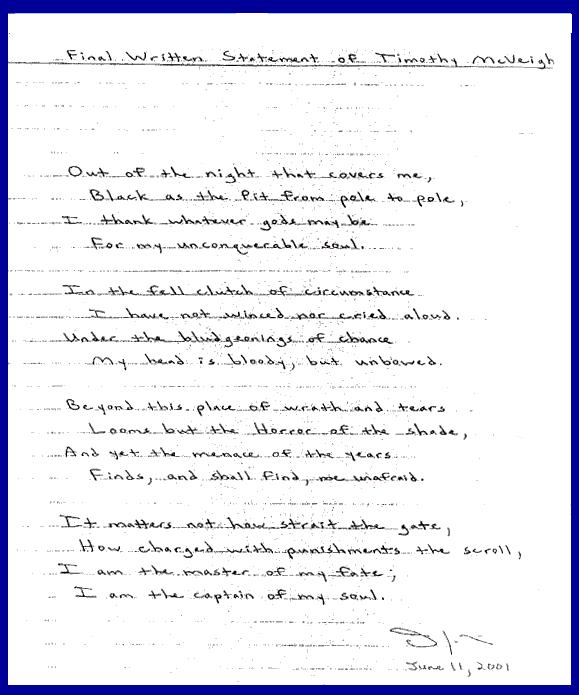
He broadcast clinical detachment in the execution itself — the first conducted by the federal government since 1963, technically imposed for the eight federal employees among his 168 victims — from his waiver of appeals to his unnervingly unblinking death mask to the stoic 19th century poem “Invictus” that formed his written (and only) final statement.

* Also — coincidentally or not — the execution date of Richard Snell in Arkansas, a militia man (and white supremacist, which McVeigh was not) who had once tried to blow up the Murrah building himself.

On this day..

1358: Guillaume Cale, leader of the Jacquerie

On this date in 1358, 14th-century France’s most serious peasant uprising was crushed when its capable commander was lured into his enemies’ power and torturously put to death in Clermont.

The Jacquerie (English Wikipedia entry | French) sprang from the fertile farmlands north of Paris. It had a hundred fathers, no one of them self-evidently the decisive cause but many in debatable combinations and proportions conspiring to render a perfect storm of catastrophe for the despised villeins who sweated out their masters’ chivalrous living.

The Calamitous 14th Century, historian Barbara Tuchman subtitled her popular work on this period: France was buffeted by famine, the Black Death, and attendant social and economic shocks; the Hundred Years’ War opened, laying the countryside waste at the hands of crossing armies, and then marauding mercenaries during the downtime between battles, and then “friendly” forces pillaging for sustenance and pressing peasants into uncompensated labor. In 1356, the English captured France’s King John II at the Battle of Poitiers, opening a yawning gap in the country’s political authority and undermining the mounted nobility’s military prestige vis-a-vis the (smaller) yeoman army that had routed it.

We do not seem to have a certain record of what match was set to this tinderbox — the most suggestive proximate cause is a fresh tax for fortifying noble citadels in the area — but the conflagration singed the gentry’s beard. Froissart, who wrote a few years after the fact and from a distinctly hostile standpoint, captured the aristocracy’s view of rising:

[C]ertain people of the common villages, without any head or ruler, assembled together in Beauvoisin. In the beginning they passed not a hundred in number they said how the noblemen of the realm of France, knights and squires, shamed the realm, and that it should be a great wealth to destroy them all: and each of them said it was true, and said all with one voice: “Shame have he that cloth not his power to destroy all the gentlemen of the realm!”

Thus they gathered together without any other counsel, and without any armour saving with staves and knives, and so went to the house of a knight dwelling thereby, and brake up his house and slew the knight and the lady and all his children great and small and brent his house. … And so they did to divers other castles and good houses; and they multiplied so that they were a six thousand, and ever as they went forward they increased, for such like as they were fell ever to them, so that every gentleman fled from them and took their wives and children with them, and fled ten or twenty leagues off to be in surety, and left their house void and their goods therein. These mischievous people thus assembled without captain or armour robbed, brent and slew all gentlemen that they could lay hands on, and forced and ravished ladies and damosels, and did such shameful deeds that no human creature ought to think on any such, and he that did most mischief was most praised with them and greatest master. I dare not write the horrible deeds that they did to ladies and damosels; among other they slew a knight and after did put him on a broach and roasted him at the fire in the sight of the lady his wife and his children; and after the lady had been enforced and ravished with a ten or twelve, they made her perforce to eat of her husband and after made her to die an evil death and all her children.

Froissart’s Chronicle is the most notable of the age and (calumniously) the most defining one on the event; it helped establish the word “jacquerie” as a synonym for bloodthirsty insurrection that would be pinned to countless riots and risings for centuries to come. Some other chronicles suggest more deliberate and purposeful (and less maniacal) organization by these original Jacques, and the trenchant “charge against these noble traitors, who have shirked on their duties to defend the kingdom, who desire to do nothing but devour the sustenance of the commoners.” (Source)

Interestingly, and seemingly contrary to the obvious reading of a downtrodden underclass driven to desperation, more recent scholarship has pointed out that the rising broke out in the best farmland, seemingly among the wealthiest of the rural third estate — artisans, proprietors, petty bureaucrats and clergy.

Leadership fell to this day’s victim, Guillaume Cale, also known by the folksy sobriquet “Jacques Bonhomme” (Goodman, or Goodfellow). A charismatic man of some fighting experience, he was able to marshal this mob into a creature of passable military capacity.

His short appearance on our stage also suggests a character of strategic vision not the less impressive for its failure to materialize.

Cale was a well-off farmer, like the backbone of his movement, and reached out to make common cause with the nearby Parisian bourgeoisie then in rebellious possession of their own city — a far more consequential challenge to authority that was soon to meet its own violent termination.

The terrorized nobility turned to Charles the Bad, King of Navarre at that time attempting to exploit the captivity of John II to hoist himself onto the throne of France. Even though Charles was also treating with the Parisian bourgeoisie in this endeavor, as Jonathan Sumption puts it in his authoritative The Hundred Years’ War: “The opportunity to present himself as the leader of the united nobility of France was not to be missed.”

Charles handled the rebels with efficiency, if not with honor. Tuchman relates:

[Charles of Navarre] invited Cale to parley, and upon this invitation from a king, Cale’s common sense apparently deserted him. Considering himself an opponent in war to whom the laws of chivalry applied, he went to the parley without a guard, whereupon his royal and noble opponent had him seized and thrown into chains. The capture of their leader by such easy and contemptuous treachery* drained the Jacques’ confidence and hope of success. When the nobles charged, the commoners succumbed … To consummate his victory, Charles of Navarre beheaded Guillaume Cale after reportedly crowning him, in wicked mockery, King of the Jacques with a circlet of red-hot iron.

The potentially tricky Battle of Mello turned into a butchery that shattered the Jacquerie, and relieved nobles gorged themselves for weeks to come on peasant blood — no less horribly than any depredation of the Jacquerie. “Our mortal foes, the English, would not have done what the nobles then did in our homeland,” wrote another 14th century scribe, Jean de Venette. (Cited by Robert Knecht; some additional Venette commentary on the Jacquerie is here, in French.)

If Cale’s decision to risk parley seems madness in retrospect, picture his situation. Sumption says the Jacquerie’s bands were already beginning to dissipate; Cale himself was known and surely in line for execution — practically the preordained denouement of every medieval peasant uprising — if he were to throw in the towel peaceably. He had no way forward but forward, and even supposing that Cale-commanded peasant lines would have held at the battle that particular day, his forces had no military prospects beyond a few more weeks.

The Jacques needed something — an exit strategy, perhaps, with the opportunity to return to life pardoned of reprisal and guaranteed against the next onerous levy; or, a cemented part in the alliance of Navarre and the Parisian bourgeoisie. To get that something, Guillaume Cale had to throw the dice, and what better odds would he get than in a pavilion face to face with the man who might become king of France? Staying in the field at the head of his ill-armed peasant horde must have looked the more improbable gamble.

Cale’s wager failed horribly this day, but from the luxurious vantage of centuries, the movement of people in those days shows the germ of an altogether more revolutionary future. Thierry‘s history of the Third Estate (available free at Google Books):

The destruction of the Jacques was followed almost immediately by the failure of the revolution of the bourgeoisie in Paris itself. Those two movements, different as they were, of the two great classes of the commonalty, terminated simultaneously — one to revive and carry all before it when its time should come; the other to leave nothing behind it but an odious name, and sad recollections.

…

The Tiers Etat, displaced from the dominant position which it had prematurely won, resumed its ordinary part of patient industry, less pretentious ambition, and slow but uninterrupted progress.

Update: Nice tangential follow-up from The Naked Philologist into a fantasy literature recommendation. Also see more about those jittery nobles.

* You’re supposed to think this is okay because chivalric codes written by nobles say nobles don’t have to keep oaths to commoners. Readers still appalled at Charles the Bad’s bad faith: enjoy the Schadenfreude of his bad end.

On this day..

1983: Simon Thelle Mogoerane, Jerry Mosololi and Marcus Motaung, anti-apartheid soldiers

This date at dawn in 1983, three African National Congress cadres were hanged — together with two unrelated common criminals — for attacks on apartheid-era South African police stations.

“Terrorists” in the eyes of the white government and “freedom fighters” in the eyes of many blacks, the “Moroka Three” — Simon Thelle Mogoerane, Jerry Mosololi and Marcus Motaung — bore arms against as part of the ANC’s military wing, Umkhonto we Sizwe (MK).

Their attacks in 1979 and 1981 had claimed the lives of four (black) policemen.

South African law until 1990 mandated hanging for a murder conviction without any extenuating circumstances — a “fact associated with the crime which serves in the mind of reasonable men to diminish morally, albeit not legally, the degree of the prisoner’s guilt.” The courtroom adjunct to MK’s guerrilla operations was establishing its position that its soldiers were prisoners of war under international law, and that that classification constituted an extenuating circumstance under South African law.

1977 protocols had extended the Geneva Conventions governing treatment of prisoners of war to explicitly cover anti-colonial and anti-racist insurgents. South Africa, unsurprisingly, did not ratify this amendment. The judge dismissed the argument that these protocols had acquired the binding force of customary international law — “we do not need to waste time.”

A decade or so later, in the waning years of apartheid, this sort of argument would find a toehold. But not in a defiantly “anti-terrorist” Pretoria of the early eighties.

The three were hanged in the face of worldwide appeals for clemency — such as this one from U.S. Congressmen and -women, and the pamphlet below by the British Anti-Apartheid Movement:

The entirety of this 24-page pamphlet is available free (at least for the remainder of this month) at the Aluka collection of digital Africa-related documents.

The executions likewise met outcry both domestic (South Africa banned public demonstrations) and international (like this U.N. resolution).

On this day..

1568: The Counts of Egmont and Hoorn, insufficiently Inquisitorial

On this date in 1568, two Flemish nobles were beheaded at Brussels’ Grand Place for treason to the Spanish crown that then ruled the Low Countries.

Lamoral, Count of Egmont and Philip de Montmorency, Count of Hoorn had a beef with the introduction of the Inquisition into the Netherlands by Egmont’s cousin, King Philip II, and got to hanging around with dubious characters like William of Orange.

Unluckily for this day’s duo, William didn’t teach them to read the writing on the wall.

After the Counts went easy on an outbreak of Protestant Iconoclasm, the Catholic king sent the hammer in the person of the Duke of Alba (or Alva).

Let this long-expired generation counsel posterity to find itself elsewhere when one’s door is darkened by a man known as “the Iron Duke”. William had the wit to get out of town. Egmont and Hoorn hung around, depending on their (professedly) clean consciences.

Oops.

Count Egmont Before His Death, by Louis Gallait

The beheadings were widely protested both locally and abroad, and festered as a grievance against the empire — a grievance that, as the nascent conflict evolved into a revolution that would detach the Netherlands from Spain, elevated these distinctly non-revolutionary wealthy nobles into freethinking martyrs of independence.

Two centuries later, Goethe put the story on the stage with his play Egmont (original German | English translation), a production for which Beethoven subsequently composed gorgeous orchestral companion pieces.

Here’s the lovely, lovely Ludwig Van’s beloved (including by Goethe himself) Overture to Egmont, Op. 84:

On this day..

1913: Antonio Echazarreta, defending Matamoros

On this date in 1913, constitutionalist troops in the Mexican Revolution consolidating control over the border town of Matamoros shot a 23-year-old colonel who helped lead the city’s volunteer resistance.

Garrisoned by fewer than 50 regular soldiers, Matamoros put up only brief resistance to Gen. Lucio Blanco‘s June 3-4 attack, many of its government officials and wealthy denizens bolting over the Rio Grande to adjacent Brownsville, Texas.*

But some of the young guns in town had an overdeveloped sense of heroic machismo and sold their lives dearly to postpone the inevitable.

Groups of young Matamoros men, some of them fourteen and fifteen years old, volunteered for service under irregular huertista officers. They fought stubbornly until early in the morning of June 4. A number of them were captured and executed by Blanco’s men. (Source.)

Echazarreta’s leadership of these ill-fated guerrillas saw him up against the wall this day, but also saw him into the revolution folk song about the city’s conquest, “Corrido de la toma de Matamoros”. Nor was the revolution yet finished with Matamoros, or its martial prowess.

In 1915, as the rival revolutionary factions openly broke with one another, carrancistas loyal to President (and Villa rival) Venustiano Carranza inflicted a signal defeat on Villa at Matamoros that began Villa’s march into political and literal wilderness. It’s commemorated in yet another revolutionary corrido, here sung by Jose Suarez (via the U.S. Library of Congress):

[audio:Corrido_villesta_de_la_toma_de_Matamoros.mp3]

* An interesting photo album covering this battle is available here.

On this day..

1962: Adolf Eichmann

On this date in 1962, the architect of the Final Solution received such justice as could be meted to him on earth at Israel’s Ramla Prison.

Adolf Eichmann, the vacuum cleaner salesman turned SS Obersturnbannfuhrer, remains the only person judicially executed in the history of modern Israel, whose intelligence services kidnapped him from Argentina where he had settled after the war.

Other Nazis had used the “only following orders” defense with little success in the Nuremberg Trials shortly after World War II. On trial years later (and at the hands a Jewish state) Eichmann — a bookish, unmenacing man who invoked Kant — posed the questions of individual responsibility and human psychology in starker terms.

To be sure, he was no anonymous functionary. Neither, however, had he dirtied his nails at the stomach-churning business end of the Holocaust: rather, he had engineered the stupendous logistical project of deporting Eastern Europe’s Jews for extermination, an (impressive) accomplishment worth exponentially more lives than any Einsatzgruppe could ever account for, yet simultaneously abstract from the upshot.

Eichmann said he did it without ill-will towards its subjects — simply to obey and to achieve.

The Banality of Evil

[I]f it was of small legal relevance, it was of great political interest to know how long it takes for an average person to overcome his innate repugnance of crime, and what exactly happens to him once he has reached that point. To this question, the case of Adolf Eichmann supplied an answer that could not have been clearer or more precise.
-Hannah Arendt

Hannah Arendt took him at his word* and saw in Eichmann the abyss gazing back into us, into his judges — not a monster but a man unsettling in his normalcy, whose job was not TPS reports or quarterly sales results but turning humans into ash.

The company man. The career man. Every man, standing in for countless thousands more who pushed the papers that drove the trains to Auschwitz.

What for Eichmann was a job, with its daily routine, its ups and downs, was for the Jews quite literally the end of the world.

Not everyone accepts her conclusions, but Arendt’s characterization of “the banality of evil” has become the man’s epigraph. And Eichmann disturbs us precisely because we seem to be able to meet him on his terms, even sympathize with him when the horror of his crimes begs for a monster like Streicher or Goebbels we could safely consign to the Other.

Arendt’s turn of phrase has a certain breezy (hackneyed, even) life in the public discourse, but her analysis of Eichmann’s careerism remains a challenging and deeply relevant one for we heirs of the world that hanged him.

The complete transcript of Eichmann’s trial is available online here. Video of his trial has been posted online here (in English) and here (original languages).

* Albeit with some reservations; others have argued that Eichmann was considerably more personally invested in his mass-murder project than his demeanor at trial admitted. Certainly he had an interest in showing the mellower Eichmann when he was on trial for his life.

On this day..