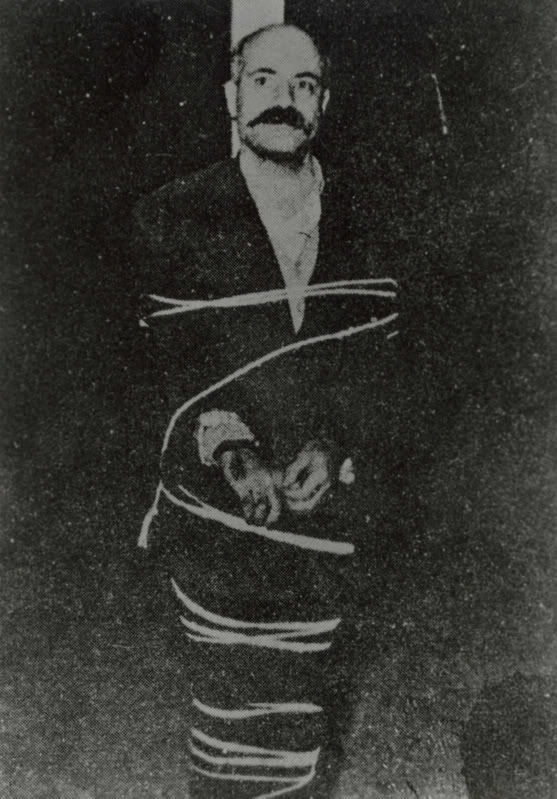
On this date in 1866 (September 3 O.S.; September 15 N.S.), Russian revolutionary Dmitry Karakozov was hanged in Peter and Paul Fortress for attempting to assassinate Tsar Alexander II.
Karakozov was a son of noble stock — the self-hating variety, obviously, and suicidally disturbed into the bargain. He supposedly hailed from a terrorism cell branding itself “Hell”, although this was bandied about by the police afterwards and conveniently supported a hunt for radicals.
Karakozov, at least, considered the state of tsarist Russia positively infernal, and on April 4, 1866, he went to scourge it — firing a shot at the monarch at St. Petersburg’s Summer Garden. He missed.
The tsar’s guards tackled him as he fled, and the unharmed Alexander walked up to the gunman and asked him, “What do you want?” He may have been genuinely bewildered: Alexander was the guy trying to liberalize Russia. Just a few years before, he had freed the serfs.
“Nothing,” Karakazov replied. “Nothing.”
A statement of implacability: no progress would be bargained with even the most progressive despot. The despotism itself must go. A manifesto addressed to “Friends-Workers” was found in his pocket underscoring the point; it read in part (translated from p. 21 of this Russian pdf):
I have decided to destroy the wicked Tsar, and to die for my beloved people…
If I accomplish this deed, I will die with the thought that in death I did something good for my dear friend, the Russian peasant.
If I do not accomplish it, then others will follow my path. Where I fail, they will succeed, and my death will be their example and inspiration.
Karakozov himself, the first Russian revolutionary to attempt regicide, didn’t seem to have revolutionary satisfaction on his mind at the end. He converted to Orthodox Christianity in prison, sought “as a Christian, of a Christian” his prospective victim’s clemency … and multiple newspaper accounts report him kneeling to kiss a cross presented to him on the scaffold by the priest. (All via Odd Man Karakozov, which argues that all this need not imply such a reversal of conscience as it might appear.)
What certainly did happen — more immediately than those copycat assassinations — was a reactionary wave of national chauvinism, whose more wretched manifestations will not be unfamiliar to the present day. The patriotic Glinka opera Ivan Susanin was staged a few days later at the Bolshoi in Moscow. According to an eyewitness account of Tchaikovsky quoted in Romanov Riches: Russian Writers and Artists Under the Tsars, this salute to a Russian peasant’s sacrifice for the Romanov dynasty went a little bit off-script.
I think the Moscow audience went beyond the bounds of sense in their outburst of enthusiasm. The opera was not really performed, for as soon as the Poles appeared onstage, the whole theater shouted, “Down with the Poles!” and so on. In the last scene of Act 4, when the Poles are supposed to kill Susanin …
… the actor playing him started fighting the chorus members who played Poles, and being very strong, knocked down several of them, while the rest of the extras, seeing that the audience approved this mockery of art, truth, and decency, fell down, and the triumphant Susanin left unharmed, brandishing his arms, to the deafening applause of the Muscovites.
If true, that is little short of fantastic.
The apparatus of state went so far as to build up a new Susanin for the occasion at hand, hyping a questionable story that a young peasant named Osip Komissarov — who was from Susanin’s own province of Kostroma — had jostled Karakozov just as he took the shot, causing it to go awry. The good-natured bumpkin was rewarded with summary ennoblement as “Komissarov-Kostromskoy” and eye-rollingly terrible poetic tributes from the likes of Vyazemsky and Nekrasov. However, Komissarov’s embarrassing stupidity and want of manners would eventually necessitate Komissarov-Kostromskoy’s being packed out of polite society to country estates on a generous pension to bankroll his ample appetite for liquor.
So Dmitry Karakozov did do something for the Russian peasant after all.
On this date* in French-occupied Moscow of the War of 1812, many alleged arsonists — unnamed and unnumbered — were shot by Napoleon’s army in the ashes of Moscow.
Although real, flesh-and-blood Muscovites died, they are best known via their bespectacled fictional companion, Pierre Bezukhov, whose miraculous escape is one of the pivotal episodes of Tolstoy’s War and Peace.
Merely the greatest novel in history by some reckonings — we’ll just let Tolstoy fight it out with Dostoyevsky for top of table in the competitive 19th Century Russia literary scene — the epic War and Peace tracks that country’s transformation under the revolutionary pressures of the Napoleonic age.
In Russian director Sergey Bondarchuk’s sprawling cinematic adaptation of War and Peace, the part of Pierre Bezukhov is played by Bondarchuk himself.
Pierre Bezukhov (“without ears”) is one of the book’s central figures, the illegitimate son of a count who unexpectedly inherits, forever consumed with his next impulsive, passionate quest for meaning (boozing around, freemasonry, religion …).
Pierre finds himself present in Moscow when the Grande Armeerolls in following its Pyrrhic victory at the Battle of Borodino. His fancy of the moment is to assassinate Napoleon: “he suddenly felt that what before had seemed to him merely a possibility had now become absolutely necessary and inevitable. He must remain in Moscow, concealing his name, and must meet Napoleon and kill him, and either perish or put an end to the misery of all Europe.” And to think, a younger Pierre actually used to admire Napoleon.
Historically, the city of Moscow started burning as soon as the French occupied it. The reasons for this conflagration have been widely disputed; Tolstoy detours in War and Peace to characterize it as nothing more than the natural consequence of the occupation, when the city’s civil infrastructure has broken down and the everyday fires that spark in wooden buildings are more liable to grow out of control.
The French blamed terrorists.
A bulletin of the Grande Armee dated September 20 (Gregorian date; this corresponds to the Julian date September 8) reports on the successful efforts to bring arsonists to heel through the expedient of mass executions.
Three hundred incendiaries have been arrested and shot; they were provided with fuse six inches long, which they had between two pieces of wood: they had also squibs, which they threw upon the roofs of the houses. The wretch Rastapchin had these prepared, on the pretence that he wished to send a balloon, full of combustible matter, amidst the French army …
The fires subsided on the 19th and 20th; three quarters of the city are burned; among other palaces that beautiful one of Catherine, which had been newly furnished: not above a quarter of the houses remain. …
Manufactures were beginning to flourish at Moscow: they are destroyed. The conflagration of this capital will throw Russia one hundred years back. The weather is becoming rainy: the greatest part of the army is in barracks in Moscow.
In this paranoid occupation, the fictional Pierre, wandering Moscow armed without a good excuse, gets himself picked up by French troops.
The travail of his resulting drumhead trial offers the anti-authoritarian (and anti-death penalty) Tolstoy the opportunity to reflect on the “legal” arrangements, a passage Tolstoy dates September 8 on the Julian calendar — the same day that army bulletin above was penned.
[Pierre] learned that all these prisoners (he, probably, among them) were to be tried for incendiarism. On the third day he was taken with the others to a house where a French general with a white mustache sat with two colonels and other Frenchmen with scarves on their arms. With the precision and definiteness customary in addressing prisoners, and which is supposed to preclude human frailty, Pierre like the others was questioned as to who he was, where he had been, with what object, and so on.
These questions, like questions put at trials generally, left the essence of the matter aside, shut out the possibility of that essence’s being revealed, and were designed only to form a channel through which the judges wished the answers of the accused to flow so as to lead to the desired result, namely a conviction. As soon as Pierre began to say anything that did not fit in with that aim, the channel was removed and the water could flow to waste. Pierre felt, moreover, what the accused always feel at their trial, perplexity as to why these questions were put to him. He had a feeling that it was only out of condescension or a kind of civility that this device of placing a channel was employed. He knew he was in these men’s power, that only by force had they brought him there, that force alone gave them the right to demand answers to their questions, and that the sole object of that assembly was to inculpate him. And so, as they had the power and wish to inculpate him, this expedient of an inquiry and trial seemed unnecessary. It was evident that any answer would lead to conviction.
It’s only by Pierre’s chance ability to forge a human connection with the officer detailed to condemn him that he’s mysteriously, and arbitrarily, not sentenced to death — a fact that Pierre doesn’t even realize until he’s led out with the rest of the prisoners only to see that it’s “only” the others who are being shot. This is the narration at length from Book XII, Chapters 10-11.
On the eighth of September an officer- a very important one judging by the respect the guards showed him- entered the coach house where the prisoners were. This officer, probably someone on the staff, was holding a paper in his hand, and called over all the Russians there, naming Pierre as “the man who does not give his name.” Glancing indolently and indifferently at all the prisoners, he ordered the officer in charge to have them decently dressed and tidied up before taking them to the marshal. An hour later a squad of soldiers arrived and Pierre with thirteen others was led to the Virgin’s Field. It was a fine day, sunny after rain, and the air was unusually pure. The smoke did not hang low as on the day when Pierre had been taken from the guardhouse on the Zubovski rampart, but rose through the pure air in columns. No flames were seen, but columns of smoke rose on all sides, and all Moscow as far as Pierre could see was one vast charred ruin. On all sides there were waste spaces with only stoves and chimney stacks still standing, and here and there the blackened walls of some brick houses. Pierre gazed at the ruins and did not recognize districts he had known well. Here and there he could see churches that had not been burned. The Kremlin, which was not destroyed, gleamed white in the distance with its towers and the belfry of Ivan the Great. The domes of the New Convent of the Virgin glittered brightly and its bells were ringing particularly clearly. These bells reminded Pierre that it was Sunday and the feast of the Nativity of the Virgin. But there seemed to be no one to celebrate this holiday: everywhere were blackened ruins, and the few Russians to be seen were tattered and frightened people who tried to hide when they saw the French.
…
Pierre had been taken by one set of soldiers and led first to one and then to another place with dozens of other men, and it seemed that they might have forgotten him, or confused him with the others. But no: the answers he had given when questioned had come back to him in his designation as “the man who does not give his name,” and under that appellation, which to Pierre seemed terrible, they were now leading him somewhere with unhesitating assurance on their faces that he and all the other prisoners were exactly the ones they wanted and that they were being taken to the proper place. Pierre felt himself to be an insignificant chip fallen among the wheels of a machine whose action he did not understand but which was working well.
He and the other prisoners were taken to the right side of the Virgin’s Field, to a large white house with an immense garden not far from the convent. This was Prince Shcherbatov‘s house, where Pierre had often been in other days, and which, as he learned from the talk of the soldiers, was now occupied by the marshal, the Duke of Eckmuhl (Davout).
They were taken to the entrance and led into the house one by one. Pierre was the sixth to enter. He was conducted through a glass gallery, an anteroom, and a hall, which were familiar to him, into a long low study at the door of which stood an adjutant.
Davout, spectacles on nose, sat bent over a table at the further end of the room. Pierre went close up to him, but Davout, evidently consulting a paper that lay before him, did not look up. Without raising his eyes, he said in a low voice:
“Who are you?”
Pierre was silent because he was incapable of uttering a word. To him Davout was not merely a French general, but a man notorious for his cruelty. Looking at his cold face, as he sat like a stern schoolmaster who was prepared to wait awhile for an answer, Pierre felt that every instant of delay might cost him his life; but he did not know what to say. He did not venture to repeat what he had said at his first examination, yet to disclose his rank and position was dangerous and embarrassing. So he was silent. But before he had decided what to do, Davout raised his head, pushed his spectacles back on his forehead, screwed up his eyes, and looked intently at him.
“I know that man,” he said in a cold, measured tone, evidently calculated to frighten Pierre.
The chill that had been running down Pierre’s back now seized his head as in a vise.
“You cannot know me, General, I have never seen you…”
“He is a Russian spy,” Davout interrupted, addressing another general who was present, but whom Pierre had not noticed.
Davout turned away. With an unexpected reverberation in his voice Pierre rapidly began:
“No, monseigneur,” he said, suddenly remembering that Davout was a duke. “No, monseigneur, you cannot have known me. I am a militia officer and have not quitted Moscow.”
“Your name?” asked Davout.
“Bezukhov.”
“What proof have I that you are not lying?”
“Monseigneur!” exclaimed Pierre, not in an offended but in a pleading voice.
Davout looked up and gazed intently at him. For some seconds they looked at one another, and that look saved Pierre. Apart from conditions of war and law, that look established human relations between the two men. At that moment an immense number of things passed dimly through both their minds, and they realized that they were both children of humanity and were brothers.
At the first glance, when Davout had only raised his head from the papers where human affairs and lives were indicated by numbers, Pierre was merely a circumstance, and Davout could have shot him without burdening his conscience with an evil deed, but now he saw in him a human being. He reflected for a moment.
“How can you show me that you are telling the truth?” said Davout coldly.
Pierre remembered Ramballe, and named him and his regiment and the street where the house was.
“You are not what you say,” returned Davout.
In a trembling, faltering voice Pierre began adducing proofs of the truth of his statements.
But at that moment an adjutant entered and reported something to Davout.
Davout brightened up at the news the adjutant brought, and began buttoning up his uniform. It seemed that he had quite forgotten Pierre.
When the adjutant reminded him of the prisoner, he jerked his head in Pierre’s direction with a frown and ordered him to be led away. But where they were to take him Pierre did not know: back to the coach house or to the place of execution his companions had pointed out to him as they crossed the Virgin’s Field.
He turned his head and saw that the adjutant was putting another question to Davout.
“Yes, of course!” replied Davout, but what this “yes” meant, Pierre did not know.
Pierre could not afterwards remember how he went, whether it was far, or in which direction. His faculties were quite numbed, he was stupefied, and noticing nothing around him went on moving his legs as the others did till they all stopped and he stopped too. The only thought in his mind at that time was: who was it that had really sentenced him to death? Not the men on the commission that had first examined him — not one of them wished to or, evidently, could have done it. It was not Davout, who had looked at him in so human a way. In another moment Davout would have realized that he was doing wrong, but just then the adjutant had come in and interrupted him. The adjutant, also, had evidently had no evil intent though he might have refrained from coming in. Then who was executing him, killing him, depriving him of life — him, Pierre, with all his memories, aspirations, hopes, and thoughts? Who was doing this? And Pierre felt that it was no one.
It was a system — a concurrence of circumstances.
A system of some sort was killing him — Pierre — depriving him of life, of everything, annihilating him.
From Prince Shcherbatov’s house the prisoners were led straight down the Virgin’s Field, to the left of the nunnery, as far as a kitchen garden in which a post had been set up. Beyond that post a fresh pit had been dug in the ground, and near the post and the pit a large crowd stood in a semicircle. The crowd consisted of a few Russians and many of Napoleon’s soldiers who were not on duty- Germans, Italians, and Frenchmen, in a variety of uniforms. To the right and left of the post stood rows of French troops in blue uniforms with red epaulets and high boots and shakos.
The prisoners were placed in a certain order, according to the list (Pierre was sixth), and were led to the post. Several drums suddenly began to beat on both sides of them, and at that sound Pierre felt as if part of his soul had been torn away. He lost the power of thinking or understanding. He could only hear and see. And he had only one wish- that the frightful thing that had to happen should happen quickly. Pierre looked round at his fellow prisoners and scrutinized them.
The two first were convicts with shaven heads. One was tall and thin, the other dark, shaggy, and sinewy, with a flat nose. The third was a domestic serf, about forty-five years old, with grizzled hair and a plump, well-nourished body. The fourth was a peasant, a very handsome man with a broad, light-brown beard and black eyes. The fifth was a factory hand, a thin, sallow-faced lad of eighteen in a loose coat.
Pierre heard the French consulting whether to shoot them separately or two at a time. “In couples,” replied the officer in command in a calm voice. There was a stir in the ranks of the soldiers and it was evident that they were all hurrying — not as men hurry to do something they understand, but as people hurry to finish a necessary but unpleasant and incomprehensible task.
A French official wearing a scarf came up to the right of the row of prisoners and read out the sentence in Russian and in French.
Then two pairs of Frenchmen approached the criminals and at the officer’s command took the two convicts who stood first in the row. The convicts stopped when they reached the post and, while sacks were being brought, looked dumbly around as a wounded beast looks at an approaching huntsman. One crossed himself continually, the other scratched his back and made a movement of the lips resembling a smile. With hurried hands the soldiers blindfolded them, drawing the sacks over their heads, and bound them to the post.
Twelve sharpshooters with muskets stepped out of the ranks with a firm regular tread and halted eight paces from the post. Pierre turned away to avoid seeing what was going to happen. Suddenly a crackling, rolling noise was heard which seemed to him louder than the most terrific thunder, and he looked round. There was some smoke, and the Frenchmen were doing something near the pit, with pale faces and trembling hands. Two more prisoners were led up. In the same way and with similar looks, these two glanced vainly at the onlookers with only a silent appeal for protection in their eyes, evidently unable to understand or believe what was going to happen to them. They could not believe it because they alone knew what their life meant to them, and so they neither understood nor believed that it could be taken from them.
Again Pierre did not wish to look and again turned away; but again the sound as of a frightful explosion struck his ear, and at the same moment he saw smoke, blood, and the pale, scared faces of the Frenchmen who were again doing something by the post, their trembling hands impeding one another. Pierre, breathing heavily, looked around as if asking what it meant. The same question was expressed in all the looks that met his.
On the faces of all the Russians and of the French soldiers and officers without exception, he read the same dismay, horror, and conflict that were in his own heart. “But who, after all, is doing this? They are all suffering as I am. Who then is it? Who?” flashed for an instant through his mind.
“Sharpshooters of the 86th, forward!” shouted someone. The fifth prisoner, the one next to Pierre, was led away- alone. Pierre did not understand that he was saved, that he and the rest had been brought there only to witness the execution. With ever-growing horror, and no sense of joy or relief, he gazed at what was taking place. The fifth man was the factory lad in the loose cloak. The moment they laid hands on him he sprang aside in terror and clutched at Pierre. (Pierre shuddered and shook himself free.) The lad was unable to walk. They dragged him along, holding him up under the arms, and he screamed. When they got him to the post he grew quiet, as if he suddenly understood something. Whether he understood that screaming was useless or whether he thought it incredible that men should kill him, at any rate he took his stand at the post, waiting to be blindfolded like the others, and like a wounded animal looked around him with glittering eyes.
Pierre was no longer able to turn away and close his eyes. His curiosity and agitation, like that of the whole crowd, reached the highest pitch at this fifth murder. Like the others this fifth man seemed calm; he wrapped his loose cloak closer and rubbed one bare foot with the other.
When they began to blindfold him he himself adjusted the knot which hurt the back of his head; then when they propped him against the bloodstained post, he leaned back and, not being comfortable in that position, straightened himself, adjusted his feet, and leaned back again more comfortably. Pierre did not take his eyes from him and did not miss his slightest movement.
Probably a word of command was given and was followed by the reports of eight muskets; but try as he would Pierre could not afterwards remember having heard the slightest sound of the shots. He only saw how the workman suddenly sank down on the cords that held him, how blood showed itself in two places, how the ropes slackened under the weight of the hanging body, and how the workman sat down, his head hanging unnaturally and one leg bent under him. Pierre ran up to the post. No one hindered him. Pale, frightened people were doing something around the workman. The lower jaw of an old Frenchman with a thick mustache trembled as he untied the ropes. The body collapsed. The soldiers dragged it awkwardly from the post and began pushing it into the pit.
They all plainly and certainly knew that they were criminals who must hide the traces of their guilt as quickly as possible.
Pierre glanced into the pit and saw that the factory lad was lying with his knees close up to his head and one shoulder higher than the other. That shoulder rose and fell rhythmically and convulsively, but spadefuls of earth were already being thrown over the whole body. One of the soldiers, evidently suffering, shouted gruffly and angrily at Pierre to go back. But Pierre did not understand him and remained near the post, and no one drove him away.
When the pit had been filled up a command was given. Pierre was taken back to his place, and the rows of troops on both sides of the post made a half turn and went past it at a measured pace. The twenty-four sharpshooters with discharged muskets, standing in the center of the circle, ran back to their places as the companies passed by.
Pierre gazed now with dazed eyes at these sharpshooters who ran in couples out of the circle. All but one rejoined their companies. This one, a young soldier, his face deadly pale, his shako pushed back, and his musket resting on the ground, still stood near the pit at the spot from which he had fired. He swayed like a drunken man, taking some steps forward and back to save himself from falling. An old, noncommissioned officer ran out of the ranks and taking him by the elbow dragged him to his company. The crowd of Russians and Frenchmen began to disperse. They all went away silently and with drooping heads.
“That will teach them to start fires,” said one of the Frenchmen.
Pierre glanced round at the speaker and saw that it was a soldier who was trying to find some relief after what had been done, but was not able to do so. Without finishing what he had begun to say he made a hopeless movement with his arm and went away.
* It’s our practice (although we’re sure it’s been violated here and there) to utilize Gregorian dates universally after the mid-18th century, even for executions in Orthodox Christendom where the Julian calendar prevailed into the 20th century. For this post, seeing as it’s straight from the text of Tolstoy himself, in his magnum opus, channeling the soul of the Russian rodina, we’re making an exception: the 12-day-slower, local-to-Russia Julian calendar prevails … just like the Russians themselves did.
The investigations following upon the recent raids on Anarchist dens here prove the existence of a revolutionary plot on a vast scale and show that there was a systematically organized “college” … where bombs were manufactured and instruction in explosives was given … The prisoners talk freely of their “heroic conduct” and “noble design,” while refusing to impart any informaton incriminating those working behind the scenes and furnishing the funds. They all confess, however, that their minds have been fired by writings in the Press and speeches on platforms.
–London Times
It’s a timeless story, really; with a tweak here or there, the excerpt above could do for reportage on seditious movements by the hundredfold. As it happens, its dateline is May 11, 1908 — Calcutta.
Separatist stirrings on the subcontinent were then manifesting themselves in the explosive revolutionary language of the day, and the chief magistrate of that ancient city of Calcutta — Kingsford by name, as in charcoal — was a character notorious for his harshness toward the movement. The year before, he’d had a 15-year-old flogged for trying to stop a British soldier beating Indian activists.
Among the more militant types excited to wrath against Kingsford was an 18-year-old Bengali who would have the privilege of martyrdom for the cause of national self-determination.
Khudiram Bose sought the judge out in Muzaffarpur and, with another young revolutionary, attempted to assassinate him in April 1908 by tossing a couple of bombs into Kingsford’s carriage.
Minor problem: it was the wrong carriage.
Instead of popping the nefarious judge, the bombs killed the wife and daughter of a barrister.
The other assassin committed suicide when cornered by police, but Bose would meet his end via the judiciary.
Bose played his patriotic martyr’s role to the hilt in the few brief weeks before his hanging, and found himself on the leading edge of a growing movement of anti-British bombers. “People are prepared to do anything for the sake of swarajya [home rule] and they no longer sing the glories of British rule,” one contemporary newspaper (quoted here) put it. “They have no dread of British power. It is simply a question of sheer brute force.” The editor was convicted of seditious libel.
One can now find plentiful Khudiram Bose hagiographies celebrating the youthful freedom fighter … regardless of his target selection.
On this date in 1916, Captain Charles Fryatt was shot at Bruges, Belgium as an illegal combatant.
Fryatt was a 42-year-old civilian mariner captaining the SS Brussels on the Harwick-Hook of Holland route when, in March 1915, a German U-Boat ordered him to heave to.
Fryatt wheeled the Brussels around on the submarine and attempted to ram it. The German ship escaped by a whisker only by scrambling an emergency dive. The Admiralty gave Fryatt a gold watch and a pat on the head for bravery.
It was not until the following year that the Germans captured that same vessel with that same captain on board. When they realized who they had, they subjected him to a snap tribunal for violating the laws of war: he’d participated in combat (by trying to ram the U-Boat) whilst being not a member of his country’s armed forces. That made him an illegal combatant, a franc-tireur in the still-current term for a civilian partisan left over from the Franco-Prussian War.
The Germans mightily loathed such terrorists, feared they would bedevil their steps in Belgium and France: people not sporting enough to stay beaten, people with the effrontery to fight back without being a duly enrolled member of a nation-state’s standing army. They did not scruple to push an expansive line on the definition of civilian non-participation.
“Every non-uniformed person,” read the a Moltke directive to the army, “if he is not designated as being justified in participating in fighting by clearly recognizable insignia, is to be treated as someone standing outside international law, if he takes part in the fighting … [or] participates in any way in the act of war without permission. He will be treated as a franc-tireur and immediately shot according to martial law.” (Source.)
So … that’s exactly what happened to Captain Fryatt.
This shooting set off a flurry of international recriminations and rebuttals.
People of normal moral sense can see readily enough that a merchant captain who scares off a submarine has not committed a grave crime any more than has a teen who chucks a grenade at commando firing at his home. The legal question for deliberation in Fryatt’s case was all about whether the merchant mariner had or had not committed an impermissible belligerent act by charging* … and as always, the definition of a war crime turned out to mirror precisely the political interest of the definer.
The British at this point had the Germans handily bottled up in a naval blockade that even seized food as “contraband”. (A tactic angrily denounced as a war crime in Berlin.) The Germans needed to get out of this stranglehold, and lacking anything approaching parity on the high seas, they staked their hopes on the U-boat. So the German interest was for maximum latitude for submarine activity; in fact, early in 1915, it was just in the process of rolling out its unrestricted submarine warfare policy of unannounced attacks on civilian freighters carrying war materiel. This does not seem to be what the U-boat stopping the Brussels did, but it gives you an idea of the scene. German military judges naturally said that German submarines who stopped a British merchant ship were not to be defied.
And the British interest, and by wonderous coincidence also its policy and legal position, naturally maintained maximum restrictions on a U-Boat’s potential targets, and maximum rights for the realm’s Captain Fryatts to resist.**
Fryatt, indeed, had followed the directives laid down by that Lord of the Admiralty, Winston Churchill. Churchill threatened to prosecute any ship captain who surrendered his vessel to a U-boat without opposing it “either with their armament if they possess it, or by ramming”: the theory was that routine resistance would maximize costs to the German navy, and maybe lead slow and vulnerable U-boats to skip the parley stage in favor of sneak attacks on unflagged steamers, which would sooner or later sink an American ship, which would help pull the U.S. into the war. (In May 1915, making no mistake at all about its target, a German U-boat intentionally torpedoed the Lusitania, generating a helpful stateside scandal also attended by dickering over the legality of the attack.)
So, the initial German announcement tersely reported that Fryatt
was condemned to death because, although he was not a member of a combatant force, he made an attempt on the afternoon of March 20, 1915, to ram the German submarine U-33 … One of the many nefarious franc-tireur proceedings of the British merchant marine against our war vessels has thus found a belated but merited expiation.
Britain replied that the captain had exercised only his “undoubted right of resistance,” and pointed out that a different merchant vessel that did obey such an order on the very same day had been sunk before it could evacuate — drowning 104 souls.
[T]he experience of German methods of warfare warned him that surrender would be no guarantee that the lives of his crew would be spared.
He determined therefore to take the best chance of saving his ship, and to steer for the submarine in order to force her to dive, and, if she were not quick enough in diving, to ram her.
This was his undoubted right under international law – to disregard her summons and resist her attack to the best of his power. It was a contest of skill and courage in which each side took their chance.
This led Germany to reiterate, on August 10, its view that Fryatt’s
act was not an act of self-defence, but a cunning attack by hired assassins …
The German War Tribunal sentenced him to death because he had performed an act of war against the German sea forces, although he did not belong to the armed forces of his country. He was not deliberately shot in cold blood without due consideration, as the British Government asserts, but he was shot as a franc-tireur, after calm consideration and thorough investigation …
Germany will continue to use this law of warfare in order to save her submarine crews from becoming the victims of francs-tireurs at sea.
There’s a 1917 monument to Captain Fryatt still displayed at London’s Liverpool Street Station, as well as a mountain in Alberta named in his honor.
Nobody was ever prosecuted for Fryatt’s execution.
* The distinction as parsed by Germany hung on whether the intended merchant prize was armed (allowed to resist) or unarmed (not).
** U-boats were new legal territory in 1915. The 1930 London Naval Treaty — although Germany was not party to it — attempted to clarify the status of these machines.
On this date in 1804, royalist counterrevolutionary Georges Cadoudal was guillotined in Paris with eleven of his chouan brothers-in-arms.
Cadoudal (English Wikipedia entry | the much more detailed French) was the French Revolution’s ultimate antagonist, a Breton notary (and commoner, obviously) who obstinately resisted the bloody progress of those years to the last of his strength.
His decade of royalist adventures (French) reads* like an adventure novel, a mind-bogglingly perilous series of revolts, captures, escapes, rappelling, martial exploits, diplomatic intrigue, terrorist plotting, high principles, low politics … a desperately heroic (or anti-heroic) struggle using every resource of a changing world to claw back the lost age of Bourbons.
After that dynasty’s last (up until then) king was guillotined in 1793, the intrepid Cadoudal staked his life to the 1793 Vendee rising, mounted an insurrection at Brest, and became one of the principal leaders of the anti-revolutionary Chouannerie fighting les bleus around northwest France through the 1790s.
Beaten but not bowed, Cadoudal took refuge in England when those campaigns came to grief following the royalist debacle at Quiberon, but he was never one to retire to the exile social circuit. Cadoudal remained an active schemer against the France of a rising Napoleon Bonaparte, and he was backed now by Britain’s statecraft … and her gold.
Spurning a proffered arrangement with the Corsican — who, say what one will, could recognize ability when he saw it — Cadoudal instead oversaw a dramatic 1800 assassination attempt on Napoleon that didn’t get the dictator but blew a bunch of Parisian bystanders to smithereens.
This effort having failed, our persistent intriguer slipped back into France to attempt an even bolder venture to kidnap Napoleon and elevate the Duke of Enghien — the going Bourbon candidate, who lurked on the French frontier to rush into the power vacuum.
This didn’t work either. As outlandish as the idea seems with benefit of hindsight, it was hardly a crackpot plan — as attested by the credentials of its participants.
“All Europe laughs at the conspiracy in Paris; it was, however, a well-built machine. Men, money, everything was ready. Bonaparte was to be taken alive and carried out like lightning from one post to the sea and the English fleet … I am inconsolable that it missed its mark. Those who criticize the French princes that they do not risk themselves while others fight for them, they will be the first to cry: What madness! How childish! [that d’Enghien risked himself] That is how men are made.”
Which is a long way of saying that it still comes down to wins and losses.
Having lost, the Bourbon pretender (he’s a pretender because he lost, of course) d’Enghien was arrested and immediately shot for his trouble; Cadoudal, taken on the streets of Paris,** was around long enough to see the hated Bonaparte take sufficient warning from the conspiracies against him to vest his governance in the imperial dignity. That was proclaimed on May 18. (The famous coronation wasn’t until December.)
“We have done better than we hoped,” the doomed Cadoudal remarked caustically from his dungeon. “We intended to give France a king, and we have given her an emperor.”
He was rock-ribbed in his royalism to the very last.
He’d met Napoleon face to face years before in an abortive parley — when Cadoudal was offered, and rejected, the bribe of a lucrative Republican military commission — and now Cadoudal’s proposed victim let it be known to him that mercy was his for the asking. The indignant Breton scorned as dishonorable the very idea of supplicating Napoleon, even when the invitation was refreshed as he underwent the fatal toilette on his final day. His dozen-strong party went to their deaths this date taking heart from following the very footsteps of their martyred king.
The Execution of Georges Cadoudal, by Armand de Polignac … who portrayed several scenes of the conspirators.
A very lovely mausoleum in his native village of Kerleano preserves Cadoudal’s remains (reburied honorably there after his Bourbon Restoration finally came to pass), and his memory.
On this date in 1915, twenty activists of the Armenian Hunchakian political party were publicly hanged in Istanbul’s Beyazit Square.
A couple of other very grainy (newspaper?) images are here.
These unfortunates had participated in a 1913 convention that resolved — secretly, so they thought — upon treating to a programme of political assassinations of the nationalist Young Turks then driving belligerent policy against Armenians.
Unfortunately for them, the Sublime Porte had sublime ears.* It pounced on the prospective terrorists at the first opportunity, and gave them a couple of years in a dungeon before a wartime show trial days just days after Armenian genocide had commenced.
Paramaz, who’s probably the most individually famous of the twenty, has a recently-erected monument in Meghri. He’s also credited with a movingly humane exchange with an Ottoman judge, each reflecting on their respective impasse vis-a-vis nationhood and self-determination.
“The attributes of history in our reality are arranged in such a way that what constitutes ‘patriotism’ for one is viewed as destructive treason by the other,” quoth the judge (!!!) to the defendants.
And thus the mutual relations between nations living together amount to the negation of international law and social concepts. Today is the last session of these trials … There was something unusual and unqualifiable in these trials. Unqualifiable because neither you nor us had enough wisdom to penetrate each other’s [worlds].
…
You cannot imagine, effendis, that it is with such grief that I will pronounce the depth of my conviction regarding the patriotism accumulated in you. What can be more heartbreaking tht warm blooded beings like you full of life have sacrificed logic to sentiments … What great deeds vigorous individuals like you could have accomplished, if the ideal of a common welfare had been pursued under one banner … What benefits could have been borne from a mutual understanding that eluded [us], the other end of which is sad and dark. You languished with the idea that you are struggling against injustice; while have felt, every minute, that the rules of the world are abasing higher tendencies under the weight of cruel necessities.
This reflection led Paramaz, who today is an Armenian national hero for his martyrdom at the Turks’ hands, to reciprocate:
I, who has never cried in my life … I am not ashamed to say that I was deeply moved by the sincerity of [the judge] Khurshid Bey’s speech … and I cried, I, Paramaz, because Khurshid Bey put his finger on the wound when he stated, ‘What good deed could have been accomplished …’ I cried because in those words I found the brilliance of truth.
[Yet] we would be asking the same question, and add, What was left that we did not do for the welfare of this country. We accepted such sacrifices, we spilled so much blood and spent so much energy to bring about the brotherhood of Armenians and Turks; we lived through such suffering to elevate each other through trust. And what did we see? Not only did you condemn our gigantic efforts to sterility but also consciously pursued our annihilation …
Gentlemen, judge people by their work, by their traditions, within the realm of their ideas. I am not a separatist from this country. On the contrary it is [this country] that is separating itself from me, being incapable of coming to terms with the ideas that inspire me.
Mutual empathy notwithstanding, the end for these twenty was indeed sad and dark.
* An Armenian informant named Arshavir Sahagian attended the conference and finked out its design. He was killed for his troubles on December 25, 1919, according to Raymond Kevorkian.
Alimohammadi, a Tehran University physics professor, was slain in January 2010 by a booby-trapped motorcycle parked next to his car just as he left for work in the morning.
Whether that’s specifically true in Alimohammadi’s case is arguably a bit harder to judge, since he was not directly involved in Iran’s nuclear program. Iran’s western opponents have speculated that Tehran itself murdered him because he was a (low-key) supporter of the country’s opposition who in death could serve as an official martyr.
That would be awfully convenient: official martyrs come cheap but Iran doesn’t exactly have a limitless supply of particle physicists.
Accurately or not, Fashi confessed to carrying out Alimohammadi’s assassination, claiming that he was recruited, paid, and trained by the Mossad for the job.
Further to that body’s sanguinary campaign against papal political domination, they authored an attempted kidnapping and/or assassination of the Vatican’s Romagna enforcer, Cardinal Rivarola. Rivarola had recently issued mass condemnations against carbonari.
Which is very nice. But they didn’t get the Cardinal.
Ubiquitous 19th century papal executioner Mastro Titta conducted the executions — the 266th through 269th of his career (he’d also done Gaetano Montanari’s better-known brother Leonida three years before) — and devoted a chapter of his memoirs to the occasion. You can call the carbonari terrorists if you wish, but the Ravenna populace’s fearsomely cinematic display of solidarity with the doomed makes eloquent historical testimony on their behalf.
The execution took place on May 13 on a large square in Ravenna, occupied by the military so that nobody could not approach the gallows other than the executioners, the soldiers, and the prisoners. The windows and doors of the city and the shops were all closed and many were hung with black. Not a person was seen on the streets. Ravenna seemed transformed into a necropolis. All attempts to convert them were vigorously rejected by the prisoners, who did not want confession nor religious comforters, and protested against the accompaniment of two friars ordered by the Cardinal.** The wagon crossed streets deserted and silent, all surrounded by soldiers on foot and horseback riding at a brisk trot. Arrived at the foot of the gallows, the condemned went down with a firm step, and one by one they boldly climbed the stairs of the gallows, and before the gallows clutching their necks shouted in a voice strong and fearless:
– Viva Italia! Down with the papacy!
The execution was conducted rapidly. I departed with my aide that night under guard, because it was rumored that the conspirators wanted to skin us.
* It appears to me — although it’s not completely clear from what I’ve seen — that a fifth man, a Jewish poisoner named Abramo Isacco Forti (aka “Machino”), was also executed in this group, for collaborating with the carbonari on a different murder. He’s listed on Titta’s roster of victims without date or explanation, but specifically named in, e.g., this Italian book’s roster of death sentences handed out by that same court.
Thousands were arrested, and brutally tortured into betraying their comrades. While most weren’t put to death, Roozbeh was both a true militant — he opposed moderates’ attempt to make common cause with the liberal Mossadegh government that the Shah had deposed — and the organizer of a network of military infiltrators. The British embassy called him the “Red Pimpernel” for his uncanny talent for slipping traps and getting about in disguise. But that act never has a long shelf-life.
Roozbeh was finally winged in a 1957 shootout and taken into custody, where he was tortured into his own confessions (e.g., that he had assassinated Tudeh members who were too willing about their police collaboration). After spending his last night on this planet putting NaNoWriMo to shame by cranking out a 70-page political manifesto, he’s supposed to have met his executioners defiant to the last, refusing a blindfold and crying “Long Live the Tudeh Party of Iran! Long Live Communism! Fire!”
But the volley that silenced Roozbeh’s cry can be seen in retrospect to mark the definitive elimination of communism from Iran’s political stage, the piece de resistance for SAVAK’s campaign of suppression.
After Roozbeh, Tudeh slipped into irrelevancy (Spanish link) … leaving little but the outsized myth of its most renowned martyr.
On this date in 1956, the British hanged two members of Cyprus’s nationalist resistance underground, the EOKA
Andreas Dimitriou (left) and Michalis Karaolis.
Michalis Karaolis murdered a local constable; Andreas Dimitriou (or Demetriou) hadn’t managed to kill his target, and only injured the British intelligence agent he shot. This, however, occurred two days after the enactment of draconian emergency regulations to counteract EOKA terrorism, under which merely possessing a firearm could be a hanging offense, never mind discharging it into someone.
The two of them weren’t connected to one another save in their common support for expelling the British from the Mediterranean island and reuniting it to the Greek mainland. It was a longtime, long-frustrated Hellenic dream.
Great Britain, even while the death penalty was eroding domestically, spurned international appeals for clemency — the Greek government made history by filing the first state-vs.-state petition to the European Commission of Human Rights a few days before the execution — reckoning that its credibility as a hard line against terrorism was at stake.
In Nicosia, where the hangings took place, schools were shuttered, armed paratroopers patrolled streets barred to traffic, and newspapers operated under a censor’s requirement not to inflame the populace.
In Athens, beyond the reach of the crown, the soundness of this policy was unpleasantly confirmed. Seven deaths and hundreds of injuries resulted from the ensuing brickbats with police. (The mayor of Athens personally smashed up a tributary plaque to Queen Elizabeth II.) And in retaliation, the EOKA subsequently executed two British soldiers it had captured, Gordon Hill and Ronnie Shilton … although British skepticism over this claim required an additional statement clarifying the matter.

 Karakozov was a son of noble stock — the self-hating variety, obviously, and suicidally disturbed into the bargain. He supposedly hailed from a terrorism cell branding itself “Hell”, although this was bandied about by the police afterwards and conveniently supported a hunt for radicals.

 Among the more militant types excited to wrath against Kingsford was

 Cadoudal (