1934: Leonid Nikolaev, Kirov’s assassin

On this date in 1934, Leonid Nikolaev was convicted and (an hour later) shot for the murder of Leningrad communist leader Sergei Kirov.

Nikolaev was a disaffected young man who’d come of age during the Revolution and latterly been expelled from the Party for his bad attitude. He took his frustration out on December 1, 1934, when he stalked into the (suspiciously unguarded) office of Kirov and shot him dead.

The victim was much the more consequential figure in this transaction — both in life, and in death. Kirov’s murder would stand as a Reichstag fire moment unleashing the darkest years of Stalinist purges.

Kirov was an old Bolshevik agitator from way back. Widely respected, he’d been the party boss of Leningrad for nearly a decade, and a few months before his murder was overwhelmingly elected to the Communist Party’s Central Committee at the party Congress.

He was also, perhaps, seen by anti-Stalin factions within the party as a potential pole of resistance to Stalin* — though his weight as an “opposition” figure has also grown with the hindsight knowledge of what came next.

Kirov’s assassination was a double gift to the Kremlin, for not only did it remove the impediment himself, it licensed a furious security crackdown against the “terrorists” who orchestrated it. Said terrorists conveniently turned out to be dozens upon dozens (and indirectly, thousands upon thousands) of officials whom Stalin found convenient to destroy. “Kirov was killed in Leningrad,” Bukharin remarked upon hearing the news. “Now Koba [Stalin] will shoot us all.”

Within weeks of the murder, the exiled Trotsky was coming to the same conclusion, and charged that the Kirov investigation’s purposes was

to terrorize completely all critics and oppositionists, and this time not by expulsion from the party, nor by depriving them of their daily bread, nor even by imprisonment or exile, but by the firing squad. To the terrorist act of Nikolaev, Stalin replies by redoubling the terror against the party.

Stalin personally oversaw the investigation, even personally interrogated Nikolaev. And no surprise: the investigation’s casualties multiplied with alacrity.

The first commissar who made it to the murder scene “fell out of a truck” the very next day. Nikolaev’s mother, wife, siblings, and other associates were all disappeared and executed. 104 prisoners already under lock and key at the time of Kirov’s murder were judged guilty of conspiring with the assassin and shot out of hand. (Source)

In January 1935, Stalin had his long-neutered old rivals Zinoviev and Kamenev** preposterously convicted for “moral responsibility” for Kirov’s murder. Though they weren’t death-sentenced directly for this “responsibility” their condemnation set them up for their fatal show trial the following year. (Which included public confessions of involvement in the Kirov affair.) Guilt in Kirov’s death would be routinely bolted onto the show trials of political opponents for the remainder of the 1930s.

Stalin mined this terrorism panic so nakedly and purged so widely that the belief that Stalin himself ordered Kirov’s murder has long predominated. This theory of Stalin’s master orchestration also happened to be very convenient (pdf) for the post-Stalin party; Khrushchev directly hinted at his predecessor’s complicity in the secret speech.

That theory remains highly contestable. Matthew Lenoe in particular has vigorously disputed the idea that Stalin ordered everything in his acclaimed The Kirov Murder and Soviet History; there’s an informative Q&A with Lenoe on the invaluable Sean’s Russia Blog here, and a podcast interview on the New Books Network here. For a bit of background on Lenoe’s research, click here.

* Foreshadowing the unwelcome independence Leningraders enjoyed post-World War II … until Stalin smashed it.

** Nikolaev, the disaffected party member, was a Leningrader himself. That meant that when he was still in the party, it was in Zinoviev’s Leningrad party, since that city happened to be Zinoviev’s base and stomping-ground. And that meant that he must ipso facto have been part of the “Zinovievite Opposition”.

On this day..

1861: Christopher Haun, potter and incendiarist

Christopher Alexander (“Alex”) Haun was perhaps the finest potter in antebellum Tennessee. He never had the chance to become the finest in post-bellum Tennessee because he was hanged in Knoxville this date in 1861 as an incendiarist.

While Tennessee seceded with the Confederacy in the U.S. Civil War, East Tennessee was a Union stronghold. This was the native soil of pro-Union “War Democrat” (and future U.S. President) Andrew Johnson.

Soon after the war began, Unionist east Tennesseans started slipping over the border to northern-controlled Kentucky, where they hatched a plot to burn railroad bridges throughout East Tennessee.

Hand of Bridge

Besides being good fun, the conspiracy promised an effectual blow against the Confederacy inasmuch as the East Tennessee & Virginia and East Tennessee & Georgia lines constituted the South’s most reliable rail and telegraph link between its capital at Richmond, Va., and the Deep South. This plan’s author, Rev. William Carter, went to Washington and had his scheme personally approved by President Abraham Lincoln, Secretary of State William Seward, and Gen. George McClellan.

The rest of the plan called for the Union army to invade East Tennessee on the heels of the bridge-burnings and occupy the area. Just a few months before, McClellan’s troops had similarly occupied the pro-Union western mountains of secessionist Virginia, which is why there’s a state of West Virginia today.

But there’s no state of East Tennessee, is there?

The bridge-burning conspiracy would go down as one of the great, failed guerrilla operations of the war.

Burning Your Bridges

With authorization straight from the top, the conspirators got going. A Captain David Fry** was tasked with targeting the Lick Creek bridge, located in northeastern Tennessee† near the settlement of Pottertown, so named for the ceramics craftsmen attracted to the area’s excellent clay.

After dark fell on Nov. 8, 1861, the local Union sympathizers recruited to the plot — Christopher Haun among them — gathered at the house of a local landowner, Jacob Harmon, Jr. There they took a dramatic lantern-lit oath on the Union flag, each to “do what was ordered of him that night and to never disclose what he had done.”

Then a party of some 40 to 60 mounted raiders stole out for the Lick Creek bridge two miles distant.

Around 2 a.m., they overpowered the small Confederate sentry detail assigned to Lick Creek, and forced the sentries to watch as they fired the bridge. That same night, several other parties elsewhere along the line all the way down to Alabama also burned, or tried to burn railroad bridges and cut telegraph lines.

These “deep-laid schemes … by an organization of Lincolnite traitors” (as the Knoxville Register accounted matters) brought a predictably furious Confederate response — and the audacious saboteurs would discover only after the fact that the planned East Tennessee invasion had been aborted by William T. Sherman without alerting his pyrotechnic fifth-column allies.

A Bridge Too Far

Within three days of the “treason,” East Tennessee had been clapped under martial law. A number of bridge-burners were also arrested (although many others escaped), and here the Lick Creek men would pay dearly for their recklessly humane decision to release their captured sentries. (pdf) As a result, several of them were captured in the days following their attack.

Confederate Secretary of War Judah P. Benjamin had a ruthless order for East Tennessee’s military authorities.

I now proceed to give you the desired instruction in relation to the prisoners of war taken by you among the traitors of East Tennessee.

First. All such as can be identified in having been engaged in bridge-burning are to be tried summarily by drum-head court-martial, and, if found guilty, executed on the spot by hanging. It would be well to leave their bodies hanging in the vicinity of the burned bridges. [emphasis added]

Second. All such as have not been so engaged are to be treated as prisoners of war, and sent with an armed guard to Tuscaloosa, Alabama, there to be kept imprisoned at the depot selected by the Government for prisoners of war.

Two men, William Hinshaw (often called “Hensie” in the period’s reports) and Henry Fry, were condemned by such a tribunal on Nov. 30 and immediately hanged — their bodies left exposed at the Greeneville Station for a day or more, until the stench became overpowering.

Haun was condemned on Dec. 10.‡ Confederate Brigadier General William H. Carroll telegraphed Benjamin for Jefferson Davis‘s confirmation of sentence.

The court-martial has sentenced A.C. Haun [sic], bridgeburner, to be hung. Sentence approved. Ordered To be executed at 12 o’clock tomorrow. Requires the approval of the President. Please telegraph.

Benjamin replied within hours, telling Carroll to make with the noosing.

Execute the sentence of your court-martial on the bridge-burners. The law does not require any approval by the President, but he entirely approves my order to hang every bridge-burner you can catch and convict.


Haun takes leave of his pregnant wife and four children before execution. Illustration from this 1862 propaganda volume by the Unionist publisher of the Knoxville Whig.

Six days after Haun hanged at Knoxville, the landowner who hosted the conspirators, Jacob Harmon, also went to the gallows, along with his son Henry. It seems someone in the incendiary party had carelessly dropped the name “Harmon” in conversation while the bridge sentries were in custody within earshot.

(Several others only narrowly avoided execution, or lynching, for the conspiracy. Given hundreds of other arrests of even merely suspect East Tennesseans and the very nasty feelings engendered by the Unionists’ attempt, it’s something of a wonder that only five were executed.)

Water Under the Bridge

Today, the Harmons are buried at Pottertown Harmon Historic Cemetery in rural Green County, Tenn., where a hexagonal monument commemorates all five executees (with an extra panel for summary text). There’s an annual ceremony there to commemorate the East Tennessee bridge burners.

Or, pay your respects any time by using the cemetery as the trailhead for the Civil War Bridge Burners’ Bike Ride (pdf). You’ll find the spot just off Bridge Burners Blvd.


View Larger Map

All the hanged incendiarists were posthumously enrolled in Company F of the 2nd Tennessee by Congress in 1862, a gesture of appreciation which also conferred on their heirs the right to survivors’ benefits.

In addition to the resources linked here, see Donahue Bible’s “Shattered like earthen vessels,” Civil War Times, Dec. 1997.

* Later to become the East Tennessee, Virginia & Georgia Railway, and then the Southern Railway, and then a big band hit.

**The intrepid Captain Fry would escape immediate capture, gather a few hundred Unionists as a guerrilla band, and eventually get caught, sent to Georgia, and condemned to death as a spy. Fry escaped by breaking out on the eve of his Oct. 15 hanging, in the company of some of the men arrested for the Great Locomotive Chase. He rejoined Union forces, was captured again, and survived the war, finally dying in 1872 … when he was hit by a train.

† The other bridges successfully torched by the conspiracy included two over the Chickamauga in southeastern Tennessee, and the theme of Civil War bridge-burning in that sector can’t help but suggest Ambrose Bierce’s “Occurrence at Owl Creek Bridge”. (The other details are nothing alike, so Bierce’s story clearly isn’t about this incident.)

‡ The railroad bridge at Lick Creek was back in action by this time.

On this day..

1868: Giuseppe Monti and Gaetano Tognetti, by the Papal guillotine

On this date in 1868, Italian revolutionaries Giuseppe Monti and Gaetano Tognetti were guillotined in Rome.

Theirs was a passion of the Risorgimento, the 19th century drive to unify as a single nation the peninsula’s quiltwork of minor kingdoms, duchies, and city-states.

Following the Third Italian War of Independence, this had largely been accomplished … with the notable exception of the Papal States surrounding Rome. You can hardly have Italy without the Eternal City.

So national liberator Giuseppe Garibaldi gathered a force under the slogan Roma o morte and prepared to march … while Pope Pius IX began receiving reinforcements from the sympathetic French emperor Napoleon III.

Inside Rome, Monti and Tognetti prepared a little morte of their own. Intending to mount a fifth-column uprising to coincide with the arrival of Garibaldi’s army, the two detonated a couple barrels of gunpowder under the Serristori barracks, killing 23 French zouaves and four Roman civilians. (All links in this paragraph are Italian.)

Unfortunately for the bombers, no general rising ensued, and the Papal and French armies subsequently repulsed Garibaldi at the Battle of Mentana on Nov. 3, 1867 — extending the papal enclave’s lease on life only slightly, but just enough to deal with Monti and Tognetti.

Their fate at the hands of the civil and religious authorities (one and the same, at this time), is dramatized in the 1977 Italian film In Nome Del Pap Re. (This Google books freebie purports to relate their final days.)

The triumph, such as it was, was short-lived for the Papal States: these were the very last executions by guillotine in Rome; the Papal States polity as a whole had time for only two more executions in its history before the Italian nationalist army completed the risorgimento by capturing Rome in 1870.

The two are memorialized in a celebratory ode by Giosue Carducci.

PER GIUSEPPE MONTI E GAETANO TOGNETTI
MARTIRI DEL DIRITTO ITALIANO

I
Torpido fra la nebbia ed increscioso
Esce su Roma il giorno:
Fiochi i suon de la vita, un pauroso
Silenzio è d’ogn’intorno.

Novembre sta del Vatican su gli orti
Come di piombo un velo:
Senza canti gli augei da’ tronchi morti
Fuggon pe ‘l morto cielo.

Fioccano d’un cader lento le fronde
Gialle, cineree, bianche;
E sotto il fioccar tristo che le asconde
Paion di vita stanche

Fin quelle, che d’etadi e genti sparte
Mirar tanta ruina
In calma gioventù, forme de l’arte
Argolica e latina.

Il gran prete quel dì svegliossi allegro,
Guardò pe’ vaticani
Vetri dorati il cielo umido e negro,
E si fregò le mani.

Natura par che di deforme orrore
Tremi innanzi a la morte:
Ei sente de le piume anco il tepore
E dice – Ecco, io son forte.

Antecessor mio santo, anni parecchi
Corser da la tua gesta:
A te, Piero, bastarono gli orecchi;
Io taglierò la testa.

A questa volta son con noi le squadre,
Né Gesù ci scompiglia:
Egli è in collegio al Sacro Cuore, e il padre
Curci lo tiene in briglia.

Un forte vecchio io son; l’ardor de i belli
Anni in cuor mi ritrovo:
La scure che aprì ‘l cielo al Locatelli
Arrotatela a novo.

Sottil, lucida, acuta, in alto splenda
Ella come un’idea:
Bello il patibol sia: l’oro si spenda
Che mandò Il Menabrea.

I francesi, posato il Maometto
Del Voltèr da l’un canto,
Diano una man, per compiere il gibetto,
Al tribunal mio santo.

Si esponga il sacramento a San Niccola
Con le indulgenze usate,
Ed in faccia a l’Italia mia figliuola
Due teste insanguinate. –

II
E pur tu sei canuto: e pur la vita
Ti rifugge dal corpo inerte al cuor,
E dal cuore al cervel, come smarrita
Nube per l’alpi solvesi in vapor.

Deh, perdona a la vita! A l’un vent’anni
Schiudon, superbi araldi, l’avvenir;
E in sen, del carcer tuo pur tra gli affanni.
La speme gli fiorisce et il desir.

Crescean tre fanciulletti a l’altro intorno,
Come novelli del castagno al piè;
Or giaccion tristi, e nel morente giorno
La madre lor pensa tremando a te.

Oh, allor che del Giordano a i freschi rivi
Traea le turbe una gentil virtù
E ascese a le città liete d’ulivi
Giovin messia del popolo Gesù,

Non tremavan le madri; e Naim in festa
Vide la morte a un suo cenno fuggir
E la piangente vedovella onesta
Tra il figlio e Cristo i baci suoi partir.

Sorridean da i cilestri occhi profondi
I pargoletti al bel profeta umìl;
Ei lacrimando entro i lor ricci biondi
La mano ravvolgea pura e sottil.

Ma tu co ‘l pugno di peccati onusto
Calchi a terra quei capi, empio signor,
E sotto al sangue del paterno busto
De le tenere vite affoghi il fior.

Tu su gli occhi de i miseri parenti
(E son tremuli vegli al par di te)
Scavi le fosse a i figli ancor viventi,
Chierico sanguinoso e imbelle re.

Deh, prete, non sia ver che dal tuo nero
Antro niun salvo a l’aure pure uscì;
Polifemo cristian, deh non sia vero
Che tu nudri la morte in trenta dì.

Stringili al petto, grida – Io del ciel messo
Sono a portar la pace, a benedir –
E sentirai dal giovanile amplesso
Nuovo sangue a le tue vene fluir…

In sua mente crudel (volgonsi inani
Le lacrime ed i prieghi) egli si sta:
Come un fallo gittò gli affetti umani
Ei solitario ne l’antica età.

III
Meglio così! Sangue dei morti, affretta
I rivi tuoi vermigli
E i fati; al ciel vapora, e di vendetta
Inebria i nostri figli.

Essi, nati a l’amore, a cui l’aurora
De l’avvenir sorride
Ne le limpide fronti, odiino ancora,
Come chi molto vide.

Mirate, udite, o avversi continenti.
O monti al ciel ribelli,
Isole e voi ne l’oceàn fiorenti
Di boschi e di vascelli;

E tu che inciampi, faticosa ancella,
Europa, in su la via;
E tu che segui pe’ i gran mar la stella
Che al Penn si discovria;

E voi che sotto i furiosi raggi
Serpenti e re nutrite,
Africa ed Asia, immani, e voi selvaggi,
Voi, pelli colorite;

E tu, sole divino: ecco l’onesto
Veglio, rosso le mani
Di sangue e ‘l viso di salute: è questo
L’angel de gli Sciuani.

Ei, prima che il fatale esecutore
Lo spazzo abbia lavato,
Esce raggiante a delibar l’orrore
Del popolo indignato.

Ei, di demenza orribile percosso,
Com’ebbro il capo scuote,
E vorria pur vedere un po’ di rosso
Ne l’òr de le sue ruote.

Veglio! son pompe di ferocie vane
In che il tuo cor si esala,
E in van t’afforza a troncar teste umane
Quei che salvò i La Gala.

Due tu spegnesti; e a la chiamata pronti
Son mille, ancor più mille.
I nostri padiglion splendon su i monti,
Ne’ piani e per le ville,

Dovunque s’apre un’alta vita umana
A la luce a l’amore:
Noi siam la sacra legion tebana,
Veglio, che mai non muore.

Sparsa è la via di tombe, ma com’ara
Ogni tomba si mostra:
La memoria de i morti arde e rischiara
La grande opera nostra.

Savi, guerrier, poeti ed operai,
Tutti ci diam la mano:
Duro lavor ne gli anni, e lieve omai
Minammo il Vaticano.

Splende la face, e il sangue pio l’avviva;
Splende siccome un sole:
Sospiri il vento, e su l’antica riva
Cadrà l’orrenda mole.

E tra i ruderi in fior la tiberina
Vergin di nere chiome
Al peregrin dirà: Son la ruina
D’un’onta senza nome.

On this day..

2012: Ajmal Kasab, 26/11 Mumbai terrorist

At 7:30 this morning at Yerwada jail in Pune, Maharashtra, the sole surviving author of 21st century India’s most notorious terrorist plot was put to death.

Ajmal Kasab was captured alive after the deadly November 26, 2008 Mumbai terrorist attacks. The “26/11” date will live quite a while in infamy on the subcontinent … as will the chilling CCTV images of the armed and armored Kasab prowling the Chhatrapati Shivaji Terminus. Kasab and his partner in the rail station attack slew more than 50 people that evening, and another dozen-plus policemen in running gun battles as they fled the scene.

This was only one of a multitude of Mumbai targets hit in an audacious attack on that 26/11 by a ten-man team of Lashkar-e-Taiba* Islamic militants, trained in Pakistan. They had sailed in from Karachi (murdering the crew of a small fishing boat they hijacked) just for the occasion.

Kasab’s confederates elsewhere in town achieved a similar body count hitting a pair of five-star hotels, the Taj Mahal and the Oberoi Trident, each of which turned into a multi-day hostage standoff only resolved by a bloody to-the-death shootout with paramilitaries.

Attacks on a cafe and a Jewish center, as well as several timed bombs, also took place. In all, some 166 people — plus nine of the ten terrorists responsible — died, with hundreds more wounded and a nation of more than a billion shaken and angry. It’s one of those cases that make people say, “if ever there was a death penalty case …” Kasab’s speedy dispatch has been a hot political topic since he was first handed a death sentence on May 6, 2010, and the whole affair has not done any favors for the ever-touchy India-Pakistan relationship.

The (usually) sluggish India death penalty process requires that cases cleared by the judiciary receive executive clemency consideration — a stage of the process that often takes years. Recent presidents have tended to stand on only considering such applications in the order they are submitted, and then either granting those clemencies after ponderous review, or scarcely prioritizing any review at all, with further judicial interventions and a shrinking pool of trained hangmen also gumming up the works.

It’s been a recipe for virtual death penalty abolition: the last hanging prior to Kasab’s was in 2004, India’s only other execution this century. This is in a country with one-sixth of the world’s population.

Pranab Mukherjee, India’s new president, took office with a number of presidential clemency applications still pending, some dating back to the late Nineties. While there’s no guarantee that he’ll break with the glacial pattern established by his predecessors when it comes to backlogged everyday criminals, Mukherjee advanced this exceptional petition right to the front of the line and turned it down flat even as Kasab was secretly transferred from his unusual egg-shaped bombproof Mumbai cell to the hanging facility at Yerwada.

“His execution,” said Maharashta Home Minister R.R. Patil, “is a tribute to the victims.”

* Lashkar-e-Taiba also masterminded a 2001 massacre at the Indian Parliament, which brought India and Pakistan to the brink of war.

On this day..

2009: John Muhammad, D.C. sniper

On this date in 2009, D.C. sniper John Muhammad was executed by lethal injection in Virginia.

Muhammad — born John Allen Williams; he renamed himself after joining the Nation of Islam — authored with Lee Boyd Malvo, a juvenile collaborator under his sway, a spree of random sniper attacks around the Washington D.C. suburbs that terrified the nation’s capital in October 2002.

The two were captured together sleeping out in their sniper-mobile — a Chevy Caprice with a hole drilled in the trunk for taking concealed potshots at gas stations and mall parking lots and the like. Although arrested initially in Maryland, the U.S. Attorney General forced their case to the more aggressive death penalty jurisdiction of Virginia. (The two killed people in both states, tallying 10 dead and three wounded all told.)

From the time of his Oct. 24, 2002 arrest until the very end, Muhammad was frustratingly tight-lipped about how and why the carnage took place. Was it personal pique? Religious terrorism? Just a regular criminal racket?

In 2006 testimony, a now-contrite Lee Malvo — at one point he addressed Muhammad directly, saying “You took me into your house and you made me a monster” — outlined a plan that constituted a fearsomely nutty combination of motives: use the mayhem to extort millions of dollars, then take the money and set up a Canadian camp for 140 homeless black youth and rear them as terrorists. It’s just possible that this proposed enterprise pushed every single button in the collective American id.

(Malvo himself pled out to the murders, accepting six life sentences.)

On this day..

1944: Boy Ecury, Aruban Dutch Resistance hero

On this date in 1944, Dutch Resistance hero Boy Ecury was shot by the occupying Germans.

Ecury (English Wikipedia entry | Dutch) grew up in Oranjestad, capital of the Dutch-controlled Caribbean island of Aruba, but had packed off to the Netherlands to finish school by the time World War II broke out. He spent the early Forties with a Resistance group sabotaging German assets and the like.

This insurgent clique eventually got rolled up, and Boy Ecury was arrested on November 5, 1944. He had only that one night to enjoy the legendary hospitality of the occupiers before he and several others of his group were shot the next day.

The young martyr’s body was repatriated to Aruba after the war and buried with honors; a public memorial still stands to him in Oranjestad.

Boy’s sister, the venerable poet Nydia Ecury, just passed away earlier this year.

On this day..

1907: Evstolia Ragozinnikova

On this date in 1907* an audacious would-be suicide bomber was executed by tsarist Russia.

Thousands of Russians immersed themselves in the late 1900s in revolutionary struggle after the Romanovs bloodily stopped the 1905 revolution. So many of them were executed that the gallows became known as “Stolypin’s Necktie”, after the sitting Prime Minister.

Twenty-one-year-old conservatory pianist and singer Evstolia Ragozinnikova got involved in a plot to assassinate the said Stolypin. (It was only one among several such plots, one of which finally succeeded in 1911.)

But “Tolia” feigned madness and then escaped the psychiatric hospital where she’d been confined. She rejoined her Socialist-Revolutionary conspirators, some of whom tried to get her to flee to Milan to further her musical studies.

Instead of concert houses, Ragozinnikova raised the curtain on her magnum opus on October 28* with a bid to land a Guy Fawkes-like blow against the autocracy.

Communist-turned-anticommunist Whittaker Chambers would, much later, remember in his correspondence with William F. Buckley the power that deeds like Ragozinnikova’s had to inspire, notwithstanding Lenin’s eventually-orthodox disavowal of terrorism. For Chambers, it was not material immiseration but spiritual disinheritance, existential despair — the sort that made artists into suicide bombers — that was the true midwife of Communism.

I may presume in supposing that the name of Ragozinikova is unknown to you. But the facts are these. In 1907, the Russian government instituted a policy of systematically beating its political prisoners. One night, a fashionably dressed young woman called at the Central Prison in Petersburg and asked to speak with the commandant, Maximovsky. This was Ragozinikova, who had come to protest the government’s policy. Inside the bodice of her dress were sewed thirteen pounds of dynamite and a detonator. When Maximovsky appeared, she shot him with her revolver and killed him. The dynamite was for another purpose. After the murder of Maximovsky, Ragozinikova asked the police to interrogate her at the headquarters of the Okhrana. She meant to blow it up together with herself; she had not known any other way to penetrate it. But she was searched and the dynamite discovered. She was sentenced to be hanged.

Awaiting execution., she wrote her family: ‘Death itself is nothing, … Frightful only is the thought of dying without having achieved what I could have done How good it is to love people. How much strength one gains from such love.’

Chambers aside, she’s not so well attested on the English-lanuage Internet; there’s a bit about her in Russian here and here, as well as some references to both Ragozinnikova and her peers in an academic pdf, “Women in the World of Gender Stereotypes: The Case of the Russian Female Terrorists at the Beginning of the 20th Century” by Nadezda Petrusenko in International Journal of Humanities and Social Science, April 2011.

* Gregorian dates. By the local Julian calendar in Russia, she committed her murder on October 15, and was hanged on October 18.

On this day..

1865: An unnamed Obeah man

From William James Gardner’s (public domain) A History of Jamaica:

On the 21st a circumstance occurred which created much controversy. A reputed Obeah-man was tried by court-martial and convicted. One of the favourite assertions of these people has been that “Buckra can’t hurt them.” Colonel Hobbs directed him to be placed on a hill-side, about four hundred yards from the firing party. The bullets caused almost instantaneous death, and it is stated that the effect on the minds of the prisoners was so great, that the colonel felt at liberty to release a considerable number then in his camp, many of whom were heard to say they never would believe in Obeah again.

On this day..

1975: The last executions under Franquismo

Though Spain’s last execution is often misremembered as that of handsome anarchist Salvador Puig Antich in 1974, that milestone actually occurred with the shooting of five anti-Franco terrorists in three different cities on September 27, 1975.

It was an ugly coda to an ugly regime and a 40-year history of political killings.

Gen. Francisco Franco had the previous year been forced by his failing health to hand over power, raising hopes for a democratic transition. But after surprisingly recovering, Franco surprisingly took back his strongman role — and anti-Franco revolutionary movements that had been biding their time greeted the return of Franquismo with a wave of bombings and assassinations.

Spain’s cabinet met in September 1975 to consider eleven death-sentenced prisoners — three Basques of the separatist ETA, and eight members of the communist revolutionary organization FRAP. It upheld five of those sentences, all involving the killing of policemen. (Two women, who both claimed to be pregnant, were among those reprieved.)

The five who ultimately died were (and these are all Spanish Wikipedia links):


Headline from the London Times, September 27, 1975. The garrote was not, in fact, used for any of the executions.

The shootings met angry — often violent — reaction throughout Europe. Spanish embassies in the Netherlands and Turkey were attacked; several countries recalled their ambassadors; and French protesters rioted on the Champs Elysees. The EU predecessor entity EEC (Spain was not then a member) voted to freeze its trade relations with Spain.

And it was about more than just the five humans shot to death.

They had all been condemned within a month before their deaths, by military tribunals requiring harsh mandatory death sentences for crimes against public order. As the unsettled situation on the ground implied quite a lot of disorder and anti-government violence, observers worried that the regime’s willingness to actually carry out those sentences would unleash a “death machine” of unstoppable condemnations, met with inevitable reprisals, and still more unstoppable death sentences. Satans mördare, in the words of outspoken Swedish Prime Minister Olof Palme. Devilish murders.

The devil had plans for a different soul.

The ailing Franco succumbed to Parkinson’s Disease on November 20, 1975, once again introducing the period of relative calm and stability that Spain could have been enjoying for the previous year had the late caudillo just stayed in retirement. Spain abolished the death penalty under its post-Franco constitution.

Spanish-speakers may enjoy this documentary focusing on one of this day’s victims: parts 1 | 2 | 3 | 4 | 5. Indeed, this gruesome parting Franco made with his mortal coil has inspired many remembrances up the present day, especially given the martyrology-friendly anti-fascist credentials of the five. There’s also a 1991 film called The Longest Night and the Luis Eduardo Aute song “At Dawn”:

* This man’s widow Silvia Carretero, who was herself arrested and tortured (while pregnant!) under Franco, pushed an unsuccessful 2010 lawuit for her husband’s execution.

On this day..

1895: The Vegetarian perpetrators of the Kucheng Massacre

On the morning of September 17, 1895, in the presence of the British and American consuls, seven perpetrators of a Chinese massacre of western Christian missionaries were beheaded at Foochow.

Anticipating the better-known Boxer Rebellion by four years, the Kucheng Massacre (there are many other transliterations of “Kucheng”) was likewise a response to the Celestial Empire’s frustrating second-class status as against European interlopers.

Christian missionaries had been a point of friction in China for decades. Though their rights to proselytize had been guaranteed in a hated treaty dictated to China by force of arms, they often met resentment or worse on the ground.

“You bring incense in one hand, a spear in the other;” one evangelist reported being told: that is, however honorable the immediate intentions of many individual missionaries, their presence looked like a stalking horse for less reputable western interventions like the opium trade. (That’s how it looked to many Chinese. Professional western diplomats themselves found the impolitic preachers a hindrance to their statecraft, according to Ian Welch’s 2006 paper “Missionaries, Murder and Diplomacy in Late 19th Century China: A Case Study” (pdf).*)

On August 1, 1895, these frustrations unleashed a river of blood at the village of Huashan in Gutian County, where a Buddhist secret society — known as “Vegetarians” in the western press for their characteristic dietary vow — fell upon a group of vacationing British Anglican missionaries still abed at dawn and ruthlessly slaughtered eleven of them. (There are some 1890s books paying tribute to the fallen available online: Robert and Louisa Stewart: In Life and in Death, and The sister martyrs of Ku Cheng : Memoir and Letters of Eleanor and Elizabeth Saunders (“Nellie” and “Topsie”) of Melbourne.)

“The attack came,” said a physician from a nearby town who was summoned to the bloody scene, “like a thunderbolt from a clear sky, not one of the victims having received the slightest intimation of the intended assault.”

Word of the carnage struck western powers with similar force.

Incensed newspaper-readers literally demanded** gunboat diplomacy, and literally got it, especially when Chinese authorities drug their feet on the condign punishment the missionaries’ countrymen were clamoring for.

All this put British diplomacy on a sticky wicket, which Welch (pdf) deals with in detail. To satisfy the domestic audience, the government had to be seen to be taking a hard line on avenging the outrages; at the same time, London was wise to the Chinese state’s shakiness and wary that a “barbarous holocaust” perpetrated against the Vegetarians would trigger a mass backlash and bring the whole thing down.

An obdurate Chinese viceroy impeded the quick resolution everyone was after by making inflammatory public proclamations against Christians, and releasing without explanation six of the thirteen men who had initially been condemned to death in the month of August. The seven who were executed on this date were therefore only the vanguard of 26 humans ultimately put to death for their involvement in the atrocity.

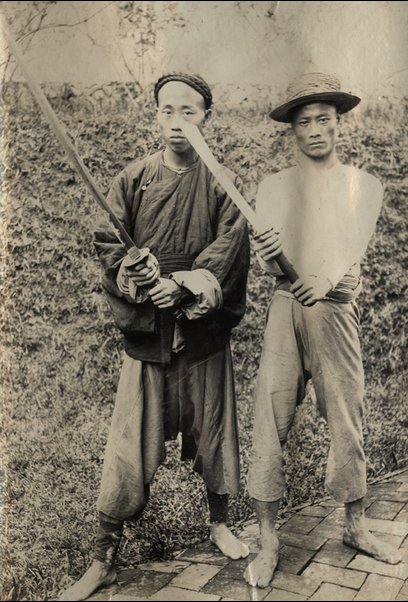
Some of the execution photographs that follow are Mature Content. They’re obtained via Visual Cultures in East Asia; some also available at USC Digital Library.


Raids and investigations to bring the Vegetarian movement to heel continued for several months thereafter, and the whole affair ultimately was quelled without doing any of the wider damage that might have been feared — not even to missionaries who continued pouring into China.

And that, effectively, kicked the can down the road on the anti-foreigner sentiments afoot in the land … sentiments that would find much costlier expression a few years later when another secret society kicked off the Boxer Rebellion.

* I’ve relied heavily on Welch for this post. He’s also collected a massive trove (over 1,200 pages) of primary documents from this incident available in a series of pdfs (some quite large) from the Australian National University website:

** This was not universally so. The wife of missionary Stephen Livingston Baldwin, who knew some of the victims of the attack, urged a “charitable” response and sensitivity that “the Chinese feel that all the world is against them, and they are not far from right.” (New York Times, Aug. 10, 1895) In letters responding to intemperate coverage elsewhere, she acidly compared (pdf) western editorialists’ high dudgeon to their look-forward-not-back dismissal of recent stateside anti-Chinese violence.

It was ten years yesterday since more Chinese were killed, and burned alive and left to die wounded, in one hour, at Rock Springs, Wyoming (the very same Territory in which the recent massacre occurred) than have been Americans and English in China in the thirty-four years I have personally known that land, being a resident there twenty years and closely connected with it ever since. Ten years yesterday since that awful Rock Springs massacre, and up to date no one arrested, much less punished! The anti-Chinese papers of the town and neighbourhood gloating over the awful details and assuring all that there would be “no Congressional investigation,” and no waste of “enterprising newspaper eloquence” over the woes of the Chinese, “though their blood flow like rivers, as they had no votes and no friends.” In less than four weeks after the Ku-Cheng massacre, arrest, investigation and execution have all taken place for the Ku-Cheng massacre. Would that our colored, red and yellow brethren, so helpless in our so-called civilized and Christian land, had some power behind them to bestir Ministers Plenipotentiary, wave flags, and run gunboats to the front, to bully, if necessary, our pusillanimous Government into some sort of civilization — I will not say Christian justice!

On this day..