1418: Beatrice di Tenda

On this date in 1418, the Duke of Milan annulled his marriage at the headsman’s block.

Beatrice (English Wikipedia entry | Italian) was initially the wife of the condottiero Facino Cane, a brutal but successful warrior who gained de facto control of the Duchy of Milan when it was inherited by a teenage Duke.

That teen’s younger brother, Filippo Visconti, spent the early 1400s packed away in Pavia, sickly and marginal, wondering which of the deadly machinations of state playing out above him might unexpectedly come crashing down on his own head. It seems doubtful that Beatrice ever had reason to give the little twerp a thought.

Delivery for Filippo came in May 1412. Big brother was assassinated while Facino Cane lay dying and suddenly the 19-year-old called the shots in Milan. In his day, he would become known as a cunning and cruel tyrant, and would make Milan the dominant power in northern Italy.

And it all was possible because of May 1412, which not only elevated Filippo but widowed our principal Beatrice. From her puissant late husband she inherited 400,000 ducats and huge … tracts of land. Her virtues could hardly fail to appeal to the whelp of a Duke, even at twenty years his senior; indeed, it was Cane himself who sketched out this succession plan from his deathbed.

It seems, however, that having taking possession of the wealth and legitimacy that came with Beatrice’s hand, Filippo soon grew irritated with the rest of her — enough so that he at last determined to put her aside. His paranoid Excellency wasn’t the quietly-retire-you-to-a-monastery type; instead, he went for the full Anne Boleyn.

Accusing his consort of consorting with a young troubadour in her court, Michele Orombelli, Filippo had the accused cuckolder and two of Beatrice’s handmaidens tortured until they produced the requisite confession/accusation of faithlnessness. Upon that basis he had Orombelli and Beatrice di Tenda both beheaded at the castle of Binasco. A plaque placed there to commemorate the spurned wife is still to be seen today.


(cc) image from Jk4u59.

Bellini’s second-last opera was based on this tragic story. Beatrice di Tenda premiered in 1833; it’s noteworthy in Bellini’s biography because deadline disputes in its composition ruined the composer’s longstanding collaboration with librettist Felice Romani.

On this day..

1782: Bartolina Sisa, indigenous rebel

September 5 is International Indigenous Women’s Day, in honor of the torturous execution in Bolivia on this date in 1782 of the Aymara peasant rebel Bartolina Sisa.

Sisa (English Wikipedia entry | Spanish) shared with her husband Tupac Katari leadership of a huge indigenous uprising against the Spanish.

Eighteen months before Bartolina’s execution, she and Tupac Katari — Julian Apasa, to use his given name before he staked out a nom de guerre claiming the inheritance of Tupac Amaru and Tomas Katari — laid La Paz* under siege with an army 40,000 strong. Over the course of that spring summer, the Bolivian capital lost 10,000 souls and teetered on the brink of collapse — actually in two separate three-month sieges with a brief interim between.

Bartolina Sisa was recognized by the rebels as the coequal of her husband; the two took command decisions together in consultation.

As such, when the siege was finally relieved and the natives defeated that October, Sisa was in line to share her husband’s fate. This was easy to effect because she had been betrayed into Spanish hands between the first and second sieges. Her enemies refused Tupac Katari’s every blandishment to exchange her, and in time had the cruel pleasure of forcing her to watch her defeated husband’s butchery. Nearly a year later Sisa tasted a like fate, and her body was thereafter chopped up to display as a warning in various towns to cow potential future native insurgents.

A present-day peasant women’s union bears Sisa’s name, the Bartolina Sisa Confederation; the president of Brazil’s 2006 Constituent Assembly that drafted the country’s current constitution was an indigenous Quechua woman named Silvia Lazarte, who was the Bartolina Sisa Confederation’s former executive secretary.

* The city‘s full original name was Nuestra Señora de La Paz, “Our Lady of Peace”. It was founded in 1548 at the site of a former indigenous village and the “peace” referred to is the restoration of calm after Gonzalo Pizarro‘s rising.

On this day..

1738: Helena Curtens and Agnes Olmans, inviolable dignity

On this date in 1738, the last victims of witch trials in the Lower Rhine were burned at the stake in Gerresheim, an ancient German city today subsumed by Düsseldorf.

More eccentric than demoniacal, the sicky 14-year-old Helena Curtens reported having seen some ghostly apparition during a curative pilgrimage to Kevelaer, and received from him some towels with weird occult inscription. (She actually did have such towels.)

This adolescent attention-seeking turned into a whole thing when judge Johann Weyrich Sigismund Schwarz’s long ears caught hold of Gerresheim’s wagging tongues.

The whole idea of witches and witchcraft was trending ever less fashionable at this time, but not for Schwarz: he routed Curtens’s occult encounter into the judicial Hexenprozess and got on record an accusation against her neighbor Agnes Olmans as well as the usual stuff about playing the harlot with a visiting devil.

Their case extended for more than a year; Helena Curtens was 16 by the time she burned.

In that time, Curtens stayed curiously committed to her crazy story, even knowing that it was putting her under the shadow of the stake.

Olmans, by contrast, fought with every fiber the allegations that her young neighbor kept confirming. Olmans even fell ironic victim to the uneven development of rational witch-law reform when she tried to demand that she be put to the ordeal of water to prove her innocence: it turned out that this backwards practice of pseudo-forensics had been barred in 1555, so Schwarz could not order it. At trial, her denials were easily overcome by the gossip of neighbors, and even her own husband — who recalled that the mother-in-law had a distinctly witchy reputation. Hey, ’til death do us part, babe.

Today, there’s a public stone monument to these milestone sorceresses, the Gerresheimer Hexenstein (“Gerresheim witches’ stone”)

Its inscription reads:

Human dignity is inviolable.
For Helene Mechthildis Curtens and Agnes Olmanns.
Burned in Gerresheim on August 19, 1738.
After the last witch trial in the Lower Rhine
and for all those tortured and outcast

On this day..

1838: The slave Mary, the youngest executed by Missouri

(Thanks to Meaghan Good of the Charley Project for the guest post. -ed.)

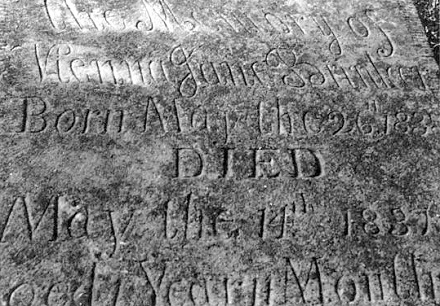
On this date in 1838, a teenage slave girl named Mary was hanged in Crawford County, Missouri. She had murdered Vienna Jane Brinker, a white child two weeks short of her second birthday.

Mary’s original owner was Abraham Brinker, Vienna Jane’s grandfather. Abraham was murdered by Indians southwest of Potosi in Washington County, Missouri in 1833. He died without a will and his widow, Fanny, and son, John, became administrators of his estate. John appropriated Mary for himself and eventually made her the babysitter for Vienna Jane, his daughter.

Mary, described as “shrewd” and “remarkably fond of children,” was “about thirteen” at the time she killed the toddler on May 14, 1837. That day Vienna Jane’s body was found in a stream on the Brinkers’ property. She’d been struck on the head and flung into the water, where she drowned.

Just why Mary committed the murder may never be known,* but she readily admitted killing Vienna Jane — at least, once Mary “was tied to a log” and interrogated with the sheriff, who “began to act as though he were going to whip Mary” — and her guilt was taken as given throughout her surprisingly protracted 15-month legal odyssey. The judge instructed Mary’s trial jury:

If the Jury shall find from the evidence that Mary, the accused person was under fourteen years when she committed the offense alleged in the indictment, then, unless they shall also find from the evidence that at the time when said offense was committed the said Mary had sufficient mind to know what act would be a crime or otherwise, they shall find for the defendant.

The jury found against her and sentenced her to death.

Mary’s lawyers — there were three of them — appealed on several grounds, but her age was not one of them. The appellate court granted her a second trial on a technicality, but she was convicted again and did not appeal further.

Writing of this case in her book Death Sentences in Missouri, 1803-2005, author Harriet Frazier remarks that “Mary remains the youngest known person ever put to death by the authority of the state of Missouri. It is no accident that she was a female and a slave.”

Willard Rand turned her case into a two-act play, The Trial of Mary, a Slave, which was performed in the Crawford County courthouse in 1990.

* This page on Brinker family history mentions speculation that Mary was revenging her own prospective sale, and/or that she might have had an illegitimate child by her master whom the family sold against Mary’s will.

On this day..

1943: Red Orchestra members, in the Nazi Paradise

From 7 to 8 p.m. on the evening of August 5, 1943 the Fallbeil at Plotzensee Prison destroyed 17 members of the Berlin Red Orchestra resistance circle.

We have touched previously on Die Rote Kapelle in the context of the first 11 executions that claimed its leadership on December 22, 1942.

But the Gestapo had a much wider network than that to break up; ultimately, there would be nearly 50 death sentences associated with Red Orchestra, for activities ranging from outright espionage to merely dissident leafletting, and other rounds of executions had taken place over the preceding months.

The executions this date were more of the sad same, and noteworthy for some sincere and ordinary citizens so sympathetic that even the Reich Military Court recommended mercy for some. Adolf Hitler refused it across the board. The victims, predominantly women who had been moved to Plotzensee for execution that very morning, included

  • Cato Bontjes van Beek, an idealistic 22-year-old ceramicist.
  • Liane Berkowitz. Two days short of her 20th birthday when she was beheaded, Berkowitz had given birth to a child while awaiting execution.
  • Eva-Maria Buch, who translated propaganda leaflets destined for illicit distribution to the forced laborers employed in German munitions factories.
  • Else Imme, an anti-fascist whose sister had emigrated to the Soviet Union.
  • Ingeborg Kummerow.
  • Anna Krauss, a 58-year-old businesswoman.
  • Klara Schabbel, a Comintern agent who in her youth had fought against the French occupation of the Ruhr after World War I.
  • Rose Schlosinger.
  • Oda Schottmuller, a dancer and sculptor who used her arts-related trips to act as a courier.
  • Writer Adam Kuckhoff. His widow Greta would go on to head the East German central bank.
  • Emil Hubner, an 81-year-old retiree, along with his daughter Frida Wesolek and her husband Stanislaus.

Besides the above, at least three others among the condemned in this group paid with their lives for an arts activism attack on Das Sowjetparadies (The Soviet Paradise), a Reich exhibition in May-June 1942 that used photographs and captured artifacts from the war’s eastern front to depict “poverty, squalor and misery” in the USSR. This associated propaganda film gives a taste of the vibe:

The Orchestra orchestrated an “attack” littering the exhibition with counter-propaganda


“Permanent Exhibition
The NAZI PARADISE
War Hunger Lies Gestapo
How much longer?”

This act of wehrkraftzersetzung was a factor in the sentences of —

  • Hilde Coppi, one of the circle’s principal members and the wife of the previously executed Hans Coppi. Like Liane Berkowitz, she was spared the first rounds of executions to bear and nurse her child.
  • Maria Terwiel, a Catholic barrister with a Jewish mother.
  • Ursula Goetze.

On this day..

1973: Mimi Wong Weng Siu, jealous hostess

On this date in 1973, former cabaret star Mimi Wong Weng Siu and her husband Sim Woh Kum were hanged for the murder of Wong’s Japanese lover’s wife.

“Overwhelmed by a consuming jealousy” (her prosecutor’s words) for Hiroshi Watanabe, a land reclamation engineer from Osaka who was in Singapore working to prepare Bedok for development, Wong recruited her estranged husband to help her get rid of the competition. (Sim was just in it for the payment Wong promised him.)

On the evening of January 6, 1968, the two broke into the home when Ayako Watanabe was alone there. Sim threw bleach in the victim’s eyes to incapacitate her, as Wong fatally gashed her neck and abdomen with a small knife.

The resulting 26-day trial riveted Singapore with the risque details of the dance hostess’s adulterous trysts. (And said dance hostess’s two courtroom fainting episodes.) But their manifest guilt plus their confessions — each vainly attempting to blame the other — assured their convictions.

While Sim situates as a side character of little lasting interest, Mimi Wong’s hanging was among the few that would really stick with long-tenured Singapore hangman Darshan Singh.

The title character, if you like, of Alan Shadrake’s Singapore death row critique Once a Jolly Hangman, Singh executed more than 850 people in more than four decades on the job and never wavered in his support for the policies that kept him occupied. Even so, Singh felt compassion for the individual humans he was called upon to kill; he was known to go out of his way to get to know condemned prisoners and to comfort them in their distressing situation.

According to an October 2013 AsiaOne profile, Singh had an unusually close pre-execution relationship with the first woman hanged in the only recently (since 1965) independent Singapore.

In prison, she was a difficult inmate who would at times strip naked and refuse to put on her clothes even when ordered by prison guards. She even threw urine at the wardens, said Madam Jeleha.

“Darshan was the only one who could control her. He would say ‘Mimi, wear the blanket and cover yourself. Don’t do this or you won’t be beautiful any more’, and she would listen to him,” Madam Jeleha said.

The two forged an unlikely friendship and other prison officers even joked that Wong was his girlfriend. Mr Singh never minded.

Before her execution, Wong told Mr Singh they should be lovers in the next life and she wanted to take him with her.

“After he hanged Mimi Wong, he fell very sick for a month. He was in Toa Payoh Hospital for more than two weeks,” his wife said.

Even when probed, he refused to tell his wife about Wong’s final moments.

On this day..

756: Yang Guifei, favored concubine

On this date in 756, the imperial consort Yang Guifei was expediently executed during the An Lushan Rebellion.

The Tang dynasty Emperor Xuanzong, whose beloved concubine Yang was, undertook this cruel extremity only in great duress. Initially married to one of the emperor’s sons, Yang so enamored the emperor that he usurped the prince’s place and got the kid a different wife. In the c. 800 classic poem “Song of Everlasting Sorrow” the poet Bai Juyi mused on the smitten sovereign rushing headlong into waiting tragedy.

The emperor neglected the world from that moment,
Lavished his time on her in endless enjoyment.
She was his springtime mistress, and his midnight tyrant.
Though there were three thousand ladies all of great beauty,a
All his gifts were devoted to one person.

Indeed, over the 740s Yang’s relations rose at court on the strength of her hold over the emperor, causing no few resentments among courtiers now obliged to flatter them. She’s been cast as a femme fatale, a siren whose chords called the emperor to capsize his own ship of state.

The general An Lushan was the rock of his ruin. Though An Lushan’s revolt would one day claim Yang’s life, he was a great favorite of hers and eventually adopted as Yang’s son; it was whispered that the imperial gifts showered on this commander might reflect favor with the concubine quite surpassing the bounds of propriety.

The most important favor was command of all northern China’s garrisons, with 150,000-plus troops.

His influence (and the fact that he was not ethnically Han, but of Turkic and Iranic extraction) made him rivals at the imperial court, even including the concubine Yang’s cousin, chancellor Yang Guozhong.

One can speculate as to who suspected whom first, but as we’ve seen with the Roman Empire a sufficiently strong inducement to treachery inevitably becomes tantamount to the real thing: eventually one’s intemperate supporters or implacable enemies will cast the die for even the most retiring general. An Lushan was Caesar enough to cross the Tang’s Rubicon, which for him was the Yellow River, above which his armies had been confined.

In the winter of 755-756, An crossed this river and marched towards Chang’an (Xi’an, then the imperial capital and the world’s most populous city), styling himself the Emperor of Yan. This aspirant state proved far from durable, and vanished by 763 — but by the time that long term had come into view, all of our principal characters were dead.

Yang Guifei was the first of them. (Plenty of secondary characters — generals, eunuchs, rivals and family of rivals — were being put to death all along and well before Yang, of course.) As the rebel army advanced on the capital, Xuanzong and his court fled in panic, Yang included. One day’s march further inland towards Chengdu, the royal guards themselves rebelled. Embittered like many others by the sway Yang and her family held — and blaming the consort for the ignominious retreat they were embarked upon — the soldiers refused to proceed without Yang’s execution. Xuanzong had little choice under the circumstances but to assent to her summary strangulation.

The Son of Heaven made good his escape, and his kingdom prevailed in the fight. (An was assassinated in 757.) Xuanzong himself, however, had to abdicate in favor of his son before the chaotic summer was out, and lived out his last five years as Taishang Huang, “Retired Emperor”.

One can only guess at the regrets he had in those days for the beloved mistress sacrificed to the safety of his person and throne. It’s a circumstance that has become a staple of Chinese literature over the centuries since, from the aforeentioned Bai Juyi right down to the present day, in every medium imaginable.

In Bai’s “Song of Everlasting Sorrow”, the bereft former emperor at last sends a Taoist priest to the heavens in search of his lost love, whose spirit has not even appeared to him in a dream. Yang Guifei sends the messenger back with a last pledge of sundered love:

“Our spirits belong together, like these precious fragments,
Sometime, in earth or heaven, we shall meet again.”
And she sent these words, by the Taoist, to remind him
of their midnight vow, secret between them.
“On that Seventh night, of the Herdboy and the Weaver,
In the silent Palace we declared our dream was
To fly together in the sky, two birds on the same wing,
To grow together on the earth, two branches of one tree.”

Earth fades, Heaven fades, at the end of days.
But Everlasting Sorrow endures always.

Yang Guifei’s tomb remains a popular tourist destination to this date.

On this day..

1616: “A gentellwoeman” by exposure, for a eunuch liaison

The English diplomat Sir Thomas Roe, envoy to the Mughal Empire from 1615 to 1619 during the reign of Jahangir, recorded in his journal* the unfortunate fate this date of a nameless woman for being caught rendezvousing with a palace eunuch.

This day a gentellwoeman of Normalls was taken in the kings house in some action with an Eunuch. Another Capon that loved her kylld him. The Poore Woeman was sett up to the Arme pitts in the Earth hard ramed, her feete tyde to a stake, to abyde 3 dayes and 2 nights without any sustenance, her head and armes bare, exposed to the sunns violence: if shee died not in that tyme she should bee pardoned. The Eunuch was Condemned to the Eliphantes. This damsell yeelded in Pearle, Jewelles, and ready mony 160,000 rupias.

That this bit character who does not even merit a name here left such a fortune surely testifies to the Mughal Empire’s famously astounding trade wealth.

Roe does not disclose how long the condemned woman managed to survive, but the separate memoir of Roe’s chaplain Edward Terry confirms that she succumbed to exposure well before the elapse of the pardonable three days. (The two seem to have received differing intelligence on the execution method of the eunuch, despite Terry’s indication that it transpired practically in the English mission’s backyard.)

Now for the disposition of that King, it ever seemed unto me to be composed of extremes; for sometimes he was barbarously cruel, and at other times he would seem to be exceedingly fair and gentle.

For his cruelties, he put one of his women to a miserable death; one of his women he had formerly touched and kept company with, but now she was superannuated; for neither himself nor nobles (as they say) come near their wives or women, after they exceed the age of thirty years. The fault of that woman was this; the Mogul upon a time found her and one of his eunuchs kissing one another; and for this very thing, the King presently gave command that a round hole should be made in the earth, and that her body should be put into that hole, where she should stnad with her head only above ground, and the earth to be put in again unto her close round about her, that so she might stand in the parching sun ’till the extreme hot beams thereof did kill her; in which torment she lived one whole day, and the night following, and almost ’till the next noon, crying out most lamentably, while she was able to speak, in her language, as the Shumanite’s child did in his, 2 King. 4. “Ah my head, my head!” which horrid execution, or rather murder, was acted near our house; where the eunuch, by the command of the said King, was brought very near the place where this poor creature was thus buried alive, and there in her sight cut all into pieces.

* Published as The embassy of Sir Thomas Roe to the court of the Great Mogul, 1615-1619, as narrated in his journal and correspondence. This vignette is from volume 1; there is also a volume 2

On this day..

1794: Rosalie Lubomirska, mother of Balzac’s antagonist

On this date in 1794, the Polish princess Rosalie Lubomirska was guillotined during the Paris Terror.

The hottest thing to come out of Chernobyl before 1986, the glamorous young Lubomirska had it all going for her before Europe turned revolutionary.

Her support for the reformist Patriotic Party in her homeland required her flight on to France when a Russian invasion defeated that movement in 1792. Indeed, short as her own thread was cut, Rosalie Lubomirska was only barely outlived by the Polish-Lithuanian Commonwealth itself.

But escaping to her friend Marie Antoinette in France might not have been the savviest choice.

The irrepressible Melanie “Madame Guillotine” Clegane, author of such topical historical fiction as The Secret Diary of a Princess: A Novel of Marie Antoinette, has everything you need to know about Rosalie Lubomirska’s activities from that point in this post: going royalist after the execution of Louis XVI, taking Vendee rebels into her salon and/or bed, and seeing her lovers precede her to the guillotine while she desperately bought time by feigning pregnancy.

She left behind a young daughter. In much later years, this little girl grown up and married to noted Orientalist scholar Waclaw Seweryn Rzeuwski would manifest as a side character in a very different story: she is “Aunt Rozalia”, whose niece was Ewelina Hanska, the admirer turned wife of the novelist Honore de Balzac. Aunt Rozalia was a bitter foe of Ewelina’s declasse romance with the bourgeois scribbler and to judge by the correspondence of the lovers was continually trafficking in rumors that Balzac — who was in actuality a legendary workaholic — was a gambler, boozer, or suchlike dissipated wastrel.

Balzac gave his antagonist the gift of literary immortality by using her as an inspiration (one inspiration: his own mother was another) for the titular killjoy spinster in his novel Cousin Bette.

On this day..

1535: Elisabeth Wandscherer, wife of Jan van Leiden

On this date in 1535, in the doomed Anabaptist commune of Münster, the dictator Jan van Leiden personally beheaded one of his 16 wives.

If it seems unfathomable from the standpoint of the 21st century to picture the famously pacific Anabaptists as millenarian theocratic polygamists, that’s in no small measure due to Leiden himself.

His kingdom of Münster lasted only a year, but its wreckage at the end led the successive strains of this Reformation movement towards very different forms of radicalism than Leiden’s sword-arm exercised.

The background preceding Anabaptist Münster was municipal conflict among Catholics, Lutherans, and Anabaptists. Small wonder that when the Anabaptists — the wild-eyed radicals among these groups — got control of the place,* the Catholic Prince-Bishop put Münster under siege.

That cordon of enemy troops strangling the city shaped much that followed.

Münster’s leading Anabaptist theologian, Bernhard Rothmann, defended polygamy thus:

God has restored the true practice of holy matrimony amongst us. Marriage is the union of man and wife — “one” has now been removed — for the honor of God and to fulfill his will, so that children might be brought up in the fear of God …

Freedom in marriage for the man consists in the possibility for him to have more than one wife … This was true of the biblical fathers until the time of the Apostles, nor has polygamy been forbidden by God. (Source)

In the first place, it killed the Anabaptists’ original leader Jan Matthys when Matthys trusted his theology so far as to believe an Easter Sunday (1534) sortie against the Prince-Bishop’s men would enjoy divine favor. Instead, Matthys’s head wound up on a pike.

This decapitation — literal and figurative — dropped leadership onto the head of our man Jan, which got very big indeed over the subsequent 14 months. Or at least, so say Jan’s foes and eventual killers; as observed by the Communist intellectual Karl Kautsky, who mounted a late 19th century defense of the Anabaptists, we know these Münster rebels almost exclusively through the dark glass of their mortal enemies’ lurid propaganda.

The Anabaptist city council (which Jan soon dissolved) had already expelled all citizens who refused adult re-baptism, the movement’s signature (and namesake) tenet. Citizens, however, meant men: the wives didn’t get run off with their husbands and evidently were often left behind to tend households and property that the men expected to resume soon enough.

As a result, the gender imbalance in besieged Münster reportedly ran to 3:1, and Jan goggled at his good fortune like a 25-year-old would do. (He was actually only 25 years old, a former barkeep. He was also already on a bigamous second marriage.)

Having already declared himself king and basically the divine intercessor, and gotten the city to go along with it, Jan van Leiden promulgated polygamy on July 23 — directing men to seek out second and third brides as their first and second ones got pregnant. Barefoot and pregnant, ladies! Maybe it would have been a great plan for explosive population growth, if only that Catholic army under the walls had consented to just hunker down for a generation or two.(Introduction of polygamy triggered an immediate internal revolt led by a blacksmith named Möllenbeck, which Jan’s team crushed.)

There’s always been the assumption, though, that this move so alien to any other strand of the Reformation throughout Europe was more personal than political. Jan took sixteen wives. One was Matthys’s former wife, soon elevated to Queen; most of the rest were in their teenage years.

Many — who can say just how many? — were probably content to indulge his reputedly (reputed by his enemies!) voracious libido because

  1. the besieged city soon began starving; and,
  2. the guy didn’t take to dissension

In its last months, Münster’s people, faint with hunger, were fed dozens of public executions, of the morally corrupt or the politically unreliable. Considering that the withering city sheltered a mere 9,000 souls at the outset,** it was a positively Stalinesque pace, surely exacerbated by the fast-deteriorating strategic situation.

Elisabeth Wandscherer, one of those 16 wives, is supposed to have been beheaded in the market on June 12, 1535, by the very hand of her husband for her “disobedience.” By the account of a hostile Catholic chronicler, said disobedience consisted in remonstrating with Jan van Leiden over the luxury of his own household vis-a-vis the suffering city, and seeking leave to desert Münster.

Whatever added measure of loyalty, vigilance, or zeal might have been anticipated from such a scene was by this point far too little to preserve the city. Before the month was out, the Prince-Bishop had overrun Münster and held Jan van Leiden in chains — now bound in his own turn for the executioner.

Even to this day, Münster’s town hall has a slipper said to have once belonged to Elisabeth Wandscherer.

* By means of an entirely legal municipal election.

** Population figure per this biography of Jan van Leiden.

On this day..