2000: Brian Roberson, “Y’all kiss my black ass”

(Thanks to Robert Elder of Last Words of the Executed — the blog, and the book — for the guest post. Fans of this here site are highly likely to enjoy following Elder’s own pithy, almanac-style collection of last words on the scaffold. -ed.)

“To all of the racist white folks in America that hate black folks and to all of the black folks in America that hate themselves: in the infamous words of my famous legendary brother, Nat Turner, ‘Y’all kiss my black ass.’ Let’s do it.”

—Brian Roberson, convicted of murder, lethal injection, Texas.
Executed August 9, 2000

Roberson was convicted in the stabbing death of James Boots, seventy-nine, and his wife, Lillian, seventy-five, who lived across the street from him in Dallas. Roberson was African-American and his victims were Caucasian. Amnesty International issued a memo before the execution urging action and “expressing concern at the prosecutor’s systematic exclusion of African-Americans from the trial jury.” Roberson claimed he was “juiced up” on PCP and liquor during the crime. His last words were alternately recorded as “You ain’t got what you want.”

Later that same year, Roberson’s twin brother, Bruce, was arrested for allegedly threatening then President-elect George W. Bush. In a New York Times article, officers reported that Bruce wanted “to take him down.” The piece continued: “Mr. Roberson told them that Mr. Bush ‘stole the election and he’s not going to get away with it.'” Bush had been governor at the time of Brian’s execution.

On this day..

1990: Sam Cayhall in Grisham’s “The Chamber”

In John Grisham’s The Chamber, it is on August 8, 1990 that the titular enclosure receives its victim in a cloud of lethal gas.

In The Chamber, Sam Cayhall, a Ku Klux Klansman who had long avoided conviction for bombing a Jewish civil rights lawyer in 1967, has at last been condemned in Mississippi twenty years later.

The action centers around the futile and increasingly hopeless efforts of Cayhall’s grandson Adam Hall to save the old man working pro bono for a Chicago law firm.

Adam comes to learn that his grandfather has a long and bloody Klan history, even killing children. (We also find that the missing link in this generational drama, Adam’s father, committed suicide after Sam was sent to death row.)

But Sam is in no way a good guy: still an unreconstructed racist, he refuses to inform on any ex-confederates. As grandpa wends his way towards his date with the executioner, Adam’s torrent of judicial appeals go nowhere and the politically sensitive nature of the case makes executive clemency a non-starter. (When The Chamber was published in 1994, the death penalty was at an acme of popularity.) This is to be expected, of course; as Chekhov might observe, you can’t call the book The Chamber if someone isn’t going to go sit in said chamber by the end.

This bestseller was made into a 1996 film starring Gene Hackman as the grizzled Klansman. (In the film version’s execution scene, the date is changed to April 13, 1996.)

There’s an excerpt of the novel available on Grisham’s site here.

On this day..

1883: James Burton, William Marwood’s last

On this date in 1883, the illustrious hanging career of executioner William Marwood came to an inglorious conclusion.

The Billy Beane of the Victorian gallows, Marwood brought metrics — that is, calculated drop distances designed for killing precision — to a craft long characterized by clumsy amateurism.

James Burton, 33, had killed his 18-year-old wife in a violent quarrel earlier that same year; according to his confession, after she jabbed him with an umbrella and threatened to swear his life away,

my temper got the best of me, and I struck her, and we both fell. She got up first to check me not to hit her any more. At that time I could not see out of my own eyes for tears, and she cried out, ‘Oh, Jim Burton, I am only trying you don’t hit me any more,’ and I said it was too late now, for I have not a home for myself. I was blind at the time with passion, and I picked up a stone and hit her with it, and she fell down in the same place where her body was picked up. Then she said, ‘Jim, don’t, for that is my last; do come with me, Jim.’ (Glasgow Herald, Aug. 8, 1883)

Hardly a criminal mastermind, Burton proceeded to wander the town of Tunstall for several furtive days trying to screw up the nerve to commit suicide.

Instead, William Marwood ended up with the task.

The 174th and last client of the great executioner surely didn’t present any difficulties in the Mass * Acceleration department, but even for Marwood there’s more to a hanging than striking force. By some last-moment faint, stumble, or twist Burton fell through the trap wrong, dinging the side of it and getting the long slack of the noose caught under his arm.

Marwood, who was an aging man of declining strength at this point, had to haul poor Jim Burton up through the trap. “When drawn up Burton presented a shocking appearance,” one reporter on-site put it.

As Burton moaned “Oh Lord, help me!” Marwood readied for an inelegant do-over: not bothering to reset the trap, he hurriedly unwound the rope and positioned it as it ought while Burton stood heaving on the platform. When all was in readiness, Marwood simply shoved the uxoricide back into the hole.

This time, Burton died. But Marwood himself had not long to outlive him: he passed away four weeks later, on September 4, at the age of 65.

On this day..

2008: Jose Medellin, precedent

On this date in 2008, Mexican national Jose Medellin was executed by Texas, pleasurably sticking its thumb in the eye of the International Court of Justice.

U.S. state and local officials have often displayed the ugly-American tendency to view binding treaty obligations as a Washington thing of no moment to the likes of a Harris County prosecutor. So when Medellin was arrested for the 1993 rape-murder of two teenage girls in a Houston park, the idea of putting him right in touch with Mexican diplomats to assist his defense was, we may safely suppose, the very farthest thing from anyone’s mind.

Yet under the Vienna Convention, that is exactly what ought to have occurred. The idea is that consular officials can help a fellow on foreign soil to understand his unfamiliar legal circumstances and assist with any measures for his defense — and by common reciprocity, every state is enabled to look after the interests of its nationals abroad.

A widespread failure to do this, in death cases and others, has involved the United States in a number of international spats over the years.

Jose Medellin was among more than 50 Mexican prisoners named in one of the most noteworthy of these: the Avena case, a suit by Mexico* against the United States in the International Court of Justice.

In its March 31, 2004 Avena decision, the ICJ found that U.S. authorities had “breached the obligations incumbent upon” them by failing in these instances to advise the Mexican nationals it arrested of their Vienna Convention rights, and of failing in almost all those cases likewise to advise Mexican representatives that a Mexican citizen had been taken into custody.

“The appropriate reparation in this case,” the 15-judge panel directed, “consists in the obligation of the United States of America to provide, by means of its own choosing, review and reconsideration of the convictions and sentences of the Mexican nationals.”

If you think the Lone Star State’s duly constituted authorities jumped right on that “obligation,” you must be new around here.

Several years before, the United Nations Special Rapporteur on Extrajudicial, Summary or Arbitrary Executions visited the United States and filed a report complaining “that there is a generalized perception that human rights are a prerogative of international affairs, and not a domestic issue.”

“Domestic laws appear de facto to prevail over international law, even if they could contradict the international obligations of the United States,” the Special Rapporteur noted.

Texas, famed for not being messed with, took a dim view indeed to being bossed about from The Hague. Indeed, the very concept of foreign law and international courts is a gleefully-thrashed political pinata among that state’s predominant conservative electorate.

U.S. President George W. Bush — a former Texas governor who in his day had no time at all for appeals based on consular notification snafus — in this instance appealed to Texas to enact the ICJ’s proposed review.† In fact, he asserted the authority to order Texas to do so.

Texas scoffed.

“The World Court has no standing in Texas and Texas is not bound by a ruling or edict from a foreign court,” a spokesman of Gov. Rick Perry retorted.

This notion that America’s federalist governance structure could insulate each of her constituent jurisdictions from treaty obligations undertaken by the nation as a whole naturally seems preposterous from the outside. But in the U.S., this dispute between Washington and Austin was resolved by the Supreme Court — and the vehicle for doing so was an appeal lodged by our man, Medellin v. Texas.

The question at stake in Medellin was whether the treaty obligation was binding domestic law on its own — or if, by contrast, such a treaty required American legislative bodies to enact corresponding domestic statutes before it could be enforced. The high court ruled for the latter interpretation, effectively striking down Avena since there was zero chance of either Texas or the U.S. Congress enacting such a statute.

Medellin, the decision, spelled the end for Medellin, the man — and, at least for now, the end of any prospect of effectual intervention in American death penalty cases by international tribunals.

* Mexico, which no longer has the death penalty itself, has the heavy preponderance of foreign nationals on United States death rows at any given time.

** The Texas Attorney General’s press release announcing Medellin’s execution included a detailed appellate history of the case which pointedly excluded anything that happened in the ICJ.

† The Bush administration did take one effective step to avoid a similarly embarrassing situation in the future: it withdrew the U.S. from the consular notification convention.

On this day..

2015: Shafqat Hussain

Minutes before dawn prayers today, Pakistan hanged Shafqat Hussain in Karachi Central Jail.*

He’s the latest casualty of Pakistan’s wild death penalty resurgence following last December’s bloody terrorist attack on a Peshawar school — leading Islamabad to break a moratorium on carrying out the death sentences that it was continuing to hand down.
And how! According to the BBC, today’s hanging brings to 193 the total of people put to death in the little more than half-year since; Pakistan could stop hanging today (it won’t) and easily rank among 2015’s execution leaders by the end of the year.

Though the first victims of the new policy were people previously death-sentenced for terrorism, and thereby at least thematically linked to the Peshawar massacre, Pakistan by March had dropped the distinction and commenced hanging prisoners by the fistful for ordinary crimes, too.

Shafqat Hussain’s name has repeatedly entered the news cycle during that time, as he has faced and then avoided multiple execution dates, most recently this past June 9. Some have gone to the very brink, and seen the young man reprieved moments from donning his hanging-shroud.

Hussain denied committing the crime laid at his door — the abduction and murder of a 7-year-old boy in the area where he worked as a watchman — but a confession “allegedly” obtained by torture doomed him. Guilt aside, the matter garnered worldwide headlines (and advocacy) largely on account of his youth: Hussain and his advocates say he was a minor of age 14 or 15 when arrested; Pakistani courts have found him to have been 23. (!) It is this dispute about the age that has been at the center of Shafqat Hussain’s recent heart-stopping cycle of appeals and stays.

Shortly before his execution, Shafqat Hussain put his byline to a compelling first-person testimonial for CNN about life on Pakistan’s death row and the experience of nearing an imminent execution date.

When the jailer tells me that my execution date has been set, he separates me immediately from the other prisoners. I spend all seven days by myself in a cell in the barracks for prisoners about to be executed. They conduct a physical exam every one of those seven days. They weigh me every day, take my blood pressure and temperature as well.

On the last two days they also measure my height, my neck and my body for the clothes I am to wear when they hang me.

One day before my hanging, they tell me about my final visit with my family and that I need to execute my will. I cannot really say what I am thinking in those last seven days. My brain is thinking all sorts of things.

* According to a brother, who told AFP that “there is a cut mark on his neck and half of his neck is separated from his body,” they did not hang him very well.

On this day..

1795: Jerry Avershaw, contemptuously

From the Newgate Calendar:


A century since highwaymen were as common as insolvent debtors are now.

Public vehicles were then little known. The roads were covered with night travellers, either on horse or foot, who became the easy prey of one or two armed and desperate ruffians. Turpin, Sixteen-String-Jack, and others of less notoriety, almost made these criminals fashionable; for, strange to say, there is a fashion even in crime.

Their daring was great; and in a country where personal prowess and high courage were so much prized, it was not to be wondered at that such characters should obtain a sort of fame. Now that our roads are covered with stage coaches, the race of highwaymen is extinct; solitary individuals of the species may be now and then met with, but the “calling” has decidedly fallen into disuse; pickpockets have succeeded them, and robberies are thus achieved with greater facility, less danger of personal violence, and with less dread of legal punishment.

The callosity of London thieves is dreadful. The Rev. Mr. Cotton is ordinary of Newgate, and in allusion to that gentleman’s spiritual consolation on the fatal platform, they call hanging, “dying with your ears stuffed with cotton.”

A pickpocket lately gave it as his reason for following his profession, “That it didn’t hurt above the arm pits;” i.e. that if discovered, the punishment was transportation, not hanging.

None of the numerous depredators we have already noticed, can excel in villainy, the subject of the present memoir. He was one of the most fierce, depraved, and infamous of the human race.

From early life he exhibited in his disposition a combination of the worst feelings of our nature, which, as the period of manhood approached, settled into a sort of prerogative of plunder and depredation, by which he seemed to consider himself as entitled to prey on the property, and sport with the lives, of his fellow creatures, with the most heartless impunity.

He attached himself to gangs of the most notorious thieves, and imposters, over whom, by a kind of supererogatory talent for all sorts of villainy, he very soon acquired unlimited influence and command, and by whose aid he committed such numerous and daring acts of highway-robbery, house-breaking, and plunder, as made him the dread and terror of the metropolis and its vicinity.

Kennington Common, Hounslow Heath, Bagshot Heath, and indeed all the commons and roads for several miles round London, were the scenes of the predatory depredations of Avershaw and his associates; and such a degree of terror had his repeated acts of robbery and brutality inspired, that the post-boys, coachmen, and all whose duty compelled them frequently to travel over the theatre of his exploits, trembled at his name and dreaded his visitation.

Although the peculiar features of the criminal laws of our country for a long time operated to the impunity of this abandoned ruffian and desperado, the cup of his iniquities was gradually filling, and he at length fell under the hand of outraged justice; but not till, unhappily, he had added a new act of murder to the long and black catalogue of his unatoned crimes: and it is lamentable to record that so base, so villainous, and so bloody a being, should have found creatures, bearing the form and name of men, so entirely forgetful of their duties to society and to God, as not only to become the admirers and apologists of what they misnamed the valour of Avershaw, but who absolutely affected to trace something prophetic in the fiendlike declarations he had too often made, that “he would murder the first ****** who attempted to deliver him into the hands of justice,” because, in the spirit of his diabolical declarations, he did actually shed the blood of a fellow-creature, who in the performance of his duty as a police officer, essayed the arrest of this most notorious of culprits.

Jerry Avershaw was the son of a laboring man who worked at one of the dye houses at Bankside — his father having met with a severe accident, was rendered incapable of following his usual employment — the support of the family consequently devolved upon the mother who took in washing, and was very indulgent to her family.

Jerry was educated in the parochial school of St. Saviour’s, Southwark — and at an early age resorted to places of public amusement which were then established in the neighborhood of St. George’s fields, where he soon became distinguished by his extravagant style of dress and profuse expenditure.

He associated at that time with many respectable young men, who were unacquainted with his real character, and way of living. This however became at length so notorious that he was obliged to seek associates in the lowest pot-houses, where from his superior address and appearance — and the liberal manner in which he spent his money — he was always welcome. Without reference to his other crimes, we shall proceed to give an account of his remarkable trial.

Jeremiah Avershaw, alias Abershaw, was tried before Mr. Baron Perryn, at Croydon, July 30th, 1795.

The prisoner was charged on two indictments; one for having, at the Two Brewers Public-house,* Southwark, feloniously shot at and murdered D. Price, an Officer belonging to the Police-Office, held at Union-hall, in the Borough. The other indictment was for having, at the same time and place, fired a pistol at Bernard Turner, another officer attached the office at Union-hall, with an intent to murder him.

Mr. Garrow, the leading counsel for the prosecution, opened the case to the Court and jury, by stating, that the prisoner at the bar, being a person of very ill fame, had been suspected of having perpetrated a number of felonies. The Magistrates of the Police-Office in the Borough of Southwark, having received information against the prisoner, sent, as was their duty, an order for his apprehension.

To execute the warrant, the deceased Price, and another officer of the name of Turner, went to the Two Brewers, a public-house, in Maid Lane, where they understood he was then drinking, in company with some other persons.

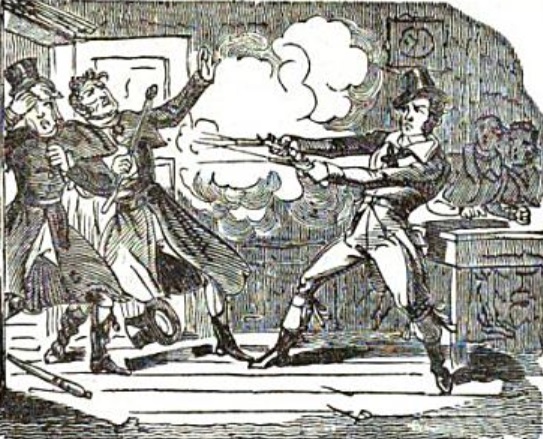
At the entrance of a parlour in the house, the prisoner appeared in a posture of intending to resist. Holding a loaded pistol in each of his hands, he with threats and imprecations desired the officers to stand off, as he would otherwise fire at them.

The officers, without being intimidated by those menaces, attempted to rush in and seize him, on which the prisoner discharged both the pistols at the same instant of time, lodging the contents of one in the body of David Price, and with the other wounded Turner very severely in the head. Price after languishing a few hours died of the wound.

Mr. Garrow was very pathetic and animated in his description of the several circumstances composing the shocking barbarity. To prove it, he would call four witnesses, whose evidence, he said, would be but too clear to establish the prisoner’s guilt.

The Jury would be enabled to judge from the facts to be submitted to them, and would undoubtedly decide on the issue joined between the Crown and the prisoner at the bar.

The learned counsel accordingly called Turner, the landlord of the house, a surgeon, and a fourth witness; but as the substance of their evidence is comprised in Mr. G’s opening of the indictment, it would be superfluous to repeat it. Turner said positively, he saw the prisoner discharge the pistols, from one of which he himself received his wound, and the contents of the other were lodged in the body of Price, who died very shortly after. The surgeon proved that the death was in consequence of the wound.

Mr. Knowles and Mr. Best were counsel for the prisoner, but the weight of evidence against him was too strong to be combatted by any exertions.

Mr. Baron Perryn summed up the evidence, on every essential part of which his lordship made several apposite, pointed, and accurate observations. The counsel for the prisoner, he remarked to the jury, had principally rested his defence on the circumstances of several other persons being present when the pistols were discharged, by some of which they contended the death wound might possibly have been inflicted. But, with respect to that part of the transaction, it would be proper for the jury to observe, that the witness Turner, had sworn positively to his having seen the prisoner in the act of discharging the contents of the pistol.

The jury, after a consultation of about three minutes, pronounced the dreadful verdict of — Guilty.

Through a flaw in the indictment for the murder, an objection was taken by the counsel. The indictment did not state that Price died in St. Saviour’s parish. This was argued nearly two hours, when Mr. Baron Perryn intimating a wish to take the opinion of the Twelve Judges of England, the counsel for the prosecution, waiving [sic] the point for the present, insisted on the prisoner’s being tried on the another [sic] indictment, for feloniously shooting at Barnaby Windsor, the officer who apprehended him after he had shot Price, which the learned counsel said, would occupy no great portion of time, as it could be sufficiently supported by the testimony of a single witness. He was accordingly tried and found guilty on a second capital indictment.

The prisoner, who, contrary to expectation, had in a great measure refrained from his usual audacity, began with unparalelled insolence of expression and gesture, to ask his lordship if he “was to be murderd by the evidence of one witness?” several times repeating the question, till the jury returned him Guilty.

When Mr. Baron Perryn put on the judicial cap, the prisoner, unconscious, and regardless of his dreadful situation, at the same time put on his hat, observing the judge with contemptuous looks while he was passing the sentence. When the constables were removing him from the dock to a coach, he continued to vent torrents of abuse against the judge and jury, whom, he charged with, as he styled it, his murder.

As his desperate dispostion was well known, he was, to prevent resistance, hand-cuffed, and his thighs and arms also bound strongly together, in which situation he was conveyed back to prison.

So callous was this ruffian to every degree of feeling, that on his way to be tried, as he was passing near the usual place of execution on Kennington Common, he put his head out of the coach window, and with all the sang froid imaginable, asked some of those who guarded him, if they did not think he would be twisted on that pretty spot by Saturday.

He was executed on Kennington Common, on the 3rd of August, 1795, with James [John] Little for the murder of Mr. Macevoy and Mrs. King at Richmond, and Sarah King for the murder of her new born bastard, at Nutfield, Surrey, in the presence of an immense multitude of spectators, among whom he recognized many acquaintances and confederates, to whom he bowed, nodded, and laughed with the most unfeeling indifference.

He had a flower in his mouth, and his waistcoat and shirt were unbuttoned, leaving his bosom open in the true style of vulgar gaiety: and, talking to the mob, and venting curses on the officers, he died, as he had lived, a ruffian and a brute! He was afterwards hung in chains upon Wimbledon Common.

The infamy of his life, and the atrocity of his deeds, rendered him a fit object for the posthumous punishment of hanging in chains on the arena of his crimes, and (painful as is the record, the truth must be told,) while the disgusting carcass of this malefactor, devoured by the birds and withered by the elements, gradually disappeared, the spot on which he had been gibbetted was converted into a temple of infamy, to which the thieves and vagabonds of London resorted in a sort of pilgrimage; and while the leading ruffians of the flash school, of which Avershaw was the child and champion, procured from his decaying and piece-meal carcass the bones of his fingers and toes to convert into stoppers for their tobacco-pipes, the tyro villains contented themselves with tearing the buttons from his clothes, as mementos of the estimation in which they held their arch prototype.


The newsmen effected horror that “Abershaw continued to the last moment of his existence in the same hardened state” (Telegraph, Aug. 4, 1795) and “took no notice either of his fellow-sufferers, or what the clergyman endeavoured to say to him” — then “when the executioner took the whip and touched the horse, made a spring from the cart, and was heard to repeat a horrid curse the last word he spoke.”

Avershaw’s larger-than-death performance of “dying game” would in subsequent years be a much-honored exemplar among kindred spirits who would not occasionally be required to attempt to outdo him in dramatic contempt of the gallows.

On this day..

1834: Eliza Joyce, confessed poisoner

(Thanks to Meaghan Good of the Charley Project for the guest post. -ed.)

On this date in 1844, Eliza Joyce was hanged on the roof of Cobb Hall at Lincoln Castle for the murders by poison of her two daughters and her stepson.

She was the fifth and last woman to be publicly hanged at the castle during the 19th century, and she remains the last woman in England to be hanged for a crime she’s pleaded guilty to.

Eliza had married William Joyce, a gardener, in 1840. He had two children by his prior marriage, Emma and William Jr., and he and Eliza went on to have a daughter together, Ann.

However, Emma died suddenly in October 1841 and William took sick the following year. In September 1842 he was visited by a doctor, who prescribed medicine for him. Eliza went to the chemist’s … where she picked not that medication, but arsenic.

Her husband found out and took the poison back to the chemist’s, where they realized some of it was missing. By then William Jr.’s condition had worsened considerably and he was showing symptoms of arsenic poisoning. Before his death at Christmastime he gave a statement, confirming his stepmother had given him the arsenic. He was fifteen years old.

Early in 1843, Eliza’s baby daughter Ann also died. Eliza was charged with William Jr.’s murder, but the indictment was thrown out on a technicality. She was then re-charged with attempted murder, which at the time carried the same penalty: death. But at her trial she claimed William Jr.’s poisoning was accidental: she’d spilled some of the arsenic powder on the floor, she said, and picked it up with a spoon, and later without washing it she used the same spoon to give William his medication.

The jury bought the story and Eliza was freed in the summer of 1843.

However, in light of what had happened, her husband cast her out and she had to move into the workhouse.

Eventually, her conscience began to trouble her and she confessed she’d been guilty all along of William Jr.’s murder, and that she had also poisoned both Emma and Ann with laudanum.

When asked why she’d done such terrible things, she plaintively replied, “I don’t know, except I thought it was such a troublesome thing to bring a family of children into this troublesome world.”

By now fully resigned to her punishment, she offered no defense to the court and pleaded guilty to both girls’ murders. (She couldn’t be charged with her stepson’s murder a second time.) William Calcraft handled her execution, and (for once) he didn’t botch it; she died quickly and quietly.

The prisoner walked with tolerable firmness, being only occasionally supported; and once, when about midway on the platform, she paused for a second, and turned to take a parting glance at the sunny scenery by which she was surrounded, and, as if to bed a lingering farewell to the bright and glorious world which she had sacrificed: her face and features wore an aspect of ghastly agony which none can forget who gazed upon her. Having ascended to the top of the tower on which the scaffold was erected, her bonnet was removed, her arms pinioned, and the cap placed over her face. She then ascended the step of the gallows. The effect of her appearance on the immense crowd was awfully striking. In an instant, the hootings, bellowings, and imprecations, which ever distinguish such enormous assemblages, were hushed, and a profound stillness reigned throughout the living mass.

The Hull Packet and East Riding Times, Aug. 9, 1844

On this day..

1831: John Bell, age 14

Fourteen-year-old John Bell was hanged at Maidstone Prison on this date in 1831, for slashing the throat of a 13-year-old chum near Rochester in order to steal a pittance of poor relief that boy had received from a parish church. (The murder netted “three half-crowns, a shilling, and a six-pence” per the Aug. 6, 1831 Preston Chronicle, from which the facts of the case below are also drawn.)

Bell’s little(r) brother James gave the evidence that would hang John: that John spied Richard Taylor and on a lark announced that they would slay him for his pennies.

To this end John borrowed James’s knife, and before employing it to open Richard’s carotid artery, retired with Richard to a turnip-field where the blade pared a few snacks for greedy boys.

Then on the pretense of taking a shortcut home, James guided Richard into a woods where avarice guided his hand to a greater sin than turnip-theft. Showing a streak of the same ruthless acquisitiveness, 11-year-old James demanded half the proceeds lest he blab on his brother — leading John, whose situation was beginning to dawn upon him, to exclaim, “Torment will come upon me for this; I know I shall be hanged!”*

The hardihood which the culprit had displayed at his trial, and even when sentence was passed, deserted him as he entered his cell. He wept bitterly; and when his mother visited him on Sunday afternoon, [the day before the hanging -ed.] he acused her of being the cause of bringing him to his “present scrape.”

On Sunday evening, after the condemned sermon had been preached by the Rev. Chaplain, Bell made a full confession of his guilt. His statement did not materially differ from that which was given on the trial; but he added some particulars of the conduct of his victim before he murdered him, which make the blood run cold.

He said that when he sprung upon Taylor with the knife in his hand, the poor boy, aware of his murderous intention, fell upon his knees before him — offered him all the money he had, his knife, his cap, and whatever else he liked. Said he would love him during the whole of his life, and never tell what had happened to any human being. This pathetic appeal was lost on the murderer, and without making any answer to it, he struck the knife into his throat!”

At half-past 11 o’clock, the solemn peals of the prison bell announced the preparations for the execution. After the operation of pinioning, &c. had been completed, the culprit attended by the Chaplain, &c., walked steadily to the platform.

When he appeared there, he gazed steadily around him; but his eyes did not quail, nor was his cheek blanched. After the rope was adjusted round his neck, he exclaimed in a firm and loud tone of voice, “Lord have mercy upon us. Pray good Lord have mercy upon us. Lord have mercy upon us. All the people before me take warning by me!”

Having been asked if he had any thing farther to say, he repeated the same words, and added, “Lord have mercy upon my poor soul.”

At the appointed signal, the bolt was withdrawn, and in a minute or two the wretched malefactor ceased to exist.

The body is to be given over to the surgeons at Rochester for dissection.

The number of persons present could not be less than 8,000 or 9,000.

The jury did not even retire to come to its verdict, but it strongly endorsed commuting the consequent (mandatory) death sentence.


The Spectator editorialized for the occasion (and we draw this text from its reprint in the Standard of Aug. 8, 1831):

The boy Bell, whose conviction of the murder of little Taylor, near Chatham, we mentioned in our last number, was hanged on Monday, at Maidstone. Bell was only 14 years of age; and, from the utter neglect of his education, could hardly be regarded, even had he been much older, as an accountable being.

It does not appear, from any thing that transpired at the trial or after it, that he felt any greater qualm in killing Taylor, than he would have done in killing the rabbit to whose squeak the dying shriek of the child was, with horrid reality, compared by the brother of the slayer.

Was an untutored boy like this, with his chubby cheeks and flaxen locks, and every attribute of childhood, a proper subject for the halter and the dissecting-knife? Is it required that our code, like that of Moloch, should receive its sanction by the sacrifice of infants? Are our children and schoolboys already murderers in intention, that we should offer them such an example; or was it our grown-up men that we sought to deter from crime by so revolting a specimen of punishment?

Of all the legal tragedies that have been enacted for the last twenty years, there has been none so replete with horror.

And yet we are told therer wer multitudes assembled to behold it! And the masses that pressed forward to glut their eyes with the expiring convulsions of the miserable boy were angry because they had to wait from eight to eleven o’clock until their longing was satisfied!

* This quote is from the Liverpool Mercury of Aug. 5, 1831.

On this day..

1701: Esther Rodgers, repentant

O my dear Friends — Take Warning by me. Here I come to Dy, and if God be not Merciful to my Soul, I shall be undone to all Eternity — If I do not turn by Repentance. I Bless God, I have found more Comfort in Prison, than ever before. O Turn to God now. O how hard it is to Repent; If you go on in Sin, God may give you up to a hard Heart. Oh! Turn whilst the Day of Grace lasts.

These, shouted to a crowd of thousands, were the last uttered by repentant sex worker and infanticide Esther Rodgers at her hanging in Ipswich, Mass., on this date in 1701. Esther Rodgers’s life story and jailhouse conversion in New England are richly explored by author and sometime Executed Today guest blogger Anthony Vaver on his site, Early American Crime. Take a look here.

On this day..

1830: Charles Wall

(Thanks to Meaghan Good of the Charley Project for the guest post. -ed.)

On this date in 1830, Charles Wall was hanged at Worcester Prison for the murder of his fiancee’s daughter.

Wall’s fiancee, Mary Chance, lived in the town of Lye and had two illegitimate children. Wall was not their father and didn’t support them financially, but he seemed fond of them and was never known to mistreat them.

The oldest child, five-year-old Sally, vanished without a trace on May 16, 1830. Sally and her mother had gone out visiting with Wall, and that evening the little girl asked permission to go outside and play. She never returned, and her mother and Wall searched frantically for her until the wee hours, but to no avail.

Little Sally’s body wasn’t recovered until May 19; it was found at Old Swinford at the bottom of a limestone pit some 240 feet deep. She had died of a fractured skull. But did she fall … or was she pushed?

Several people reported having seen Wall alone with Sally the night of her disappearance. One witness picked him out of a lineup of more than a dozen men and said he’d seen Wall carrying Sally, who was sobbing and begging to be allowed to go home for her supper. Another witness saw Wall walking alone from the direction of the limestone pit at 9:00 that evening. Still a third witness said that on the morning of May 16, Wall had asked her some questions about which limestone pits in the area were being worked.

The inquest returned a verdict of willful murder against Wall and he was brought to trial. Nicola Sly’s A Grim Almanac of the Black Country notes,

For every witness called by the prosecution, the defense countered with a witness who had either seen Sally playing alone around the top of the unfenced mineshaft on the night of her disappearance, or who testified about the kindness shown by Wall to both of Mary Chance’s illegitimate children.

Mr. Justice Park told the jury that he personally could not see any possible motive that Wall might have for killing the little girl, reminding them that nobody had spoken of anything but kindness and fondness between Wall and his alleged victim.

He was convicted anyway, after only fifteen minutes’ deliberation on the part of the jury, but they recommended mercy. Wall’s death sentence was not respited, though. He was hanged two days later, still protesting his innocence.

On this day..