1996: Thomas Reckley, the first in Bahamas in 12 years

On this date in 1996, Thomas Reckley was hanged in the Bahamas for a 1989 Nassau drug murder.

This execution was noteworthy as the first in 12 years in the Bahamas.*

It was also notable as the first since the British Privy Council’s 1993 Pratt and Morgan ruling. That decision held that keeping a condemned prisoner awaiting the gallows for more than five years constituted “cruel and inhumane treatment” sufficient to invalidate the death sentence.

In an uncomfortable holdover from the Empire, the Privy Council was then and still remains today the court of last resort for Commonwealth countries in the region. Therefore, Pratt and Morgan had the effect of making death sentences extremely difficult to carry out: the Privy Council itself dilated appeals (or at least, this was what irritated tough-on-crime types said), and also asserted a human rights standard requiring expedited appeals. In 1994, Trinidad & Tobago squared the hemp circle by hanging Glenn Ashby six days before the deadline even though his last Privy Council appeal was still pending. (It was granted … but too late.)

Sentenced to death on November 7, 1990, Reckley was clearly past the five-year pole when the Bahamas decided to hang him. (He’d received five stays of execution in his time.) This execution appears to be the first in the Caribbean that would fail to meet the Pratt and Morgan test.

* The last previous was William Armbrister on April 10, 1984, capping a period in the 1970s and early 1980s when the Bahamas saw routine hangings every year or two.

On this day..

1872: Sher Ali Afridi, assassin of the viceroy

On this date in 1872, Sher Ali Afridi was hanged at Viper Island for knifing to death the British Viceroy of India 32 days before.

Richard Bourke, the 6th Earl of Mayo, had stopped off to visit the convict settlement at the Andaman Islands.

Little remembered today, Great Britain shipped tens of thousands of Indian convicts to that Bay of Bengal archipelago in the latter half of the 19th century (and continuing into the 1930s).

One of them was Sher Ali.

This former cavalryman in the UK’s Indian military forces had murdered a relative in a private feud, and was dispatched to the prison colony for his trouble. Evidently he nursed a terrible grudge at being judicially punished for what, in his opinion, was no crime at all. The standard story* is that he dreamed of wreaking revenge on the person of “some high British official.”

They don’t come much higher than the Viceroy to India.

So despite his sterling conduct record as a prisoner, Sher Ali was ready with an opportunistic blade when Lord Mayo took the wrong pause at the wrong spot.

Notwithstanding the enormity of the blow — the Viceroy of India was literally one of the most powerful figures in the British Empire — the incident was relatively downplayed, perhaps to avoid stoking any wider sectarian martyr-making or conveying the impression of colonies in turmoil. Arrested on the spot, Sher Ali was condemned quickly and hanged with little fanfare.

An Indian paper quoted by the April 15 London Times reported the assassin’s last hours thus:

I had a long interview with the prisoner the evening previous to his execution. He talked quite freely, and appeared to think he had done a fine thing. He had been told about an hour before I saw him that he was to be hanged next morning. We got up steam early next morning and went to Chatham, passing him with his police guard in a boat on the way. As soon as we were moored we got over to Viper Island, where the gaol is. There was no unusual preparation for the affair, and the convicts were at work as usual. Indeed, it was not generally known that it was to be. There were from 30 to 40 Europeans present, no natives except the police and sepoys, and no European soldiers. About a quarter to 8 the fellow was led out. He was smiling and quite collected. The police officer who came down to investigate the affair, as he ascended the steps leading up to the scaffold, asked him a question. He shook his head with a smile, as he said nahin sahib. As soon as he got up he asked the hangman to turn his face towards Mecca, and then began to pray very loudly and quickly. He said two prayers, and kept on repeating the Mussulman’s creed. The drop fell at seven minutes to 8 o’clock exactly. The knot slipped round to the back of his neck, and although he had nearly seven feet of a drop, his neck was not broken, so he died very hard. He was hanging about ten minutes before he ceased to struggle. As he was scantily clothed, and his legs and most of his body naked, his struggles were distinctly visible. We were quite close to the scaffold. After he was dead we adjourned, and returned to see him cut down at 9. His face was not distorted in the least, but wore an expression of pain. We afterwards went to see the post mortem examination. There were only eight persons present. The prisoner’s lungs, liver, heart, &c., were taken out and weighed. The top of his head was cut off, and his brain taken out: the latter weighed 47 ounces.

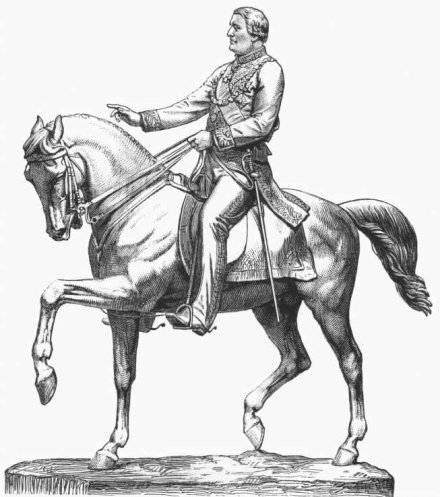
Despite not making a particularly big deal about Lord Mayo’s murder, the Empire did favor its Indian subjects with a Calcutta equestrian statue of the assassinated viceroy.


This monument and other former public memorials from the British imperial period now squirreled out of view in independent India can be found on a fun Flickr gallery, Forgotten Statuary of the British Raj. Brits can find the Earl of Mayo in marble closer to home in Cockermouth.

Mayo was also the namesake of the Mayo School of Arts in Lahore, present-day Pakistan (it’s now known as the National College of Arts). The school’s first principal was Lockwood Kipling, and this man was able to hook his 16-year-old son up with an assistant-editorship at a Lahore newspaper … from which young Rudyard Kipling launched his literary career.

* The “lone nut with a grudge” version has been latterly disputed with attempts to reconstruct Sher Ali as an Islamic revolutionary.

On this day..

1981: Steven T. Judy, Hoosier rapist

(Thanks to Robert Elder of Last Words of the Executed — the blog, and the book — for the guest post on the anniversary of what was then the first execution in Indiana for nearly 20 years. Fans of this here site are highly likely to enjoy following Elder’s own pithy, almanac-style collection of last words on the scaffold. -ed.)

“I don’t hold no grudges. I’m sorry it happened. I know what I’m doing.”

— Steven T. Judy, convicted of rape and murder, electric chair, Indiana.
Executed March 9, 1981

A serial rapist, Judy openly courted capital punishment. At his trial for killing a woman and her three children (ages five, four, and two), Judy told a jury to condemn him or else he might kill them, their children, and the judge. He showed no remorse for the murders, telling reporters, “I don’t lose sleep over it.” Judy asked for death. “I’ve lived my hell,” he said. “So [what waits for me] has to be better.”

On this day..

1945: Karl Hulten, for the Cleft Chin Murder

On this date in 1945, Karl (or Carl) Hulten, a 22-year-old American paratrooper, hanged in Pentonville Prison for murdering an English taxi driver for £8.

The “cleft chin murder” — so dubbed because the victim had this feature — is explored as extensively as anyone need know about it in George Orwell’s curmudgeonly 1946 essay “Decline of the English Murder”.

Orwell posited the passing of “our great period in murder, our Elizabethan period, so to speak … roughly 1850 and 1925” featuring magnetic, literary-quality criminals whose misdeeds had “stood the test of time”: “Dr. Palmer of Rugely, Jack the Ripper, Neill Cream, Mrs. Maybrick, Dr. Crippen, Seddon, Joseph Smith, Armstrong, and Bywaters and Thompson.”

For Orwell, the “great period” elapsed in part because the 20th century’s monumental destruction of human life dwarfed the meaning of individual homicides, and in part because the crimes themselves (and even their frequent medium, arsenic) connected to frustrated (usually domestic) Victorian passions and imbued “dramatic and even tragic qualities which make [them] memorable and excite pity for both victim and murderer.”

But that was then. Orwell wants these newfangled atavistic hoodlums and their crummy American films to get off his damn terrace.


Sure, but where’s the heart? (London Times, Jan. 24, 1945)

Now compare the Cleft Chin Murder. There is no depth of feeling in it. It was almost chance that the two people concerned committed that particular murder, and it was only by good luck that they did not commit several others. The background was not domesticity, but the anonymous life of the dance-halls and the false values of the American film. The two culprits were an eighteen-year-old ex-waitress named Elizabeth Jones, and an American army deserter, posing as an officer, named Karl Hulten. They were only together for six days, and it seems doubtful whether, until they were arrested, they even learned one another’s true names. They met casually in a teashop, and that night went out for a ride in a stolen army truck. Jones described herself as a strip-tease artist, which was not strictly true (she had given one unsuccessful performance in this line); and declared that she wanted to do something dangerous, “like being a gun-moll.” Hulten described himself as a big-time Chicago gangster, which was also untrue. They met a girl bicycling along the road, and to show how tough he was Hulten ran over her with his truck, after which the pair robbed her of the few shillings that were on her. On another occasion they knocked out a girl to whom they had offered a lift, took her coat and handbag and threw her into a river. Finally, in the most wanton way, they murdered a taxi-driver who happened to have £8 in his pocket. Soon afterwards they parted. Hulten was caught because he had foolishly kept the dead man’s car, and Jones made spontaneous confessions to the police. In court each prisoner incriminated the other. In between crimes, both of them seem to have behaved with the utmost callousness: they spent the dead taxi-driver’s £8 at the dog races.

Judging from her letters, the girl’s case has a certain amount of psychological interest, but this murder probably captured the headlines because it provided distraction amid the doodle-bugs and the anxieties of the Battle of France. Jones and Hulten committed their murder to the tune of V1, and were convicted to the tune of V2. There was also considerable excitement because — as has become usual in England — the man was sentenced to death and the girl to imprisonment. According to Mr. Raymond, the reprieving of Jones caused widespread indignation and streams of telegrams to the Home Secretary: in her native town, “SHE SHOULD HANG” was chalked on the walls beside pictures of a figure dangling from a gallows. Considering that only ten women have been hanged in Britain this century, and that the practice has gone out largely because of popular feeling against it, it is difficult not to feel that this clamour to hang an eighteen-year-old girl was due partly to the brutalizing effects of war. Indeed, the whole meaningless story, with its atmosphere of dance-halls, movie-palaces, cheap perfume, false names and stolen cars, belongs essentially to a war period.

Perhaps it is significant that the most talked-of English murder of recent years should have been committed by an American and an English girl who had become partly Americanized. But it is difficult to believe that this case will be so long remembered as the old domestic poisoning dramas, product of a stable society where the all-prevailing hypocrisy did at least ensure that crimes as serious as murder should have strong emotions behind them.

On this day..

1968: Veyusile Qoba, the last of the Langa Six

On this date in 1968, the black South African revolutionary Veyusile Qoba was hanged for his role in the murder of a policeman six years before.

Four men before him had gone to the gallows the previous Halloween for this crime; a fifth hanged separately for a different policeman’s killing late in 1967. Together with Qoba, they constituted the “Langa Six”.

The color line, of course, was the beef of the Six — and not only that, but the divide within the anti-resistance movement between the African National Congress (ANC) and the Pan Africanist Congress (PAC).

The Langa Six belonged to the latter entity’s military wing, Poqo (later to develop into the Azania People’s Liberation Army, but we’ll use the period-appropriate original nomenclature here). After police response to a PAC-organized 1960 protest against South Africa’s notorious racial passes turned into the Sharpeville Massacre,* Poqo girded for violent struggle against a violent state.

With the alleged slogan “one settler, one bullet,”** Poqo mounted an aggressive terrorist campaign that did not scruple to target white civilians, or black civilians perceived as collaborators. (The ANC’s simultaneous Nelson Mandela-led terrorist campaign had a more selective attitude.)

And this, in turn, spurred a further crackdown, as Pretoria banned both the ANC and PAC, and enacted a Sabotage Act — the law under which Nelson Mandea was jailed for life.

Poqo and PAC operatives were likewise arrested by the thousands in the troubled 1960s.

In March 1962, five of the Langa Six attacked police vehicles in the Cape Town suburb, killing a police Sgt. Moyi.

According to [policeman] Basson, some 50 Bantu attacked his vehicle when he tried to start the engine … he found that one of the petrol bombs set the vehicle alight and they were compelled to jump out — they were dragged out of the vehicle. It was at this stage that Sgt Moyi was set upon, pulled to the ground, and stabbed to death. Det-Sgt Josiah Moss was also injured and knocked unconscious but owing to that he fortunately escaped with his life. (Source)

(South Africa’s post-apartheid Truth & Reconciliation Commission found that this event was an impromptu, local ambush, rather than a centrally-planned operation.)

* The date of that massacre, March 21, is now honored as Human Rights Day in South Africa; it’s also the United Nations’ International Day for the Elimination of Racial Discrimination.

** As Sartre put it in his notes to Fanon’s 1961 Wretched of the Earth, “to shoot down a European is to kill two birds with one stone, to destroy an oppressor and the man he oppresses at the same time: there remain a dead man, and a free man.” PAC spokespeople have denied that “one settler, one bullet” was an actual party slogan or policy, however.

On this day..

1673: The effigy of Charles Alexis dit Dessessards

According to this registry of events in French Quebec before the English conquest, one Charles Alexis dit Dessessards was ordered broken on the wheel by Quebec’s high executioner on this date in 1673.

He had been convicted of murdering a fur-trapping buddy named Herme, and plundering his pelts.

In the terrifying words of the sentence, he was at 3 p.m. to have “arms and legs broken with four blows, then be strangled and thrown on a wheel to remain there until seven o’clock in the evening. His body will then be brought to the gallows, there to remain until entirely consumed” by the elements. On top of everything, he had a 200-livre fine to pay.

There was just one bit of good news for the murderer Charles Alexis dit Dessessards:

“Until the said Charles Alexis is apprehended, the aforesaid sentence will be executed upon his effigy.”

MARS

Le 6. — “Charles Alexis dit Dessessards, convaincu d avoir tué de guet-à-pens le nommé Herme, son camarade de voyage, et d’avoir volé ses hardes et pelleteries, sera conduit sur la grande place de cette vile (Québec), par l;exécuteur de la haute justice, un lundi, à trois heures après-midi, et là, sur un échafaud qui y sera dressé à cet effet, y aura les bras et les jambes rompues de quatre coups qu’il recevra vif; sera ensuite étranglé et jeté sur une roue pour y demeurer jusqu’à sept heures du soir. Son corps sera porté sur les fourches patibulaires pour y demeurer jusqu’à parfaite consommation. Condamne en outre à deux cents livres d’amende envers le Roy, à la restitution des choses volées et le surplus de ses biens confisqué. Et en attendant que le dit Charles Alexis soit appréhendé, sera exécuté en effigie aux fourches patibulaires, un lundi, à l’heure que dessus.

On this day..

1676: George Bromham and Dorothy Newman, on the Combe Gibbet

On this date in 1676, the Combe Gibbet was put to its first and only use.

Adulterous lovers George Bromham (or Broomham) and Dorothy Newman had been doomed by the Winchester Assize for murdering the wife and son of Bromham’s inconvenient marriage. “With a staff,” the trial record says. Ouch.

The two were sentenced to hang together “in chaynes near the place of the murder,” which demonstrative sentence required the erection of a brand-new purpose-built double gibbet just for the occasion, high atop Inkpen Beacon, the 975-foot hill overlooking the countryside.* After execution, they were taken down, laid out a nearby barn (inevitably to become known as “Gibbet Barn”), and then strapped back up on the double-gallows in chains for a few days.

Although this dreadful landmark has never been used again, it’s stood ever since. Or, technically, a succession of different versions have stood, but the point is that there’s still today a large, black execution device looming over scenic Berkshire. It’s a nice place for a walk. (pdf)

When next in West Berkshire, top your visit to the Combe Gibbet with a refreshing Gibbet Ale at Inkpen Common’s Crown and Garter Bed & Breakfast. (That’s where the Gibbet Barn used to be.)

The murder behind the gibbet was the the subject of a student film called Black Legend in 1948 — the first movie made by future legendary director John Schlesinger.

* Bromham was from Combe, and Newman from neighboring Inkpen, and the murder itself took place on the towns’ border. In the great tradition of municipal politics, there was a consequent dispute over the bill for setting up this gibbet; they were forced to split the bill.

On this day..

1886: David Roberts, dutiful son

On this date in 1886, David Roberts was hanged at Cardiff for a murder-robbery the October previous.

Both Roberts and his father, Edward Roberts, were arraigned for the murder. The Robertses, father and son, had both been playing cards with the late David Thomas on the night of the crime, and left together with him (as well as another man).

The next day, David Thomas was found in a field bludgeoned and stabbed to death, with David Roberts’ pipe nearby. A search of the Roberts home revealed £66 stashed away in a bloody handkerchief, the approximate amount Thomas as known to have made at market on the day before he died.

David Roberts made a voluntary written confession specifically claiming sole responsibility for the murder. He even pleaded guilty in court, shouting out, “I swear my dad had nothing to do with this murder!”

Apparently he was persuasive: prosecutors decided to present no evidence against Edward Thomas and allowed him to be acquitted.

So Roberts stood alone on the trap this day, having at least the comfort of having done right by his family duty. Unfortunately the hangman did not quite do right by Roberts fils as he appeared to survive the drop. Witnesses were hastily conducted away while Roberts dangled, still twitching and strangling. The error was ascribed to the condemned man’s “muscular neck,” but this alleged physiognomy only mattered because at this late date British hangmen still designed the parameters of the drop impressionistically.

All that was changing to follow the professional example of the scientific William Marwood, however. Later in 1886, a commission was formed under former Liberal Home Secretary Baron Aberdare to examine the issue. This commission ultimately produced the first official table of drops specifying the fall that should be allotted to prisoners based on their weight, with a view to reliably breaking the neck.

On this day..

2013: Naw Kham, Mekong drug lord

Today in Kunming, China, Burmese drug lord Naw Kham was executed by lethal injection along with three of his associates.

Naw Kham (or Nor Kham), a Burmese Shan, ran a sizable gang of drug traffickers/paramilitaries/pirates, the Hawngleuk Militia, in the Golden Triangle.

In addition to heroin smuggling, this gang also shook down for protection money the many Chinese commercial shippers coming down the Mekong River, and wantonly raided shippers that held out on them. He was untouchable in his lawless zone (with the possible protection of Burmese military to boot) for more than a decade.

Times may have started passing Naw Kham by in the 2000s.*

China’s economic boom has driven more shipping, and a search for investment outlets for Chinese capital, both inevitably increasing its presence on the economically developing Mekong. Ultimately this had to come at Naw Kham’s expense.

He had hit Chinese shippers before to the annoyance of Beijing, but matters came to a head when the kingpin allegedly retaliated against the flouting of his “taxes” by massacring 13 Chinese sailors in 2011 on board two tightfisted merchantmen. (“Allegedly” because Naw Kham blamed the Thai military for this slaughter, and some people believe him.)

At any rate, China put the screws to the drug lord, not only pressuring Southeast Asian governments for his capture but directly hunting him with special forces. Early in 2012, Naw Kham was arrested and his gang broken up after a multinational manhunt; the leader was extradited from Laos to face Chinese justice with five of his associates.** The accused had little recourse but to throw themselves on the mercy of the court.

Executed with Naw Kham — and underscoring the multinational complexion of his outfit — were Hsang Kham (a Thai), Zha Xika (a Lao), and Yi Lai (stateless). The other two defendants received a suspended (reprieved) death sentence, and an eight-year prison term.


Naw Kham being led to an execution van on March 1, 2013. Two hours of footage of the “Mekong River murderers” walking their green mile was broadcast on CCTV News, although not the executions themselves.

The case isn’t entirely closed with his date’s executions, however. China is still pressuring Thailand to bring to book Thai troops whom China says colluded (at the very least) in the Mekong murders. The future direction of that investigation is quite unclear.

* China, Burma, Thailand, and Laos, inked a 2001 pact to regularize shipping on the Mekong. It contained no provision allowing for stateless narco-buccaneers.

** It’s noteworthy that this is a non-Chinese citizen being extradited to China for a crime not on Chinese soil.

On this day..

1925: Jovan Stanisavljevic Caruga, Slavonian hajduk

On this date in 1925, the Serbian outlaw Jovan “Jovo” Stanisavljevic, better known by his nickname Caruga (Charuga), was hanged before a crowd of 3,000 in Osijek.

Caruga was born to peasant stock within the Kingdom of Croatia-Slavonia within the Hungarian Kingdom within the Austro-Hungarian Empire, and at just the right age for service at arms when World War I came along to wreck that agglomeration.

Caruga soon deserted the front lines on a false pass — but his unauthorized leave became permanent when he came across a Hungarian soldier paying court to the innkeeper’s daughter whom Caruga, too, desired. Caruga shot him dead.

He did a short turn in prison but escaped in 1919 and shortly thereafter established himself the captain of a posse of brigands styled the “Mountain Birds”. From roosts in the Papul and Krndija mountains they preyed on the nearby Slavonian plains — ducking away freely when needed to Dalmatia or Bosnia in what was now the independent (and quite unsettled) Kingdom of Serbs, Croats and Slovenes. (This polity would become Yugoslavia four years after Caruga’s execution.)

Caruga et al obtained a reputation as a Robin Hood-esque character who revenged himself on the rich. He was a late throwback to the classical hajduk character, a complex thief-with-the-heart-of-gold archetype who straddled the line between freebooting highwayman and rebel partisan during the era of Ottoman ascendancy in the Balkans. (The term’s roots trace to a caste of independent Hungarian footsoldiers in the 1600s.)

While the Turks were out of the picture at this point, the romance of the road and the social resentments rife in the fractious young kingdom were still sufficient to support a legendary bandit. Sentiment and fair fortune only turned against him after a botched raid on the estate of one Count Eltz of Vukovar, which resulted in an armed standoff with the local gendarmerie and the death of an innocent forester caught in the crossfire. Caruga was taken with some of his gang not long after.

Caruga is the subject of the so-called “last Yugoslavian film” before that country split apart. The movie Caruga stars the Croatian actor Ivo Gregurevic in what could arguably read as an allegory for the banditry of the outgoing communist years.

Most information about this date’s subject is in Serbo-Croatian; see for instance this .doc file.

* A number of present-day sports clubs in the former Yugoslavia use the name “Hajduk”, not unlike the way “Spartak” (Spartacus) brands Bulgarian and former-USSR teams. For instance, HNK Hajduk Split in Croatia, and FK Hajduk Kula in Serbia.

On this day..