On this date in 1850, a 57-year-old Harvard professor expiated upon a gallows at Boston’s Leverett Square the murder of one of the university’s donors.
The buzz of Boston in 1849-50, the Parkman-Webster murder case began with the disappearance of one of the crimson’s great benefactors, George Parkman, a Boston Brahmin known for his Ministry of Silly Walks gait about town (see right). According to Oliver Wendell Holmes, Sr. (who appeared as a witness at the trial of Parkman’s accused murderer), “he abstained while others indulged, he walked while others rode, he worked while others slept.”
Also, he inherited a ridiculous sum of money, and was tight with the debtors to whom he lent it.
Back before collection agencies, Parkman disappeared in November 1849 while making the rounds to shake down his borrowers. Within days, suspicion settled on Harvard anatomy and geology professor John Webster, who had squandered his own pile of money buying rock collections and maintaining appearances and such, and sank into desperate hock to the jutting-chinned ambulator who had helped him land the Ivy League appointment in the first place.
A weighty circumstantial case soon formed against Webster, with the invaluable aid of a snoopy janitor who turned up human remains in the office and testified to incriminating-sounding conversations.
Elites-on-elite crime epidemics always churn the scandal mills. Henry Wadsworth Longfellow’s wife Fanny wrote a friend,
You will see by the papers what dark horror overshadows us like an eclipse. Of course we cannot believe Dr. Webster guilty, bad as the evidence looks. … Many suspect the janitor, who is known to be a bad man and to have wished for the reward offered for Dr. Parkman’s body. … I trust our minds will be soon relieved, but, meanwhile, they are soiled by new details continually.
Boston high society was about to see a whole different side of Harvard.
Although perhaps individually explicable — anatomists had plausible reasons to have human remains at work, and other anatomists than Webster could have had access to his office — the cumulative weight of Webster’s ham-handed attempts to declare that he had paid up his debts to Parkman just before the latter’s mysterious disappearance, of the discovery of what (disputed) dental forensics declared to be Parkman’s dentures, of the ghastly appearance of a torso (disputedly) declared to be Parkman’s stuffed in a tea chest at Webster’s offices started to really make the man look guilty.
In view of a mediocre defense, the jury convicted Webster of whacking his own professional benefactor, in the university building erected on said benefactor’s donated plot of land.
While the prof’s seeming post-conviction acceptance of guilt — in a plain strategem to secure clemency — and generally shifty demeanor have cemented him as the definitive perpetrator in the standard historical reading,* Fanny’s snobbish take on the “bad man,” janitor (and moonlight body-snatcher) Ephraim Littlefield, has not been entirely lost to the tradition.
At the end of the day, everything about the case is circumstantial — indeed, besides being historically noteworthy for the first use of dental forensic evidence in a murder trial (forensics we might find rather speculative and unconvincing today), Webster’s case generated a landmark ruling from the judge’s jury instruction establishing “reasonable doubt” as the threshold for criminal conviction rather than the “absolute certainty” Webster’s prosecutors had no hope of attaining; that ruling influences American jurisprudence down to the present day.
And one cannot but notice how many of the circumstances — creepily playing Sherlock Holmes with a freelance dig into the professor’s furnace to discover charred bones, for instance — were provided by the fellow-suspect-turned-star-witness Littlefield, who niftily reaped the $3,000 reward for his offices in substituting Webster for himself under the pall of suspicion.
According to peripatetic crime blogger Laura James, a forthcoming (2009) book promises to revisit the sensational trial, “to examine all the intricacies for ourselves — not aided by the eager voice of the janitor.”
* Bemis, one of the prosecutors, wrote the go-to source on the Webster trial, available from Google Books; another contemporaneous account is here.
On this date in 1807, James McLean survived one hanging but not a second at Batavia, N.Y.
Subject of the first public execution in Genesee County, the drunken Scottish immigrant had axed to death a fellow squatter in an argument … and then a second man who ran to his victim’s aid … and then almost a third who was saved by flight.
This minor execution is the subject of an extensive historical inquiry* by a descendant of one of the victims full of period color: the defendant claiming the (then-recognized) right to a jury consisting of half non-citizen aliens as a “jury of his peers”; the billing receipts for the manhunt and the gallows construction (including gallons of brandy for the guards); and the indeterminate legends about what happened when the rope broke the first time.
The story has been told and retold that during the hanging the rope broke and McLean fell to the ground, shaken and stunned but alive. While another rope was being secured, McLean was reputed to remark, “As I killed two men, I deserve two hangings.” Another version has McLean protesting a second hanging since he had been convicted of only the one murder and had already been hung for that.
However, a historian’s recounting of the era’s newspaper accounts claims
that when the weight fell, the rope broke and McClean fell to the ground. He soon recovered from the shock and rising to his feet, expressed a strong desire not to be “hung again.” Some insisted that one hanging was a fulfillment of the law. Others, however, thought differently and informed McClean that “as he had killed two men, he ought to be hung twice.”
* The writer’s use of “gibbet” to mean an apparatus for a “sudden suspension” hanging, where the prisoner is not dropped but jerked into the air by a countervailing weight, is non-standard; “gibbet” means a gallows (or certain types of gallows structures, if you’re persnickety about it), and became a verb signifying the salutary posthumous display upon such a structure of an executed prisoner’s remains.
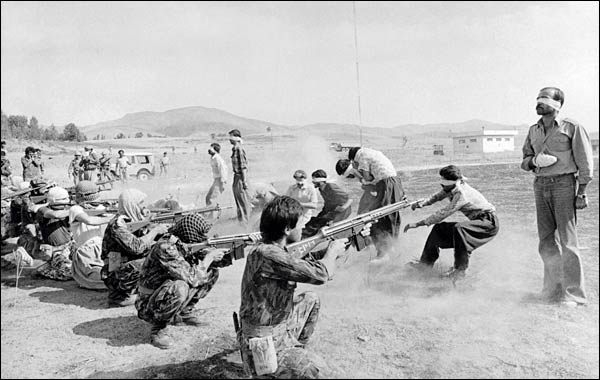
On this date in 1979, the only anonymous photograph to win a Pulitzer Prize captured nine Kurdish rebels and two of the Shah’s policemen executed by firing squad in revolutionary Iran.
This shot, one of a series taken of the event with the permission of the judge who condemned the men to immediate death in a half-hour trial at the Sanandaj airfield, ran the next day in the Iranian paper Ettela’at, whose editor prudently kept the photographer’s identity secret. Within two days, the stunning photo had rocketed around the world.
It won the Pulitzer Prize for Spot News Photography the following spring, still credited anonymously.
Two years ago, the Wall Street Journalrevealed — with the photographer’s permission — the identity of the man who shot this indelible image: Jahangir Razmi, who had gone on to a career as one of Iran’s top photographic journalists. He came to New York to collect the prize 27 years late.
On this date in 1993, Texas gave a lethal injection to a young man for murder — a crime many involved in the case no longer believe he committed, since the sole witness against him has recanted.
Lise Olsen — interviewed by NPR here — blew up the case; Cantu’s jury forewoman and the district attorney who tried him for his life are among those who have publicly regretted their roles in what has emerged one of the most compelling cases of an executed innocent in the modern American death penalty era. Nobody could possibly have predicted that pitiable public defender resources and an extremely aggressive capital punishment regime could result in such a thing.
One year ago today, justice was served better late than never, courtesy of the crime lab.
The 1987 rape and murder of Jo Talley Cooper, a pregnant 28-year-old Norman woman killed while her infant son lay unharmed in the next room, had stood unsolved for a decade.
Coincidentally — unluckily for Frank Duane Welch — forensic DNA testing was just coming online during that decade. A match in another case led the database to its culprit, in the Cooper murder and a similar crime around the same time.
Apart from the manner of his capture — and the incidental minor distinction of being the last person killed in Oklahoma’s busy death chamber before the 2007-2008 execution moratorium due to court challenges to lethal injection — Welch is an almost wholly unremarkable character, central casting for the modern American death row, a paragon of the banality undergirding appalling, life-shattering crimes.
My name is Frank Duane Welch, I am a 38 yr. old white male who is confined on Death Row within the Oklahoma Department of Corrections. I enjoy watching numerous sporting events, such as football, baseball, tennis and rodeo. Here on Death Row we have only two options of exercise, basketball or handball. I try and take advantage of both in order to stay in shape. Besides sports, I enjoy a good book, novels mostly. My tastes in music are first country and then some light rock, no heavy metal. My educational background consists of a bachelors degree in Animal Science. Now as for what I am looking for in a pen pal. I am looking for a friend, age not important. One who is willing to be straight forward with me, no games. For I will be straightforward with them. I need someone who is willing to help me both emotionally and financially. Someone who, when I am having a bad day, is willing to listen and give support. I am a proud man, but it is hard being alone in this place, no one to share your thoughts and feelings with. For this is the reason I have written this letter. If you are willing to accept me as I am and not hold my faults against me, I would love to hear from you.
According to the macabre* blog Dead Man Eating, Welch checked out with a belly full of pizza and a two-liter Coke, tritely last-wording:
There is nothing that can change the horrible thing I done. There is nothing that can change that. I take full responsibility for what I done. I am truly, truly sorry for all the hurt and pain I have caused you. I take full responsibility for what I’ve done. There’s no excuse for it. There never was. It was just me.
I love y’all. God bless y’all. I’m ready.
Maybe that’s as much closure as one can have in this world. That infant child who survived the horror had grown into a 20-year-old man who had never known his mother. Travis Cooper’s testimony at the clemency board hearing helped seal Welch’s fate.
It would be different if my mother would have died of natural causes. It would be different if it was God’s will, but the truth is that an evil man named Frank Welch took her life … And the unspeakable things he did to her, my mother, is what fills me with anger, the pain, and the loneliness that I feel to this day.
“None of this will ever bring my mom back,” Cooper told reporters after the execution. “I miss my mom.”
On this date in 1894, Sante Geronimo Caserio was guillotined in Lyon, where he had assassinated the president of France two months before.
In the day when the terror stalking European order brandished the black flag of anarchy, the Italian immigrant Caserio (his first name can be rendered either Sante or Santo, and his middle name alternately as Jeronimo, Ironimo or Heironymus) escalated the “propaganda of the deed” into the nightmares of Europe’s executives.
Before the decade was out, the Prime Minister of Spain, the King of Italy and the Empress of Austria-Hungary would all likewise be murdered by Italian anarchists.
As one might imagine, Caserio played the role of cocksure martyr to the hilt: asked whether he repented, he vowed to kill another president if given a few minutes; he refused to pursue a mental illness defense or inform on comrades; and at the guillotine, he exhorted the onlookers, “Forza, compagni! Viva l’anarchia!” (The New York Times account of the beheading recounts Caserio’s background, from an obviously hostile class position.)
By the time Caserio lost his head, the propaganda of his deed had already provoked mass arrests of Italians, and a tightening of the lois scelerates (“villainous laws”) cracking down on dissidents.
But as always, one person’s evildoer is another’s hero, and Caserio has his online monuments — like this Italian page, or this blog entry, or this rendition of one of the several songs in his honor:
In an artsier vein, one can also follow the thread of the story to Les Bal des Innocents, a downloadable French production billing itself as “The first feature film under Creative Commons Licence.”
On this date in 1963, the executioner paid his last call to Scotland with the hanging of Henry John Burnett for the murder of a rival-in-love seaman.
The type whom parents hope their daughter never dates, Burnett liked to keep his squeeze Margaret May Guyan under lock and key to keep her stepping out on him.
It’s an old, old tale. Boy meets girl, boy makes girl his prisoner, girl gets creeped out and returns to estranged hubby Thomas Guyan at 14 Jackson Terrace in Aberdeen, boy blasts Guyan in the face with a shotgun. How many times have we heard it told?
Even though the noose was on its way out — this is not only the last execution in Scotland, but the only hanging in Aberdeen in the past century and a half — there wasn’t much pussyfooting around when they’d made up their mind to use it: Burnett outlived his victim by only eleven weeks — notwithstanding an insanity plea and clemency petitions from both his own and the victim’s families — before hanging at Craiginches Prison, a facility that surely ought to be somebody’s porn name.
It’s got pride of place in a book about Aberdeen crime history, Blood and Granite. Because you can find anything on YouTube, there’s also this fine teaser for a forthcoming animation project of some kind:
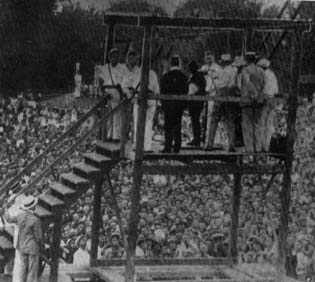
On this date in 1936, thousands thronged Owensboro, Kentucky, for a glimpse of what would prove to be the last public hanging in the United States.
The U.S. followed the trend of its onetime mother country, England, in moving the formerly iconic public hanging increasingly behind closed doors, but its federalist structure made that change uneven. In Kentucky itself at this time, the law displayed sedimentary layers of death penalty history.
Caught up for killing a 70-year-old woman — done in the midst of a drunken burglary, he had left a telltale ring at the scene; fingerprint analysis also helped establish his guilt — Rainey Bethea was on the hook for murder, robbery and rape. The former two indictments would have subjected him to (private) electrocution at the state penitentiary. The latter charge still carried the punishment of public hanging in the local county seat.
Bethea was charged only with rape.
While the explicit sentencing disparity between the crimes bears the clear marks of racism and patriarchy that made purported black-on-white sexual crimes such live fodder for lynch law, and the four-and-a-half-minute jury deliberation doesn’t have the look of solemnity, Bethea’s actual guilt seems fairly well-established.
But the case attracted a nationwide media swarm not for any exceptional quality of the crime or the anachronistic nature of the punishment, but for the involvement of a female sheriff. The “matronly” (virtually all descriptions of her gravitate to this adjective) Florence Thompson had inherited the top law enforcement post upon the death of her husband … and that meant she had inherited the responsibility of hanging Rainey Bethea, which would make her the first American woman to supervise an execution.
Would she or wouldn’t she? The press descended on Owensboro to cover the edifying spectacle of a plump mother stringing up a rapist, or else maneuvering her way out of the job. Thompson played cagey until the very last moment, when the ringers she had secretly hired appeared on the scaffold while she watched from a nearby vehicle.
In this photo, Bethea — almost totally obscured between his escorts — has just begun ascending the gallows.
The man who threw the trap showed up drunk and performed appallingly, but press reports subsequently focused on the beastly behavior of the “jeering” crowd rushing the gallows to tear souvenirs from the corpse. (For instance, Time and the New York Times.)
But according to Perry T. Ryan’s 1992 review of the case — including interviews with surviving witnesses — little to nothing of the kind occurred. Ryan claims Bethea faced about the most dignified hanging mob imaginable.
Maybe hyped-up atrocities in the hinterlands were part of what distant editors demanded after H.L. Mencken at the Scopes trial. Certainly, the local Messenger-Inquirer painted a sharply different picture from more prominent outlets in this August 16 editorial (titled “Panderers Galore”) whose themes could have stepped fresh from a modern cable TV gabfest:
Ambitious and irresponsible reporters and photographers who swarmed into Owensboro for the Bethea hanging dipped their ready hands into the cloaca of evil designs and plastered over the name of this fair city the dirty results of their pandering.
Those who saw the dawn kindling in the east and ushering in the last sunrise of the despicable creature about to die, did not expect all of the watchers to be in reverent mood, but a calm, quiet demeanor characterized their behavior, as a group, throughout their long wait, surprisingly moderate for an occasion on which the law was exacting the supreme penalty.
Considering the size of the throng that witnessed the hanging Friday morning and that it was composed largely of people, who journeyed to Owensboro from distant places, the wonder is that there was no demonstration, no emotional outburst. There was not the semblance of ‘mob impulse’ or ‘eagerness for the kill.’ For the sensation seeking star scribes of quacks of American journalism, it was entirely too tame an affair. This is the reason that some of them reported it as they wanted it to be — not as it was.
They heard a very few people on the outskirts of the crowd call out at different times: ‘Hurry up,’ ‘Get it over’ or ‘hang him.’ To give screaming bulletins to the yellow press and to ruthless radio commentators, they magnified and colored it into a scene of ‘great disorder’ though there was never a general outcry of any kind.
When a priest held up his hand from the scaffold for silence, as Bethea was about to go to his death, there was no ‘blood thirst’ mob ‘shouting and yelling.’ Present were several thousand, who came from near and far to see a man legally hanged for the most heinous crime ever committed in Daviess county, and several thousand more, who turned out to see how the rest would act. When that hand went up in a gesture for silence, the buzz of the multitude’s conversations died down till the fall of the proverbial pin could have been heard.
The smart scribes and sob sisters looked on. All they saw was a black man standing on a scaffold with a rope around his neck and a mass of people peering up at him. That was too tame, they would call it a ‘jeering’ throng. All they heard was the click of the trap door. That would not do. There would have to be ‘cheering.’ So they said there was. Then they heard cameramen from cities where nothing is cared about the horrible crime Bethea committed. They were bawling at officials to ‘move out of the way,’ to ‘give us a break.’ They had to have their souvenirs to show the half civilized readers of their yellow sheets. The boys and girls who had to tell the story needed more color to regale them with atrocious accounts of how the people behaved. They found a few individuals who had gone in the bizarre which inspired thundering headlines about ‘gayety’ and ‘carnival’ spirit.
In administering the last sacrament, the Rev. H. J. Lammers, of Louisville, made an opening in the hood. When the doctors pronounced Bethea dead, one of the attendants at the scaffold took a tag off the hood. Another then took a fragment and others, who were at arms length from the dead man, followed suit. The blunder of tearing off that tag gave the high powered thrill-writers their big opening. They pictured the crowd as tearing Bethea’s clothes from his body. The crowd was never in disorder and Bethea’s clothes were never torn.
The ‘souvenir hunting mob’ did not even pick up the sox [sic] and shoes the doomed man left at the foot of the gallows. It did not so much as touch the basket in which Agnew and Wheatley, colored undertakers, placed the body, clothes and all, or molest it or them in the slightest as they bore it away.
The scavenger writers who came to depict a ‘jolly holiday’ and ‘gala occasion’ had both, but they never saw a more orderly throng at a baseball game.
The public hanging of Bethea was not a disgrace to Kentucky. But, a disgrace to Illinois, Missouri, Tennessee, and some other states, was the spectacle made of it in their scandal monger press. Owensboro should not be surprised at the scurrilous attack upon it by lurid writers and glib tongued talkers in northern and eastern states for they delight to distort any news from Kentucky into weird barbaric tales. We have learned how best to protect our women from rapists-murderers, white or colored. The only way, it seems, that we will ever be able to protect them from the cruelties of a sordid section of the press, will be by softening the state’s anti-rape law, which makes public hanging mandatory. So many as favor that will please tell the legislature.
Vendors of news occupy an important place in the nation, and their purpose should always be to maintain unquestioned exactness of facts. Where the subject matter is susceptible to coloring there should be no sacrifice of truth. To pervert the high honor of the profession for the paltry reward of more readers is a dangerous venture and one that should be curbed.
Owensboro’s citizenry, than which no finer representatives of high-bred Americans can be found anywhere, regrets that it was necessary to invoke the Mosaic law, but a sobered regret and a more solemn memory is that the hanging was eagerly seized upon and transformed into a picturization of the exhibition of low passions loosed.
We are proud of our city, and justly so, for no people are of finer fiber. The putrid pens of those who wore the garb of the news profession painted in lurid colors purported happenings, and it is sad but true that such distorted reports are accepted while the plain statement of facts is discarded as an attempted apology.
Thousands of those who witnessed the Bethea hanging came from outside the county. They belonged to good families in their communities, temporarily bereft of their better judgment and bent on viewing a scene which ordinarily would be extremely repugnant to them. And the out-of-town reporters found in the visitors elements to embody in their sordid stories.
A thoughtless word here and there, expressed without cognizance of its probability of misuse, and the staid citizen away from home becomes to the wild-eyed correspondent a Kentuckian gunning for human game. There should be available means of calling to account the writer who for a few filthy shekels diverts his sense of justice into the recording of things that never were.
As the editorial intimates, regardless of what actually happened in Owensboro, the circus atmosphere quickly brought the matter of public hangings into question. In 1938, the Kentucky legislature moved all executions behind prison walls … and Bethea secured an indefinite claim to the status of last person publicly executed in the United States.
At 8 o’clock in the morning this date in 1964, two gallows traps 50 kilometers apart opened simultaneously — dropping the last two men England ever hanged.
The two twentysomethings had dropped by Evans’s former coworker’s place in the aptly-named port Workington to borrow money. Since the call was at 3 a.m. and the petitioners were armed, it might appear that they had in mind an offer that John Alan West couldn’t refuse. The reader is invited to fill in the rest: a quarrel, a murder, a stolen watch, a medallion dropped at the crime scene with one of the perps’ own names on it …
Three months later, they were on trial for their lives; a month after that, hanged by the neck until dead. If there is tragedy in these hapless thugs, it may be that either could possibly have saved the other by claiming sole responsibility for the murder; since each blamed the other, the jury ended up finding them equally culpable.
While the last hangings in Canada featured two unconnected men hanged together, the last in England had partners in crime hanged separately. Allen died at Liverpool’s Walton Prison; Evans was dropped at Manchester’s Strangeways Prison.*
And unlike the Canadian case, Evans and Allen didn’t die knowing they were likely the last.
Although hangings had slowed to a crawl in Britain — there were just two in 1963, and none in 1964 before this day — death sentences continued to be handed down. But the trend was toward abolition: the British Parliament suspended the death penalty for ordinary crimes late in 1965, and made the suspension permanent in 1969. The handful of exceptional crimes for which the gallows remained nominally available — treason, piracy, espionage — were never enforced as such before those statutes too were removed from the hangman’s jurisdiction by 1998.
On this date in 1890 the iconic symbol of the American death penalty made its grisly debut upon the person of William Kemmler at New York’s Auburn Prison.
The long New World tradition of hanging condemned prisoners came under fire as a barbarism in the late 19th century, leading reformers to look for killing procedures less likely to result in a horrendously protracted strangulation or a midair decapitation. As Empire State Governor David Hill put it,
The present mode of executing criminals by hanging has come down to us from the dark ages, and it may well be questioned whether the science of the present day cannot provide a means for taking the life of such as are condemned to die in a less barbarous manner.
On this stage, Executed Today presents a rogues’ gallery of homo Americanus, the salesmen and swindlers who would help the U.S.A. ride the lightning.
The Dentist
A true renaissance man, Buffalo dentist Dr. Alfred Southwick, applied his active mind to the need to better kill a fellow, and soon hit upon an inspiration — that is to say, a town drunk hit upon an electrical generator and died instantaneously, and the observant Southwick said “eureka!”
Without the subsequent industry of this neglected gentleman, who added to his repertoire scientifically-minded electrical butchery of animals alongside political gladhandings to bring a flutter to a busybody’s heart, the Chair’s entire oeuvre of machismo-sadism might have missed the country altogether. Just imagine living in a world where New York had pioneered its other leading reform alternative: lethal injection.
(This, incidentally, is why the chair is a chair, and not a bed or a stake or a St. Andrew’s Cross: because the guy who thought of it spent all day administering his own tender mercies to seated penitents.)
The Plutocrats
As Southwick nagged his senator and shocked stray cats into the great hereafter, the gears of commerce strove relentlessly ever-onward. The business of America was ever business, and never more so than the Gilded Age.
And the business of killing people was about to become the biggest business there was.
The age of electricity was buzzing into incandescence, and two rival standards were at currents amped over eventual dominance of this stupendous industry. Thomas Edison’s earlier Direct Current (DC) standard was being challenged by Nikolai Tesla’s Alternating Current (AC), backed by the financial muscle of George Westinghouse.
Cheaper and more efficient, AC tilted the playing field against Edison. Seeing his days numbered, the Wizard of Menlo Park fought back the way any dinosaur industry would: dirty.
This clip of the electric demise of a circus elephant — don’t hit “play” if you’re not up for animal cruelty — is from some years later (Edison kept tilting at windmills and megafauna carcasses as his DC empire disappeared), but it’ll give a sense of the horrifying spectacle.
With the New York legislature’s embrace of Southwick’s seated voltage people-eater, Edison turned his PR gears on the state, demanding they adopt his competitor’s “deadlier” current for the contraption. And they did, reflecting a widespread belief inculcated by Edison’s experiments — as this New York Times article on an Edison crony’s public livestock-killing show in the days leading up to the advent of the electrocution law indicates:
The experiments proved the alternating current to be the most deadly force known to science, and that less than half the pressure used in this city for electric lighting by this system is sufficient to cause instant death.
After Jan. 1 the alternating current will undoubtedly drive the hangmen out of business in this State.
Too bad for Edison that the business he was really trying to kill was made of sturdier stuff.
The Alcoholic Vegetable Merchant
As the 1880’s wane, we come at last to our subject — in several senses of the term — an illiterate nobody of German stock who chanced to kill his common-law wife with just the right timing to join in a new kind of experiment.
William Kemmler mounted a “cruel and unusual punishment” appeal against his sentence funded by Westinghouse himself: no dice. Perhaps appreciating the odd foothold on history he was about to attain, he showed little worry as he entered the execution room and sat himself — “undoubtedly the coolest man in the room,” a journalist present reported.
The End of the Beginning
That reporter’s description for the New York Herald graphically captures humanity’s first horrible encounter with this “humanitarian” machine, beginning with the prisoner’s parting remarks.*
Doubtless he knew that his words will go down in history and he had his lesson well learned. He addressed his audience [in] a commonplace way and without hesitation.
…
“Well, gentleman, I wish everyone good luck in this world, and I think I am going to a good place, and the papers have been sa[yi]ng a lot of stuff that isn’t so. That’s all I have to say.”
And so with a parting shot at what he was good enough to refer to not long ago as “those d—d reporters,” William Kemmler took his leave of earth. The quiet demeanor of the man as he entered had made a strong impression on those in the room. His self-possession after his oratorical effort simply amazed them. He got up out of his chair as though he were anxious to try the experiment, not as though he courted death, but as though he was thoroughly prepared for it. …
There was no delay. Kemmler constantly encouraged the workers at the straps with “Take your time; don’t be in a hurry; do it well; be sure everything is all right.” He did not speak with any nervous apprehension.
Warden Durston leaned over, drawing the buckle of the straps about the arm. “It won’t hurt you, Bill,” he said, “I’ll be with you all the time.”
A minute later Kemmler said, “There’s plenty of time.” He said it as calmly as the conductor of a streetcar might have encouraged a passenger not to hurry.
…
Kemmler was pinioned so close that he could hardly have moved a muscle except those of his mouth.
The Warden took a last look at the straps. “This is all right,” he said.
“All right,” said Dr. Spitzka, and then bent over and said, “God bless you, Kemmler.”
“Thank you,” said the little man, quietly.
“Ready?” Said the Warden.
“Ready,” answered the doctors.
“Goodbye,” said the Warden to Kemmler. There was no response.
GAVE THE SIGNAL.
The Warden stepped to the door leading into the next room. It was then forty-three and one-half minutes past six o’clock by the prison clock. “Everything is ready,” said the Warden to some one hidden from view in the next room.
The answer came like a flash in the sudden convulsion that went over the frame of the chair. If it seemed rigid before under the influence of the straps, [it] was doubly so now has it strained against them.
The seconds ticked off. Dr. McDonald, who was holding the stopwatch, said “Stop.”
Two voices near him echoed, “Stop.”
The Warden stepped to the door of the next room and repeated the word “Stop.”
As the syllable [passed] his lips the forehead of the man in the chair [grew] dark [in] color, while his nose, or so much of it as was exposed, appeared a dark red.
There was very little apparent relaxation of the body, however. [A] fly lighted on the nose and walked about unconcernedly. The witnesses drew nearer to the chair.
“He’s dead,” said Spitzka, authoritatively.
“Oh, yes, he’s dead,” said McDonald.
“You’ll notice,” said Spitzka, “the post-mortem appearance of the nose immediately. There is that remarkable change that cannot be mistaken for anything else, that remarkable appearance of the nose.”
The other doctors nodded [assent]. They looked at the body critically for a minute and then Spitzka said, [“]oh, undo that now. The body can be taken to the hospital.”
“Well, I can’t let you gentlemen out of here until I have your certificates,” said the Warden.
FOUND SIGNS OF LIFE.
It was while this businesslike conversation was going on that Dr. Balch made a discovery.
“McDonald,” he cried, “McDonald, look at that rupture,” he pointed at the abrasion of the skin on Kemmler’s right thumb. In the contraction of the muscles the figurehead[?] scraped against it and removed the skin, and from that little [wound] blood was flowing-[an] almost certain indication of life.
A low cry of horror went through the assemblage.
“[Turn] on the current,” excitedly cried Dr. Spitzka. “This man is not dead.”
The crowd fell back from the chair, as though they were in danger. The Warden sprang into the closed door and pounded on it with his hand.
“Start the current!” he cried. As he spoke of fluid began to drop from Kemmler’s mouth and to run down his beard; a groaning sound came from his lips, repeated and growing louder each time.
It seemed [an] age before the card was again turned on. In fact it was just seventy-three seconds from the end of the first contact when the first sound was heard to issue from Kemmler’s lips, and it was not more than a half [minute] before the card was again turned on.
RECOVERING CONSCIOUSNESS.
But every second to that time the horrible sound from those groaning lips was becoming more distinct, [a straining] of the chest against the leather harness stronger and more evident.
The man was coming to life. The spectators grew faint and sick. [Men] who had stood over dead and dying [men] and had cut [men] to pieces without an emotion [grew] pale and turned their heads away.
One witness was forced to lie down while one of the doctors fanned him.
But [the end] came at last. There was another convulsion of the body, and … it became rigid with the rigidity of iron.
“That man wasn’t dead,” cried Spitzka excitedly. As he spoke the body twitched again. The electrician had given the current gain new alternation and now 2,000 volts [were] playing in short, successive shocks down Kemmler spine. The sound ceased with the first convulsion, but the fluid continued to trip from the mouth and down the beard, making the body a sickening spectacle.
“Keep it on now until he’s killed,” said one of the doctors. …
“Keep it on! Keep it on!” Cried Warden Durston through the door.
Silence reigned for a moment. A bell without began to [toll] solemnly. …
BURNED BY THE CURRENT.
Then from the chair came a sizzling sound, as of [meat] cooking on hand. Following it immediately a billow of smoke came from the body and filled the air of the room with the odor of burning hair.
There was a cry from all the members of the little group, and Warden Durston cried through the door leading to the next room to [turn] the current off.
More shocking — so to speak — papers ran the next day’s headline “Kemmler Westinghoused,” the verb “to Westinghouse” being another shameless Edisonian bid to stamp his marketing project onto the Queen’s English. This fine, rounded, archaic neologism the right sports anchor could resuscitate as a fresh synonym for thrashing, horsewhipping, poleaxing, or else (in greater justice) for moderation and decency as the only principal in the sordid affair that rejected death-dealing by electricity.
(Officially, Edison also opposed the death penalty. Like Dr. Guillotin, he was doing his part for humanity in the meantime … just with a little skin in the game. Did we mention the business of America is business?)
Official reviews for the “art of killing by electricity” were, ahem, mixed.
“They could have done better with an axe.”**
-George Westinghouse
“Strong men fainted and fell like logs on the floor.”
-New York Herald
“Revolting … a disgrace to civilization.”
-New York Times
“We live in a higher civilization from this day on.”
-Alfred Southwick
Books (remarkably numerous!) about the creation of the electric chair
It should, in fairness, be noted that the U.S. was not the only country (pdf) to mull an electrocution chair in the 19th century … but it was (and for a long time remained) the only one to actually use one.
* The Herald excerpt, along with several other articles from the same paper about the Kemmler execution, is here, but the text has obviously been generated from a scan with uneven results. As I do not have access to the originals, [bracketed] remarks in the excerpt indicate this author’s own interpretations or interpolations of seemingly mistaken transcriptions.
** Some sources make it “would have done better with an axe.”

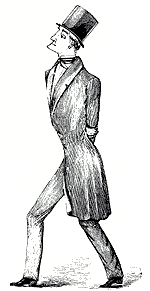 The buzz of Boston in 1849-50, the Parkman-Webster murder case began with the disappearance of one of the crimson’s great benefactors, George Parkman, a Boston Brahmin known for his Ministry of Silly Walks gait about town (see right). According to Oliver Wendell Holmes, Sr. (who appeared as a witness at the trial of Parkman’s accused murderer), “he abstained while others indulged, he walked while others rode, he worked while others slept.”
 Although perhaps individually explicable — anatomists had plausible reasons to have human remains at work, and other anatomists than Webster could have had access to his office — the cumulative weight of Webster’s ham-handed attempts to declare that he had paid up his debts to Parkman just before the latter’s mysterious disappearance, of the discovery of what (disputed) dental forensics declared to be Parkman’s dentures, of the ghastly appearance of a torso (disputedly) declared to be Parkman’s stuffed in a tea chest at Webster’s offices started to really make the man look guilty.

 Coincidentally — unluckily for
 In the day when