756: Yang Guifei, favored concubine

On this date in 756, the imperial consort Yang Guifei was expediently executed during the An Lushan Rebellion.

The Tang dynasty Emperor Xuanzong, whose beloved concubine Yang was, undertook this cruel extremity only in great duress. Initially married to one of the emperor’s sons, Yang so enamored the emperor that he usurped the prince’s place and got the kid a different wife. In the c. 800 classic poem “Song of Everlasting Sorrow” the poet Bai Juyi mused on the smitten sovereign rushing headlong into waiting tragedy.

The emperor neglected the world from that moment,
Lavished his time on her in endless enjoyment.
She was his springtime mistress, and his midnight tyrant.
Though there were three thousand ladies all of great beauty,a
All his gifts were devoted to one person.

Indeed, over the 740s Yang’s relations rose at court on the strength of her hold over the emperor, causing no few resentments among courtiers now obliged to flatter them. She’s been cast as a femme fatale, a siren whose chords called the emperor to capsize his own ship of state.

The general An Lushan was the rock of his ruin. Though An Lushan’s revolt would one day claim Yang’s life, he was a great favorite of hers and eventually adopted as Yang’s son; it was whispered that the imperial gifts showered on this commander might reflect favor with the concubine quite surpassing the bounds of propriety.

The most important favor was command of all northern China’s garrisons, with 150,000-plus troops.

His influence (and the fact that he was not ethnically Han, but of Turkic and Iranic extraction) made him rivals at the imperial court, even including the concubine Yang’s cousin, chancellor Yang Guozhong.

One can speculate as to who suspected whom first, but as we’ve seen with the Roman Empire a sufficiently strong inducement to treachery inevitably becomes tantamount to the real thing: eventually one’s intemperate supporters or implacable enemies will cast the die for even the most retiring general. An Lushan was Caesar enough to cross the Tang’s Rubicon, which for him was the Yellow River, above which his armies had been confined.

In the winter of 755-756, An crossed this river and marched towards Chang’an (Xi’an, then the imperial capital and the world’s most populous city), styling himself the Emperor of Yan. This aspirant state proved far from durable, and vanished by 763 — but by the time that long term had come into view, all of our principal characters were dead.

Yang Guifei was the first of them. (Plenty of secondary characters — generals, eunuchs, rivals and family of rivals — were being put to death all along and well before Yang, of course.) As the rebel army advanced on the capital, Xuanzong and his court fled in panic, Yang included. One day’s march further inland towards Chengdu, the royal guards themselves rebelled. Embittered like many others by the sway Yang and her family held — and blaming the consort for the ignominious retreat they were embarked upon — the soldiers refused to proceed without Yang’s execution. Xuanzong had little choice under the circumstances but to assent to her summary strangulation.

The Son of Heaven made good his escape, and his kingdom prevailed in the fight. (An was assassinated in 757.) Xuanzong himself, however, had to abdicate in favor of his son before the chaotic summer was out, and lived out his last five years as Taishang Huang, “Retired Emperor”.

One can only guess at the regrets he had in those days for the beloved mistress sacrificed to the safety of his person and throne. It’s a circumstance that has become a staple of Chinese literature over the centuries since, from the aforeentioned Bai Juyi right down to the present day, in every medium imaginable.

In Bai’s “Song of Everlasting Sorrow”, the bereft former emperor at last sends a Taoist priest to the heavens in search of his lost love, whose spirit has not even appeared to him in a dream. Yang Guifei sends the messenger back with a last pledge of sundered love:

“Our spirits belong together, like these precious fragments,
Sometime, in earth or heaven, we shall meet again.”
And she sent these words, by the Taoist, to remind him
of their midnight vow, secret between them.
“On that Seventh night, of the Herdboy and the Weaver,
In the silent Palace we declared our dream was
To fly together in the sky, two birds on the same wing,
To grow together on the earth, two branches of one tree.”

Earth fades, Heaven fades, at the end of days.
But Everlasting Sorrow endures always.

Yang Guifei’s tomb remains a popular tourist destination to this date.

On this day..

1944: Ferruccio Nazionale, Ivrea partisan

On this date in 1944, the fascist frogman unit Decima Mas Flottiglia MAS (English Wikipedia link | Italian) executed and publicly gibbeted the partisan Ferruccio Nazionale in Ivrea.


The placard around his neck claims the hanged man “made an armed attack on the Decima.”

The square where he’s hanging in these images is today named in his honor — Piazza Ferruccio Nazionale.

On this day..

1340: Nicholas Behuchet, Battle of Sluys naval commander

On this date in 1340, the English and French fought an early naval engagement of the Hundred Years’ War: the Battle of Sluys.

The English won the battle … and the French admiral wound up hanging from a mast.

At the outset of the Hundred Years’ War in 1337, the French bossed the Channel and inflicted devastating sea raids on the English coast. In the long war’s first major battle at sea, a French fleet in September 1338 overwhelmed an English flotilla carrying valuable English wool to the Low Countries.

Nicholas Behuchet, one of the French commanders at this earlier battle, did not hesitate to massacre his prisoners.

Thus conquering did these said mariners of the king of France in this winter take great pillage, and especially they conquered the handsome great nef called the Christophe, all charged with the goods and wool that the English were sending to Flanders, which nef had cost the English king much to build: but its crew were lost to these Normans, and were put to death.

England’s allies were in the Low Countries, so too many battles like this stood to strangle the English cause in the crib. For near two years, French privateers had leave to ravage the English coast, while French troops overran Flanders and made the English Queen Philippa* hostage.

Seeking a breakout, King Edward III requisitioned English merchant cogs — there was no standing navy at the time — into a fleet of perhaps 160 or 200 vessels, heavy with soldiers to invade Flanders.

On June 24, two days after setting out from the Orwell estuary at Ipswich, Edward’s armada boldly fell upon a larger French fleet anchored at the Flanders port of Sluys.

The medieval chronicler Froissart’s account makes for riveting reading.** This was no stately ballet of seamanship but a gory close-quarters melee: as was characteristic for the time, the “sea” battle was mostly just about coming together for the respective fleets’ marines to board one another’s ships and murder anyone on board who wasn’t worth a ransom. The French admiral Behuchet lashed his ships together across the mouth of the harbor, a sort of floating breastwork that would enable the French soldiery to shimmy up and down the entire line no matter where the English focused their attack.

To the sound of “scores of trumpets, horns and other instruments,”

Fierce fighting broke out on every side, archers and crossbowmen shooting arrows and bolts at each other pell-mell, and men-at-arms struggling and striking in hand-to-hand combat. In order to come to closer quarters, they had great iron grappling-hooks fixed to chains, and these they hurled into each others’ ships to draw them together and hold them fast while the men engaged. Many deadly blows were struck and gallant deeds performed, ships and men were battered, captured and recaptured. The great ship Christopher [a large English cog previously captured by the French and situated in the French front row -ed.] was recovered by the English at the beginning of the battle and all those on board were killed or taken prisoner …


An illustration of the Battle of Sluys from Froissart’s chronicle. Note the mast of the ship at far left: it displays the English arms quartered with the French, Edward III’s heraldic assertion of sovereignty over both realms.

It was indeed a bloody and murderous battle. Sea-fights are always fiercer than fights on land, because retreat and flight are impossible. Every man is obliged to hazard his life and hope for success, relying on his own personal bravery and skill … [it] rage[d] furiously from early morning until afternoon, during which time there were many notable feats of arms and the English were hard put to it to hold their own, since they were opposed by hardened soldiers and seamen, who outnumbered them by four to one.

Edward III took an arrow or crossbow bolt to the leg — great-man historical legend has it that it was fired by Nicholas Behuchet himself — but captained his flotilla to an overwhelming victory, capturing most of the French ships and destroying the French, their Genoese allies, “and all who were with them … [they were] killed or drowned, not a single one escaping in the general slaughter.” Poetic license aside, it was a spectacular triumph for the English — and a crushing defeat for the French.†

In the 1596 play Edward III, which might have been co-written by Shakespeare, imagined the scene in the report of an escaped mariner:

Purple the sea, whose channel filled as fast
With streaming gore that from the maimed fell
As did the gushing moisture break into
The crannied cleftures of the through-shot planks.
Here flew a head dissevered from the trunk,
There mangled arms and legs were tossed aloft
As when a whirlwind takes the summer dust
And scatters it in middle of the air.
Then might ye see the reeling vessels split
And tottering sink into the ruthless flood,
Until their lofty tops were seen no more.

Let it not be said that in this instance the commander escaped the consequences of his folly. Behuchet, who insisted against advice on lashing the boats together and thereby sacrificed all maneuverability, didn’t have much room for maneuver himself when the victorious English hanged him at battle’s end from the mast of his own ship.

* Seen elsewhere in these pages successfully begging her husband’s pardon of the famed Six Burghers of Calais later in the war. Philippa was a homegrown native of the Low Countries, and her marriage to Edward III reflects the alliance between their respective regions.

** For a snappy modern gloss on the battle, check this excerpt of Dan Jones’s The Plantagenets: The Warrior Kings and Queens Who Made England.

It is said that no courtier dared give King Philip VI of France the horrifying news until a jester availing his station’s license for cheek informed him that “Our knights are much braver than the English.” Asked why, the fool replied, “The English do not dare jump into the sea in full armour.”

On this day..

1979: Bill Stewart, ABC News reporter

On this date in 1979, the American Broadcasting Company journalist Bill Stewart was executed at a somocista checkpoint during Nicaragua’s bloody civil war.

And what is more, the deed was caught on film — pre-emptively balking the crumbling Nicaraguan dictatorship of the ability to, say, blame the killing on the Sandinista rebels.

Warning: This is the execution footage.

Stewart was stopped in a marked press vehicle in Managua, ordered to lie down, and then kicked and shot through the head while colleagues looked on. Though his summary execution by national guardsmen was taped by fellow journos in the convoy, the reasons for it are well into the fog of war: even the identity of the guardsman who pulled the trigger isn’t known. (The commander of the roadblock would claim that it was a “Private Gonzalez” who conveniently died in combat later the very same day.) The immediate “investigation” promised by dictator Anastasio Somoza didn’t really have much chance to get off the ground before Somoza himself had to take to the skies fleeing, on July 17, the collapse of his own regime. Whether the executioner also escaped the revolution, fled into exile, became a Contra guerrilla, or actually did die in the fighting, only God can say.

“The murder of American newsman Bill Stewart in Nicaragua was an act of barbarism that all civilized people condemn,” said U.S. President Jimmy Carter, who of course was backing Somoza.* “Journalists seeking to report the news and inform the public are soldiers in no nation’s army. When. they are made innocent victims of violence and war, all people who cherish the truth and believe in free debate pay a terrible price.”

Stewart’s career and murder are a principal inspiration for the 1983 film Under Fire.

* Or more precisely by this point, backing Somocismo sin Somoza — ease out the unpopular Somoza but keep the same system.

On this day..

1628: John Lambe murdered

Here Dr Lambe, the conjurer lyes,
Against his will untimely dies
The Divell did show himselfe a Glutton
In taking this Lambe before he was mutton
The Divell in Hell will rost him there
Whome the Prentises basted here.
In Hell they wondred when he came
To see among the Goats a Lambe.

Libel (one of many) on John Lambe’s murder

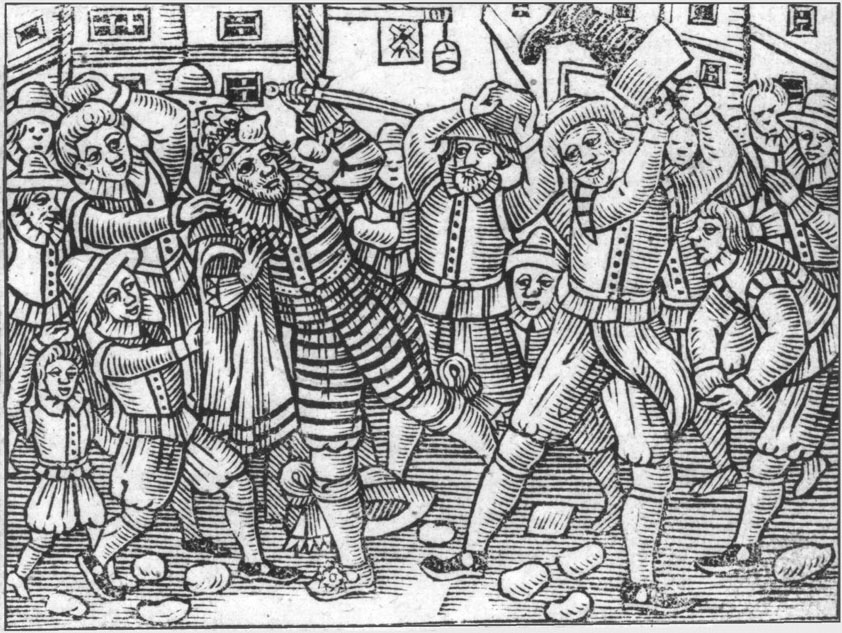
Friday the 13th of June in 1628 bore foul luck for John Lambe, an aged astrologer, magician, and folk healer so hated of Londoners that a mob fell on him as he returned from theater this evening and butchered him in the street.

While we hope to justify Lambe’s presence in these pages under our going interest in lynchings, his curious homicide transgresses the boundaries of Executed Today as surely as did Lambe transgress those of Stuart London.

North of 80 at the time of his death — although still vigorous enough at that age to defend himself with a sword — Lambe came to misfortunate public notoriety in the 1620s. These were crisis years when the crown sowed the dragon’s teeth that would in later years devour Charles I. Lambe’s slaughter was a little taste of worse to come.

Sources from the period view Lambe as both a shameless fraud and a vile wizard, with no consistency between the propositions save for their vitriol. Lambe seems like he got the worst of both perceptions at once: he faced a 1619 complaint to the Royal College of Physicians that he was a “mountebank and impostor.” [sic] Three years after that, he was in the dock for witchcraft

What Lambe did do was beat two charges in as many years that could easily have hanged him: the aforementioned witchcraft case in 1622, and a rape charge in 1624. Evidence in either case was underwhelming, but the charges themselves were incendiary; Lambe’s knack for slithering out of the hangman’s grasp must have suggested for the man on the street a channel to sinister higher powers.

Commoners bestirred themselves about this time against the realm’s own higher powers — the politically ham-fisted new king Charles and his grapples with Parliament to secure sufficient tax revenue for his inept war with France and Spain.

In all this mess, the Duke of Buckingham — royal favorite and possible lover of Charles’s father — was the number two man in the kingdom, and the number one object of hate.

In the mid-1620s, Lambe became conjoined in the public eye with Buckingham — as Buckingham’s demon-summoning henchman, say. Was it the Duke’s pull that spared his familiar the noose? Was it Lambe’s necromancy that captured the king in the thrall of his detested aide?

Did it even matter?

From the distance of centuries the particulars of the supposed affiliation between the two seems difficult to establish,* but it sufficed for Lambe’s death (and Buckingham’s too) that they were analogues for one another, that their respective villainies could be multiplied one atop the other.

Despite all that tinder lying around, we don’t know the exact spark for Lambe’s murder on June 13, 1628. A few months before, Buckingham had fled a humiliating military defeat in France; Parliament and King were at loggerheads that June, forcing the reluctant Charles to accede to a Petition of Right on June 7 that remains to this day a bedrock document of Britons’ liberties.

On the 13th, Lambe was recognized by “the boyes of the towne, and other unruly people” attending a play at the Fortune Playhouse.

As he left it, some began to follow him. Maybe it was just one insult too tartly answered that multiplied these hooligans, or maybe there was a ready rabble that immediately took to his heels. The frightened Lambe picked his way to the city walls menaced all the way by his lynch mob, hired a few soldiers as an ad hoc bodyguard, and by the dark of night tried desperately to find some sort of shelter from the crowd growing in both number and hostility. Under the mob’s threat, a tavern put him out, and a barrister likewise; his guards fled their posts; and someone at last laid his hands on John Lambe. By the time the frenzy had passed, Lambe’s “skull was broken, one of his eyes hung out of his head, and all parties of his body bruised and wounded so much, that no part was left to receive a wound.” Many contemporaries must have understood it as the just punishment that courts could not manage to exact.


Woodcut of the assault on Lambe outside the Windmill Tavern, from the title page of A Briefe Description of the Notorious Life of Iohn Lambe (1628)

The libels now rejoiced openly in Lambe’s summary justice — nobody was ever prosecuted for his murder — and anticipated another one to follow it.

“Who rules the Kingdome? The King. Who rules the King? The Duke. Who rules the Duke? The Devill,” one menacing placard announced. “And that the libellers there professe, Lett the Duke look to it; for they intend shortly to use him worse then they did his Doctor, and if thinges be not shortly reformed, they will work a reformation themselves.”

Their thirst for “reformation” was not long delayed.

Ten weeks after Lambe’s murder, a disaffected army officer named John Felton at last enacted the swelling popular sentiment and assassinated Buckingham.

“The Shepheards struck, The sheepe are fledd,” one unsympathetic doggerel taunted, recalling the dead wizard whose supernatural exertions could no longer protect his wicked patron. “For want of Lambe the Wolfe is dead.”

The History of Witchcraft podcast has an excellent episode on Dr. Lambe here.

* So says Alastair Bellany, whose “The Murder of John Lambe: Crowd Violence, Court Scandal and Popular Politics in Early Seventeenth-Century England” in Past and Present, vol. 200, no. 1 is a principal source for this post. (It’s here, but behind academic paywalls.)

On this day..

1942: Vladislav Vancura, “Marketa Lazarova” author

On this date in 1942, leftist Czech novelist Vladislav Vancura was executed at Prague’s Kobylisy shooting range.

An “unsung giant” of European letters, the Bohemian doctor burst onto the literary scene in the 1920s with Pekar Jan Marhoul (Baker Jan Marhoul) and Pole orná a válecná (Fields to Plough, Fields of War). But he was notable for a remarkable perspicacity in style, genre, and artistic perspective throughout his career. He’s often referred to as a poet in prose, and maybe for this reason was equally keen on writing for and directing cinema.

Milan Kundera credited Vancura with “probably the richest vocabulary that any Czech writer has ever had; a vocabulary in which the language of every era is preserved, in which words from the Bible of Kralice [the first complete translation of the Bible into Czech] stand humbly side by side with modern argot.”

His greatest commercial success and possibly his crowning achievement was Marketa Lazarova, a short novel (120 pages in the original Czech) set amid a feud of nobles in he Middle Ages. Only tranlated into English in 2013, it “does for Czech literature something akin to what James Joyce did for English-language literature with Ulysses: breaking with the realism that previously dominated to open up a new frontier in the realm of style.”

Here’s an excerpt (via):

Folly scatters without rhyme or reason. Lend an ear to this tale of a place in the county of Mladá Boleslav, in the time of the disturbances, when the king strove for the safety of the highways, having cruel troubles with the nobles, who conducted themselves downright thievishly, and what is worse, who shed blood practically laughing out loud. You have become truly too sensitive from musing upon our nation’s nobility and fair manners, and when you drink, you waste the cook’s water, spilling it ‘cross the table, but the men of whom I speak were an unruly and devilish lot. A rabble which I cannot compare to anything else than stallions. Precious little cared they of that which you account as important. Comb and soap! Why, they did not heed even the Lord’s commandments.

‘Tis said that there were countless such ruffians, but this story concerns itself with none save the family whose name most surely calls to mind Václav unjustly. Shifty nobles they were! The eldest amidst this bloody time was baptized with a graceful name, but forgot it and called himself Kozlík till the time of his beastly death.

Vancura’s death was plenty beastly too, albeit not particularly surprising: Communist avant-garde artists in German-occupied Slavic countries didn’t usually fare the best during the war years, and Vancura compounded his risk by taking active part in the resistance. He was among hundreds of Czechs arrested, tortured, and executed in the bloody German crackdown that followed the May 27, 1942 assassination of Reinhard Heydrich.

On this day..

1871: Archbishop Georges Darboy, Paris Commune hostage

On this date in 1871, the doomed Paris Commune martyred Archbishop Georges Darboy.

When Darboy (English Wikipedia entry | French) was tapped for the job in 1863, there had already been two recent occupants of the seat of Notre Dame killed violently over the generation preceding.*

A “learned, conscientious, and respected prelate,” Darboy’s own cross to shoulder was the collapse of the Second Empire with France’s defeat in the Franco-Prussian War.

That conflict in turn triggered the 1871 working-class revolution in Paris which briefly drove the established government to the old Bourbon haunts at Versailles while maintaining the capital as the Paris Commune.

Darboy declined to follow the many Parisian bourgeoisie who escaped the city in those brief months, but his importance as a visible envoy of the rival order was not so easily refused. The Communards seized Darboy as perhaps the crown jewel among dozens of hostages against the anticipated Versailles counterattack.

Versailles declined to bargain for Darboy or any of the other human shields.** Instead, the city’s cobblestones drank the blood of 20,000 or more in a seven-day urban invasion in late May that has become known as the “bloody week” (semaine sangiante) — and the Commune’s hostages would mingle their blood with the those on the barricades, suffering in their few individual persons the vengeance the Parisian workers longed to visit upon an entire class.

When the Versaillese fixed his eye upon you, you must die; when he searched a house, nothing escaped him. “These are no longer soldiers accomplishing a duty,” said a conservative journal, La France. And indeed these were hyenas, thirsting for blood and pillage. In some places it sufficed to have a watch to be shot. The corpses were searched, and the correspondents of foreign newspapers called those thefts the last perquisition. And the same day M. Thiers had the effrontery to tell the Assembly: “Our valiant soldiers conduct themselves in such a manner as to inspire foreign countries with the highest esteem and admiration.”

At half-past seven a great noise was heard before the prison of La Roquette, where the day before the three hundred hostages, detained until then at Mazas, had been transported. Amidst a crowd of guards, exasperated at the massacres, stood a delegate of the Public Safety Commission, who said, ‘Since they shoot our men, six hostages shall be executed. Who will form the platoon?’ ‘I! I!’ was cried from all sides. One advanced and said, ‘I avenge my father,’ another, ‘I avenge my brother.’ ‘As for me,’ said a guard, ‘they have shot my wife.’ Each one brought forward his right to vengeance. Thirty men were chosen and entered the prison.

The delegate looked over the jail register, pointed out the Archbishop Darboy, the President Bonjean, the banker Jecker, the Jesuits Allard, Clerc, and Ducoudray; at the last moment Jecker was replaced by the Curé Deguerry.

They were taken to the exercise-ground. Darboy stammered out, ‘I am not the enemy of the Commune. I have done all I could. I have written twice to Versailles.’ He recovered a little when he saw death was inevitable. Bonjean could not keep on his legs. ‘Who condemns us?’ said he. ‘The justice of the people.’ ‘0h, this is not the right one,’ replied the president. One of the priests threw himself against the sentry-box and uncovered his breast. They were led further on, and, turning a corner, — met the firing-party. Some men harangued them; the delegate at once ordered silence. The hostages placed themselves against the wall, and the officer of the platoon said to them, ‘It is not we whom you must accuse of your death, but the Versaillese, who are shooting the prisoners.’ He then gave the signal and the guns were fired. The hostages fell back in one line, at an equal distance from each other. Darboy alone remained standing, wounded in the head, one hand raised. A second volley laid him by the side of the others.

The blind justice of revolutions punishes in the first-comers the accumulated crimes of their caste.

Lissagaray

The six who fell on this occasion would be followed in the Commune’s few remaining days by many more of their fellow hostages — and by countless communards. Theophile Ferre, who authorized the May 24 reprisal execution (and specifically called for Archbishop Darboy’s selection) was himself executed by the victorious bourgeois government that November.

* One of those violent deaths sent an assassin to the guillotine in 1857.

** Specifically, the Commune attempted to exchange Darboy and other hostages for Louis Auguste Blanqui, the great socialist leader whom Versailles had taken prisoner.

On this day..

1857: 52 European prisoners at Delhi

In 1857, the centennial of the British East India Company’s mastery of the India, the subcontinent’s sepoy troops rebelled against the Company Raj.

There had been rumblings of disaffection for months before, signals that read portentous in retrospect but passed by the oblivious occupation army. That March, aggrieved at having been issued new ammunition cartridges rumored to have been prepared with pig and cow fat in offense to both Muslim and Hindu soldiery,* Mangal Pandey wrote himself into India’s nationalist lore by mutinying at Barrackpore.

Pandey’s own revolt fizzled, and saw him hanged.

But he’s remembered as the precursor of the much wider rebellion that ensued.

On Sunday, May 10th — the British garrison’s guard was down for religious services — sepoys at Meerut mutinied, too. Just the day before they had seen 85 of their own brothers in arms provocatively marched in chains after refusing the controversial cartridges.

Now, they fell upon their commanding officers, and on their families and British civilians in an wave of pent fury. Brits misforunate enough to be caught in it spent the dark hours that night as prey.

“Never was dawn more welcome to us than on the 11th of May,” one Englishwoman who survived the harrowing night wrote. “The daylight showed how complete the work of destruction had been. All was turned into ruin and desolation, and our once bright happy home was now a blackened pile.”

Meerut is just 60 kilometers or so from Delhi, and the mutineers soon made for that city — where the last Mughal Emperor, 81-year-old Bahadur Shah II, known as Zafar, “reigned” as Prince of Delhi. In reality, he was a pensioned ward of the East India Company … but symbolically, he was the heir to a once-mighty empire.

The rebels fell on Delhi, slaughtering Englishmen and women who had not been quick enough to escape the city, and looting opportunistically. Zafar tsk-tsked the disorder but he and most of his princes joined the revolt. Why not? The Company had already made known that the imperial title would disappear with Zafar’s death; here was the one last chance to restore the Mughal dignity.

This ride on the tiger would prove instead to be the final destruction of Zafar’s house.

On May the 16th, the sepoys, who were far from deferential to the emperor they proposed to raise up, demanded 52 European prisoners that Zafar’s courtiers were holding — holding instead of murdering, a restraint the sepoys angrily suspected was calculated as a potential future sop to the returning British. By putting those prisoners all to sudden death, they relieved the emperor of any avenue for compromise, binding him inescapably to the insurrection.

From William Dalrymple’s The Last Mughal:

The sepoys then called for the prisoners, who were being kept and fed by Zafar in a room beside the Palace kitchens, not far from the Lahore Gate. They bound them and took them to a peepul tree near the shallow tank in front of the Palace drum house, the Naqqar Khana, and began to taunt them that they were about to be slaughtered.

According to Jiwan Lal, “the King and his courtiers stood like dumb puppets” at first, horrified by what the sepoys were contemplating. “Then the King ordered the sepoys to separate into parties, Mahommedans and Hindus, and he appealed to each to consult their religious advisers to see if there was any authority for the slaughter of helpless men and women and children.” “Their murder can never be allowed,” said Zafar, adding that the Queen was also wholly opposed to any massacre. Sa’id Mubarak Shah recorded that

the king wept and besought the mutineers not to take the lives of helpless women and children, saying to them “take care — for if you commit such a deed the vengeance and angel of God will fall on us all. Why slay the innocent?” But the Mutineers refused to listen and replied “we’ll kill them, and in your palace, so that whatever the result you and we shall be considered one in this business, and you will be thought equally guilty by the English.”

… the King continued to argue with the sepoys and refused to give his consent to the murder, but was eventually silenced …

When Zahir saw that the sepoys were preparing to go ahead with the slaughter, he begged the hakim to make a last effort to stop the massacre: “I told him that I had seen the prisoners being taken out,” he recorded later,

and I was afraid that they were about to kill them, and that he must do something quickly to stop them. To this I got a reply, “What can I do?” I told him this is the time to prove our loyalty, and that if he wanted to save the King then he had to try and persuade the rebels to stop this crime and save the prisoners, otherwise the English would come and level Delhi and turn it into an empty wasteland in revenge for this spilling of innocent blood. Ahsanullah Khan replied, “You are still a child. You do not realize that in public life a man must use his reason rather than give way to his emotions. If we try to dissuade the rebels now they will kill us before they kill the English, and then they will kill the King.”

It was anyway too late. By the time Ahsanullah had finished speaking, the sepoys and the Palace mob had got to work.

They made the prisoners sit down, and one of them fired his carbine at them. After this two of the King’s personal armed retainers killed all the Europeans, men, women and children, with their swords. There were about 200 Mussalmans standing at the tank, uttering the coarsest abuse at the prisoners. The sword of one of the king’s retainers broke. After the slaughter, the bodies were taken on two carts, and thrown into the river. This occurrence caused a great excitement amongst the Hindus throughout the city, who said that these Purbeas who had committed this heinous and atrocious cruelty could never be victorious against the English.

For Zafar the massacre was a turning point. The sepoys were quite correct that the British would never forgive the mass killing of innocents, and Zafar’s failure to prevent it proved as fatal for him and his dynasty as it was for them.

Three weeks later, the British besieged Delhi. When the city succumbed that September, it lay at the mercy of a foe which had been incited to spectacularly furious revenge. Vengeful fantasies of razing Delhi to the ground and slaughtering its denizens en masse were openly mooted; if the actual reprisal never attained that scale, it was still wildly indiscriminate. Dalrymple once again:

Everywhere the British convinced themselves that the atrocities committed by the sepoys against their women and children absolved them of any need to treat the rebels as human beings: “Since they had butchered our defenceless women and children,” wrote Colonel A. R. D. Mackenzie, “we would have been more than human, we would have been less than men, if we had not exterminated them as men kill snakes wherever they meet them.” It soon became exceptional among the British to regard anyone on the opposite side of the battle lines as even belonging to the same species: “I [simply] cannot consider these sepoys human beings,” wrote Captain J. M. Wade, “and it is only common practice to destroy them as reptiles.” George Wagentrieber helped fan such flames from his new Delhi Gazette Extra printing press in Lahore: “Our army is exasperated almost to madness by what they have seen of the brutality of the insurgents,” he expostulated in one editorial.

Moreover, as far as many of the British troops were concerned, their fury and thirst for revenge were not so much a desire as a right enshrined in the Bible. One British soldier, “Quaker” Wallace, was in the habit of bayoneting his sepoy adversaries while chanting the 116th Psalm. As General Neill put it, “The Word of God gives no authority to the modern tenderness for human life.” Padre Rotton was in full agreement. The rebels did not realise, he wrote, that the Uprising was in fact

a battle of principles, a conflict between truth and error; and that because they had elected in favour of darkness, and eschewed the light, therefore they could not possibly succeed. Moreover, they had imbrued their hands in the innocent blood of helpless women and children, and that very blood was [now] appealing to heaven for vengeance. The appeal was unquestionably heard. The Lord could not do otherwise than be avenged on such a nation as this.

1857 marks the textbook end date for the Mughal Empire.

For his support of the rebellion, and his failure to avert the May 16 massacre of prisoners, Zafar was deposed and sent to exile in Burma, where he wrote his own epitaph in Urdu verse:

I asked for a long life, I received four days
Two passed in desire, two in waiting.

The days of life are over, evening has fallen
I shall sleep, legs outstretched, in my tomb

How unfortunate is Zafar! For his burial
Not even two yards of land were to be had, in the land of his beloved.

Many of Zafar’s sons and grandsons were killed (at least 29 by execution, according to Dalrymple) as the revolt was crushed.


This photo of an unidentified hanging of India rebels comes from this page, which also features a number of images of Delhi after its capture from photographer Felice Beato. Beato’s work in China has been highlighted elsewhere in Executed Today’s annals.

On this day..

1471: Edward of Westminster, Prince of Wales, after the Battle of Tewkesbury

May 4, 1471 was the date of one of England’s most pivotal battles, Tewkesbury.

Tewkesbury was the last great victory in the War of the Roses for the House of York, and it must have seemed to contemporaries like the last victory Yorkists would ever need. The “kingmaker” Warwick was dead from a previous battle that April; the Lancastrian claimant Henry VI was imprisoned by the Yorkists, who would murder him before the month was out; and Henry’s heir apparent, the 17-year-old Prince of Wales, was put to death immediately after Tewkesbury.

Young Edward of Westminster had been stewing these past several years — until the aforementioned Kingmaker swung to his side — in exile in France, trying to finagle a way to rally the Lancastrian cause. Like many a teenager he was prone to nursing bilious fantasies of revenging himself on people, as the Milanese ambassador wrote in 1467.

This boy, though only thirteen years of age, already talks of nothing but of cutting off heads* or making war, as if he had everything in his hands or was the god of battle or the peaceful occupant of that throne.

“Peace” would not be the watchword of the abortive Lancastrian restoration attempt.

Shortly after returning to England, Edward had word of Warwick’s defeat. But having taken the trouble to come all this way from France, he still plowed ahead into the desperate stand at Tewkesbury. Edward had no experience at all in battlefield command.

When the Lancastrian lines broke at Tewkesbury, a disordered rout fled towards nearby Tewkesbury Abbey. The nobles who reached it would hole up there claiming the privilege of sanctuary … for just two days, at which point the victorious Yorkist King Edward IV had them arrested and put to swift execution, sanctuary be damned. (The abbey had to close to re-purify.)

Prince Edward didn’t even make it that long. There are varying accounts of his death at Tewkesbury suggesting a summary execution scenario of some kind.

In one version, the Duke of Clarence overtook him in flight. Clarence having himself briefly supported the rebellion before he returned to the Yorkist side, he’s supposed to have immediately beheaded the youth in a paroxysm of demonstrative loyalty.

Alternatively,

Prince Edward was taken as he fled towards the towne, by Sir Richard Crofts, and kept close … After the field was ended, proclamation was made, that whosoever could bring forth prince Edward alive or dead, should have an annuity of a hundred pounds during his life, and the princes life to be saved, if he were brought forth alive. Sir Richard Crofts, nothing mistrusting the kings promise, brought forth his prisoner prince Edward, being a faire and well proportioned young gentleman; whom when king Edward had well advised, he demanded of him, how he durst so presumptuously enter into his realm with banner displayed.

Whereunto the prince boldly answered, saying; “To recover my fathers kingdom and heritage, from his father and grandfather to him and from him after him to me lineally descended.” At which words king Edward said nothing, but with his hand thrust him from him, or (as some say) stroke him with his gauntlet; whom incontinently, George duke of Clarence, Richard duke of Gloucester, Thomas Grey marquess Dorset,** and William lord Hastings that stood by, suddenly murdered: for the which cruel act, the more part of the doers in their latter days drank of the like cup, by the righteous justice and due punishment of God.

Shakespeare dramatized this (considerably more dramatic — if admittedly less execution-like) version in Henry VI, Part 3.

Lancaster’s very dim (circa 1471) fortunes would ultimately be rescued in the 1480s by the grandson of a beheaded Welsh courtier — who won the throne as Henry VII and founded the Tudor dynasty.

* Edward as a seven-year-old was alleged to have been given the authority by his mother to decide what fate should befall the knights who had not successfully protected Henry VI from capture. Edward decreed their beheading.

** Ancestor of Lady Jane Grey.

On this day..

1945: Charlotte Rebhun, Righteous Gentile

(Thanks to Meaghan Good of the Charley Project for the guest post. -ed.)

On this date in 1945 in Berlin, a German woman named Charlotte Rebhun was executed by the Nazis. She had almost made it through the war: Berlin fell to the Russians the very next day.

Charlotte, a Gentile, had been married to Max Rebhun, a Jew. They had two children: Wolfgang, born in 1927, and Adele, born in 1930. Following Kristallnacht, Max was deported to Poland. Charlotte and the children followed him in 1939, and after war broke out the entire family wound up in the Warsaw Ghetto.

On August 20, 1942, during the Grossaktion that ultimately resulted in a quarter-million deaths, Max was taken to Treblinka and gassed. His wife and children escaped the ghetto and set up residence in the Aryan sector of the city.


Charlotte Rebhun (top); Charlotte with the infant Barbara (bottom).

Already at considerable risk, Charlotte placed herself in further danger by hiding eight additional Jewish people in her apartment.

In early 1943, a young Jewish couple in the Warsaw Ghetto, anxious to protect their nine- month-old daughter, convinced a German soldier (!) to smuggle her out of the ghetto. He gave the baby to his girlfriend, who passed her on to Charlotte Rebhun. The baby was named Barbara and called Bashka.

The infant’s parents thought they would only need to be separated for a short time, and promised to come back soon to collect her. But they never did. Charlotte treated Bashka as her own and kept her for about eighteen months, until the Warsaw Uprising in August 1944.

With the Red Army approaching, the population of Warsaw decided to liberate themselves, and launched a rebellion against the Nazi occupiers. They were able to take the city back, but didn’t have sufficient arms or fighters to keep it without help, and help never came. While the Soviets sat and watched at a discreet distance, the Nazis regrouped, went back to Warsaw and crushed the rebellion.

More than 150,000 Polish civillians died and more than half the city’s buildings were destroyed in the aftermath of the failed uprising.

Charlotte’s son Wolfgang was one of the fighters who participated in the rebellion. He escaped summary execution, but was sent to the hellish Mauthausen Concentration Camp. Charlotte and her daughter Adele were sent to a slave labor camp in the city of Czestochowa.

Little Bashka, who was two and a half years old, somehow got separated from her foster family. A Red Cross worker found her all alone in a little Polish town twenty kilometers outside of Warsaw.

Barbara was taken in by a Polish family named Kaczmarek, who raised her alongside their five children for the next several years. After the war, the Jewish Central Committee in Warsaw initiated a search-and-recovery effort for child Holocaust survivors living with Gentile families. The Kaczmarek family wanted to legally adopt Barbara, and in 1948 the wrote to the JCC to ask if anyone in her biological family had survived. In response, the JCC sent someone to their to their house and removed Barbara by force. Sent to a Jewish orphanage, she was adopted by a Jewish couple and in 1950, they moved to Israel.

It wasn’t until she was sixteen years old that Barbara learned she was adopted, and it wasn’t until 1996 that she began seeking out her roots. She was able to reconnect with the Kaczmarek children (the parents had died in the years since the war) and then Charlotte’s children, both of whom survived the camps.

It was only then that she learned her rescuer’s fate: Charlotte and Adele had been liberated from the labor camp in Czestochowa and gone home to Berlin, but after their arrival Charlotte was executed. Just what “crime” she had committed to deserve her fate has not been recorded.

The adult Barbara, now known as Pnina Gutman.

Unfortunately, Barbara (who now calls herself Pnina Gutman) has never been able to identify her biological parents. Adele and Wolfgang didn’t remember their names. Barbara had come to the Rebhuns with a note giving her name as Barbara Wenglinski, but that may not have been her real family name.

The note had asked their daughter’s rescuers to contact their relatives in America if her parents didn’t survive the war and come back for her. Barbara wrote letters to seventy people in America named Wenglinski, but none of them provided any useful information. She would still like to learn who her parents were and what happened to them, and has appealed for information over the internet.

Barbara’s mother and father are presumed to have perished, probably during the Warsaw Ghetto Uprising in the spring of 1943. Barbara would not have survived either were it not for the courage of Charlotte Rebhun and the others. Yad Vashem honored Charlotte as Righteous Among the Nations on November 20, 1997, more than fifty years after her death.

On this day..