1942: Coastwatchers on Tarawa

On this date in 1942, the Japanese military occupying the atoll of Tarawa beheaded 17 New Zealand Coastwatchers, along with five civilians.

Tarawa, a fishhook-shaped atoll that belongs to the Republic of Kiribati, was one of many specks of South Pacific land to which Australia and New Zealand deployed World War II Coastwatchers.

These small teams of mixed civilian and service personnel, as well as locals, kept up 24-hour watch for Japanese naval movements.* The tips provided by coastwatchers in the Solomon Islands during the Guadalcanal campaign led Vice Admiral William Halsey to exclaim that “the coastwatchers saved Guadalcanal, and Guadalcanal saved the Pacific.”

But their lonely forward positions also potentially exposed coastwatchers to considerable danger.

Even as Guadalcanal was unfolding in August and September in 1942, Japan was fortifying the occupied Gilbert Islands** (present-day Kiribati) in the wake of the Makin Island raid. Seventeen coastwatchers in the Gilberts were swept up in the process, and transferred to Tarawa along with five civilians (three British, one Australian, and one New Zealander). There they were held at the atoll’s old lunatic asylum, on the islet of Betio.

On Oct. 15, Allied planes bombed Tarawa. One of the captives got loose and ran onto the beach, frantically trying to signal the bombers. Instead, the Japanese — who fretted prisoners on their occupied islands becoming a fifth column in the event of an attack — summarily executed not only the signaler but all their captives.

“I saw the Europeans sitting in line,” one Tarawa local remembered later.

One Japanese started to kill the Europeans. He cut off the head of the first European, then the second, then the third, then I did not see any more because I fainted. When I came to, I saw the Japanese carrying the dead bodies to two pits.

In November 1943, a U.S. amphibious invasion took back the island at the bloody Battle of Tarawa. Twelve hundred Americans, and several times that many of the island’s Japanese defenders and Korean war slaves, were slain.

Old gun emplacements from that battle — as well as a monument to the New Zealand coastwatchers — can still be found on Tarawa.†

Catch these sights while they last. The average height above sea level for Kiribati is two meters, making global climate change liable to send the nation’s scattered islands to Atlantis. Kiribati residents have already begun turning up in Australia and New Zealand as climate change refugees.

* When the occasion arose, coastwatchers also rescued stranded Allied servicemen. After LTJG John F. Kennedy’s torpedo boat was rammed by a Japanese aircraft carrier in August 1942, it was a pair of Solomon Island natives dispatched by an Australian coastwatcher who found the future U.S. President and his surviving crew.

** Seven other coastwatchers besides those beheaded this date had been captured in the Gilberts when Japan first (but lightly) occupied it following Pearl Harbor. They survived the war as POWs in mainland Japan.

† There was a monument to the dead coastwatchers from shortly after the war. The remains of the seventeen, however, were long neglected by the New Zealand government, and have only recently been turned up … by Americans scouring Betio for casualties from the Battle of Tarawa.

On this day..

1990: The October 13 Massacre

This date is the dolorous anniversary of the “October 13 massacre”, a bloodbath wrapping up the Lebanese Civil War when the Syrian army executed hundreds of captured Lebanese.

The intractable war, which dated back to 1975 and made “Beirut” a 1980s watchword for conflict, had boiled down* to two rival governments: a Maronite military government based in East Beirut under the leadership of Michel Aoun, and the Syrian-sponsored Muslim government in West Beirut putatively headed by Selim al-Hoss. Over the course of 1989-1990 Aoun’s “war of liberation” against the occupying Syrian army all but emptied the city of Beirut.

Thanks to a complex political schism, Aoun was also ensconced in the city’s presidential palace from which he issued decrees denouncing and rejecting the political settlement that was supposed to return the country to normalcy.

Unfortunately for him — and moreso for the prisoners who are the day’s topic — Aoun was also supported by Iraq’s dictator Saddam Hussein. In August 1990, Hussein invaded Kuwait, precipitating an American attack on Iraq in response.

As this latter operation involved the U.S. attacking a Muslim oil-producing state with military resources it deployed for that purpose the politically sensitive sands of a neighboring Muslim oil-producing state, the U.S. spent the last months of 1990 working the Middle East diplomatic circuit to bring the region’s governments on board for the impending bout of ultraviolence.

Syria’s particular carrot was the green light to finish off Aoun — who, simultaneously, had of course been deprived of aid from the now-preoccupied Iraqis. This the Syrian army did with a massive attack on Beirut’s presidential palace beginning at seven in the morning on October 13th. The palace was overcome by 10:00 a.m., but resistance continued elsewhere throughout the day from pro-Aoun militias who had not received word of that gentleman’s surrender and escape to the French embassy.**

Several hundred people were killed during the onslaught into pro-Aoun enclaves. An unknown number of these ballparked to around two or three hundred are thought to have been killed by summary execution after capture (or after intentional rounding-up). A Lebanese nurse claimed that at the nearby village of Dahr al-Wahsh “I counted between 75 and 80 [executed] … Most of them had a bullet in the back of their heads or in their mouth. The corpses still carried the mark of cords around their wrists.” Other captured Lebanese fighters were reportedly deported to Syria and never heard from again.

There are several other atrocity accounts collected here. This two-part documentary on the end of the Lebanese civil war available on YouTube has several participants’ perspectives (including Aoun’s) on the chaotic situation marking the war’s last days: 1, 2.

* This is quite a gross oversimplification of a fractious civil conflict in which innumerable blocs continually rearranged their alliances.

“I had a chart on my wall of the constantly proliferating militias — four dozen or so by the time I left in 1985 — and their constantly shifting alliances and enmities,” one former Beirut denizen wrote recently. “Allies one day could be trying to kill one another the next, even within sects, over issues that had digressed far from their common cause.”

** Aoun went into exile in France, returning in 2005 when the Cedar Revolution finally drove the still-occupying Syrians out of Lebanon. He has served in the Lebanese parliament since that time, leading the country’s largest Christian party.

On this day..

610: Phocas, “will you rule better?”

It was on this date in 610 that the Byzantine Emperor Phocas was overthrown and put to summary execution — by the very hand, legend says, of his successor Heraclius.*

Perhaps Byzantium’s most anathematized emperor — one Byzantine historian elided his whole 8-year reign because “speaking of suffering is itself suffering” — Phocas’s own rise to the purple owed itself to extrajudicial executions.

That gentleman was a mere army officer of no regal proximity during the previous emperor’s campaigns to ward off the incursions of the Slavs and Avars into the Balkans. While this campaign on the whole enjoyed its successes, Phocas enters the historical scene about 600 as the leader of a delegation sent from the legions to Constantinople to object when the cash-poor imperial court refused to pony up ransom money for comrade soldiers taken prisoner. Phocas was abused at court, and the Avars executed their hostages.

By 602 the policy of having the soldiery take it in the braccae (soldiers’ own allotments had also been pinched by the same budget strictures) blew back when the foul-tempered army was ordered to winter on the far side of the remote Danube. The government collapsed in the face of a military mutiny; Phocas was crowned emperor; and he executed the former emperor Maurice, plus Maurice’s six sons. Much as we are accustomed to think of the old Roman emperors ever on the edge of violent overthrow, this event was for its contemporaries a great novelty and a dangerous precedent. There had not been a regime change by coup d’etat in Constantinople since that city’s namesake set it up as his capital nearly three centuries before.

This fact is a small part of Phocas’s vile reputation for later historians. But — and we will come to this — that reputation is also heavily colored by the perspective of the regime that would eventually overthrow Phocas himself. For Phocas’s subjects, while he had subjects, he was very far form universally hated. He found particular favor with the church, delivering the gorgeous pagan Pantheon to the pontiffs for use as a church. When touring Rome, you might learn that the very last imperial monument in the Forum is the Column of Phocas.**


Erected in gratitude by the Exarch of Ravenna.

Phocas’s reign, however, was defined by war with the Persians. And it was in the time of Phocas that King Khosrau, who actually owed his throne to previous Roman support, started breaking through the weakened Byzantine frontiers and tearing off huge pieces of territory.

By the last years of Phocas the Persians had taken Upper Mesopotamia and Armenia, and begun pressing into Anatolia where resistance collapsed with frightful ease. A Persian raid reached as far as Chalcedon in 608. There’s just something about having an enemy army in the suburbs of your capital that tends to overwhelm the value of any goodwill you got from cozying up to the pope.

In that same year (and this was surely a factor in the Persians’ shocking penetration into Anatolia) the Exarch of Africa began a revolt against the former centurion wearing the purple. From his position he was able to cut off grain shipments to the capital from the empire’s breadbasket, Egypt, which put Phocas in a truly desperate position. This exarch’s name was Heraclius but it was the man’s son, also named Heraclius, who would do the usurping.

Approaching the capital in 610, the Heraclii were able to quickly gather allies. Even the Excubitors, Constantinople’s Praetorian Guards under the leadership here of Phocas’s own son-in-law, saw where the winds were blowing and deserted immediately.

The rebels took Constantinople without a fight, and two patricians seized Phocas and presented him to the new sovereign.

“Is this how you have ruled, wretch?”

To which Phocas sneered,

“And will you rule better?”

Heraclius wasn’t in in the mood to be upstaged by his doomed predecessor, and got the latter’s execution, together with his own immediate coronation, enacted straighaway.

his right arm was removed from the shoulder, as well as his head, his hand was impaled on a sword, and thus it was paraded along the Mese, starting from the Forum. His head was put on a pole, and thus it too was paraded around. The rest of the body was dragged along on the belly, and was brought in the direction of the Chalce of the Hippodrome … And about the ninth hour of the same Monday, heraclius was crowned emperor in the most holy Great Church by Sergius patriarch of Constantinople. And on the following day, Tuesday … the head of Leontius the syrian [the former finance minister] was brought in and burnt in the Hippodrome, along with the image of Phocas which during his lifetime, foolish men wearing white robes had conducted into the Hippodrome with lighted candles. (Chronicon Paschale, as quoted here)

As if in retort to Phocas’s dying taunt, Heraclius held power for 30 distinguished years — “the brightness of the meridian sun,” in the estimation of Gibbon, for “the honor of Rome and Heraclius was gloriously retrieved by the exploits and trophies of six adventurous campaigns” that rescued Byzantium from the brink of destruction, drove back the Persians, enlarged the empire, and even returned the True Cross to Jerusalem. Heraclius himself commanded the army in the field, a practice long out of fashion for emperors. “Since the days of Scipio and Hannibal, no bolder enterprise has been attempted than that which Heraclius achieved for the deliverance of the empire.”

Phocas’s reputation did not profit from the comparison, and for Heraclius the last guy made a convenient foil to whom every evil of the realm could be attributed. We know Phocas almost exclusively through the accounts of later historians dating to this period, which is undoubtedly a factor in the black name our principal enjoys all the way to the present. The excellent History of Byzantium podcast attempts a balanced portrait of this era in an episode aptly named “In Fairness to Phocas”. The subsequent episode, “Heraclius to the Rescue”, deals with Phocas’s unpleasant exit from the scene.

* The new emperor personally executing his rival had a Roman precedent.

** Other Phocas achievement: he re-introduced the beard onto the imperial fashion scene. His predecessors had almost universally gone for the clean-cut look.

On this day..

1925: Shi Congbin, grievance

On this date in 1925 the Chinese warlord Sun Chuanfang had a captured enemy commander beheaded. In so doing, he signed his own death warrant too.

Our scene lies deep into China’s Warlord Era, the chaotic decade-plus after the collapsing empire gave way to a fractured republic: f rom 1916 to 1928, leagues of rival generals cut China into jigsaw pieces.

The chiefs of these shifting statelets, being warlords, fought numerous wars.

Sun Chuangfang, one of the generals of a warlord party known as the Zhili clique, was engaged in the south in 1925 in a campaign whose successful resolution would ultimately install him in Nanking with effective control of five provinces. In the service of achieving such a power base he must have thought little about destroying an enemy commander caught in a counterattack and mounting the man’s severed head on a pike to cow any opposition.

According to Eugenia Lean’s book about the amazing incident,

On October 3, 1925, while leading the Superior Iron Brigade (Tiejia jun), a brigade of mercenary troops, in an attempt to capture Guzhen, Shandong, Shi Congbin was surrounded by Sun Chuanfang’s troops with no support in sight. Shi’s four thousand soldiers were slaughtered, while Shi himself was taken prisoner and beheaded the next day upon Sun’s personal order. Shi Jianqiao [Shi Congbin’s daughter] related in heart-wrenching detail how her family would not have learned the truth except for the bravery and loyalty of one of Shi Congbin’s personal servants. “Only a single servant was able to flee home. When we asked him about news from the front line, he threw himself to the ground in tears. We knew the news was not good.” The servant had been too grief-stricken to speak. Only after he Shi family had gone to Tianjin did they learn all the facts behind Shi Congbin’s death.

The named daughter Shi Jianqiao was about 20 years old when she received this devastating news.

Years elapsed. The general, as we have said, rose to his acme, and then fell, and retired, and like as not he had never in the following decade tarried over the destruction of Shi Congbin.

But Shi Jianqiao did. She nursed her grievance and her sense of filial honor until when she was 30, she at last found her opportunity to strike back at her father’s slayer. Approaching the by-then-long-retired general as he performed Buddhist meditations, the faithful daughter shot him three times.

The supporting cast in Shi’s tale of revenge included the grieving widow and the suffering family her father had left behind. Even though there is little indication that the Shi family underwent any real financial strain, Shi Jianqiao nonetheless insisted that Shi Conbin’s death meant that a poor widow and six children, four of whom were still young, were left to fend for themselves. Sun Chuanfang was directly to blame for her family’s plight. The way in which Shi portrayed her mother was particularly important. Traditionally, dutiful daughters and chaste wives were expected to commit suicide if their fathers o husbands were killed unjustly. Such an extreme gesture was meant as an ultimate expression of loyalty and protest against injustice. But in this twentieth-century tale, Shi Jianqiao did not commit suicide and, moreover, justified her decision to live in terms of her filial piety to her mother. She portrayed her mother as particularly grief-stricken by the affair and argued that she needed to right the wrong committed against her father on behalf of her mother. In her GGRS, Shi declared, “Although all I wanted to do was die, my elderly moter’s illness gave me the will to live.” In her will, she stated, with similar effect, “To my dear mother … what I have been hiding from you for years, I can no longer hide. Our enemy has not yet been retaliated [against]. Father’s death can no longer be obscured … A sacrifice should be made for father’s revenge. In the future, five children will still be able to wait on you. They are all dutiful.” Shi Jianqiao’s act of revenge would be the ultimate gesture of filial piety, while her remaining siblings would be able to wait on her elderly mother in more mundane ways throughout the rest of her mother’s life.

Shi Jianqiao’s family loyalty attracted so much sympathy in China that she received a free pardon and even became a symbol of national resistance against the Japanese occupation. She died in 1979.

On this day..

1904: Newly caught Herero prisoners-of-war

“Newly caught Herero prisoners-of-war were hung by the neck. Since that day, I would often see Herero swaying from the branch of a tree.”

-Diary of German soldier Emil Malzahn, writing of prisoners captured and summarily executed 26 September 1904 at the waterhole of Owisombo-Owidimbo during the Herero genocide

On this day..

1814: Not William Beanes, anthem enabler

On this date two centuries ago, a man on a mission of mercy found his accidental entry into history.

The mercy in question was required for a Maryland fellow named William Beanes. During the War of 1812, the British had seized this 65-year-old doctor on their march back from torching the White House, on grounds of his role jailing British soldiers who were doing some freelance plundering around his beloved Upper Marlboro.

They were making worrying (possibly empty) threats about hanging the man for infringing the laws of war as they held Dr. Beanes in the Chesapeake Bay aboard the H.M.S. Tonnant.* Beanes’s friends recruited a respected lawyer (and amateur poet) to get the venerable gentleman out of the soup.

This was accomplished easily enough. Approaching the British warship under a flag of truce, the lawyer and a buddy who was the government’s designated prisoner exchange agent managed to convince Gen. Robert Ross to parole his “war criminal” by producing a packet of testimonials from previous British POWs affirming the honorable treatment Dr. Beanes had accorded them. Problem solved.

There was one minor hitch.

Because the British were preparing to attack Baltimore, and the visiting envoys had perforce become privy to some of the forthcoming operational details whose exposure might complicate matters, the hosts detained the whole party at sea pending the encounter’s conclusion.

There the Americans looked on, helplessly entranced, as the Battle of Baltimore unfolded. On September 12, there was a land battle (the munificent Gen. Ross was slain by an American sharpshooter as he directed troops in this affair). Then at dawn on September 13, the British fleet commenced a withering bombardment of Baltimore’s principal harbor bulwark, Fort McHenry. Safely out of range of the fort’s guns, British cannons rained ordnance on the fort throughout the day, 1,500 bombs in all. At one point a missile ripped a white star from the fort’s gigantic American flag.

The firing continued into the night. The American bystanders now saw nothing of the fort save by the fleeting illumination of exploding shells. Could it possibly weather the assault? As morning approached, the fleet’s firing came to a virtual stop. The Americans could only surmise that this abatement might indicate Fort McHenry’s capture by the British. The suspense over the course of the long, dark night must have been near unbearable.

Dawn’s early light on September 14, 1814 brought for the Yankees a wondrous sight: the tattered American banner somehow still fluttered over the fort, where they had watched it all the day before.


On September 14, 1814, Francis Scott Key beholds the American flag still flying over Baltimore, just as it had at the previous twilight’s last gleaming. (1912 painting by Edward Moran.)

Overjoyed now, Beanes’s deliverer Francis Scott Key put his poetic gifts to patriotic use and dashed off a verse celebrating Baltimore’s fortitude. “The Defence of Fort McHenry” is better known today (when set to the tune of a British drinking song) as “The Star-Spangled Banner” — the American national anthem. We owe it all to Williams Beanes’s capture and prospective hanging.

* A French-built ship captured in Egypt by Horatio Nelson. (Cool painting.) She would go on to fight in the naval prelude to the Battle of New Orleans.

On this day..

1526: 2,000 Hungarian prisoners after the Battle of Mohacs

The Sultan, seated on a golden throne, receives the homage of the viziers and the beys, massacre of 2,000 prisoners, the rain falls in torrents.

-Sultain Suleiman the Magnificent (writing of himself in the third person), diary, 31 August 1526

On this date in 1526, two days after the pivotal Battle of Mohács, the Ottomans executed all their Hungarian captives from that battle.

After the 1490 death of Hungary’s greatest king Matthias Corvinus, the Hungarian kingdom began to crumble. Ottoman incursions ate away at that realm’s Balkan possessions.

Squeezed between two stronger empires, Hungary’s King Lajos II put a ring on the non-Turkish one by marrying a Habsburg princess. Fair enough.

Less successful statecraft was his decision not to cut a deal for peace with the Turks and instead force a decisive confrontation … especially since that battle was a tactical debacle. Eschewing a coy retreat towards nearby friendly forces, the belligerent Hungarian nobles hurled their heavy cavalry straight at the numerically superior Turks, basically duplicating the gameplan that the West’s last Crusaders had used when they got their lances handed to them by the Ottomans a century before at Nicopolis.

And those who did not learn from history were here doomed to repeat it. “The Hungarian nation will have twenty thousand martyrs on the day of the battle, and it would be well to have them canonized by the Pope,” a priest is reported to have said when he heard about the decision. By sundown, the Hungarians were routing in disarray, the wounded Lajos himself falling into the Danube in the disorder and drowning in his heavy armor.


Well, we’re boned. The Battle of Mohacs, by Hungarian painter Mor Than (1856).

“May Allah be merciful to him, and punish those who misled his inexperience,” said Suleiman of his 20-year-old opposite number. “It was not my wish that he should thus be cut off, while he had scarcely tasted the sweets of life and royalty.”

Not so tender were Suleiman’s pities for those 2,000 anonymous prisoners of war … and, for that matter, for anyone in the surrounding countryside unfortunate enough to find him- or herself in the path of the now-unchecked Ottoman force.

The cavalry, knowing no mercy, dispersed into the provinces of the wicked one like a stream overflowing its banks and, with the fiery meteors of its sparkling sabers, burned every home to the ground, sparing not a single one…. The contemptible ones were slain, their goods and families destroyed…. Not a stone of the churches and monasteries remained.

Within the fortnight the Turks were sacking defenseless Buda(pest); they would take it for good in 1541 and hold it for 145 years, pressing the Ottoman frontier deep into Europe. It wouldn’t be a Hungarian polity that recaptured it, but the Habsburg empire into which the Magyar wreckage was subsumed — retaking Buda in 1686 in the counterattack after the failed Ottoman Siege of Vienna.

On this day..

476: Basiliscus, victim of the fine print

At some point around August 476 — the exact date(s) lost to history — the deposed Eastern Roman Emperor Basiliscus was executed most cruelly with his family.

But having himself played for power with ruthlessness to equal his rivals, Basiliscus was hardly in a position to complain about the treatment. Besides, his killers were just playing by the rules.

The mid-470s saw a confused succession of countercoups toppling short-lived successors to the able Leo I.

The succession went initially to a a 7-year-old grandson whose father, an Isaurian warrior, was proclaimed co-emperor to give the state adult supervision. When the kid died mysteriously (or “mysteriously”) months into his reign, the dad became Emperor Zeno.

As a “barbarian” who had married into the imperial family, Zeno couldn’t catch a break from the capital. He was run out of town in January 475 by a conspiracy of grandees, who elevated our man Basiliscus to power. (Basilicus nailed down the throne by executing his chief rival among the plotters for Big Man in Constantinople.) Basiliscus had been a general in his own right with a somewhat mixed track record; the highlight entry on his c.v. was a gigantic 468 invasion of Carthage that came to such catastrophic grief tht Basiliscus upon his return had to hide out in the basilica of Hagia Sophia claiming sanctuary to protect himself from popular fury.* Eventually the lynch mob died down and Basiliscus copped a pardon from Emperor Leo and returned to prominence in time to be a leading player in the putsch.

Demonstrating his customary aptitude for great undertakings, Basiliscus immediately busted as emperor. A huge fire ravaged Constantinople under his watch. He recalled exiled Monophysite clergy, leading the patriarch of Constantinople to drape icons in the Hagia Sophia in black.

It wasn’t long before daggers were drawn for Basiliscus in his scheming court, just as they had been for Zeno.

In fact, it was Zeno himself who would be the instrument of his successor’s destruction.

A general dispatched to Isauria to take care of the absconded Zeno got word of the gathering discontent and switched to backing the former and now future emperor. As they marched together on Constantinople, a second general sent to stop them also backstabbed Basiliscus by making an arrangement with Zeno to march his defending army down the wrong road. The barbarian warlord looked pretty good to the Senate by now, and it threw open the gates of Constantinople to welcome back its former master in August of 476. Basiliscus for the second time in his life made tracks for the sanctuary of Hagia Sophia.

It’s said that the restored Zeno got rid of Basiliscus without violating the church via a nasty little ruse: he got the former emperor to abandon sanctuary with a promise never to spill his blood, then promptly had Basiliscus together with his wife and his son thrown into a dry cistern at some Cappadocian fortress to desiccate from exposure. Zeno would have made a great lawyer.


Basiliscus forced into the cistern.

The restored Emperor Zeno reigned for 15 more years, during which he caused a schism in the church and played a lot of backgammon. Legend has it that he too met a horrific end by deprivation when he drank himself into such a stupor** that he was buried as dead, and finally awoke to find himself entombed. By now quite unpopular himself, he was roundly ignored as he pounded on the inside of his sarcophagus shouting for aid.

Robin Pierson’s History of Byzantium podcast handles this period in episodes 2 and 3.

* Procopius accuses Basiliscus of negligence verging on treason in this operation by accepting a plea (and a bribe) by the defending Vandals to defer the attack for a few days on some pretext. “If he had not purposely played the coward and hesitated, but had undertaken to go straight for Carthage, he would have captured it at the first onset.”

** Or alternatively (but less expressively, in moral terms), fell very ill — an epileptic coma, perhaps.

On this day..

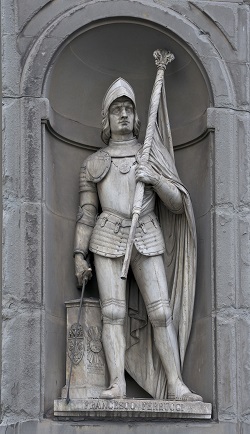
1530: Francesco Ferruccio, victim of Maramaldo

On this date in 1530, Francesco Ferruccio (or just Ferrucci) and his executioner Fabrizio Maramaldo clinched their immortality at the Battle of Gavinana.

The battle was the tragic final scene of the War of the League of Cognac, in which an alliance of Italian city-states tried to expel the Habsburg Holy Roman Emperor Charles V from the peninsula. Charles had already in effect decided matters by forcing the French out of the fight, which also brought about the capitulation of the Vatican.

Left alone in the fray, doughty Florence — ever so briefly at this moment restored as a Republic, having given the Medici the boot — continued to hold out against impossible odds. A vast imperial army swollen by landsknechts whose mercenary arms were now unnecessary elsewhere in Italy besieged Florence on October 24, 1529.


The Siege of Florence, by Tuscan Renaissance Man Giorgio Vasari.

The intrepid Florentine commander Francesco Ferruccio (English Wikipedia entry | Italian) strove to take his hopeless fight to the enemy. After a plan to coerce papal support by striking Rome was vetoed, Ferruccio mounted a march through the Apennines to threaten the Imperials’ rear.

He was intercepted at Gavinana, a battle decided by the arrival of landsknecht reinforcements under the command of the notoriously cruel condottiere Fabrizio Maramaldo.

Maramaldo would elevate himself for posterity out of the ranks of his merely brutal brethren by finding Ferruccio, badly wounded, his prisoner, and putting him to immediate death by his own hand — an execution that resulted in Florentine capitulation one week later, and the installation of Alessandro de’ Medici as Duke of the now ex-Republic.*

While admittedly borderline as an “execution” suitable for this here site, Ferruccio’s defiance in the face of his killer and his last denunciation of Maramaldo — “Coward, you kill a dead man!” — became the stuff of legend in a later Italy. (It also helped Ferruccio’s case for the nationalist pantheon that he died fighting against the Germans, not against the next city-state over.)

The romantic novelist Francesco Domenico Guerrazzi** made Ferruccio the subject of his magnum opus L’Assedio di Firenze, and before you knew it the name was on the lips of every risorgimento Tom, Dick and Francesco. Garibaldi invoked him in speech; Goffredo Mameli wrote him into the national anthem.


Every man has the heart
and hand of Ferruccio …

Under the Italian state those men helped to make, Ferruccio was appropriated as the name of a battleship; fascist Italy especially found Ferruccio congenial to the national-pride project and valorized the martyr relentlessly.


1930 Fascist Italy stamp depicting — for the 400th anniversary of the occasion — Fabrizio Maramaldo murdering his prisoner Francesco Ferruccio. Other Februccio stamps from the same period can be found on the man’s Italian Wikipedia page.

For Maramaldo, a less flattering but possibly more durable legacy: Italian gained the noun maramaldo, the adjective maramaldesco, and the verb maramaldeggiare to signify bullying or cruel domineering.

* Alessandro had a reputation for despotism, and was assassinated a few years later by his cousin Lorenzino de’ Medici in a tyrannicide that was Brutus-like in both its motivation and effect. That later affair is the subject of the 19th century play Lorenzaccio.

** Guerrazzi also did his bit for the legend of Beatrice Cenci.

On this day..

2005: Steven Vincent, Iraq War journalist

On this date in 2005, U.S. journalist Stephen Vincent was abducted off the streets of Basra by a Shia militia. Before the day was out, he had been extrajudicially executed on the outskirts of town — along with his assistant and translator, who managed to survive the execution.

Vincent, originally from California, had been a New York journalist (most prominent on the arts scene) for more than twenty years when he stood on his apartment’s roof on September 11, 2001, and watched United Airlines Flight 175 smash into the South Tower of the World Trade Center.

Deeply shaken by the specter of Islamic terrorism and wanting to, as he put it, “do my part in the conflict”, Vincent took an abrupt turn from his Gotham haunts and in 2003 bought his own ticket to Iraq to venture into the war zone with nothing but wits honed by a lifetime’s freelancing. Free of both institutional control and institutional protection, and picking up his Arabic on the fly, the dauntless Vincent reported from the ground in war-ravaged Iraq, eyed by perplexed officials who could scarcely help but suspect him a spy.

His 2004 book In the Red Zone: A Journey into the Soul of Iraq captures his impressions.

In April 2005, Vincent returned to Iraq — this time, to Muqtada al-Sadr‘s* bastion in the Shia south where, as he put it in a post on his still-extant blog, “militant Shiites … have transformed once free-wheeling Basra into something resembling Savonarola‘s Florence.”

One of few Western journalists in British-occupied but increasingly Sadr-controlled Basra, Vincent filed numerous stories raising the alarm on fundamentalism and Iranian influence.

“Basran politics (and everyday life) is increasingly coming under the control of Shiite religious groups,” Vincent wrote in a July 31, 2005 New York Times piece that would prove to be his last. “And unfortunately, the British seem unable or unwilling to do anything about it.”

Vincent traces the early cracks that would widen into Iraq’s now-familiar sectarian fracturing, and the ruins of a secular society as institutions like the university dare not shoo away self-appointed purity monitors of students’ dress and conduct lest they invite the wrath of the Iranian-backed Shia parties (and Shia police).

An Iraqi police lieutenant, who for obvious reasons asked to remain anonymous, confirmed to me the widespread rumors that a few police officers are perpetrating many of the hundreds of assassinations — mostly of former Baath Party members — that take place in Basra each month. He told me that there is even a sort of “death car”: a white Toyota Mark II that glides through the city streets, carrying off-duty police officers in the pay of extremist religious groups to their next assignment.

This passage prefigures Vincent’s own fate, and it’s thought to be the fact of his filing reports like this one that sealed it. Returning on the afternoon of August 2 from a Basra currency exchange with his translator Nouriya Itais Wadi (or Nouri al-Khal; Steven Vincent referred to her as “Leyla” in the personal dispatches he posted on his blog),** the pair was seized in broad daylight by armed men in a white police vehicle. Hours later, their bodies were recovered just a short drive away. Or rather, Vincent’s body was recovered: his aide, left for dead by her executioners, was clinging to life despite multiple gunshot wounds.

There’s an Open Source Radio interview with Vincent’s widow Lisa Ramaci-Vincent from August 10, 2005, available as a podcast here. After yet another journalist was abducted and murdered in Basra a few weeks later, Ramaci-Vincent launched the Steven Vincent Foundation “to assist the families of indigenous journalists in regions of conflict throughout the world who are killed for doing their jobs, and to support the work of female journalists in those regions.” She also helped Nouriya, who survived her injuries, to emigrate to the U.S.

Muqtada al-Sadr, who survived a 2008 attack by the American-backed Iraqi army on Basra, remains today one of the dominant figures in Iraqi politics.

* Saddam Hussein — a Sunni — had the name “Muqtada” chanted at him by his executioners during the fiasco of his hanging.

** Vincent’s relationship with his unmarried translator has also been cited as a possible factor in their murder. He was apparently planning to marry her opportunistically to help her escape Iraq, a plan that his wife knew about and supported.

On this day..