In honor of this impressive anniversary, we travel back in time and into the twilit frontier between fact and legend to another century’s intervention in that Graveyard of Empires — the Second Anglo-Afghan War, 1878-1880. Dr. Watson was there; maybe even his literary compatriot Sherlock Holmes, too.
It’s too bad we don’t have the services of those excellent detectives in this matter. We can’t date this particular method, or attribute any specific victim to it, or even substantiate the actuality of the practice to our liking (though there are several books by British soldiers of that war which traffick in the report). Frankly, everything about it smells. But we think you’ll agree that execution by urophagia is a story that needs to be told.
The following is an account from a biography of English officer and novelist John Masters. We’ll label it Mature Content both for what it describes and the manner of its description, just to make you really want to savor every word.
War for the Pathans [Pashtuns] was an honourable, exciting and manly exercise, in which each succeeding generation needed to prove itself, but war was also ruthless; no mercy was shown and none was expected. Neither side aimed to take prisoners. The Pathans customarily mutilated and then beheaded any wounded or dead who fell into their hands. Women often carried out these operations. A well-known torture was called the Thousand Cuts, whereby flesh woulds were newly made and grass and thorns pushed into them so that they would hurt horribly. A prisoner might be pegged out on the ground and his jaw forcibly opened with a stick so that he could not swallow, then women would urinate in his mouth until he drowned.Frank Baines, who served on the North-West Frontier and later with Masters in Burma, put it more crudely:* ‘If you got captured, you were not only killed in a lively and imaginative manner, you were carved up and quartered and had your cock cut off and stuffed in your mouth for good measure.’
Thanks to Undine of the blog The World of Edgar Allan Poe for breaking her posting hiatus with this guest entry. -ed.
When reflecting upon the life and times of Edgar Allan Poe, Edward Wagenknecht once wrote that “One might also say of Poe that he lived in a Gothic novel. Hardly anybody behaves normally in this history.” Of all the names one finds in Poe’s biographies, no one better illustrates these words than Marie Louise Barney Shew Houghton. While there were many players in Poe’s life story who undoubtedly deserved to be put in the dock, (the Reverend Rufus Wilmot Griswold being merely the most famous example,) Mrs. Houghton was the only one of the lot who faced the prospect of being tried, and very possibly convicted and executed, of first-degree murder.
This was the date in the year of the nation’s centennial that Houghton slipped the noose.
Mrs. Houghton is known to history as having been the nurse of Poe’s wife Virginia during her final illness, as well as an all-around Poe family benefactor. This saintly reputation, unfortunately, comes largely from her own boasts on the matter, made many years after the poet’s death. In 1875, she began a correspondence with Poe’s early biographer John H. Ingram. Her avowed intent was to insure that she—as opposed to other ladies who were vying for the title—would be remembered as Poe’s dear friend and guardian angel. Unfortunately, at the time she contacted Ingram, she was clearly in appalling shape, mentally and emotionally. The numerous extant letters she wrote him—which date from January to June of 1875–are always rambling, usually incoherent, and occasionally quite insane. She related to Ingram many colorful stories about Poe that are completely uncorroborated, patently absurd, and often at complete variance with the known facts. Ingram privately acknowledged that Mrs. Houghton was mentally unstable, and he suspected as well that she was enhancing, or even completely inventing, many Poe anecdotes, in order to keep their correspondence alive. He wound up dismissing her with the euphemism, “imaginative.” In spite of all this, Ingram—who was desperately in need of original source material about the ever-elusive Poe—wound up relaying far too much of her dubious information in his 1880 biography, and, even more unforgivably, Poe’s modern-day historians repeat unquestioningly this same apocrypha to this day.
One wonders what Ingram’s reaction would have been if he had known anything about his pen-pal’s personal life. Marie Houghton was a predecessor to today’s “New Age” devotees. Her first marriage, to the “water-cure” practitioner Joel Shew, gave her an avenue into what were the more extreme circles of Transcendentalist faddism, which embraced alternative medicine, “free love,” “freethinking,” communal living, and disdain for established institutions. Ironically, she represented everything Poe most despised in contemporary society.
In the mid-1840s, Marie Louise separated from her husband and entered into an affair with another member of their circle, Dr. Ronald Houghton, although she continued to live with Dr. Shew. In 1849, she gave birth to a son, Henry, who was probably acknowledged as Houghton’s, although at least one historian has theorized that the father was a third man who was living with (and financially aiding) the Shews. The next year, the Shews divorced and she married Houghton. Although they had several more children, the marriage proved unhappy, and they too separated. She continued to work as a nurse, while indulging in a number of extremely complicated and very dodgy financial and property transactions on the side.
However, it was this son Henry who proved to be the catalyst that brought Mrs. Houghton serious trouble. After a varied and exciting career out west where he was charged with adultery, mule thievery, swindling, and “open and notorious lewdness,” Henry Houghton returned to the family home in New York, bringing with him his mistress, a Mary E. Stanley, who had evidently been Henry’s partner in crime as well. With them was a toddler who was understood to have been their child, even though Mary was at the time married to another man.
In 1876, the now-pregnant Mrs. Stanley was living with the Houghton family, although by this point Henry appears to have tired of her. Her common-law mother-in-law, Mrs. Houghton, acted as her sole medical attendant. Unfortunately, Mrs. Stanley died soon after giving birth. The Houghtons failed to summon a doctor until she was obviously at death’s door. Very curiously, she was quickly buried without a death certificate having been issued, apparently at the instigation of Marie Houghton. After her burial, the undertaker prevailed upon the physician who had been at her deathbed, a Dr. Bleecker, to provide him with some sort of certificate. Bleecker was reluctant to do so, as he had never actually treated the deceased, but finally issued one with the noncommittal statement that the cause of death appeared to be “congestive chills.”
Of all who hail thy presence as the morning–
Of all to whom thine absence is the night–
The blotting utterly from out high heaven
The sacred sun–of all who, weeping, bless thee
Hourly for hope–for life–ah, above all,
For the resurrection of deep buried faith
In truth, in virtue, in humanity–
Of all who, on despair’s unhallowed bed
Lying down to die, have suddenly arisen
At thy soft-murmured words, “Let there be light!”
At thy soft-murmured words that were fulfilled
In thy seraphic glancing of thine eyes–
Of all who owe thee most, whose gratitude
Nearest resembles worship,–oh, remember
The truest, the most fervently devoted,
And think that these weak lines are written by him–
By him who, as he pens them, thrills to think
His spirit is communing with an angel’s.
Mary Stanley’s death would have passed unremarked had it not been for a collection of letters she had written to a friend, which was soon brought to the attention of the authorities. In brief, these letters stated that Mrs. Houghton wished to perform an abortion on her. (It was alleged that Houghton supplemented her income as a professional—and, on occasion, fatally incompetent—abortionist.) When Mrs. Stanley refused, she attempted to give her patient certain “medicines” which Mrs. Stanley believed were intended to permanently rid the Houghtons of her as well. Faced with this uncooperative attitude, Mrs. Houghton “became cruel to her, and starved both herself and her child.” The question of why she remained in the household appeared to be answered by murky and never-clarified issues regarding the estate of Mrs. Houghton’s late estranged husband. It was said that she stubbornly stayed put in an effort to defend the interests of Mrs. Houghton’s other son, Frank, who was involved with a legal dispute with his mother over a certain piece of property. There was a good deal of nightmarishly complex litigation surrounding Dr. Houghton’s estate, and evidently Mrs. Stanley played some crucial role regarding the dispute over the distribution of Roland Houghton’s properties. According to these letters, Mrs. Stanley was attempting to act as some sort of a roadblock in schemes Henry and his mother were attempting in relation to the matter.
After the local coroner and District Attorney had read their fill of these missives, their first act was to have Mrs. Houghton arrested.
An inquest was soon held, and these letters, as well as testimonies of friends of the dead woman, were presented to the jury. A lurid picture was painted of Mrs. Houghton’s long career of poisoning (including two alleged attempts against her husband,) abortions both successful and fatal (Mrs. Stanley wrote of seeing “terrible things” in the Houghton’s cellar that related to this practice—other testimony agreed that she literally knew where the bodies were buried,) financial fraud, and all-purpose cruelty. Mrs. Stanley wrote that “I do not think there is another woman as bad as her living,” and if half of what was related about her at the inquest was true, this was a genteel understatement. Mrs. Stanley also declared that the Houghtons wanted her dead, not only for the fact that she “knew too much” about their depraved dealings, but because she was threatening to “swear her child” on Henry Houghton—i.e., hit him with a paternity suit. (The inquest also included testimony that Mrs. Houghton expressed great joy that Mary Stanley’s death freed her son from taking responsibility for his mistress and their child.)
When Mrs. Houghton took the stand in her defense, it was said that she gave her testimony “fairly and with much plausibility.” She simply denied everything the dead woman had written. Mrs. Stanley, she said, was a designing criminal who had robbed her son “not only of his money, but of his good name.” She had allowed the pregnant woman to live in her house out of pure Christian charity. Mrs. Stanley’s death, on September 12th 1876, was of a “congestive chill” that came on so suddenly there was no time to send for a doctor. She admitted that she had practiced medicine from 1851 until the previous year, when she was threatened with imprisonment if she did not cease her unaccredited ministrations. She also conceded that Mrs. Stanley had threatened to “crush” the Houghton family, and that “something disagreeable” had occurred several months before that had inspired Mrs. Stanley to write these accusatory letters. However, it was also revealed that at the time of Mrs. Houghton’s arrest, certain family papers were seized by the authorities which corroborated much of what the deceased had alleged.
When Dr. Bleecker testified, he could say only that an autopsy on the dead woman “could not determine the cause of death satisfactorily.”
After all this, it is quite startling to read that the jury ruled that Mary Stanley died of natural causes, “from hemorrhage and exhaustion while in labor.” The only way of explaining this conclusion (which seemed to have no evidence to back it up) is to note that from the newspaper reports, the jury was clearly on Mrs. Houghton’s side from the beginning. In fact, the jury attempted to halt the inquest very early on, claiming they had heard enough evidence to reach a verdict. The coroner and DA overruled them, insisting that they hear additional witnesses. Also, one of the jurors questioned a doctor who testified, asking if it wasn’t true that pregnant women were often prone to paranoid fancies, where they imagined dangers that did not exist. When the doctor admitted that such things were possible, this obviously sealed the deal for this panel. The reason for this obvious bias in favor of the defendant is, most unfortunately, unknown.
The case was left open for further investigation, but as far as can be ascertained by a search of contemporary newspapers, the matter was closed as far as the authorities were concerned. Marie Houghton left the court a free woman, if not exactly one without a stain on her character. She died less than a year later, at the age of fifty-five, on September 3, 1877.
One of the strangest things about this case is the fact that it has attracted so little attention, from that time to this. The only detailed contemporary accounts I have been able to uncover are a handful of articles from one newspaper, the Brooklyn Eagle, and two columns in the New York Herald which simply repeated some of the information published in the Eagle. Even though the story contained enough scandal to keep a platoon of yellow journalists in clover for years, it was otherwise ignored. Despite the fact that the central character was a figure well-known to anyone who has the slightest interest in Poe’s life, this odd little episode appears to be unknown to his biographers. It is a great pity deeper investigation in the matter appears impossible at this late date, as from what was reported, Marie Houghton was either the most viciously slandered woman of her era, or a monster Poe himself could not have created in his darkest fits of imagination.
Sources: Brooklyn Eagle, Sept. 21, Sept. 23, Sept. 25, Sept. 30, Oct. 3 1876 New York Herald, Sept. 22 and 23, 1876 Building Poe Biography, ed. John Carl Miller
On this date in 1916 — true story — this happened.
Five-ton circus elephant Mary (yes, she has her own Wikipedia page) was in Kingsport, Tennessee on the chintzy fairgrounds touring circuit with Sparks World Famous Circus.
Billed as as “The Largest Living Land Animal on Earth,”* this exotic creature was a prime draw for the circus — and also a beloved pet of the Sparks family.
Unfortunately, this valuable asset was placed in the temporary stewardship of an inexperienced “under keeper” whom the circus had had to scoop up at a recent stop to cover staff turnover. Between shows on September 12, that fellow somehow (accounts conflict) enraged Mary, and (again according to one version among several) she
“collided its trunk vice-like [sic] about [the under keeper’s] body, lifted him 10 feet in the air, then dashed him with fury to the ground … and with the full force of her biestly [sic] fury is said to have sunk her giant tusks entirely through his body. The animal then trampled the dying form of Eldridge as if seeking a murderous triumph, then with a sudden … swing of her massive foot hurled his body into the crowd.”
It’s apparent in this report that the facts of an already-sensational event almost instantly began disappearing into its spectacle. See the largest land animal on earth! See it maul its handler to death! But what happened next lifted Mary all the way to legend.
The owners knew they had to euthanize the “mankiller,” or if they didn’t know they were soon persuaded by mushrooming press attention and towns threatening to ban the Sparks circus.
But how? They couldn’t shoot Mary to death — she apparently survived gunshots from the vengeful crowd in the immediate aftermath of the trampling; firearms just didn’t pack the wallop to put down a pachyderm in 1916. The area didn’t have the sort of electrical juice available that Thomas Edison had once used to drop a circus elephant during his weird campaign for the electric chair.
The choice for the baleful logistical task of killing a 10,000-pound evildoer was hanging, selected over “crushing it between railroad cars.”
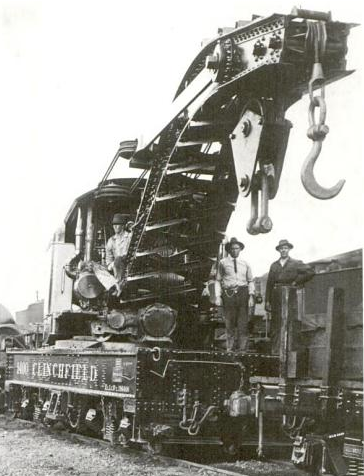
And for stringing up “Murderous Mary”, you need no ordinary gallows. No, for this job, you’re using the hoist on a train derrick and an industrial-strength chain for a noose.
The actual train derrick that hanged Mary the elephant. The leftmost man, seated on the machine, is the “executioner” who worked the controls, according toThe Day They Hung the Elephant.
The railroad was game for the operation, provided the circus would come to it. So on this date, the circus train cars loaded up for the nearest usable train derrickscaffold at Erwin, Tennessee.
There, a procession of all five Sparks elephants — the routine was supposed to keep Mary compliant, and it did the trick even though some observers later remembered the condemned creature behaving unusually skittishly — marched to the railyard.
There Mary was noosed with a 7/8″ chain and hoisted up. The chain broke, and the animal shattered its hip crashing to the ground; another, still larger, chain, did the trick on the second try.
There’s something about this event abidingly piteous, even shameful. It may be for that reason that it’s also abidingly mysterious. The particulars about what happened on the day they hanged the elephant and what became of the body (a steamshovel dug a grave, but the exact location was never marked and there’s a wild story that it was dug up later for ivory) are the topics of conflicting, nth-hand rumors. Some in Erwin don’t to this day want to discuss the matter. Others, just the opposite.
Image (c) John Pugh of SourceToSea.net and used with permission.
* Sparks evidently kept the “largest living land animal” marquee in use for Mary’s successor, as indicated by this 1919 poster (pdf) for the show.
Young Cristovao would be ground up in this conflict whose mixture of geopolitics and sectarianism overtly smacked of those old-time Crusades.
After a jaunt to India in the train of his older brother, appointed the Portuguese governor of India, Cristavao was sidetracked on a return voyage for an intervention on the Christian side in a raging local war. For Europeans who for generations had trafficked in the vague and fantastical rumors of mythical Abyssinian ruler “Prester John”, putting a thumb on the scale for Ethiopian Christians against the rampant Arabs must have been nigh irresistible.
Joao III and his government, faced with mounting debts as the costs of military operations in the East steadily grew, were now forced to re-evaluate their global commitments … the new viceroy, Estevao da Gama, was ordered to destroy the Turkish fleet in Suez …
Estevao da Gama’s raid into the Red Sea became one of the best remembered episodes in the history of the Portuguese Estado da India. The fleet assembled at Massawa on the African shore and then proceeded to Suakin which was burnt and plundered. Part of the fleet then returned to Massawa while the rest sailed on to Suez where the Turkish ships proved to be securely based and inaccessible. On the shore of Sinai, as close to Jerusalem as the Portuguese were ever to come, Estevao da Gama enacted some of the rituals of crusading chivalary and made a number of knights before returning to Massawa. Meanwhile, Dom Joao de Castro, who accompanied the expedition, used the time to produce his famous guide to the Red Sea, the Roteiro do Mar Roxo, complete with the meticulous drawings of the ports and anchorages, a masterpiece of Portuguese Renaissance geography and science.
One of Joao de Castro’s drawings. (Source, a Portuguese pdf)
Meanwhile the Portuguese at Massawa had suffered extreme privations and a hundred of them had deserted, having been persuaded by [untrustworthy Potuguese-descended Ethiopian ambassador Joao] Bermudes of the richness and wealth of the interior. Their fate was to be captured and massacred by Ahmed Gran. Estevao da Gama now dispatched a force of four hundred soldiers under the command of his brother, Cristovao da Gama, into the interior to assist the Ethiopian king. Cristovao da Gama advanced from the coast with a force much the same size as that which Cortez had led into Mexico in 1519. He had with him horses, arquebuses and eight small cannon. His first objective was to link up with the fugitive Ethiopian king and his followers, but da Gama got separated from his supplies and was forced to fight a superior Somali force supported by Turkish mercenaries. The result was catastrophe. The small Portuguese army was badly mauled and da Gama himself fled wounded from the battlefield and was taken prisoner.
The capture of the viceroy’s brother, son of the great admiral, carried with it huge importance for the Turks. After being ritually humiliated (his beard being set on fire and his face buffeted with the shoes of his negro servant) Cristovao da Gama was beheaded.* For the Portuguese this was a disaster, the symbolic significance of which far transcended the military consequences of the defeat. However, the Christian church had long experience of turning catastrophe into triumph and, soon after the news of Cristovao da Gama’s death reached the outside world, rumours of miracles began to circulate.** Da Gama became one of the first martyrs of the new church overseas which in a hundred years of expansion had had all too few heroic deeds to celebrate.
After the death of their commander fewer than two hundred of the original army survived, but they were able to meet up with the Christian Ethiopian forces and, when the next campaigning season started in 1542, the combined army inflicted a heavy defeat on the Muslims, a defeat which took on a decisive complexion when it was realised that the leader of the jihad, Ahmed Gran, had been killed in the battle.
Da Gama’s expedition had been mounted from the resources of the official empire and had been commanded by one of the leading fidalgos of the Estado da India. However, few of da Gama’s soldiers returned to India Instead they settled in Ethiopia and married Ethiopian women, establishing a ‘Portuguese’ community that mirrored the ‘Portuguese’ communities in Aythia, Bengal, Kongo and elsewhere where soldiers had offered their military expertise to local rulers an had been content to settle and make their fortures far removed from the jurisdiction of the Portuguese Crown.
Although da Gama’s own end was unfortunate, his surviving force’s exploits on a side badly pressed could arguably be considered the decisive factor enabling Christianity to survive in Ethiopia’s highlands interior. Prester John would have been proud.
* “I write what I heard, it may well be that it was thus, for all that is barbarous and cruel about the Moorish king can be believed. The body, after death, was dismembered and sent to various places … because once when Granha was speaking with Dom Christovao, he asked him: ‘If you had me in your power, as I have you, what would you do to me?’ Dom Christovao, with great resolution and freedom replied, ‘If I had you in my power, I would have you killed, the head I would send to one place and the quarters I would distribute to other places’ (naming them, but I do not recall them). And Granha, they say that it was because he heard this, scattered the body to various places.”
** “Directly they cut off his head, God worked a great and manifest miracle through it, which was, that in the place where they slew him a fountain of running water gushed out, which had never been seen before: its water, through the goodness and power of God, gives sight to the blind, and cures those ill of other diseases. It appears that this miracle is like the one that God did in Rome for His Apostle St. Paul. The remains of the body of D. Christovao smell sweetly, giving forth so delightful an odour, that it seems rather of heaven than of earth.”
The Partisans were Tito’s Communist guerrilla movement against the Nazi occupation and while they were up against it at this early date, they would in due time wind up on the winning side and help birth the postwar government.
Their legacy remains in every European sports page as the namesake of the Belgrade sports association Partizan founded immediately after the war. It’s the umbrella entity for the frequent Serbian football and basketball champions as well as a variety of other sports. (Current world tennis no. 1 Novak Djokovic played for Partizan, for instance.)
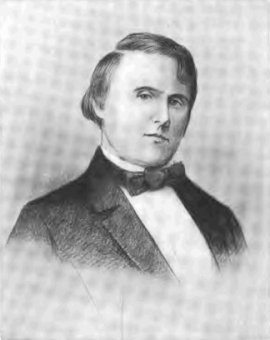
“An American kneels only to his God, and always faces his enemy,”* declared William Logan Crittenden, refusing to kneel before his executioners in Havana this date in 1851.
This well-bred** Kentuckian veteran of the Mexican-American War ditched a New Orleans customs-house gig when Narciso Lopez formed a private filibustering expedition to try to steal Cuba from the Spanish.
Placed at the head of one of Lopez’s three battalions, Crittenden’s force was cut off and overwhelmed by the Spanish. (The detailed progress of the campaign is described here.)
He and 50 of his command captured with him were all ordered for immediate execution, six at a time, as pirates, with just a few hours’ allowance to take down official statements and scribble their hasty goodbyes. With “not the heart to write to any of my family,” Crittenden sent one to a friend giving his farewells … then, just before the end, dashed off another addressed to the Attorney General of the United States — his uncle, John J. Crittenden.†
Dear Uncle: In a few moments some fifty of us will be shot. We came with Lopez. You will do me the justice to believe that my motive was a good one. I was deceived by Lopez — he, as well as the public press,‡ assured me tat the island was in a state of prosperous revolution.
I am commanded to finish writing at once.
Your nephew,
W.L. Crittenden
I will die like a man
(Some other affecting last letters from Crittenden’s party can be perused here.)
All this scene, including a post-mortem mutilation by the enraged mob of onlookers, became a bloody banner for U.S. Southerners — since expanding the slave power was core to the entire filibustering project.
When word of the shootings reached New Orleans, a crowd sacked the Spanish consulate.
But in the international relations game, the U.S. had disavowed filibustering and its raiders enjoyed no special diplomatic protection. When a number of the later prisoners were returned in chains to Spain, the Millard Fillmore administration asked their release, but had no grounds to demand it. It was a touchy diplomatic situation … one that our late Crittenden’s uncle, as a member of cabinet, was right in the middle of.
Fillmore eventually secured the captives’ release, atoning the insult to the European power’s agents by causing the Spanish colors to be saluted in New Orleans in honor of the birth of the Infanta Isabella.
All this mincing instead of brawling struck a certain variety of hothead as distinctly unmanful.
Our flag has been wantonly insulted in the Caribbean sea … captured citizens of our country [were] sent in a slave ship to the coast of Spain, fettered, according to the custom of that inhuman traffic, and released, not as an acknowledgement of wrong on demand of our government, but as a gracious boon accorded to a friendly suit … Whilst the dying words of Crittenden yet rung in the American ear, and the heart turned sickening away from the mutilated remains of his liberty-loving followers; whilst public indignation yet swelled at the torture which had been inflicted on our captive countrymen, even then we were called upon to witness a further manifestation of the truckling spirit of the administration …
William Crittenden’s brother Thomas Theodore Crittenden fought on the Union side of the Civil War, and became Governor of Missouri in 1881. He’s noteworthy for having issued the bounty on outlaw Jesse James that led to the latter’s assassination by Robert Ford.
† Family in the president’s cabinet was just no guarantee of preferential treatment, abroad or at home; just a few years before, a son of the sitting Secretary of War had been hanged at sea for mutiny.
‡ The Spanish press likewise excoriated American yellow journalism in terms that no few present-day scribes would also deserve.
New Orleans papers, there is your work! There is the result of your diragations, of your iniquitous falsehoods, of your placards with large black letters, and your detestable extras … This blood must flow, drop by drop, upon your heads — this blood will torment you in your sleep, for they have lost their lives when you were in security in your houses.
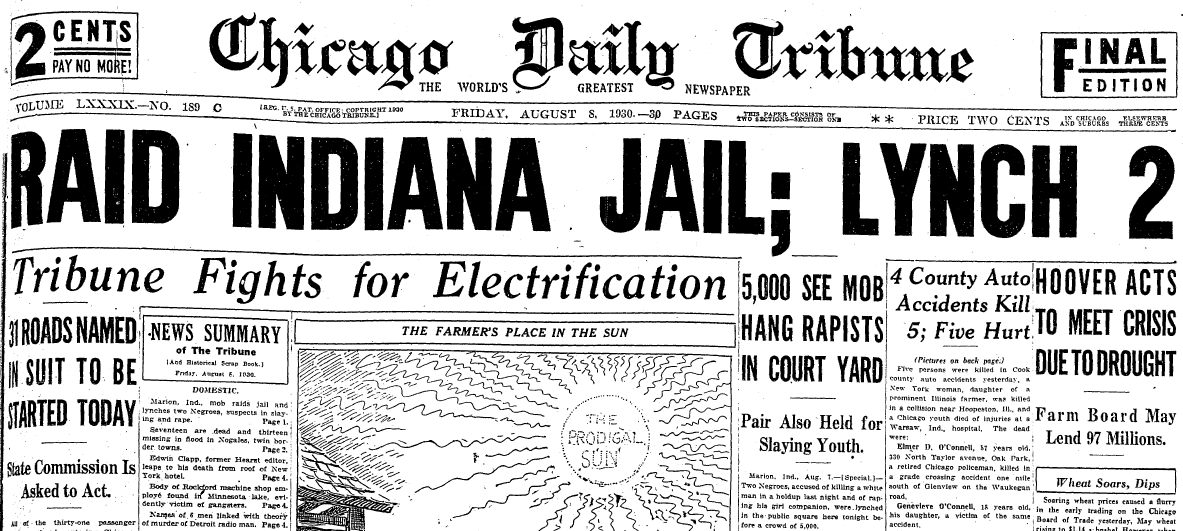
On this date in 1930, two black youths were lynched in Marion, Indiana for murdering a white man and raping his girlfriend.
(The rape allegation — although it, and not the homicide, seems to have been the thing that triggered the lynching — was subsequently withdrawn, and there were even rumors that the white girlfriend was a lover and confederate of one of the lynched men. It’s just one strand in the very human tapestry around the “last classic lynching north of the Mason-Dixon line” explored by Cynthia Carr in Our Town: A Heartland Lynching, a Haunted Town, and the Hidden History of White America.)
Shipp, who is said to have confessed killing the white man, Claude Deeter, 23, of Fairmount, Ind., was hanged from an elm tree in the courthouse yard. Smith, whom the girl identified as her assailant, was thrown from a third floor window of the jail with a noose around his neck and strangled.
…
Reports of the crimes and confessions, published in Marion newspapers this afternoon, stirred this quiet community of 23,000 to intense excitement. There was no hint of the impending violence, however, until 8:30 p.m., when a motorcade of Deeter’s fellow townsmen arrived from Fairmount.
The Fairmount delegation, numbering about 100, gathered in the public square, openly displaying their guns and shouting for a lynching … The sheriff led his deputies to the front door, argued a moment with the leaders of the mob and then ordered the tear bombs thrown. Blinded, the lynchers fell back for a few minutes, but returned and began the sledge hammer siege which forced the jail doors within ten minutes. No shots were fired on either side.
Following the lynching the mob gathered in the square for an hour, some proposing to drive the 2,000 members of the Negro colony from the city and burn their dwellings. Peace officers from Indianapolis, Kokomo, Fort Wayne, and other towns were arriving however, and gradually the mob broke up.
The corpses hung in the square for hours, attracting throngs of gawkers — including a photographer able to snap this picture:
Teacher/poet Abel Meeropol ran across this photo of the Shipp-Smith lynching a few years later in a magazine, and it so “haunted” him — his word — that he penned the anti-lynching poem “Strange Fruit”. You know it from Billie Holiday‘s arresting vocal rendition.
Southern trees bear strange fruit
Blood on the leaves
Blood at the root
Black bodies swinging in the southern breeze
Strange fruit hanging from the poplar trees
Pastoral scene of the gallant south
The bulging eyes and the twisted mouth
The scent of magnolia sweet and fresh
Then the sudden smell of burning flesh
Here is a fruit for the crows to pluck
for the rain to gather
for the wind to suck
for the sun to rot
for the tree to drop
Here is a strange and bitter crop
Abel Meeropol was no passing sentimentalist himself, but a prolific left-wing activist. During the McCarthy years, he adopted the children of the Rosenbergs when the latter were electrocuted as Soviet spies. As faithfully as those two orphaned boys have carried the torch for their lost birth parents, they also still carry an adoptive surname: Michael Meeropol and Robert Meeropol.
A third person was almost lynched in the same Marion, Ind., incident, but 16-year-old James Cameron (sometimes called “Herbert” or “Robert” in the 1930 news reports) managed to convince the mob that he wasn’t involved. Just how he managed this feat and what he’d really been up to is another strand of Carr’s tapestry: many of the Marion blacks as well as whites she interviewed overtly mistrusted Cameron.
At any rate, the crowd let him off with a beating, and Cameron served time as an accessory to the crime.
After release, he became an anti-lynching activist in Indiana and, later, Wisconsin — where he founded a (since-shuttered) Black Holocaust Museum. He started several NAACP chapters.
In the more immediate aftermath, it was far from a given that this date’s effusion of summary justice wouldn’t cascade into a generalized racial pogrom.
As the Tribune article notes, the lynch mob mulled attacking the black community, ultimately dissuaded by the gradual arrival of lawmen. By the next day, the Indiana national guard had occupied Marion. The Tribune on Aug. 10 reported the town “peaceful to all outward appearances but acutely aware of an undercurrent of racial antagonism that it feared might flame into open warfare at any moment.”
Lest this seem a bit over-the-top, recall that all this went down just a few years since a lynch mob in Tulsa had metastasized into one of America’s most notorious race riots. The prospect of wholesale bloodletting was very real.
When the local attorney general and grand jury waved away the small matter of punishing mob leaders, several of whom were publicly known by name, Indianapolis attorney general (and Marion native) James M. Ogden drove up to town and personally filed indictments, to the fury of white residents.
“It was astonishing to see and feel the mob atmosphere that still prevailed nearly seven months after the murder,” wrote a correspondent for The Nation. Ogden’s deputies were “looked upon as enemies of the community, not only by the mob, but also by most of the court officials.” After all-white juries acquitted the first two people tried, the state dropped its remaining indictments.
The maelstrom of race and politics and history that emerged from that first fatal transaction — a brutal but banal Lover’s Lane heist — grew so far beyond the original cast of criminal and victim that they practically became secondary to the story.
On August 8, 1930, a wire story datelined Fairmount, Ind., ran in the Indianapolis Star (but not the Marion papers):
Deep regret that the negro slayers of their son Claude, were lynched in Marion last night by a mob, was expressed today by Mr. and Mrs. William Deeter, members of the Apostolic faith, a sect similar to the Quakers.
“God should have been the judge,” said the elderly Deeter. “They had no right to do it,” his wife assented.
Both are opposed to capital punishment and did not want to see the negroes put to death for their crime.
On August 6, 1942, in the Warsaw Ghetto, Polish/Jewish hero Janusz Korczak marched with his orphans to the death trains and into legend.
The man, his activities in the ghetto, and above all his famed final walk to the Umschlagplatz, are mentioned in many books and memoirs about the ghetto.
Korczak’s real name was Henryk Goldschmidt. He took the name Janusz Korczak (pronounced “ya-nish kor-chok”) for his writing and it wound up taking over his entire life, a la Mark Twain.
Born in an observant Jewish household in Warsaw (which was then Russian Territory) in either 1878 or 1879,* he became man of the house after his father suffered a nervous breakdown in 1889 and eventually had to be hospitalized.
By thirteen, bored by school, he was writing poetry and learning foreign languages by himself. He went to medical school and served as a military doctor with the Russian Army in the Sino-Japanese War of 1905-1906. Eventually he was promoted to the rank of major.
Korczak’s true calling wasn’t in medicine, however, but in writing and in working with children. He found himself drawn to neglected and abused youngsters, and believed in treating every child with honesty and respect.
While he was in China with the military, his first book, Child of the Drawing Room, became famous in Poland. He didn’t realize he was a celebrity until he returned home.
He tried to distance himself from his writing and his fame and be an ordinary pediatrician, but people wanted to see him, to the extent that they would pretend their children were sick in order to entice him to their homes.
Korczak wrote later that one woman claimed her sons had the flu and, when he made a house call, insisted on serving him tea.
“Have you been writing anything lately?” she asked.
“Prescriptions,” he replied, and left, realizing he’d been had.
In 1910, he gave up his medical practice to start an orphanage for Jewish children age seven to fourteen. His institution was very different from most of that time and place, for Korczak had very democratic ideas: the children wrote their own newspaper and had their own parliament and court system.
If one child had a falling-out with another, the urchin could “sue” and bring a case to be decided before the orphanage court, which met once a week. (Even teachers and other staff members could be sued.) The orphanage court also held trials for children accused of violating one of the home’s rules.
Children were rewarded for good behavior, and spanked only as a last resort. Every child had a private, lockable drawer to hold their most precious belongings. Korczak carefully monitored the children’s health and also acted as a sort of informal therapist, encouraging them — most of them orphans from backgrounds of desperate poverty and abuse — to talk about their feelings. The children called him Pan (“Mister”) Doctor.
When World War I broke out, Korczak left the orphanage to serve in the Army again. He left it in good hands, however, in the care of teachers and staff he had trained himself.
“All the world is submerged in blood and fire, in tears and mourning,” he wrote sadly of his war experiences.
It was while in the trenches on the Eastern Front that he began writing a book on child development, titled For The Love of a Child. In 1918, the war finally ended, Poland became a free and independent nation, and Korczak returned to his orphans in Warsaw.
He stayed busy, setting up a second orphanage in 1919, and afterwards writing King Matt the First. The novel, a children’s story about a young boy who becomes king and puts the country’s children in charge, became a bestseller throughout the country in the wake of the calamity lately unleashed by the grown-ups. The sequel, King Matt on the Desert Island, was also a commercial success.
Korczak continued to work for his children, however; he consulted at Warsaw’s juvenile court, and in 1928 founded third orphanage, called Our Home, which had attached dormitories for teachers-in-training and was intended for Catholic children.
In 1925, Korczak wrote another book called When I Am Little Again, told from the point of view of a middle-aged teacher and meant to be read by both children and adults.
He started a children’s newspaper, the Little Review, in 1926. Saying he wanted to “defend children” in his new paper, he invited children from all over Poland to write and tell him the stories of their lives. The newspaper lasted until 1939.
He also hosted a hugely popular radio show, using the name “Old Doctor.” The program was terminated in 1937, however, after only a couple of years; Korczak’s employers with the radio station were reluctant to keep a Jew on the air. When his identity became known, the right-wing press castigated him, saying that as Jew he could never be a real Pole and shouldn’t be allowed to educate Polish children.
Like any public figure, Korczak had his critics. Anti-Semites called Our Home “a new nest of Masonry and potential Communism erected in the heart of the capital.” Communists said his institutions weren’t Communist enough; Zionists criticized him for not directing the children towards a life in Palestine; religious Jews said there wasn’t enough religion in the orphanages while assimilationist Jews said there was too much.
Yet Korczak’s methods worked.
In a follow-up study he conducted of all the former residents 21 years after the first of his institutions was opened, he found that only a few had turned to crime or prostitution as adults. The same could not be said for children who graduated from other children’s homes in Poland.
During the 1930s, many of Korczak’s friends encouraged him to move to Palestine to escape the growing problems in Poland. He actually visited a kibbutz there, but he couldn’t make up his mind whether or to go; he had trouble leaning Hebrew and wasn’t sure a man of his age could start a whole new life.
“I don’t have forty years to spend in the desert,” he wrote to a friend.
Germany’s invasion of Poland in 1939 settled the question for him; leaving the country was no longer an option. Korczak volunteered for the Army again, but was turned down due to his age.
As the Nazis tightened their strangehold around Poland and Poland’s Jews, Korczak did the best he could to shied his orphans from the chaos, suffering and bigotry around them.
He turned his pen to appeals for funds for the children. As a protest against the occupation, he walked around the city openly in his old Polish Army uniform as well as the required Star of David armband.
The uniform proved surprisingly useful: he told a friend that when he went door to door asking for money for the children, “Some people are generous, but not everyone. If they’re difficult, I just undo my coat and reveal my Polish uniform. They get so nervous about having someone in uniform in their place that they give me something just to make me leave.”
The Warsaw Ghetto opened in 1940, and the orphanage was outside its boundaries, so they had to move. (Later, the Germans reduced the size of the ghetto, and Korczak’s orphanage had to relocate again.)
The Warsaw Ghetto was a kind of hell for Jews; allotted rations of only 800 calories a day — if they could get that — people died in droves of starvation and related diseases, including typhus and tuberculosis, as well as deliberate murder by the Nazis and their collaborators.
As recorded in Betty Lifton’s biography, a gentile friend, Igor Newerly, offered to help Korczak escape this fate:
“Everyone’s worried about your going into the ghetto with the children,” Newerly told him. “Just say the word and we’ll get you false identity papers to live on our side.”
“And the children?”
“We’ll try to hide as many as we can in monasteries and private homes.”
Korczak put down his cigarette, took off his glasses in their cheap round metal frames, and began wiping them with his handkerchief as he always did when he was stalling for time.
Finally, he asked: “Do you realize how difficult it would be to hide one hundred and seventy Jewish children — that’s that’s how many we have now.”
“We’d try,” Newerlv repeated.
“But can you guarantee me that every child will be safe?”
Newerly shook his head sadly: “I’m afraid that’s impossible. We can’t guarantee anything” — he
paused — “even for ourselves.”
Korczak thanked his friend, but turned him down. He would take his chances in the ghetto. His decision was sensible for the time — the “Final Solution” had not been conceived of, and no one knew what the eventual fate of the ghetto residents would be.
Lifton records:
On the day they were scheduled to depart, November 29, the children lined up in the courtyard as rehearsed, while Korczak made a final inspection of the wagons filled with the coal and potatoes that he had so arduously procured on his daily rounds. The children waved goodbye sadly to the Polish janitor, Piotr Zalewski, who was staying behind to care for the house. His face was swollen almost beyond recognition from the beating he had received the day before when he and the laundress had applied to the Nazi police for permission to go into the ghetto with the orphans. The Germans had thrown the laundress out, but detained Zalewski for questioning. Didn’t he know that Aryans were no longer allowed to work for Jews? When the janitor replied that after twenty years of service he considered the orphanage his home, the Germans thrashed him with whips and rifle butts.
[…]
The orphans tried to sing as they marched out of the courtyard and into the street, clutching their few possessions. The green flag of King Matt, with a Jewish star on one side, flew over the little parade as it made its way through the teeming streets the short distance to 33 Chlodna Street. When they reached the place where the wall cut along Chlodna, slicing its “Aryan” half off from the ghetto, they found German and Polish police at the gate demanding identification, as if they were crossing a foreign border.
Within the ghetto, Korczak continued his activities for children’s welfare.
He tirelessly solicited aid for the orphanage to keep the children clothed and fed. He and others held benefit concerts and poetry readings, and put posters all around the ghetto saying “OUR CHILDREN MUST LIVE” and “A CHILD IS THE HOLIEST OF BEINGS.”
He took the job as director of a hopelessly underfunded shelter that housed a thousand children; in spite of his efforts, the mortality rate there was sixty percent.
Everywhere children were dying of starvation and disease on the streets or in filthy, overcrowded hovels; Korczak lobbied for the creation of a sort of hospice where they could at least breathe their last in clean, quiet surroundings.
For himself he functioned mostly on pure willpower. It was hard for him to eat when he knew the children were hungry. Five shots of pure alcohol a day, mixed with water, provided precious calories.
Yet his health was failing. His friends noticed how emaciated he had become: “ill, wasted and stooped.” He had a persistent cough and a doctor who examined him diagnosed him with pulmonary edema. Nightmares interrupted his sleep. “How hard it is to live,” he wrote, “how easy to die!”
Yet he carried on.
In the summer of 1942, it became increasingly apparent that the ghetto would be liquidated. Igor Newerly approached Korczak again and offered to help save whoever he could.
Korczak declined his offer again, but gave him his diary for safekeeping — a sign that Korczak, too, knew the end was coming. He had decided to throw his lot in with the children.
In July, the Nazis announced that there were “too many Jews” and they were sending away the children, the old, the sick and anyone else who could not work. Orphans, of course, would be at the top of the list. Resettlement meant death, and many of the ghetto residents knew it, although a substantial number clung to the hope that they would be placed in work camps and find someway of surviving a little longer.
Adam Czerniaków, the Warsaw Ghetto Chairman and Korczak’s personal friend, took his own life rather than supervise the deportations.
For the next few weeks, people were marched or dragged to the death trains, packed inside and driven off to the Treblinka Extermination Camp for gassing.
Many people tried to hide, for the most part unsuccessfully, to escape being deported. Some of the ghetto residents were so hungry that they volunteered to go, because the Nazis promised bread and marmalade to anyone who reported of their own accord.
Korczak’s orphanage’s turn came on August 6. He and the staff had made up their minds earlier: all of them would go together. And they would go quietly, in an orderly fashion, so as not to frighten the children.
Their walk to the death trains, witnessed by thousands, has passed into Holocaust legend.
Lipton records:
The Germans had taken a roll call: one hundred and ninety-two children and ten adults. Korczak was at the head of this little army, the tattered remnants of the generations of moral soldiers he had raised in his children’s republic. He held five-year-old Romcia in one arm, and perhaps Szymonek Jakubowicz…
Stefa followed a little way back with the nine- to twelve year-olds. There were Giena, with sad, dark eyes like her mother’s; Eva Mandelblatt, whose brother had been in the orphanage before her. Halinka Pinchonson, who chose to go with Korczak rather than stay behind with her mother. There were Jakub, who wrote the poem about Moses; Leon with his polished box; Mietek with his dead brother’s prayer book; and Abus, who had stayed too long on the toilet.
There were Zygmus, Sami, Hanka, and Aronek, who had signed the petition to play in the church garden; Hella, who was always restless; big Hanna, who had asthma; and little Hanna with her pale, tubercular smile; Mendelek, who had the bad dream; and the agitated boy who had not wanted to leave his dying mother. There were Abrasha, who had played Amal, with his violin; Jerzyk, the fakir. Chaimek, the doctor; Adek, the lord mayor. , and the rest of the cast of The Post Office, all following their own Pan Doctor on their way to meet the Messiah King. One of the older boys carried the green flag of King Matt, the blue Star of David set against a field of white on one side. The older children took turns carrying the flag during the course of their two-mile walk…
The young protagonist of Jerry Spinelli’s novel Milkweed described it this way:
The orphans were going by. They were marching. Their heads were high and they were singing the song I had learned. I sang along with them. Not one was dressed in rags. Everyone wore shoes. Doctor Korczak lead the way…
“The very stones of the street,” wrote Yehoshue Perle, another chronicler, “wept at the sight of the procession.”
As the group waited for the trains to leave, Korczak’s many friends were seeking out anyone with influence, desperately trying to get them out of Umschlagplatz and back to the orphanage to die another day.
It was said that a German officer, who had been a fan Korczak’s King Matt books as a child, offered him the chance to leave — without the children. Korczak refused.
His presence kept the children calm; if he left them they might panic. He knew what was coming, and he knew he could not force the children to face death alone. The fact that he was in such poor health and probably would not have survived the war in any case does not make his sacrifice any less.
Eventually the orphans and the staff boarded the train and were hauled away. There were no survivors. His name is listed on a memorial stone at the site where Treblinka once stood — the only such stone with a name on it.
Korczak’s legacy is not just in books; his name and image have been used in a lot of memorabilia over the years, and have appeared on stamps in Poland, Israel and Germany. In 1991, Polish filmmaker Andrzej Wajda made a film about Korczak and his last march. There are four statues of him in Warsaw, and a school for street children in Thailand is named after him.
From Andrzej Wajda’s Korczak.
* His year of birth is uncertain; Korczak himself may not have known it.
On this date in 1992, 42* Baghdad merchants who were among several hundred rounded up over the preceding 48 hours were executed at Saddam Hussein‘s command at Abu Ghraib prison and the Interior Ministry compound.
The merchants were accused of profiteering by manipulating food prices — a chilling threat to businessmen, but one that had little power to arrest the wreck of Iraq’s economy. Prices for food, and everything else, were spiking under the blockade.
“Hardly any Iraqi trader sent anything to his country from our warehouse” after the executions, according to a Jordanian exporter quoted by Reuters.** “They tell us even if the goods are given to them for free, they are not ready to risk their lives.”
These executions have put some former Iraqi officials at risk of their lives in American-occupied Iraq.
The country’s longtime Deputy Prime Minister, Tariq Aziz, was tried for his life in 2008-2009 for ordering these executions; Aziz received a 15-year sentence.†
Just days ago as of this writing, those two gentlemen were transferred from American to Iraqi custody, where they figure to be put to death very soon — though this is a matter of ongoing political wrangling.
* It’s not completely unambiguous to me that the “42 merchants” at issue in several post-Saddam trials were all executed on July 26 (though Amnesty International seems to think so); the roundup and execution process was less than orderly. But it’s certainly the case that at least many died this date.
Some testimony and trial documents related to the incident are available in pdf form here.
Jensen’s counterattack [during the Battle of Chochiwon in the opening days of the Korean War] in the afternoon [of July 10] uncovered the first known North Korean mass atrocity perpetrated on captured American soldiers. The bodies of six Americans, jeep drivers and mortar-men of the Heavy Mortar Company, were found with hands tied in back and shot through the back of the head. Infiltrating enemy soldiers had captured them in the morning when they were on their way to the mortar position with a resupply of ammunition. An American officer farther back witnessed the capture. One of the jeep drivers managed to escape when the others surrendered. (Source, specifically)

 Mrs. Houghton is known to history as having been the nurse of Poe’s wife Virginia during her final illness, as well as an all-around Poe family benefactor. This saintly reputation, unfortunately, comes largely from her own boasts on the matter, made many years after the poet’s death. In 1875, she began a correspondence with Poe’s early biographer John H. Ingram. Her avowed intent was to insure that she—as opposed to other ladies who were vying for the title—would be remembered as Poe’s dear friend and guardian angel. Unfortunately, at the time she contacted Ingram, she was clearly in appalling shape, mentally and emotionally. The numerous extant letters she wrote him—which date from January to June of 1875–are always rambling, usually incoherent, and occasionally quite insane. She related to Ingram many colorful stories about Poe that are completely uncorroborated, patently absurd, and often at complete variance with the known facts. Ingram privately acknowledged that Mrs. Houghton was mentally unstable, and he suspected as well that she was enhancing, or even completely inventing, many Poe anecdotes, in order to keep their correspondence alive. He wound up dismissing her with the euphemism, “imaginative.” In spite of all this, Ingram—who was desperately in need of original source material about the ever-elusive Poe—wound up relaying far too much of her dubious information in his 1880 biography, and, even more unforgivably, Poe’s modern-day historians repeat unquestioningly this same apocrypha to this day.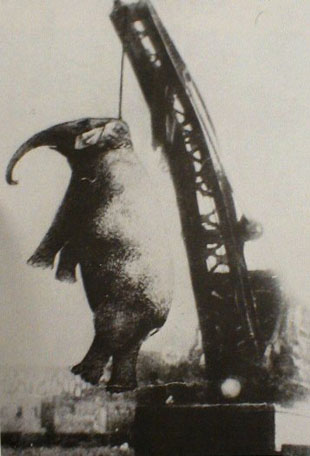


 This well-bred** Kentuckian veteran of the Mexican-American War ditched a New Orleans customs-house gig when
 The man, his activities in the ghetto, and above all his famed final walk to the Umschlagplatz, are mentioned in many books and memoirs about the ghetto.