1942: Lodz ghetto “Children’s Action” begins

(Thanks to Meaghan Good of the Charley Project for the guest post. -ed.)

Between September 5 and September 13 was the great deportation of vulnerable individuals from the Lodz Ghetto, one of the largest Nazi ghettos in Europe.

The 150,000-odd Jews within had starved, slaved and suffered for nearly two years, but what came next was almost too much to bear. The Nazis demanded that Mordechai Chaim Rumkowski,* the ghetto’s controversial chairman, turn over 20,000 non-working people for deportation, including the elderly and all children under the age of ten.

Those two groups constituted only 13,000 people altogether, so the gap had to be filled with the sick. The police and other Jewish authorities in the ghetto would have a chance to round up the deportees themselves. If they didn’t accomplish this, the Germans would do it themselves.

Rumkowski’s policy had always been one of accomodating to the Nazis’ demands and appeasing them with the goal of saving as many Jews as possible. He didn’t deviate from his plan even in this instance, and tried to explain himself to the ghetto population in an electrifying speech on September 4:

A grievous blow has struck the ghetto. They are asking us to give up the best we possess — the children and the elderly. I was unworthy of having a child of my own, so I gave the best years of my life to children. I’ve lived and breathed with children, I never imagined I would be forced to deliver this sacrifice to the altar with my own hands. In my old age, I must stretch out my hands and beg: Brothers and sisters! Hand them over to me! Fathers and mothers: Give me your children! […] I must perform this difficult and bloody operation — I must cut off limbs in order to save the body itself. I must take children because, if not, others may be taken as well — God forbid.

I have no thought of consoling you today. Nor do I wish to calm you. I must lay bare your full anguish and pain. I come to you like a bandit, to take from you what you treasure most in your hearts! I have tried, using every possible means, to get the order revoked. I tried — when that proved to be impossible — to soften the order. Just yesterday, I ordered a list of children aged 9 — I wanted at least to save this one aged-group: the nine to 10-year-olds. But I was not granted this concession. On only one point did I succeed: in saving the 10-year-olds and up. Let this be a consolation to our profound grief.

There are, in the ghetto, many patients who can expect to live only a few days more, maybe a few weeks. I don’t know if the idea is diabolical or not, but I must say it: “Give me the sick. In their place we can save the healthy.” I know how dear the sick are to any family, and particularly to Jews. However, when cruel demands are made, one has to weigh and measure: who shall, can and may be saved? And common sense dictates that the saved must be those who can be saved and those who have a chance of being rescued, not those who cannot be saved in any case. […]

Although it was never explicitly stated, the beaten-down, demoralized Lodz Jews harbored few illusions about the fate of deportees; most of them knew by now that deportation meant death.

Naturally there were cries of protest. People in the crowd suggested alternatives. They should all go together. Parents’ only children should not be taken; children should only be taken from families who had several. Rumkowski would have none if it:

These are empty phrases! I don’t have the strength to argue with you! If the authorities were to arrive, none of you would be shouting! I understand what it means to tear off a part of the body. Yesterday, I begged on my knees, but it did not work. From small villages with Jewish populations of 7000 to 8000, barely 1000 arrived here. So which is better? What do you want? That 80,000 to 90,000 Jews remain, or God forbid, that the whole population be annihilated? I have done and will continue doing everything possible to keep arms from appearing in the streets and blood from being shed. The order could not be undone; it could only be reduced.

One needs the heart of a bandit to ask from you what I am asking. But put yourself in my place, think logically, and you’ll reach the conclusion that I cannot proceed any other way. The part that can be saved is much larger than the part that must be given away!

In short, Rumkowski believed that only by cooperating with the German orders could he prevent even more lives from being lost.

He did have a point: The chairman of the Warsaw Ghetto, when faced with a similar deportation order, had committed suicide, and, as the Jewish authorities dragged their feet, the Nazis stepped in and, with much terror and bloodshed, forcibly deported close to 300,000 people over the course of six weeks. Resistance in Warsaw had made no appreciable difference in the death toll.

During the days that followed Rumkowski’s announcement, a general curfew was implemented and everyone was ordered to remain in their homes while the German SS and authorities, assisted by the Ghetto police and fire department (whose own families were exempted from the deportation) went from house to house to select their victims. The orphanages and old age homes were emptied, and Rumkowski himself supervised this to make sure no one was left behind.

People worked desperately to try to save themselves and the families. They knew the Germans would not be picky, would not be closely checking birth records or doctors’ certificates; it was enough for someone to simply look old or sick or very young.

Older men and women darkened their gray hair with coffee. Sick people dragged themselves out of bed and used makeup to brighten their faces. Children tried to hide, with their parents’ help, as Gordon J. Horwitz described in his book
Ghettostadt: Lodz and the Making of a Nazi City:

Some children hid in furniture and bedding, others in basement, in heaps of garbage and laundry, or in woodpiles. Parents did whatever they could, concealing children “in barrels in the attics, in ditches in the field, covered with leaves and branches.” One child sought refuge in a tree but was shot dead when discovered. Another, thanks to his father’s efforts to fashion an unusual hideout, rode out the danger concealed in a chimney on the roof. Though isolated and abandoned by the time they had been assembled in the collection area, child captives fought and scratched at the walls in a last-ditch effort to resist removal.

One teenage girl, after many attempts, managed to escape the assembly point and hid inside a mattress until it was safe to come out. Six-year-old Sylvia Perlmutter, whose experiences were fictionalized in her niece’s verse novel Yellow Star, hid in the cemetery.

Most of these efforts were in vain, however.

The search was thorough and the hunters ruthless. On September 13, the Nazis announced that the deportation was over. The survivors could resume their daily lives. It was not as bad as it could have been; 20,000 were not taken, after all. 15,859 people had been packed into trains, taken to the Chelmno Extermination Camp and killed. A further 600 had been shot within the ghetto itself.

For a long time after this, there were no more deportations. The ghetto inhabitants, although many of them continued to perish from starvation, overwork and disease, dared to hope that perhaps the Nazis would let them survive as long as they worked. But in the end, they didn’t escape: in August 1944, with the approaching Russian Army just 60 miles away, the entire ghetto population was deported to Chelmno and Auschwitz. An overwhelming number, including Chairman Rumkowski, perished.

* It was an open secret that Rumkowski was a pedophile who sexually abused the children in his charge both before and during the war. See Lucille Eichengreen’s Rumkowski and the Orphans of Lodz, and Edward Reichter’s Country of Ash.

On this day..

1996: Ebbisaa Addunyaa, extrajudicially executed

On this date in 1996, Oromo singer Ebbissaa Addunyaa was slain in his Addis Ababa home.

He “appeared to have been extrajudicially executed on suspicion of supporting the OLF,” according to Amnesty International. “No investigations were known to have taken place into allegations of torture, ”disappearance” or extrajudicial execution.”

“Extrajudicial execution” is a category challenge for these pages; Ebbisaa Addunyaa was not tried for anything, never mind convicted. His “execution” was a close cousin to simple murder … but a murder carried out by state security forces, targeting him specifically, and acting, if not under color of law, at least with legal impunity.

Ebbisaa and his friend Tana Wayessa

were at Ebbisaa’s home … north of the American Embassy in Addis Ababa, when gunmen burst in. Eyewitnesses claim the bodies were dragged from the house and put in a Land Rover with a government license plate. The security men, who carried out the murders, first cleared the street. Residents who looked out of their houses after the gunfire were told to get back indoors. The bodies were recovered [the] next day from the morgue at the Menelik II hospital.

All this took place in the turbulent 1990s wake of the collapsed Derg dictatorship. An initial multiparty post-Derg coalition government had included the Oromo Liberation Front — an organization upholding the rights of Ethiopia’s largest ethnic group — but the OLF soon withdrew from the coalition.

Ebbisaa was an OLF cadre who used his musical gifts for advocacy, and became a target when the outlawed OLF was forced underground.

A United Nations “Special Rapporteur” monitors “Extrajudicial, Summary or Arbitrary Executions” for the Economic and Social Council (ECOSOC).

Many of the Special Rapporteur’s reports dating back to the 1990s are available on the website of NYU’s Project on Extrajudicial Executions, and the 1997 country report (pdf) for Ethiopia reveals that Ebbisaa’s execution/assassination/murder was only one in a pattern.

The Special Rapporteur transmitted the following allegations of violations of the right to life concerning 16 identified persons and 13 unidentified persons: Ahmed Good Abdi, Ahmed Sanay Farah, Ahmed Sangaab and Hassan Ahmed Sagal, reportedly arrested and killed on 8 August 1996 in Toon-Ceeley by members of the Ethiopian armed forces; Ebissa Addunya, a singer and musician, and Tana Wayessa, reportedly shot and killed on 30 August 1996 by members of the Ethiopian security forces in the former’s house in Addis Ababa; 4 unidentified persons reportedly killed on 8 August 1996 in Gabababo; Awal Idire, aged 16, Awal Sani, aged 13, Badiri Shaza, aged 12, and Usen Kalu, aged 12, reportedly killed on 20 July 1996 by members of the Ethiopian armed forces because they had the initials of the Oromo Liberation Front tattooed on their hands; Mohamed Arabi Hirsi, Abdi Mohamed Yare, Gahnug Yusuf Aare, Mohamed Aw Farah Ga’iye, Haye Hirad, alleged to be tribal chiefs and clan elders, reportedly killed on 18 July 1996 by members of the Ethiopian armed forces; Sarecya Seerar Mohamed, her newborn child and eight other unidentified individuals, reportedly killed in mid-August 1996 by members of the Ethiopian armed forces in Qabridaharre (30 September 1996).

On this day..

1460: The residents of Amlas, impaled by Vlad Dracula

This date is the 550th anniversary of (in)famous Wallachian dictator/vampire prototype Vlad III Tepes‘s destruction of the town of Amlas, impaling all its surviving citizens.

The signature execution form of “Vlad the Impaler” was as nasty as it sounds: still-living victim mounted on a long, oiled stake driven through the rectum and emerging through the mouth to expire agonizingly over a period of hours or days. Or, alternatively, stuck through the midsection, leaving the subject horizontally mounted like a flopping fish.

And he had frequent recourse to it during his long struggle for power in the treacherous 1450s and 1460s, the period* when Vlad III became famous for the iron-willed cruelty required to exercise power in a Wallachia squeezed between the expanding Ottoman Empire and Hungary.

It was this terrifying period from the late 1450s that made Vlad Dracula — the titular second name inherited from his father‘s investment into the Order of the Dragon, Draco in Latin — the namesake for Bram Stoker‘s famous bloodthirsty Transylvanian noble, and the granddaddy of all its lucrative latter-day offspring.

(Bram Stoker didn’t invent the vampire myth, and the notion that Vlad Dracula “is” Count Dracula is one of those bits of popular folklore that’s become academically unfashionable. But still.)

The historical Vlad has his latter-day defenders, who see him as a nation-builder. Certainly, both the man himself and his vulnerable frontier principality were menaced by innumerable threats both foreign and domestic.

This date’s massacre was to deal with one such, Germans in the territory of Transylvania, which lay to the north of Vlad’s own Wallachia. Both realms are part of present-day Romania, and they were closely connected in Vlad’s time as well; the young Dracula himself was born in Transylvania, and Transylvanian towns had helped him take the Wallachian throne with the support of Hungary.

So far, everyone was on the same page. But when a power struggle erupted for the Hungarian throne in 1457, the “Saxon” emigres who formed the upper crust of merchants in Transylvania (supported by a vast sea of Romanian peasants) backed the Holy Roman Emperor while Vlad supported the usurping Hunyadi family that had so ably patronized him.** It’s quite a bit more dizzyingly complex than that, but the bottom line is that commercial and political conflicts soon saw Vlad Dracula mounting a campaign of Transylvanian terror from 1458 onward.

During the summer of 1460 Dracula organized his final raid on Transylvania. This time he attacked townships and villages in the district of Amlas known as the “Land of the Forest” or Unterwald … The meistersinger Beheim gives the exact date of the attack as falling on the feast day of Saint Bartholomew in the year 1460: August 24. Dracula struck in the early morning after “passing through the great forest” with his cavalry force. He burned the town of Amlas and impaled all the citizens, a priest having led the procession to the burial scene …

Dracula’s raid on Amlas was aimed at eliminating any remaining dissident resistance and at killing rival contenders to his throne … Dracula knew, for instance, that … the boyar Bogdan Doboca, was hiding in the village of Sercaia, in the Fagaras district. So he had the entire village razed to the ground; it had to be completely repopulated in the following century. Similar was the fat of the village of Mica. The narrator Beheim tells us that Dracula burned or destroyed half the communities in the Amlas district, including the capital city by that name. He “assembled all the citizens and all those he could find” from other villages and hanged them on hooks and pitchforks, after having had his men hack them to pieces with knives, swords, and sabers. Amlas was reduced to a ghost town, as it still is today, and other villages such as Saliste, Apodul de Sus, and Tilisca were similarly destroyed. Beheim claims that altogether some 30,000 Germans were killed during this Dracula raid on the district of Amlas.

Impressive as this date’s butchery would have been — although we know it from German propagandists who figure to have made the most of it — it was simply of a piece with Vlad’s Transylvanian campaign. To this campaign, Florescu and McNally attribute an impressive catalogue of atrocities, such as:

  • Slaughtering all the inhabitants of a village named Bod
  • Impaling one of his own captains who reported an inability to take an enemy position “for the inhabitants are brave and well fortified”
  • Boiling alive 600 Saxon merchants
  • Impaling as spies 41 Saxons who came to Wallachia to learn the Romanian language
  • Forcing one captured rival claimant with Saxon support to go through a Mass for the dead clothed in funerary vestments before personally beheading him

Fleeing Germans carrying spine-tingling eyewitness accounts and rumors of even worse made a happy match with that new media technology, the printing press, giving Dracula continental infamy and a purchase on future literary immortality.

“The horror genre conformed to the tastes of the fifteenth-century reading public as much as it does today,” observe those same authors Florescu and McNally in another volume. “No fewer than thirteen different fiteenth- and sixteenth-century Dracula stories have been discovered thus far in the various German states.”

The St. Bartholomew’s Day 1460 events are seemingly sometimes conflated† with a more famous bloodbath during the spring of 1459, when Vlad arranged a demonstrative mass impaling on the outskirts of Brasov.‡

All those whom he had taken captive, men and women, young and old, chlidren, he had impaled on the hill by the chapel and all around the hill, and under them he proceeded to eat at table and enjoyed himself in that way.

It’s this 1459 event that provides us the most horribly recognizable images of Dracula’s reign, with the insouciant Wallachian prince enjoying his repast amid a thicket of impaled wretches.

* 1456 to 1462, specifically, which was the second (and most consequential) of the three different periods Vlad III was Prince of Wallachia. The Ottomans drove him out in 1462, and he took refuge in Hungary before a return bid in 1476, which ended in his own death in battle.

** And specifically, Mihaly Szilagy (Hungarian link), the uncle of the ascendant king Matthias Corvinus. The latter would seek to woo Saxon support, and he had an on-again, off-again relationship with Vlad Dracula. Wallachia was a small buffer state from the standpoint of a greater power like Hungary, and Wallachia’s ruler a political instrument no matter how much impaling he might do.

† Perhaps because Brasov’s Church of St. Bartholomew was among the targets ravaged by Dracula’s force?

‡ Attack staged from picturesquely vampiric Castle Bran.

On this day..

1672: Cornelis and Johan de Witt lynched

Chapter 1. A Grateful People

On the 20th of August, 1672, the city of the Hague, always so lively, so neat, and so trim that one might believe every day to be Sunday, with its shady park, with its tall trees, spreading over its Gothic houses, with its canals like large mirrors, in which its steeples and its almost Eastern cupolas are reflected,–the city of the Hague, the capital of the Seven United Provinces, was swelling in all its arteries with a black and red stream of hurried, panting, and restless citizens, who, with their knives in their girdles, muskets on their shoulders, or sticks in their hands, were pushing on to the Buytenhof, a terrible prison, the grated windows of which are still shown, where, on the charge of attempted murder preferred against him by the surgeon Tyckelaer, Cornelius de Witt, the brother of the Grand Pensionary of Holland was confined.

the whole town was crowding towards the Buytenhof, to witness the departure of Cornelius de Witt from prison, as he was going to exile; and to see what traces the torture of the rack had left on the noble frame of the man who knew his Horace so well.

Yet all this multitude was not crowding to the Buytenhof with the innocent view of merely feasting their eyes with the spectacle; there were many who went there to play an active part in it, and to take upon themselves an office which they conceived had been badly filled,–that of the executioner.

There were, indeed, others with less hostile intentions. All that they cared for was the spectacle, always so attractive to the mob, whose instinctive pride is flattered by it,–the sight of greatness hurled down into the dust.

-Alexandre Dumas, pere, The Black Tulip

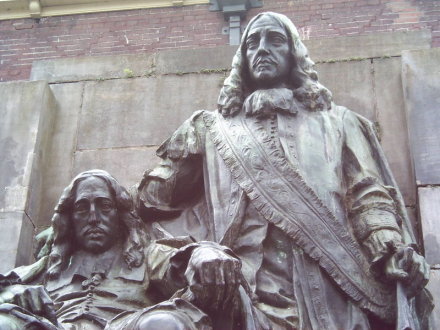
That ominous mob got its spectacle this date in 1672, lynching the Dutch Republic’s longtime de facto head of state, Johan de Witt along with his brother Cornelis/Cornelius.


A statue of Johan (standing) and Cornelis de Witt in their native Dordrecht.

The mercantile powerhouse that was the 17th century Dutch Republic was the stage for a long-running conflict between the Orange monarchists (hence the soccer uniforms) and the Republican merchant class.

With the sudden death of the young William II, Prince of Orange in 1650, leaving the (non-hereditary) executive office of stadtholder vacant, the Republicans became ascendant.

And the outstanding figure of the First Stadtholderless Period was Johan de Witt, scion of a Dordrecht merchant family powerful enough that William II had imprisoned de Witt’s own father during a power struggle.

Elevated in 1653 and at the tender age of 28 to the leadership position of Grand Pensionary, Johan de Witt’s “eloquence, sagacity and business talents” guided the Dutch ship of state for essentially the remainder of his life.

This was the apex of the Dutch Golden Age. The Dutch East India Company dominated Asian trade routes,* and the Low Countries’ culture thrived on the wealth: Rembrandt and Vermeer were at the height of their talents; Spinoza revolutionized philosophy; van Leeuwenhoek invented the microscope.

While all these guys were landing themselves in their respective canons, Johan de Witt was trying to keep the age Golden.

Having only relatively recently broken free of Spain, the small country was an up-and-comer on the horns of a serious security dilemma: its leading commercial position put it into maritime competition with England, while its continental location made it vulnerable to the enormous army of the neighboring continental hegemon, France. Ultimately, even with its trade wealth, it did not have the resources to keep up with both of western Europe’s leading powers.

For a generation, de Witt’s statecraft kept the men of the Low Countries out of that predicament, while his brother Cornelis chipped in with a couple of timely naval victories. (Actually authored by Michiel de Ruyter, but Cornelis rode shotgun.)

In 1654, Johan brought the First Anglo-Dutch War to a close, making with Oliver Cromwell a secret pact he was only too happy to enforce never to allow William II’s son, the eventual William III, to be named stadtholder. Reason being: William III was the grandson of the Stuart king Cromwell beheaded, Charles I, and thus a potential claimant to the English throne. Both Protestant Republics had a distinct interest in keeping this monarchist well away from power. (Both would be sorely disappointed.)

A decade and a Stuart Restoration later, de Witt maintained (mostly) Dutch dominance of the seas in the Second Anglo-Dutch War, then held off France (with the help of a timely alliance with the recent adversary, England) in the War of Devolution.

In each case, he kept at least one of England or France on the sideline, or in his own camp.

But the Third Anglo-Dutch War was the charm — as it was also the Franco-Dutch War, and therefore 1672 was Rampjaar: disaster year. While the Dutch were aces on the waves, a massive French invasion easily overwhelmed them on terra firma.

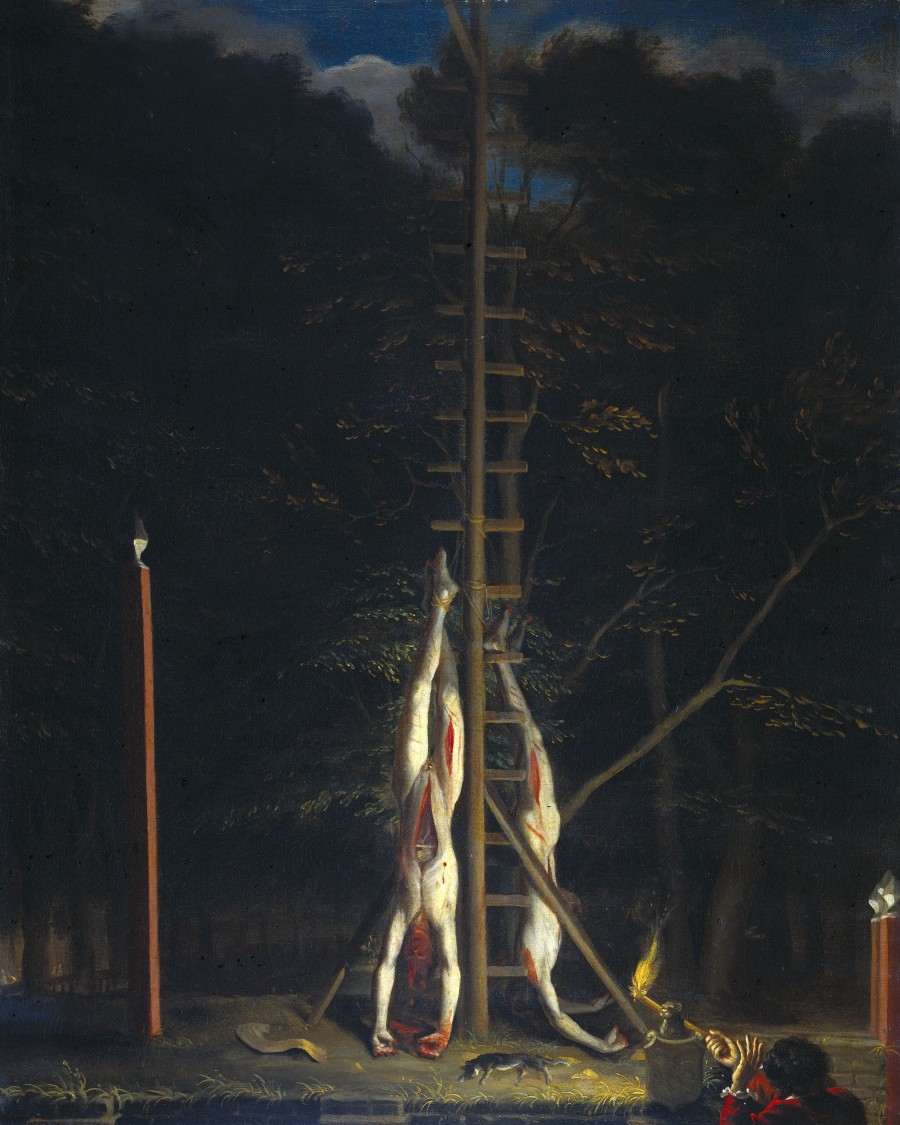
Detail view (click for the full image) of a grisly painting of the mutilated de Witt brothers strung up at The Hague. It’s attributed to Jan de Baen, who in better times took Johan de Witt’s portrait.

De Witt’s never-beloved mercantile oligarchy speedily collapsed with the military reverses, and the now all-grown-up William III was there to pick up the pieces to popular acclaim. Arrested for treason, Cornelis sustained torture without confessing, but when Johan visited him in prison — and William III incriminatingly withdrew the cavalry protecting the brothers — the mob quenched its fury with the de Witts’ blood.

every one of the miscreants, emboldened by his [Johan’s] fall, wanted to fire his gun at him, or strike him with blows of the sledge-hammer, or stab him with a knife or swords, every one wanted to draw a drop of blood from the fallen hero, and tear off a shred from his garments.

And after having mangled, and torn, and completely stripped the two brothers, the mob dragged their naked and bloody bodies to an extemporised gibbet, where amateur executioners hung them up by the feet.

Then came the most dastardly scoundrels of all, who not having dared to strike the living flesh, cut the dead in pieces, and then went about the town selling small slices of the bodies of John and Cornelius at ten sous a piece.

-Dumas

The word “ungrateful” comes to mind.

De Witt stood altogether on a lower plane than Cromwell. We regard him rather as a man of rare and singular talent, than as one of the chosen great ones of the earth, which Cromwell was. He stands far above the common run of men; and he was head and shoulders above nearly all the notable men of his time. He would have been greater if the movement of his limbs had been less burdened with the Dutch governing apparatus … He is not one whom the world can ever greatly admire or love.

History of the administration of John De Witt, grand pensionary of Holland, a Google books freebie.

(Here’s another, and here’s a 17th century volume de Witt himself coauthored.)

The rise of William III came with the decline of that Dutch Golden Age: the country fended off the immediate military threat, but it increasingly slipped behind its larger neighbors. Costly as was the Franco-Dutch War, it is a step on the path towards the present-day Europe, and this gives us enough excuse to notice that the Eurovision lead-in tune is actually from a Te Deum composed to mark its end.

But William’s own ascent to this wealthy sovereignty was just the beginning for him. Sixteen years later, the House of Orange’s champion vindicated Cromwell’s trepidation about him and gained a far more satisfactory position from which to do battle with his Gallic rival Louis XIV by stunningly overthrowing the Stuart dynasty and becoming King of England in the Glorious Revolution.**

* The Dutch remained the sole western contact of closed Japan until 1854, which is why Japan’s eventual period of scientific advancement became known as ‘Dutch Learning’.

** Albion did not forget the de Witts, either: according to this 1785 cant dictionary, the term “dewitted” had a 17th-18th century run in English to denote — well, exactly what happened to Cornelis and Johan.

On this day..

1860: John Moyse, the Private of the Buffs

“Our readers,” intoned the London Times on Nov. 5 of 1860, “will not have overlooked the behavior and fate of Private Moyse, of the Buffs, whose resolution, indeed, was not proof against the allurements of the grog-cart, but who actually faced death in cold blood rather than demean himself by prostration before ‘any Chinaman alive.'”

It was on this date that said Private Moyse, John to call him by his Christian name, died in captivity — allegedly because he refused to kowtow to a Chinese mandarin. “The Sikhs obeyed” this Asiatic command, goes the account. “But Moyse, the English soldier, declaring that he would not prostrate himself before any Chinaman alive, was immediately knocked upon the head and his body thrown on a dunghill.”

Kowtowing — Chinese insistence upon; British rejection of — was a touchy symbolic issue between the rising European hegemon and the ancient Chinese empire. It’s said (likely with more color than accuracy) that the British envoy Earl Macartney‘s 1790s trade mission to the east failed for want of a kowtow.

For the same reasons this legend became current, the Moyse tale made sensational propaganda during Britain’s Second Opium War intervention in China, valorized in this jingoistic tear-jerker.

The Private of the Buffs
by Sir Francis Doyle

Last night, among his fellow roughs,
He jested, quaffed and swore,
A drunken private of the Buffs,
Who never looked before.
Today, beneath the foeman’s frown
He stands in Elgin‘s place,
Ambassador from Britain’s Crown
And type of all her race.

Poor, reckless, rude, low-born, untaught,
Bewildered and alone.
A heart, with English instinct fraught,
He yet can call his own.
Aye, tear his body limb from limb,
Bring cord, or axe, or flame;
He only knows that not through him
Shall England come to shame.

Far Kentish hop fields round him seem’d
Like dreams, to come and go;
Bright leagues of cherry blossom gleam’d,
One sheet of living snow;
The smoke above his father’s door
In grey soft eddyings hung.
Must he then watch it rise no more,
Doomed by himself so young?

Yes, honour calls! With strength like steel
He puts the vision by.
Let dusky Indians whine and kneel;
An English lad must die.
And thus, with eyes that would not shrink,
With knee to man unbent,
Unfaltering on its dreadful brink
To his red grave he went.

Vain, mightiest fleets of iron framed;
Vain, those all-shattering guns;
Unless proud England keep, untamed
The strong heart of her sons.
So, let his name through England ring –
A man of mean estate,
Who died, as firm as Sparta’s King
Because his soul was great.

Moyse’s defiance and death make an appearance in this Flashman novel.

Aye, Moyse liked to get into the drink and had a discipline problem, but no matter. This fact was easily appropriated further to his bluff and earnest character in national martyrdom.

Getting a bit carried away with itself, the Times editorialized on Nov. 16,

We have no such visions of human perfectibility as to believe that all the young men of this country will be “respectable youth” looking for “honourable service.” … The English are a people endowed with superabundant energy, and energy must sometimes take an irregular and even a criminal form. The best use that can be made of a young man who will settle down to nothing is to get him to enlist as a soldier. He is kept under strict discipline at the same time that his love of activity and adventure is gratified. He becomes a first-rate fighting man, and fulfils splendidly the only duty which society can ever hope to obtain from him. There is no reason to wonder, with Colonel McMurdo, that acts of heroism have been performed by such men, for they have performed them in all ages and all countries. The “obstinate intemperate hero” is of all time, whether in the shape of Alexander or Lord Clive, or Private Moyse of the Buffs. There are two kinds of valour, belonging to two different classes of men, and a citizen-force may very usefully be employed side by side with the wildest lads who ever rioted in Tipperary or gambled in a London pothouse.

Basically forgotten now, this story can be fleetingly encountered among Anglophiles as an arcane indicator that the national character of Britain, or the West, or what have you, is not now what it once was, given all the kowtowing to mandarins going on in these debased times.

(Although this post amusingly juxtaposes the “commonsense prudence and practicality” of Wellington taking an expedient knee so that a military strategem would not be lost on account of bullheaded pride. Maybe it helped that Wellington was kneeling to a European.)

On this day..

1936: The Sacred Heart, by Spanish leftists

On this date in 1936, anticlerical leftists in the Spanish Civil War allegedly subjected a monumental statue of Christ to a ritual “execution”.


“This picture, taken by a Paramount News-reel representative and received by air from Madrid yesterday, illustrates an outrage which has no parallel in the photographs published by “The Daily Mail” of the Spanish Reds’ war on religion. It shows a Communist firing squad aiming at the colossal Monument of the Sacred Heart on the Cerro de los Angeles, a hill a few miles south of Madrid which is regarded as the exact centre of Spain.” (Source)

This outstandingly incendiary image made for great recruiting for the Francoist enemies of the “firing squad” and gave credence to a “crusade” lexicology that insured the devout would break overwhelmingly against the Republic. (Nearly 7,000 men and women in religious orders whose deaths during the war are charged to the Republican account also helped.)

Maybe that was inevitable, anyway.

George Orwell, the English leftist who volunteered for the Spanish Republicans, noted in his Homage to Catalonia that

the people in this part of Spain must be genuinely without religious feeling — religious feeling, I mean, in the orthodox sense. It is curious that all the time I was in Spain I never once saw a person cross himself; yet you would think such a movement would become instinctive, revolution or no revolution. Obviously the Spanish Church will come back (as the saying goes, night and the Jesuits always return), but there is no doubt that at the outbreak of the revolution it collapsed and was smashed up to an extent that would be unthinkable even for the moribund C. of E. in like circumstances. To the Spanish people, at any rate in Catalonia and Aragon, the Church was a racket pure and simple. And possibly Christian belief was replaced to some extent by Anarchism, whose influence is widely spread and which undoubtedly has a religious tinge.

Be that as it may, Republican types suspected photographic fakery.

Just like its inspiration is reported to have done, this statue survived its “execution” in fine shapewas resurrected by public subscription, and can still be seen at Cerro de los Angeles outside Madrid.


The “executed” statue today. (cc) image from bigchus.

On this day..

Feast Day of the Holy Maccabees

This is the feast date, in both the Orthodox and Catholic traditions, of the Woman with Seven Sons — each of whom is supposed to have been put to death for refusing to break the Mosaic law by eating pork.

Although they are Jewish martyrs more than a century before Christ, they are revered most especially by the Christian faith that elbowed Judaism aside. Their story comes from 2 Maccabees, a “deuterocanonical” text that is part of the Old Testament but not part of the Hebrew Bible — for reasons having to do with the contingent process of formulating the canon.* (Short explanation | Long explanation)

Whether sent from the Lord or not, this story features the righteous resistance of the faithful family against Antiochus IV Epiphanes, ruler of the Seleucid Empire, which was one of the successor Hellenistic states to Alexander the Great’s conquests.

In 2 Maccabees (and also in 1 Maccabees, which covers the same period, though not this specific martyrdom), Antiochus IV is making an unwelcome pro-heathen intervention in a Jewish civil war on the side of the hellenizers as against the hidebound traditionalists. This comes to attempting “to compel the Jews to depart from the laws of their fathers, and not to live after the laws of God: And to pollute also the temple in Jerusalem, and to call it the temple of Jupiter Olympius.” (2 Maccabees 6:1-2; this chapter features a Whitman’s sampler of other faithful traditionalists slaughtered for various forms of adherence to the Law.)

Same deal with the dietary laws, whose countermanding edict Antiochus (being a wicked heathen king) is pleased to enforce by the most ghastly tortures.

Here’s the description of the martyrdom from 2 Maccabees chapter 7:

Das Martyrium der sieben Makkabaer, by Antonio Ciseri, in an aptly classical setting.

1: It came to pass also, that seven brethren with their mother were taken, and compelled by the king against the law to taste swine’s flesh, and were tormented with scourges and whips.
2: But one of them that spake first said thus, What wouldest thou ask or learn of us? we are ready to die, rather than to transgress the laws of our fathers.
3: Then the king, being in a rage, commanded pans and caldrons to be made hot:
4: Which forthwith being heated, he commanded to cut out the tongue of him that spake first, and to cut off the utmost parts of his body, the rest of his brethren and his mother looking on.
5: Now when he was thus maimed in all his members, he commanded him being yet alive to be brought to the fire, and to be fried in the pan: and as the vapour of the pan was for a good space dispersed, they exhorted one another with the mother to die manfully, saying thus,
6: The Lord God looketh upon us, and in truth hath comfort in us, as Moses in his song, which witnessed to their faces, declared, saying, And he shall be comforted in his servants.
7: So when the first was dead after this number, they brought the second to make him a mocking stock: and when they had pulled off the skin of his head with the hair, they asked him, Wilt thou eat, before thou be punished throughout every member of thy body?
8: But he answered in his own language, and said, No. Wherefore he also received the next torment in order, as the former did.
9: And when he was at the last gasp, he said, Thou like a fury takest us out of this present life, but the King of the world shall raise us up, who have died for his laws, unto everlasting life.
10: After him was the third made a mocking stock: and when he was required, he put out his tongue, and that right soon, holding forth his hands manfully.
11: And said courageously, These I had from heaven; and for his laws I despise them; and from him I hope to receive them again.
12: Insomuch that the king, and they that were with him, marvelled at the young man’s courage, for that he nothing regarded the pains.
13: Now when this man was dead also, they tormented and mangled the fourth in like manner.
14: So when he was ready to die he said thus, It is good, being put to death by men, to look for hope from God to be raised up again by him: as for thee, thou shalt have no resurrection to life.
15: Afterward they brought the fifth also, and mangled him.
16: Then looked he unto the king, and said, Thou hast power over men, thou art corruptible, thou doest what thou wilt; yet think not that our nation is forsaken of God;
17: But abide a while, and behold his great power, how he will torment thee and thy seed.
18: After him also they brought the sixth, who being ready to die said, Be not deceived without cause: for we suffer these things for ourselves, having sinned against our God: therefore marvellous things are done unto us.
19: But think not thou, that takest in hand to strive against God, that thou shalt escape unpunished.
20: But the mother was marvellous above all, and worthy of honourable memory: for when she saw her seven sons slain within the space of one day, she bare it with a good courage, because of the hope that she had in the Lord.
21: Yea, she exhorted every one of them in her own language, filled with courageous spirits; and stirring up her womanish thoughts with a manly stomach, she said unto them,
22: I cannot tell how ye came into my womb: for I neither gave you breath nor life, neither was it I that formed the members of every one of you;
23: But doubtless the Creator of the world, who formed the generation of man, and found out the beginning of all things, will also of his own mercy give you breath and life again, as ye now regard not your own selves for his laws’ sake.
24: Now Antiochus, thinking himself despised, and suspecting it to be a reproachful speech, whilst the youngest was yet alive, did not only exhort him by words, but also assured him with oaths, that he would make him both a rich and a happy man, if he would turn from the laws of his fathers; and that also he would take him for his friend, and trust him with affairs.
25: But when the young man would in no case hearken unto him, the king called his mother, and exhorted her that she would counsel the young man to save his life.
26: And when he had exhorted her with many words, she promised him that she would counsel her son.
27: But she bowing herself toward him, laughing the cruel tyrant to scorn, spake in her country language on this manner; O my son, have pity upon me that bare thee nine months in my womb, and gave thee such three years, and nourished thee, and brought thee up unto this age, and endured the troubles of education.
28: I beseech thee, my son, look upon the heaven and the earth, and all that is therein, and consider that God made them of things that were not; and so was mankind made likewise.
29: Fear not this tormentor, but, being worthy of thy brethren, take thy death that I may receive thee again in mercy with thy brethren.
30: Whiles she was yet speaking these words, the young man said, Whom wait ye for? I will not obey the king’s commandment: but I will obey the commandment of the law that was given unto our fathers by Moses.
31: And thou, that hast been the author of all mischief against the Hebrews, shalt not escape the hands of God.
32: For we suffer because of our sins.
33: And though the living Lord be angry with us a little while for our chastening and correction, yet shall he be at one again with his servants.
34: But thou, O godless man, and of all other most wicked, be not lifted up without a cause, nor puffed up with uncertain hopes, lifting up thy hand against the servants of God:
35: For thou hast not yet escaped the judgment of Almighty God, who seeth all things.
36: For our brethren, who now have suffered a short pain, are dead under God’s covenant of everlasting life: but thou, through the judgment of God, shalt receive just punishment for thy pride.
37: But I, as my brethren, offer up my body and life for the laws of our fathers, beseeching God that he would speedily be merciful unto our nation; and that thou by torments and plagues mayest confess, that he alone is God;
38: And that in me and my brethren the wrath of the Almighty, which is justly brought upon our nation, may cease.
39: Than the king’ being in a rage, handed him worse than all the rest, and took it grievously that he was mocked.
40: So this man died undefiled, and put his whole trust in the Lord.
41: Last of all after the sons the mother died.
42: Let this be enough now to have spoken concerning the idolatrous feasts, and the extreme tortures.

The upshot of the Maccabees texts is the revolt of Judas Maccabeus against the Seleucids, the episode that gives us Hanukkah, when that “temple of Jupiter Olympius” was rededicated back to YHWH.

And though not specifically because of the Holy Maccabees, the start of that revolt is the very next thing to occur in the text,** at the start of chapter 8:

1: Then Judas Maccabeus, and they that were with him, went privily into the towns, and called their kinsfolks together, and took unto them all such as continued in the Jews’ religion, and assembled about six thousand men.
2: And they called upon the Lord, that he would look upon the people that was trodden down of all; and also pity the temple profaned of ungodly men.
3: And that he would have compassion upon the city, sore defaced, and ready to be made even with the ground; and hear the blood that cried unto him,
4: And remember the wicked slaughter of harmless infants, and the blasphemies committed against his name; and that he would shew his hatred against the wicked.

And then, of course, it’s the good guys’ turn to start killing.

* It is worth noting that deuterocanonical books aren’t part of the Old Testament for most Protestants; Martin Luther declared himself “so great an enemy to the second book of the Maccabees, and to Esther, that I wish they had not come to us at all, for they have too many heathen unnaturalities.”

** The book’s chronology is scarcely rigorous, but if the episode is considered historical, it would have occurred in 167 B.C.E. (the year the Maccabean revolt began) or the few years before, reaching back to Antiochus’s anti-Mosaic injunctions c. 175 B.C.E.

On this day..

1419: The (first) Defenestration of Prague

(Thanks to Meaghan Good of the Charley Project for the guest post. -ed.)

On this day in 1419, an angry mob of Hussite peasant rebels stormed the town hall on Charles Square in Prague and threw the judge, the mayor and several city council members (either seven or thirteen; accounts differ) out the window. They all either died in the fall or were killed by the crowd outside.

The event has been the subject of several paintings, as well as being beautifully illustrated in Lego form and also reenacted.

Hussites followed a Christian reformer, Jan Hus, who was one of the forerunners of the Protestant Reformation. Hus was eventually excommunicated and burned as a heretic. The cause of the July 30 riot was the city council’s refusal to release from custody several Hussite prisoners.

The mob, led by the Hussite priest Jan Želivský and future general Jan Žižka, marched to the town hall, but they only became violent after someone inside the building threw a stone at them. After that there was no stopping them.

The riot had far-reaching consequences, inasmuch as it is seen as the start of the Hussite Wars, which lasted until 1434 or so and involved government-sponsored military action against the Hussites as well as Hussites fighting amongst themselves.

This event has come to be known as the First Defenestration of Prague. That is, I’m sure we all can agree, an AWESOME name, and probably the principal reason the riot is still remembered today. The word “defenestration” comes from Latin: de-, meaning “out of,” and fenestra, “window.”

The Czechs have a habit of throwing people out of windows at critical junctures in history; since 1419 there has been at least one more (nonfatal, but more famous) Defenestration of Prague, in 1618. A couple of similar events since then have sometimes been called the Third Defenestration of Prague, though this is not universally agreed upon.

On this day..

1582: Philippe Strozzi, corsair

On this date in 1582, Philippe Strozzi, the Florentine-born commander of a French naval expedition against the Spanish was summarily executed as a pirate.

The Strozzi were long one of Florence’s wealthy and powerful families, as evidenced by, say, the Strozzi Palace, or the Strozzi coat of arms on Michelangelo’s Doni Tondo.

That made the Strozzi sometime-allies, sometime-rivals* of Florence’s more famous powerbrokers, the Medici. It is in both capacities that we meet Philippe (English Wikipedia entry | Italian | French).

To cut a centuries-long story short, the Strozzi had basically come out on the wrong side of the power struggle in the 16th century.

Philippe’s father, Piero Strozzi, was the child of a Strozzi-Medici union, and Piero too married a Medici. He also fought the Medici for power and ended up in exile whereupon he gravitated to the French court of … Catherine de’ Medici. (Catherine had been educated at the home of Philippe’s grandfather, Filippo Strozzi.) Catherine then turned around and used Piero as a French Marshal, including sending him to back Tuscan city-state Siena in opposition to its (and France’s) rival, Florence.**

Your basic tangled geopolitical-genealogical web.

Bottom line, Piero’s son Philippe was born in Florence but grew up Gallic, and fought in the French army all over the continent from the time he was a teenager.

When France got involved in the War of Portuguese Succession, they put this warlike fellow aboard a boat and sent him to dispute Spanish King Philip II‘s attempt to claim the Portuguese throne and unify the Iberian peninsula.

Strozzi’s armada got its clock cleaned at the naval Battle of Ponta Delgada near the Azores, with devastating loss of life.


The Spanish galleon San Mateo, which did yeoman service at this battle.

Since Spain and France were putatively at peace, Spain treated its captives not as prisoners of war but as pirates, and proceeded to execute several hundred in Vila Franca do Campo. Strozzi didn’t even get that much ceremony, however; the day after the battle, he was mortally stabbed, then tossed into the waves.

Happily, the name and the fame of the Strozzi outlived Spanish justice. In the next century, a distant relative by the handle of Barbara Strozzi became one of the most renowned composers of Baroque vocal music. (As befits wealthy Italians of the Renaissance, the Strozzi were big on the arts; Philippe was supposed to be a fine musician himself.)

* The Strozzi-Medici conflict frames the action in the play Lorenzaccio, in which the titular Brutus-like character mulls assassinating the Medici dictator in order to restore the Republic, only to find no such restoration in the offing once he actually does the deed; the father and grandfather of our day’s protagonists are both principal characters.

** That didn’t work. Strozzi was trounced at the Battle of Marciano, which signaled the permanent demise of the ancient city-state‘s independence.

On this day..

1872: Jose Balta, former President of Peru

On this date in 1872, four days after he was deposed as President of Peru, Jose Balta was summarily shot by the would-be dictatorship of Tomas Gutierrez.

Balta (English Wikipedia entry | Spanish) made his name as a soldier, an ironic background for a martyr to constitutional government.

As a colonel, Balta in 1867 led a revolt against President Mariano Ignacio Prado in Chiclayo (mirrored by a similar revolt by Gen. Pedro Diez Canseco Corbacho in Arequipa). The resistance forced Prado’s resignation, and Balta won the ensuing 1868 election.

(Notably, it was under Balta’s administration that unprincipled American railroad speculator Henry Meiggs got his prolific track-building operations going in Peru. Basically, the government took all the capital it raised on its guano-export contract — appropriate source — and plowed it into Meiggs’ well-hyped railroads, whose returns rarely justified the outlay to construct them. Wealthy and influential at his zenith, this adventurer was widely considered culpable for the disastrous state of the Peruvian economy by the time of his 1877 death, since in the interim the guano market had crashed and Peru found itself buried in debt it would ultimately default on. Oh, and: reason Meiggs was in Peru? He had to flee California after perpetrating a real estate scheme.)

Back to Balta. The soldier-President was adamant about an orderly departure from office (with a handover to an opposition party*) when his term came up in 1872, but others around him were less keen on constitutional precedents when there was power to be kept or lost.

On July 22, 1872, War Minister Tomas Gutierrez and his brother, Col. Silvestre Gutierrez, arrested the president. Tomas Gutierrez proclaimed himself dictator.

He was surely expecting a more appropriately cowed reaction from the country than he got: the President-elect got away on a warship, whose crew declared for him; the Peruvian Congress passed a resolution outlawing the Gutierrez coup; and the public reaction against him was chilly enough that someone gunned down Silvestre Gutierrez in a railway station on July 26.

News of this turn for the worse reached brother Marcelino, who had (ex-)President Balta in his charge at Callao … and Marcelino had Jose Balta immediately shot. This event meets the definition of an execution better by its circumstances than by its ceremony, since there was none of the latter; Balta was simply blasted while lying sick in bed, perhaps even still asleep, and not with the least sense of occasion.

And by no standard did it meet the usurpers’ definition of utility.

Neither of the remaining two Gutierrezes would outlive Jose Balta by so much as a day, and news of Balta’s murder only helped fan the incipient uprising: both were killed by mobs as the would-be dictatorial party collapsed in the hours ahead. All three of Tomas, Silvestre and Marcelino wound up on lampposts in Lima (and then burned to ashes in a public square) as recompense for their four days’ sovereignty.

As one report given out in North America recounted it:

The events of the past week will forever be remembered in Peruvian history. The spectacle of a Constitutional President deposed and imprisoned by a military usurper; of a Congress dispersed at the point of the bayonet, after the members, irrespective of partisan feeling, had united in signing a solemn protest, declaring the new officers of the so-called Government criminals and outlaws; of an entire country gathering together its strength to repel the attack made upon its liberties and legal rights; of the rising of the people when their indignation could no longer be restrained on the news of the cowardly assassination of Balta by the Dictator; of the triumph of moral force and justice over bayonets and a bastard cause; of the terrible vengeance of the populace on their tyrants; of the final re-establishment of peace, order and good government. This wonderful series of events has been witnessed by Lima in the space of five days. The Peruvian people have nobly vindicated their name and their national honor; the country is now on a firmer basis, and presents greater hopes for prolonged tranquility, prosperity and progress than it has for many years past.

(Not exactly. The economy, as mentioned, crashed in the 1870s, and there was a successful coup in 1879.)

* The guy set to succeed Balta was Manuel Pardo — not to be confused with Mariano Prado, whom Balta had supplanted.

On this day..